
Life, 1899-12-21 · page 4 of 20
Life — December 21, 1899 — page 4: what you’re looking at
What you’re looking at
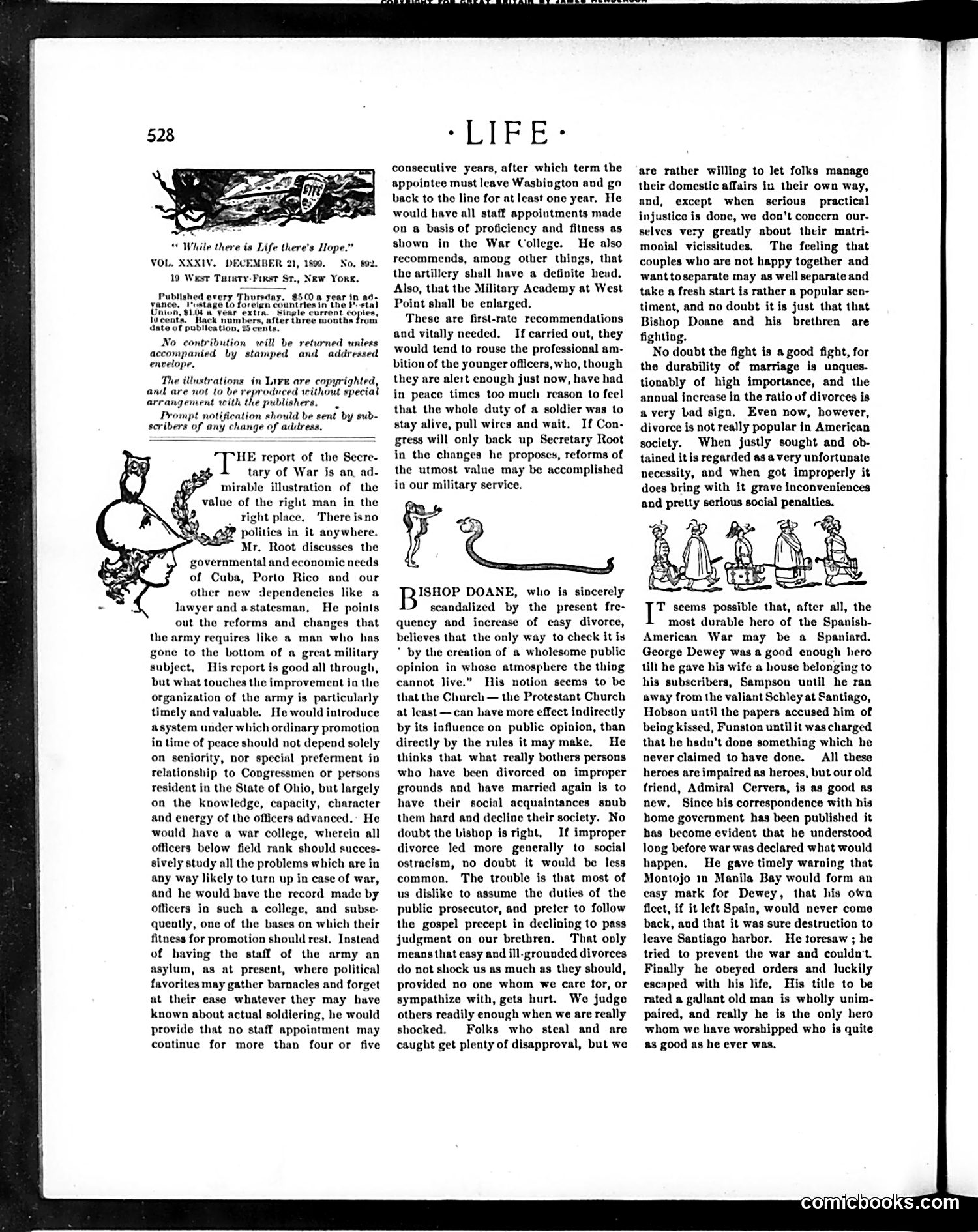
This page contains no political cartoons but rather editorial commentary on military and social issues circa 1909. The main text discusses Secretary of War Root's report, praising his administrative reforms while debating military academy expansion and officer promotion standards. A secondary editorial addresses Bishop Doane's views on divorce, which the writer considers too restrictive. The piece argues that while divorce carries social stigma, the Church's influence on public opinion matters more than legal restrictions in controlling its frequency. The small decorative illustration at top left appears ornamental rather than satirical. Overall, this represents serious magazine journalism rather than visual satire or cartooning.
📄 Transcribed text from this page (OCR, searchable)
Machine-transcribed from the original scan — historical spelling and the odd misread are preserved.
“While there is Life there's Hope.” VOL. XXXIV. DI MBER 21, 1899. No, 892. 19 West Taixty-Fixst St., New Yore. Published every Thursday. $500 a year in ad- y vatage to foreign countrles tn the P-stal LOU a Year extin. Single current copies, Ww Hack numbers, after three months from date of publication, 2 cents. No contribution rill be returned unless accompanied by stamped and addressed envelope. The illustrations in Live are copyrighted, and are not to be reproduced without special arrangement with the publishers. Prompt notification should be sent by sub- scribers of any change of address. HE report of the Secre- tary of War is an, ad. mirable illustration of the value of the right man in the _ right place. ‘There isno politics in it anywhere. Mr. Root discusses the governmental and economic needs of Cuba, Porto Rico and our other new dependencics like a lawyer and a statesman, He points out the reforms and changes that the army requires like a man who has gone to the bottom of a great military subject, His report is good all through, but what touches the improvement ja the organization of the army is particularly timely and valuable. He would introduce asystem under which ordinary promotion in time of peace should not depend solely on seniority, nor special preferment in relationship to Congressmen or persons resident in the State of Ohio, but largely on the knowledge, capacity, character and energy of the officers advanced,: He would have a war college, wherein all officers below field rank should succes- sively study all the problems which are in any way likely to turn up in case of war, and he would have the record made by officers in such a college, and subse- quently, one of the bases on which their fitness for promotion should rest. Instead of having the staff of the army an asylum, as at present, where political favorites may gather barnacles and forget at their ease whatever they may have known about actual soldiering, he would provide that no staff appointment may continue for more than four or five ‘LIF E> consecutive years, after which term the appointee must leave Washington and go back to the line for at least one year. He would have all staff appointments made on a basis of proficiency and fitness as shown in the War College. He also recommends, among other things, that the artillery shall have a definite heud, Also, that the Military Academy at West Point shall be enlarged. These are first-rate recommendations and vitally needed, If carried out, they would tend to rouse the professional am- Dition of the younger officers, who, though they are alert enough just now, have had in peace times too much reason to feel that the whole duty of a soldier was to stay alive, pull wircs and wait. If Con- gress will only back up Secretary Root in the changes he proposes, reforms of the utmost value may be accomplished in our military service. ISHOP DOANE, who is sincerely scandalized by the present fre- quency and increase of easy divorce, believes that the only way to check it is * by the creation of a wholesome public opinion in whose atmosphere the thiog cannot live.” His notion seems to be that the Church — the Protestant Church at Icast —can have more effect indirectly by its influence on public opinion, than directly by the rules it may make, He thinks that what really bothers persons who have been divorced on improper grounds and have married again is to have their social acquaintances snub them hard and decline their society. No doubt the bishop is right, If improper divorce led more generally to social ostracism, no doubt it would be less common. The trouble is that most of us dislike to assume the duties of the public prosecutor, and preter to follow the gospel precept in declining to pass judgment on our brethren. That only means that casy and ill-grounded divorces do not shock us as much as they should, provided no one whom we care for, or sympathize with, gets hurt. We judge others readily enough when we are really shocked, Folks who steal and are caught get plenty of disapproval, but we are rather willing to let folks manage their domestic affairs iu their own way, and, except when serious practical injustice is done, we don’t concern our- selves very greatly about their matri- mooial vicissitudes. The feeling that couples who are not happy together and wanttoseparate may as well separate and take a fresh start is rather a popular scn- timent, and no doubt it is just that that Bishop Doane and his brethren are fighting. No doubt the fight is a good fight, for the durability of marriage is unques- tionably of high importance, and the annual increase in the ratio of divorces is avery bad sign. Even now, however, divorce is not really popular in American society. When justly sought and ob- tained it is regarded asa very unfortunate necessity, and when got improperly it does bring with it grave inconveniences and pretty serious social penalties. T scems possible that, after all, the most durable hero of the Spanish- American War may be a Spaniard. George Dewey was a good enough hero till he gave his wife a house belonging to his subscribers, Sampson until he ran away from the valiant Schley at Santiago, Hobson until the papers accused him of being kissed, Funston until it was charged that he hadn't done something which he never claimed to have done. All these heroes are impaired as heroes, but our old friend, Admiral Cervera, is as good as new, Since his correspondence with his home government has been published it has become evident that he understood long before war was declared what would happen. He gave timely warning that Montojo in Manila Bay would form an casy mark for Dewey, that his own fleet, if it left Spain, would never come back, and that it was sure destruction to leave Santiago harbor. He toresaw ; he tried to prevent the war and couldn't. Finally he obeyed orders and luckily escaped with his life. His title to be rated a gallant old man is wholly unim- paired, and really he is the only hero whom we have worshipped who is quite as good as he ever was.