
Life, 1899-12-21 · page 6 of 20
Life — December 21, 1899 — page 6: what you’re looking at
What you’re looking at
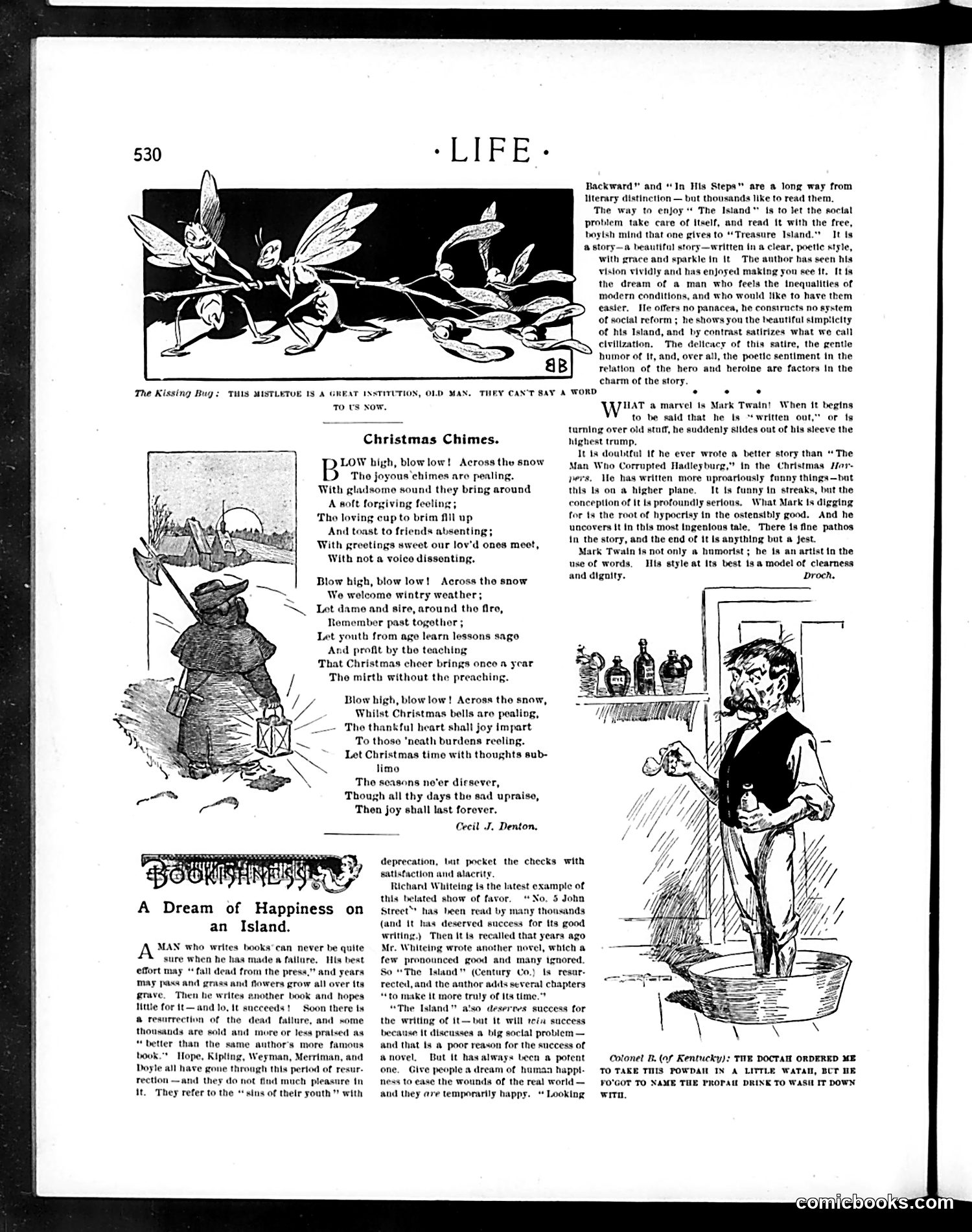
This page contains literary criticism and seasonal content rather than political satire. The main elements are: **"The Kissing Bug"** cartoon (top): A satirical illustration with mistletoe, captioned as "A GREAT INSTITUTION, OLD MAN. THEY CAN'T SAY A WORD TO US." This appears to reference the "kissing bug" phenomenon—likely a seasonal social custom or insect pest that was newsworthy at the time. **"Christmas Chimes"** poem: A sentimental seasonal verse by Oreil J. Denton celebrating Christmas traditions. **Book review**: Discussion of a novel called "The Island," praising Mark Twain's literary merit and his satirical critique of modern civilization through the story's protagonist seeking escape from societal constraints. The page is primarily cultural and literary commentary rather than political satire.
📄 Transcribed text from this page (OCR, searchable)
Machine-transcribed from the original scan — historical spelling and the odd misread are preserved.
Backward" and “In His Steps” are a long way from Mterary distinction — but thousands like to read them. The way to enjoy“ The Island" ts to let the soctal problem take care of Itaelf, and read It with the free, boyish mind that one gives to “Treasure Island.’ It ts. @ story—a beautifal story—written in a clear, poetic style, with grace and sparkle In It The author has seen his vision vividly and has enjoyed making yon see ft, Its the dream of a man who feels the Inequalities of modern conditions, and who would like to have them easier, Ie offers no panacea, he constructs no system of social reform ; he shows you the heautifal simpitcity of his Island, and by contrast satirizes what we call clvillzation. The delicacy of this satire, the gentle humor of tt, and, over all, the poetic sentiment in the relation of the hero and heroine are factors In the charm of the story. THEY CAN'T SAY A WORD o 8 WHAT a marvel ts Mark Twain! When tt begins to be said that he is vritten out,” or ts turning over old stuff, he suddenly sitdes out of his sleeve the highest tramp. It 18 doubttul If he ever wrote a better story than “The Man Who Corrupted Hadleyburg,” In the Christmas Har- pers, Me has written more uproartously funny things—bat this Is on a higher plane. It Is funny in streaks, but the conception of tt Is profoundly serious. What Mark Is digging for ts the root of hypocriay in the ostensibly good. And he uncovers it in this most Ingentous tale, There 1s fine pathos 1n the story, and the end of {ts anything but a Jest. Mark Twain 1s not only a humorist ; he 18 an artist tn the use of words, His style at Its best 18 a model of clearness and dignity. Droch. THIS MISTLETOE 18 A GREAT INSTITUTION, OLD MAN. To 8 Now. The Kissing Bug: Christmas Chimes. ry LOW high, blow low! Across the snow B Tho joyous chimes are penling. With gladsome sound they bring around A noft forgiving feeling; Tho loving cup to brim fill up And toast to friends absenting; With greetings sweet our lov'd ones meet, With not a voico dissenting. Blow high, blow low! Across tho snow Wo wolcome wintry weather; Lot damo and sire, around tho firo, Remember past togothor ; Let youth from age learn lessons sago And profit by tho teaching That Christmas cheer brings onco a year Tho mirth without the preaching. Blow high, blow low! Across tho snow, Whilst Christmas bolls aro pealiog, Tho thankful heart shall joy impart To thoso ‘neath burdens reoling. Lot Christmas timo with thoughts aub- limo Tho seasons ne'er dirsever, Though all thy days the sad upraiso, Thon joy shall last forever. Cecil J. Denton, deprecation, bat pocket the checks with satisfaction and alacrity, Richard Whiteing ts the latest example of A Dream of Happiness on an Island. MAN who writes books’ can never be quite sure when he has made a failure. His best effort may “fall dead from the press,” and years May pass and grass and flowers grow all over {ts grave, Then he writes another book and hopes little for 1t—and lo, tt succeeds! Soon there tx & resurrection of the dead fallure, and some thousands are sold and more or less pratsed as “better than the same author's more famous book." Hope, Kipling, Weyman, Merriman, and Doyle all have gone through this pertod of resur- ection —and they do not find much pleasure tn it. They refer to the “sins of thelr youth” with this belated show of favor. “No, 5 John Street’? has been read by many thonsands {and It has deserved success for Its good writing.) Then it {8 recalled that years ago Mr. Whiteing wrote another novel, which a few pronounced good and many tgnored, So "The Island (Century Co.) ts resar- rected, and the anthor adds several chapters “to make It more truly of Its time."* “The Island” a'so deserves success for the writing of 1t—bat it will rein success because It discusses a big social problem — and that 18 a poor reason for the success of novel, But tt has always Leen a potent one. Give people a dream of human happ!- ness to ease the wounds of the real world — and they ave temporarily happy.“ Looking Colonel B. (of Kentucky): THR DOCTAH ORDERED ME TO TAKE THIS POWDAM IN A LITTLE WATAT, BCT 0K ¥O'GOT TO NAME THE PROPAM! DRINK TO WaSit IT DOWN wirn.