
Life, 1899-12-21 · page 7 of 20
Life — December 21, 1899 — page 7: what you’re looking at
What you’re looking at
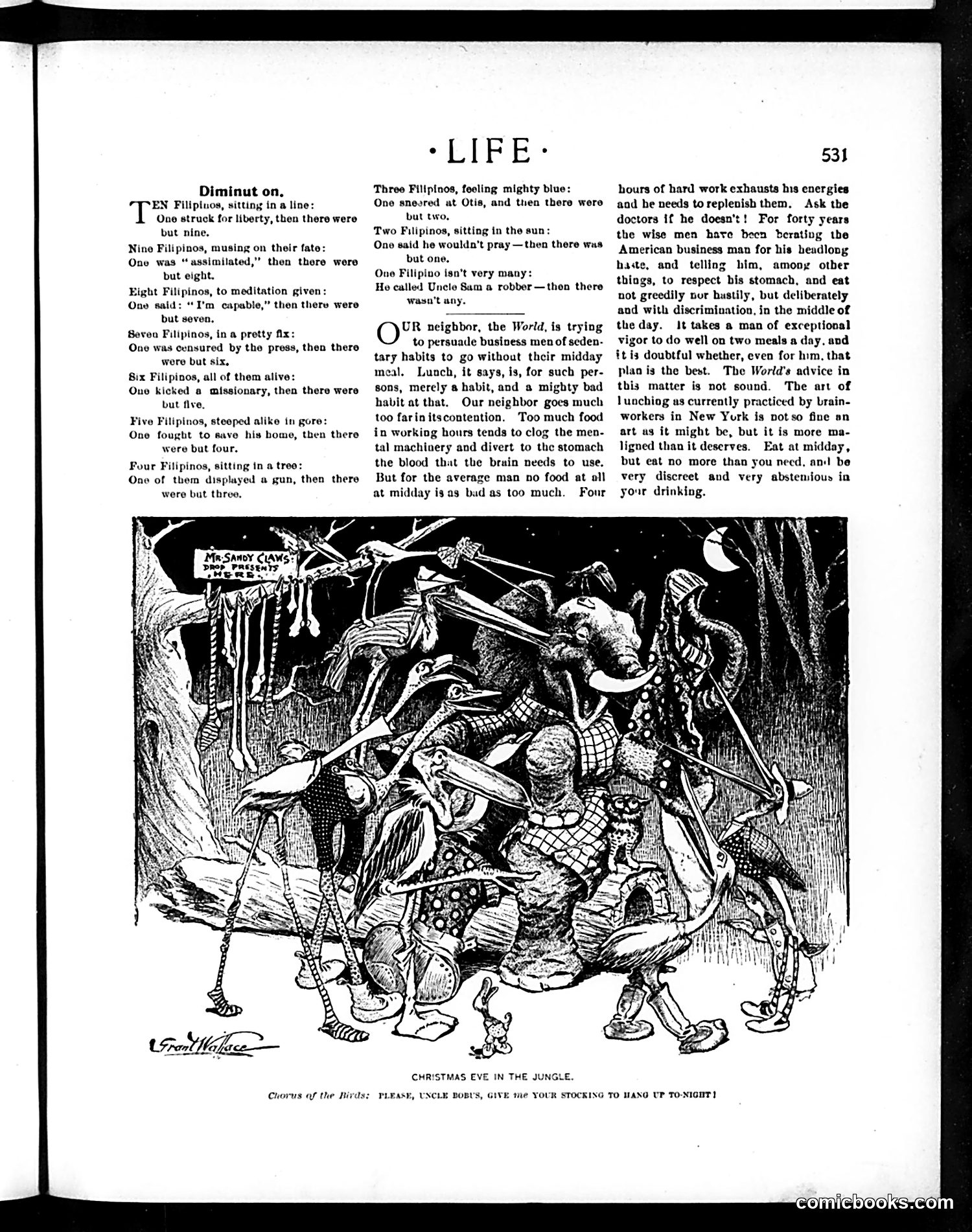
This satirical illustration by Ufred Wallace depicts anthropomorphized Filipino figures engaged in what appears to be a chaotic Christmas celebration. The accompanying text "Diminut on" presents a series of short, rhyming couplets about Filipinos with stereotypical characterizations—some described as lazy, drunk, or criminal. The cartoon's context reflects American colonial attitudes toward the Philippines following the 1898 Spanish-American War. It mocks Filipino culture through crude ethnic stereotyping while the "Chorus of the Birds" caption creates absurdist humor by having animals comment on the scene. The overall message reinforces early 20th-century American imperialist attitudes, portraying Filipinos as uncivilized and requiring American guidance—a common propaganda tool during U.S. occupation of the islands.
📄 Transcribed text from this page (OCR, searchable)
Machine-transcribed from the original scan — historical spelling and the odd misread are preserved.
Diminut on, EN Filipinos, sitting in a line: One struck for liberty, then there were but nine. Nino Filipinos, musing on their fate: One was “assimilated,” then there were but eight. Eight Filipinos, to meditation given: One said: “I'm capable,” then there were but seven, Beven Filipinos, in a pretty fix: One was censured by the press, then thero were but six, Bix Filipinos, all of them alive: Oue kicked a missionary, then there were but five, Five Filipinos, steoped alike in gore: One fought to save his bome, then there were but four, Four Filipinos, sitting in a treo: One of them displayed a gun, then there were but three, JANDY CLAW: meme? Got Chorus of the Rivas: «DBE Three Filipinos, fooling mighty blue: Ono snevred at Otis, and then there wero but tio. Two Filipinos, sitting in the sun: Ono said he wouldn't pray—then there was but one, Ono Filipino isn’t vory many: He called Uncle 8am a robber —then there wasn't any. UR neighbor, the World, is trying to persuade business men of seden- tary habits to go without thcir midday meal. Lunch, it says, is, for such per- sons, merely a habit, and a mighty bad habit at that. Our neighbor goes much too farinitscontention. Too much food in working hours tends to clog the men- tal machinery and divert to the stomach the blood that the brain needs to use. But for the average man no food at oll at midday isas bud as too much. Four CHRISTMAS EVE IN THE JUNGLE. 531 hours of hard work exhausts his energies aad he needs toreplenish them. Ask the doctors if he doesn’t! For forty years the wise men hare been berating the American business man for his headlong haste, and telling him, among otber things, to respect bis stomach, and eat not greedily nor hustily, but deliberately and with discrimination, in the middle of the day. It takes a man of exceptional vigor to do well on two meals a day, and it is doubtful whether, even for him, that plan is the best. The World's advice in this matter is not sound. The art of lunchiog us currently practiced by brain- workers in New York is potso fine on art as it might be, but it is more ma- ligned than it deserves. Eat at midday, but eat no more than you necd, anil be very discreet and very abstemious in your drinking. PLEASE, UNCLE BOBUS, GIVE me YOUR STOCKING TO HANG UP TO-NIGHT1