
Life, 1899-12-21 · page 12 of 20
Life — December 21, 1899 — page 12: what you’re looking at
What you’re looking at
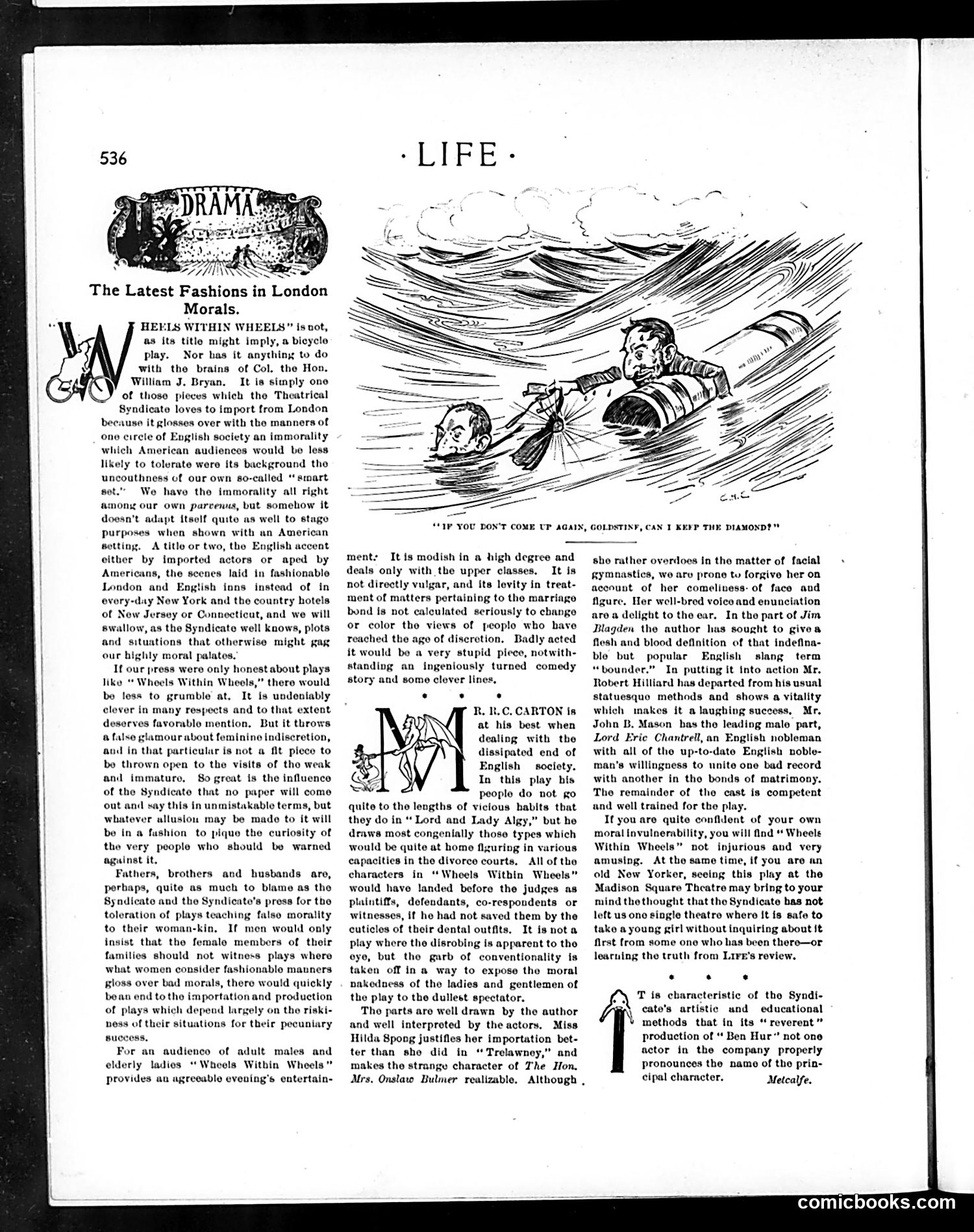
This page reviews a London theatrical production titled "Wheels Within Wheels." The illustration shows two figures in water or turbulent circumstances, with one saying "If you don't come up again, Goldstine, can I keep the diamond?" The review criticizes the play as a shallow work dealing with divorce and upper-class morality, lacking serious engagement with its subject matter. The author argues the play merely exposes surface-level scandals of London society rather than offering genuine insight. The satire targets both the play's pretentiousness and the Theatrical Syndicate's practice of importing such frivolous English comedies for American audiences—suggesting they mistake fashionable immorality for sophisticated entertainment.
📄 Transcribed text from this page (OCR, searchable)
Machine-transcribed from the original scan — historical spelling and the odd misread are preserved.
The Latest Fashions in L: Morals. HEELS WITHIN WHEELS” is vot, as its title might imply, a bicyclo play. Nor has it anything to do With tho brains of Col. the Hon. William J. Bryan, It is simply one of those pieces which the Theatrical Syndicato loves to import from London because it glosses over with the manners of ono circle of English society an immorality which American audiences would be less likely to tolerate were its background tho uncouthness of our own so-called “ sinart sot.” We have the immorality all right Among our own parcenus, but somehow it doesn't adapt itself quite as well to stage Purposes when shown with an American setting. A title or two, the English accent either by imported actors or aped by Americans, the scenes laid in fashionable London and Engtish inns instead of in every-day New York and the country hotels of Now Jersey or Connecticut, and we will swallow, as the Syndicate well knows, plots and situations that otherwise might gag our bighly moral palates, If our press were only honest about plays like “ Wheels Within Wheels,” there would. bo less to grumble at. It is undeniably clever in many respects and to that extent deserves favorable mention, But it throws @ falso glamour about feminino indiscretion, aud in that particular is not a fit piece to bo thrown open to the visits of tho weak and immature, So great {s the influence of the Syndicate that no paper will come out and say this in unmistakable terms, but whatever ullusion may be made to it will be in a fushion to pique the curiosity of the very people who should be warned aguinst it, Fathers, brothers and husbands aro, perbaps, quite as much to blame as the Syndicato and the Syndicato’s press for the toleration of plays teaching false morality to their woman-kin, If mon would only insist that the femalo members of their families should not witness plays where what women consider fashionable manners gloss over bad morals, there would quickly bean end tothe importation and production of plays which depend largely on the riski- ness of their situations for their pecuniary success, For an audienco of adult males and elderly ladies “Wheels Within Wheels” provides au agreeable evening's entertain- ‘LP YOU DON'T COME UP AGAIN, GOLDSTINY, CAN I KEYP THE DIAMOND?" ment: It is modish in a high degree and deals only with the upper classes, It is not directly vulgar, and {ts levity in treat- ment of matters pertaining to tho marringo bond fs not calculated seriously to change or color tho views of peoplo who have reached the ago of discretion. Badly acted it would be a very stupid pleco, notwith- standing an ingeniously turned comedy story and some clever lines, * R. B.C. CARTON fs at his best when dealing with the dissipated end of English society. In this play bis people do not go quite to the lengths of vicious habits that they do in “Lord and Lady Algy,” but he draws most congenially those types which would be quite at homo figuring in various capacities in the divorco courts, All of the characters in “Wheels Within Wheels” would have landed before the judges as plaintiffs, defendants, co-respondents or witnesses, if he had not saved them by the cuticles of their dental outfits. It is not a lay where tho disrobing is apparent to the eye, but tho garb of conventionality is taken off in a way to expose the moral nakedness of the Indies and gentlemen of the play to the dullest spectator. Tho parts aro well drawn by the author and well interproted by the actors. Miss Hilda Spong justifles her importation bet- ter than sho did in “Trelawney,” and makes the strange character of The Ion. Mrs. Onslaw Bulmer realizable. Although , sho rather overdoes in the matter of facial gymnastics, we are prone tu forgive her on account of her comelivess- of face aud figure, Her well-bred voice and enunciation are a delight to the ear, In the part of Jim Blagden the author hus sought to give a flesh and blood definition of that indefina- ble but popular English slang term “vounder.” In putting it into action Mr, Robert Hilliard has departed from his usual statuesquo methods and shows a vitality which imakes it a laughing success, Mr. John B, Mason bas the leading male part, Lord Eric Chantrell, an English nobleman with all of the up-to-date English noble- man's willingness to unite one bad record with another in tho bonds of matrimony. The remainder of the cast is competent and well trained for the play. If you are quite confident of your own moral invulnerability, you will And “ Wheele Within Wheels” not injurious and very amusing. At the same time, if you are an old Now Yorker, seeing this play at the Madison Square Theatre may bring to your mind the thought that the Syndicate bas not left us ono single theatro where It is safe to tako a young girl without inquiring about it first from some one who has been there—or learning the truth from Lrre’s review. . . . T is characteristic of tho Syndi- \ cato’s artistic and educational methods that in its “reverent” production of “ Ben Hur” not one actor in the company properly pronounces the name of the prin- cipal character. Metcalfe. comicbooks.com