
A complete issue · 20 pages · 1899
Life — November 2, 1899
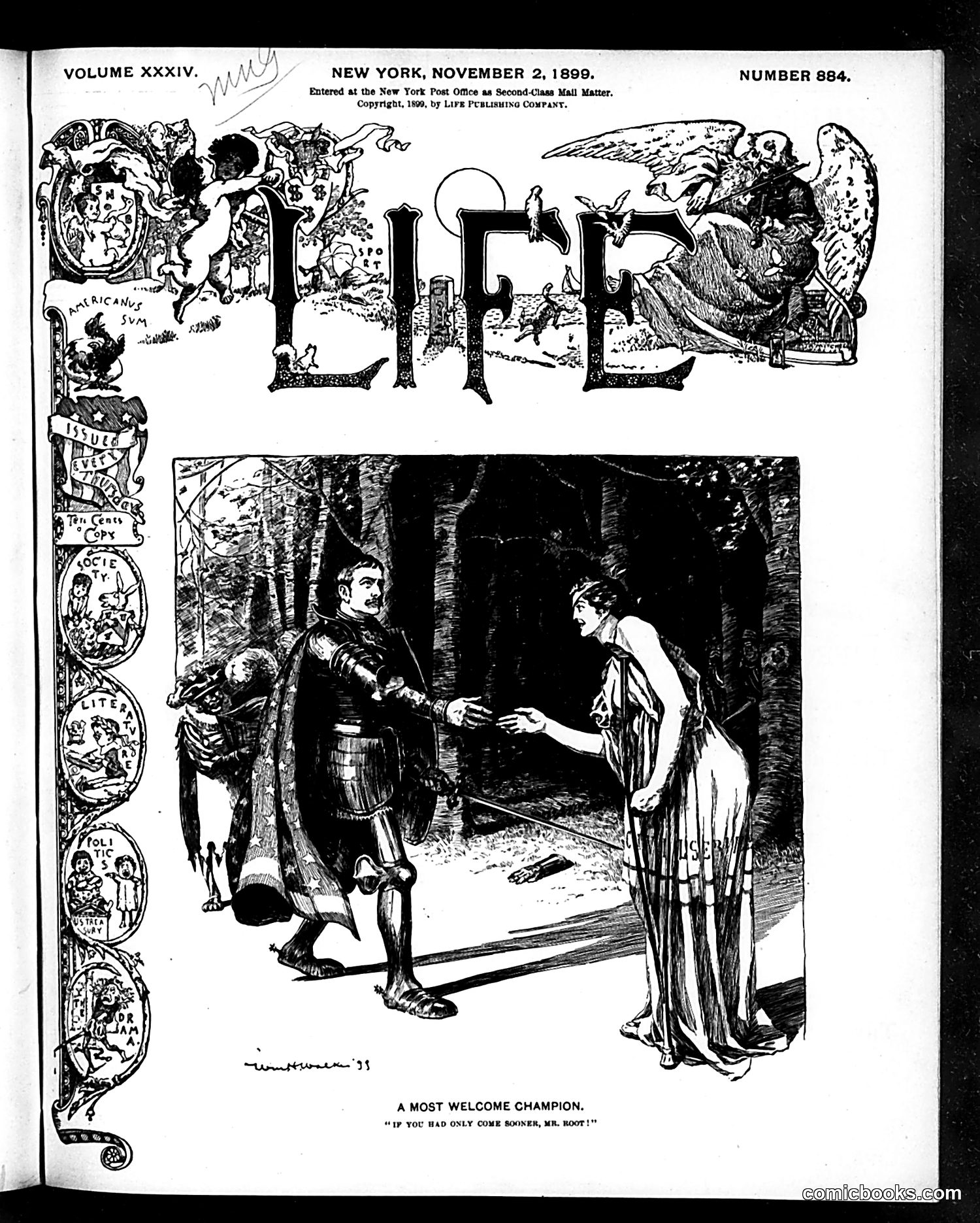
This page features a single illustration titled "A Most Welcome Champion" with the subtitle "If you had only come sooner, Mr. Boot!" The cartoon depicts a knight in armor meeting a classical female figure (likely representing Britain or a virtue) in a forest setting. The "Mr. Boot" reference appears to target a specific political figure of 1899—likely referring to someone involved in the Second Boer War (1899-1902), which was controversial in Britain. The satire suggests this person arrived too late to prevent some calamity, or that their intervention, while appreciated, couldn't undo previous damage. The decorative left border contains classical medallions typical of Life's design. Without additional context, the precise identity of "Mr. Boot" remains unclear, though the martial imagery suggests military or political leadership during wartime.
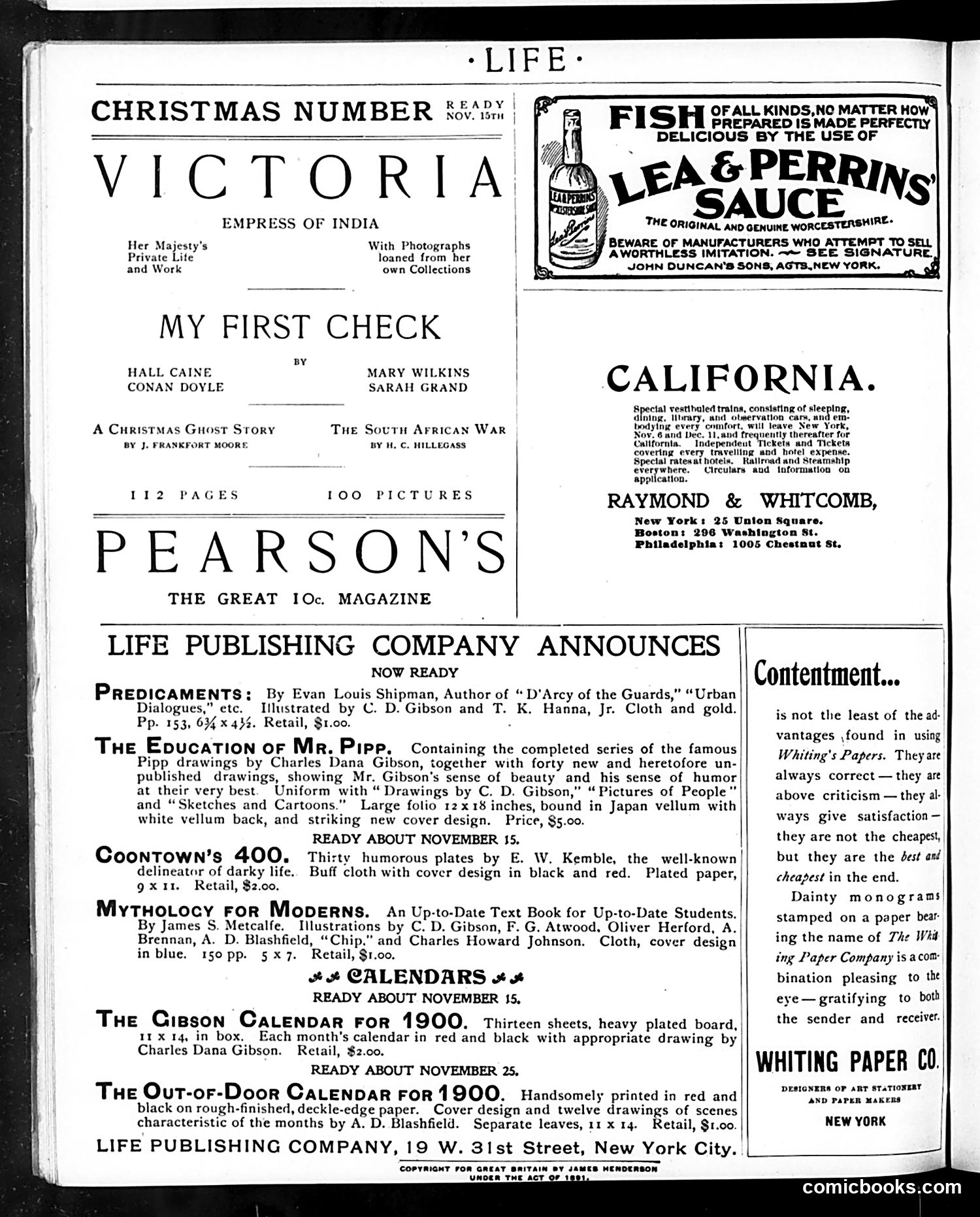
This page is primarily **advertising and publishing announcements**, not political satire or editorial cartooning. The content includes: - **Magazine promotion**: *Pearson's* and *Life* publishing company announcements - **Product ads**: Lea & Perrins Sauce, Whiting Paper Company, and California travel promotions by Raymond & Whitcomb - **Book announcements**: Including works on Victoria (Empress of India), "My First Check" stories, and various illustrated volumes by C. D. Gibson The page reflects **turn-of-the-century consumer culture** (circa 1899-1900), showcasing books, travel services, and condiments marketed to educated, affluent readers. The Gibson Calendar and "Education of Mr. Pipp" suggest Gibson's popularity as an illustrator during this period. No significant political cartoons or satirical commentary appears on this particular page.
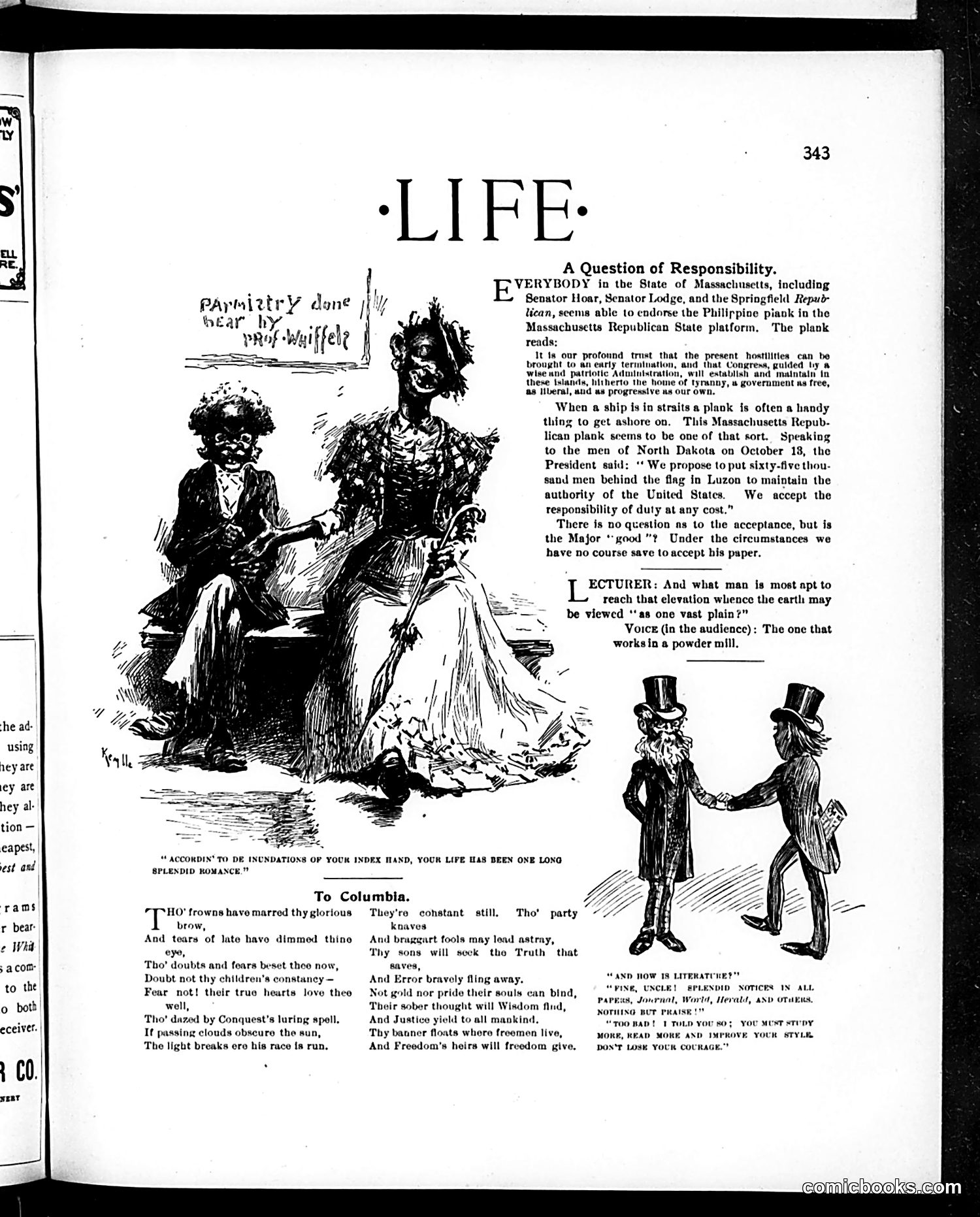
**Main Cartoon (upper left):** Depicts two grotesque figures in elaborate dress, likely caricatures of political or social figures of the era. The handwritten caption references "Philippine plank" and Republican platforms, suggesting commentary on U.S. Philippine policy debates. **"A Question of Responsibility" essay:** Discusses Massachusetts Republicans endorsing the Philippine plank, debating whether to support military action in the Philippines. The text mentions President Roosevelt's October 13 proposal to place soldiers in Luzon "to maintain the authority of the United States." **"To Columbia" poem:** Satirizes political outcomes, mentioning conquest, darkness, and questioning whether "Justice" and "Truth" prevail. **Lower cartoons:** Two gentlemen in top hats discussing "literature," likely satirizing cultural or political pretensions. The page reflects early 1900s debates over American imperialism and Philippine colonization.
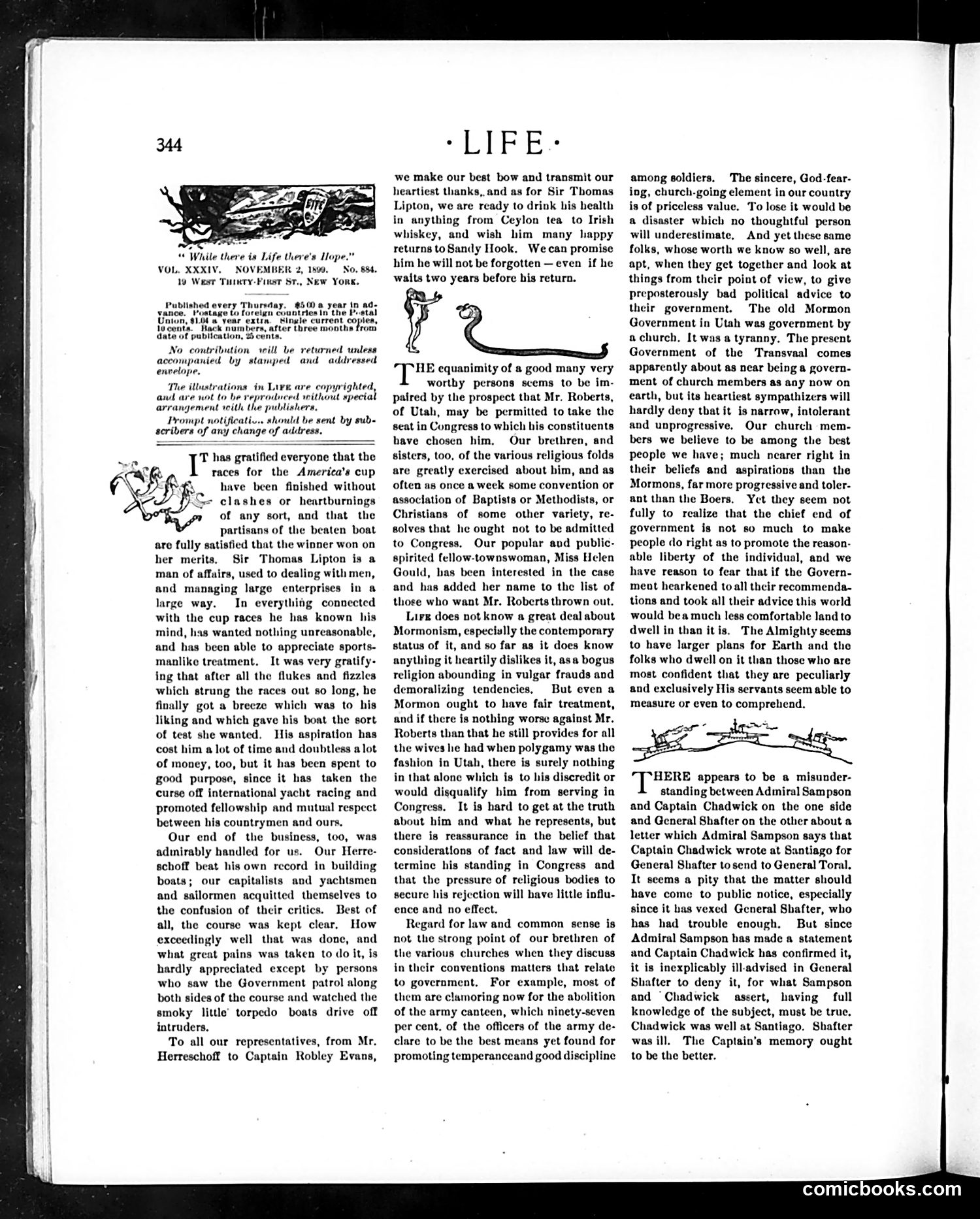
This page contains editorial commentary on political and religious matters, primarily discussing B.H. Roberts of Utah and his potential appointment to Congress. The text expresses concern about Roberts's Mormon faith and polygamous past, arguing he should still be allowed to serve despite these controversies. The editors advocate for religious tolerance and individual liberty, opposing what they see as unfair discrimination based on his religion. There is also a brief discussion of an apparent disagreement between Admiral Sampson and Captain Chadwick regarding Santiago during the Spanish-American War, suggesting a "misunderstanding" that should be clarified publicly. The cartoons on the page appear to be decorative line drawings rather than satirical commentary on the main text topics.
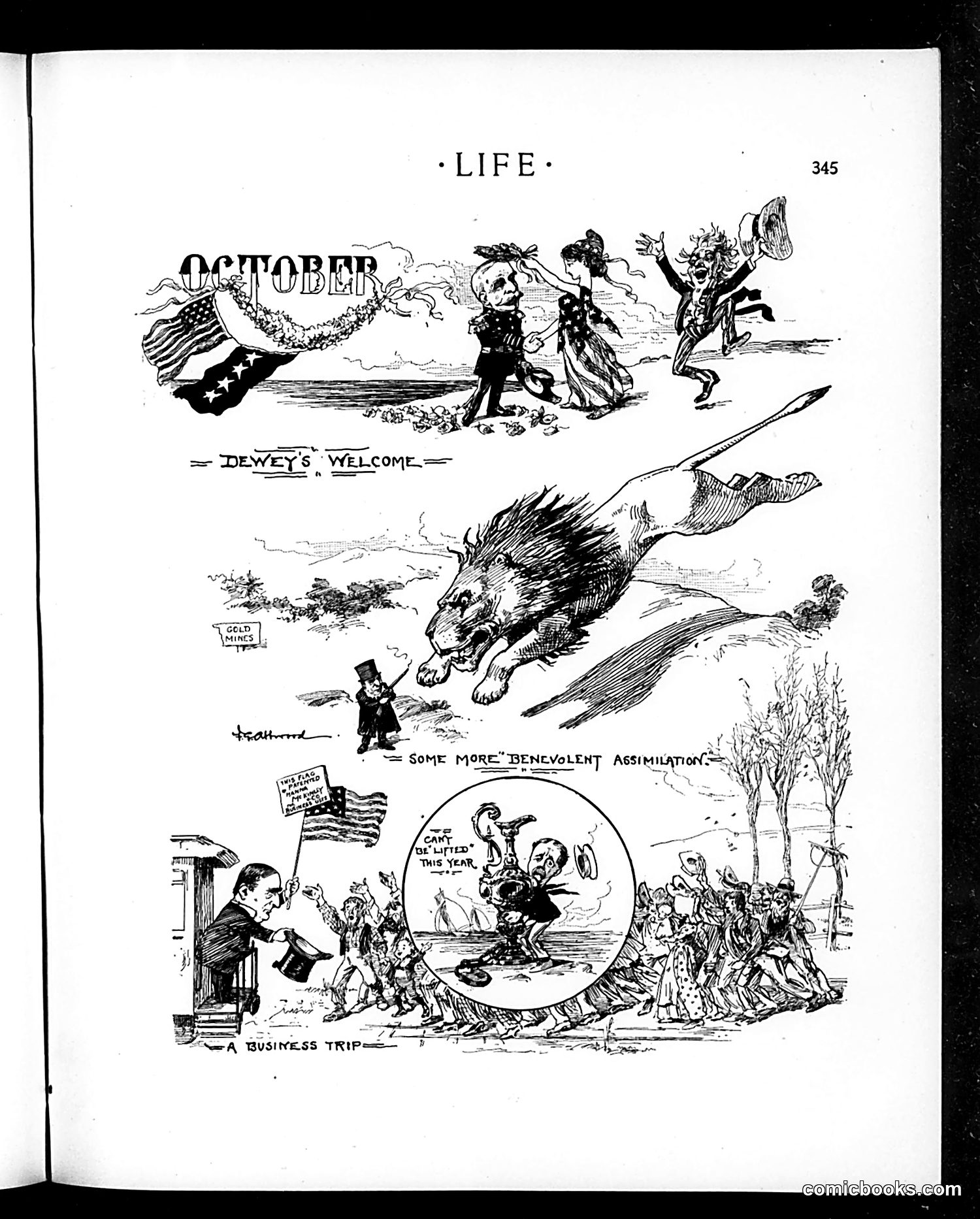
This page satirizes Admiral George Dewey's return to America following the Spanish-American War. The top cartoon, "Dewey's Welcome," depicts celebratory figures with an American flag welcoming the victorious naval commander home from the Philippines. The middle cartoon, "Some More Benevolent Assimilation," shows a large bear attacking a small figure—likely satirizing American imperial expansion in the Philippines under the guise of "benevolent assimilation," the phrase used to justify U.S. colonization. The bottom cartoon, "A Business Trip," appears to depict political or commercial scheming related to post-war opportunities, possibly criticizing how politicians exploited Dewey's popularity or war profits. The cartoons collectively critique American imperialism and opportunism during the Spanish-American War period.
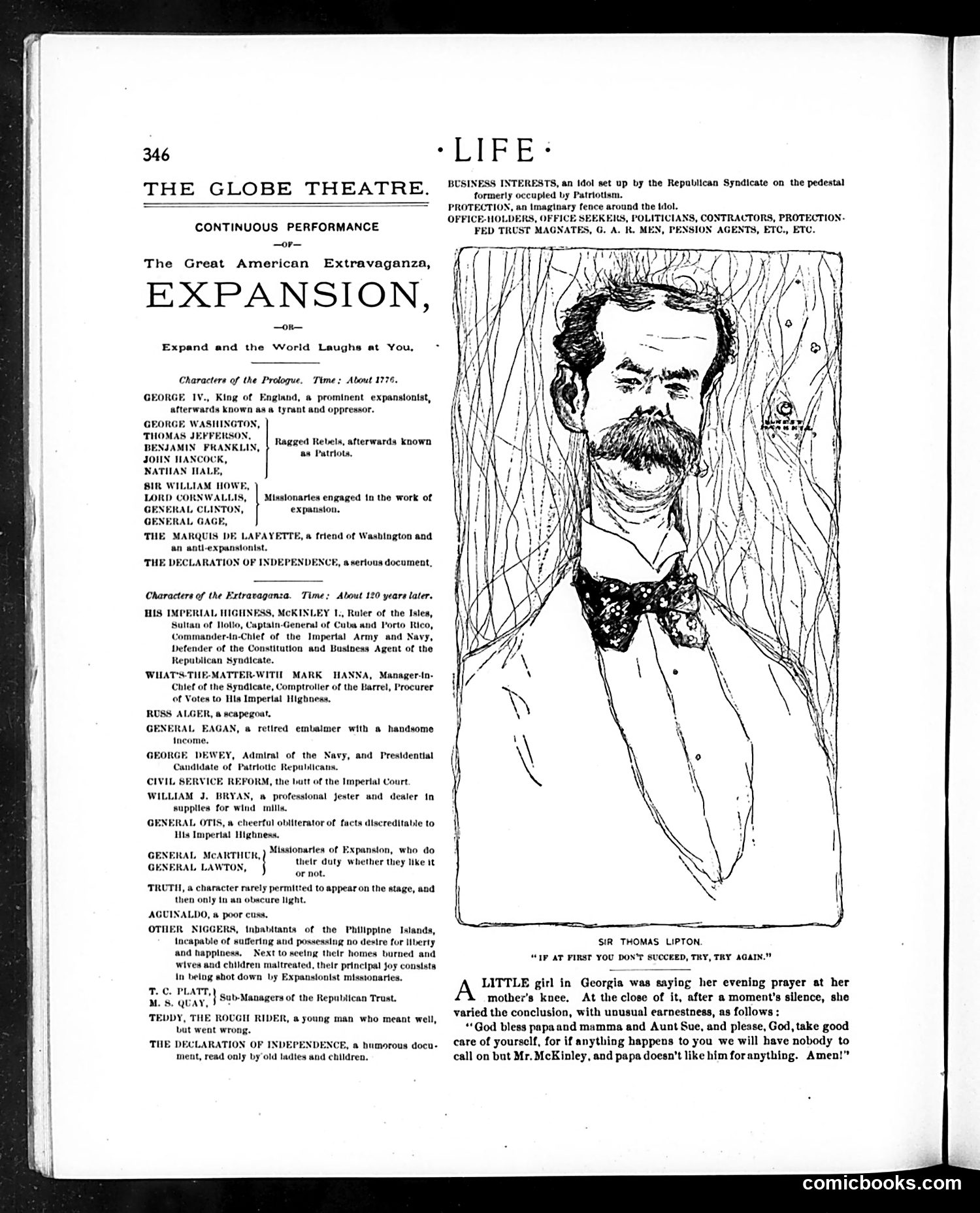
This page advertises a theatrical production titled "Expansion; or, Expand and the World Laughs at You," presented at the Globe Theatre as continuous performance. The play satirizes American expansionism (likely circa 1898, the era of U.S. imperial growth). It features historical figures like George Washington and Thomas Jefferson alongside contemporary characters representing expansion advocates—including missionaries, military figures, and business interests. The portrait shows Sir Thomas Lipton, labeled with the quote "If at first you don't succeed, try, try again." Lipton, a Scottish businessman and yacht racer, likely represents commercial expansion ambitions. The anecdote below mocks American naïveté about expansion's consequences, presenting a child's prayer that reveals provincial attitudes toward global involvement.
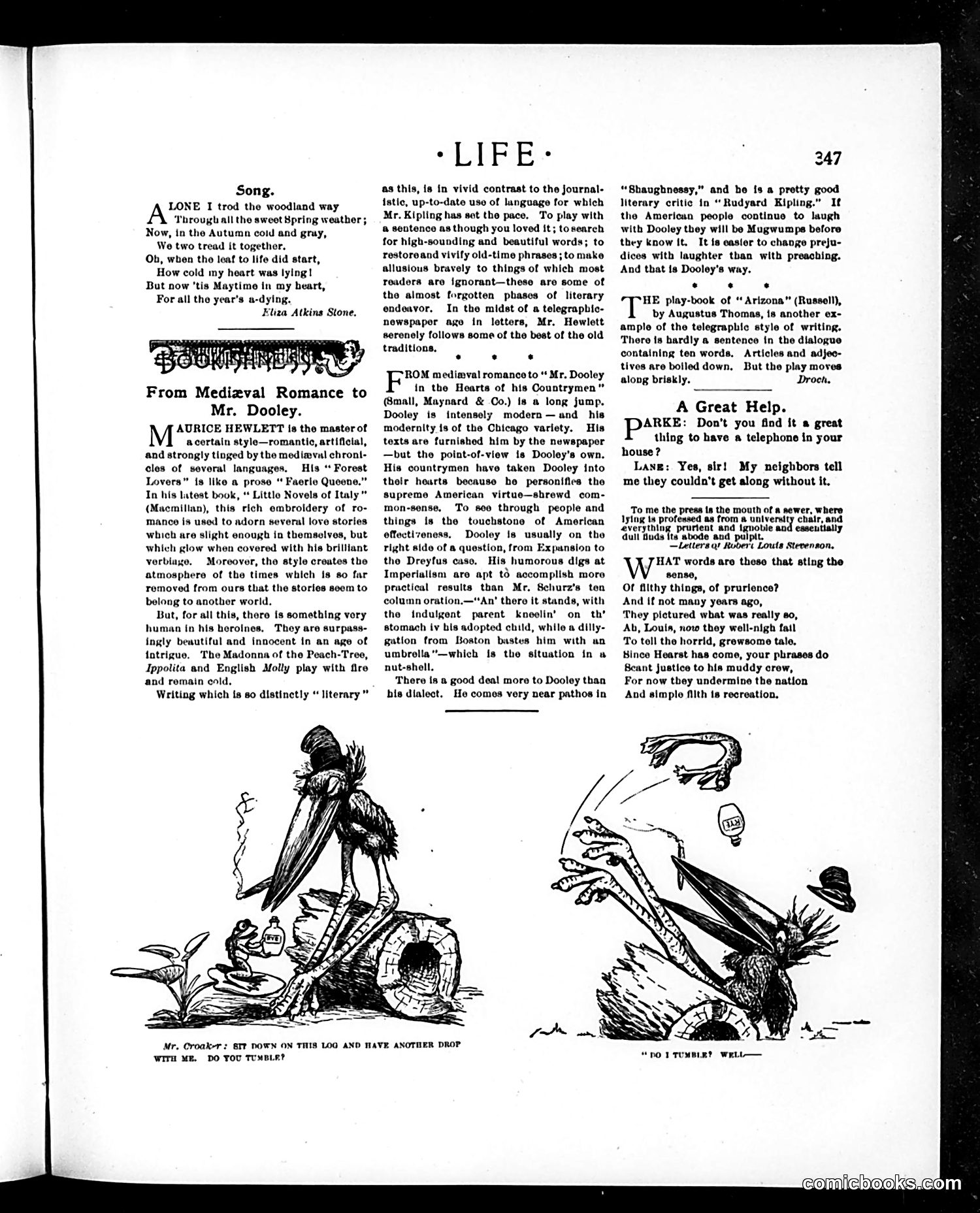
This page contains literary criticism and two humorous cartoons rather than political commentary. **Left cartoon**: Shows a grotesque creature sitting on a log addressing another creature, saying "SIT DOWN ON THIS LOG AND HAVE ANOTHER DROP WITH ME. DO YOU TUMBLE?" The caption references "Mr. Crooker," though the specific literary or cultural reference is unclear from the visible text. **Right cartoon**: Titled "DO I TUMBLE? WELL—" depicts a creature performing acrobatic movements, apparently responding to the left cartoon's invitation. The page's main text discusses Maurice Hewlett's medieval romance writing and Mr. Dooley's newspaper columns, praising their literary merit. The cartoons appear to illustrate literary themes or characters, though without additional context, the specific satirical targets remain uncertain.
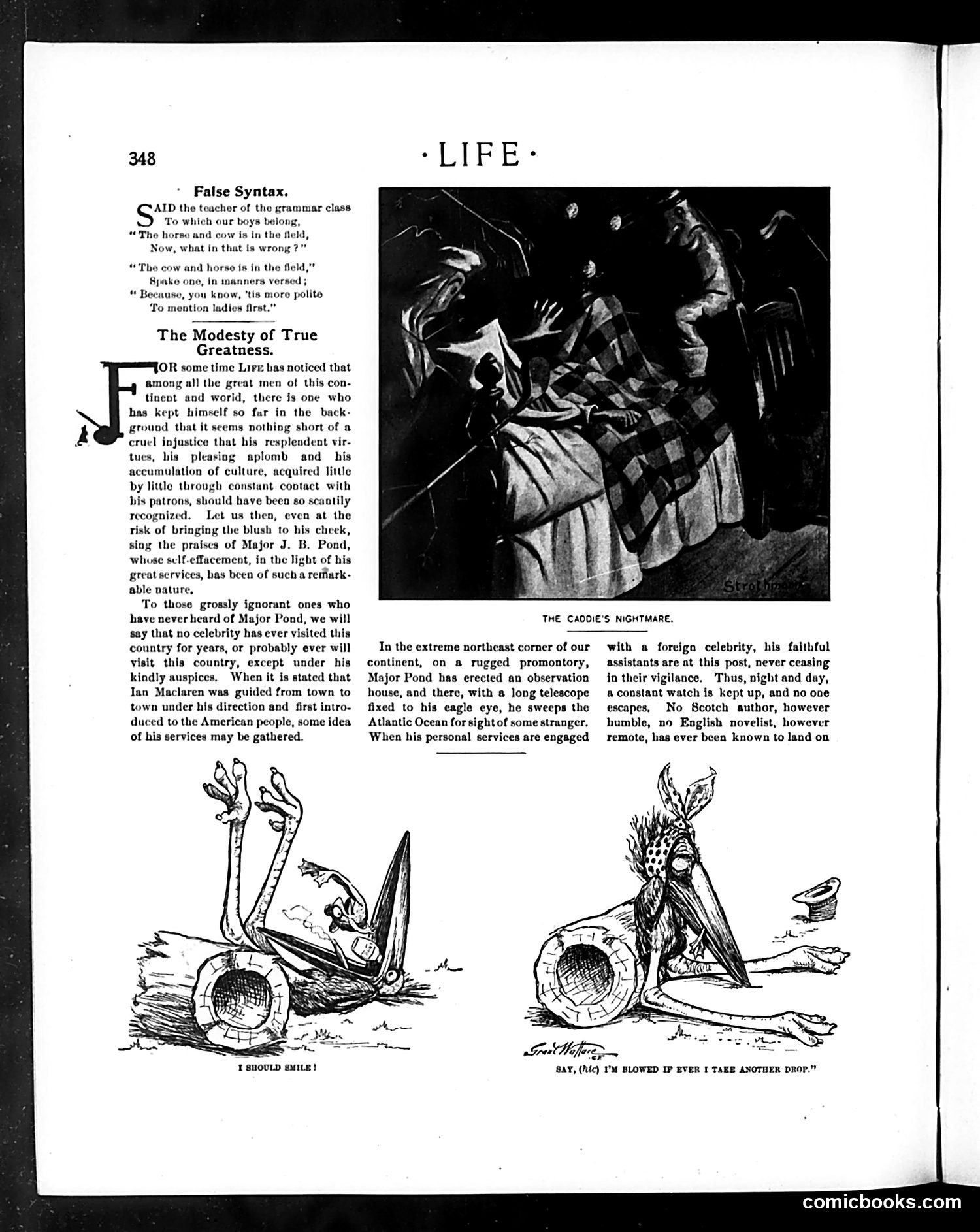
This article praises Major J. B. Pond, apparently a prominent figure of the era, for remaining humble despite his accomplishments and public recognition. The text suggests Pond has been so self-effacing that even famous people like Ian Maclaren didn't fully recognize his contributions to American culture. The two cartoon illustrations below appear to be humorous commentary on Pond's modesty—depicting anthropomorphized creatures (possibly representing pride or vanity) in uncomfortable or awkward situations, with captions "I SHOULD SMILE!" and "SAY, (BIG) I'M BLOWED IF EVER I TAKE ANOTHER DROP." The satire suggests that true greatness manifests through restraint and self-deprecation rather than self-promotion, a value the magazine appears to celebrate.
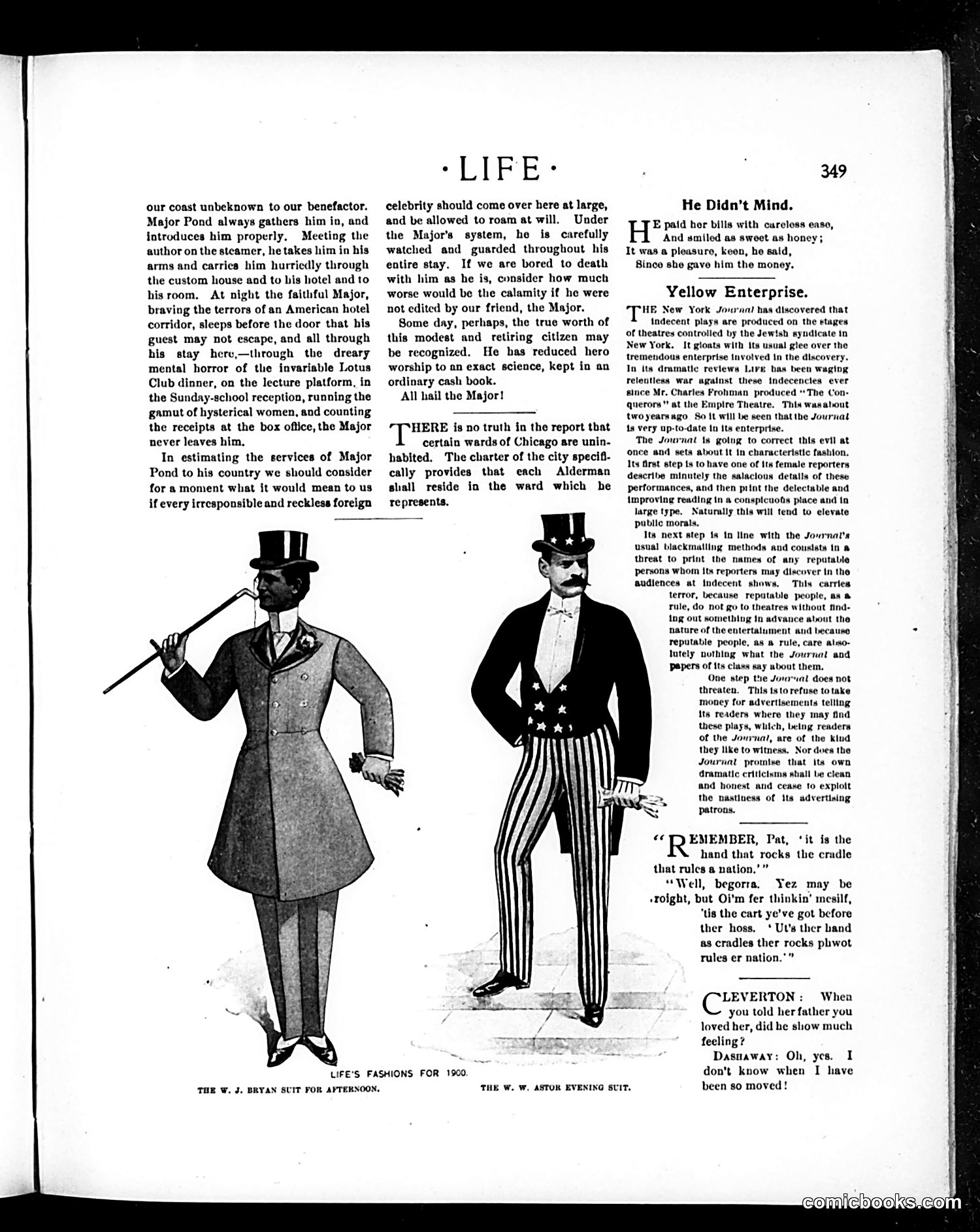
This page contains fashion illustrations labeled "Life's Fashions for 1900" rather than political cartoons. The left figure shows "The W. J. Bryan Suit for Afternoon" and the right depicts "The W. W. Astor Evening Suit." **The satire:** William Jennings Bryan (three-time presidential candidate and Populist icon) is caricatured in an exaggerated, somewhat absurd afternoon outfit, while William Waldorf Astor (wealthy socialite) models a formal evening suit. The joke appears to mock the contrast between Bryan's political ambitions and his fashion sense, satirizing him through clothing rather than ideology—a common Life magazine tactic of belittling political figures through fashion ridicule. The accompanying text discusses Chicago politics and theater criticism, unrelated to the fashion illustrations.
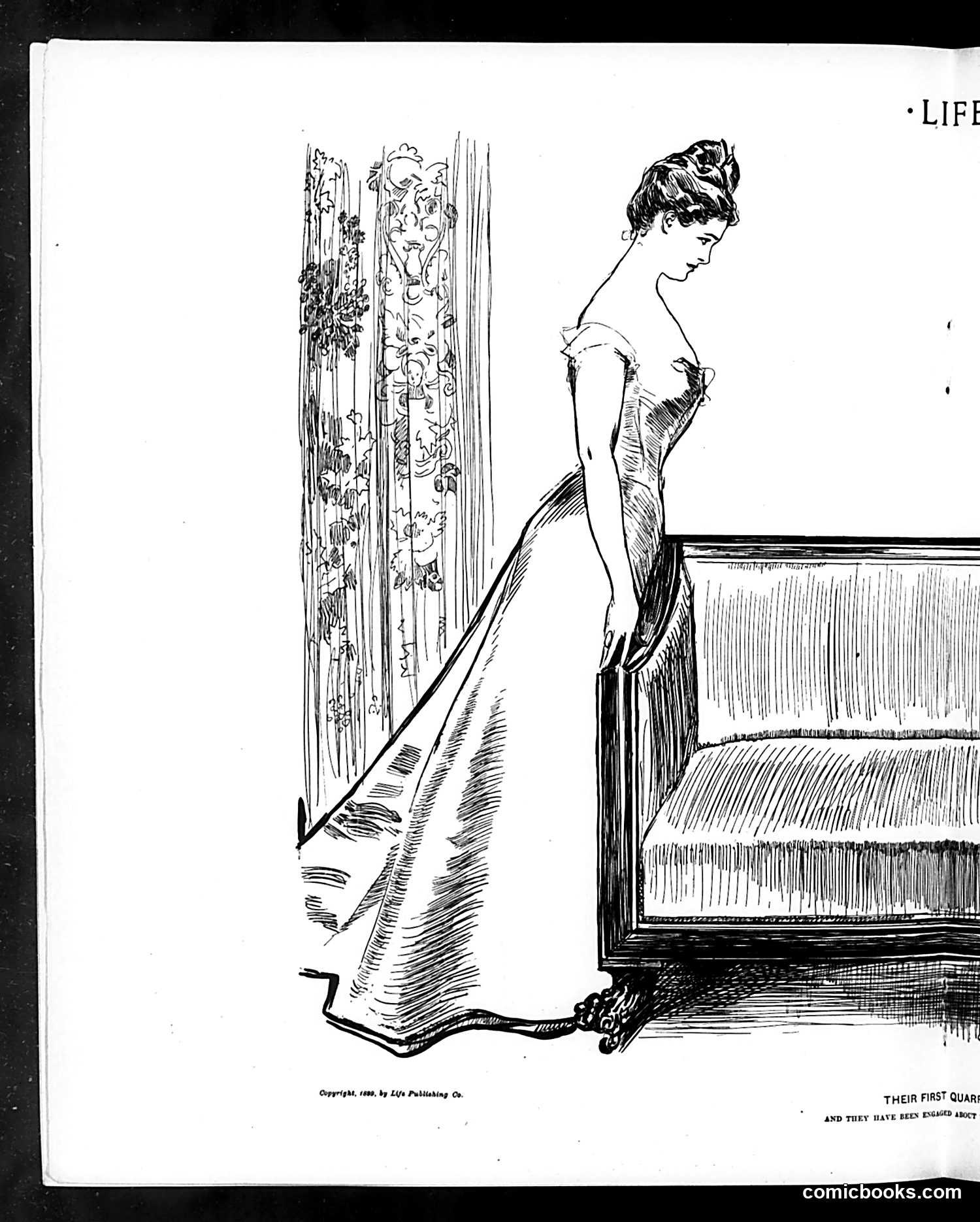
This page contains a single ink illustration from *Life* magazine (copyright 1908, by Life Publishing Co.). It depicts an elegantly dressed woman in an off-shoulder evening gown, posed beside ornate interior furnishings—a decorative curtain and upholstered furniture. The visible text fragment reads "THEIR FIRST QUAR[REL]" and "AND THEY HAVE BEEN ENGAGED ABOUT—" suggesting this is a romantic or matrimonial humor piece typical of *Life's* social satire. The cartoon likely satirizes upper-class courtship rituals or newlywed domestic life, common subjects in early 1900s humor. The woman's sophisticated pose and refined setting emphasize the genteel world being mocked. Without seeing the complete caption or full context, the specific joke remains unclear, though it presumably commented on relationship dynamics among the wealthy.
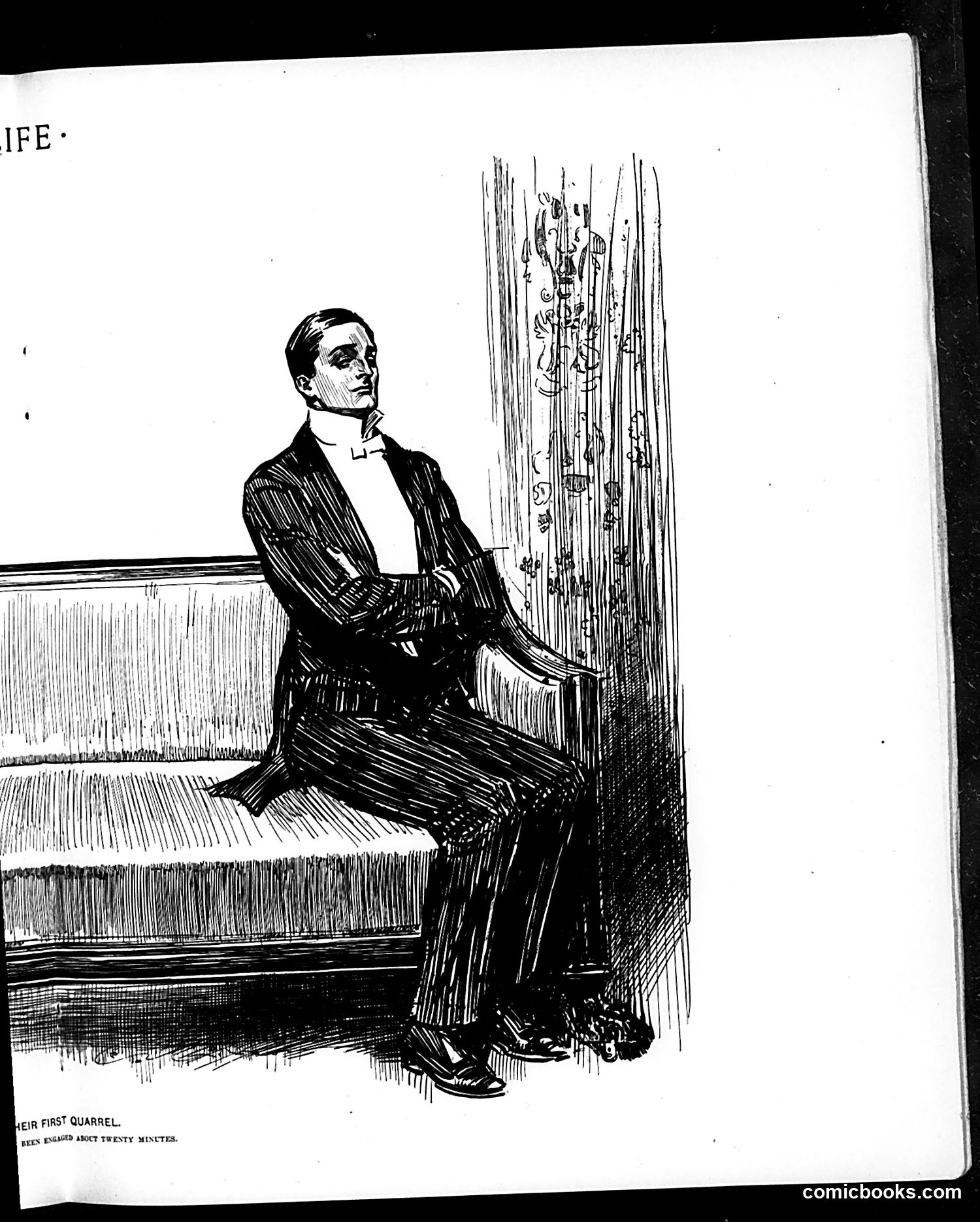
This cartoon depicts a well-dressed man in formal evening attire (tuxedo and bow tie) sitting alone on a sofa, appearing pensive or melancholy. The caption reads "THEIR FIRST QUARREL — BEEN ENGAGED ABOUT TWENTY MINUTES." The satire mocks the impulsiveness and emotional volatility of newly engaged couples. The joke relies on the absurd compression of time: the couple has been engaged for merely twenty minutes, yet the man already appears dejected, suggesting the relationship has already experienced its first serious conflict. This reflects early 20th-century social commentary on courtship, marriage, and romantic relationships—poking fun at the dramatic, unstable nature of young love and hasty engagements. The cartoon's humor depends on the contrast between the momentary duration of the engagement and the emotional turmoil already evident.
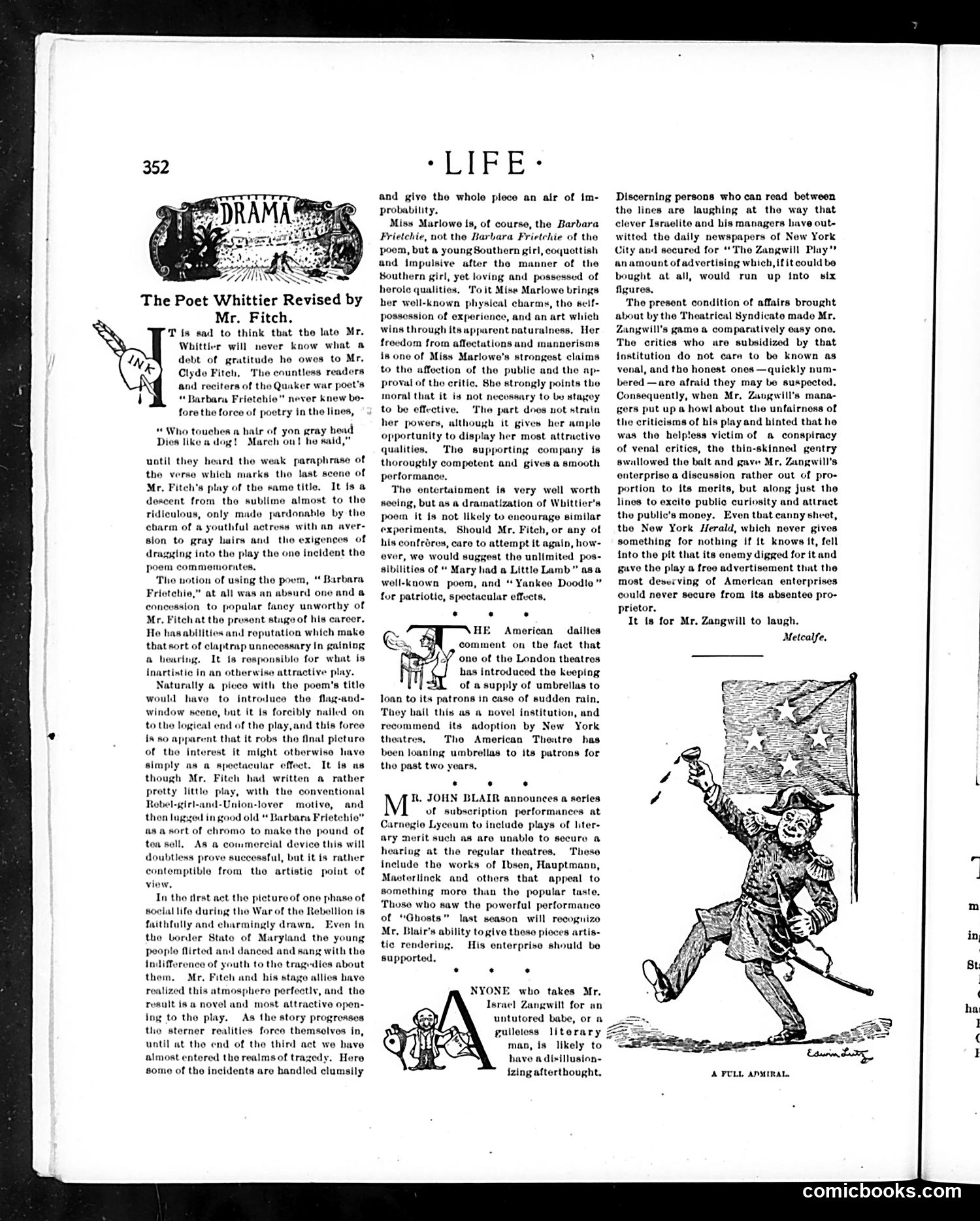
This page critiques playwright Clyde Fitch's theatrical adaptation of Whittier's poem "Barbara Frietchie." The text argues that Fitch has dramatized the poem in ways that sacrifice its moral integrity for spectacle and popularity. The critic claims Fitch added unnecessary theatrical effects—including an umbrella as a novel stage device—to attract audiences rather than honor Whittier's original work. The satire targets Fitch for prioritizing commercial success and visual novelty over artistic fidelity. The illustration labeled "A Full Admiral" (lower right) appears to be a character from the play, though its specific satirical meaning is unclear from this excerpt alone.
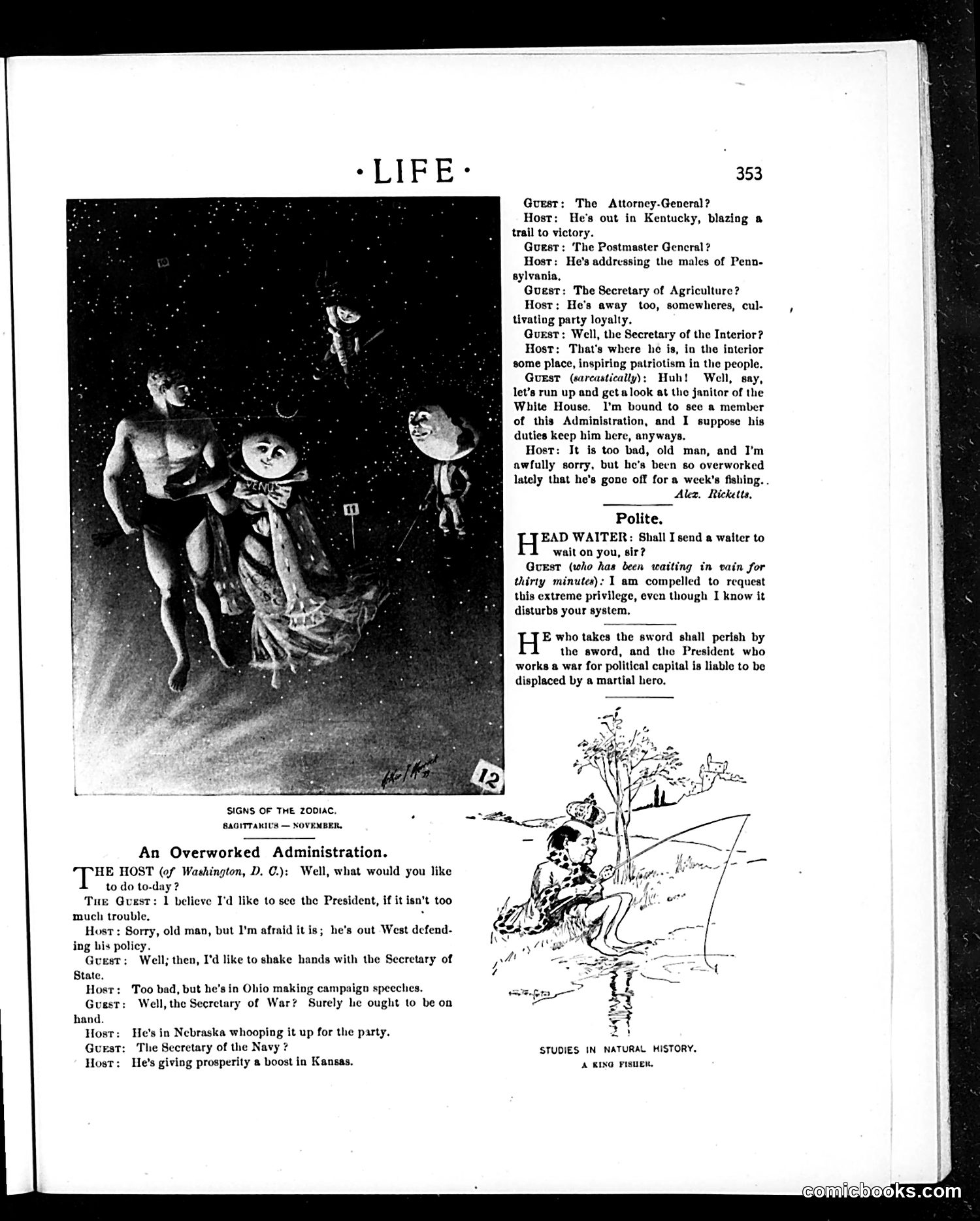
**"An Overworked Administration"** satirizes a U.S. presidential administration (appears to be early 20th century, likely Theodore Roosevelt era based on context) as dysfunctional and absent. A visiting guest trying to tour Washington cannot meet the President or any cabinet secretary—each is away campaigning or speechmaking in various states. The joke escalates absurdly, ending with even the White House janitor being unavailable due to exhaustion. The satire attacks the administration for prioritizing partisan political campaigning over actual governance. Cabinet members should be at their posts, not stumping for "the party" across America. By the punchline, the implication is that the entire government has abandoned its responsibilities for electoral advantage. **"Polite"** is a brief, separate joke about restaurant service etiquette—a sarcastic guest, ignored for thirty minutes, sardonically "requests" a waiter's attention while acknowledging it will "disturb your system." The page includes zodiac illustrations unrelated to the political content.
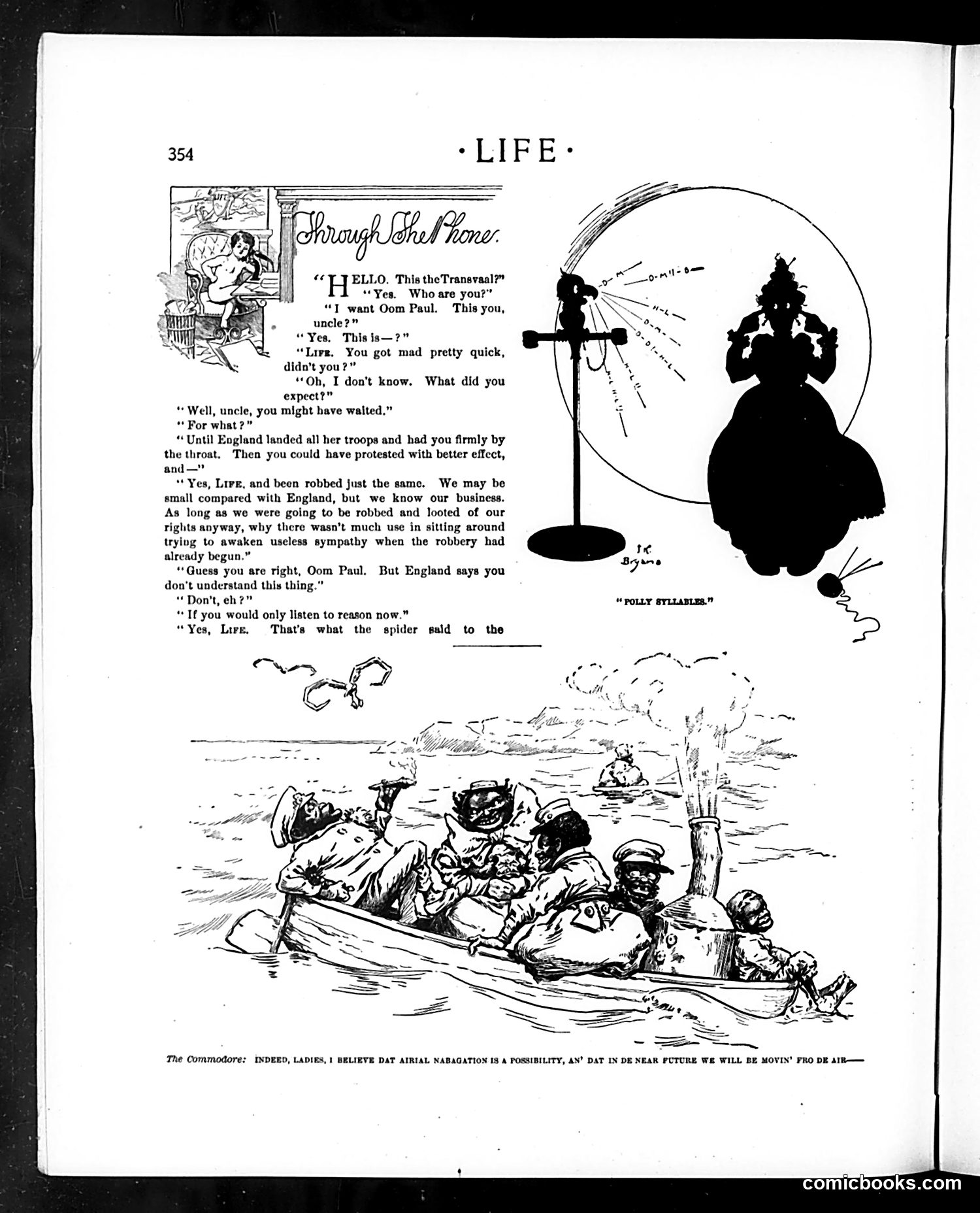
This page satirizes the Second Boer War (1899-1902) between Britain and the South African Republic (Transvaal). The dialogue features "Oom Paul" (Paul Kruger, Transvaal's president) defending his decision to resist British invasion rather than wait for more troops. **The satire's point:** Life mocks Britain's moral posturing. Kruger argues that since Britain would "rob and loot" the Transvaal regardless, resisting immediately makes sense—waiting for sympathy is futile, like the spider's trap metaphor (suggesting England deceives with false reasonableness). The silhouette cartoon titled "Polly Stifler" (right) appears to show a woman with a telephone or similar device—possibly commenting on communication or public discourse surrounding the war. The bottom cartoon about "aerial navigation" seems unrelated editorial commentary. This represents American sympathy for the underdog Boers against imperial British expansion.
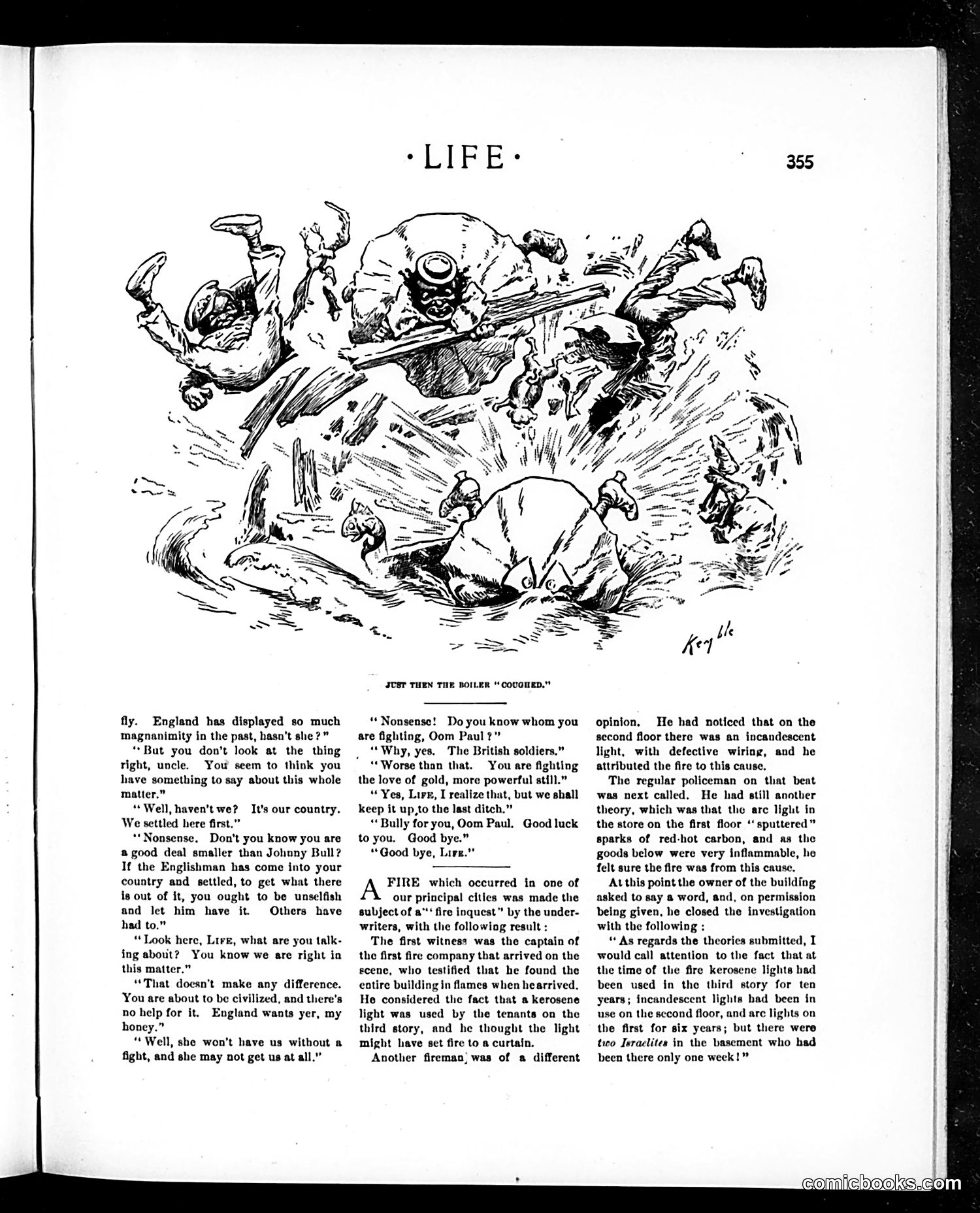
This page contains two satirical pieces: a dialogue cartoon and a fire investigation anecdote. **The Cartoon** depicts a confrontation between "Uncle Sam" (America, left) and "Oom Paul" (Paul Kruger, Boer leader), with "Life" (personified) mediating. The exchange mocks American isolationism during the Boer War (1899-1902). Life argues America should remain neutral because Britain represents superior economic power ("love of gold"), while Uncle Sam insists on American independence. The "boiler coughed" signals the conversation's disruption. **The Fire Anecdote** is an anti-Semitic joke. Three officials blame different electrical causes—kerosene, faulty wiring, arc lights—each used for years without incident. The building owner then implies the real cause: Jewish tenants ("Israelites") newly arrived in the basement, suggesting Jewish people themselves are inherently fire hazards or arsonists. This reflects period prejudices portraying Jewish immigrants as dangerous. Both pieces reveal early-1900s American attitudes toward empire, neutrality, and ethnic stereotyping.
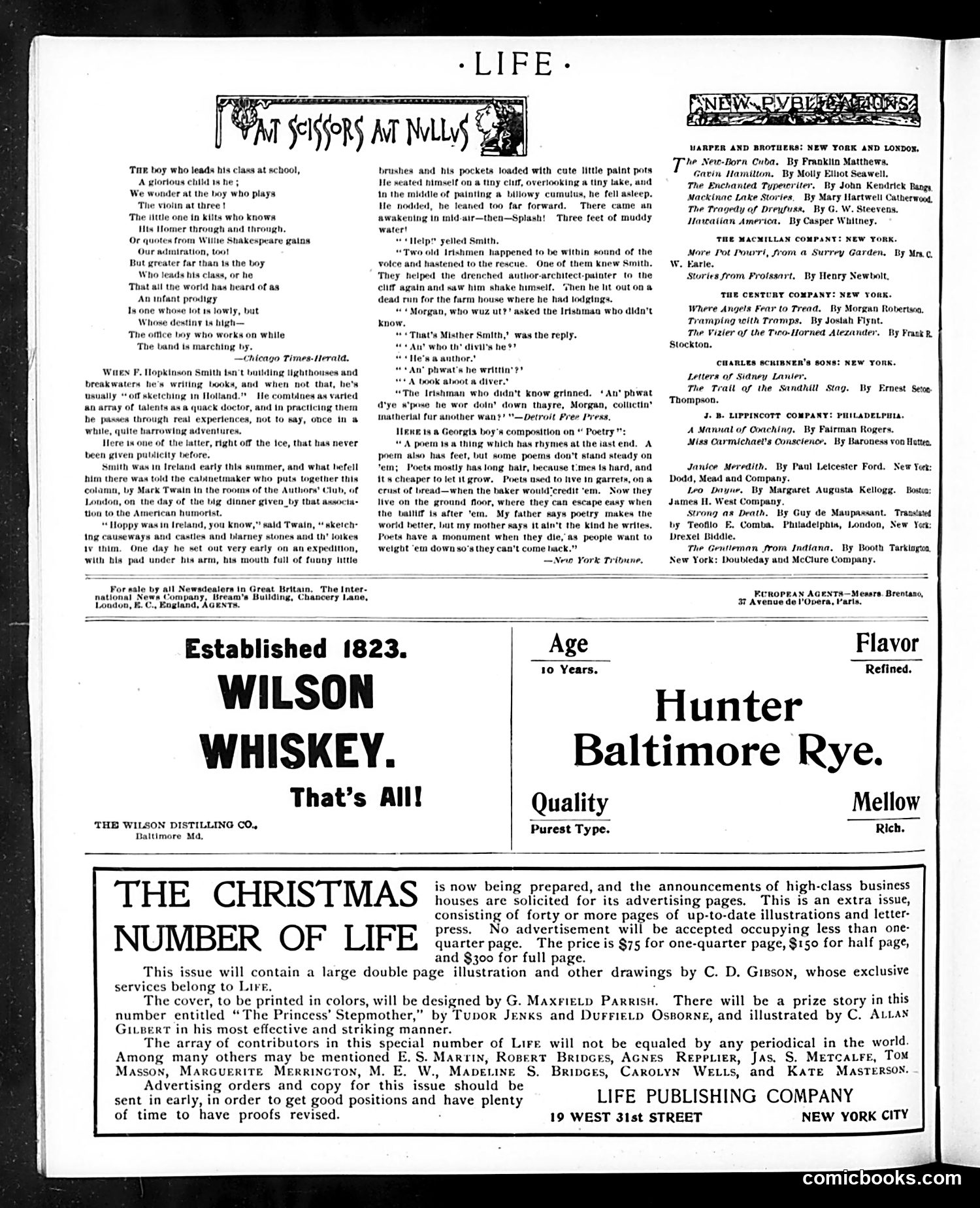
This page is primarily **advertising and book announcements** rather than political satire. The main content includes: 1. **"Tom Scissors at Nulls"** — A sentimental poem celebrating the "office boy who works on while the band is marching by" — valorizing humble, steady workers over celebrated prodigies. This reflects Progressive Era values about character and duty. 2. **An anecdote by Mark Twain** about artist F. Hopkinson Smith falling into an Irish lake while sketching. The humor derives from the Irish characters' confusion about what Smith does ("a book about a diver") — gentle ethnic comedy typical of the period. 3. **A Georgia boy's composition on poetry** — humor from a child's naive but sensible observations about poets' poor living conditions and long hair. The page reflects turn-of-the-century American magazine culture: sentimental verse, celebrity gossip (presented as anecdotes from famous writers), light humor, and extensive **book advertisements** from major publishers announcing new releases.
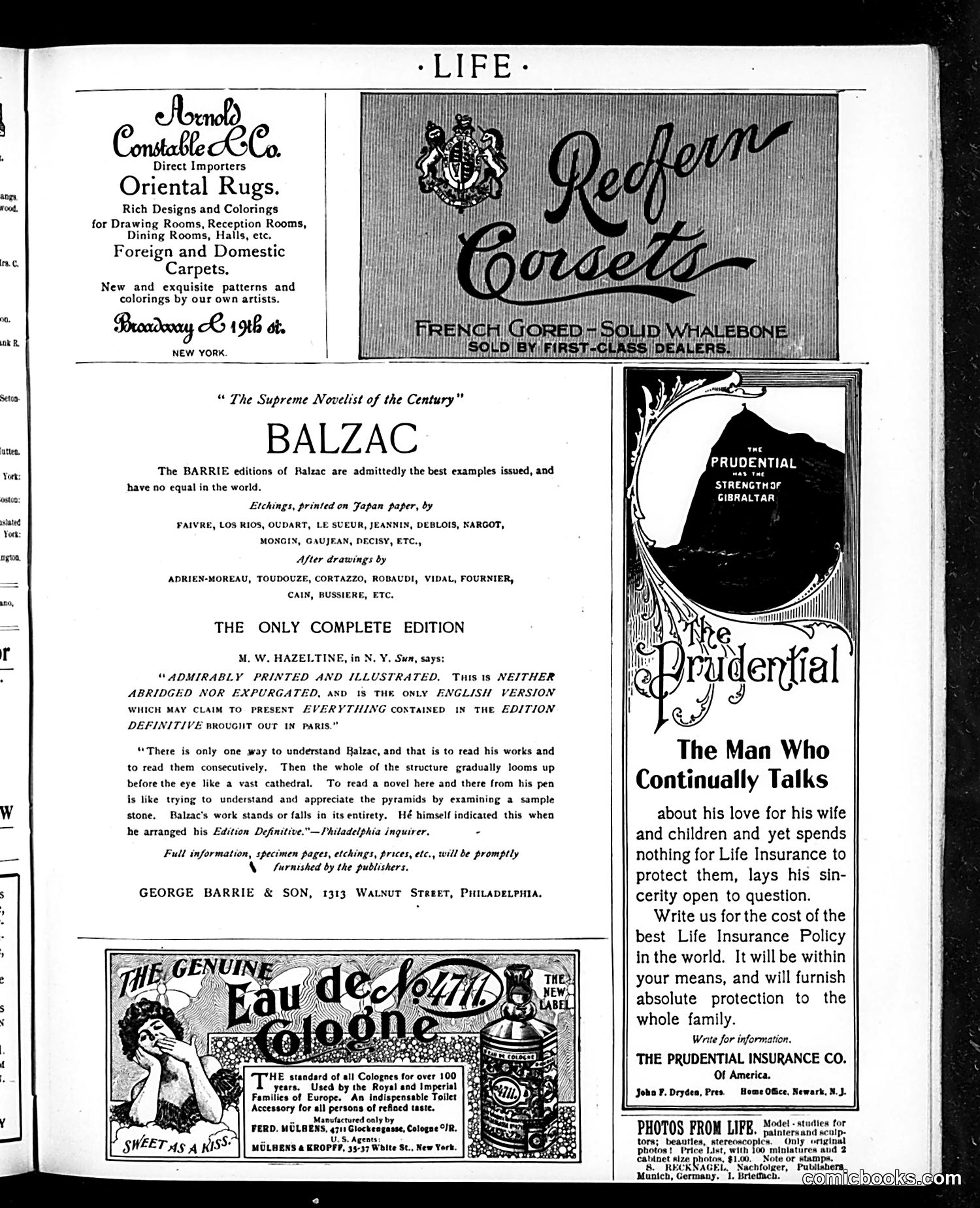
This is primarily an advertising page from *Life* magazine with no satirical cartoons. The page features: **Commercial advertisements** for luxury imports (Oriental rugs, fine editions of Balzac's works, cologne, and life insurance). The Balzac ad emphasizes the "only complete edition" with elaborate etchings, appealing to educated, wealthy readers. **One moralizing advertisement** by Prudential Insurance depicts "The Man Who Continually Talks" about loving his family but won't buy life insurance—implying his professions of love are insincere without financial protection. This uses social shame (questioning his sincerity) as a sales tactic. The page reflects *Life*'s advertising model: marketing to affluent audiences through appeals to refinement, family values, and conspicuous consumption. There is no political satire or cartoon content to analyze.
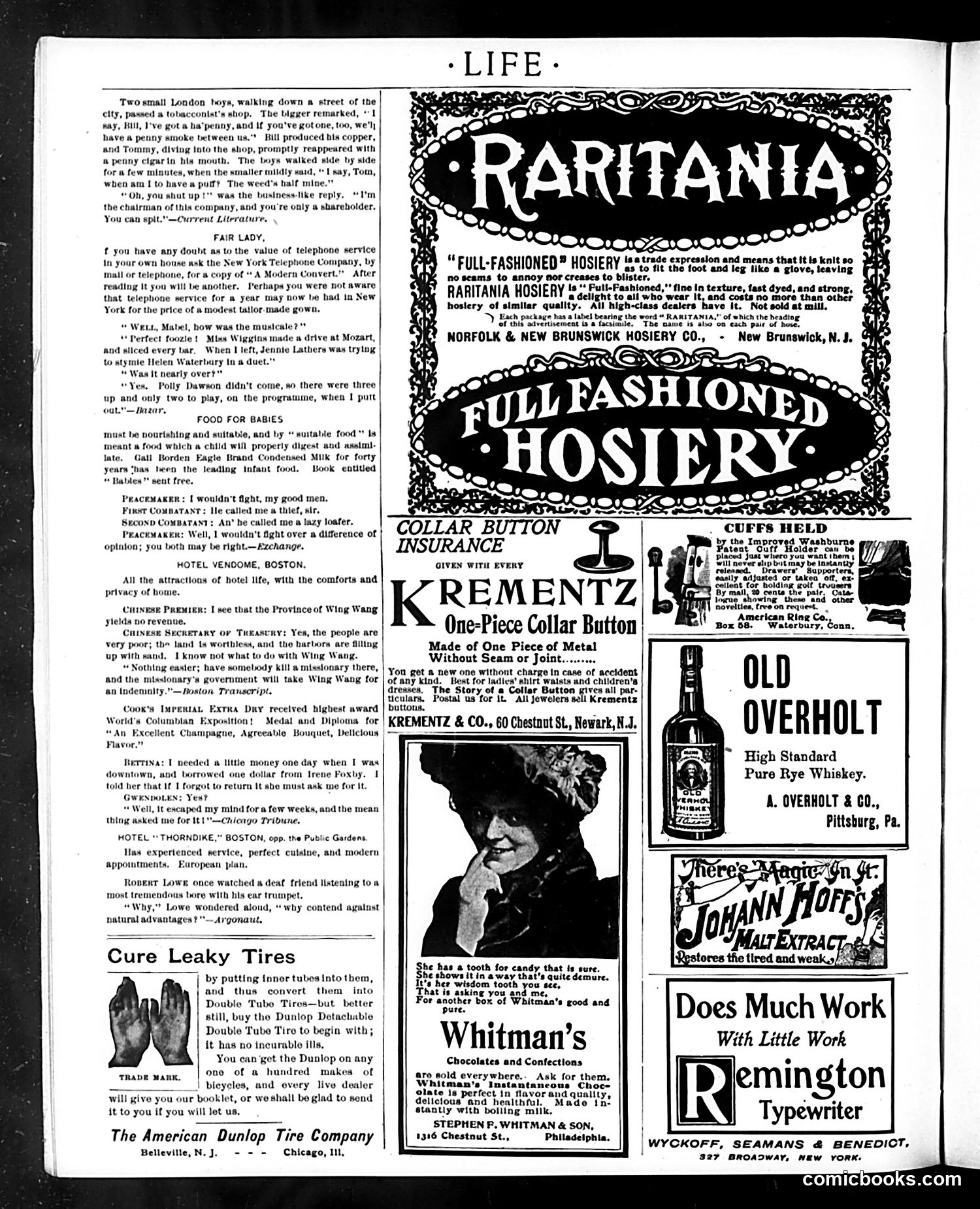
This page is primarily **advertising** rather than editorial content. The small anecdotes and jokes scattered throughout are filler material typical of early 1900s magazines. The one satirical element is a **Chinese joke** mocking Western imperialism. It depicts a conversation between a Chinese official and treasurer discussing how to extract revenue from the impoverished province of "Wing Wang." The punchline suggests killing a missionary to justify foreign military intervention and extract "indemnity" payments—satirizing how Western powers (particularly America) used missionary incidents as pretexts for colonizing China and extracting financial reparations. The page's main content consists of product advertisements: **Raritania Hosiery**, Krementz collar buttons, Old Overholt whiskey, Johann Hoff's malt extract, and Remington typewriters. The humor throughout is genteel, domestic, and inconsequential—typical of Life's satirical approach in this era.
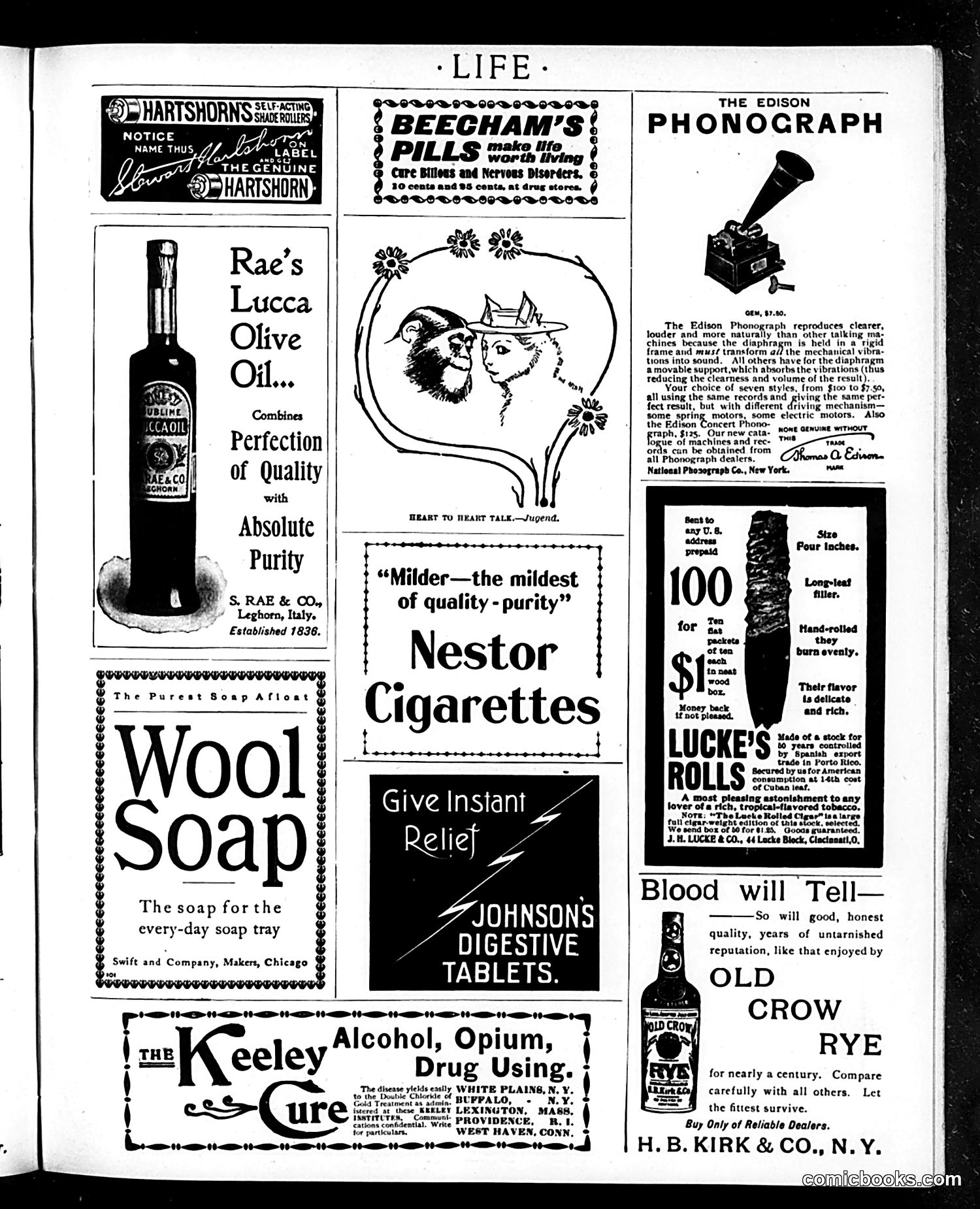
This page is **primarily advertising** rather than editorial content or political satire. It showcases various consumer products from the early 20th century, reflecting the era's product landscape and marketing approaches. The central cartoon—labeled "Heart to Heart Talk" (credited to *Jugend*, a German publication)—depicts two anthropomorphized figures (appears to be a cat and dog) in conversation, framed by decorative flowers. The specific meaning is unclear without fuller context, though it likely serves as a humorous separator between advertisements. The ads themselves reveal period attitudes: Beecham's Pills and Johnson's Digestive Tablets promise medical relief; Keeley Cure advertises treatment for "Alcohol, Opium, Drug Using"; Wool Soap, Rae's Olive Oil, and Lucke's Rolls compete for household purchases; and liquor (Old Crow Rye) appears alongside medicinal products. The Edison Phonograph ad emphasizes technical superiority. This reflects an era when patent medicines, now-prohibited substances, and unregulated health claims dominated advertising.
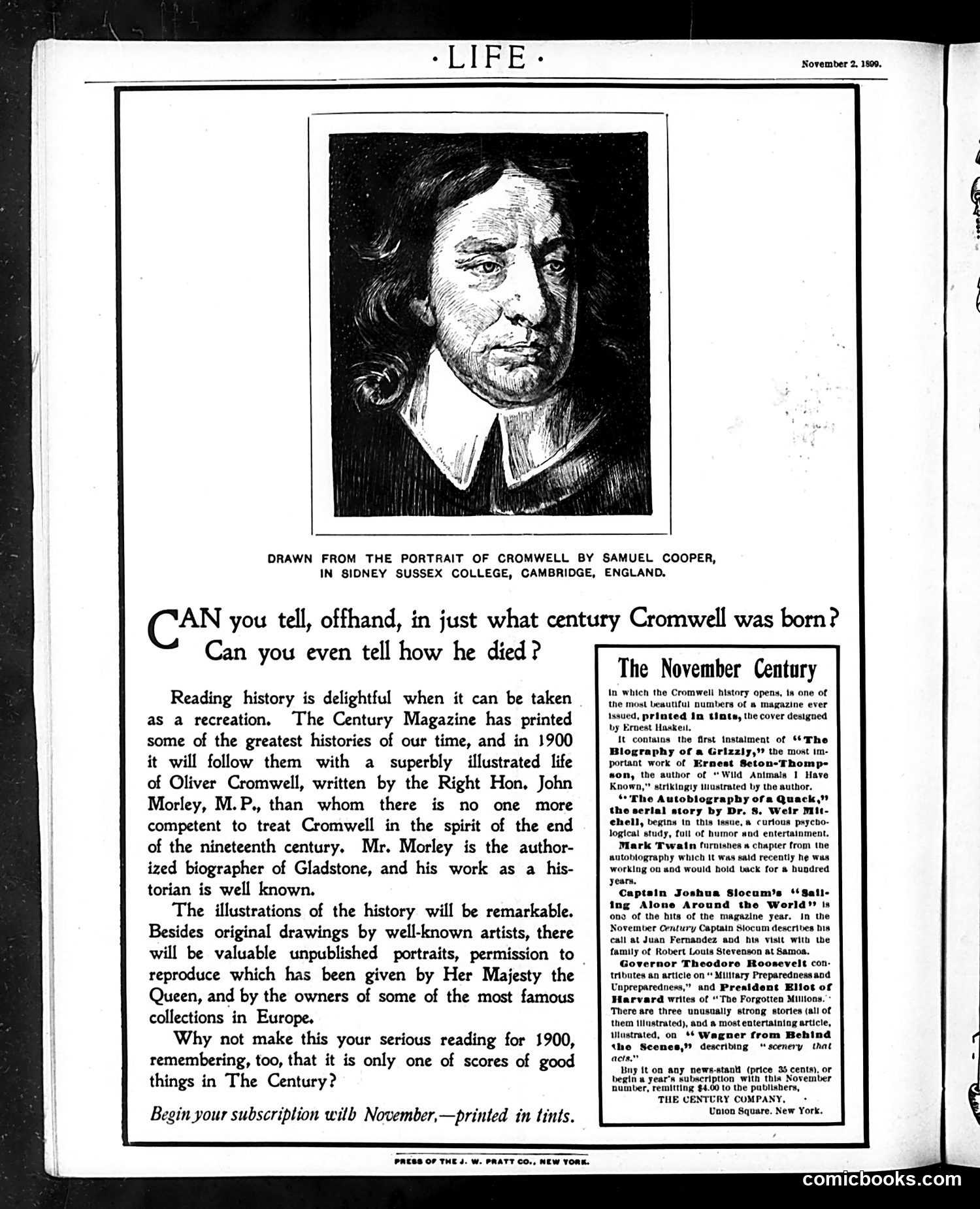
This page is primarily a subscription advertisement for *The Century* magazine, not a political cartoon. It promotes an upcoming serialized biography of Oliver Cromwell (the 17th-century English military and political leader) written by John Morley, a prominent British politician and historian. The portrait at top is a historical engraving of Cromwell by Samuel Cooper. The advertisement's opening rhetorical questions ("Can you tell, offhand, in just what century Cromwell was born?") are designed to hook readers by suggesting they lack historical knowledge that *The Century's* forthcoming illustrated biography will remedy. The page emphasizes the magazine's quality through mentions of distinguished contributors (Mark Twain, Theodore Roosevelt, President Eliot of Harvard) and its beautiful color printing ("printed in tints"). This was *Life's* way of attracting educated, affluent subscribers willing to pay for serious historical and literary content.