
Life, 1899-11-02 · page 12 of 20
Life — November 2, 1899 — page 12: what you’re looking at
What you’re looking at
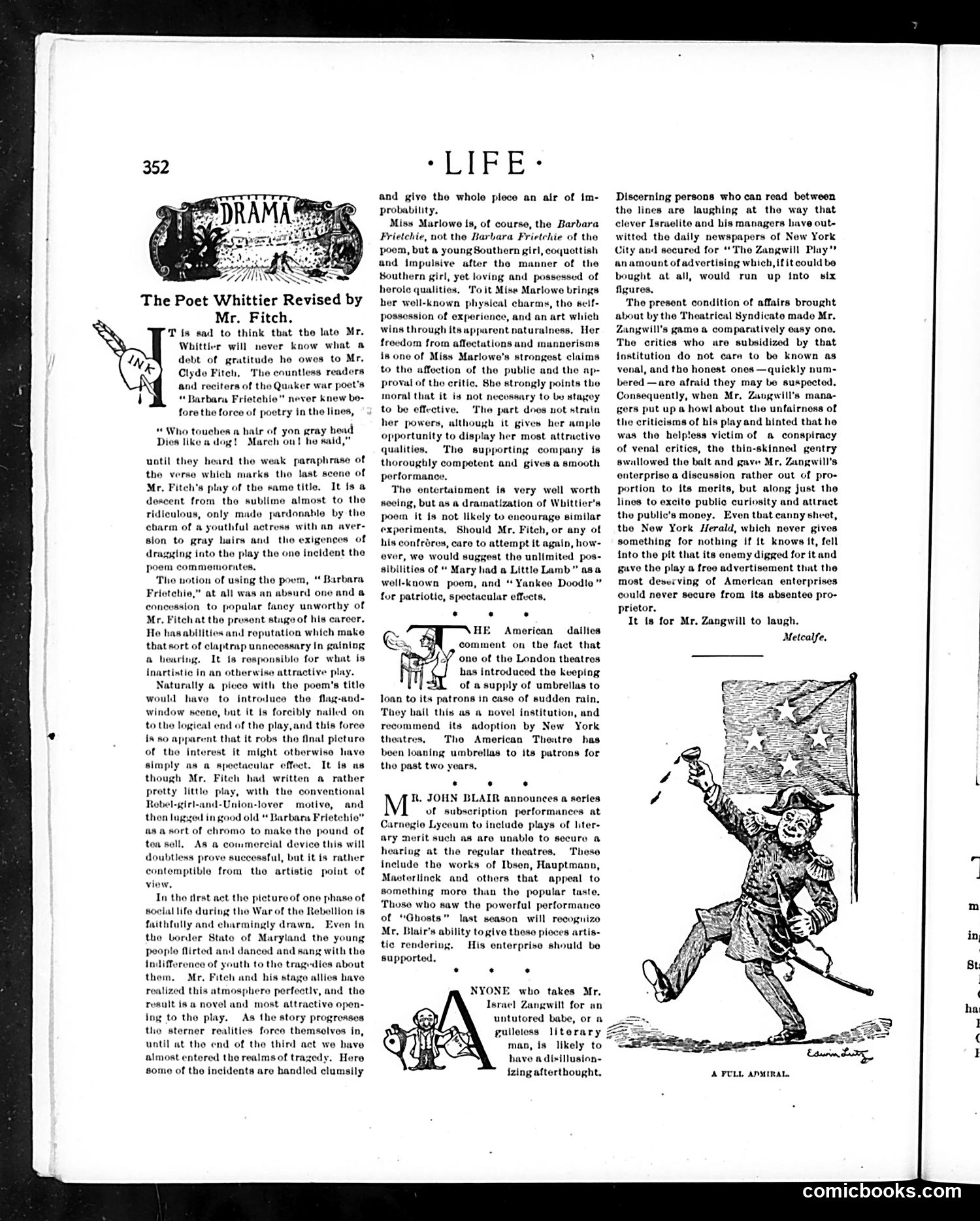
This page critiques playwright Clyde Fitch's theatrical adaptation of Whittier's poem "Barbara Frietchie." The text argues that Fitch has dramatized the poem in ways that sacrifice its moral integrity for spectacle and popularity. The critic claims Fitch added unnecessary theatrical effects—including an umbrella as a novel stage device—to attract audiences rather than honor Whittier's original work. The satire targets Fitch for prioritizing commercial success and visual novelty over artistic fidelity. The illustration labeled "A Full Admiral" (lower right) appears to be a character from the play, though its specific satirical meaning is unclear from this excerpt alone.
📄 Transcribed text from this page (OCR, searchable)
Machine-transcribed from the original scan — historical spelling and the odd misread are preserved.
The Poet Whittier Revised by Mr. Fitch. T Is sad to think that tho late Mr. Whittier will never know what @ debt of gratitude he owes to Mr. Clyde Fiteh, The countless readers and reciters of the Quaker war poet's Barbara Frietehie” never knew bo- fore the force of poetry in the lines, “Who touches a hair of yon gray head Dies like adog! March ont he said,” until they heard the weak paraphrase of the verse which marks tho last scene of Mr, Fitch's play of the same title, It 1s a descent from tho sublime almost to the ridiculous, only made pardonable by the cbarm of a youthful actress with an aver- sion to gray buirs and tho exigences of dragging into the play the one incident the poem commemorates Tho uotion of using the powm, ‘ Barbara Frietehie,” at all was an absurd one and & concession to popular fancy unworthy of Mr. Fitch at tho presont stage of his career. Ho hasabilities and reputation which make that sort of claptrap unnecessary In gaining, & bearing. It 8 responsible for what is inartistic in an otherwise attractive play. Naturally a picco with the poom's title would have to introduce the fliug-and- put it is forcibly nailed on nd of the play,and this foree it that it robs the fnal picturo est it might otherwise have It is as though Mr. 1 had written a rather pretty little play, with the conventional Rebel-gir -Union-lover motive, and thon lugged in good old “ Barbara Frietehio” a8 a sort of chromo to make the pound of tea sell, As a commercial device this will doubtless prove successful, but it is rather contemptible from tho artistic point of view, In tho first act the picture of one phase of social life during the War of the Rebellion is faithfully and charmingly drawn, Even in tho border State of Maryland the young people flirted and danced and sang with tho Indifference of youth to the tragedies about thom. Mr, Fiteh and his stago allies have realized this atmosphere perfectly, and tho result is a novel and most attractive open- ing to tho play. As the story progroases tho sterner realities force themsolves in, until at the end of the third act we have almost entered tho realmsof tragedy. Hero somo of the incidents are handled clumsily window scone, to tho logical is so appari of the int ‘LIP EB and give the whole piece an air of im- probability, Miss Marlowe is, of course, the Barbara Frietchie, not the Barbara Frietchie of the poem, but a young Southern girl, coquettish and impulsive after tho manner of the Southern girl, yet loving and possessed of heroic qualities, ‘To it Mise Marlowe brings her well-known physical ebarms, tho belf- possession of experience, and an art which wins through its apparent naturalness, Her freedom from affectations and munnerisms is one of Miss Marlowe's strongest claims to the affection of the public and the ap- proval of the critic, She strongly points the moral that it is not necossary to by stayoy to be effective. ‘The part does not strain her powers, although it gives her ample opportunity to display her most attractive qualities. The supporting company is thoroughly competent and gives a smooth performance, The entertainment is very well worth seeing, but as a dramatization of Whittier’s poem it 1s not likely to encourage similar exporiments, Should Mr. Fitch, or any of his confréres, caro to attempt It again, how- ever, we would suggest the unlimited pos- sibilities of * Mary had a Little Lamb” asa well-known poem, and * Yankee Doodle” tor patriotic, spectacular effects, . . . HE American dailies comment on the fact that one of the London theatres has introduced the keeping | of a supply of umbrellas to loan to its patrons in caso of sudden rain, They hail this as a novel institution, and recommend its adoption by New York theatres, Tho American Theatre has been loaning umbrellas to its patrons for tho past two years, . . . KR. JOHN BLAIR announces a series of subscription performances at Carnegie Lycoum to include plays of Iiter- ary morit such as aro unable to secure a hearing at the regular theatres, These include tho works of Ibsen, Hauptmann, Mavterlinck and others that appeal to something more than the popular taste. Those who saw the powerful performanco of “Ghosts” last season will recognizo Mr. Blair’s ability togive these pieces artis- tic rendering. His enterprise should be supported, * 6 6 NYONE who takes Mr. Israel Zangwill for an untutored babe, or a guileless literary man, is likely to have a disillusion- izing afterthought. Discerning persons who can read between the lines are laughing at the way that clover Israelite and his managers have out- witted the daily newspapers of New York City and secured for “The Zangwill Play’? an amount of advertising which, {fit could be bought at all, would run up into six figures. ‘Tho present condition of affairs brought about by the Theatrical Syndicate mado Mr. Zangwill’s gamo a comparatively easy one. The critics who are subsidized by that {ostitution do not cara to be known as venal, and tho honest ones —quickly num- bered —aro afraid they may be suspected. Consequently, when Mr. Zangwill’s mana- gers put up @ howl about the unfairness of the criticisms of his play and hinted that ho was tho helptess victim of a conspiracy ot venal critics, the thin-skinned gentry swallowed tho bait and gave Mr. Zangwill's onterpriso a discussion rather out of pro- portion to its morits, but along just the lines to excite public curiosity and attract the public's money. Even that canny sheet, the Now York Herald, which never gives something for nothing if it knows tt, fell Into the pit that its onemy digged for itand gave the play a froe advertisement that the most deserving of Amorican enterprises could never secure from its absentee pro- prictor. It is for Mr. Zangwill to laugh. Metcalfe, comicbooks.com