
Life, 1899-11-02 · page 9 of 20
Life — November 2, 1899 — page 9: what you’re looking at
What you’re looking at
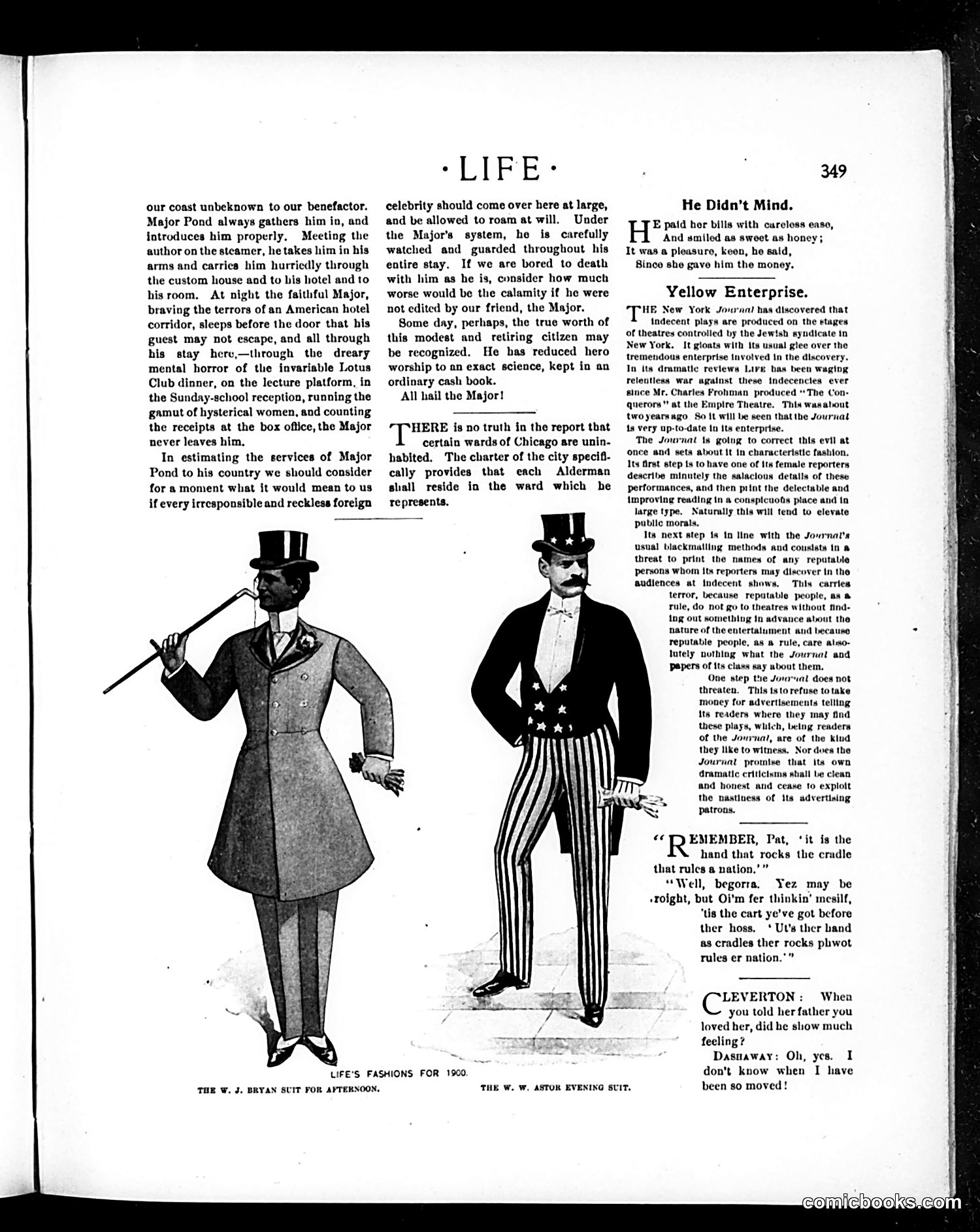
This page contains fashion illustrations labeled "Life's Fashions for 1900" rather than political cartoons. The left figure shows "The W. J. Bryan Suit for Afternoon" and the right depicts "The W. W. Astor Evening Suit." **The satire:** William Jennings Bryan (three-time presidential candidate and Populist icon) is caricatured in an exaggerated, somewhat absurd afternoon outfit, while William Waldorf Astor (wealthy socialite) models a formal evening suit. The joke appears to mock the contrast between Bryan's political ambitions and his fashion sense, satirizing him through clothing rather than ideology—a common Life magazine tactic of belittling political figures through fashion ridicule. The accompanying text discusses Chicago politics and theater criticism, unrelated to the fashion illustrations.
📄 Transcribed text from this page (OCR, searchable)
Machine-transcribed from the original scan — historical spelling and the odd misread are preserved.
our coast unbeknown to our benefactor. Major Pond always gathers him in, and introduces him properly, Meeting the author on the steamer, he takes him in his arms and carries him hurriedly through the custom house aod to bis hotel and to his room, At night the faithful Major, braving the terrors of an American hotel corridor, sleeps before the door that his guest may not escape, and all through his stay here,—through the dreary mental horror of the invariable Lotus Club dinner, on the lecture platform, in the Sunday-school reception, running the gamut of hysterical women, and counting the receipts at the box office, the Major never leaves him, In estimating the services of Major Pond to his country we should consider for a moment what it would mean to us if every irresponsible and reckless foreign ‘LIFE celebrity should come over here at large, and be allowed to roam at will. Under the Major's system, he is carefully watched and guarded throughout his entire stay. If we are bored to death with him as he is, consider how much worse would be the calamity if he were not edited by our friend, the Major. Some day, perhaps, the true worth of this modest and retiring citizen may be recognized. He has reduced hero worship to an exact science, kept in an ordinary cash book. All hail the Major! HERE is no truth in the report that certain wards of Chicago are unin- habited. The charter of the city specifl- cally provides that each Alderman shall reside in the ward which he Tepresents. LIFE’S FASHIONS FOR THE W. J. BRYAN SUIT FOR AFTERNOON, THE w. w. 349 He Didn’t Mind. E patd hor bills with carcloss easo, And smiled as sweet as honey; It was a pleasuro, keon, he said, Bince she gave him the money. Yellow Enterprise. HE New York Journal has discovered that indecent plays are produced on the stages of theatres controlled by the Jewish syndicate in New York. It glouts with its usual glee over the tremendous enterprise involved In the discovery. In tts dramatic reviews Lirg has been waging Feleutleas war against these indecenctes ever since Mr. Charles Frohman produced “The Con- querors" at the Emptre Theatre. This wasabout twoyearsago So ft will Le seen that the Journal 1s very up-to-date tn its enterprise. The Journal is gotng to correct this evil at once and sets about It in characteristic fashlon. Its firat step ts to have one of its female reporters describe minutely the salacious details of these performances, and then print the delectable aud improving reading in a consptcuots place and ta large type. Naturally this will tend to elevate public morals, Its next step is tn line with the Journal's usual blackmatting methods and constets In & threat to print the names of any reputable persons whom {ts reporters may discover tn the Gudiences at indecent shows. This carries terror, because reputable people, as ® Tule, do not go to theatres without find- ing out something In advance about the nature of the entertalument and because Feputable people, as a rule, care also- lutely nothing what the Journal and papers of its class say about them, One step te Junruat does not threaten. This ts to refuse to take money for advertisements telling 1ts readers where they may find these plays, which, being readers of the Journal, are of the kind they like to witness. Nor does the Journal promise that its own dramatic eritictsins shall be clean and honest and cease to exploit the nastiness of its advertising patrons, <© DEMEMBER, Pat, ‘it is the hand that rocks the cradle that rulcs a nation, “Well, begorra, Yez may be «roight, but Oi'm fer thinkin’ incsilf, ‘tis the cart ye've got before ther hoss. ‘ Uv’s ther band as cradles ther rocks phwot rules er nation.'” LEVERTON: Whea you told her father you loved her, did he show much feeling? Dasnawar: Oh, ycs. I don't know when I have been so moved!