
Life, 1899-11-02 · page 4 of 20
Life — November 2, 1899 — page 4: what you’re looking at
What you’re looking at
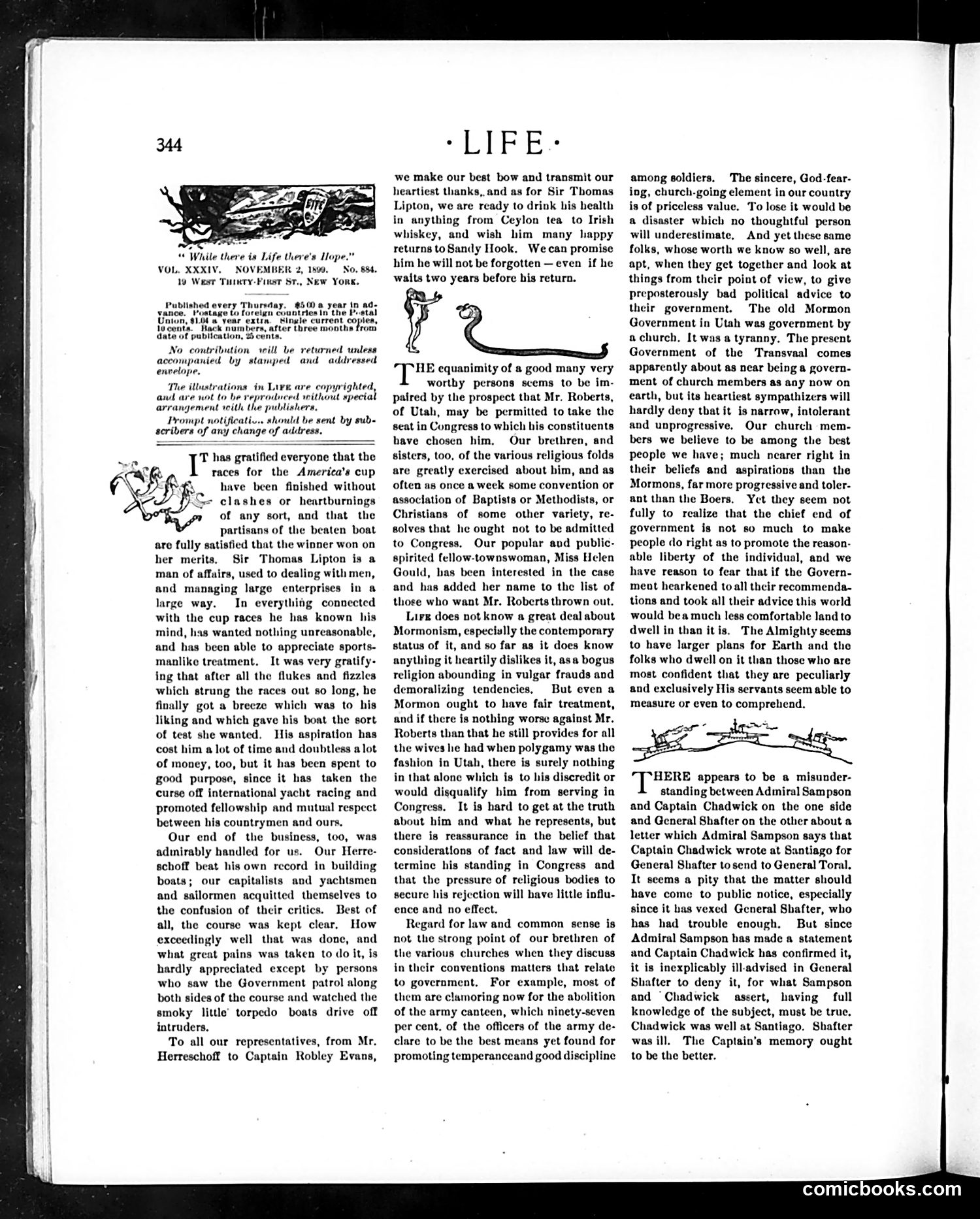
This page contains editorial commentary on political and religious matters, primarily discussing B.H. Roberts of Utah and his potential appointment to Congress. The text expresses concern about Roberts's Mormon faith and polygamous past, arguing he should still be allowed to serve despite these controversies. The editors advocate for religious tolerance and individual liberty, opposing what they see as unfair discrimination based on his religion. There is also a brief discussion of an apparent disagreement between Admiral Sampson and Captain Chadwick regarding Santiago during the Spanish-American War, suggesting a "misunderstanding" that should be clarified publicly. The cartoons on the page appear to be decorative line drawings rather than satirical commentary on the main text topics.
📄 Transcribed text from this page (OCR, searchable)
Machine-transcribed from the original scan — historical spelling and the odd misread are preserved.
day. $5000 year in ad~ yi i 1 countries In the Postal Union, Mingle current copies, lo cents. ‘after three months from date of publicatk No contribution will be returned unless accompanied by stamped and addressed envelope. The illustrations in Live are copyrighted, anil are not to be reproduced without special arrangement with the publishers, Prompt notificatiow should be sent by sub- scribers of any change of address. T has gratified everyone that the races for the America’s cup have been finished without S= clashes or heartburnings of any sort, and that the partisans of the beaten boat are fully satisfied that the winner won on her merits, Sir Thomas Lipton is a man of affairs, used to dealing with men, and managing large enterprises in a large way. In everything connected with the cup races he has known his mind, has wanted nothing unreasonable, and has been able to appreciate sports- manlike treatment, It was very gratify- ing that after all the flukes and fizzles which strung the races out so long, he finally got a breeze which was to his liking and which gave his boat the sort of test she wanted. His aspiration has cost him a lot of time and doubtless alot of money, too, but it has been spent to good purpose, since it has taken the curse off international yacht racing and promoted fellowship and mutual respect between his countrymen and ours, Our end of the business, too, was admirably handled for us. Our Herre- schoff beat his own record in building boats; our capitalists and yachtsmen and sailormen acquitted themselves to the confusion of their critics. Best of all, the course was kept clear, How exceedingly well that was donc, and what great pains was taken to do it, is hardly appreciated except by persons who saw the Government patrol along both sides of the course and watched the smoky little’ torpedo boats drive off intruders, To all our representatives, from Mr. Herreschoff to Captain Robley Evans, *LTPE* we make our best bow and transmit our heartiest thanks, and as for Sir Thomas Lipton, we are ready to drink his health in anything from Ceylon tea to Irish whiskey, and wish him many happy returns to Sandy Hook. Wecan promise him he will not be forgotten — even if he waits two years before his return. HE equanimity of a good many very worthy persons scems to be im- paired by the prospect that Mr. Roberts, of Utah, may be permitted to take the seat in Congress to which his constituents have chosen him, Our brethren, and sisters, too, of the various religious folds are greatly exercised about him, and as often as once a week some convention or association of Baptists or Methodists, or Christians of some other variety, re- solves that he ought not to be admitted to Congress. Our popular and public- spirited fellow-townswoman, Miss Helen Gould, has been interested in the case and has added her name to the list of those who want Mr. Roberts thrown out. Lire does not know a great deal about Mormonism, especislly the contemporary status of it, and so far as it does know anything it heartily dislikes it, asa bogus religion abounding in vulgar frauds and demoralizing tendencies, But even a Mormon ought to have fair treatment, and if there is nothing worse against Mr. Roberts than that he still provides for all the wives he had when polygamy was the fashion in Utah, there is surely nothing in that alone which is to his discredit or would disqualify him from serving in Congress. It is hard to get at the truth about him and what he represents, but there is reassurance in the belief that considerations of fact and law will de- termine his standing in Congress and that the pressure of religious bodies to secure his rejection will have little influ- ence and no effect. Regard for law and common sense is not the strong point of our brethren of the various churches when they discuss in their conventions matters that relate to government, For example, most of them are clamoring now for the abolition of the army canteen, which ninety-seven per cent, of the officers of the army de- clare to be the best means yet found for promoting temperanceand good discipline among soldiers, The sincere, God-fear- ing, church-going element in our country is of priceless value. To lose it would be a disaster which no thoughtful person will underestimate, And yet these same folks, whose worth we know so well, are apt, when they get together and look at things from their point of view, to give Preposterously bad political advice to their government. The old Mormon Government in Utah was government by achurch. It was a tyranny. The present Government of the Transvaal comes apparcotly about as near being a govern- ment of church members as any now on earth, but its heartiest sympathizers will hardly deny that it is narrow, intolerant and unprogressive. Our church mem- bers we believe to be among the best people we have; much nearer right in their beliefs and aspirations than the Mormons, far more progressive and toler- ant than the Boers. Yet they seem not fully to realize that the chief end of government is not so much to make people do right as to promote the reason- able liberty of the individual, and we have reason to fear that if the Govern- ment hearkened toall thcir recommenda- tions and took all their advice this world would bea much less comfortable land to dwell in than it is, The Almighty seems to have larger plans for Earth and the folks who dwell on it than those who are most confident that they are peculiarly and exclusively His servants seem able to measure or even to comprehend. HERE appears to be a misunder- standing between Admiral Sampson and Captain Chadwick on the one side and General Shafter on the other about a letter which Admiral Sampson says that Captain Chadwick wrote at Santiago for General Shafter to send to General Toral, It seems a pity that the matter should have come to public notice, especially since it has vexed General Shafter, who has had trouble enough, But since Admiral Sampson has made a statement and Captain Chadwick has confirmed it, it is inexplicably ill-advised in General Shafter to deny it, for what Sampson and “Chadwick assert, having full knowledge of the subject, must be true, Chadwick was well at Santiago. Shafter was ill. The Captain’s memory ought to be the better. comicbooks.com