
Life, 1899-11-02 · page 7 of 20
Life — November 2, 1899 — page 7: what you’re looking at
What you’re looking at
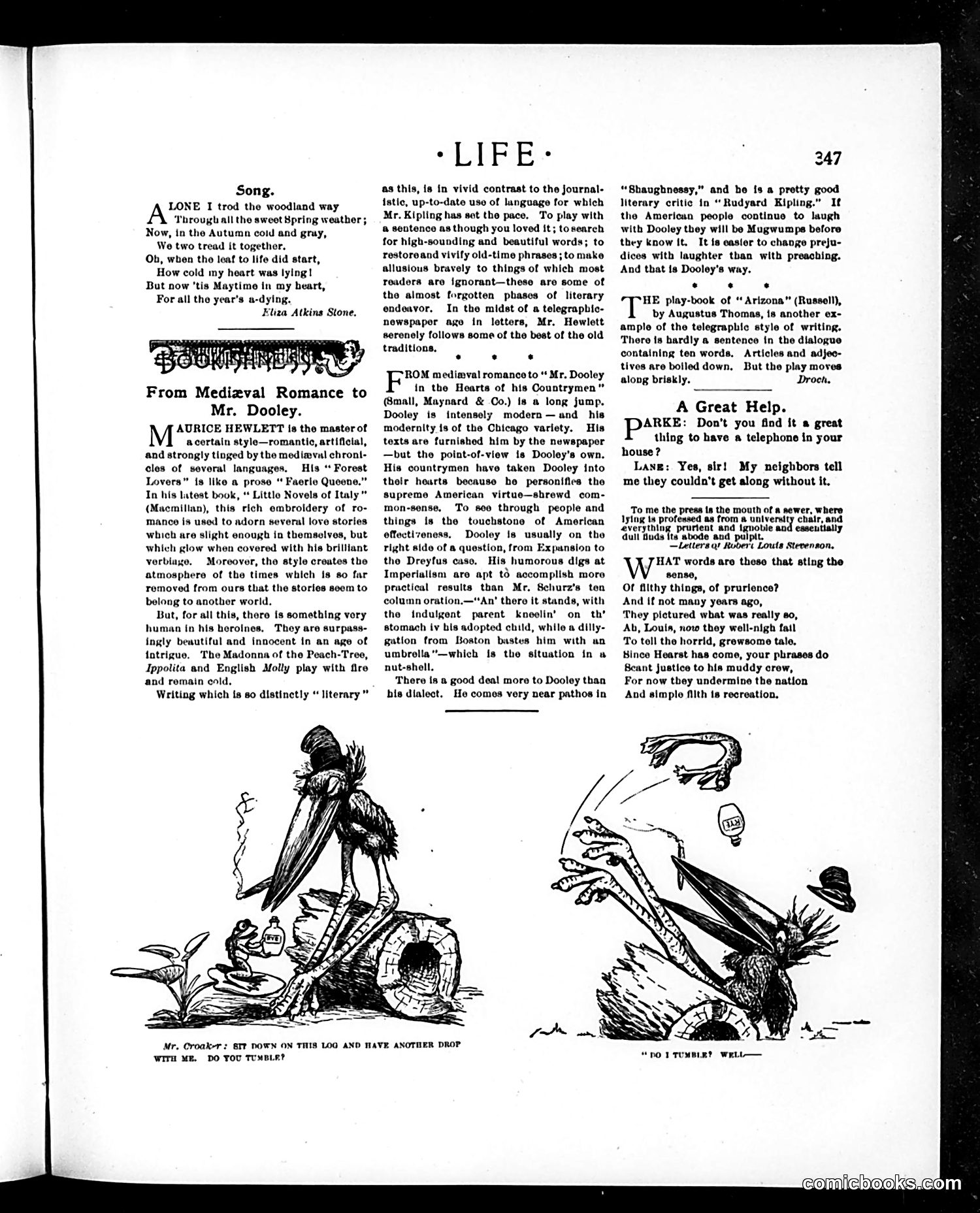
This page contains literary criticism and two humorous cartoons rather than political commentary. **Left cartoon**: Shows a grotesque creature sitting on a log addressing another creature, saying "SIT DOWN ON THIS LOG AND HAVE ANOTHER DROP WITH ME. DO YOU TUMBLE?" The caption references "Mr. Crooker," though the specific literary or cultural reference is unclear from the visible text. **Right cartoon**: Titled "DO I TUMBLE? WELL—" depicts a creature performing acrobatic movements, apparently responding to the left cartoon's invitation. The page's main text discusses Maurice Hewlett's medieval romance writing and Mr. Dooley's newspaper columns, praising their literary merit. The cartoons appear to illustrate literary themes or characters, though without additional context, the specific satirical targets remain uncertain.
📄 Transcribed text from this page (OCR, searchable)
Machine-transcribed from the original scan — historical spelling and the odd misread are preserved.
Song. LONE I trod the woodland way Through all the sweet Spring weather ; Now, in the Autumn cotd and gray, We two tread it together. Ob, when tho leaf to life did start, How cold my heart was lying! But now ‘tis Maytime in my heart, For all tho year's a-dying. Eliza Atkins Stone, From Medizval Romance to Mr. Dooley. AURICE HEWLETT Is tho master of acertain style—romantic, artificial, and strongly tinged by the medimvul chront- cles of several languages. His ** Forest Lovers” is like a prose * Faerie Queen In his latest book, “ Little Novels of Italy" (Macmillan), this rich embroidery of ro- mance is used to adorn several love stories: which are slight enough in themselves, but which glow when covered with his brilliant verbiage. Moreover, tho style creates the atmosphere of the times which {8 80 far removed from ours that the stories seem to belong to another world. But, for all this, thero {s something vory human in his heroines, They are surpass- ingly bewutiful and innocent in an age of intrigue. The Madonna of the Peach-Tree, Ippolita and English Molly play with fire and remain cold, Writing which is so distinctly “literary” *LIFE- as this, is in vivid contrast to the journal- istic, up-to-date uso of language for which Mr. Kipling has sot the pace. To play with 4 sentence as though you loved it; tosearch for high-sounding and beautiful words; to restoreand vivify old-time phrases; to make allusious bravely to things of which most readers aro ignorant—these aro some of tho almost forgotten phases of literary endeavor. In tho midst of a telegraphic- newspaper ago in lotters, Mr. Hewlett serenely follows some of the best of the old traditions, ° . ROM medimval romance to “ Mr. Dooley in the Hearts of his Countrymen” (mall, Maynard & Co.) is a long jump. Dooley is intensely modern — und his modernity {8 of the Chicago variety. His texts are furnished him by the newspaper —but the point-of-view {s Dooley’s own. His countrymen have taken Dooley into thoir hourts because he personifies tho supreme American virtue—shrewd com- mon-sense, To soo through people and things Is the touchstone of American offectizoness. Dooley 1s usually on tho right aldo of a question, from Expansion to tho Dreyfus caso, His humorous digs at Imperialism are apt td accomplish moro Practical results than Mr. Schurz’s ten column oration,—“An’ thero it stands, with tho indulgent parent knoolin’ on th’ stomach iv bis adopted child, while a dilly- gation from Boston bastes him with an umbrolla”—which {8 the situation in w nut-shell. ‘There is a good deal more to Dooley than his dialect. Hoe comes very near pathos in Mr. Croaker : 81? DOWN ON THIS LOO AND HAVE ANOTHER DROP ‘WITH ME. DO YOU TUMBLR? 347 “Shaughnessy,” and he is a pretty good literary critic in “Rudyard Kipling.” It the American people continue to laugh with Dooley they will be Mugwumps before they know It, It is easier to change preju- dices with laughter than with preaching. And that is Dooley’s way. . . . HE play-book of “ Arizona” (Russell), by Augustus Thomas, is another ex- ample of the telegraphic style of writing. There is hardly a sentence in the dialogue containing ten words. Articles and adjeo- tives are boiled down, But the play moves along briskly. Droch, A Great Help. ARKE: Don’t you find it a great thing to have a telephone in your house? Lane: Yes, sir! My neighbors tell me they couldn't get along without it, To me the press ts the mouth of a sewer, where lying 1s profensed as from a university chair, and everything, prurient and tgnoble and csseutially dull Huds {ts abode and pulpit. —Lettera at Robert Louts Stevenson, HAT words are theso that sting the sense, Of filthy things, of prurience? ‘And if not many years ago, ‘They pictured what was really 80, Ab, Louis, now they well-nigh fail To tell the horrid, grewsome tale, Since Hearst has come, your phrases do Beant justice to his muddy crew, For now they undermine the nation And simple filth ts recreation, po LTUMBLR? WRLt—