
A complete issue · 20 pages · 1899
Life — September 7, 1899
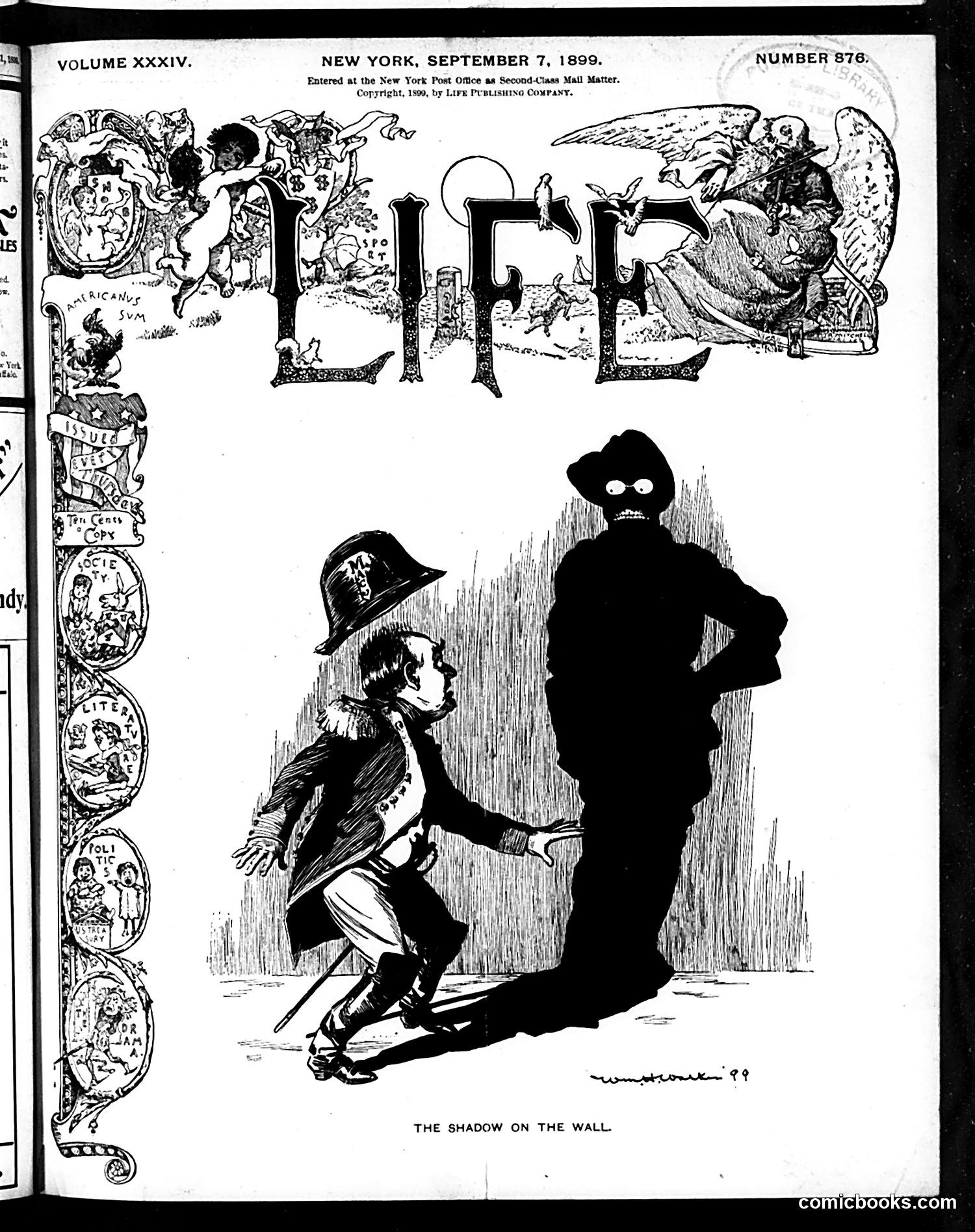
This September 1899 *Life* cartoon uses silhouette technique to depict a confrontation between a small military figure (wearing a helmet, likely representing a European power or general) and a large, menacing shadow looming behind him. The shadow's exaggerated size and skull-like face suggest an ominous, death-like force. The cartoon likely comments on late-19th-century imperial conflicts or military aggression—possibly referencing the Boer War (ongoing 1899-1902) or European colonial expansion. The "shadow" represents consequences or a larger threat the military figure fails to recognize or acknowledge. The satire suggests the figure's actions create dangers far exceeding his understanding or control.
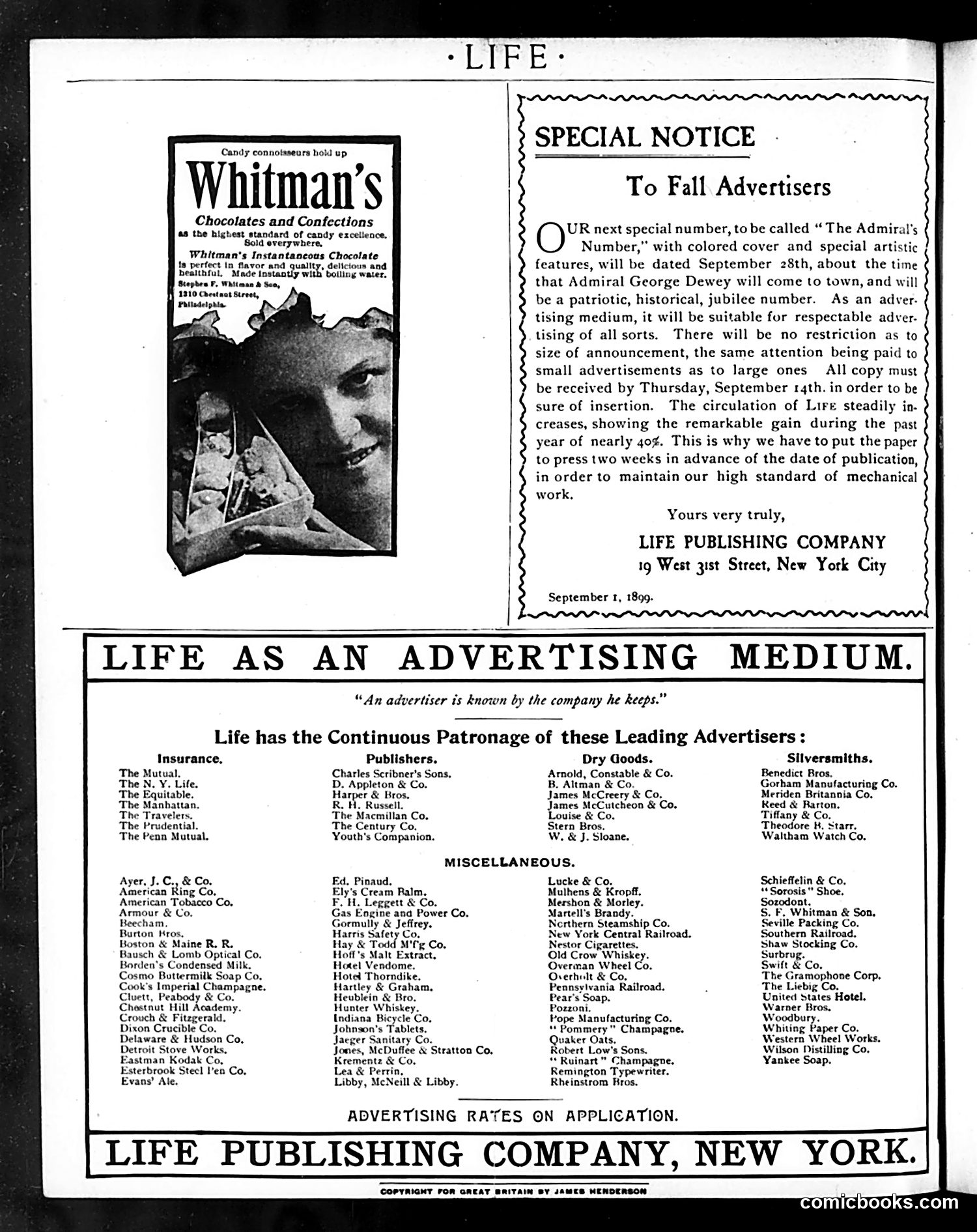
This page is primarily **advertising and publisher announcements** rather than political satire. The left side shows a Whitman's chocolate advertisement featuring a woman enjoying candy, emphasizing product quality. The right side contains a special notice from Life Publishing Company announcing "The Admiral's Number"—a special September 28th issue celebrating Admiral George Dewey's arrival in town. The notice solicits fall advertisements, noting the publication's circulation has grown nearly 40% and explaining why they need two weeks' advance notice for copy. Below is a full-page advertisement listing Life's major advertisers across categories (Insurance, Publishers, Dry Goods, Silversmiths, and Miscellaneous), promoting Life as an effective advertising medium with the tagline "An advertiser is known by the company he keeps." The page reflects Life's role as both satirical magazine and commercial publishing venture circa 1899.
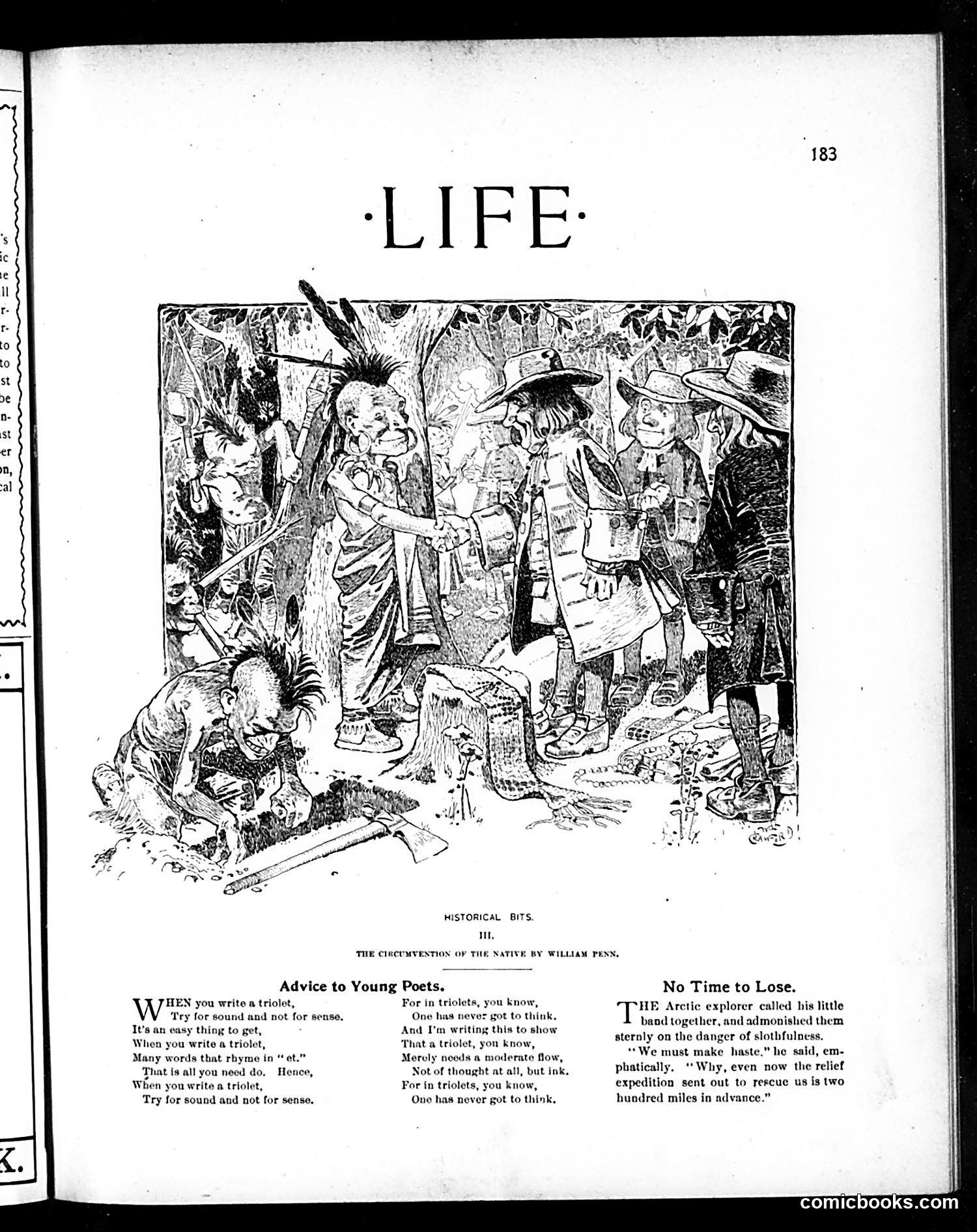
This page contains two distinct items: **Main Illustration:** "Historical Bits III: The Circumvention of the Native by William Penn" depicts a satirical scene of Native Americans encountering European colonists in formal dress. The cartoon appears to comment on early colonial interactions, suggesting Penn's dealings with Native peoples involved cunning or deception—implied by the word "circumvention" (meaning to get around or outwit). **Text Content:** Two separate pieces follow—"Advice to Young Poets" (satirizing poetry composition by mocking the triolet form's emphasis on sound over substance) and "No Time to Lose" (a brief anecdote about an Arctic explorer). The cartoon's satire critiques colonial-era treatment of Native Americans through historical retrospect, typical of Life magazine's social commentary.
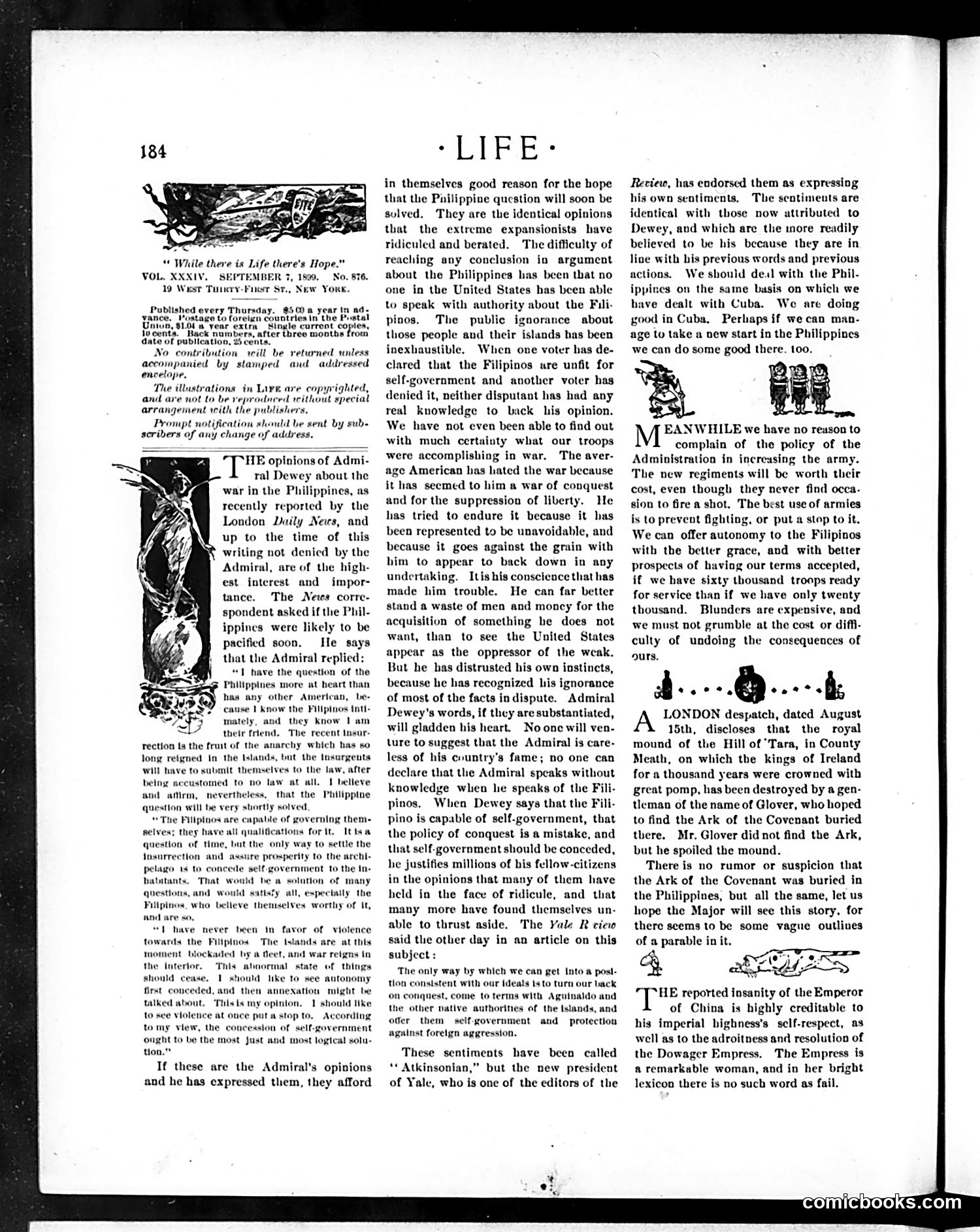
This page from Life magazine (Vol. XXXV, Sept. 1, 1900) discusses Admiral Dewey's recent statements about the Philippine-American War. The text critiques Dewey's rationale for the conflict, noting his arguments about conquest and suppressing insurgency reveal ignorance about Filipino capabilities for self-government. The decorative initial letters contain illustrated figures (typical of the era's design), but don't represent specific individuals—they're ornamental. The article presents a satirical counterargument: if Dewey truly knows little about the Philippines, his military judgments are suspect. The piece suggests the war reflects American imperialism rather than necessity, and questions whether acquiring territory justifies the human and financial cost. A separate dispatch about China's Empress Dowager appears at page's bottom.
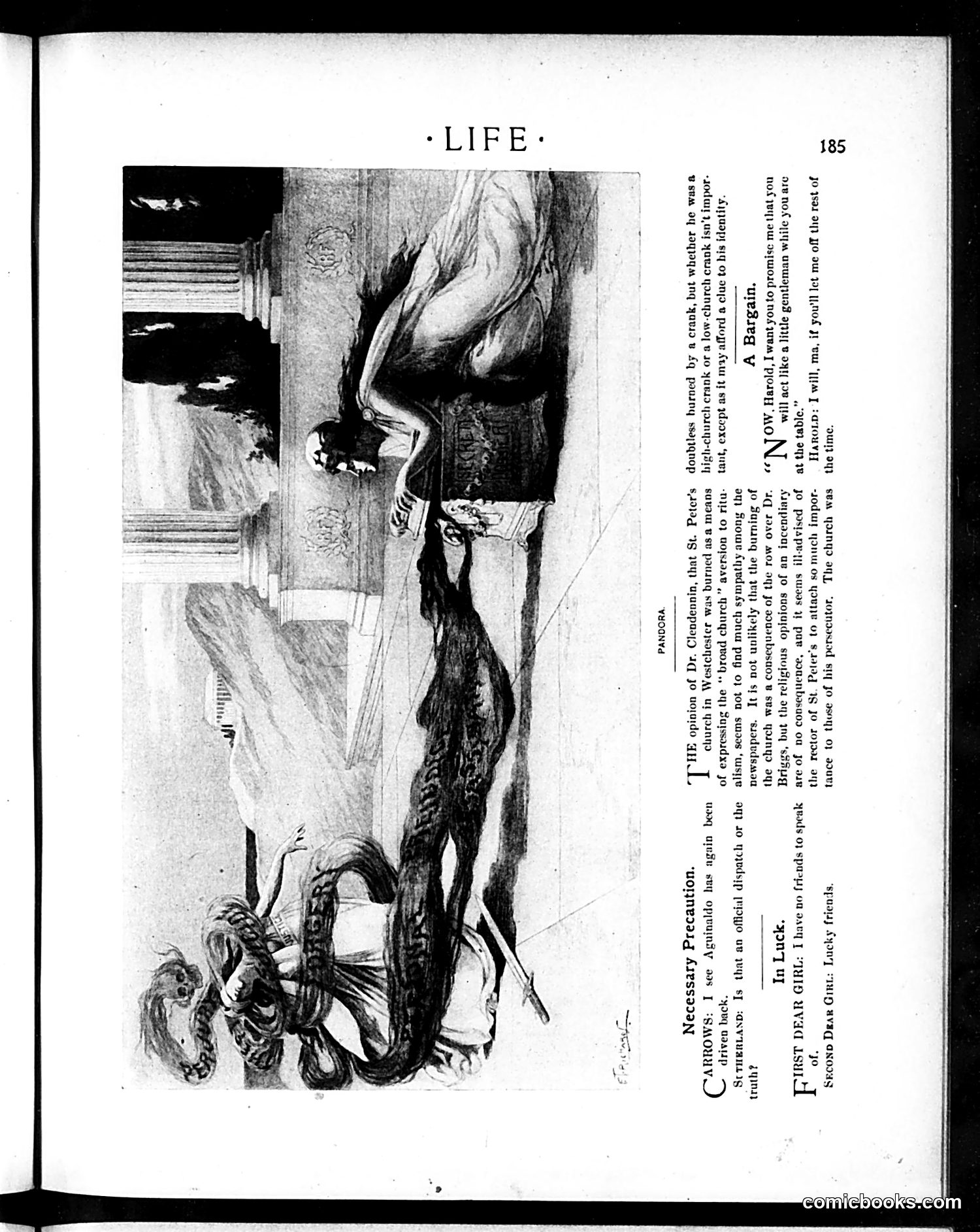
This page contains two illustrations labeled "Pardon" and "In Luck," though the image quality makes precise details difficult to discern. The top caption references "Cheddar-min that St. Peter's slouches horned by a crook but whether it was a crook of a bishop or of an ordinary crook is not to be seen in the picture." This appears to be religious or ecclesiastical satire, possibly concerning a clergyman or church official's moral character being questioned—the ambiguity about whether wrongdoing was "official" or personal forming the joke. The lower illustration's caption mentions "In Luck" and references something about a girl being "fresh to people," suggesting social commentary on courtship or romantic behavior, though specific context remains unclear from the degraded image quality.
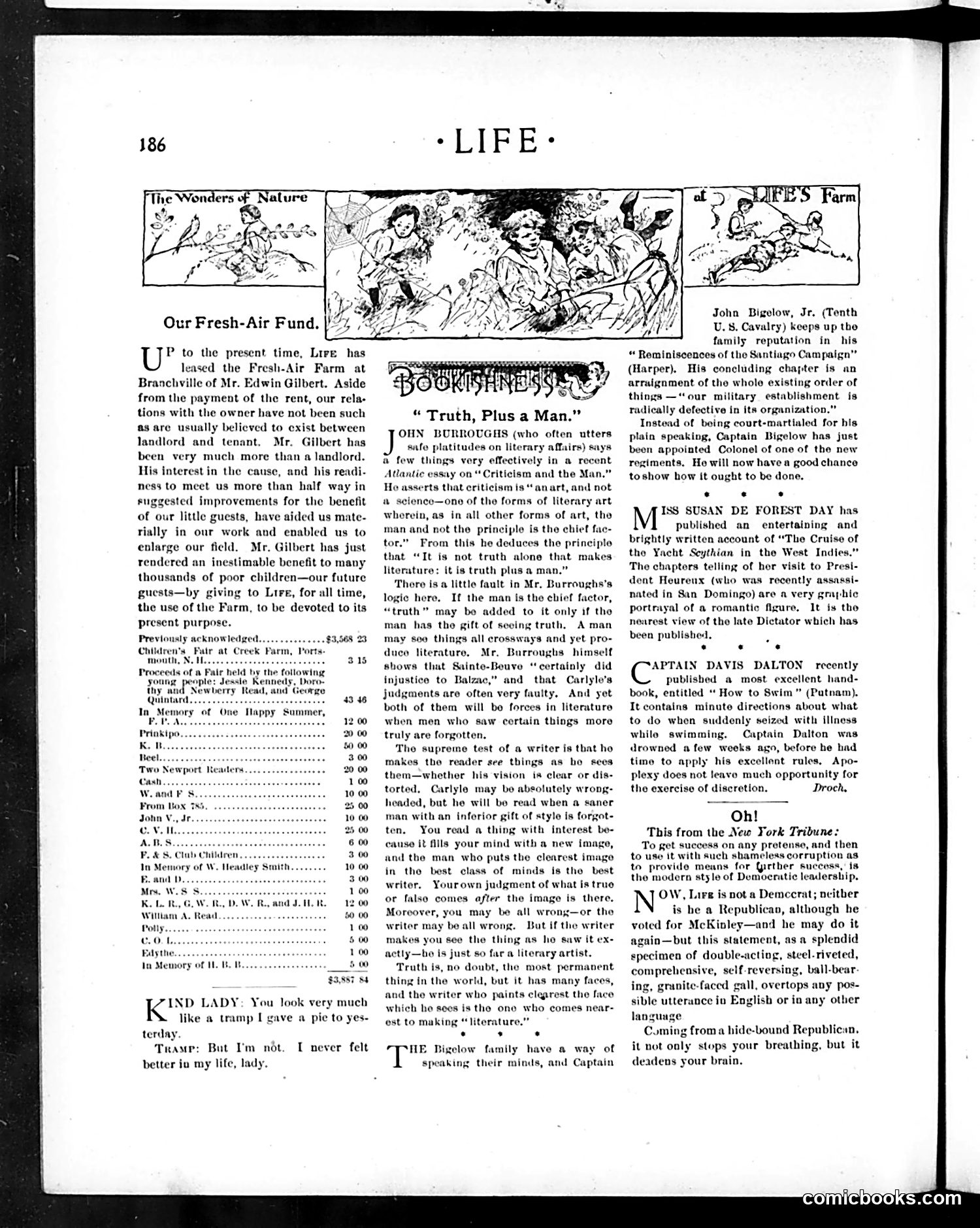
This page contains literary criticism and social commentary rather than political cartoons. The main article, "Truth, Plus a Man," discusses writer John Burroughs's assertion that criticism requires both truth and the critic's personal vision. The piece argues that the best writers make readers "see things as [they] see them." There's also commentary on the Bigelow family's speaking style and Captain Bigelow's military career, suggesting internal family tensions about propriety and public reputation. A separate item mocks Republican leadership using language about "double-acting, steel-riveted" comprehensiveness—likely satirizing political hypocrisy. The page is primarily text-based literary and social criticism typical of Life's intellectual content during this era.
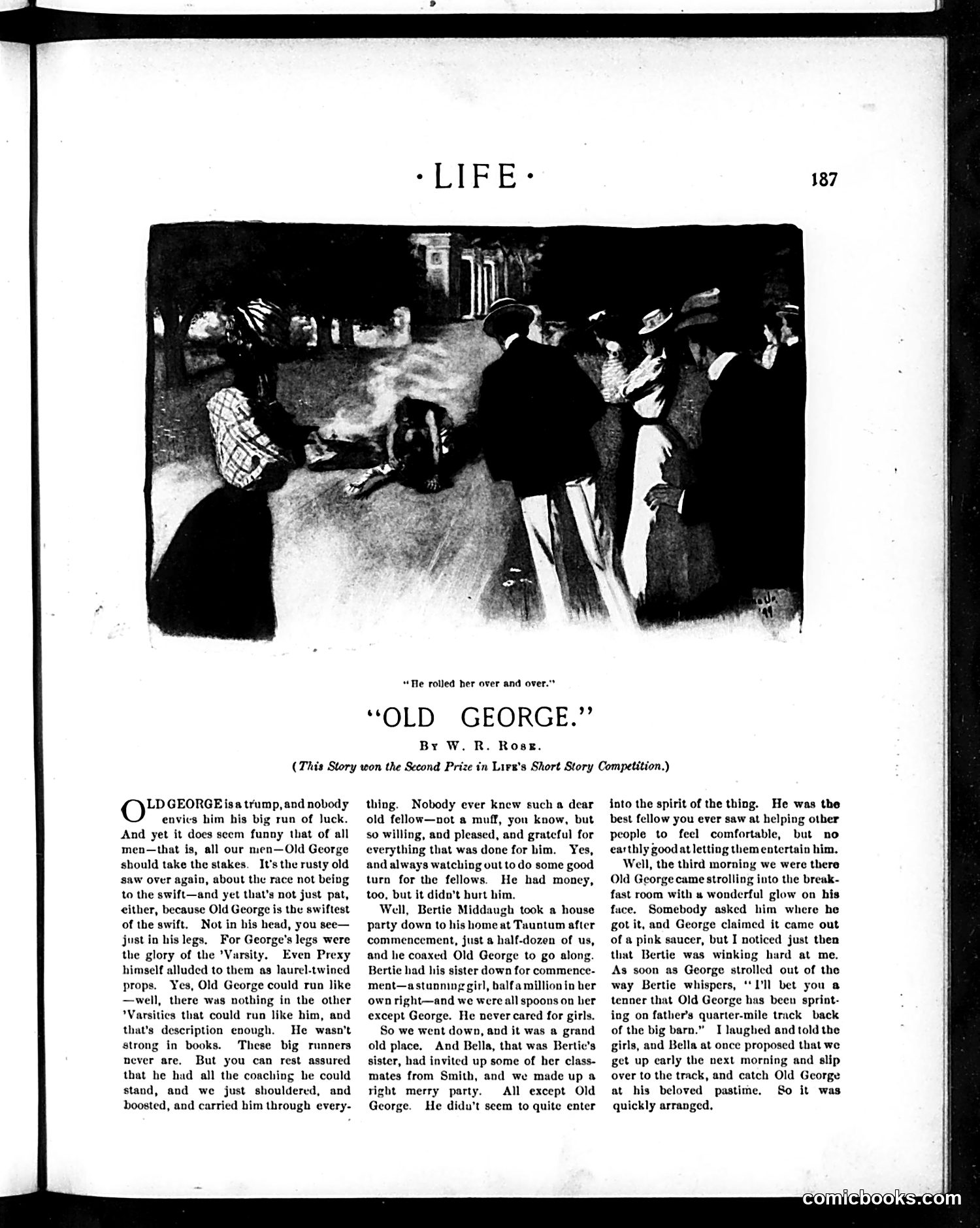
This page presents a short story that won second prize in Life's Short Story Competition. The accompanying illustration shows a nighttime scene with several figures gathered around what appears to be a horse and carriage accident ("He rolled her over and over"). The story text describes "Old George," a working-class man of modest means who is beloved by his peers. The narrative appears to focus on George's character and loyalty—he's portrayed as unpretentious, helpful to others, and unconcerned with romantic pursuits, unlike his wealthier social peers. Without additional context, the specific satirical or political commentary is unclear. The story seems primarily a character study celebrating working-class virtue rather than containing obvious social satire.
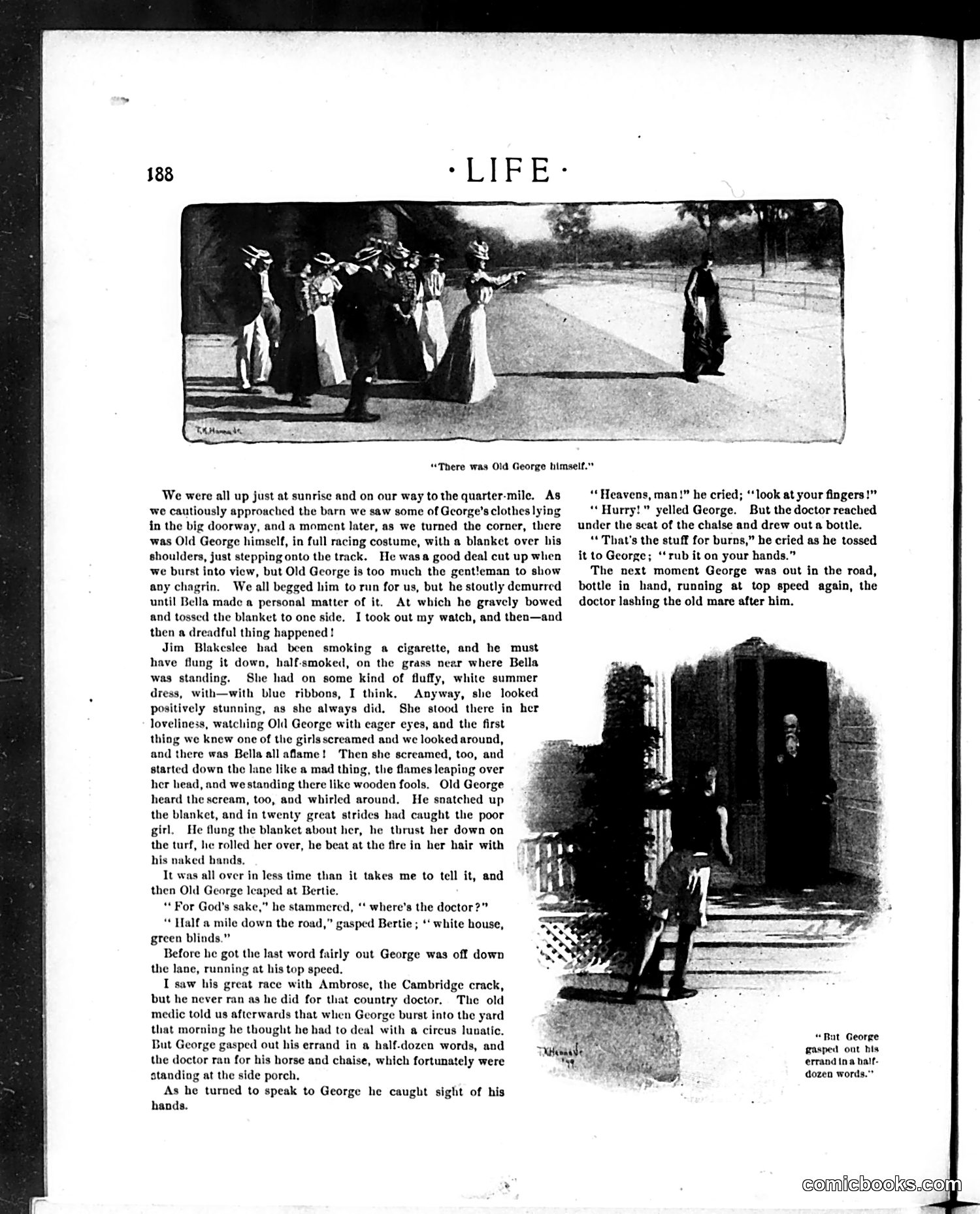
This page contains an illustrated story about "Old George," depicting a dramatic incident involving a character named Bella and a doctor's visit. The narrative describes an early-morning incident where Old George, fully dressed in costume with a blanket, encounters Bella (described as wearing a fluffy summer dress with blue ribbons). The story humorously escalates when George catches fire and must be rolled over and beaten by the narrator. The text emphasizes comedic chaos—George running for a doctor at top speed, the old mare chasing after him, and the doctor finding the situation absurd. The accompanying illustrations show period-appropriate dress and rural or estate settings. Without additional context about "Old George" as a recurring character in Life magazine, the specific satirical target remains unclear, though the humor appears rooted in slapstick mishap and character farce.
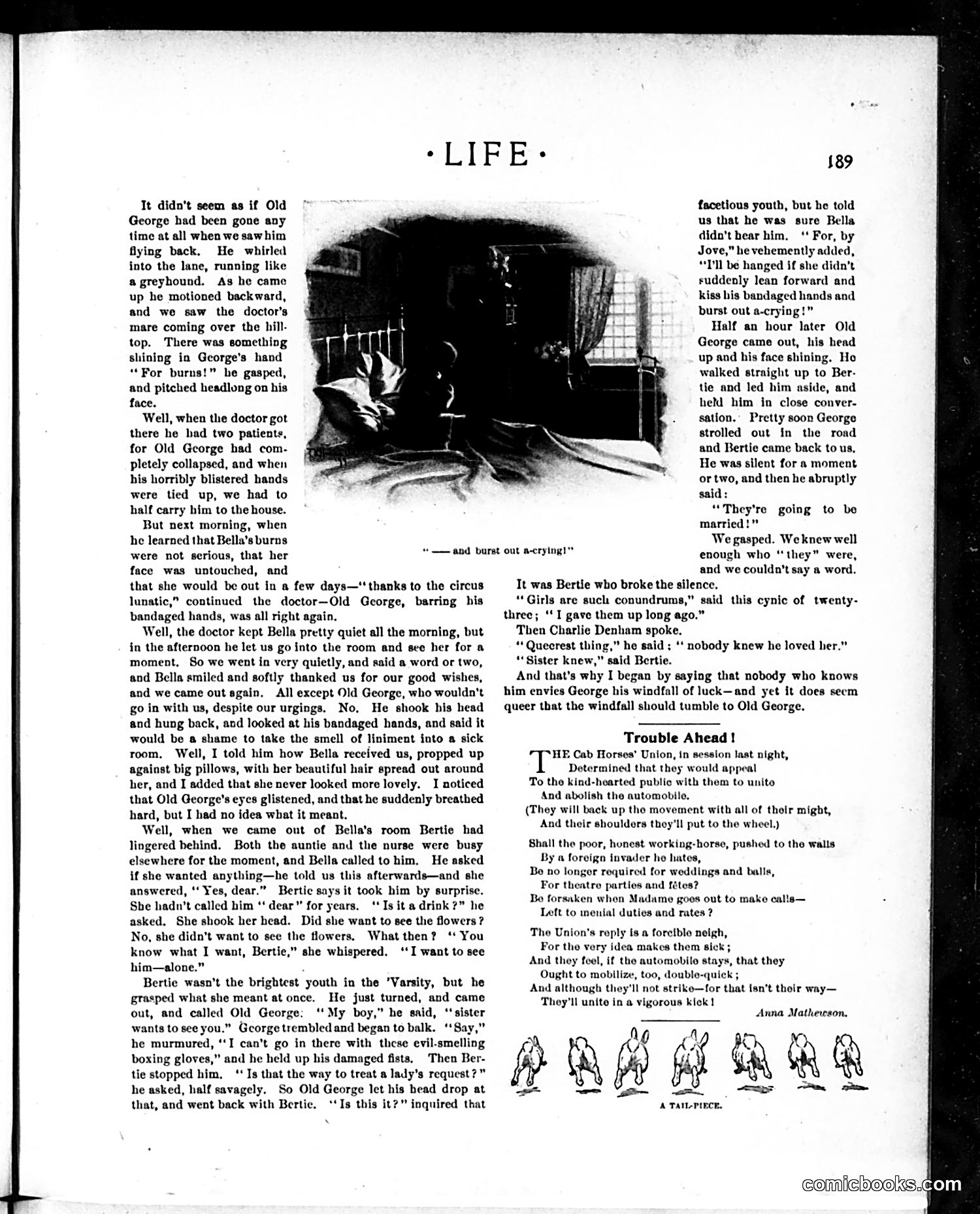
This page from *Life* magazine contains a narrative story about Old George and Bella's romance, alongside a separate poem titled "Trouble Ahead!" The main illustrated text describes a romantic plot where Old George tends to Bella after she suffers burns. The story emphasizes working-class courtship and medical care, culminating in an announcement that "They're going to be married!" The poem "Trouble Ahead!" satirizes the Cab Horses' Union, apparently a labor organization. It mocks union demands regarding working conditions—specifically their opposition to wedding duties, theater parties, and calls for shortened hours. The satire suggests the union makes unreasonable demands that could paralyze transportation services. The small illustrations at the bottom ("A Tail-Piece") appear to be decorative visual humor, likely related to the horses mentioned in the poem. This reflects early labor movement satire common to *Life* magazine's editorial stance.
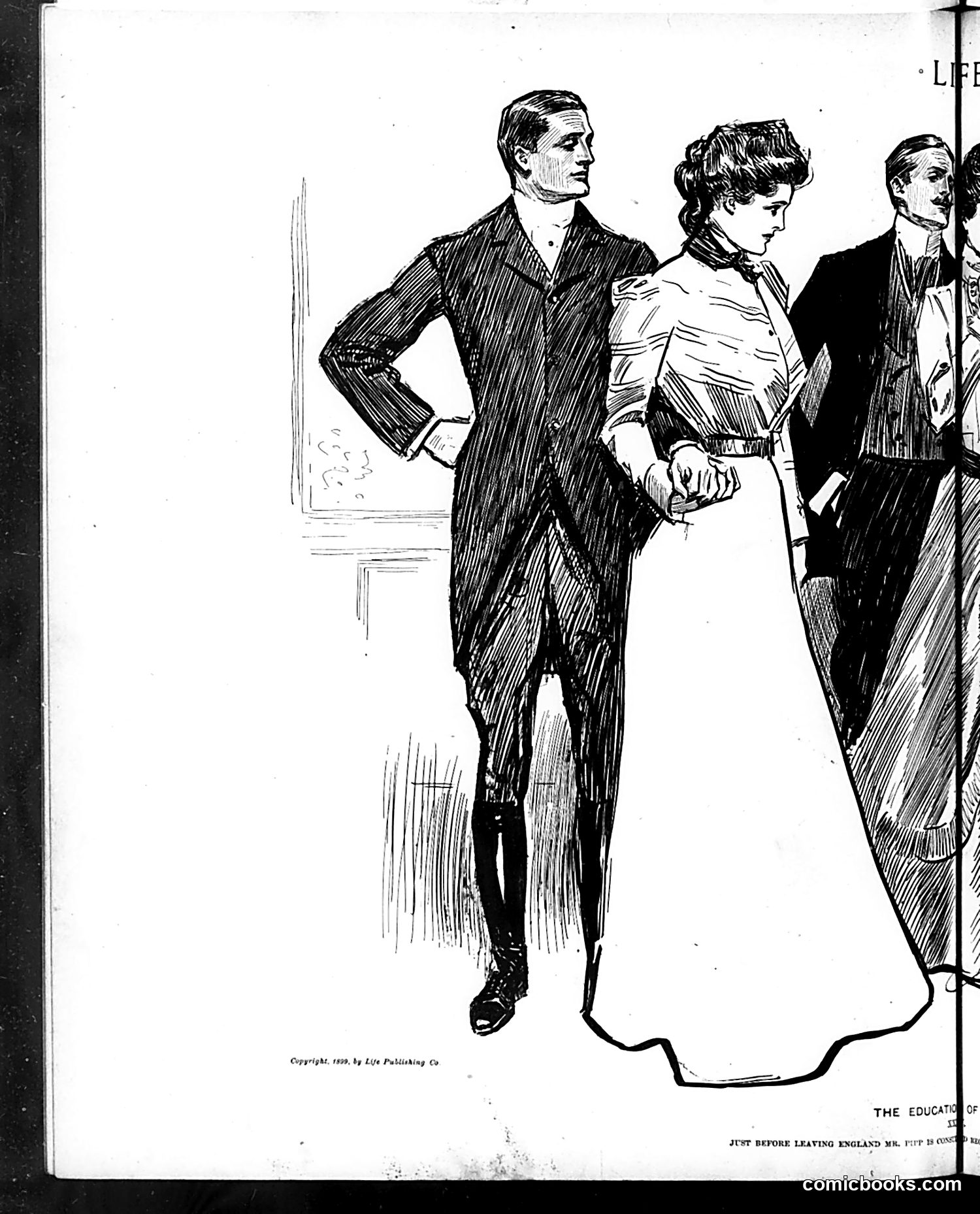
This appears to be an illustration from *Life* magazine showing three figures in formal early-20th-century dress. The caption references "just before leaving England" and mentions "Mr. Pitt," though the full context is partially cut off at the page bottom. The sketch depicts what seems to be a social or political scene—possibly satirizing British-American relations or the departure of a notable figure. The woman in the center wears a fashionable white dress, while the men are in dark formal attire, suggesting this represents an upper-class social moment rather than a working-class scene. Without the complete caption text visible, I cannot definitively identify the specific historical event, individuals, or satirical point being made. The copyright notice indicates Life Publishing Co., but the exact date and full context remain unclear from this partial page.
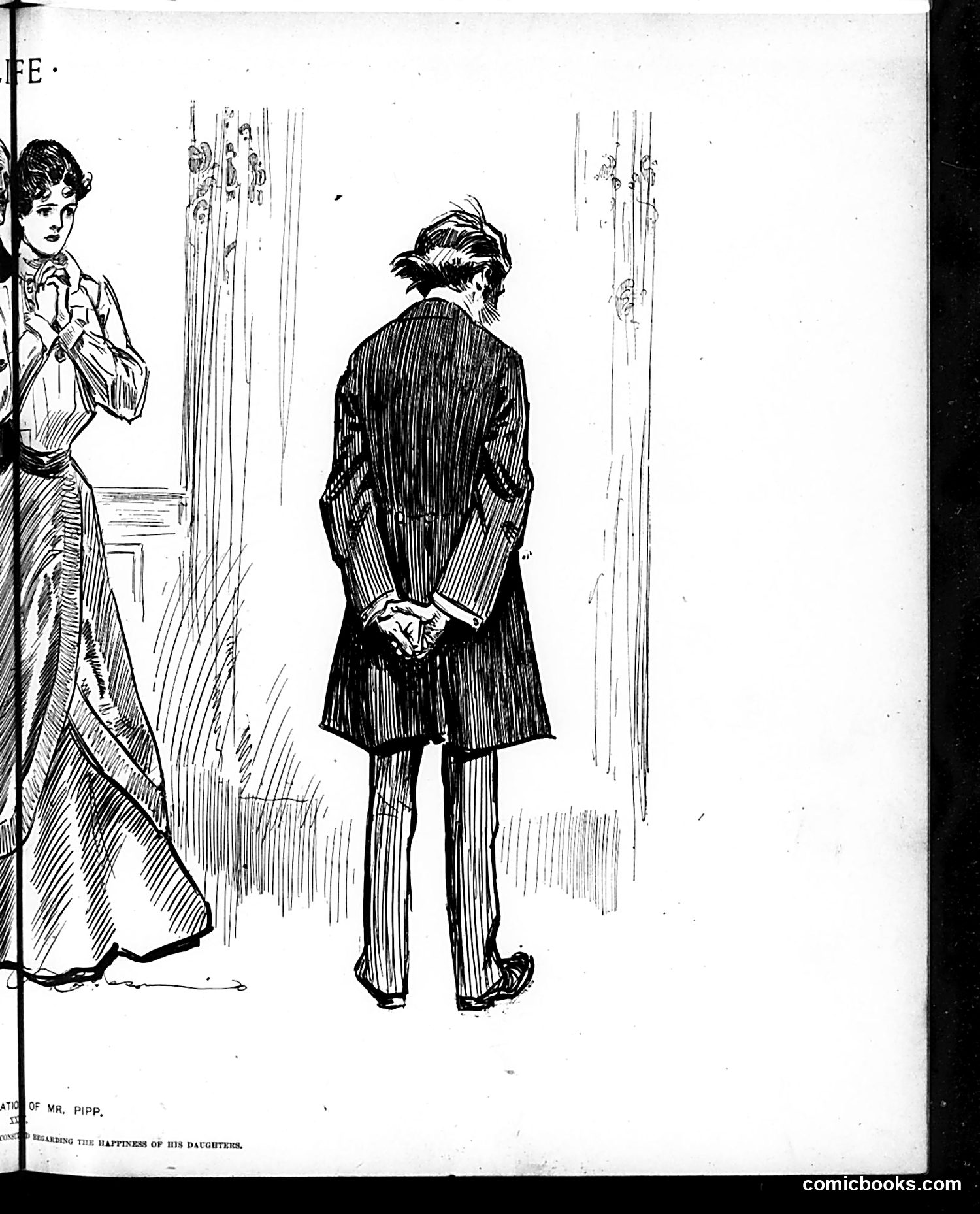
This appears to be an illustration from Life magazine's satirical section. The caption references "Mr. Pipp" and mentions "regarding the happiness of his daughters." The image shows a man in formal Victorian-era attire (pinstriped suit, viewed from behind) standing in a hallway between two tall doors or panels, with a woman visible on the left side of the frame wearing period dress. Without access to the full article or clearer caption text, the specific satirical point is unclear. It likely comments on a contemporary social situation involving Mr. Pipp and his daughters—possibly regarding courtship, marriage prospects, or paternal concerns—themes common in early 20th-century Life magazine satire. The formal setting and the man's body language (hands clasped behind back) suggest some tension or awkwardness in the domestic scenario being depicted.
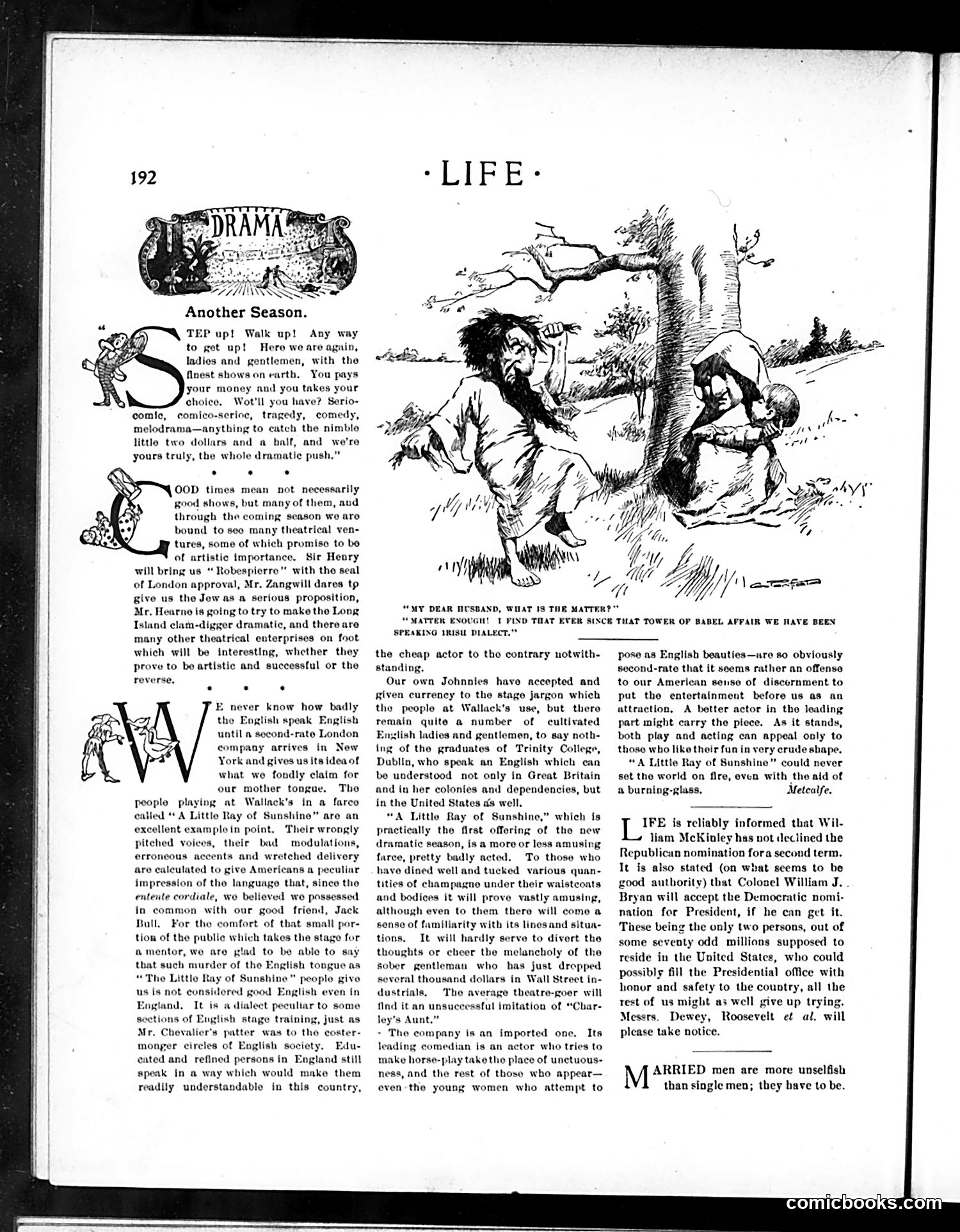
This page discusses the upcoming theatrical season. The main cartoon depicts a disheveled man (likely representing a struggling actor or playwright) gesturing to a woman, with the caption "MY DEAR HUSBAND, WHAT IS THE MATTER?" and his response about "that tower of Babel affair" and "Irish dialect." The text criticizes cheap London theater companies touring America, contrasting them with quality American productions like "A Little Ray of Sunshine." The piece mocks English actors' affected accents and poor performances, arguing they lack the refinement of American theatrical training. The satire targets cultural pretension—English performers claiming superiority while delivering mediocre work. The editorial takes pride in American theatrical development, asserting it rivals or exceeds English standards.
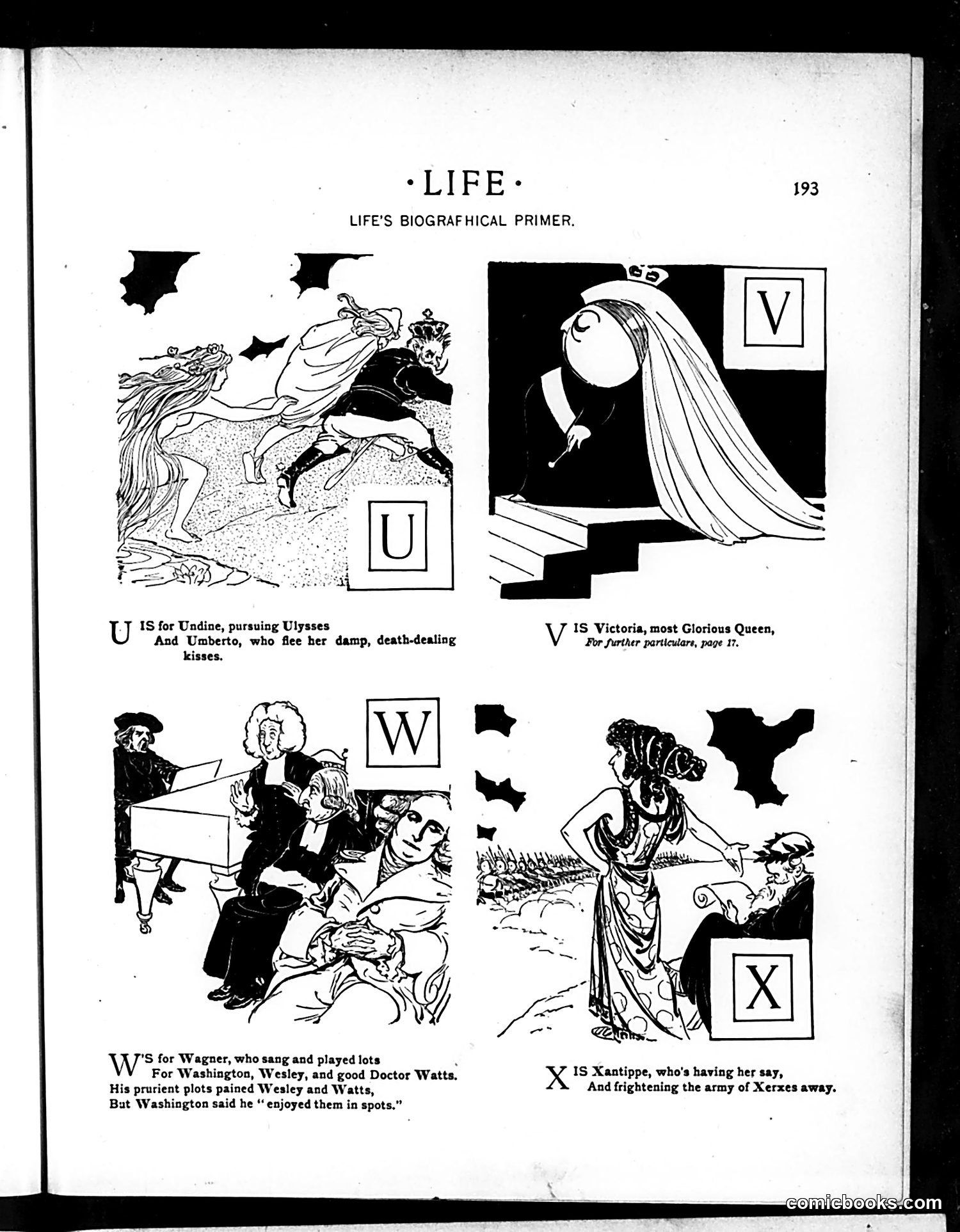
This is an alphabetical satirical primer using classical and historical figures. "U" references the operatic character Undine and Italian King Umberto I (likely alluding to romantic or scandalous rumors). "V" depicts Queen Victoria in her widow's veil, a familiar image from her decades of mourning. "W" targets composer Richard Wagner, suggesting his plots were morally questionable ("prurient"), offending Wesley and Watts (likely religious figures), though George Washington supposedly enjoyed them anyway—a jab at American tolerance for European excess. "X" shows Xantippe, Socrates' legendary shrewish wife, humorously reimagined as so formidable she frightens away King Xerxes' Persian army. The satire mocks both historical pretension and gendered stereotypes about domineering women.
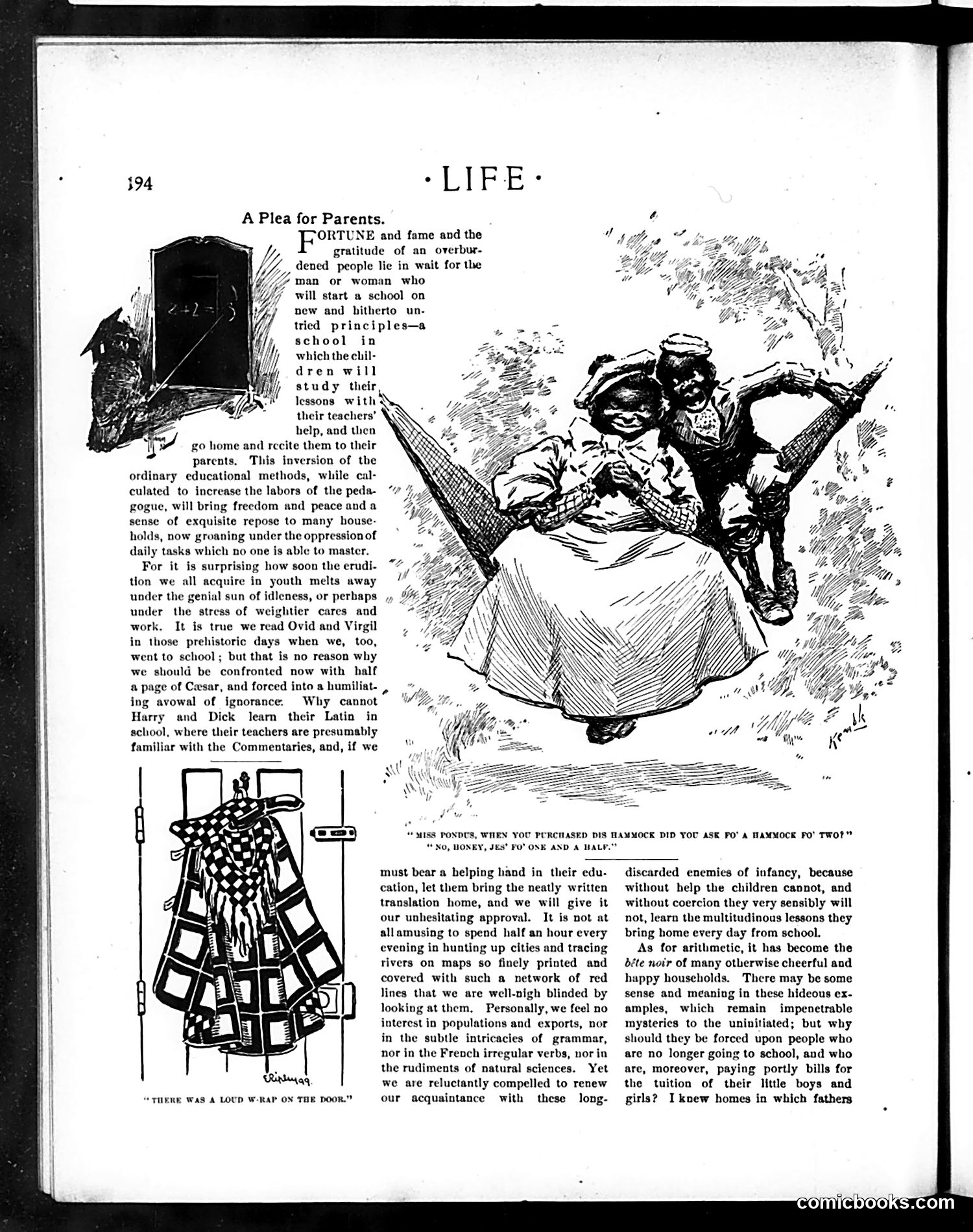
This article satirizes the burden homework places on Victorian-era parents. The author argues that parents—who've forgotten their own Latin, geography, and arithmetic—are forced to help children with lessons nightly, despite having paid tuition fees. The satire's target is the educational system's assumption that parents remain competent in subjects they studied decades ago but have abandoned. The accompanying illustrations show domestic scenes: children in a hammock (captioned with a couple's complaint about sharing), and "There Was a Loud W-rap on the Door" (suggesting domestic disruption). These reinforce the theme that homework intrudes on family life and household peace. The author's tongue-in-cheek "solution"—schools teaching children who then recite lessons to parents—mocks the absurdity of the current system while expressing genuine frustration with parental educational responsibilities. This reflects 19th-century anxieties about education's expanding scope into home life.
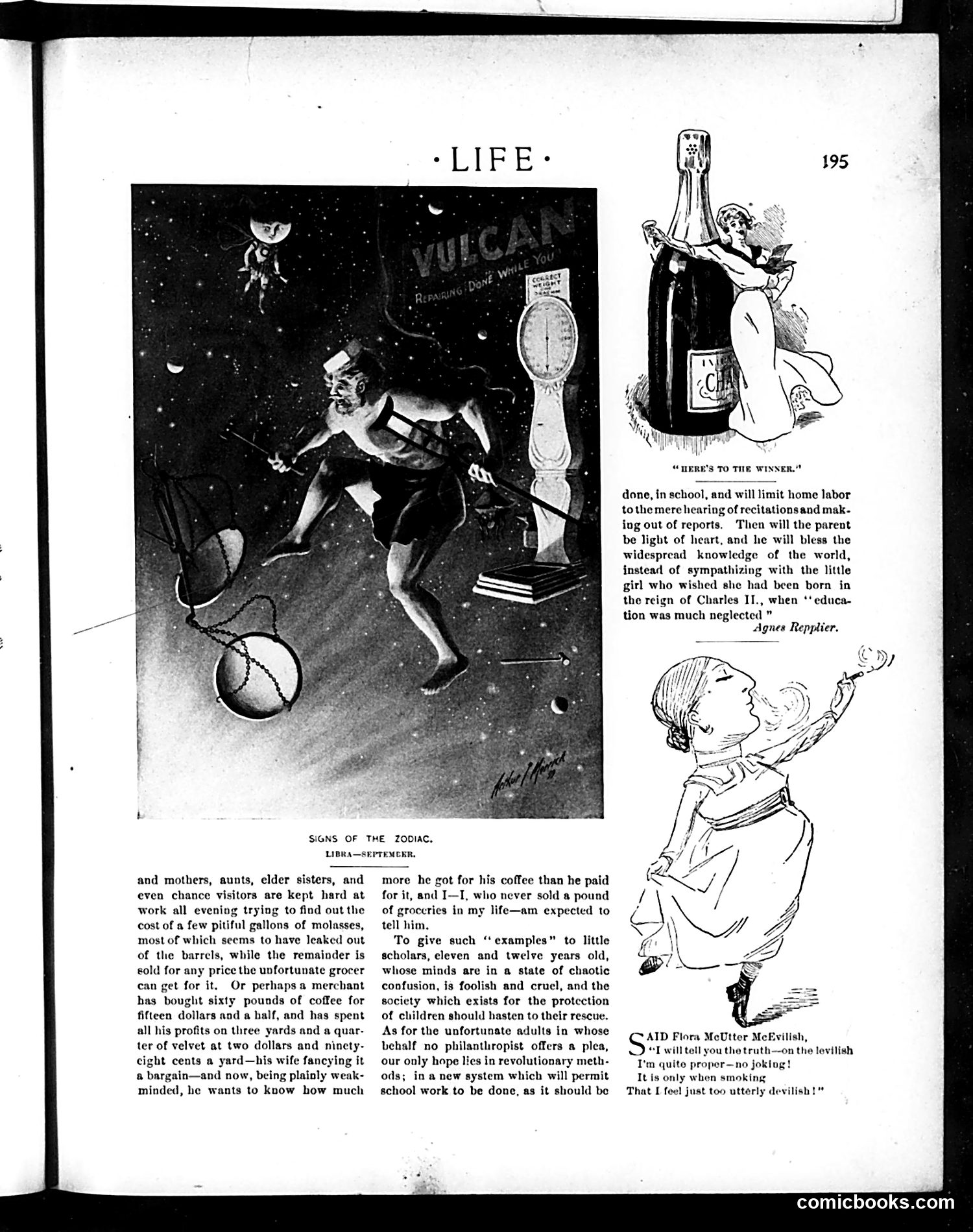
This page satirizes the burden of homework on American families. The left illustration shows chaotic domestic chaos—parents and relatives frantically calculating grocery costs and fabric prices to solve arithmetic "examples" assigned to schoolchildren ages 11-12. Writer Agnes Repplier argues this system is cruel: children's minds are in "chaotic confusion," yet parents must do unpaid labor at home helping with lessons. She calls for educational reform so schoolwork happens *in school*, freeing parents from evening torment. The right side contains unrelated advertisements/humor: a champagne toast illustration and a satirical poem by "Flora McUttor McEvilish" about a woman who claims to be proper but becomes "devilish" only when smoking—poking fun at women's affected respectability. The page critiques early-20th-century education policy while depicting the very real domestic frustration homework caused before modern school systems changed.
This page contains two satirical anecdotes about human nature and hypocrisy, presented in typical Life magazine style. **The first story** mocks a Washington man who celebrates his wife's patience with his drinking binges by buying her an expensive dress ($250). Rather than expressing gratitude, she sends a cold letter discussing weather and gossip, with a cutting postscript: "You must have had an elegant time"—implying she knows exactly what he was doing and won't be bought off with gifts. **The second story** uses a fable-like format: a man rescues a fly from butter out of kindness; later, that same fly alerts him to a burglar and saves his silver. The moral claims kindness is rewarded, but the satire likely mocks naive sentimentality—the actual point being that even small creatures have self-interest, not gratitude. Both pieces target masculine vanity and the notion that money or sentiment can manipulate women or nature. The humor relies on deflating pretension.
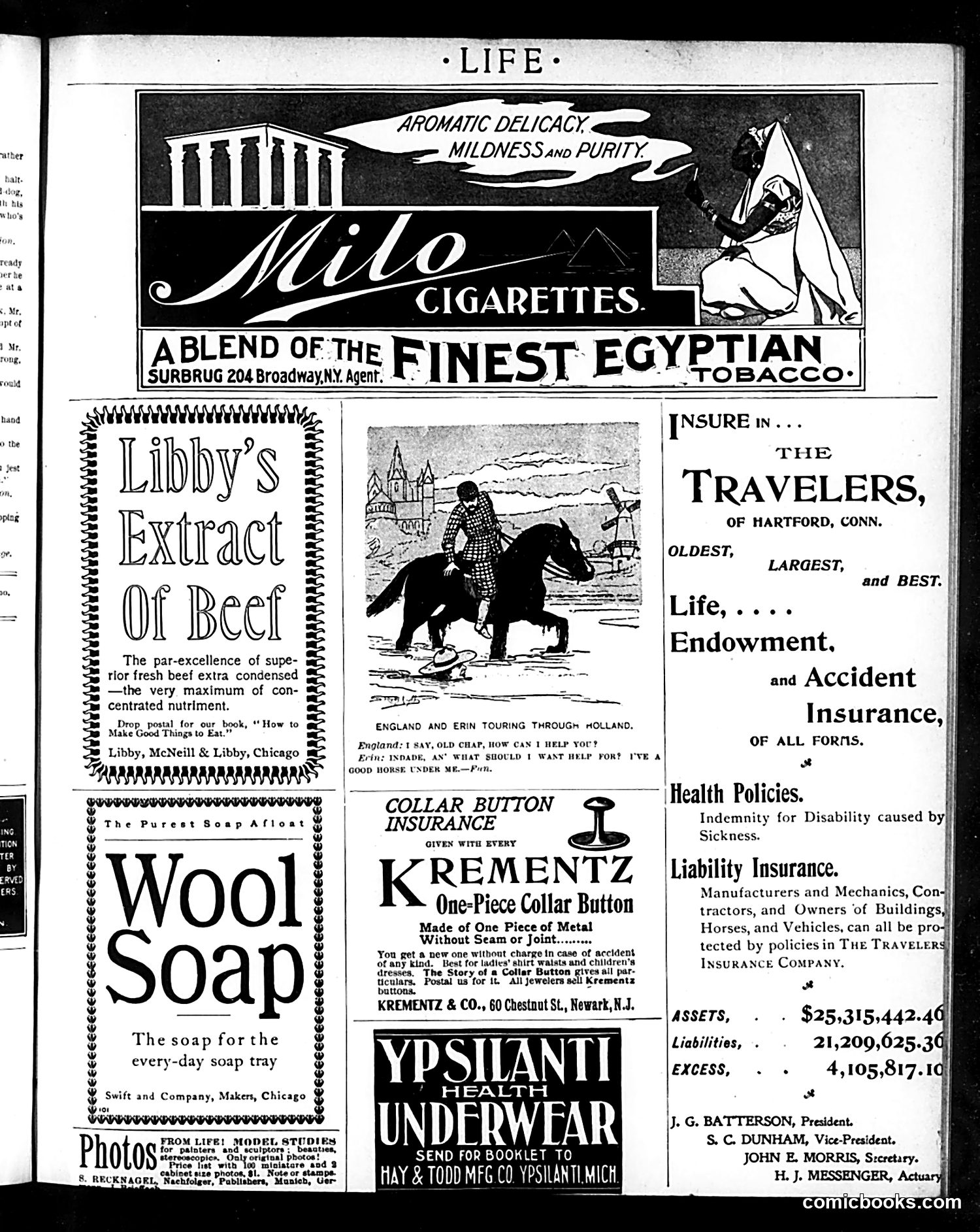
This Life magazine page is primarily **advertising**, not political satire. The bulk of the space consists of product advertisements typical of the era: The main cartoon (center-bottom) shows a humorous exchange between an Englishman and Irishman touring Holland—a light, nationality-based joke about language and cultural difference rather than political commentary. The Englishman offers help, and the Irishman quips that he has "a good horse under me"—the humor lying in misunderstanding and Irish stereotype. Other advertisements include Milo cigarettes, Libby's beef extract, Wool Soap, and insurance products from The Travelers. The Krementz collar button ad emphasizes durability—a selling point for everyday items. The page reflects early 20th-century American consumer culture and advertising strategies, with no discernible political cartoon or deeper satirical content—just commercial messaging mixed with mild ethnic humor.
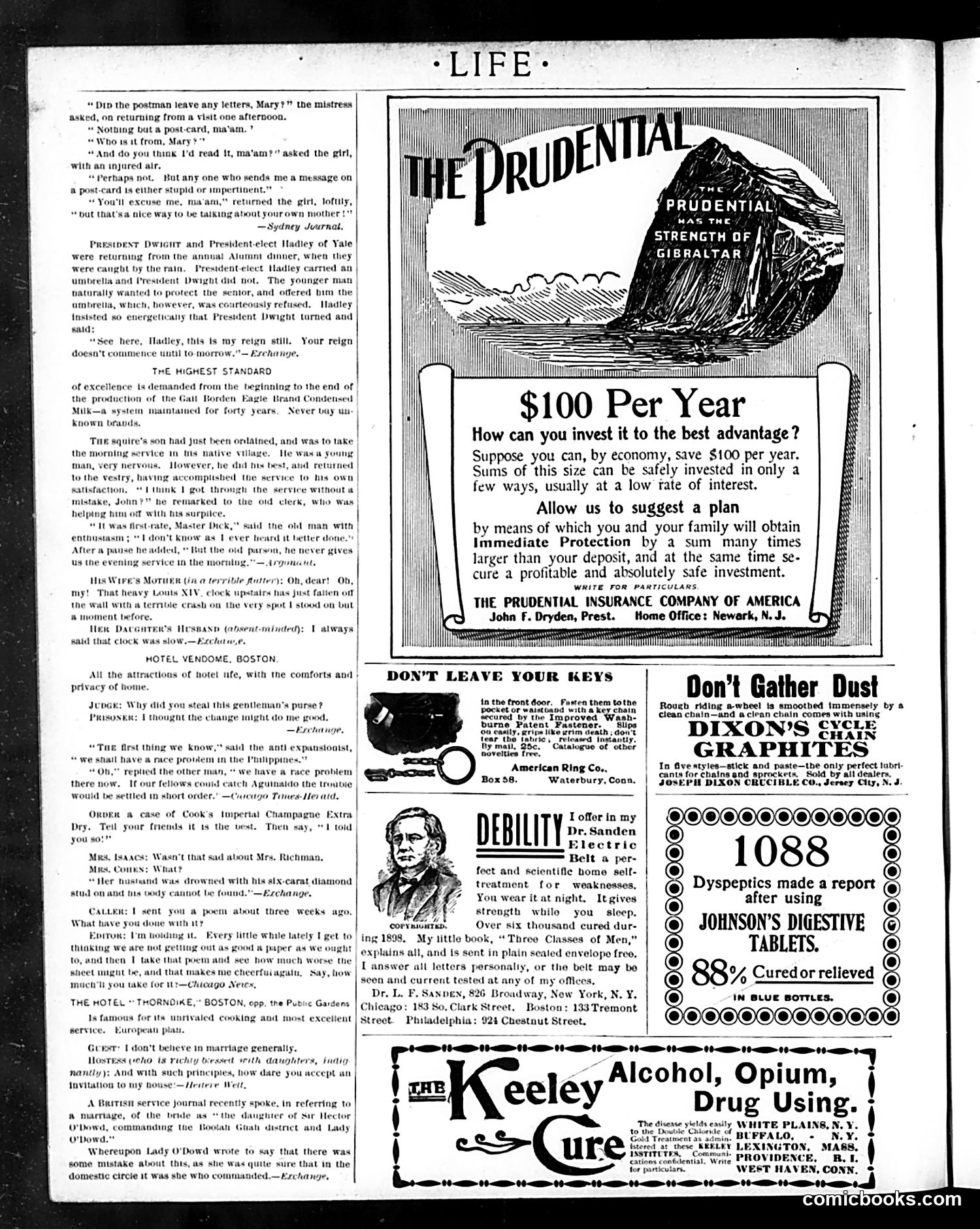
This page contains primarily **short humorous anecdotes and advertisements** typical of early 20th-century Life magazine, rather than political cartoons. The jokes satirize domestic life and social conventions: a servant's impertinence about reading postcards; a young clergyman's self-consciousness about his first service; social climbers and pretension. One anecdote mocks racial anxieties—someone worrying that allowing Black people equal treatment will create "race problems." The advertisements reflect period concerns: The Prudential Insurance Company emphasizes financial security; Dixon's Chain Graphites advertise durability; Johnson's Digestive Tablets promise relief (88% cure rate claimed); and The Keeley Cure promotes treatment for "Alcohol, Opium, Drug Using"—reflecting contemporary medical attitudes toward addiction. There are no identifiable political figures or sophisticated satire. The page represents Life's general-interest humor and commercial messaging for a middle-class audience.
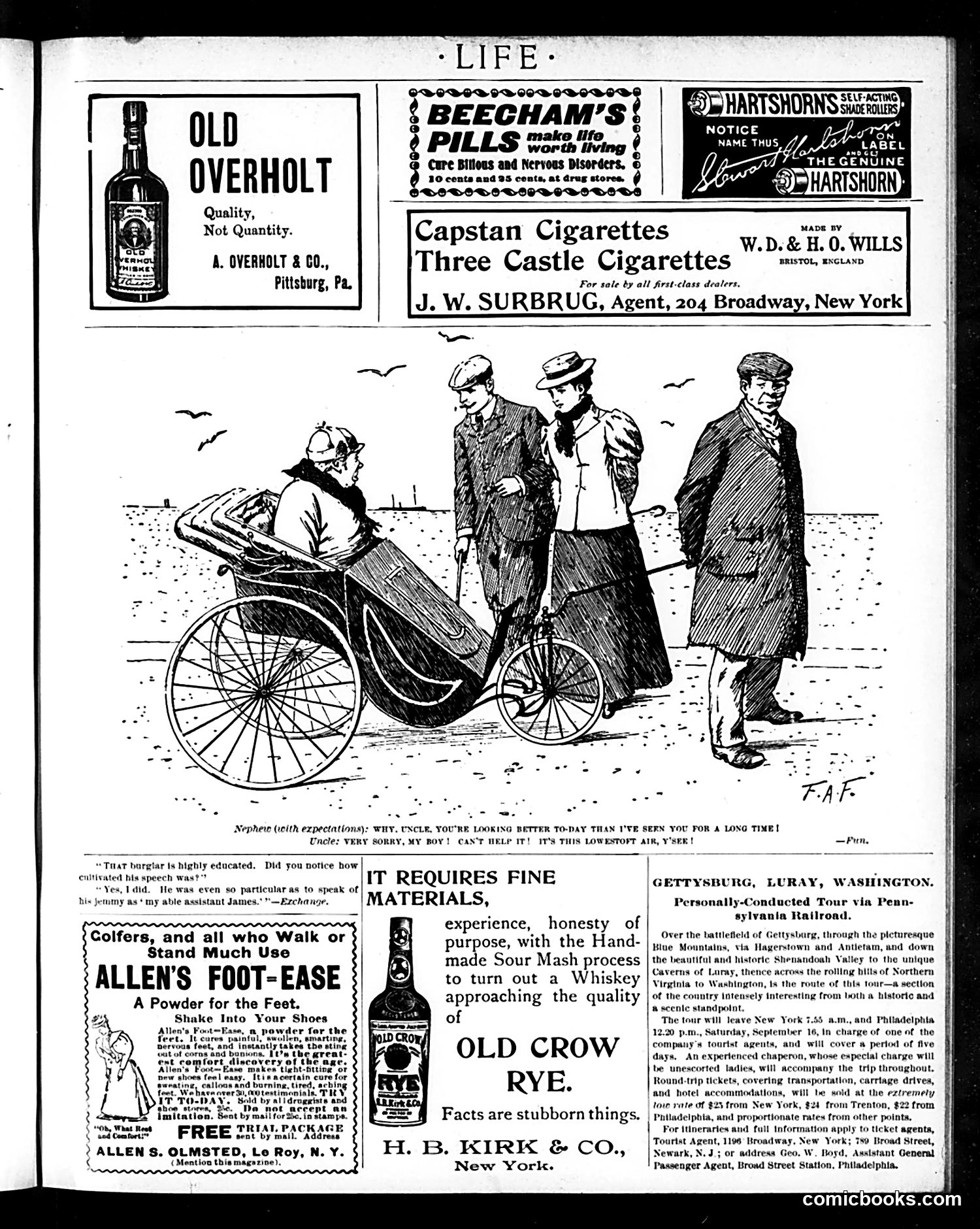
The main cartoon depicts a social encounter at what appears to be a seaside resort (Lowestoft, England). A well-dressed uncle greets his nephew, who arrives with a woman in a carriage. The caption suggests the uncle hasn't seen the nephew "for a long time," and the uncle attributes his own disheveled appearance to "this Lowestoft air." The humor relies on a double meaning: the "air" is blamed for the uncle's condition, but the accompanying dialogue snippet about a "bargiar" (burglar) speaking "cultivated" speech—referring to his "jemmy" (crowbar) as "my able assistant James"—suggests the uncle may actually be disreputable himself, perhaps a criminal. This creates ironic commentary on class pretense and respectability. The page is primarily advertisements for period products (cigarettes, foot powder, whiskey, pills) with the cartoon serving as the magazine's main editorial content.
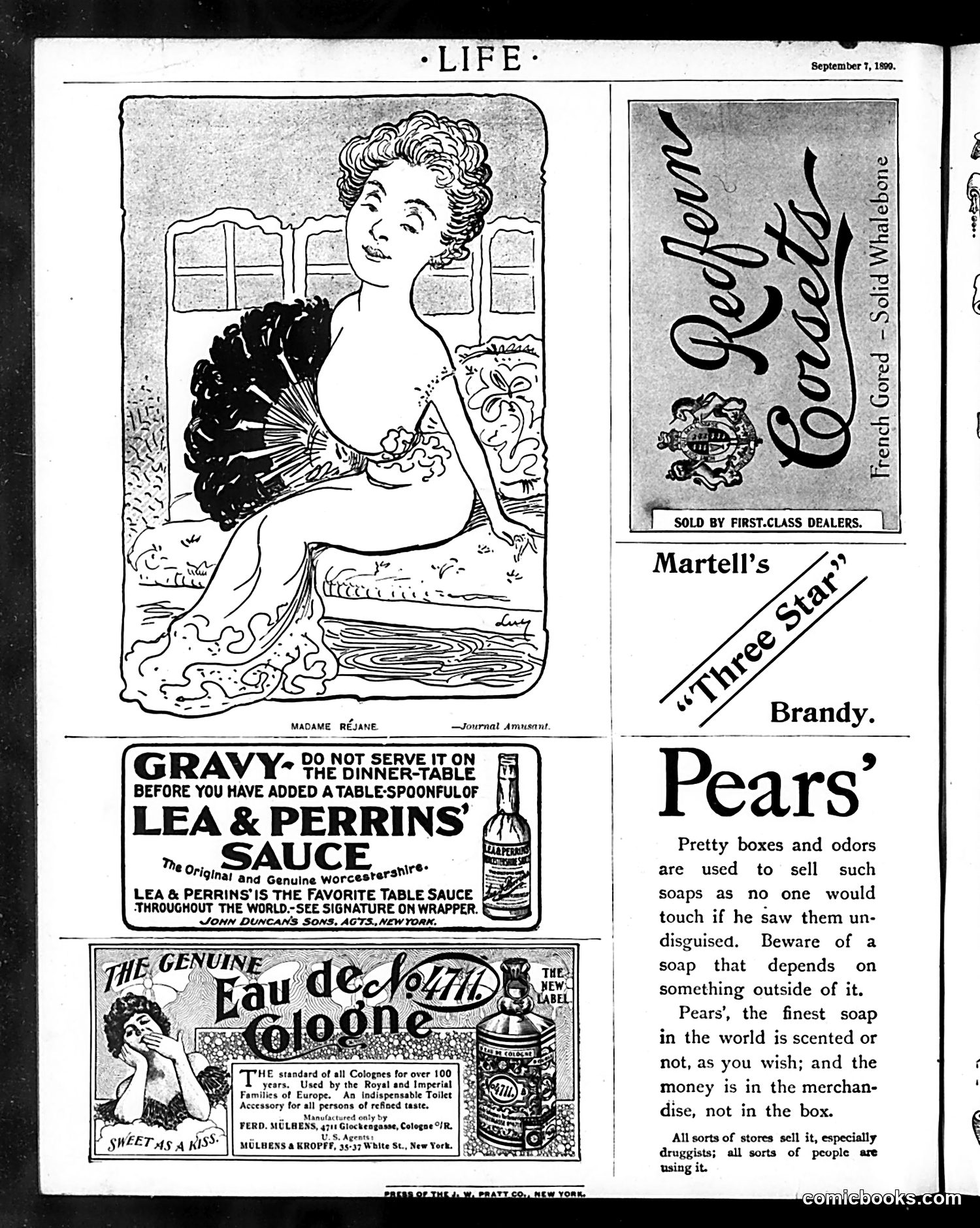
This is primarily an **advertising page** rather than editorial content. The main illustration, credited to "Madame Rejane" from *Journal Amusant*, depicts an elegant woman in classical dress—likely a theatrical or society figure of the era, though the specific identity is unclear to modern readers. The advertisements promote luxury goods typical of the 1890s: Lea & Perrins Worcestershire sauce, Eau de Cologne, and Pears' soap. The editorial content about Pears' soap contains subtle **social satire**: it mocks competitors who rely on packaging and marketing ("pretty boxes and odors") rather than product quality. The text suggests consumers should value substance over appearance—an ironic critique, since Pears' itself was a heavily marketed luxury brand. The commentary that "all sorts of people are using it" appears to reference the soap's mass-market aspirations during an era of expanding consumer culture. The page reflects turn-of-century advertising practices and emerging consumer skepticism.