
Life, 1899-09-07 · page 4 of 20
Life — September 7, 1899 — page 4: what you’re looking at
What you’re looking at
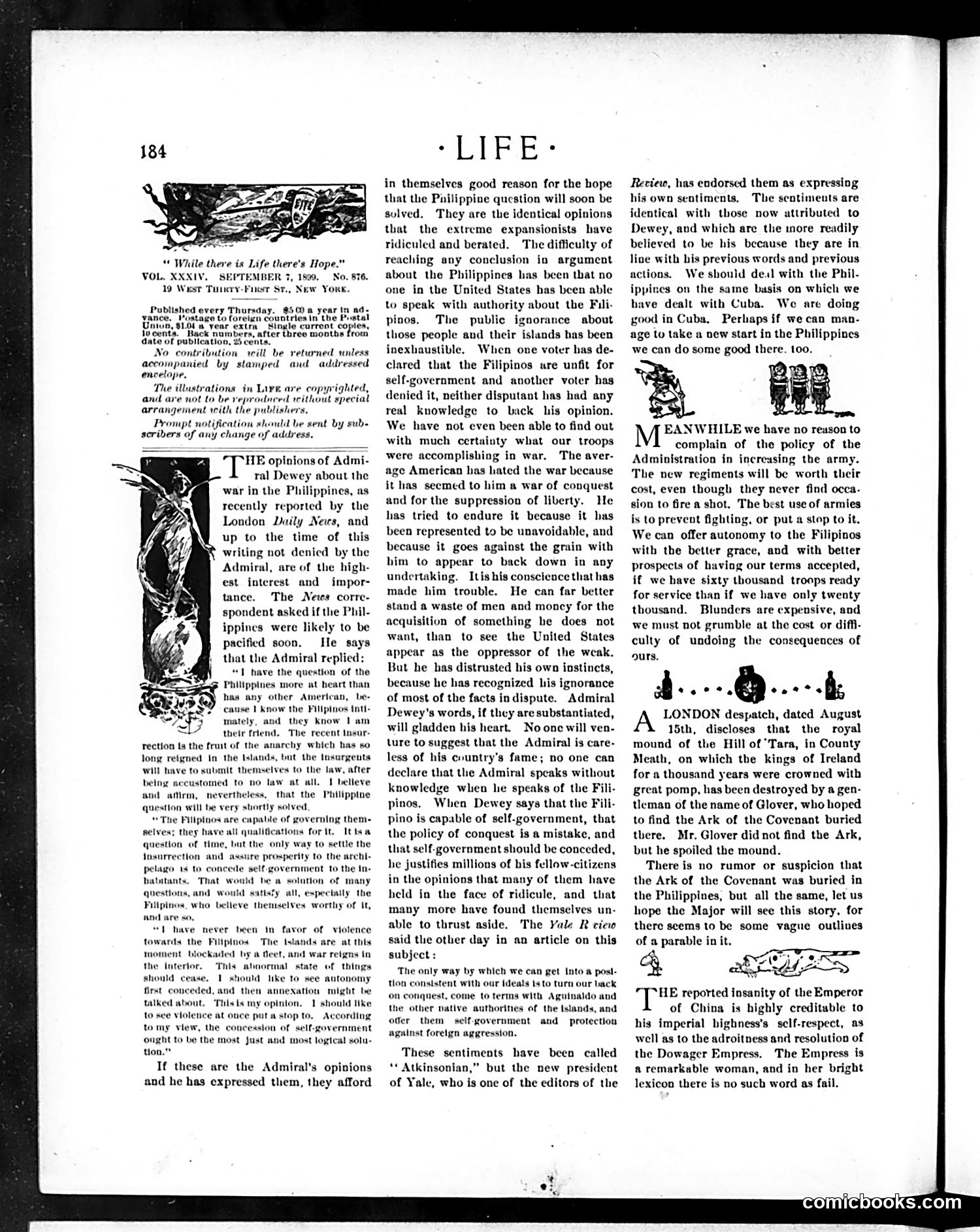
This page from Life magazine (Vol. XXXV, Sept. 1, 1900) discusses Admiral Dewey's recent statements about the Philippine-American War. The text critiques Dewey's rationale for the conflict, noting his arguments about conquest and suppressing insurgency reveal ignorance about Filipino capabilities for self-government. The decorative initial letters contain illustrated figures (typical of the era's design), but don't represent specific individuals—they're ornamental. The article presents a satirical counterargument: if Dewey truly knows little about the Philippines, his military judgments are suspect. The piece suggests the war reflects American imperialism rather than necessity, and questions whether acquiring territory justifies the human and financial cost. A separate dispatch about China's Empress Dowager appears at page's bottom.
📄 Transcribed text from this page (OCR, searchable)
Machine-transcribed from the original scan — historical spelling and the odd misread are preserved.
VOL. XX MBER 19 West Tutery-Fiest Sr, 1899, New Yous. Published every Thursday. $500 @ year in ad val ‘oatago to foreign countries in the Postal Uhion, $10r'a‘vear extrn. ‘Single current copies, locents. ‘Back numbers, after three monte from date of publication, 25 cents. No contribution will be returned unless and addressed accompanied by stamped envelope. The illustrations in Live ave copyrighted, and are not to be reproduced teithout special arrangement with the publ Prompt notification should be sent by sub= seribers of any change of address, hers, HE optatons of ‘Admi- ral Dewey about the war in the Philippines, as recently reported by the London Duily News, and up to the time of this writing not denied by the Admiral, are of the high- est interest and impor- tance. The News corre- spondent asked if the Phil- ippines were likely to be pacified soon. He says that the Admiral replied: “1 have the question of the Philippines more at heart than has any other American, be- cause I know the Filipinos tntl- mately, and they know 1 am their friend, The recent Insur- rection Is the fruit of the anarchy which has so long reigned In the Islands, but the Insurgents Will have to submit themselves to the law, after being accustomed to no law at all. 1 belleve and aflirm, nevertheless, that the Philippine question will be very shortly solved “The Fulplnos are expatite of governing them- ut the only way to settle the satire prosperity to the archl- ede self-government to the In- That would be a solution of many satisfy all, expecially the na. Who beleve themselves worthy of It, fund are 50, “1 have never been tn favor of violence towards the Filiptnos The tslands are at this moment and war reigns in the Interior. I state of things should cease. 1 should like to see autonomy first conceded, and then annexation might be talked about. ‘Thisis my opinion, 1 should like to see Violence at once puta stop to. According tomy view, the aston of self-government ought to be the most Just and most logteal solu- tion." If these are the Admiral’s opinions and he has expressed them, they afford hatatunts. LIFE in themselves good reason for the hope that the Pailippine question will soon be sulved. They are the identical opinions that the extreme expansionists have ridiculed and berated. The difficulty of reaching any conclusion in argument about the Philippines has been that no one in the United States has been able to speak with authority about the Fili- pinos. The public ignorance about those people and their islands has been inexhaustible. When one voter has de- clared that the Filipinos are unfit for self-government and another voter has denied it, neither disputant has had any real knowledge to back his opinion. We have not even been able to find out with much certaiuty what our troops were accomplishing in war. The aver- age American has hated the war because it has seemed to him a war of conquest and for the suppression of liberty. He has tried to endure it because it has been represented to be unavoidable, and because it goes against the grain with him to appear to back down in any undertaking. Itis his conscience that has made him trouble. He can far better stand a waste of men and moncy for the acquisition of something be does not want, than to see the United States appear as the oppressor of the weak. But he has distrusted his own instincts, because he has recognized his ignorance of most of the facts indispute. Admiral Dewey's words, if they are substantiated, will gladden his heart. No one will ven- lure to suggest that the Admiral is care- less of his country’s fame; no one can declare that the Admiral speaks without knowledge when he speaks of the Fili- pinos. When Dewey says that the Fili- pino is capable of self-government, that the policy of conquest is a mistake, and that self-government should be conceded, he justifies millions of his fellow-citizens in the opinions that many of them have held in the face of ridicule, and that many more have found themselves un- able to thrust aside, The Yale R ciew said the other day in an article on this subject : The only way by which we can get Into a post- tlon consistent with our Ideals ts to turn our lack on conquest, come to terms with Aguinaldo and the other native authorines of the tstands, and offer them self-government and protection against foreign aggression. These sentiments have been called ** Atkinsonian,” but the new president of Yale, who is one of the editors of the Review, has endorsed them as expressing his own sentiments, The sentiments are identical with those now attributed to Dewey, and which are the inore readily believed to be his because they are in line with bis previous words and previous actions. We should deal with the Phil- ippines on the same basis on which we have dealt with Cuba. We are doing good in Cuba, Perhaps if we can man- age to take a new start in the Philippines we can do some good there. too. = we EAN WHILE we have no reason to complain of the policy of the Administration in increasing the army. The new regiments will be worth their cost, even though they never find occa. sion to fire a shot. The best use of armies is to prevent fighting, or put a stop to it, We can offer autonomy to the Filipinos with the better grace, and with better prospects of having our terms accepted, if we have sixty thousand troops ready for service than if we have only twenty thousand. Blunders are expensive, and we must not grumble at the cost or diffl- culty of undoing the consequences of ours. A A... despatch, dated August 15th, discloses that the royal mound of the Hill of ‘Tara, in County Meath, on which the kings of Ireland for a thousand years were crowned with great pomp, has been destroyed by a gen- tleman of the name of Glover, who hoped to find the Ark of the Covenant buried there. Mr. Glover did not find the Ark, but he spoiled the mound. There is no rumor or suspicion that the Ark of the Covenant was buried in the Philippines, but all the same, let us hope the Major will see this story, for there seems to be some vague outlines of a parable in it, Sey, HE reported tosanity of the Emperor of China is highly creditable to his imperial highness’s sclf-respect, as well as to the adroitness and resolution of the Dowager Empress. The Empress is a remarkable woman, and in her bright lexicon there is no such word as fail. icbhooks.com