
Life, 1899-09-07 · page 6 of 20
Life — September 7, 1899 — page 6: what you’re looking at
What you’re looking at
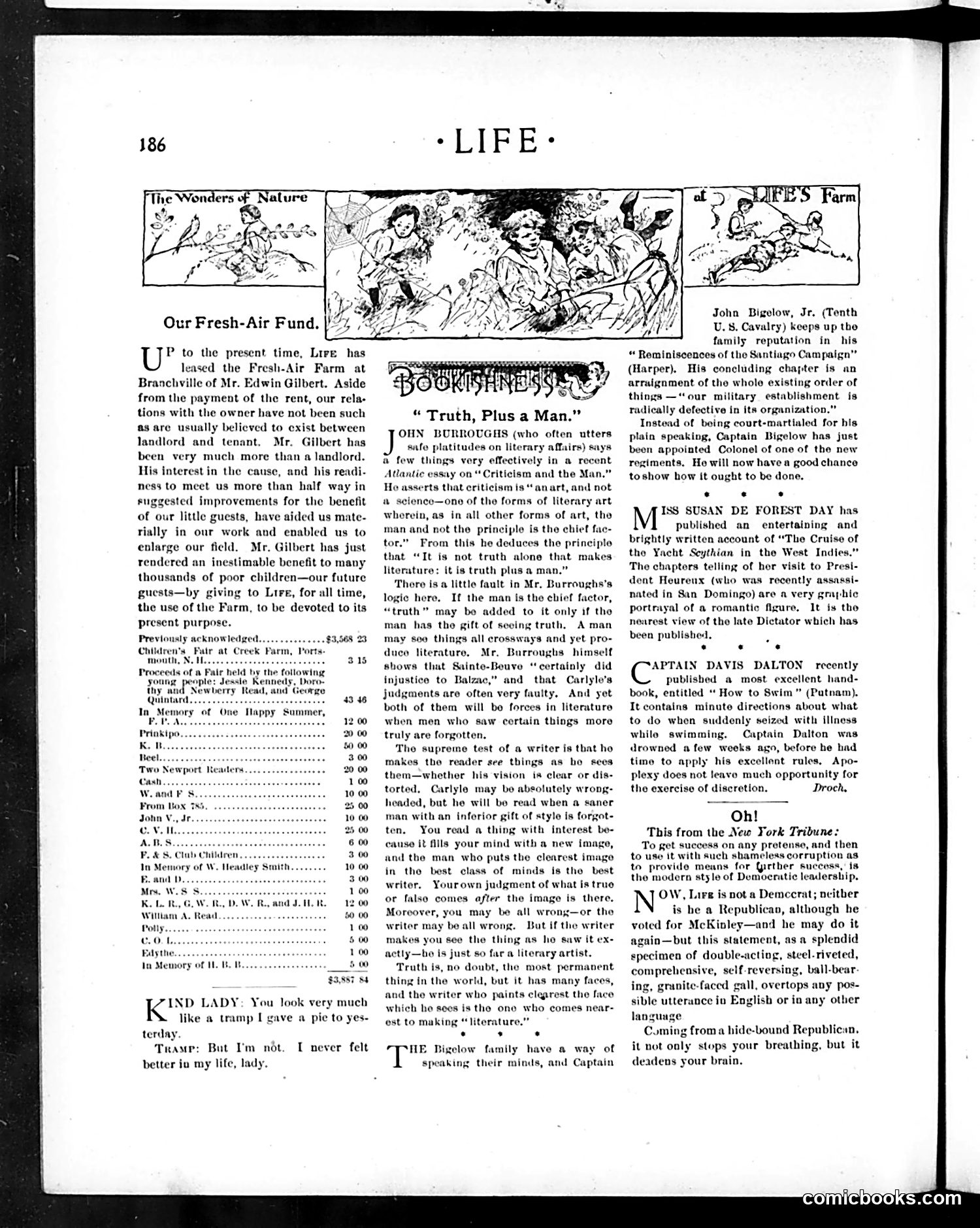
This page contains literary criticism and social commentary rather than political cartoons. The main article, "Truth, Plus a Man," discusses writer John Burroughs's assertion that criticism requires both truth and the critic's personal vision. The piece argues that the best writers make readers "see things as [they] see them." There's also commentary on the Bigelow family's speaking style and Captain Bigelow's military career, suggesting internal family tensions about propriety and public reputation. A separate item mocks Republican leadership using language about "double-acting, steel-riveted" comprehensiveness—likely satirizing political hypocrisy. The page is primarily text-based literary and social criticism typical of Life's intellectual content during this era.
📄 Transcribed text from this page (OCR, searchable)
Machine-transcribed from the original scan — historical spelling and the odd misread are preserved.
P to the present time, Lire has leased the Fresh-Air Farm at Branchville of Mr. Edwin Gilbert. Aside from the payment of the rent, our rela- tions with the owner have not been such as are usually belicved to exist between landlord and tenant, Mr. Gilbert has been very much more than a landlord. His interest in the cause, and his readi- ness to meet us more than half way in suggested improvements for the benefit of our little guests, have aided us mate- rially in our work and enabled us to evlarge our ficld. Mr. Gilbert has just rendered an inestimable benefit to many thousands of poor children—our future gucsts—by giving to Lrre, for all time, the use of the Farm, to be devoted to its present purpose. sly acknowledged Proceeds of a Fair held by the following Jessie K zp thy and Quintard. 43:46 12 00 2 00 50 00 300 20 00 100 10 00 2 00 10 00 2% 00 6 00 3.00 10 00 3.00 1 00 12 00 40 00 100 500 Ratythe sacgueaganeunece 100 In Memory of H. I He... . 500 $3,887 Sb From lox 785. Jonn V., Jr. IND LADY: You look very much like a tramp I gave a pie to yes- terday. Tramp: But I'm not. better iu my life, lady, I never felt SYS “ Truth, Plus a Man.” OHN BURROUGHS (who often utters safe platitudes on literary affairs) says & few things very effectively in a recent Atlantic essay on“ Criticism and the Man.” Ho asserts that criticism is “anart, and not a seience—ono of the forms of literary art wherein, as in all other forms of art, the man and not the principle is the chief fac- tor.” From this he deduces the principle that “It is not truth alone that makes literature: it is truth plus a man.” There is a little fault in Mr, Burroughs’s logic here, If the man is the chief factor, “truth” may be added to it only if tho man has tho gift of seeing truth, A man may seo things all crossways and yet pro- duce literature, Mr. Burroughs himself shows thut Sainte-Beuve “certainly did injustice to Balzac,” and that Carlyle’s judgments are often very faulty, And yet both of them will be forces in literature when men who saw certain things more truly are forgotten. Tho supreme test of a writer is that ho makes tho reader see things as ho sees them—whether his vision ia clear or dis- torted, Carlyle may be absolutely wrong: headed, but he will be read when a saner man with an inforior gift of style is forgot- ten. You read a thing with interest be- cause it fills your mind with a new image and the man who puts the clearest image in the best class of minds is the best writer. Yourown judgment of what is true or falso comes after the image ts there. Moreover, you may be all wrong—or the writer may be all wrong. But if the writer makes you see the thing as ho saw it ex- actly—ho is just so fara literary artist. Truth is, no doubt, the most permanent thing in the world, but it has many faces, and the writer who paints clearest the face which he sees is tho one who comes nea: ost to making “literature. . . . HE Bigelow family have a wi speaking their minds, and Captain John Bigelow, Jr. (Tenth U. 8. Cavalry) keeps up the family reputation in his “ Reminiscences of the Santiago Campaign” (Harper), His concluding chapter is an arraignment of the whole existing order of things —“‘our military establishment is radically defective in its organization.” Instead of being court-martialed for his plain speaking, Captain Bigelow has just been appointed Colonel of one of the new rogiments. Ho will now have a good chance toshow how it ought to be done. * * . Ms SUSAN DE FOREST DAY has published an entertaining and brightly written account of “The Cruise of the Yacht Scythian in the West Indies.” The chapters telling of hor visit to Presi- dent Heurenx (who was recently assassi- nated in San Domingo) are a very graphic portrayal of a romantic figure, It is the nearest view of the late Dictator which has been published, . . . . APTAIN DAVIS DALTON recently published a most excellent hand- book, entitled “ How to Swim” (Putnam), It contains minute directions about what to do when suddenly seized with illness while swimmir Captain Dalton was drowned afew weeks ago, before he had time to apply his excellent rules. Apo- plexy does not leave much opportunity for the exercise of discretion, Droch, Oh! This from the New York Tribune: To get success on any pretense, and then to use it with such shameless corruption as to provide means for Girther success, 18 the modern style of Democratic leadership. OW, Lire is not a Demccrat; neither is he a Republican, although he voted for McKinley—and he may do it again—but this statement, asa splendid specimen of double-acting, steel-riveted, comprehensive, self-reversing, ball-bear- ing, granite-faced gall, overtops any pos- sible utterance in English or in any other language Coming froma hide-bound Republican, it not only stops your breathing, but it deadens your brain,