
Life, 1899-09-07 · page 7 of 20
Life — September 7, 1899 — page 7: what you’re looking at
What you’re looking at
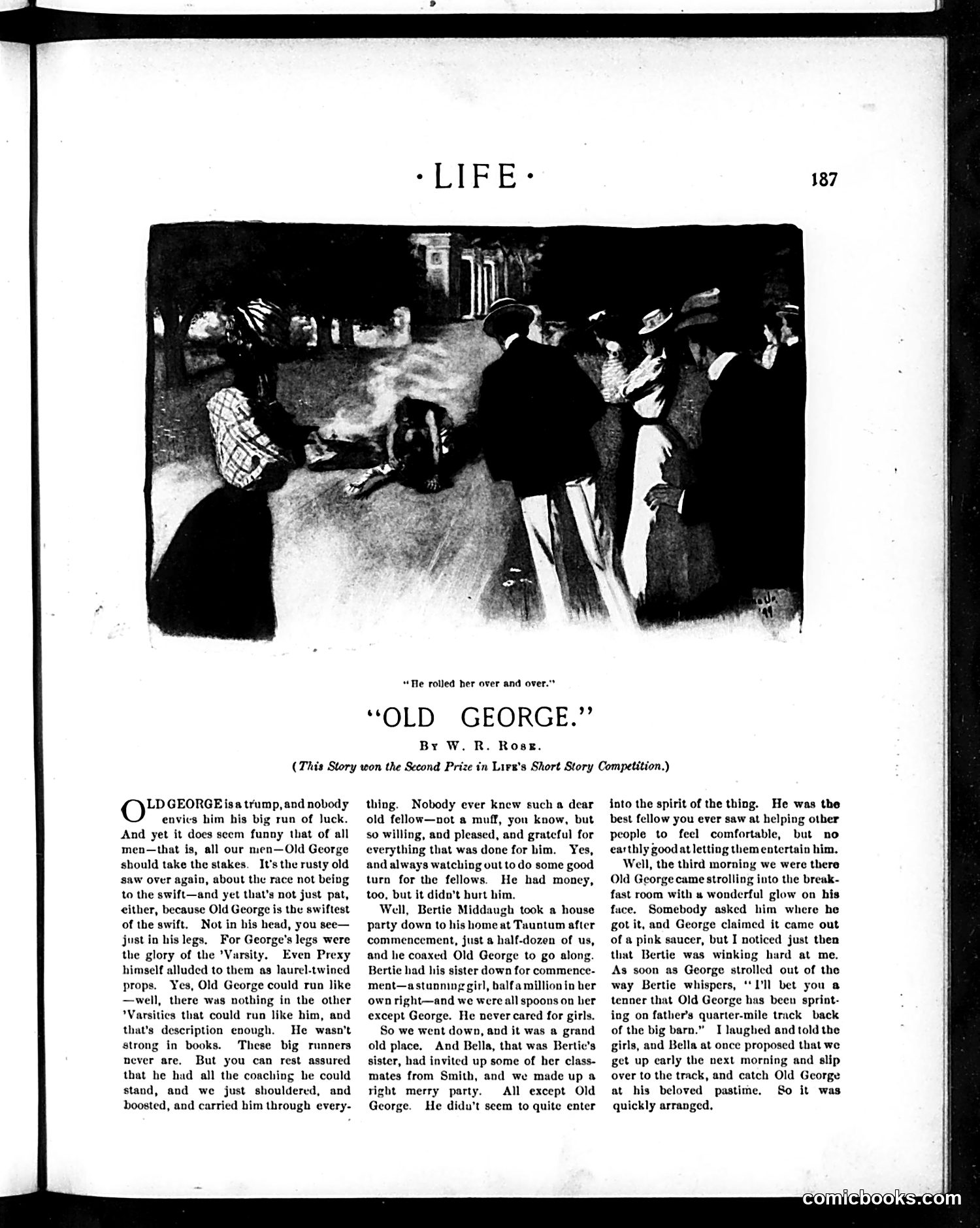
This page presents a short story that won second prize in Life's Short Story Competition. The accompanying illustration shows a nighttime scene with several figures gathered around what appears to be a horse and carriage accident ("He rolled her over and over"). The story text describes "Old George," a working-class man of modest means who is beloved by his peers. The narrative appears to focus on George's character and loyalty—he's portrayed as unpretentious, helpful to others, and unconcerned with romantic pursuits, unlike his wealthier social peers. Without additional context, the specific satirical or political commentary is unclear. The story seems primarily a character study celebrating working-class virtue rather than containing obvious social satire.
📄 Transcribed text from this page (OCR, searchable)
Machine-transcribed from the original scan — historical spelling and the odd misread are preserved.
“He rolled her over and over.” “OLD GEORGE.” By W. R. Ross. (This Story won the Second Prize in Lire’s Short Story Competition.) LD GEORGEisa trump, and nobody envics him his big run of luck. And yet it does seem funny that of all men—that is, all our men—Old George should take the stakes. It’s the rusty old saw over again, about the race not being to the swift—and yet that's not just pat, either, because Old George is the swiftest of the swift. Not in his head, you see— just in his legs. For George's legs were the glory of the Varsity, Even Prexy himself alluded to them as laurel-twined props, Yes, Old George could run like —well, there was nothing in the other ’Varsitics that could run like him, and that’s description enough. He wasn’t strong in books. These big runners never are. But you can rest assured that he had all the coaching be could stand, and we just shouldered, and boosted, and carried him through every- thing. Nobody ever knew such a dear old fellow—not a muff, you know, but so willing, and pleased, and grateful for everything that was done for him. Yes, and always watching out to do some good turn for the fellows. He had money, too, but it didn’t hurt him. Well, Bertie Middaugh took a house party down to his home at Tauntum after commencement, just a half-dozen of us, and he coaxed Old George to go along. Bertie had his sister down for commence- ment—astunning girl, balfa millionin ber own right—and we were all spoons on her except George. He never cared for girls. So we went down, and it was a grand old place. And Bella, that was Bertic's sister, had invited up some of her class- mates from Smith, and we made up a right merry party. All except Old George. He didu’t seem to quite enter into the spirit of the thing. He was the best fellow you ever saw at helping other people to feel comfortable, but no earthly good at letting them entertain him. Well, the third morning we were there Old George came strolling into the break- fast room with # wonderful glow on his face. Somebody asked him where he got it, and George claimed it came out of a pink saucer, but I noticed just then that Bertie was winking hard at me. As soon as George strolled out of the way Bertie whispers, ‘I'll bet you a tenner that Old George has been sprint- ing on father’s quarter-mile track back of the big barn.” I laughed and told the girls, and Bella at once proposed that we get up early the next morning and slip over to the track, and catch Old George at his beloved pastime. So it was quickly arranged,