
A complete issue · 20 pages · 1899
Life — August 31, 1899
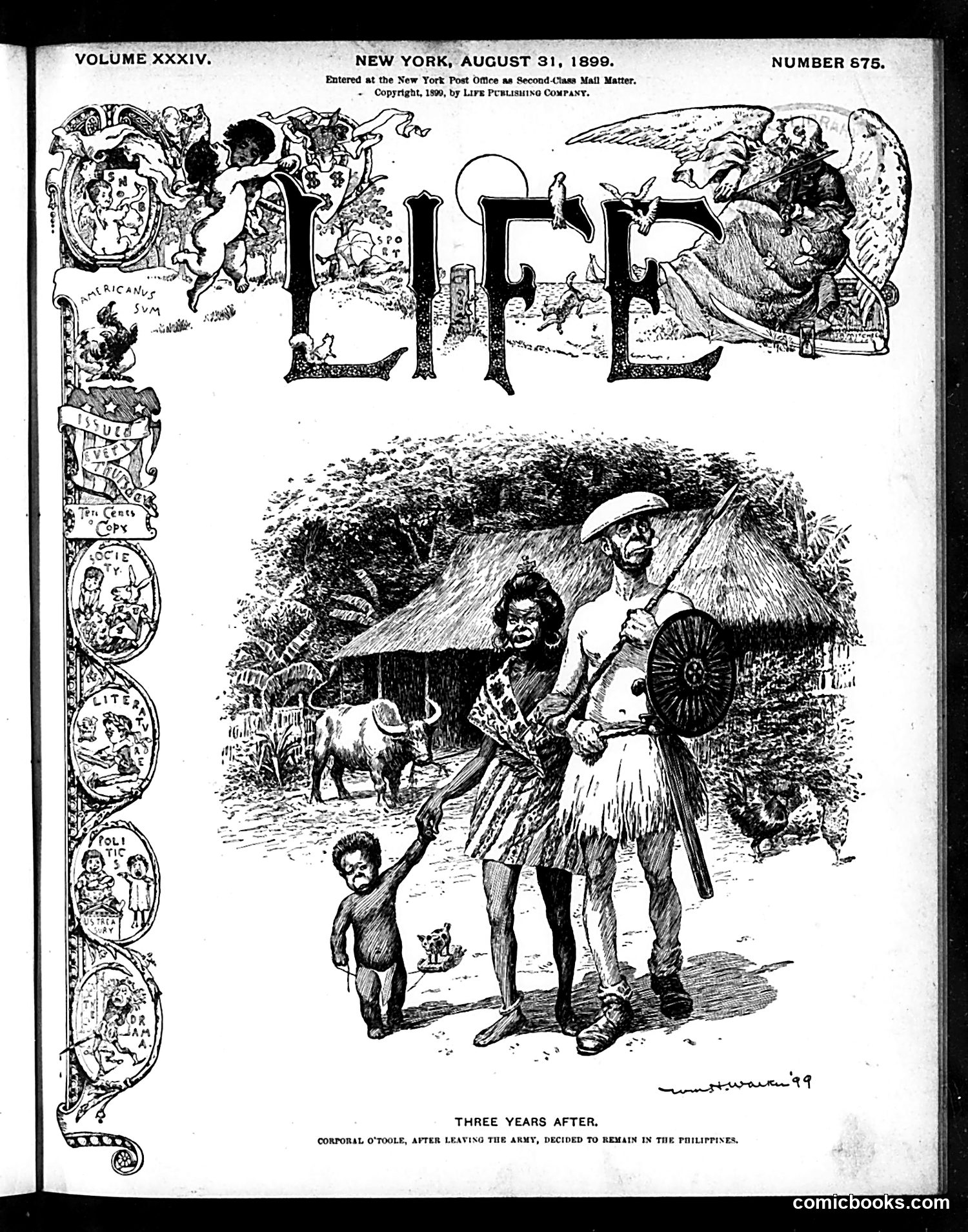
This satirical cartoon titled "THREE YEARS AFTER" depicts Corporal O'Toole, who left the Army to remain in the Philippines. The image shows O'Toole as an adult man with a Filipino woman and child, standing before a modest thatched-roof dwelling with a goat nearby. The satire comments on American military involvement in the Philippines following the Spanish-American War (1898). It mocks the idea that soldiers remaining in the Philippines might establish permanent lives there, mixing with local populations. The cartoon suggests concerns about American soldiers' extended presence abroad and the cultural/social consequences. The decorative left border contains small vignettes relating to "Americanus" themes, reinforcing the satirical commentary on American imperialism and colonial presence.
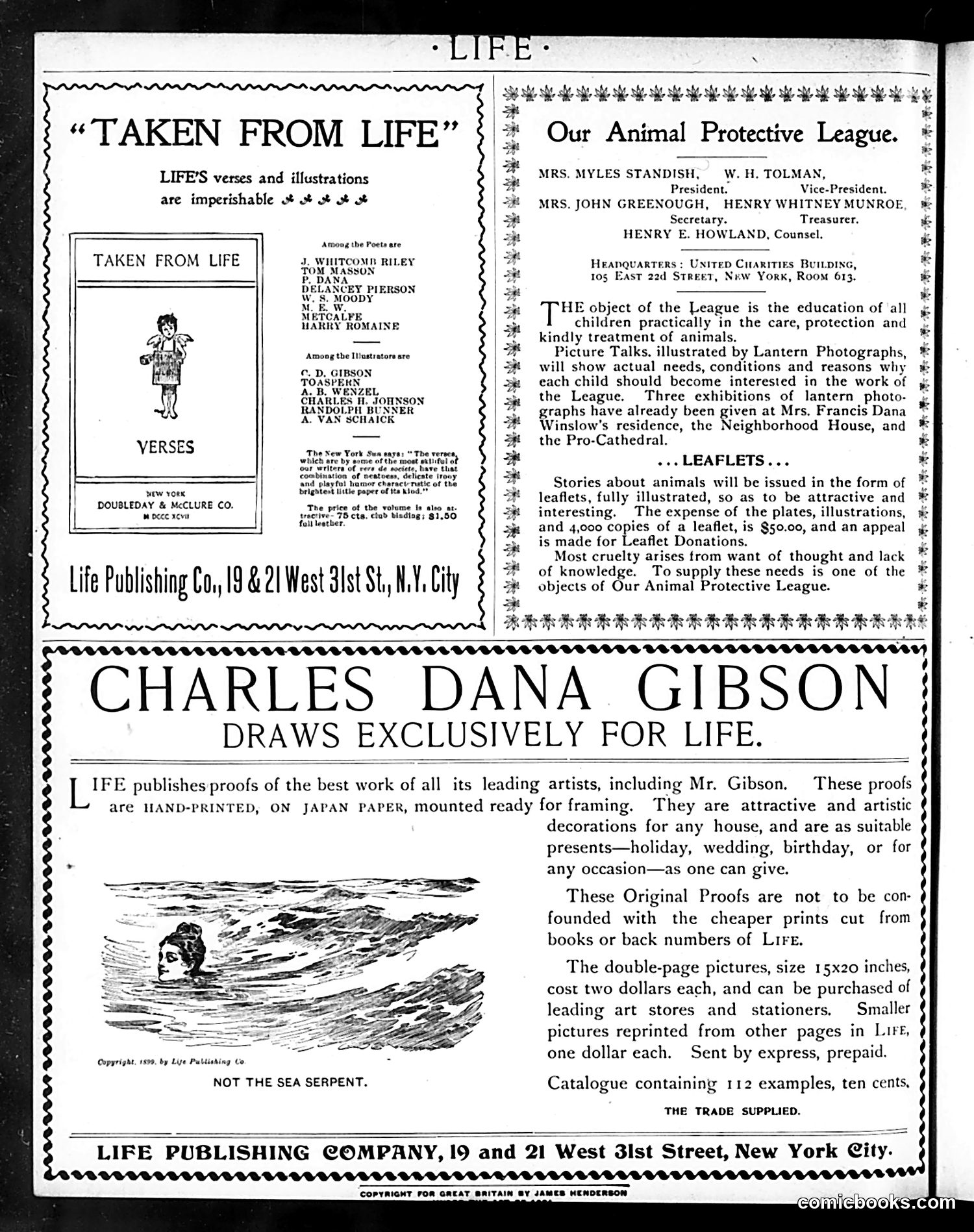
This page is primarily **advertising and promotional content** rather than satirical cartoons. It features: 1. **"Taken from Life" book advertisement** (top left): promoting a poetry and illustration collection by contributors like J. Whitcomb Riley and Delancey Pierson. 2. **Animal Protective League announcement** (top right): information about an educational organization promoting kindly treatment of animals, with officer names and headquarters listed. 3. **Charles Dana Gibson advertisement** (bottom): promoting exclusive artwork by the famous illustrator Gibson (known for the "Gibson Girl"). The ad emphasizes that his proofs are hand-printed on Japan paper and suitable as gifts—priced at two dollars for large pieces or one dollar for smaller reprints. The page demonstrates **early 20th-century magazine business models**, combining editorial content with advertising to support publication costs.
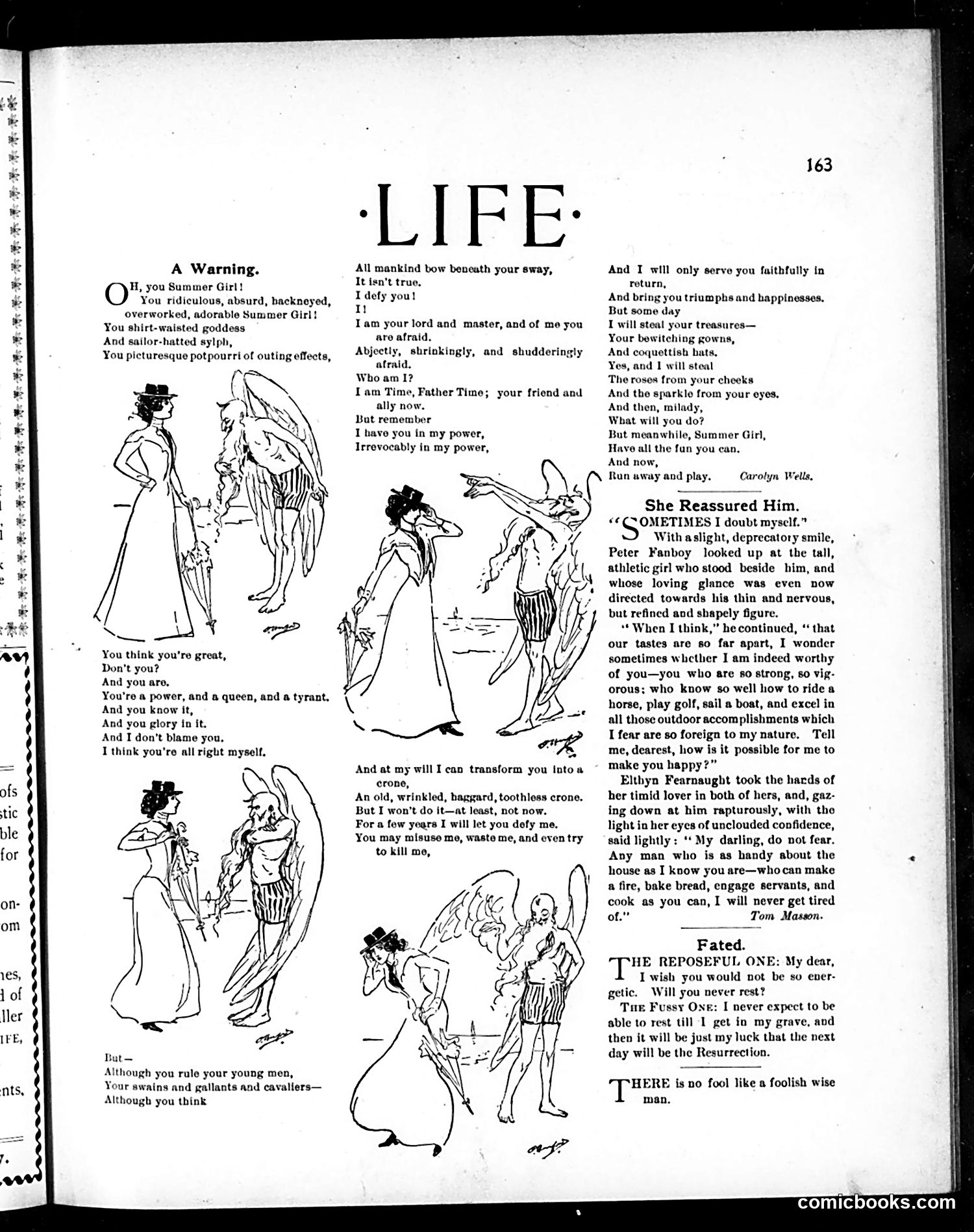
This page contains satirical poetry and illustrations about a "Summer Girl" and the passage of time. The left side features a poem warning a fashionable young woman that her youth and beauty are temporary. Father Time (depicted as a winged, skeletal figure in the illustrations) threatens to steal her "bewitching gowns" and "coquettish balls," warning her to "have all the fun you can" while young. The right side includes two brief prose pieces: "She Reassured Him" (a dialogue between a young couple) and "Fated" (brief witticisms about rest and foolishness). The cartoon's social satire targets the vanity and frivolity of fashionable young women of the era, while humorously reminding readers of mortality and aging—a common theme in Life magazine's gentle social commentary.
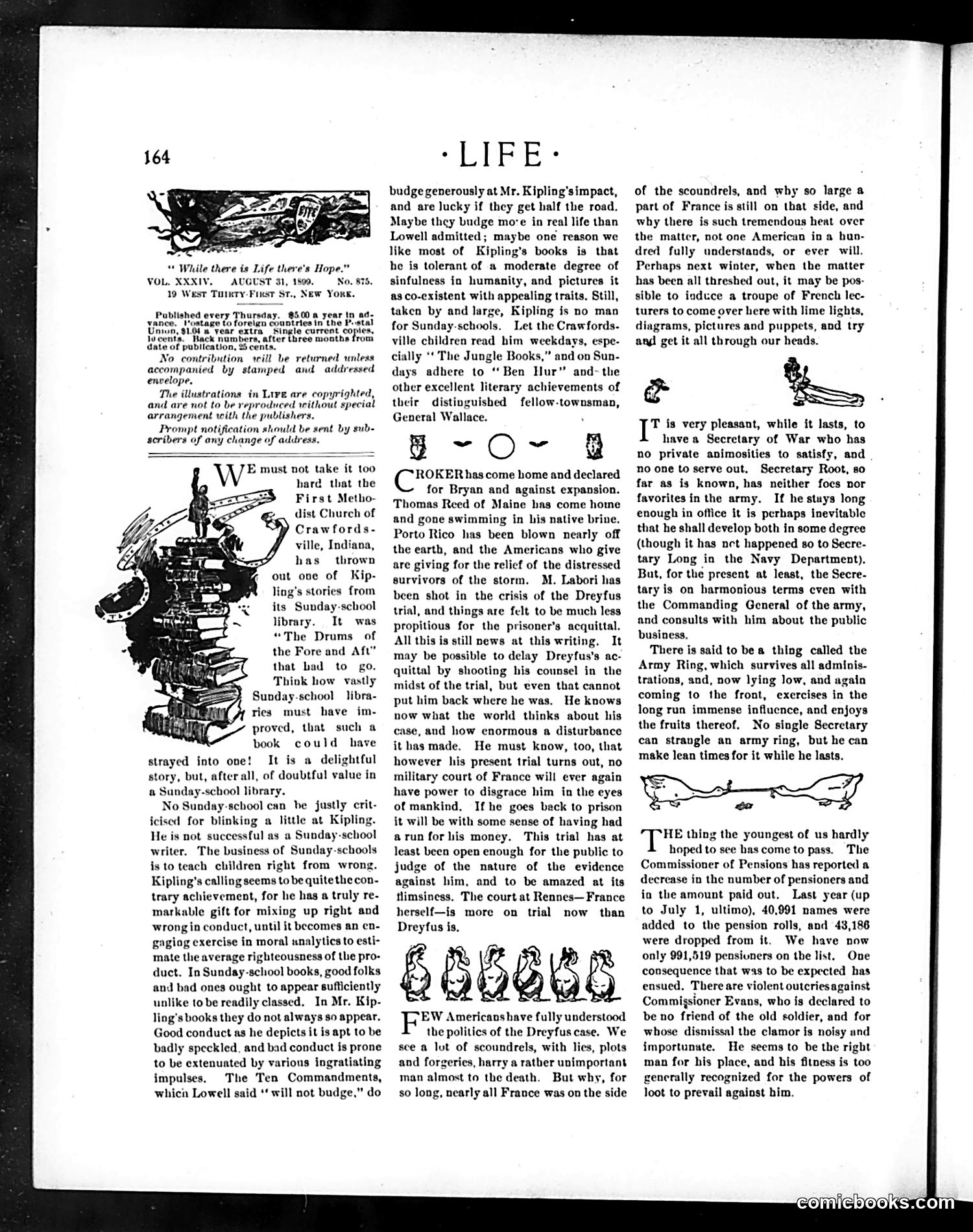
This page contains editorial commentary rather than political cartoons. The left illustration shows a stack of books labeled "The Drums of the Fore and Aft," depicting criticism of Rudyard Kipling's work in Sunday schools. The main text discusses the Dreyfus case—the French military trial of Alfred Dreyfus, a Jewish officer accused of treason. The author expresses concern that a retrial might not fully restore Dreyfus's reputation, noting France remained divided on the matter. References to "Secretary of War" and "Army Ring" suggest American readers' awareness of French institutional corruption. The final section critiques pension administration under Commissioner Evans, indicating contemporary concerns about veteran benefits and bureaucratic mismanagement. Overall, the page addresses European politics and American military governance.
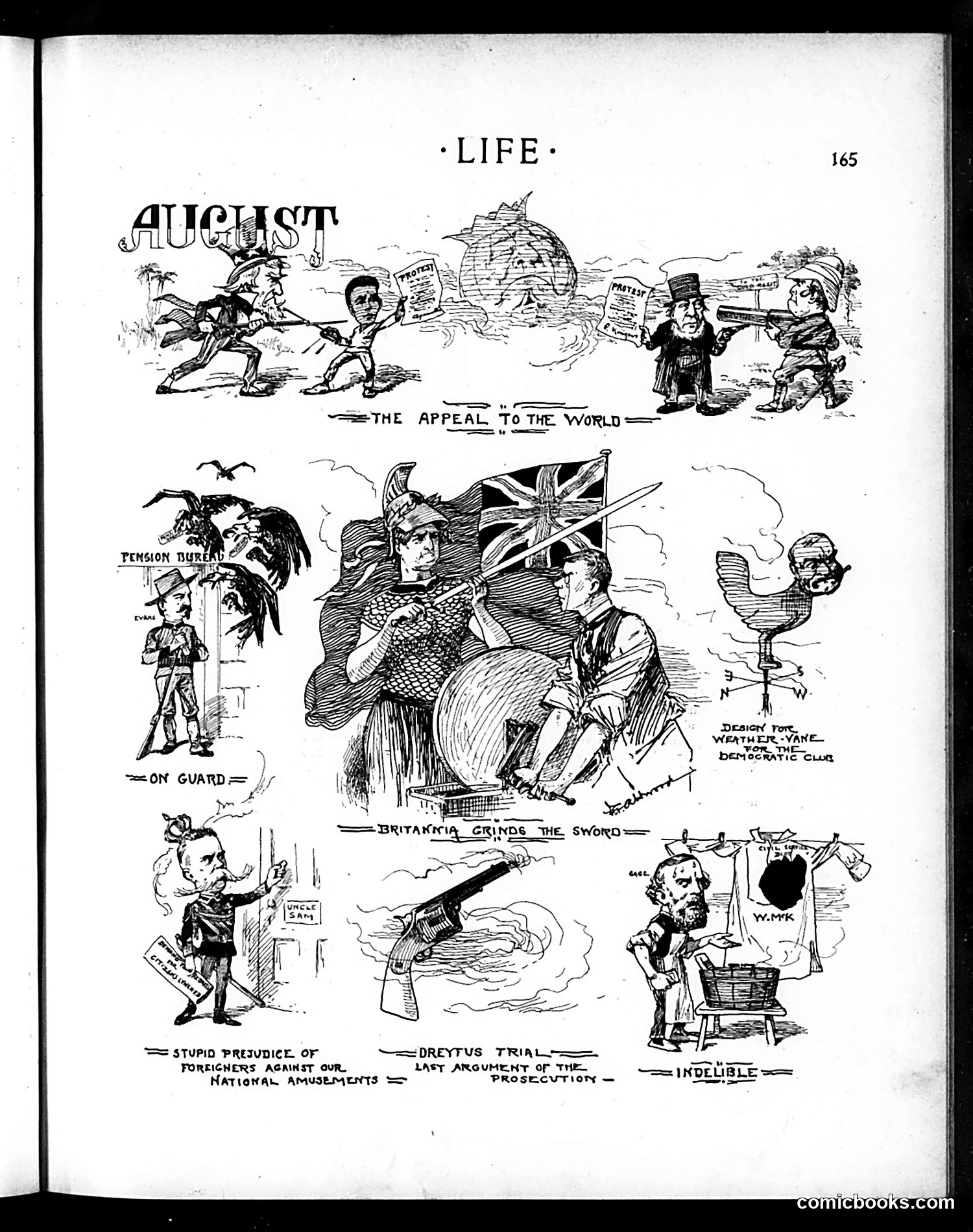
This page presents six satirical vignettes commenting on British and international tensions, likely from the early 20th century. **Top section ("The Appeal to the World")**: Depicts various figures—apparently representing different nations or interests—making competing claims. **"Britannia Grinds the Sword"**: Shows Britannia (Britain personified) sharpening weapons, suggesting military preparation. **"On Guard"**: A soldier at attention, labeled regarding "Tension Ruling." **"Stupid Prejudice of Foreigners Against Our National Amusements"**: Critiques foreign criticism of British activities. **"Dreytus Trial—Last Argument of the Prosecution"**: References the infamous Dreyfus Affair, a French military scandal. **"Indelible"**: Shows what appears to be laundry or cleaning, likely a pun about stains or marks. The overall theme emphasizes British military readiness amid international conflict and contemporary scandals.
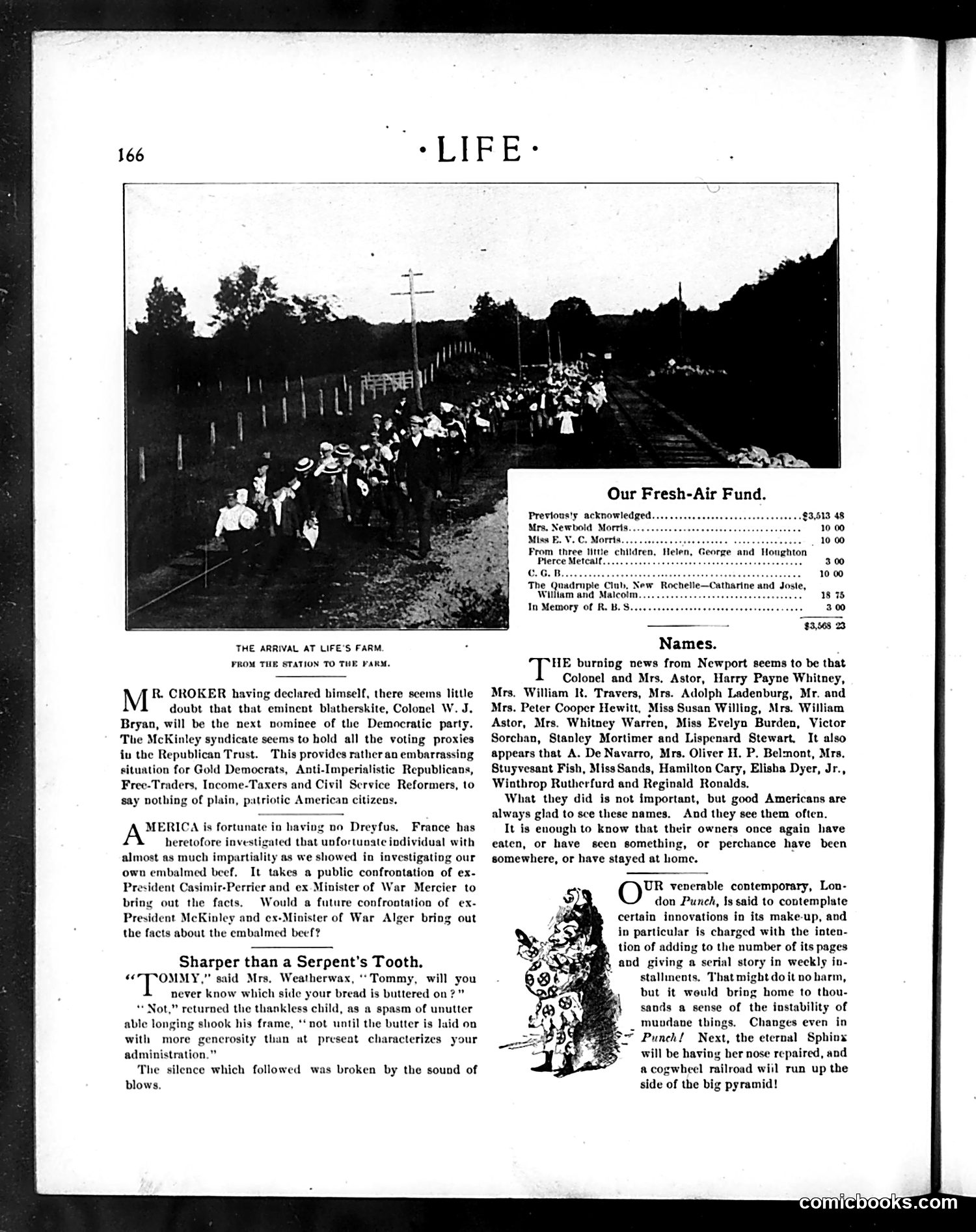
This page combines social commentary with humor typical of early 20th-century American satire. **"The Arrival at Life's Farm"** photograph shows a large crowd arriving by rail—appearing to reference a charitable or social welfare initiative ("Fresh-Air Fund" donations listed). **Political content**: The article on Colonel W.J. Bryan discusses Democratic Party politics and voting proxies within the Republican Trust, suggesting internal party corruption or manipulation concerns relevant to the era. **"Sharper than a Serpent's Tooth"** presents domestic humor: a child ("Tommy") refuses to eat butter, prompting his mother's sharp rebuke about ingratitude and generosity—a common moralizing theme in period humor about children and parental authority. The tone reflects Progressive-era concerns about political reform and traditional family values.
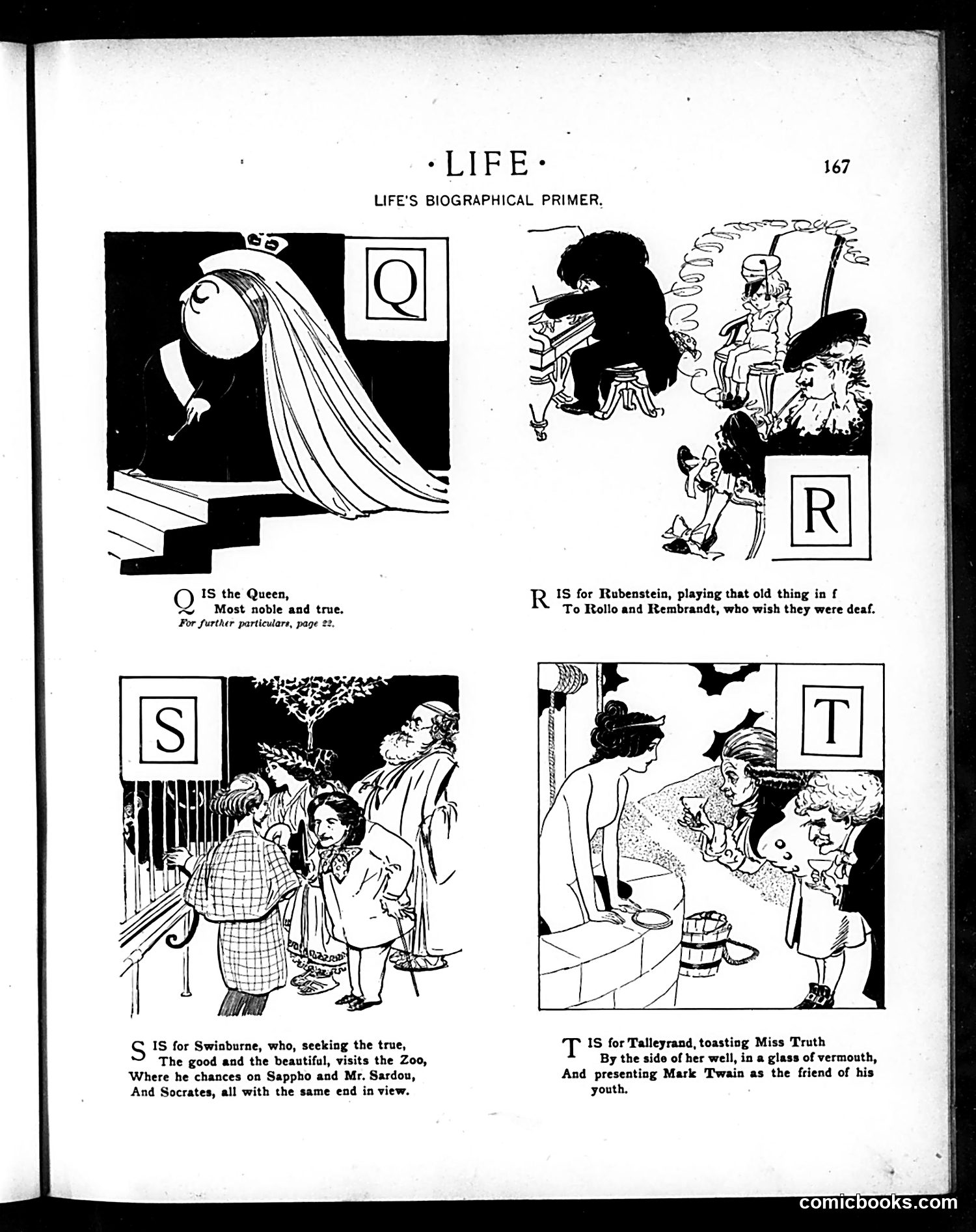
This is a satirical alphabet page from *Life* magazine presenting caricatured biographical sketches of notable figures: **Q - The Queen**: Depicted with exaggerated features and long hair, labeled "Most noble and true." **R - Rubenstein**: Shown playing music, with a joke about wishing "Rollo and Itembrand...were deaf." **S - Swinburne**: A literary figure visiting the zoo, seeking "the true, the good and the beautiful," with references to classical philosophers (Sappho, Socrates). **T - Talleyrand**: Toasting "Miss Truth" with Mark Twain, in a glass of vermouth. These are humorous biographical sketches mixing real historical/contemporary figures with satirical commentary on their characteristics, pretensions, or public personas. The format suggests this was educational satire aimed at readers familiar with these notable personalities.
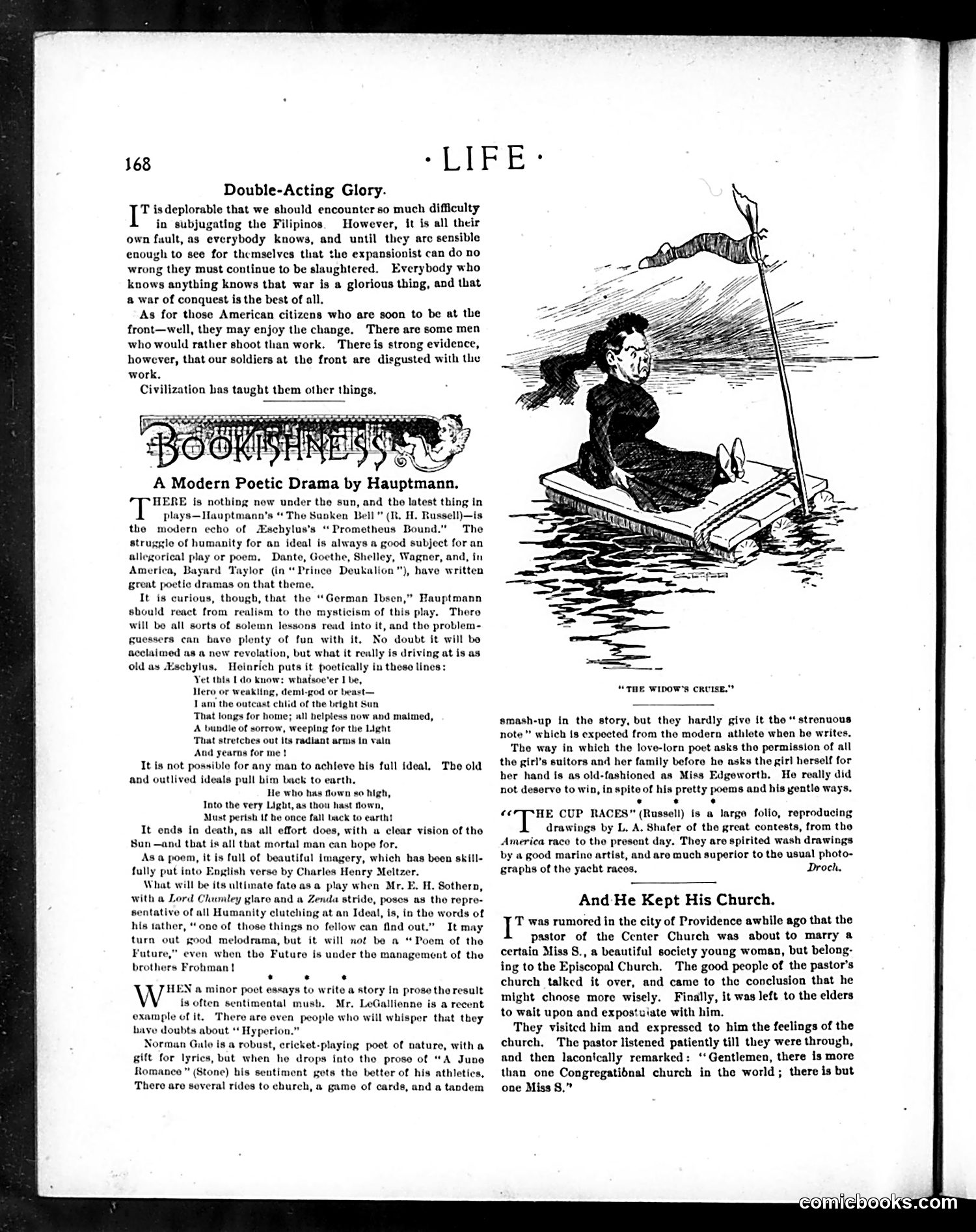
This cartoon depicts a woman in a small boat on rough waters, labeled "The Widow's Cruise." Based on the surrounding text discussing American expansionism and the Philippines, this appears to be political satire about American foreign policy. The "widow" likely represents America or a specific American political position regarding colonial expansion. The precarious boat on turbulent seas suggests the dangers or instability of the nation's aggressive imperial ventures, particularly in the Philippines, which the page's opening text explicitly discusses. The cartoon critiques American militarism and expansionism as reckless and unstable—a "widow" in peril rather than a confident, stable nation. It reflects early 20th-century American anti-imperialist sentiment opposing overseas military interventions.
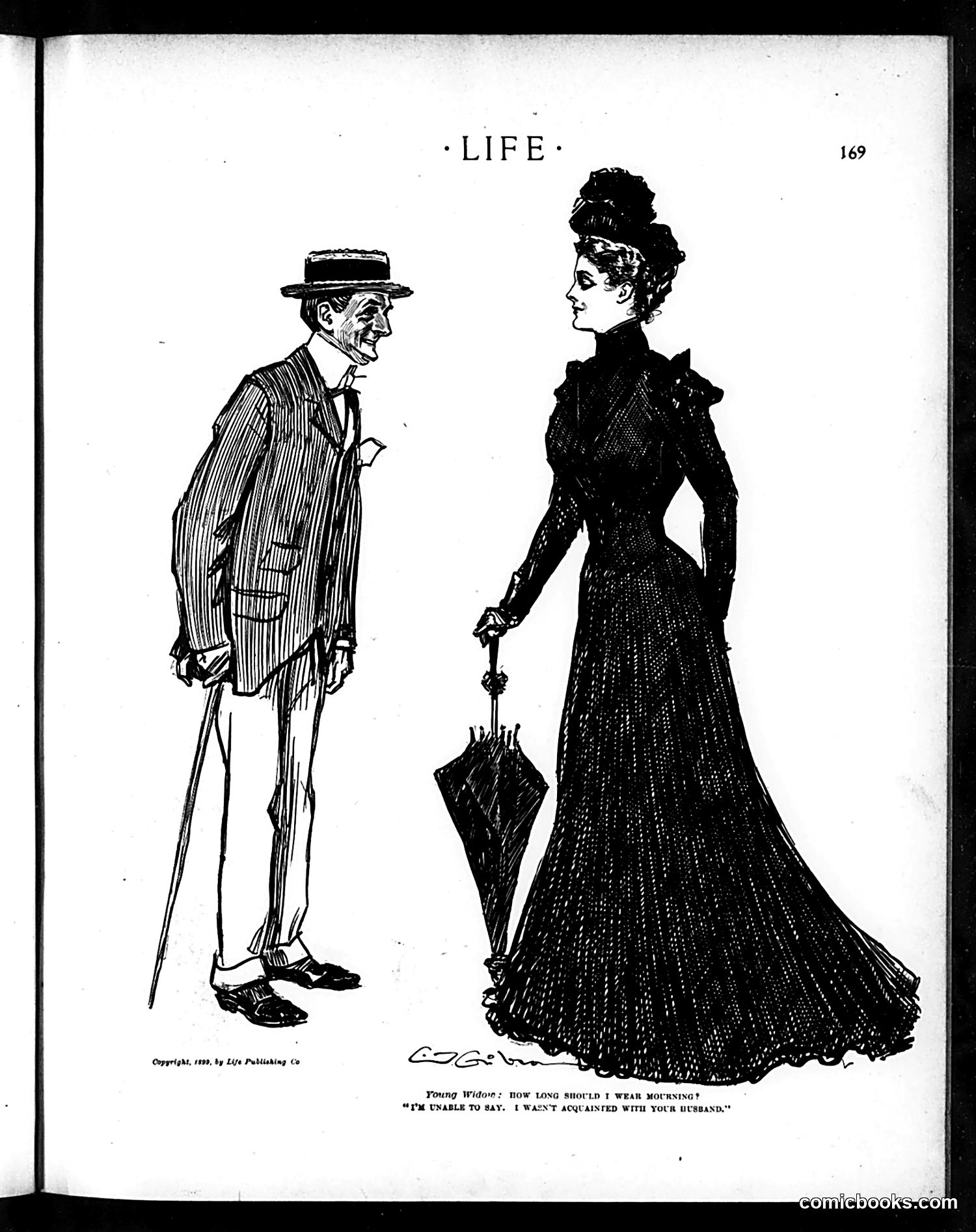
This is a single satirical cartoon from *Life* magazine (page 169). The caption reads: "Young Widow: 'HOW LONG SHOULD I WEAR MOURNING?' 'I'M UNABLE TO SAY. I WAN'T ACQUAINTED WITH YOUR HUSBAND.'" The joke hinges on a social convention of the period: widows were expected to wear black mourning clothes for a specified duration after their husband's death. The man (appearing to be an older gentleman or family advisor) cannot answer her question because he didn't know her late husband—making it impossible to judge his character or worth. The implication is darkly comic: the duration of mourning was supposedly proportional to how much the widow valued her husband, so his ignorance prevents assessment. This satirizes both rigid mourning etiquette and suggests skepticism about widows' genuine grief versus social performance.
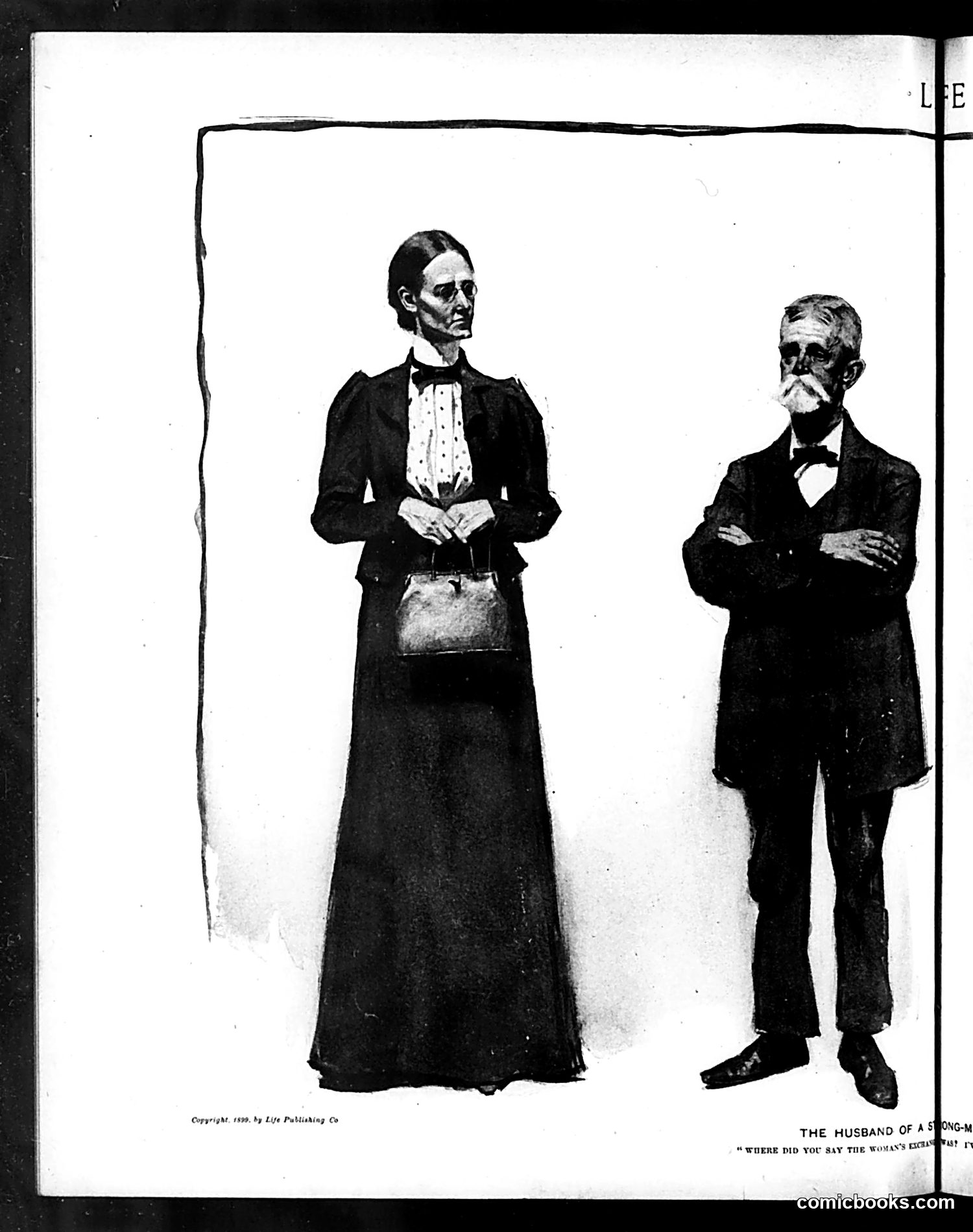
This appears to be a satirical illustration titled "The Husband of a Strong-Minded Woman" (text partially visible at bottom). The image depicts two figures in formal late 19th or early 20th-century dress: a tall woman on the left in an assertive pose, and a man on the right with arms crossed in a defensive or resigned stance. The satire targets the "New Woman" movement and women's rights advocacy of that era. The "strong-minded woman" (likely a suffragist or feminist) is portrayed as domineering, while her husband appears emasculated and subordinate. This reflects period anxieties about shifting gender roles—the cartoon mocks both the woman's assertiveness and implies the husband has lost masculine authority in the relationship. The joke relies on contemporary gender stereotypes to criticize women's independence movements.
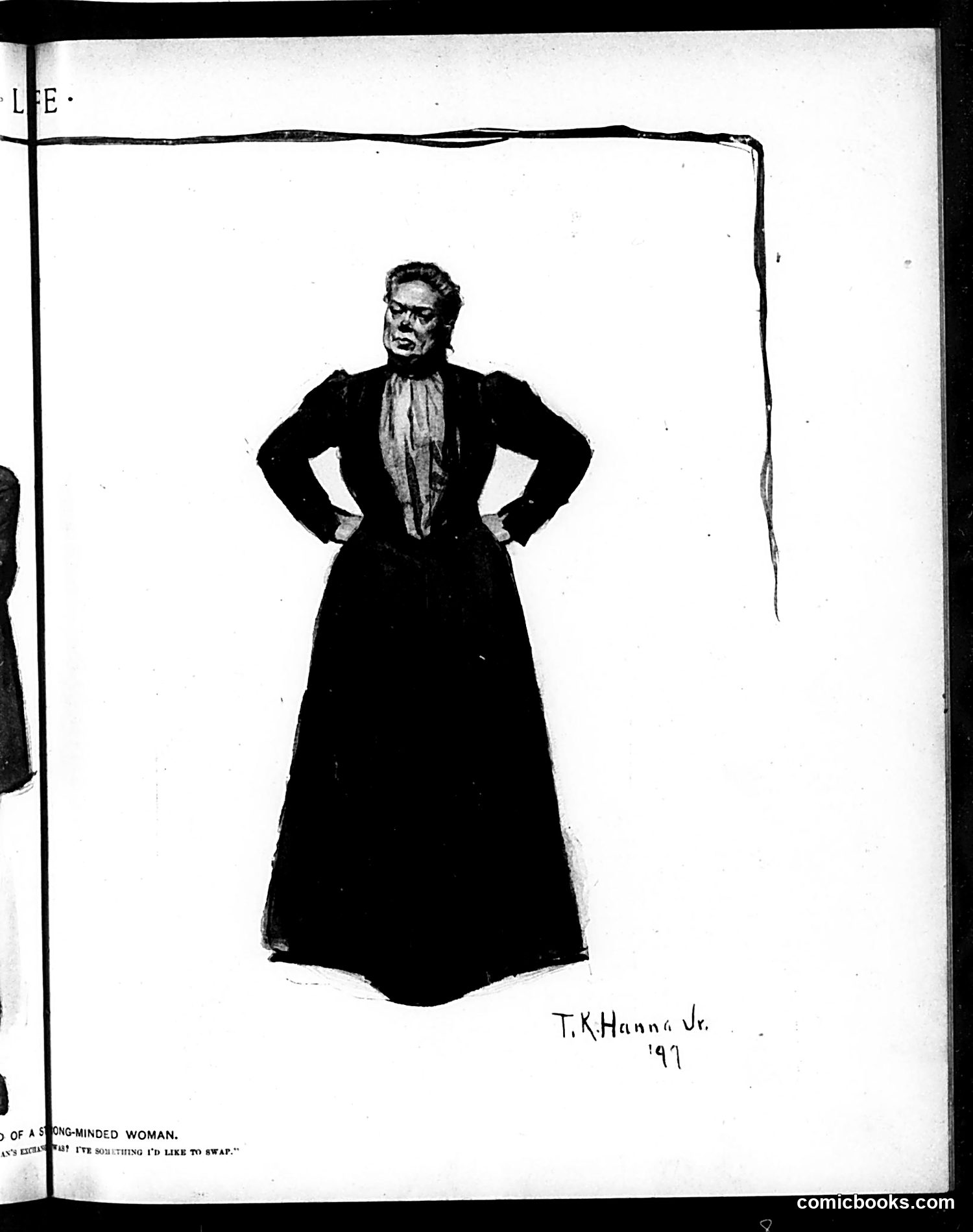
This appears to be a satirical illustration by T.K. Hanna Jr. (signed and dated '99, likely 1899) from *Life* magazine. The image shows a woman in Victorian dress standing with hands on hips in a confident, assertive pose. The partial caption visible at bottom references "a strong-minded woman" and mentions "something I'd like to swat," suggesting the cartoon satirizes the "New Woman" movement of the 1890s—particularly women advocating for independence, education, and voting rights. The figure's bold stance and dark clothing seem designed to mock feminist activists of the era. The "strong-minded woman" was a common target of period satire, with opponents using caricature to ridicule women's rights advocates as unfeminine or threatening to traditional gender roles.
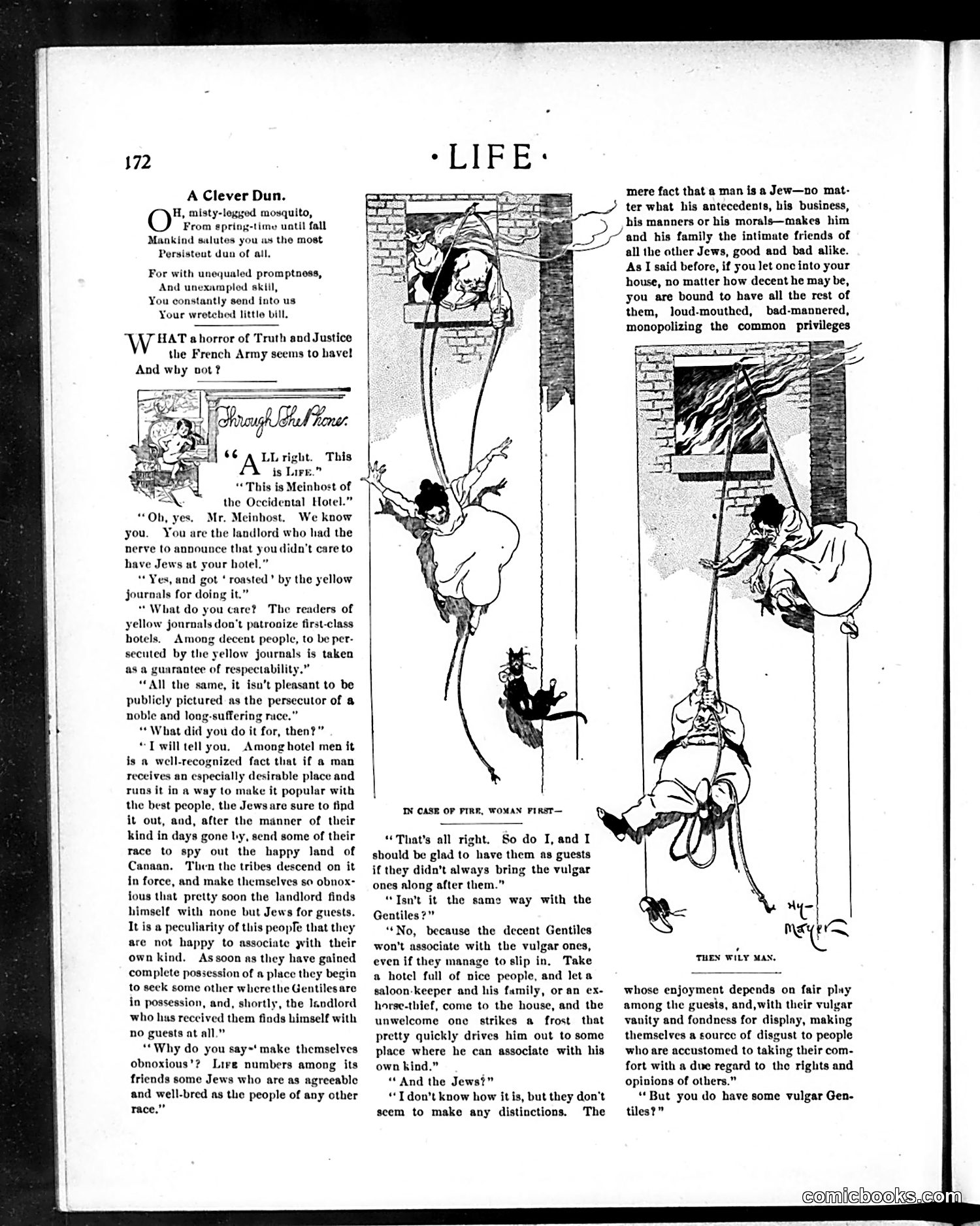
This page satirizes antisemitic hotel discrimination practices. The dialogue between a hotel manager ("Meinhost") and a guest debates whether Jewish guests should be admitted to respectable establishments. The guest argues that excluding Jews based on religion is unjust, comparing it to how decent gentiles don't want to associate with "vulgar" ones—implying that character, not ethnicity, should determine acceptability. The manager defends discriminatory practices by claiming Jewish guests damage a hotel's reputation and drive away other patrons, even if they're wealthy and well-behaved. The cartoon's point appears critical of these prejudices, exposing the illogical and cruel nature of religious discrimination through this pointed debate. The illustrations showing people hanging from a building emphasize the absurdity and cruelty being satirized.
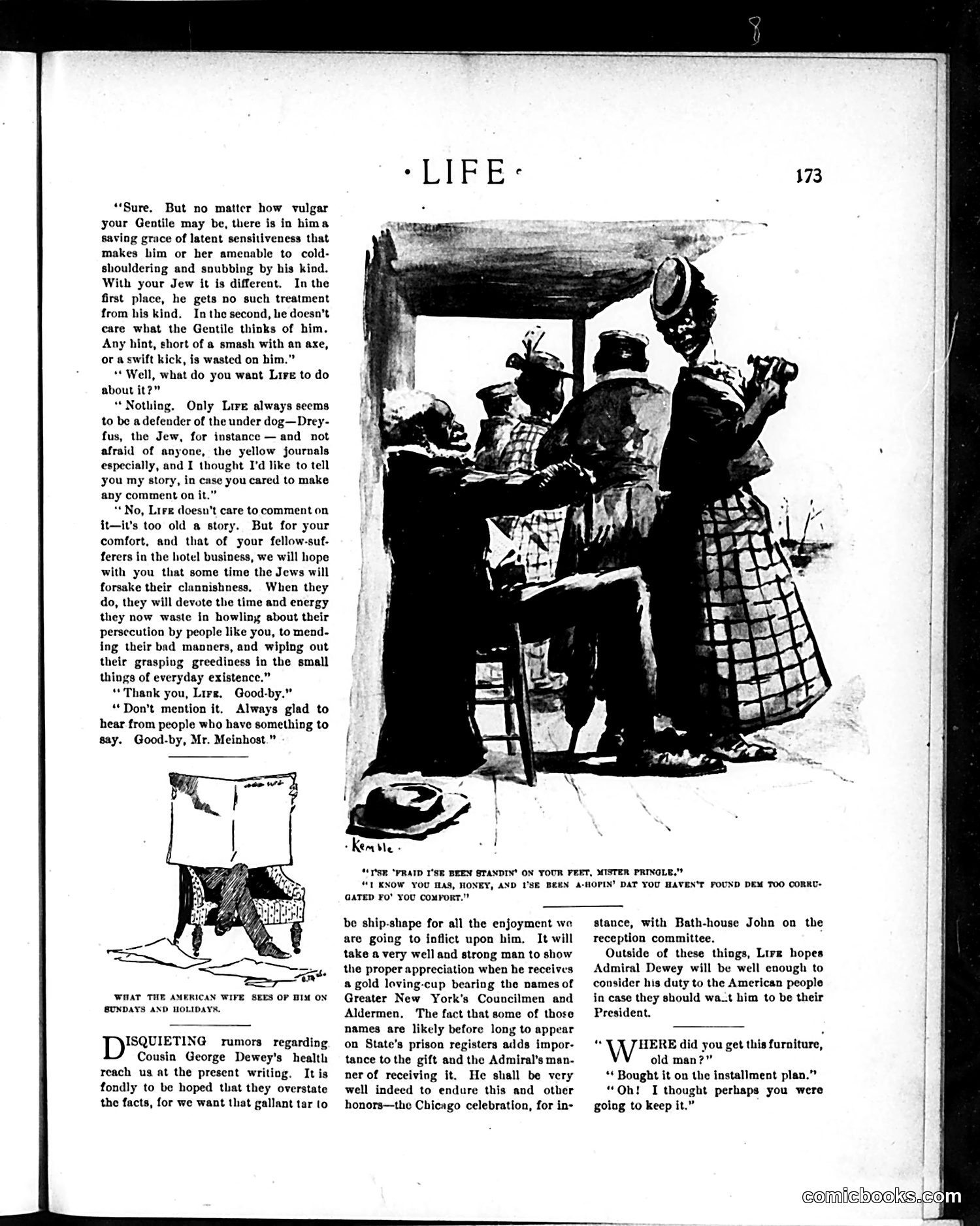
This page contains satirical commentary and two distinct cartoons reflecting early 1900s social prejudices. **Main Text Dialogue**: A hotel proprietor complains to *Life* magazine about Jewish guests, claiming they're thick-skinned to social snubbing unlike "Gentiles." The proprietor wants *Life* to criticize Jewish "clannishness" and "grasping greediness." *Life's* response defends the underdog (referencing the Dreyfus Affair) while surprisingly accepting some stereotypes, hoping Jews will "forsake their clannishness." **Left Cartoon**: Titled "What the American Wife Sees of Him on Sundays and Holidays"—depicts a man relaxing, satirizing how husbands behave at home versus in public. **Right Cartoon**: Shows two figures in dialect, likely mocking working-class or immigrant speech patterns, discussing standing on someone's feet. **Bottom Text**: Discusses Admiral Dewey's health and an upcoming gold loving-cup gift from New York officials—some of whom may face prison, adding ironic commentary. The page exemplifies *Life's* satirical approach: addressing social issues while itself reflecting period prejudices.
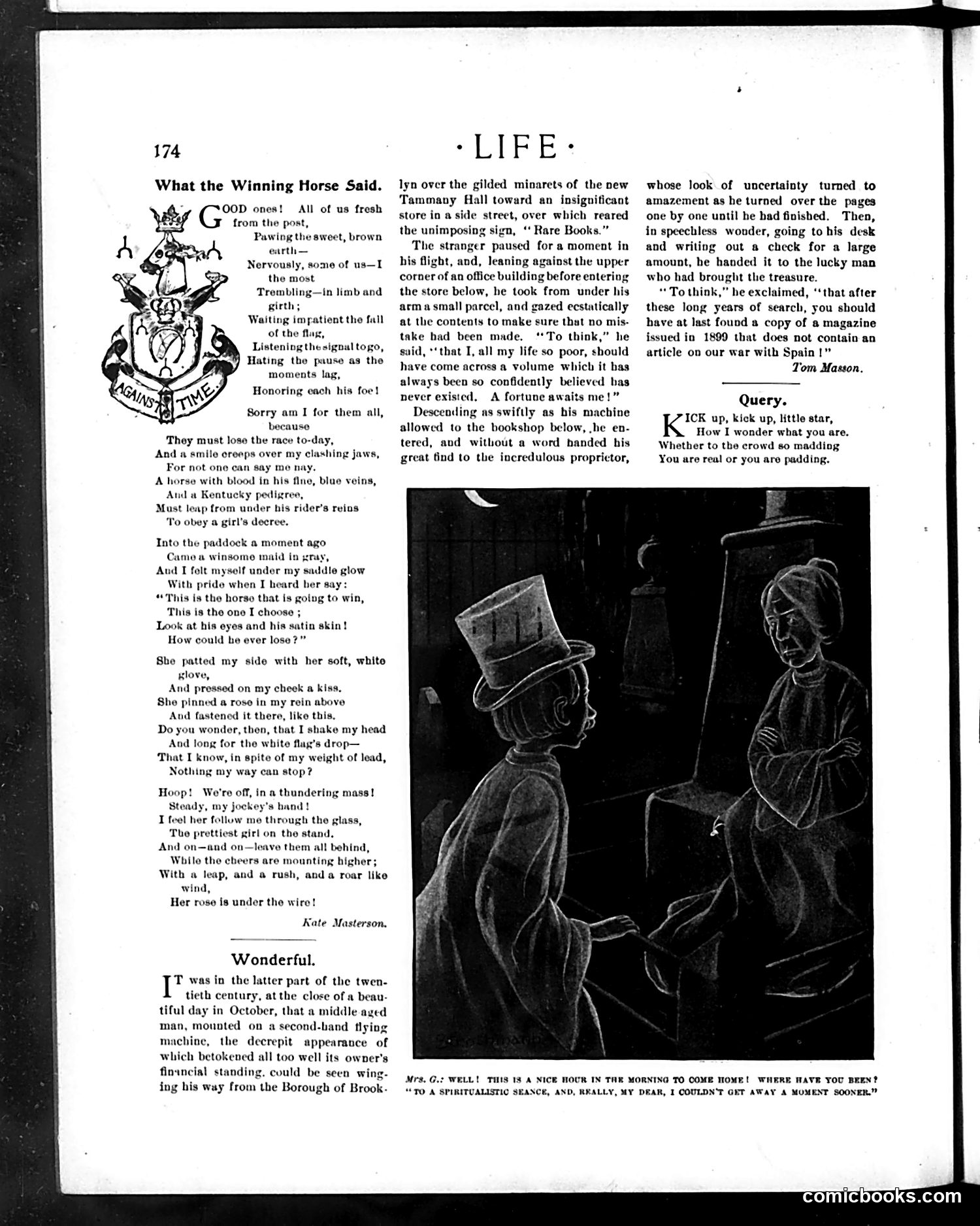
This page contains three pieces of satirical content: **"What the Winning Horse Said"** (poem by Kate Masterson): A sentimental verse from a racehorse's perspective, romanticizing how a young woman's attention and encouragement inspires the animal to victory. The satire mocks the era's sentimental attachment to romantic notions of devotion and fate. **"Wonderful"** (by Tom Masson): Science fiction satire set in the "twentieth century" (future from Life's perspective). A poor man discovers a miraculous artifact—a 1899 magazine *without* an article about the Spanish-American War. The joke satirizes Life magazine's obsessive coverage of the recent conflict (1898), suggesting such complete absence would be impossible and therefore priceless. It's self-aware mockery of the magazine's own editorial priorities. **"Query"** and the cartoon: A brief joke about spiritualism fads. The cartoon shows a woman returning home at an odd hour, claiming she attended a séance and "couldn't get away a moment sooner"—obvious nonsense used as an excuse, satirizing both spiritualism's popularity and marital deception.
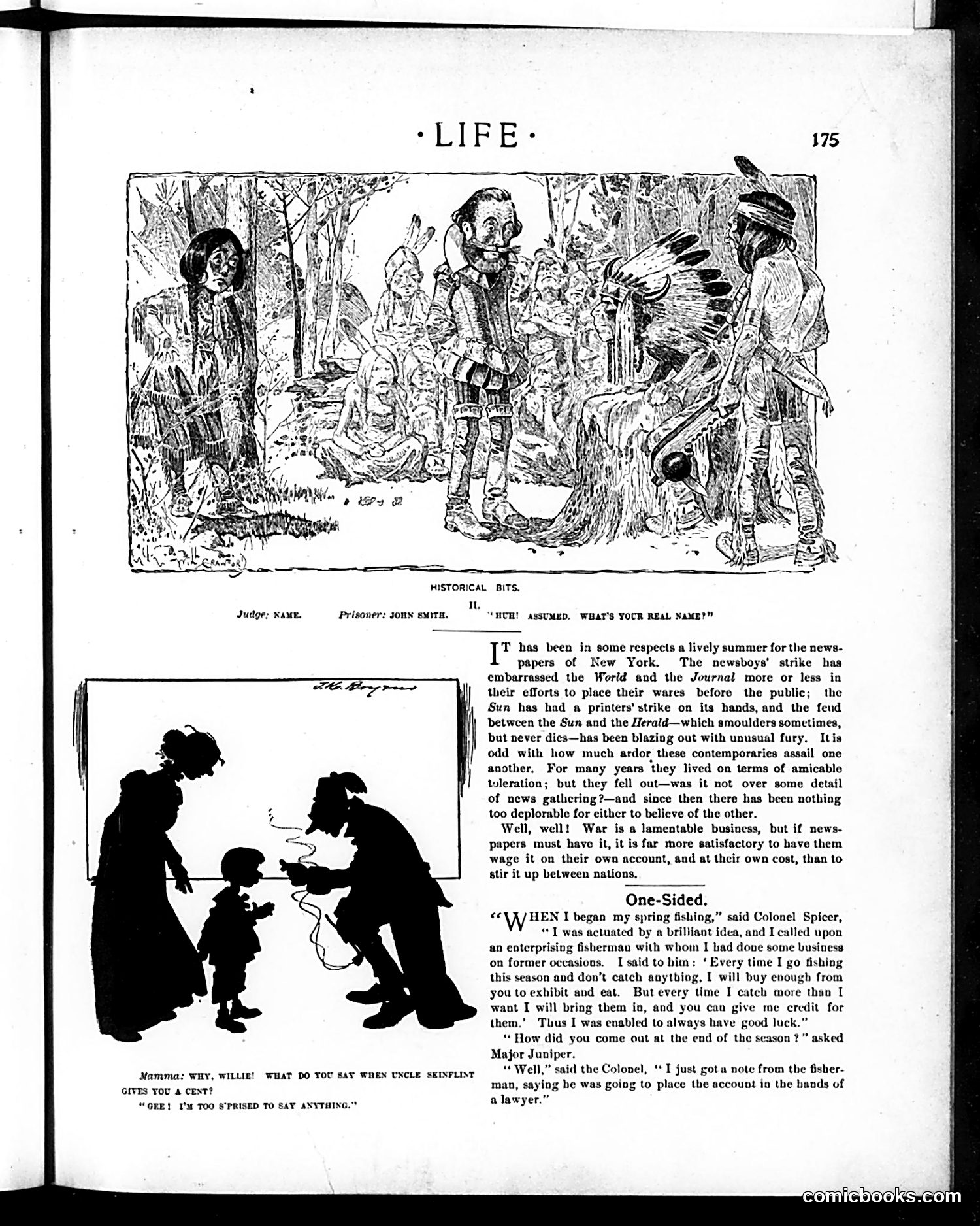
This page contains two satirical cartoons addressing contemporary issues: **Top cartoon ("Historical Bits"):** Depicts a courtroom scene where a judge questions prisoner "John Smith," who claims his "real name" is assumed. This appears to satirize the newspaper wars among New York papers (the World, Journal, Sun, and Herald), referenced in the accompanying text. The cartoon likely mocks how these rival publications engaged in fierce competition and mudslinging, questioning each other's credibility and legitimacy—treating them as fraudsters hiding their true identities. **Bottom cartoon:** Shows a child refusing to answer his mother about receiving money from "Uncle Skinflint," saying he's "too s'prised." This humorous domestic scene illustrates a common social anxiety about stingy relatives—the joke being the child is so shocked by generosity from a notoriously cheap uncle that he's speechless. The accompanying "One-Sided" story satirizes a fishing scheme where a man arranges one-sided bargains, ultimately getting sued by the fisherman—mocking the illusion of getting "good luck" through manipulative deals.
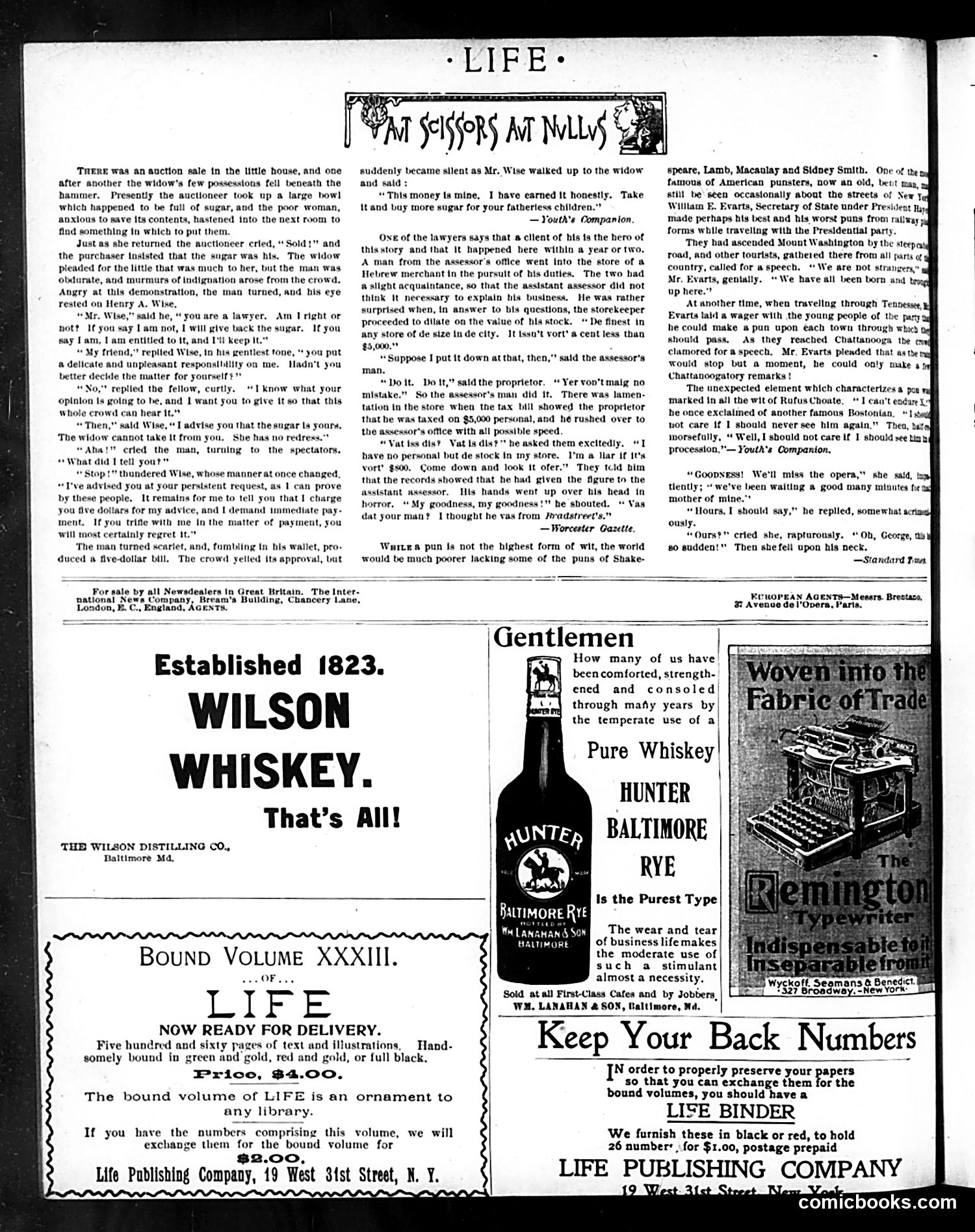
This page from *Life* magazine presents two humorous anecdotes illustrating legal and moral cleverness, likely from the late 19th or early 20th century. **First Story**: A lawyer named Henry A. Wise is asked to arbitrate an auction dispute where a man claims sugar the widow couldn't remove in time. Wise advises the man he's legally correct—then charges him five dollars for the opinion and gives the money to the widow. The satire mocks legalism divorced from justice: technically correct but morally wrong advice can be exposed and punished through wit. **Second Story**: An assessor's assistant mistakes a Hebrew merchant's boastful exaggeration about his stock value ($5,000) for an actual assessment, creating an inflated tax bill. The merchant's horror and the assistant's misunderstanding satirize both inflated claims and bureaucratic gullibility. Both tales celebrate common sense and moral cleverness triumphing over rigid legalism or careless authority—a popular theme in period American humor.
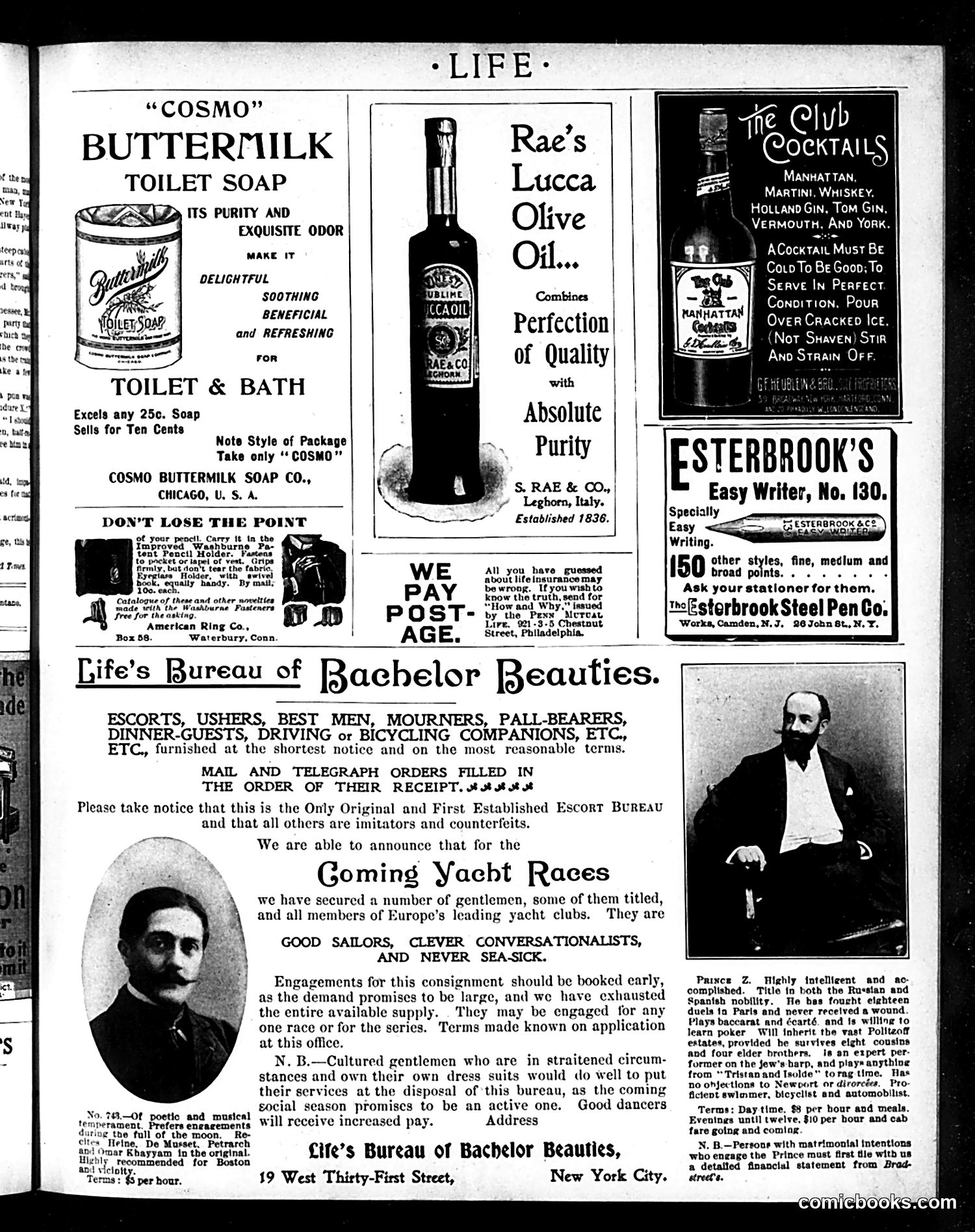
This page is primarily **advertising and satirical content** from an early 1900s Life magazine. The main feature is "Life's Bureau of Bachelor Beauties"—a humorous mock-escort service that rents out gentlemen for social functions (weddings, dinners, yacht races, etc.). The satire targets **wealthy idle bachelors and social pretension**. The advertisement offers "escorts, ushers, best men" and specifically for "Coming Yacht Races," promising titled European gentlemen who are "good sailors" and "never sea-sick." One featured client is "Prince Z.," described with absurdly detailed credentials: a Russian-Spanish nobleman who survived eighteen duels, plays baccarat, and performs on the Jew's-harp. The joke satirizes the Gilded Age obsession with European nobility, the performative nature of high society, and the apparent availability of impoverished aristocrats willing to hire themselves out for social occasions. The remainder of the page consists of period advertisements for toilet soap, olive oil, cocktail recipes, and fountain pens—typical early 1900s consumer goods.
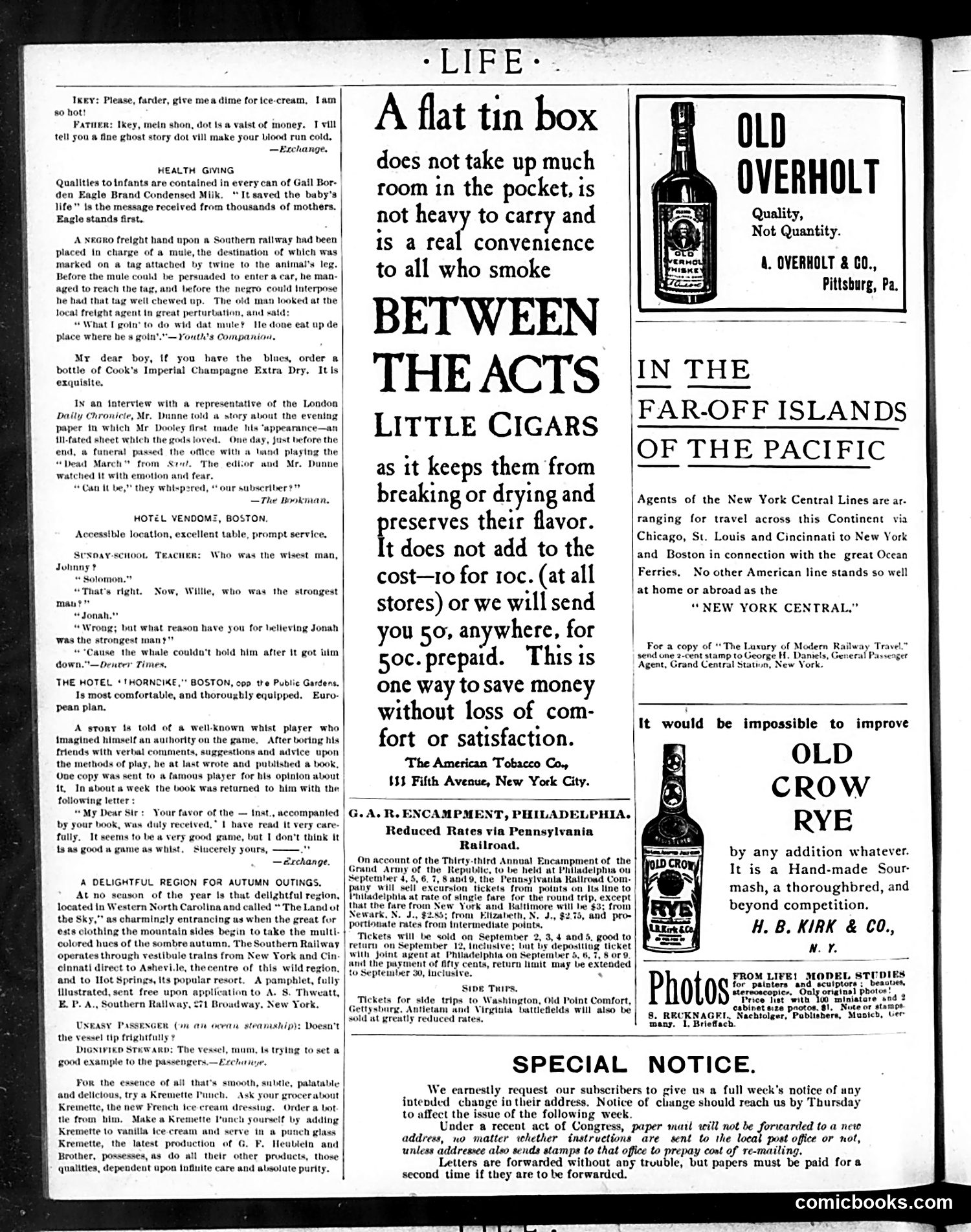
This page is primarily **advertising and humorous anecdotes** rather than political satire. The content includes: **Humor pieces**: Brief jokes using ethnic stereotypes common to the era—notably a "Ikey/Patuer" dialogue employing Yiddish-inflected speech to mock Jewish immigrants ("dot is a valst of money"), and a "negro freight hand" story using racist dialect. These reflect early 20th-century American magazine humor conventions that relied on caricatured ethnic and racial speech patterns. **Advertisements**: Multiple product ads (condensed milk, champagne, cigars, whiskey, railway travel) dominate the page. **Hotel/resort promotions and classified notices** complete the layout. The page lacks coherent political cartooning or pointed satire—instead offering light, stereotype-dependent humor typical of Life magazine's populist entertainment approach during this period.
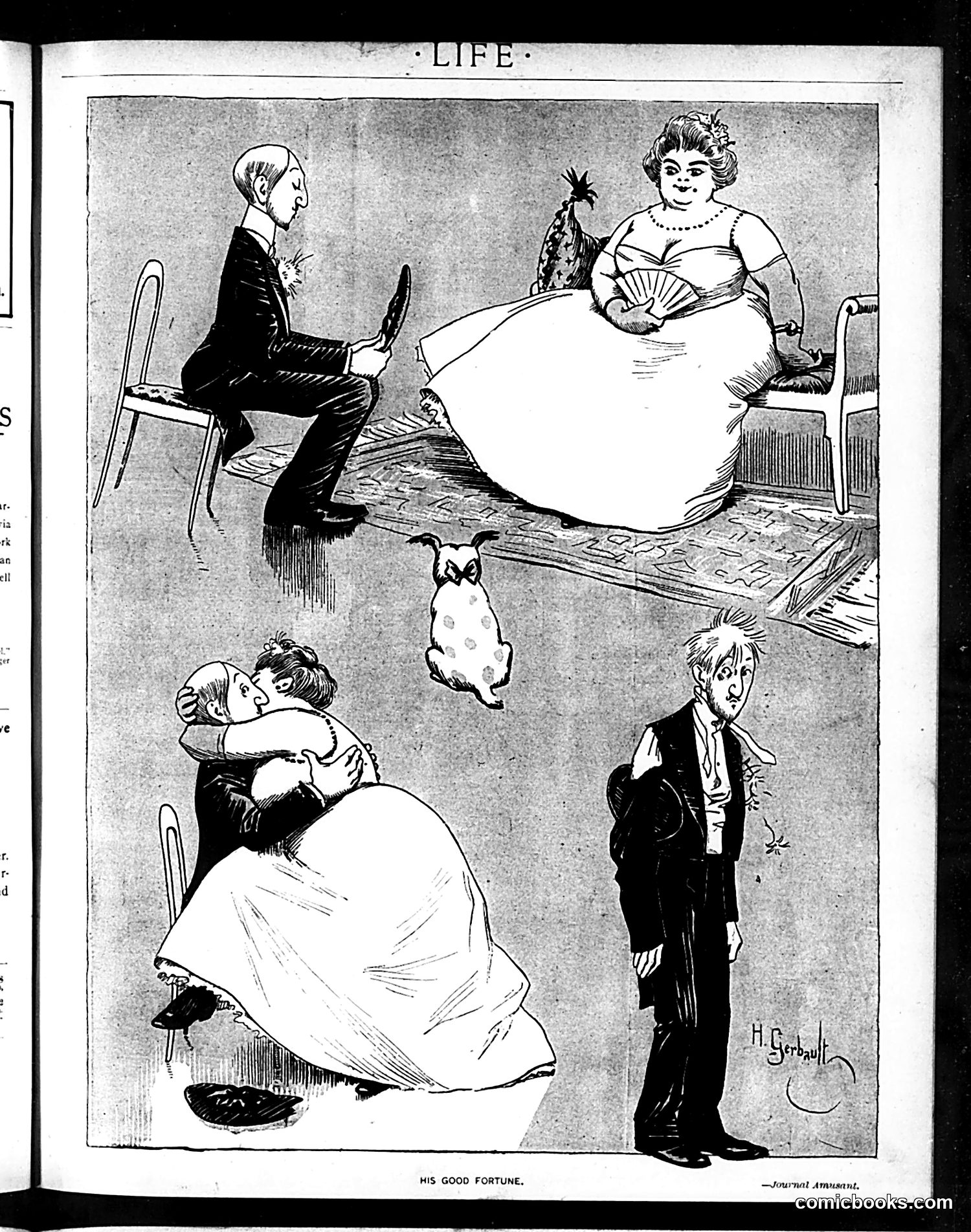
This satirical cartoon depicts a domestic scene titled "His Good Fortune." A thin, gaunt man in formal attire sits across from a corpulent woman in an elaborate dress, who holds a fan and appears to be a wealthy widow or society woman. Below, another scene shows the same man cradling a child while a woman sits nearby, and a separate figure stands apart looking dejected. The satire likely mocks fortune-hunting or social climbing—the "good fortune" being the man's advantageous romantic or financial situation through marriage to a wealthy woman. The contrast between his lean appearance and her substantial wealth, combined with the child and other figures, suggests commentary on matrimonial opportunism or the social dynamics of marriage for financial gain in the era. The cartoon's cynical tone critiques such mercenary relationships.
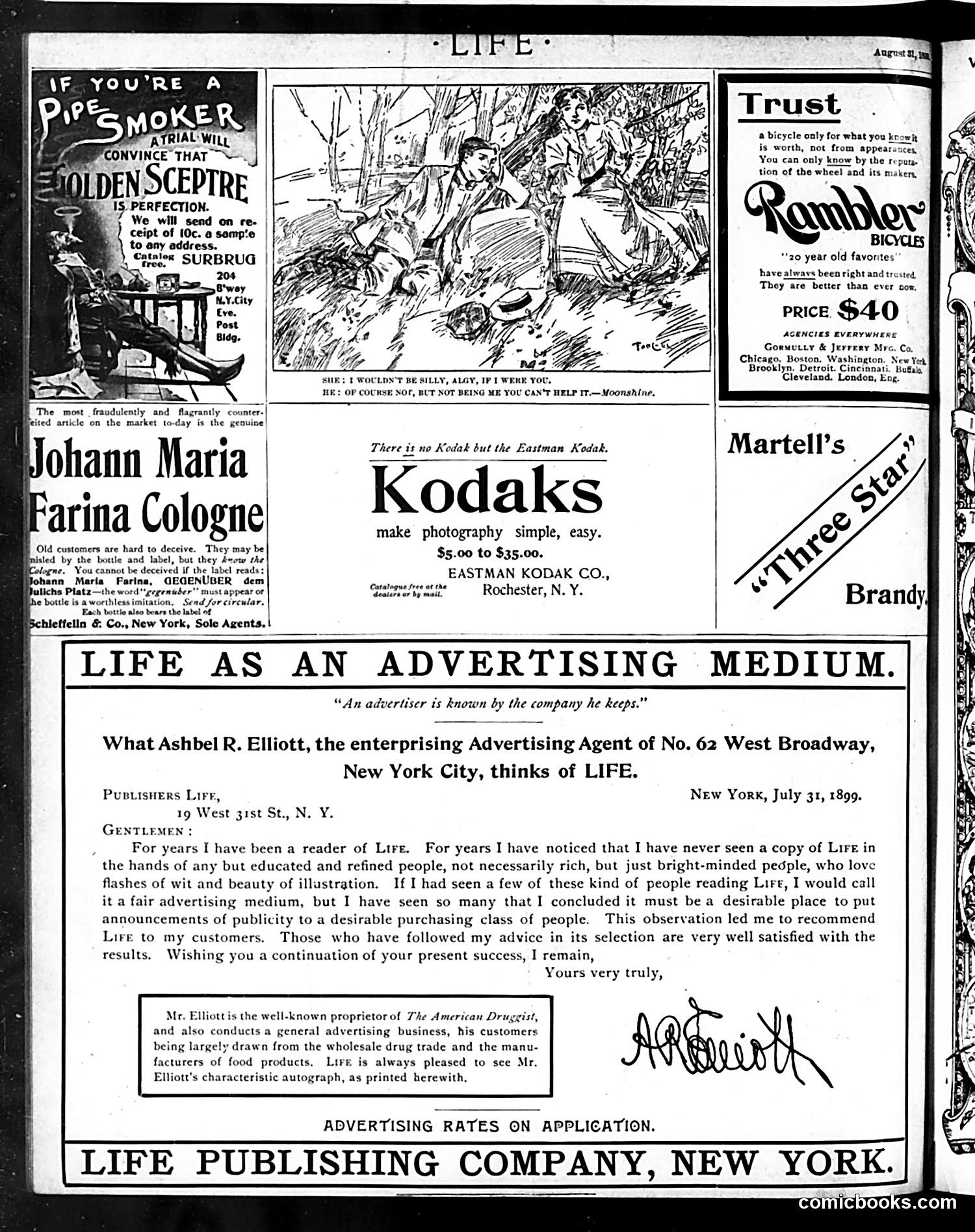
This page combines advertisements with satirical content typical of Life magazine's format. **The Main Cartoon** depicts a couple in a romantic woodland setting. The caption reads: "She: I wouldn't be silly, Algy, if I were you. / He: Of course not, but not being me you can't help it." This is genteel Victorian-era humor mocking male foolishness in courtship—the joke being that the man can't help being silly because he's himself, not her. **The Advertisements** showcase products marketed to educated, affluent consumers: Golden Sceptre pipes, Rambler bicycles ($40), Johann Maria Farina cologne, and Kodak cameras ($5-$35). Notably, the lengthy testimonial from advertising agent Ashbel R. Elliott claims *Life* magazine reaches only "educated and refined people"—essentially arguing that advertising in Life reaches desirable, wealthy customers. This self-promotional piece subtly validates Life's advertising value through endorsement. The page demonstrates Life's dual purpose: sophisticated humor and entertainment for upscale readers, packaged as an advertising vehicle for luxury goods.