
Life, 1899-08-31 · page 8 of 20
Life — August 31, 1899 — page 8: what you’re looking at
What you’re looking at
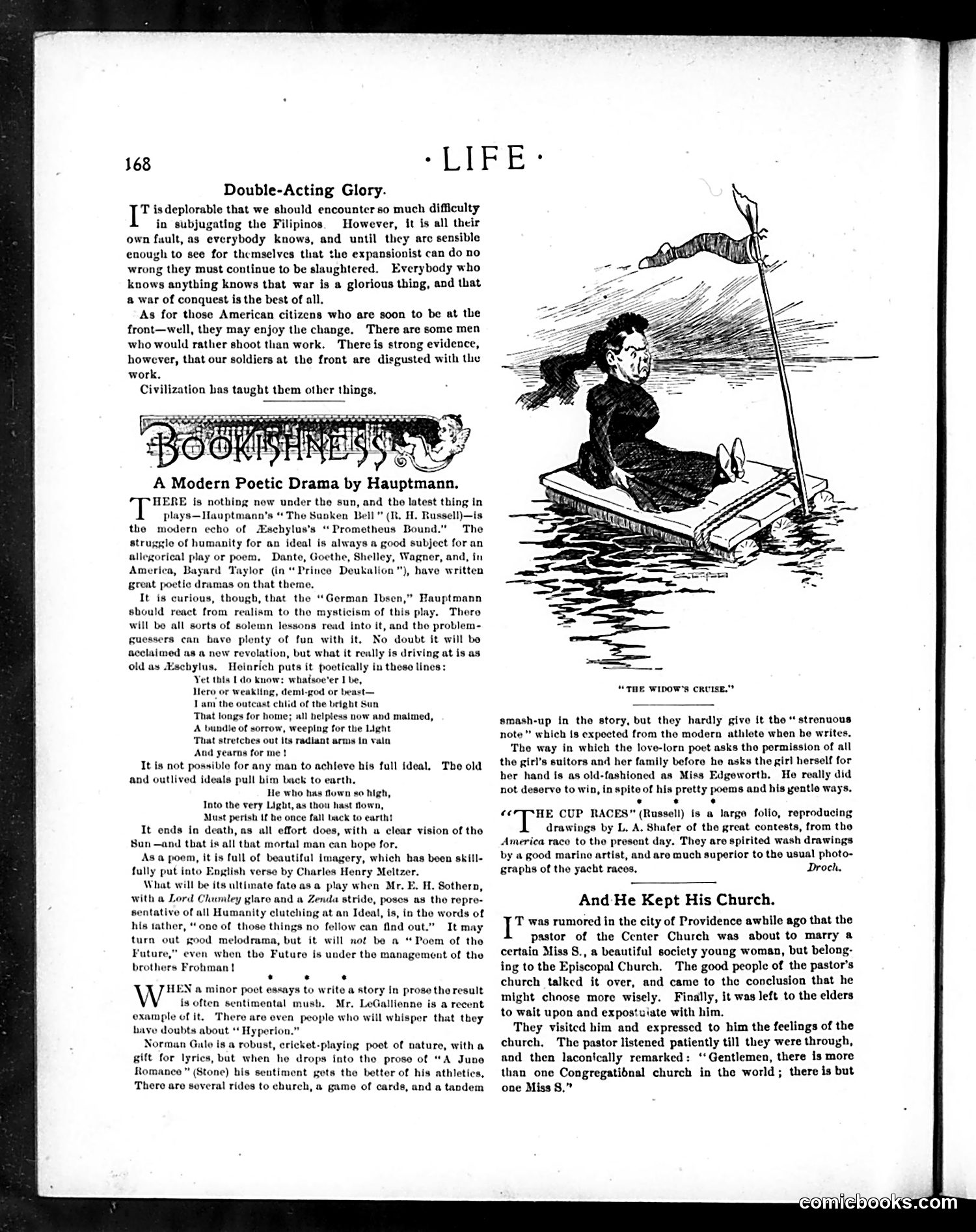
This cartoon depicts a woman in a small boat on rough waters, labeled "The Widow's Cruise." Based on the surrounding text discussing American expansionism and the Philippines, this appears to be political satire about American foreign policy. The "widow" likely represents America or a specific American political position regarding colonial expansion. The precarious boat on turbulent seas suggests the dangers or instability of the nation's aggressive imperial ventures, particularly in the Philippines, which the page's opening text explicitly discusses. The cartoon critiques American militarism and expansionism as reckless and unstable—a "widow" in peril rather than a confident, stable nation. It reflects early 20th-century American anti-imperialist sentiment opposing overseas military interventions.
📄 Transcribed text from this page (OCR, searchable)
Machine-transcribed from the original scan — historical spelling and the odd misread are preserved.
168 Double-Acting Glory. I’ isdeplorable that we should encounter so much difficulty in subjugating the Filipinos. However, it is all their own fault, as everybody knows, and until they arc sensible enough to see for themselves that the expansionist can do no wrong they must continue to be slaughtered. Everybody who knows anything knows that war is a glorious thing, and that a war of conquest is the best of all. As for those American citizens who are soon to be at the front—well, they may enjoy the change. There are some men who would rather shoot than work. There is strong evidence, however, that our soldiers at the front are disgusted with the work. Civilization bas taught them other things. A Modern Poetic Drama by Hauptmann. HERE is nothing now under the sun, and the latest thing in plays—Hauptmann’s “ The Sunken Bell" (RH, Russell)—is the modern echo of Zschylus’s “Prometheus Bound." The struggle of humanity for an ideal is always a good subject for an allegorical play or poem, Dante, Goethe, Shelley, Wagner, and, in America, Bayard Taylor (in “Prince Deukalion"), have written great poetic dramas on that theme, It is curious, though, that the “German Ibsen,” Hauptmann should react from realism to tho mysticism of this play. Thero will bo all sorts of solemn lessons read into it, and the problem- guessers can bave plenty of fun with it, No doubt it will be acclaimed a8 a new revelation, but what it really is driving at is as old as Eschylus, Heinrich puts it poetically in theso lines: t this Ldo know: whafsoe'er I be, Hero of weakling, demt-god or beast— Tam the outcast chiid of the bright Sun That longs for home; ll helpless now and maimed, A bundle of sorrow, weeping for the Light That stretches out its radiant arms tn vain And yearns for met It is not possible for any man to achteve his full ideal, The old and outlived ideals pull bim back to earth, He who has flown so high, Into the very Light, as thou hast own, Must perish If he once fall back to earth! It ends in death, as all effort does, with a clear vision of tho Sun —and that is all that mortal man can hope for. Asa poem, it is full of beautiful imagery, which bas been skill- fully put into English verse by Charles Henry Meltzer. What will be its ultimate fate asa play when Mr. E. H. Sothern, with a Lord Chumley glare and a Zenda stride, poses as tho repre- sentative of all Humanity clutching at an Ideal, is, in the words of his tather, “ one of those things no fellow can find out.” It may turn out good melodrama, but it will not be a “Poem of the Future,” even when tho Future is under the management of the brothers Frohman ! V HEN a minor poot essays to write a story In prose tho result is often sentimental mush. Mr. LeGallienne is a recent example of it. There are even people who will whisper that they have doubts about “ Hyperion.” Norman Gulo is a robust, cricket-playing poot of nature, with a gift for lyrics, but when he drops into the prose of “A Juno Romance" (Stone) bis sentiment gots tho better of his athletics. There aro several rides to church, a game of cards, and a tandem . . . LIFE * “THE WIDOW'S CRUISE.” smash-up in tho story, but they hardly give it the“ strenuous note” which 1s expected from the modern athlete when he writes. ‘The way in which the love-lorn poet asks tho permission of all the girl's suitors and her family before ho asks the girl herself for her hand {s as old-fashioned as Miss Edgeworth. He really did not deserve to win, in spite of his pretty poems and his gentle ways. . * * «¢OPHE CUP RACES” (Russell) is a largo folio, reproducing drawings by L. A. Shafer of the great contests, from the America raco to tho presont day. They are spirited wash drawings by a good marino artist, and aro much superior to the usual photo- gtaphs of the yacht races, Droch. And He Kept His Church. iT was rumored in the city of Providence awhile ago that the pastor of the Center Church was about to marry a certain Miss S., a beautiful society young woman, but belong- ing to the Episcopal Church. The good people of the pastor's church talked it over, and came to the conclusion that he might choose more wisely. Finally, it was left to the elders to wait upon and expostuiate with him. They visited him and expressed to him the feelings of the church, The pastor listened patiently till they were through, and then laconically remarked: ‘Gentlemen, there is more than one Congregatibnal church in the world; there is but one Miss 8,”