
Life, 1899-08-31 · page 12 of 20
Life — August 31, 1899 — page 12: what you’re looking at
What you’re looking at
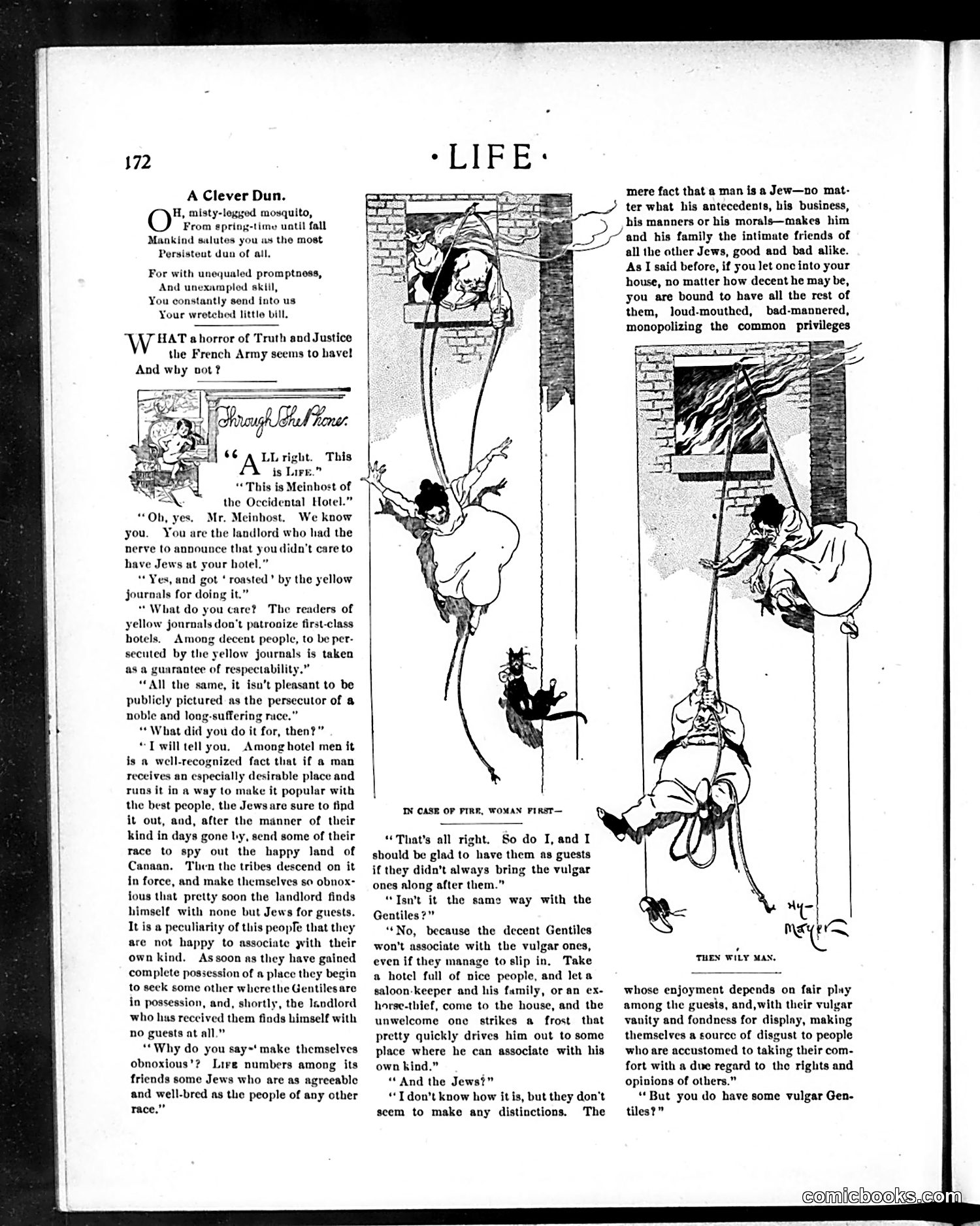
This page satirizes antisemitic hotel discrimination practices. The dialogue between a hotel manager ("Meinhost") and a guest debates whether Jewish guests should be admitted to respectable establishments. The guest argues that excluding Jews based on religion is unjust, comparing it to how decent gentiles don't want to associate with "vulgar" ones—implying that character, not ethnicity, should determine acceptability. The manager defends discriminatory practices by claiming Jewish guests damage a hotel's reputation and drive away other patrons, even if they're wealthy and well-behaved. The cartoon's point appears critical of these prejudices, exposing the illogical and cruel nature of religious discrimination through this pointed debate. The illustrations showing people hanging from a building emphasize the absurdity and cruelty being satirized.
📄 Transcribed text from this page (OCR, searchable)
Machine-transcribed from the original scan — historical spelling and the odd misread are preserved.
A Clever Dun. H, misty-legged mosquito, From epring-time until fall Mankind salutes you as the most Persisteut dun of all, For with unequaled promptnoss, And unexampled skiil, You constantly send into us Your wretched little bill. V HAT a horror of Truth and Justice the French Army seems to have! And why oot? i 66 AQ LL right A is Lire. “This is Meinbost of the Occidental Hotel.” “Ob, yes. Mr. Meinhost. We know you. You are the landlord who had the nerve to announce that you didn’t care to have Jews at your hotel.” s, and got ‘ roasted’ by the yellow journals for doing it.” “What do you care?’ The readers of yellow jonrnals don't patronize first-class hotels. Among decent people, to be per- secuted by the yellow journals is taken as a guarantee of respectability.” “‘All the same, it isu’t pleasant to be publicly pictured as the persecutor of a noble and long-suffering race.” “What did you do it for, then?” “Twill tell you. Among hotel men it is a well-recognized fact that if a man receives an especially desirable place and runs it in a way to make it popular with the best people. the Jews are sure to find it out, and, after the manner of their kind in days gone ly, send some of their race to spy out the happy land of Canaan. Then the tribes descend on it in force, and make themselves se obnox- fous that pretty soon the landlord finds himself with none but Jews for guests. It is a peculiarity of this peopfe that they are not happy to associate with their own kind. Assoon as they have gained complete possession of a place they begin to seek some other where the Gentiles are in possession, and, shortly, the Isndlord who hus received them finds himself with no guests at all.” ‘“Why do you say-' make themselves obnoxious’? Lire numbers among its friends some Jews who are as agreeable and well-bred as the people of any other race.” IN CASE OF FIRE, WOMAN PIRST— “That's all right. So do I, and I should be glad to have them as guests if they didn't always bring the vulgar ones along after them.” “Isn't it the same way with the Gentiles?” ‘‘No, because the decent Gentiles won't associate with the vulgar ones, even if they manage to slip in, Take a hotel full of nice people, and let a saloon-keeper and his family, or an ex- horse-thief, come to the house, and the unwelcome one strikes a frost that pretty quickly drives him out to some place where he can associate with his own kind.” “And the Jews?” “ T don’t know how it is, but they don't scem to make any distinctions. The mere fact that a man is a Jew—no mat- ter what his antecedents, his business, his manners or his morals—makes him and his family the intimate friends of all the other Jews, good and bad alike. As I said before, if you let onc into your house, no matter how decent he may be, you are bound to have all the rest of them, loud-mouthed, bad-mannered, monopolizing the common privileges whose enjoyment depends on fair play among the guests, and, with their vulgar vanity and fondness for display, making themselves a source of disgust to people who are accustomed to taking their com- fort with a due regard to tho rights and opinions of others.” “But you do have some vulgar Gen- tiles?”