
Life, 1899-08-31 · page 4 of 20
Life — August 31, 1899 — page 4: what you’re looking at
What you’re looking at
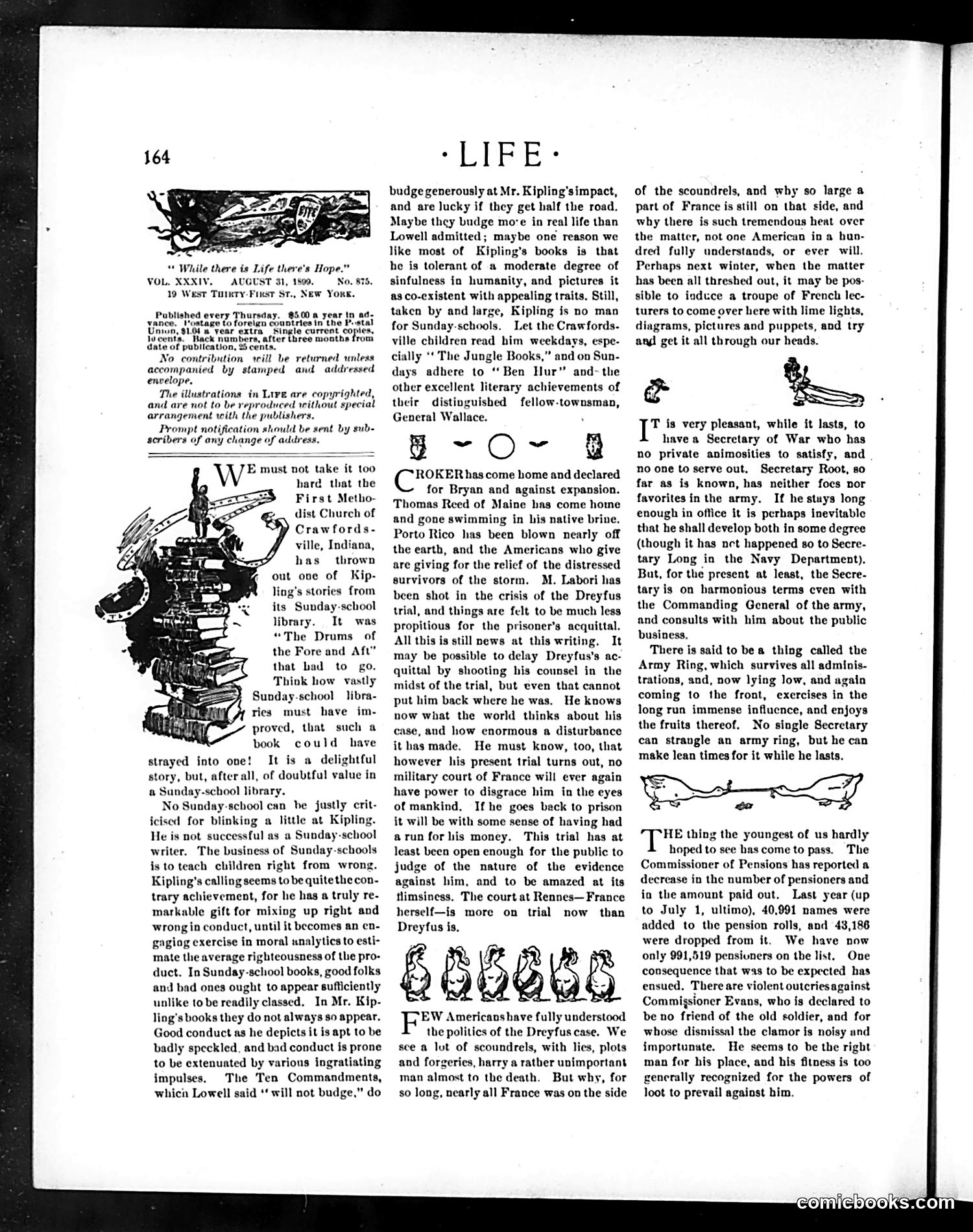
This page contains editorial commentary rather than political cartoons. The left illustration shows a stack of books labeled "The Drums of the Fore and Aft," depicting criticism of Rudyard Kipling's work in Sunday schools. The main text discusses the Dreyfus case—the French military trial of Alfred Dreyfus, a Jewish officer accused of treason. The author expresses concern that a retrial might not fully restore Dreyfus's reputation, noting France remained divided on the matter. References to "Secretary of War" and "Army Ring" suggest American readers' awareness of French institutional corruption. The final section critiques pension administration under Commissioner Evans, indicating contemporary concerns about veteran benefits and bureaucratic mismanagement. Overall, the page addresses European politics and American military governance.
📄 Transcribed text from this page (OCR, searchable)
Machine-transcribed from the original scan — historical spelling and the odd misread are preserved.
IV, AUGUST 31, 189. ON st Tunury-Finsr St., NEw YORE. Published every Thursday. $5.00 a year In ade Vostage to foreign countries in the P..stal on, $100 a year extra, single current co pies. 's. Rack numbers, after three months date of publication, 2 No contribution be returned unless accompanied by stamped and addressed envelope. The illustrations in Live are copyrighted, ani are not to be reproduced without special arrangement with the publishers, Prompt notification should be sent by sub- scribers of any change of address, E must not take it too hard that the First Metho- dist Church of Crawfords- ville, Indiana, has thrown out one of Kip- ling’s stories from its Sunday-school library. It was “The Drums of the Fore and Aft” that bad to go. Think how vastly Sunday.school libra- ries must have im- proved, that such a book could have strayed into one! It is a delightful story, but, afterall, of doubtful value in a Sunday-school library. No Sunday-school can be justly crit- icised for blinking a little at Kipling. He is not successful as a Sunday-school writer. The business of Sunday-schools is to teach children right from wrong. Kipling’s calling seems to be quite the con- trary achievement, for he has a truly re- markable gift for mixing up right and wrong in conduct, until it becomes an en- gagiog exercise in moral unalytics to esti- mate the average righteousness of the pro- duct. In Sunday-school books, good folks and bad ones ought to appear sufficiently unlike to be readily classed. In Mr. Kip- ling’s books they do not always so appear. Good conduct as he depicts it is apt to be badly speckled, and bad conduct is prone to be extenuated by various ingratiating impulses. The Ten Commandments, which Lowell said “ will not budge,” do LIFE budge generously at Mr. Kipling’simpact, and are lucky if they get half the road. Maybe they budge more in real life than Lowell admitted; maybe one reason we like most of Kipling’s books is that he is tolerant of a moderate degree of sinfulness ia humanity, and pictures it as co-existent with appealing traits, Still, taken by and large, Kipling is no man for Sunday-schools. Let the Crawfords- ville children read him weekdays, espe- cially “‘ The Jungle Books,” and on Sun- days adhere to ‘Ben Hur” and- the other excellent literary achievements of their distinguished fellow-townsman, General Wallace. 8 ~O~ & ROKER has come home and declared for Bryan and against expansion. Thomas Reed of Maine has come home and gone swimming in his native brine. Porto Rico has been blown nearly off the earth, and the Americans who give are giving for the relief of the distressed survivors of the storm. M. Labori has been shot in the crisis of the Dreyfus trial, and things are felt to be much less propitious for the prisoner's acquittal. All this is still news at this writing. It may be possible to delay Dreyfus’s ac- quittal by shooting his counsel in the midst of the trial, but even that cannot put him back where he was, He knows now what the world thinks about his case, and how enormous a disturbance ithas made. He must know, too, that however his present trial turns out, no military court of France will ever again have power to disgrace him in the eyes of mankind. Ifhe goes back to prison it will be with some sense of having had arun forhis money. This trial has at least been open enough for the public to judge of the nature of the evidence against him, and to be amazed at its tlimsiness, The court at Rennes— France herself—is more on trial now than Dreyfus is. EW Americans have fully understood the politics of the Dreyfus case. We sce a lut of scoundrels, with lies, plots and forgeries, harry a ratber unimportant man almost to the death. But why, for so long, nearly all France was on the side of the scoundrels, and why so large & part of France is still on that side, and why there is such tremendous heat over the matter, not one American in a buo- dred fully understands, or ever will. Perhaps next winter, when the matter has been all threshed out, it may be pos- sible to induce a troupe of French lec- turers to come over here with lime lights, diagrams, pictures and puppets, and try and get it all through our heads. & T is very pleasant, while it lasts, to have a Secretary of War who has no private animosities to satisfy, and no one to serve out. Secretary Root, so far as is known, has neither foes nor favorites in the army. If he stuys long enough in office it is perhaps inevitable that he shall develop both in some degree (though it has net happened so to Secre- tary Long in the Navy Department). But, for the present at least, the Secre- tary is on harmonious terms even with the Commanding General of the army, and consults with him about the public business, There is said to be a thing called the Army Ring, which survives all adminis- trations, and, now lying low, and again coming to the front, exercises in the long run immense influence, and enjoys the fruits thereof. No single Secretary can strangle an army ring, but he can make lean times for it while he lasts. HE thing the youngest of us hardly hoped to see bas come to pass. The Commissioner of Pensions has reported a decrease in the number of pensioners and io the amount paid out. Last year (up to July 1, ultimo), 40,991 names were added to the pension rolls, and 43,186 were dropped from it. We have now only 991,519 pensiuners on the list. One consequence that was to be expected has ensued. There are violent outcriesagainst Commigsioner Evans, who is declared to be no friend of the old soldier, and for whose dismissal the clamor is noisy and importunate. He seems to be the right man for his place, and his fitness is too generally recognized for the powers of loot to prevail against him.