
A complete issue · 20 pages · 1899
Life — July 27, 1899
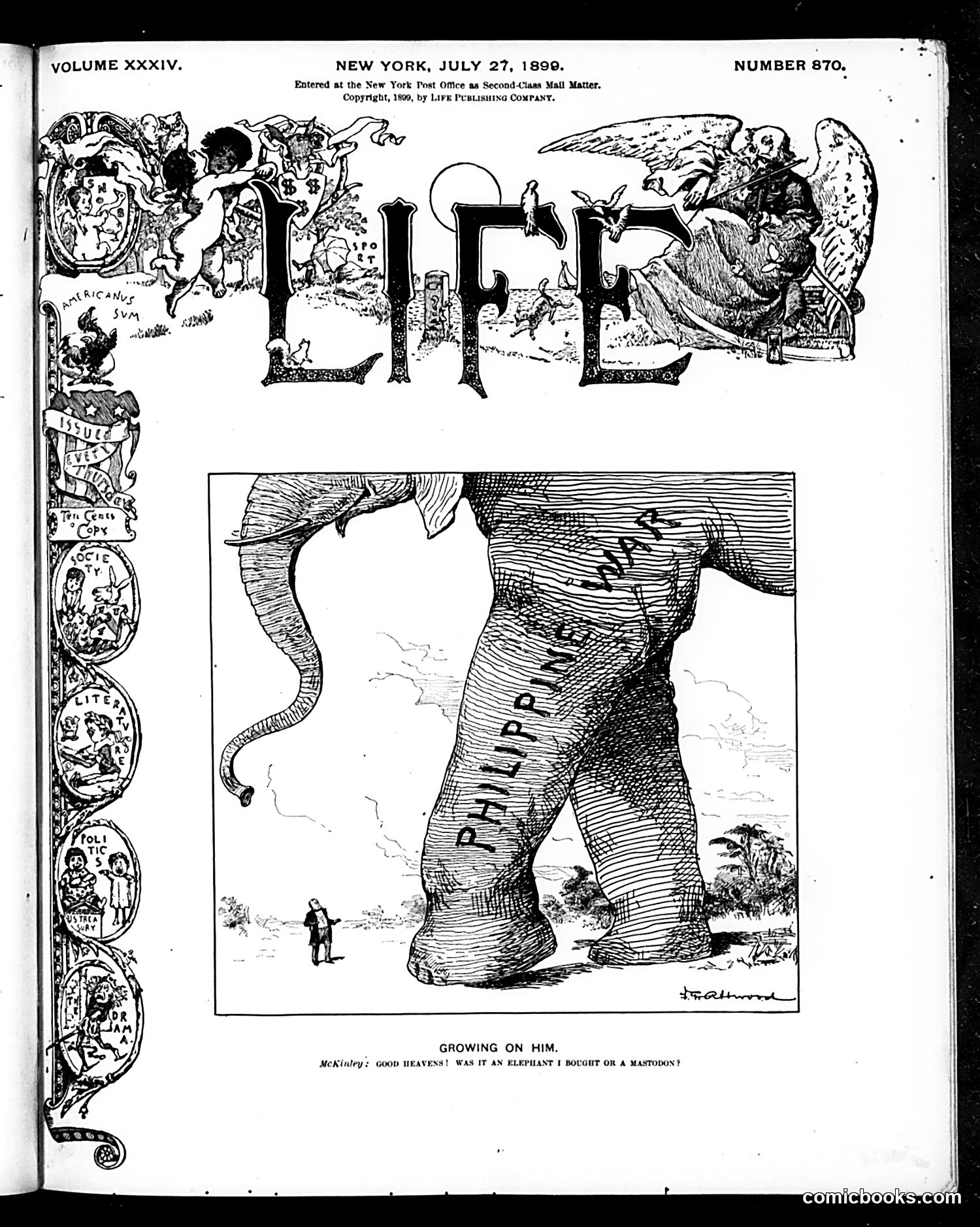
This is the cover of *Life* magazine from July 27, 1896 (Volume XXXIV, Number 870). The main cartoon, titled "Growing on Him," depicts a massive elephant labeled "PHILIPPINE" with a small human figure standing beside it for scale. McKinley's quoted reaction—"Good heavens! Was it an elephant I bought or a mastodon?"—suggests he's overwhelmed by the size and burden of the Philippines. This references the Spanish-American War and the subsequent U.S. acquisition of the Philippine Islands as a territory. The cartoon satirizes President McKinley's surprise at the magnitude of governing and supporting this new colonial possession. The elephant's enormous proportions symbolize an unexpectedly massive financial and political commitment "growing" beyond McKinley's initial expectations.
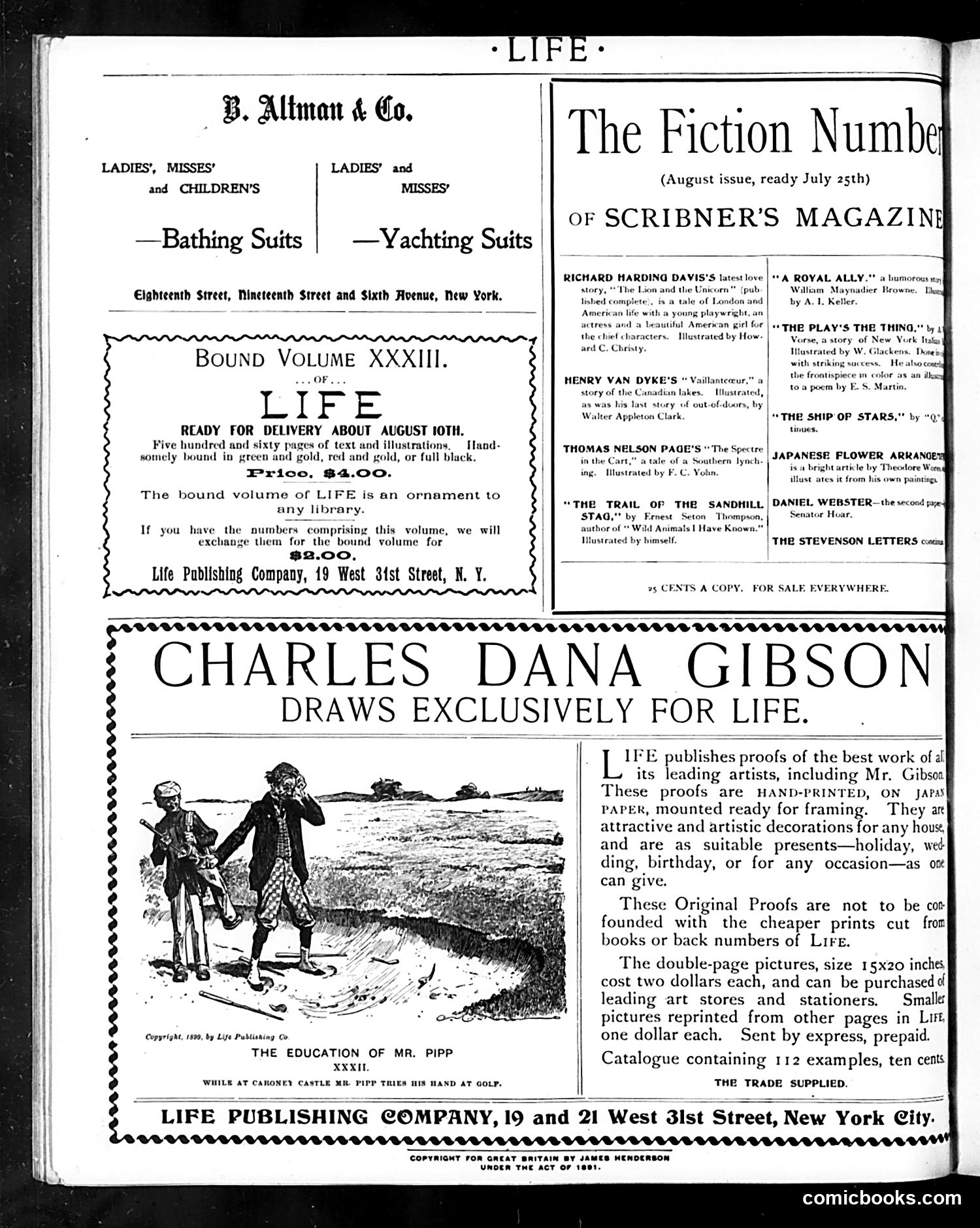
This page is primarily **advertising and promotional content** for Life magazine and related products, rather than political satire. The main feature is a **Charles Dana Gibson illustration** titled "The Education of Mr. Pipp XXVIII," showing two figures at what appears to be a golf course. Gibson was Life's most famous cartoonist, known for creating the idealized "Gibson Girl." This particular cartoon is part of an ongoing serialized feature about a character named Mr. Pipp. The rest of the page contains **ads for bathing suits, yachting suits, bound volumes of Life magazine, and Gibson's art proofs**—typical commercial content. The "Fiction Number" announcement for Scribner's Magazine appears as well. There is **no evident political commentary** on this page.
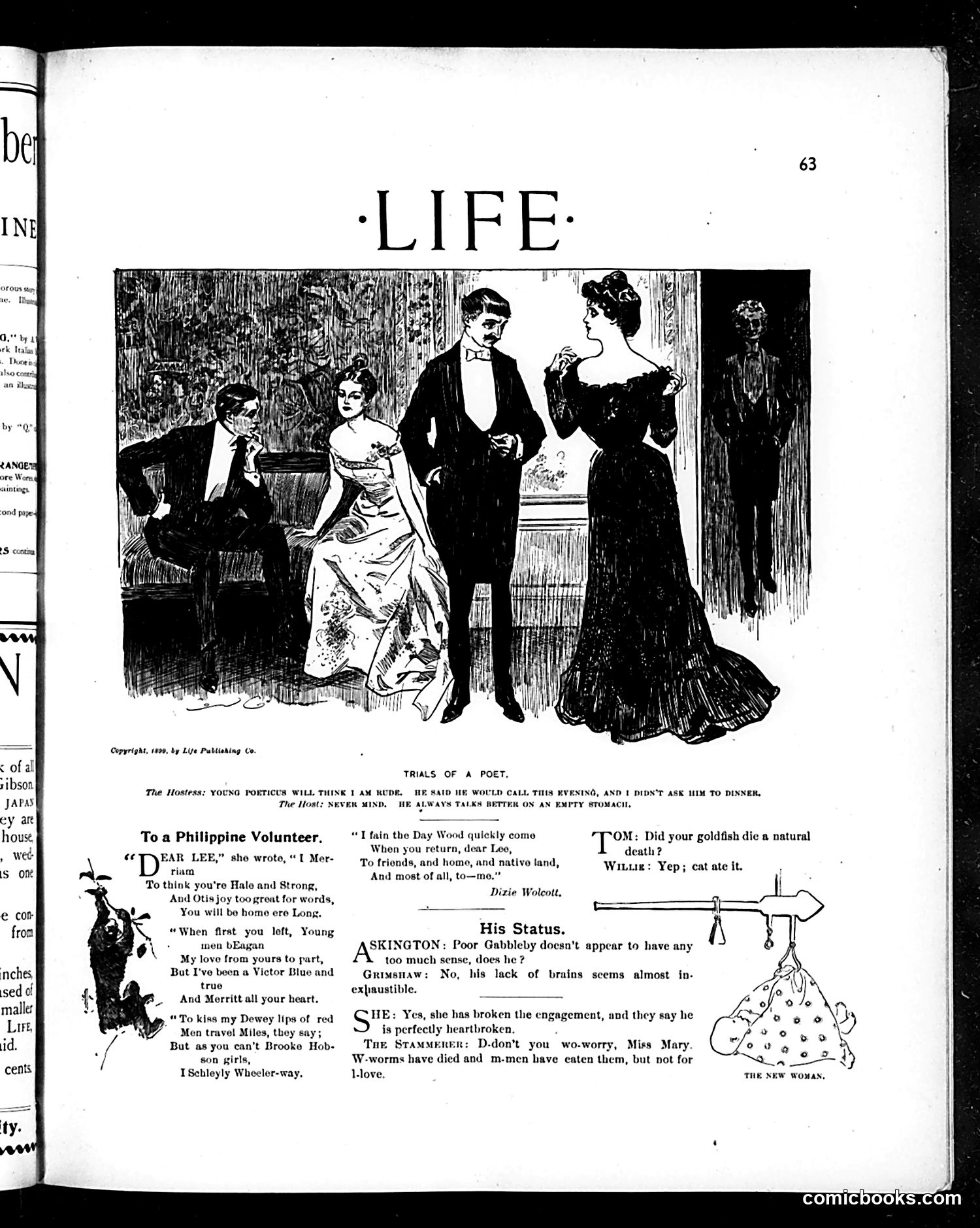
This page contains satirical poetry and brief comedic exchanges typical of early 20th-century humor magazines. **"Trials of a Poet"** depicts a social scene where a young poet struggles for acceptance. The illustration shows well-dressed figures at what appears to be an evening gathering—the hostess warns guests that the poet will be boring, expecting dinner conversation rather than poetry recitation. **"To a Philippine Volunteer"** addresses someone departing for the Philippines (likely during the Philippine-American War era), using romantic language about sacrifice and heroic duty. The brief comic dialogues ("His Status," "Did your goldfish die") are simple one-liners poking fun at social pretension and romantic melodrama. **"The New Woman"** cartoon satirizes emerging feminist attitudes through a figure in modern dress, reflecting period anxieties about changing gender roles. The humor relies on class commentary and social observation rather than political critique.
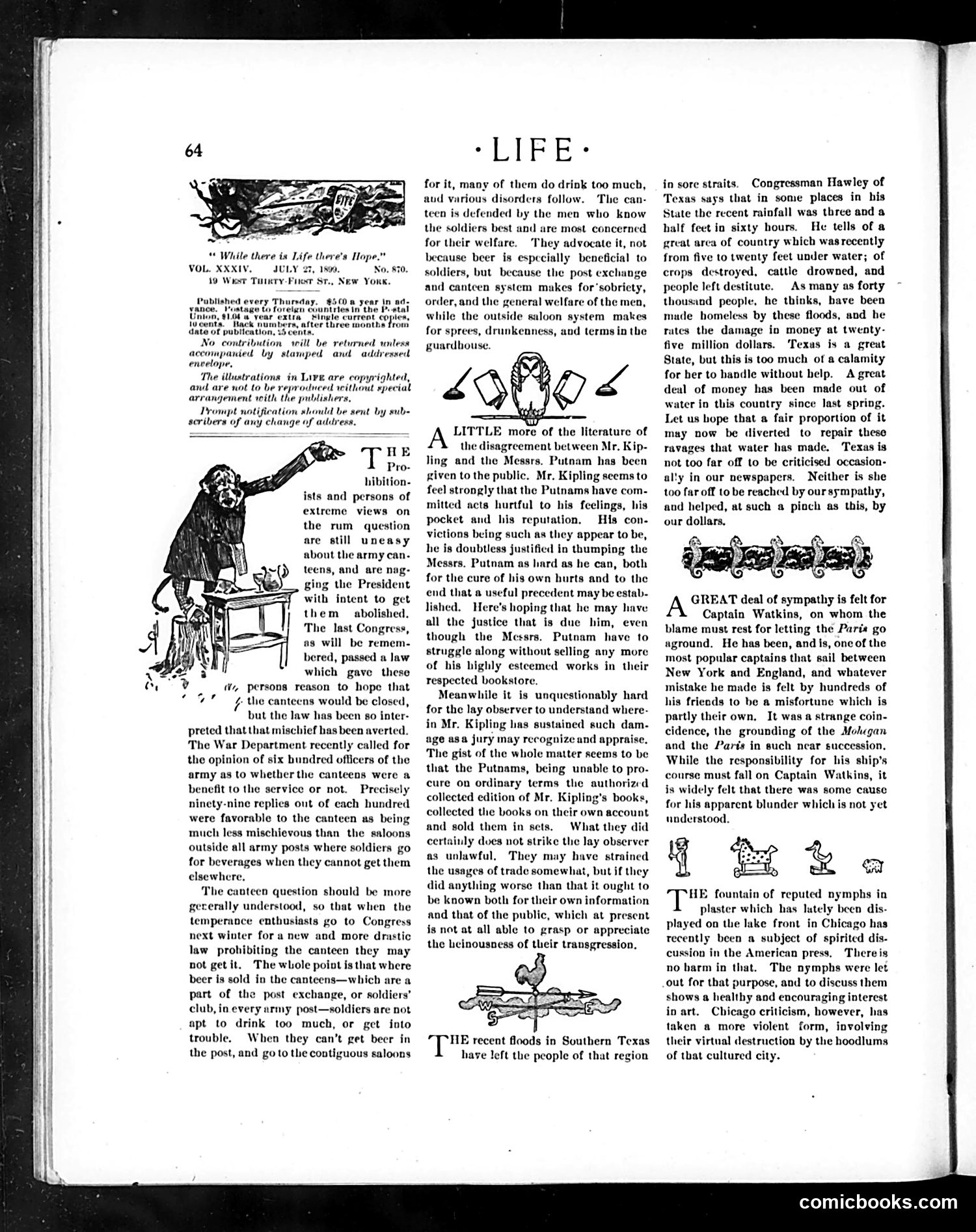
This page contains editorial commentary rather than political cartoons. The main illustration shows a figure at a desk, likely representing a publisher or editor addressing concerns about canteen operations and beer sales to soldiers. The text discusses a dispute between Rudyard Kipling and the Putnams (likely the publishing house) regarding unauthorized collected editions of Kipling's works sold without his consent. The editorial defends Kipling's position, arguing he was justified in his anger at this copyright violation. A secondary section addresses recent Texas floods and their devastation, calling for federal aid to help the state recover from water damage affecting crops and leaving many homeless. The page demonstrates Life's role as a forum for social commentary on literary disputes and natural disasters.
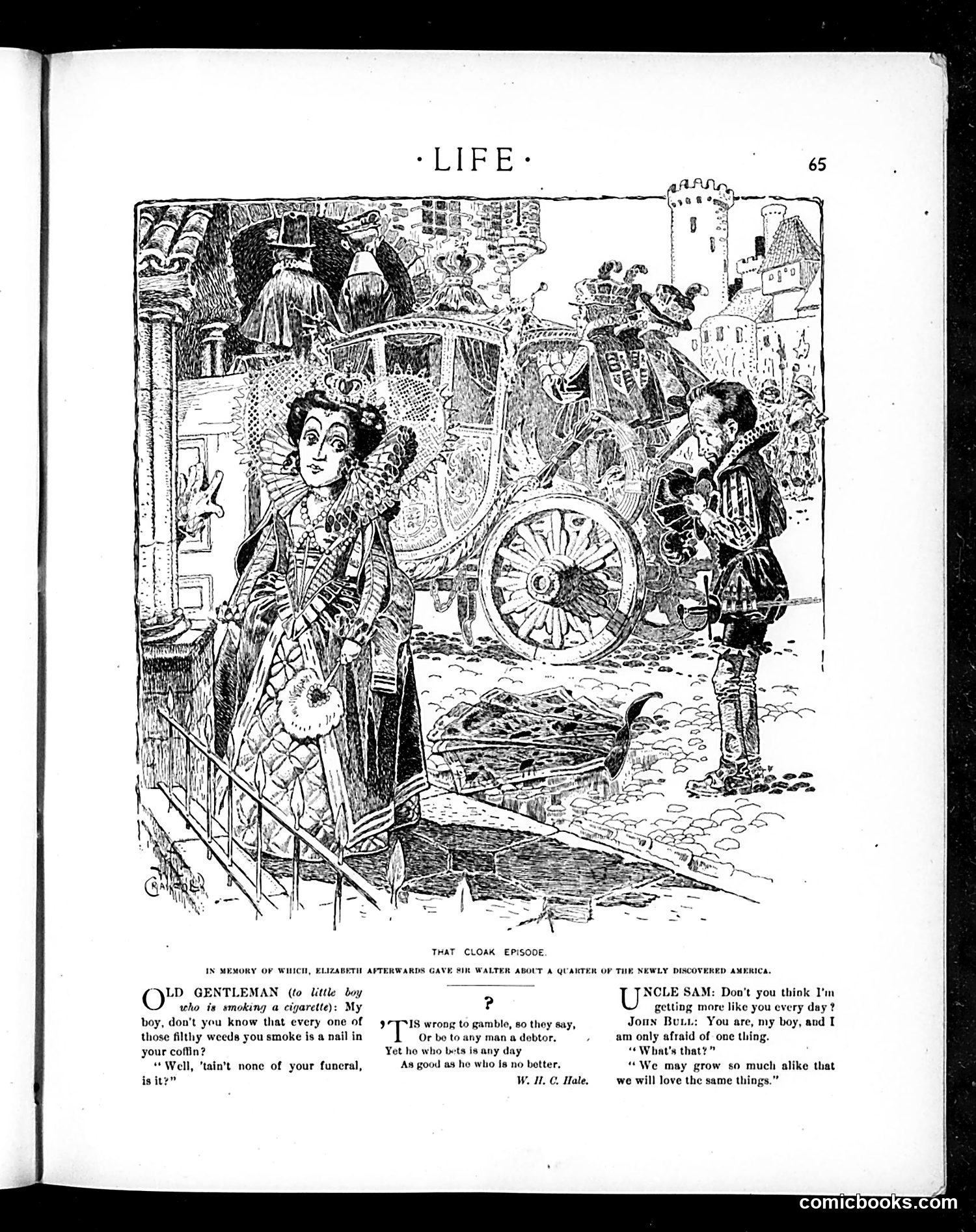
This illustration depicts a historical scene titled "That Cloak Episode," referencing Elizabeth Atterbury giving Sir Walter Raleigh a quarter of newly discovered America. The main cartoon shows an elaborately dressed noblewoman (likely representing Elizabeth I or a court figure) with a man in period costume beside a carriage. The accompanying text presents three brief moral dialogues: an old gentleman warns a boy that smoking and gambling lead to poverty; Uncle Sam advises a young "John Bull" (Britain personified) that friendship matters more than material similarity. The overall piece appears to satirize courtly pretension and colonial-era power dynamics while embedding practical moral lessons about vice and international relations.
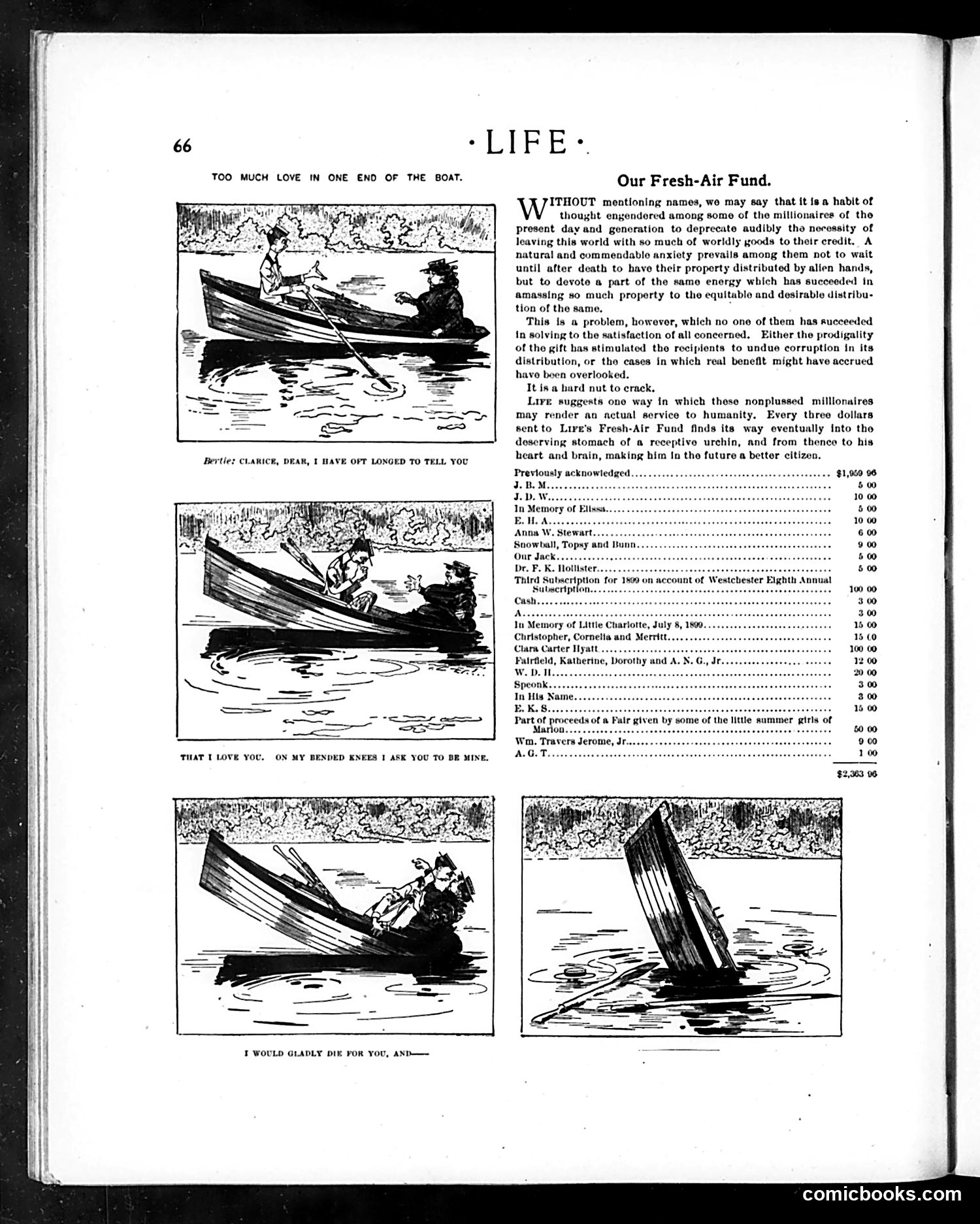
This page contains four romantic boat scenes illustrating sentimental declarations between couples. The captions—"Too Much Love in One End of the Boat," "Better Clarkie, Dear, I Have oft Longed to Tell You," "That I Love You. On My Bended Knees I Ask You to Be Mine," and "I Would Gladly Die for You, And—"—appear to satirize overwrought Victorian romantic rhetoric and melodrama. The accompanying article, "Our Fresh-Air Fund," shifts tone entirely, discussing wealthy philanthropists' charitable contributions to help poor children. This juxtaposition suggests social commentary: contrasting the self-indulgent emotional excess of the upper classes with their actual charitable obligations to society. The list of donations totals $2,263.00, emphasizing the fund's purpose of directing wealth toward meaningful social benefit.
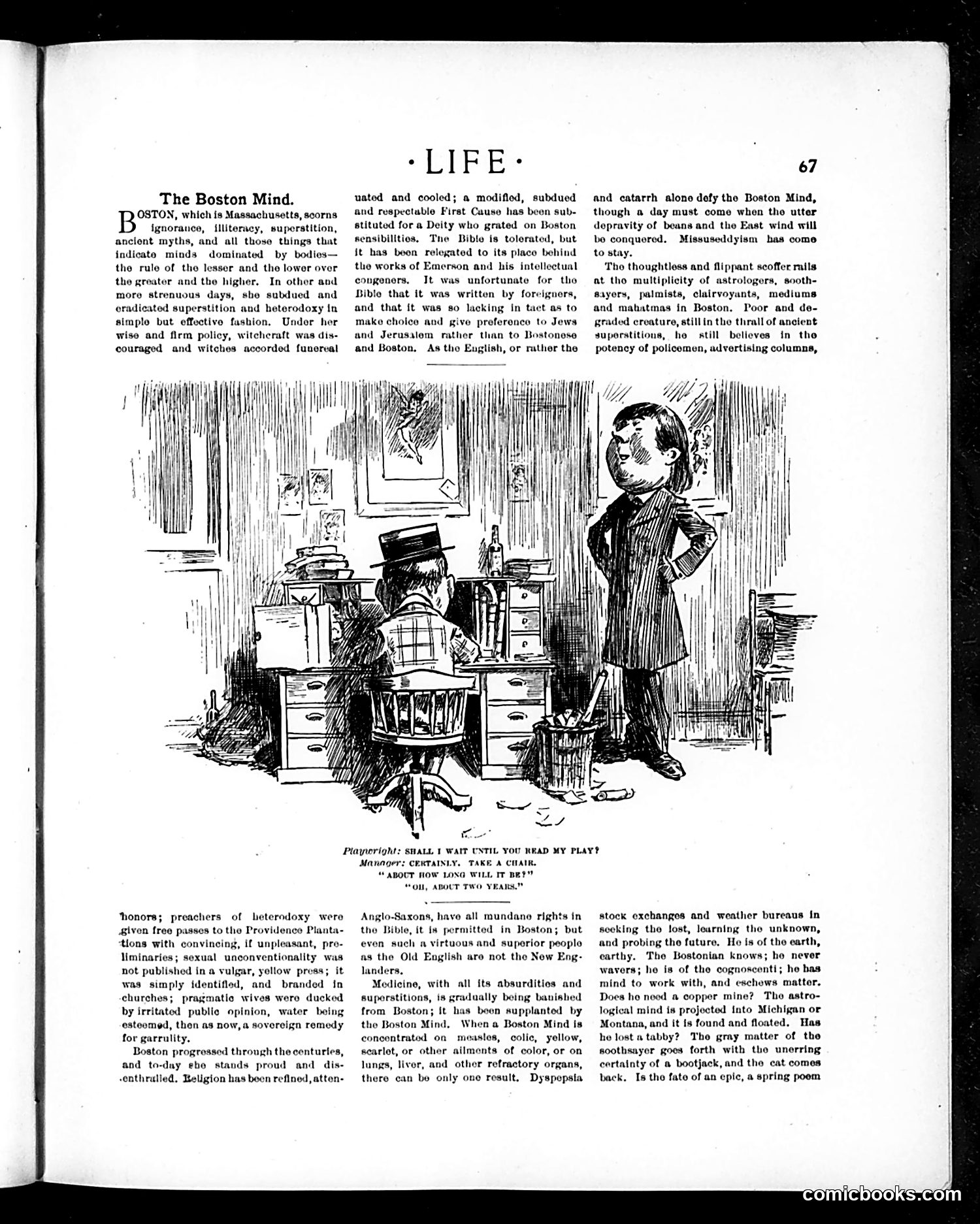
This page satirizes Boston intellectual culture. The article critiques Boston's reputation for superiority—describing how the city's educated class exhibits "ignorance, illiteracy, superstition" despite claims of enlightenment. The text dismisses Boston's religious intolerance and mocks its embrace of pseudoscience like phrenology and astrology. The cartoon shows a playwright waiting for an actor, with dialogue: "SHALL I WAIT UNTIL YOU READ MY PLAY?" / "CERTAINLY, TAKE A CHAIR" / "ABOUT HOW LONG WILL IT BE?" / "OH, ABOUT TWO YEARS." This joke satirizes Boston's notoriously slow, overly intellectual theater scene—suggesting that even reading a script takes years due to Bostonians' pretentious, laborious approach to culture and art.
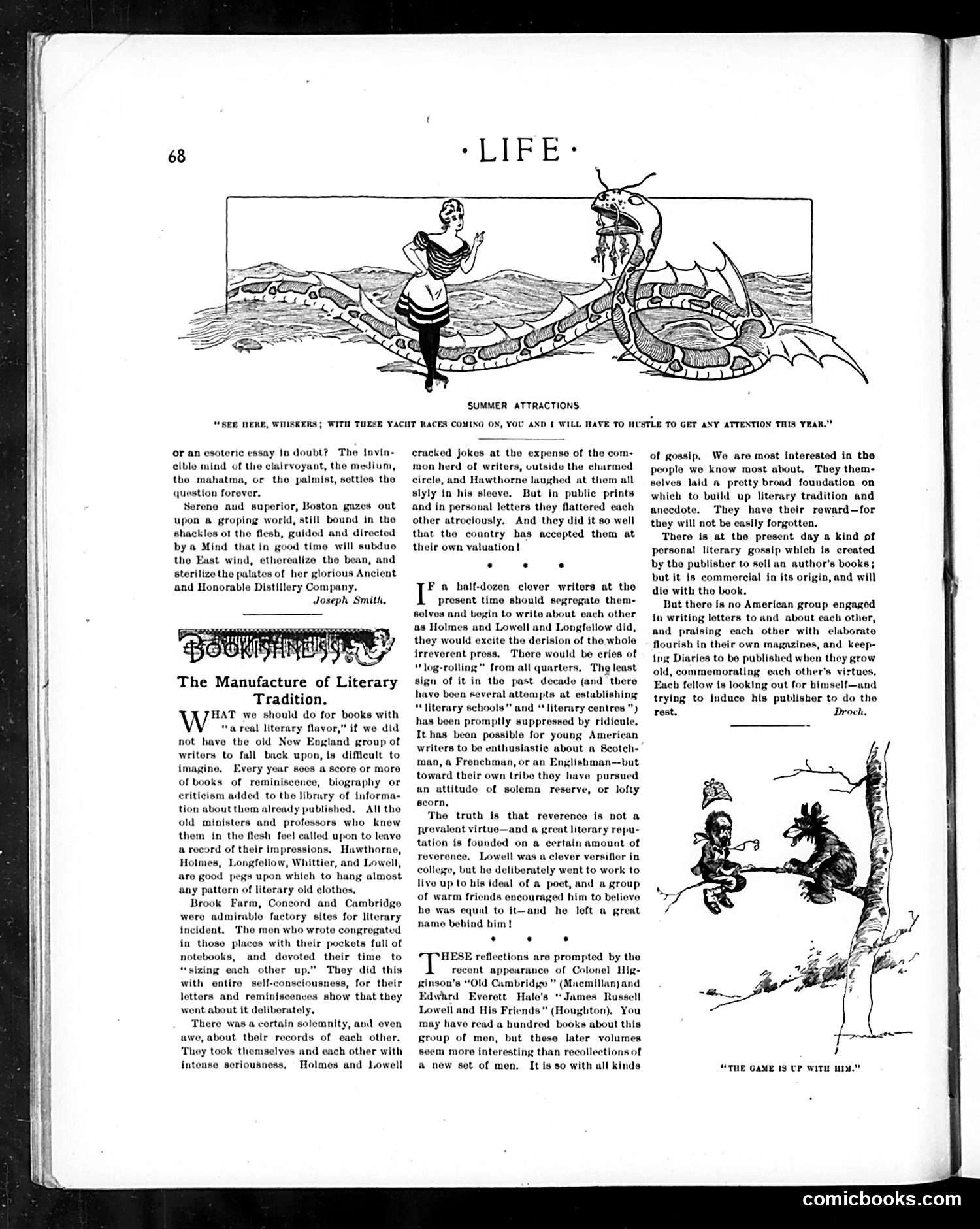
The top illustration titled "Summer Attractions" depicts a woman in bathing attire encountering fantastical sea creatures, with a caption about yacht races demanding attention. This appears to be satirizing the social season and competing leisure activities for wealthy Americans. The main article, "The Manufacture of Literary Tradition," critiques how American writers cultivate reputations through social circles and mutual promotion. It references specific literary figures including Holmes, Lowell, Longfellow, Hawthorne, and Emerson—establishing that this targets 19th-century New England's literary establishment. The piece mocks how these writers' legacies were constructed through deliberate image-building rather than purely merit-based recognition. The small cartoon at bottom right remains unclear without additional context.
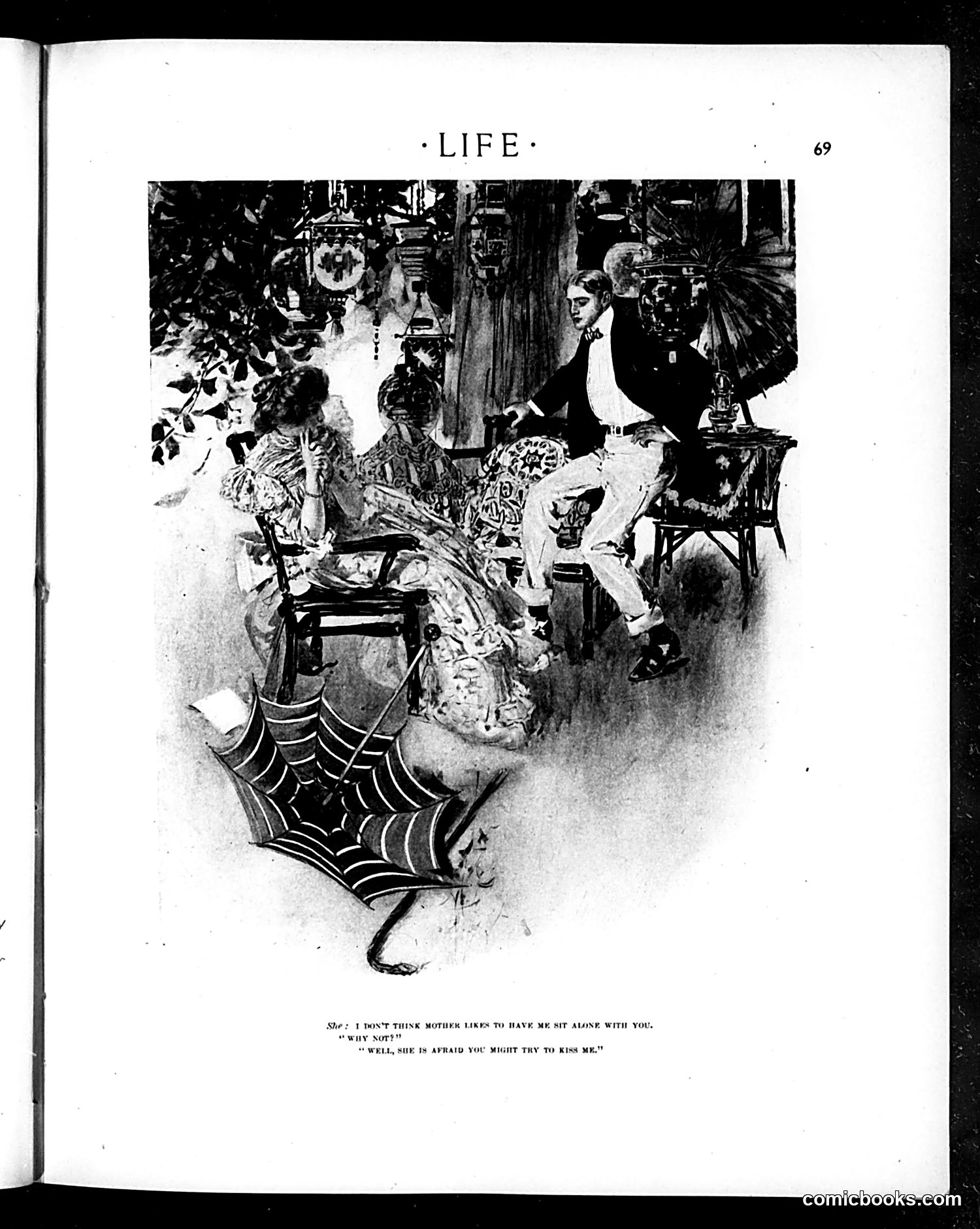
This illustration from *Life* magazine (page 69) depicts a romantic scene in an ornate interior with potted plants and decorative elements. A well-dressed man in formal attire sits beside a woman in an elaborate patterned dress. The caption reads: **She: "I DON'T THINK MOTHER LIKES TO HAVE ME SIT ALONE WITH YOU. WHY NOT?" He: "WELL, SHE IS AFRAID YOU MIGHT TRY TO KISS ME."** The satire targets early 20th-century courtship customs and parental anxiety about unsupervised young couples. The man's boastful, presumptuous response—implying the woman would initiate kissing—mocks male vanity and presumption about female romantic interest. The joke plays on the tension between strict social propriety (requiring chaperones) and the private dynamics of courting couples, exposing masculine overconfidence as ridiculous.
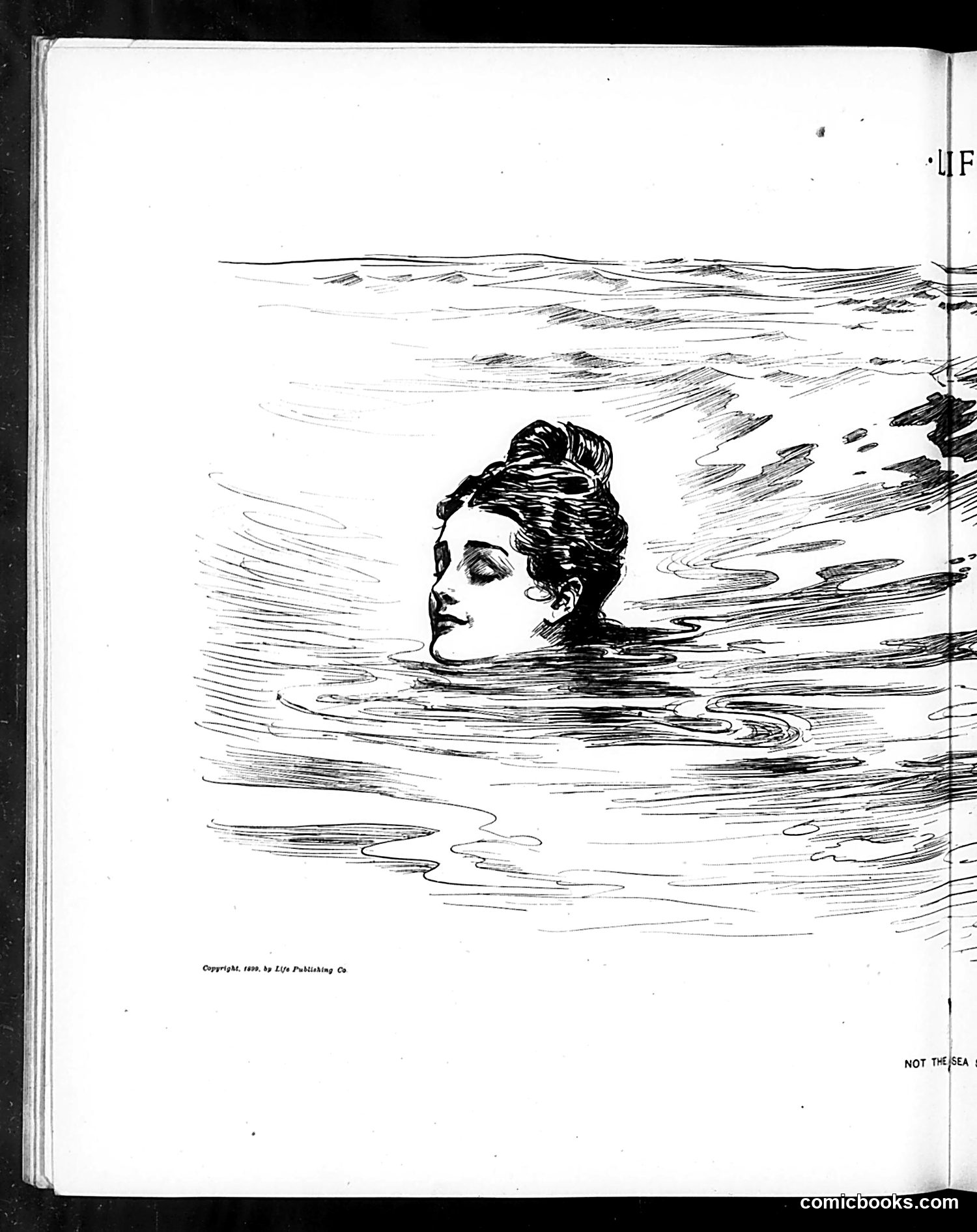
This is a pen-and-ink illustration from Life magazine (copyright 1909, Life Publishing Co.) depicting a woman's head and shoulders emerging from water. The drawing style emphasizes flowing lines to represent rippling water around her. The caption text at bottom reads "NOT THE SEA" (partially visible), suggesting this is a humorous or satirical commentary, though the full context and specific target of the satire are unclear from this image alone. The illustration appears to be a standalone artwork rather than part of a larger cartoon sequence. Without additional context or complete caption text visible, the specific political or social reference remains uncertain. The artistic quality suggests it was a featured illustration in Life's satirical content from the Edwardian era.
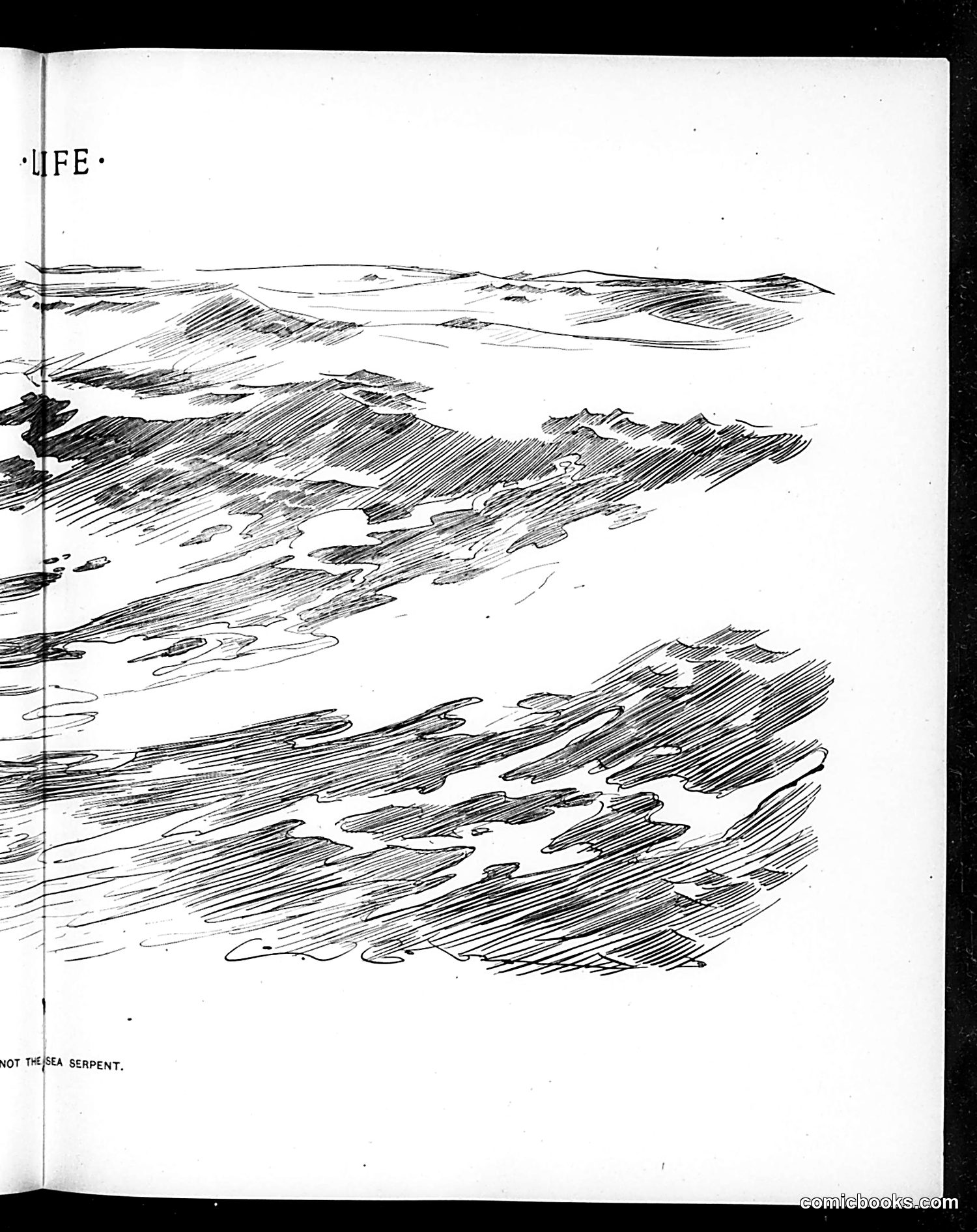
This page from *Life* magazine features a line drawing titled "NOT THE SEA SERPENT" at the bottom. The sketch depicts a landscape with rolling terrain and water, rendered in characteristic cross-hatching ink lines. The drawing appears to be a satirical or humorous landscape illustration, likely commenting on contemporary sightings or folklore about a "sea serpent." The title's phrasing—explicitly stating what the image is *not*—suggests the cartoon is making a joke about mistaken identity or the public's tendency to misidentify natural phenomena as legendary creatures. Without additional context about the specific date or surrounding articles, the exact target of satire remains unclear, though it likely mocks either contemporary sea serpent hoaxes or gullible public belief in such creatures.
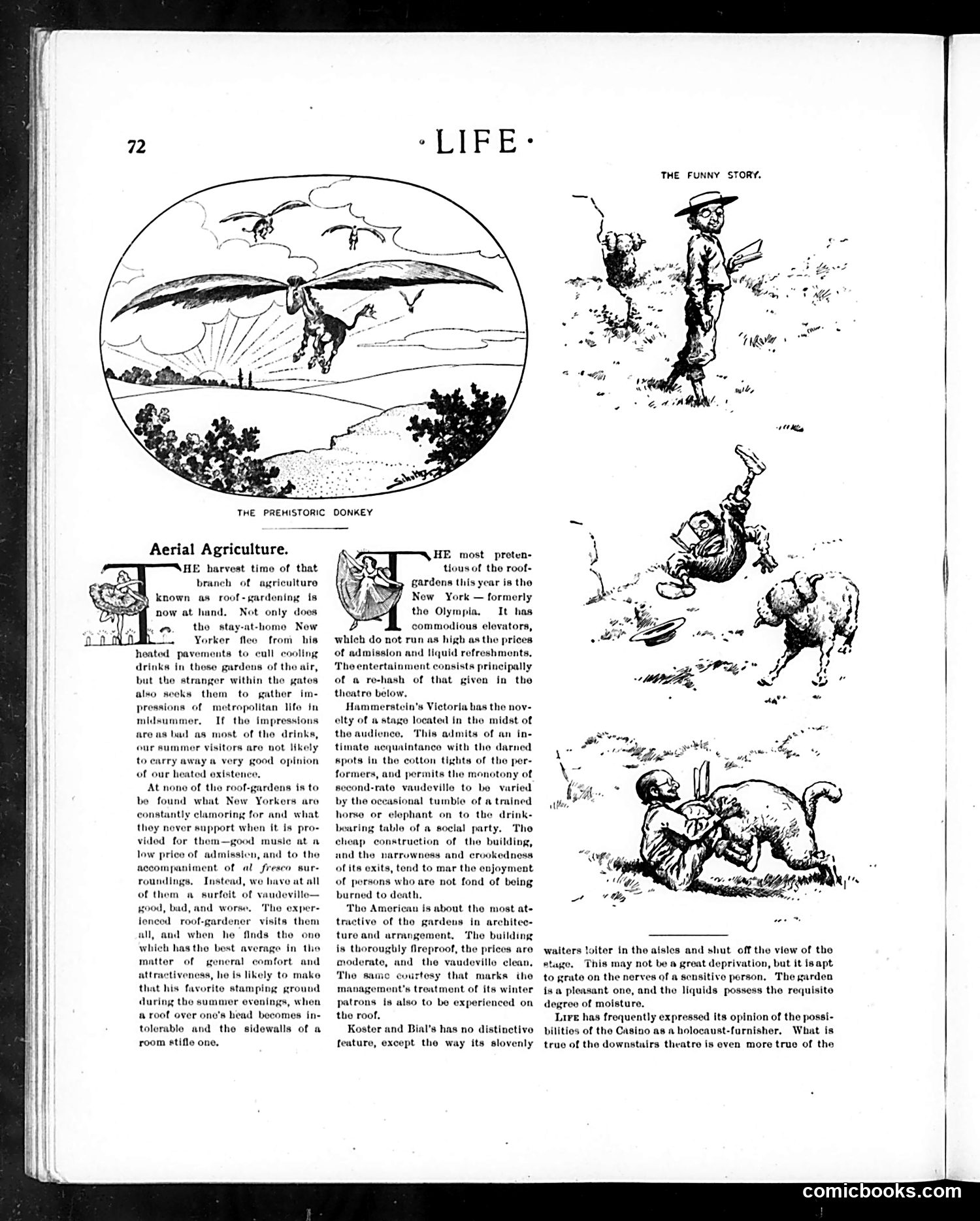
This page satirizes New York's rooftop gardens—fashionable entertainment venues of the era. The text humorously critiques these establishments as pretentious spaces offering mediocre music, expensive drinks, and cramped conditions, yet attracting wealthy patrons seeking to appear sophisticated. The central cartoon, "The Funny Story," depicts a man telling an anecdote to companions while gesturing dramatically. The joke appears to be visual rather than textual—the humor likely derives from the man's exaggerated storytelling performance at a social gathering. The "Prehistoric Donkey" illustration at left references aerial agriculture, discussing rooftop farming innovations in New York. Overall, the page mocks the affectations of upper-class New York society and their enthusiasm for trendy but ultimately uncomfortable leisure venues.
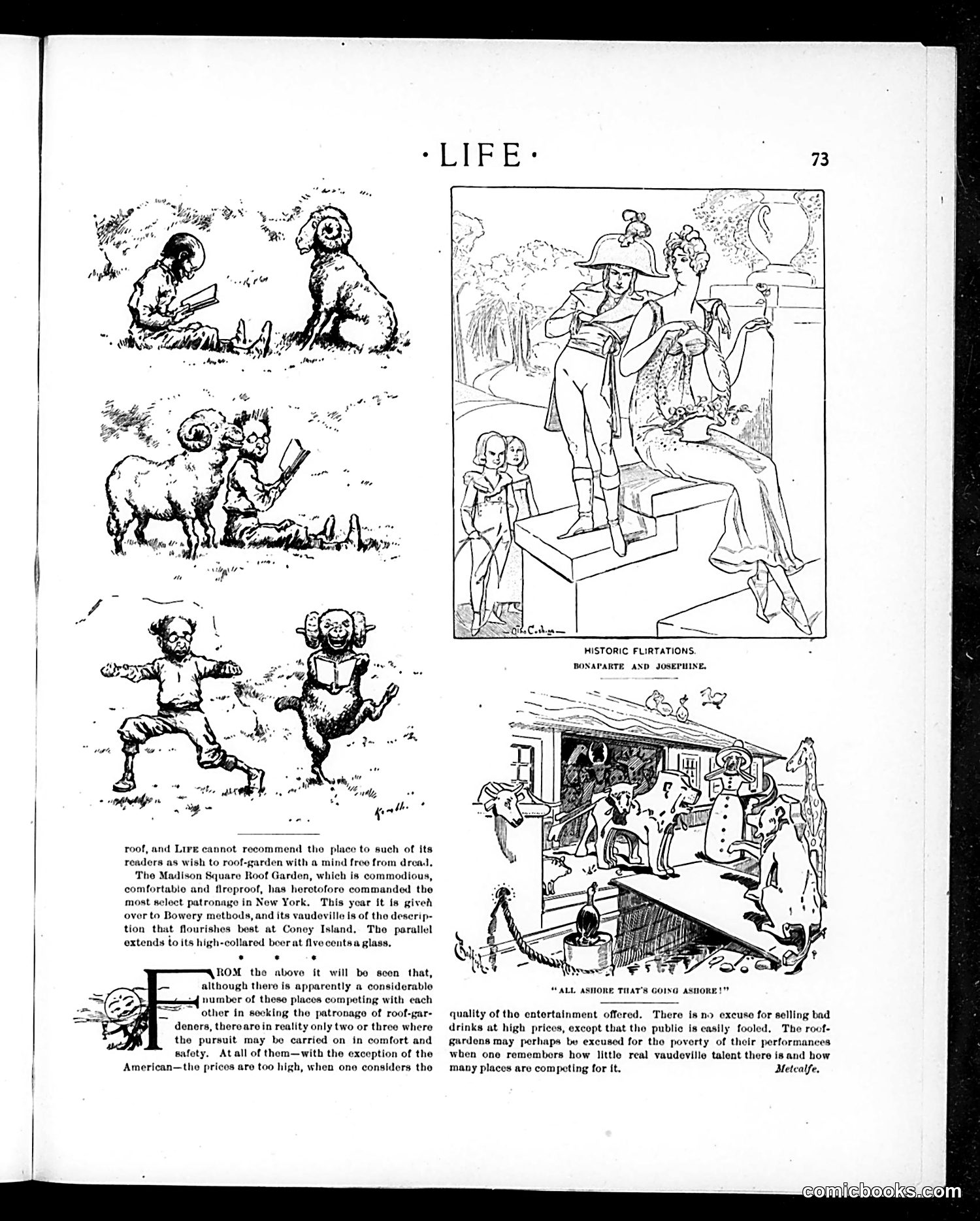
This page critiques New York's popular rooftop entertainment venues of the early 1900s. The text mocks how Madison Square Root Garden (a pun on Madison Square Garden) has declined in quality, now offering "Bowery methods" and cheap vaudeville better suited to Coney Island, while charging high prices for poor drinks and mediocre entertainment. The cartoons illustrate the absurdity: the left panel shows comical animal acts or performers; the right panels depict "Historic Flirtations" featuring Bonaparte and Josephine, and a beach/seaside scene titled "All Ashore That's Going Ashore"—likely satirizing the venue's low-quality vaudeville programming. The author Metcalfe argues venues excuse poor entertainment by blaming competition for talent, but criticizes them for overcharging the "easily fooled" public. The satire targets both the deteriorating quality of roof gardens and audiences' gullibility.
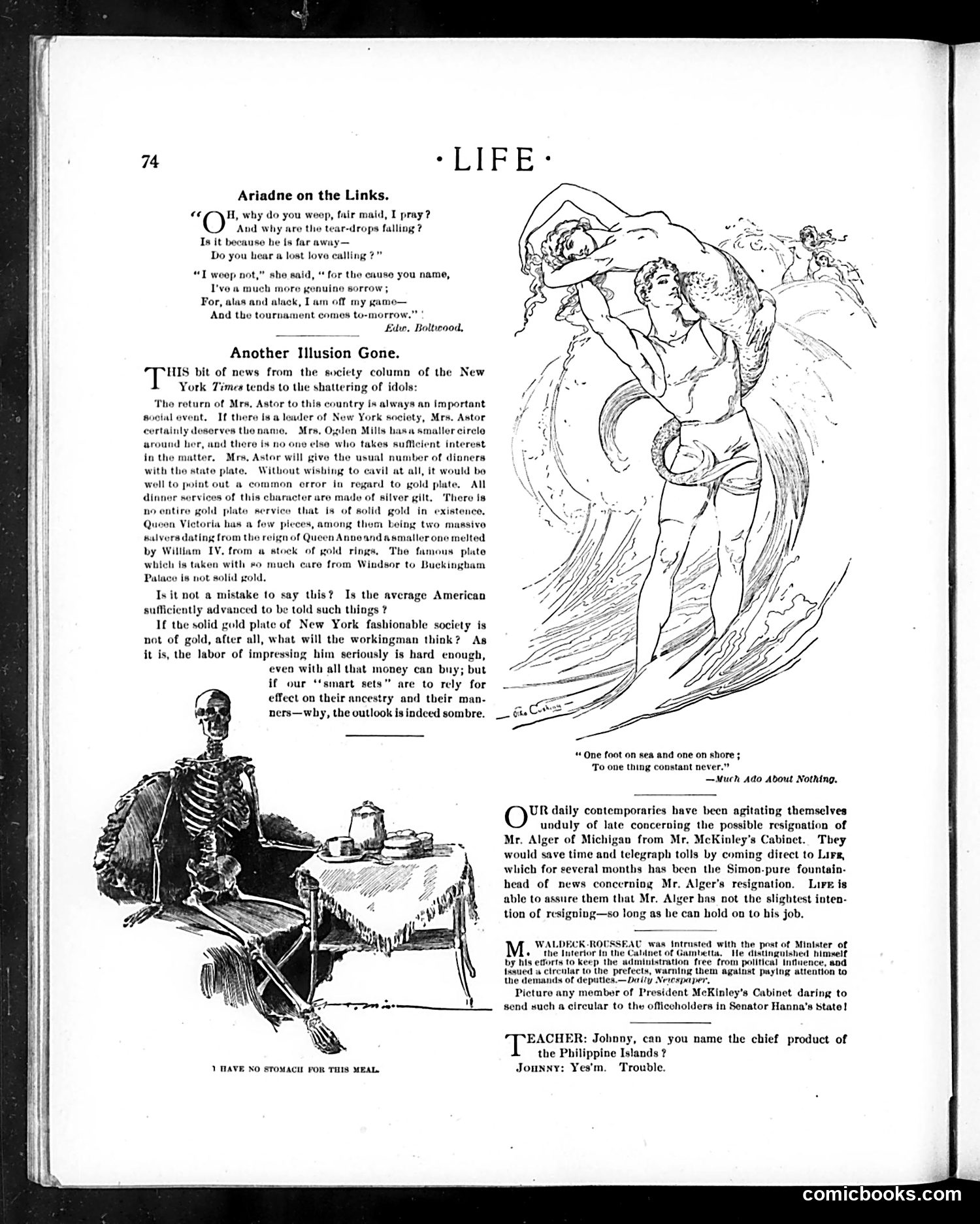
This page contains three satirical pieces targeting American society and politics: 1. **"Ariadne on the Links"**: A poem mocking wealthy women's obsession with golf tournaments, suggesting their romantic concerns pale beside athletic competition—social commentary on the "New Woman" phenomenon. 2. **"Another Illusion Gone"**: Satirizes New York high society's pretensions. It exposes that the "gold plate" supposedly owned by Mrs. Astor and other elites is actually silver gilt (silver-plated), not solid gold. The satire mocks both the wealthy for their false claims to status and questions whether average Americans can maintain faith in social hierarchies built on such deceptions. 3. **Cabinet/Philippines jokes**: Brief political jabs at President McKinley's administration regarding Secretary Alger (who faced resignation pressure) and American colonial policy in the recently-acquired Philippines—suggesting "trouble" as the chief product of imperial expansion. The skeleton illustration labeled "I Have No Stomach for This Meal" reinforces themes of hollow, insubstantial claims.
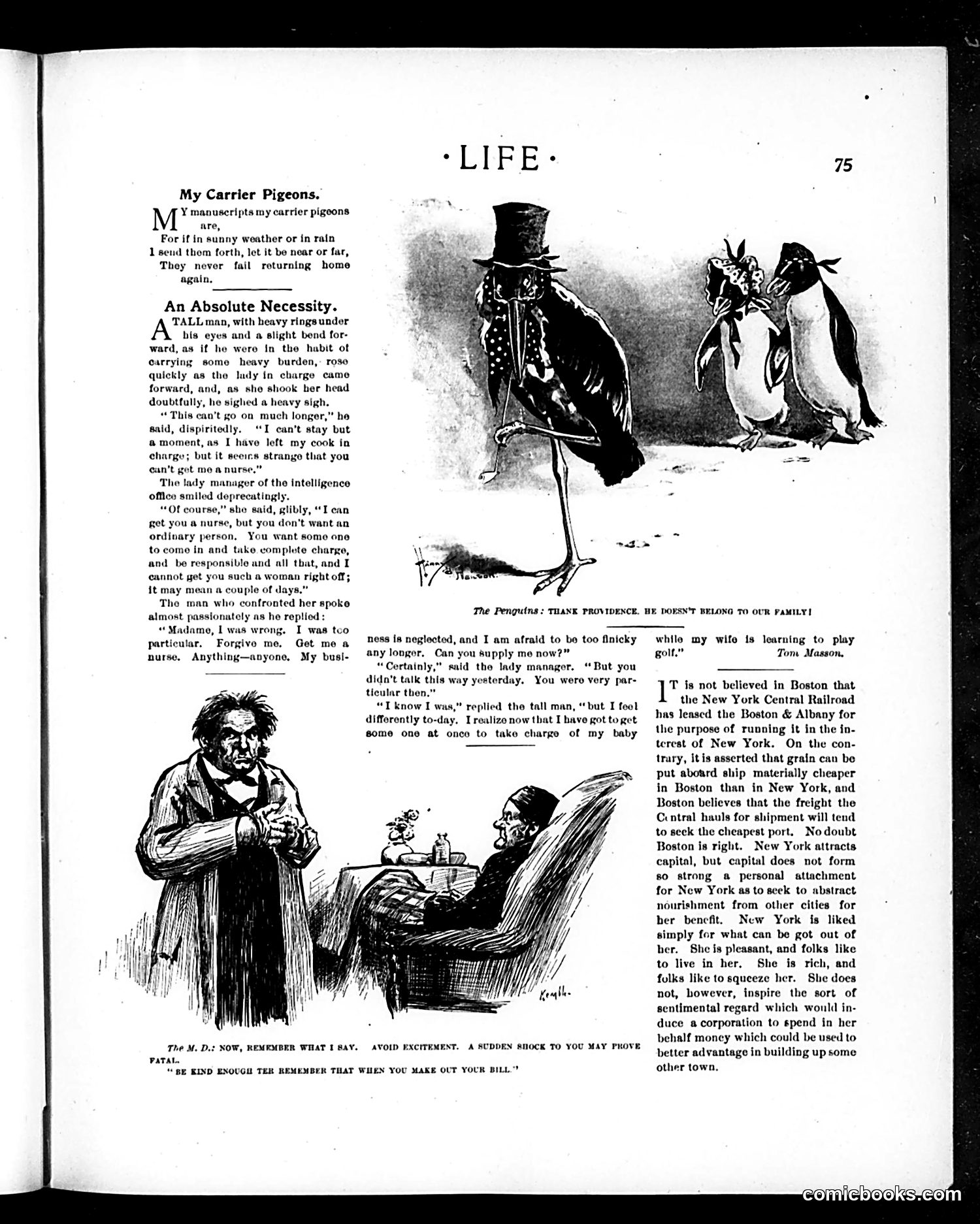
This page contains three distinct pieces of humor: **"My Carrier Pigeons"** is a short poem about manuscripts reliably returning home—likely a writer's jest about their own work. **"An Absolute Necessity"** depicts a harried father at a domestic employment agency. Desperate to hire a nurse for his baby while his wife plays golf, he abandons his earlier pickiness and accepts "anyone." The satire targets both the childcare crisis (nurses were scarce) and the emerging leisure culture of wealthy women—golf being a fashionable but time-consuming pursuit that left domestic duties to hired help. His desperation underscores how dependent affluent families had become on domestic workers. **"The Penguins"** cartoon shows penguins relieved a gentleman "doesn't belong to our family"—likely satirizing some contemporary public figure through animal commentary, though the specific target is unclear without additional context. The bottom item discusses railroad economics between Boston and New York, apparently satirizing New York's self-interested exploitation of other cities.
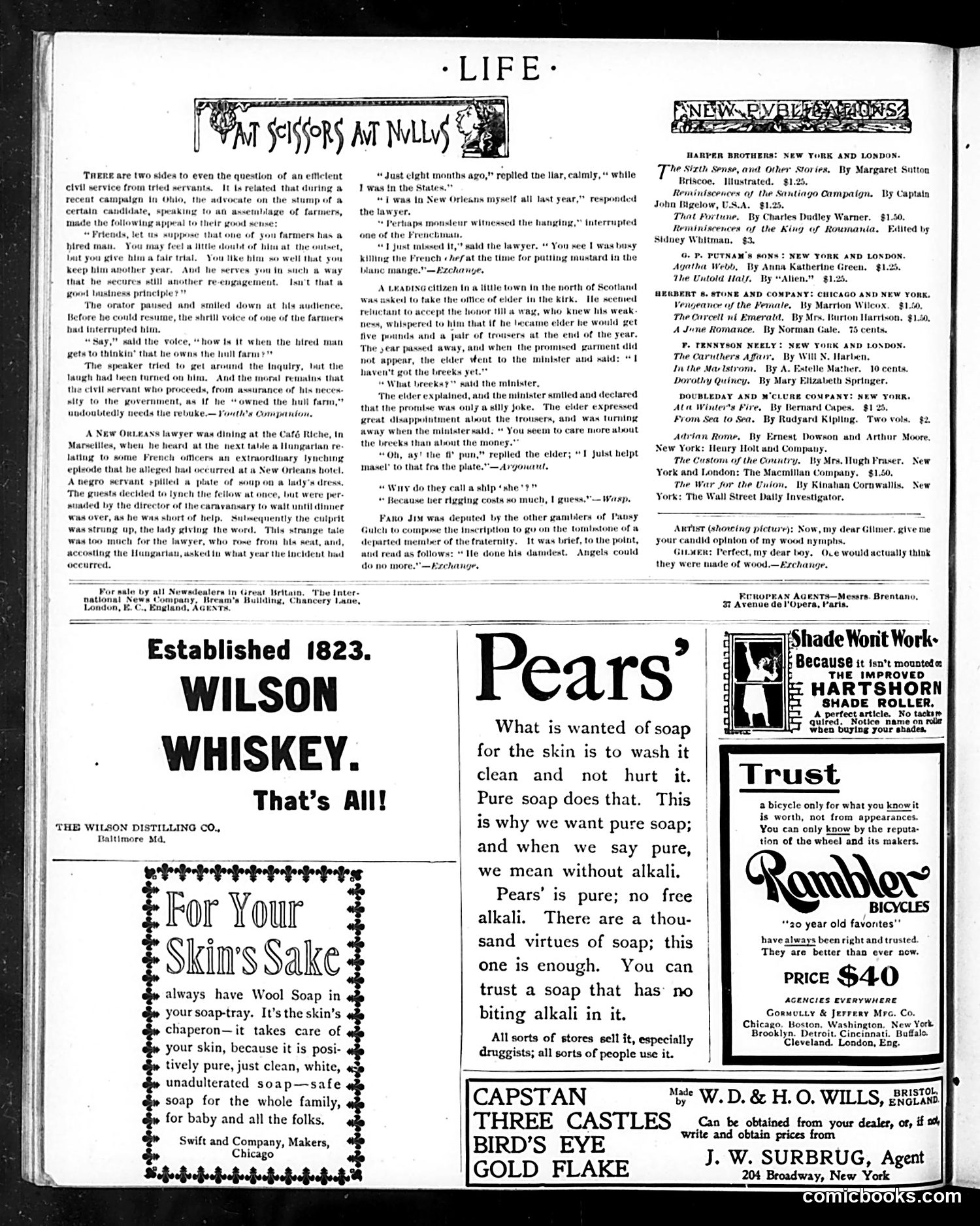
This page contains **humorous anecdotes and advertisements** rather than political cartoons. The main content includes three satirical stories: 1. **"The Hired Man"**: A moral tale about a civil servant who behaves as if he "owns the whole farm"—a metaphor for government officials overstepping their authority. 2. **"The Lynching Hoax"**: A lawyer debunks a tall tale about a lynching in New Orleans, revealing the Hungarian storyteller as a liar who wasn't even present. 3. **"The Elder's Trousers"**: A Scottish church elder is tricked into accepting his position for promised compensation he never receives—satirizing gullibility and broken promises. These stories use **humor to critique vanity, dishonesty, and foolishness** in everyday life. The advertisements (Wilson Whiskey, Pears' Soap, Rambler Bicycles, etc.) occupy significant space, typical of Life magazine's revenue model. The page reflects early-1900s sensibilities about class, authority, and social behavior rather than specific political events.
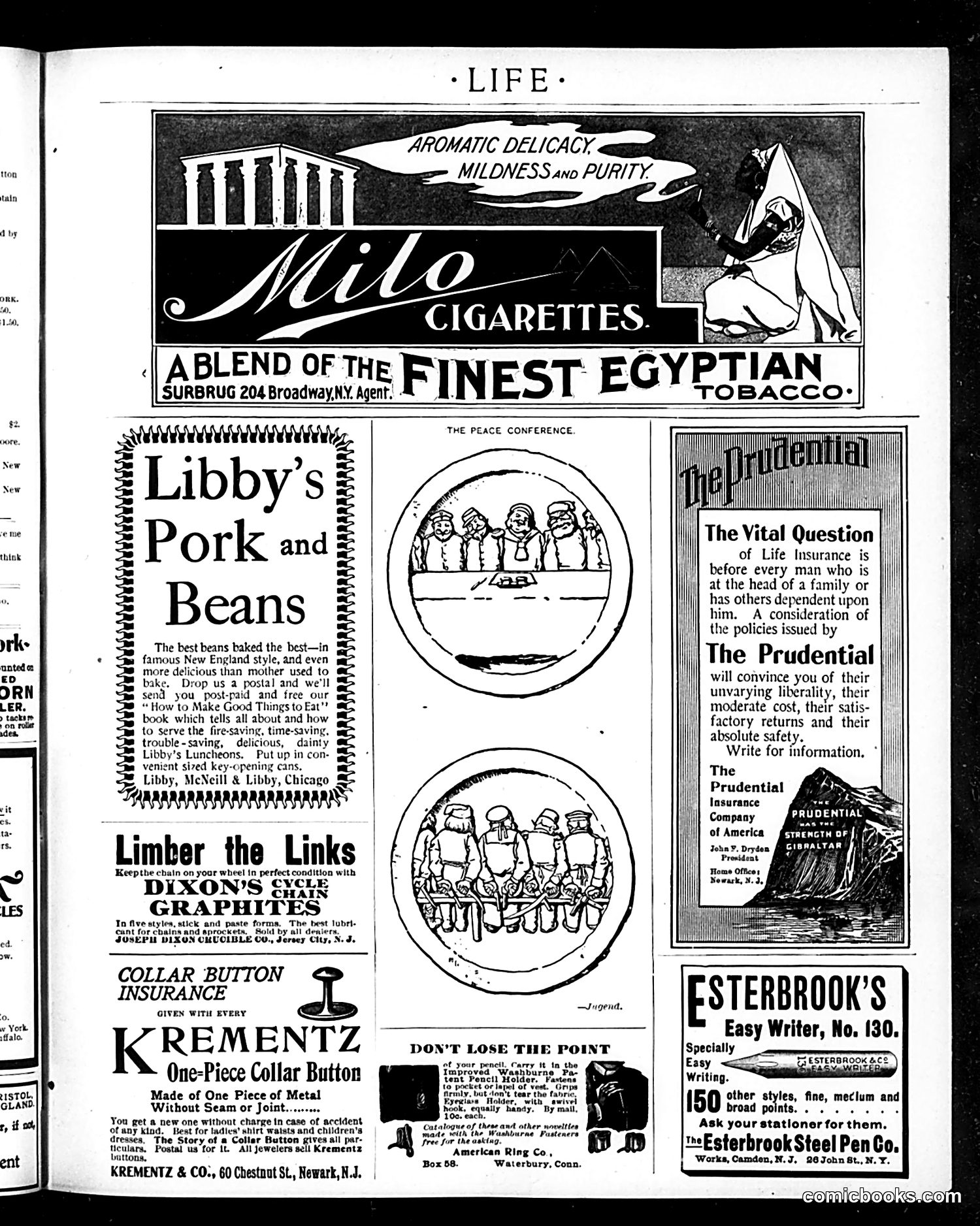
The central cartoon, titled "The Peace Conference," depicts what appears to be diplomatic negotiations, likely referencing peace talks following World War I. Two circular panels show groups of figures seated around tables in discussion. The satire's point—indicated by the caption "DON'T LOSE THE POINT"—is unclear without additional context, but seems to mock the difficulty or futility of maintaining focus during peace negotiations. The pairing with an advertisement for a pencil holder suggests ironic commentary: while diplomats struggle to "keep their point" on important matters, ordinary people need mechanical aids to do the same. The cartoon likely criticizes diplomats' tendency to lose sight of negotiation objectives or drift from stated goals—a common contemporary criticism of post-WWI peace efforts. The page is otherwise filled with period advertisements for consumer goods (cigarettes, food, pen holders, insurance), typical of Life magazine's revenue model.
This page is primarily **advertisements and short humorous anecdotes**, not political cartoons. The content reflects early 20th-century American life and concerns: **Main Elements:** 1. **Opening anecdote**: Thackeray's zoo visit—a literary reference showing educated readers' appreciation for famous writers' personal habits. 2. **Humorous vignettes**: Brief jokes about Irish priests, marriage, and Jewish immigration. The "Colton/Levy" story satirizes Jewish immigrants adopting Anglicized names to escape persecution and business discrimination—a genuine historical practice. 3. **Advertisements**: Heavily featured products (Old Overholt whiskey, digestive tablets, saddles, rye whiskey) reflect period concerns: digestive health as a major worry, alcohol as "medicine," and equestrian culture still relevant. 4. **Social humor**: The "Hotel Vendome" jokes reveal gender dynamics—husbands and wives strategizing over domestic details. **Context for modern readers**: This reflects a society where immigration assimilation was urgent, patent medicines ubiquitous, and marital tension a standard joke topic.
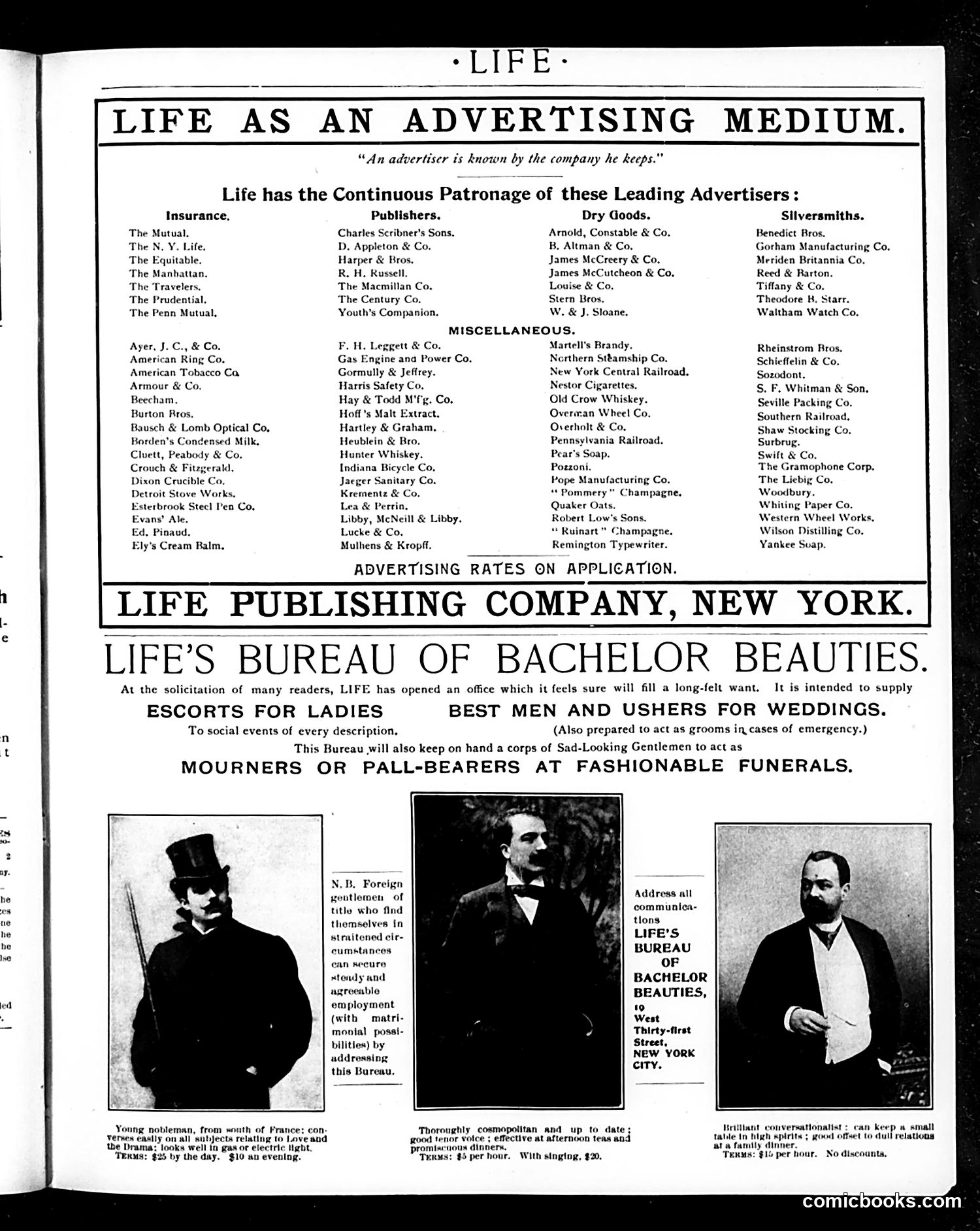
This page is primarily **advertising and self-promotion** for Life magazine, not a political cartoon. It showcases two distinct sections: **Top section:** A list of major advertisers (insurance companies, publishers, dry goods merchants, etc.) with the motto "An advertiser is known by the company he keeps"—establishing Life's prestige by association with recognizable brands. **Bottom section:** A satirical "Bureau of Bachelor Beauties" service offering escorts, wedding attendants, and mourners for hire. The three photographs show available men with tongue-in-cheek descriptions: a young French nobleman in reduced circumstances, a cosmopolitan gentleman, and a witty conversationalist. Their rates are listed (e.g., "$25 by day, $10 evening"). The satire mocks both the pretensions of impoverished European aristocrats seeking American employment and the absurdity of commercializing social respectability. It's a humorous commentary on Gilded Age society's obsession with appearances and hiring appropriate-looking people for social functions.
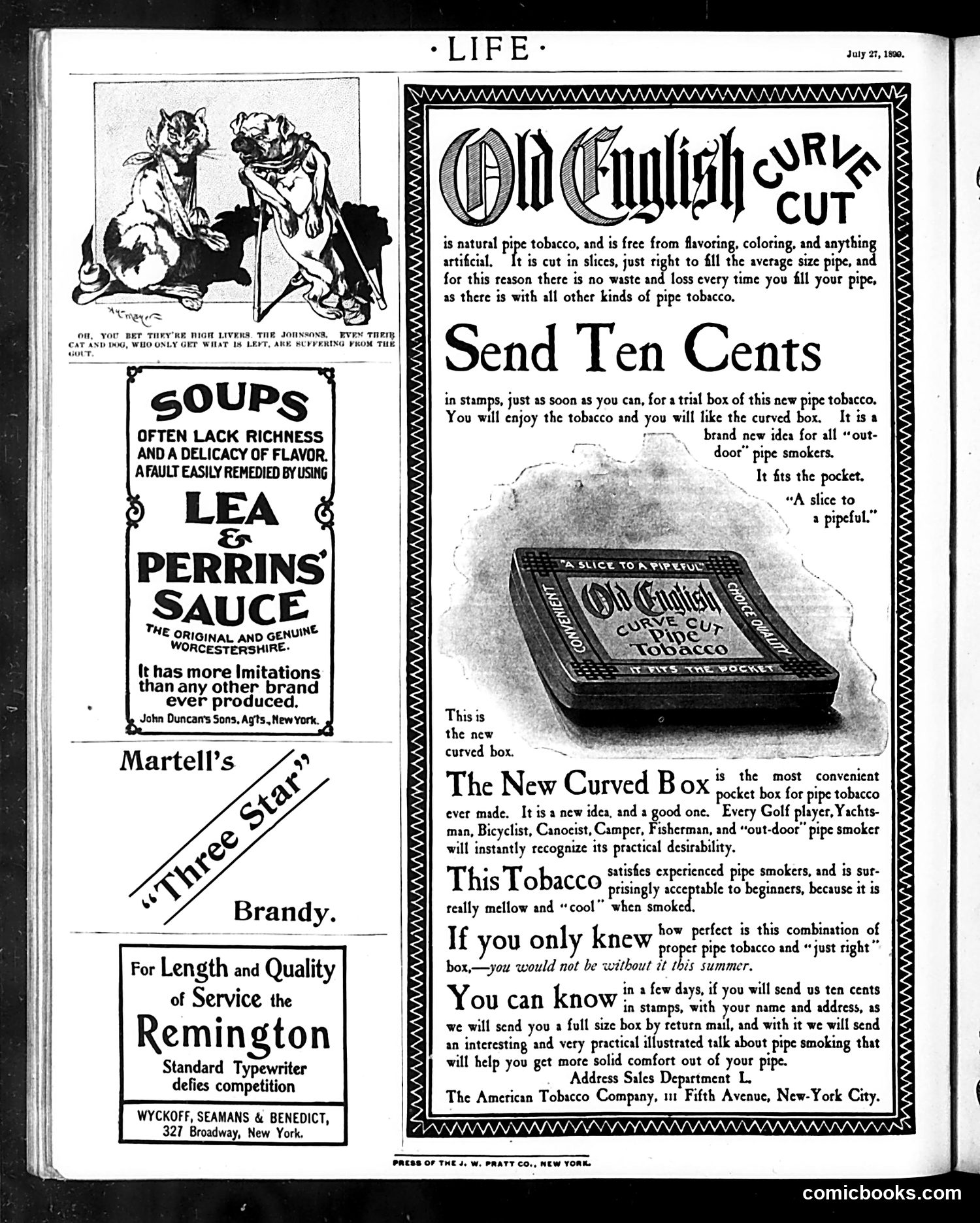
This page is primarily **advertising**, not political satire. The dominant content is a large advertisement for "Old English Curve Cut" pipe tobacco by the American Tobacco Company, promoting a new curved box design marketed to outdoor enthusiasts (golfers, cyclists, campers, fishermen). The small cartoon in the upper left appears to show a **cat and dog suffering from hunger**, with a caption suggesting they, like the Johnson family, are experiencing hardship—possibly a commentary on economic hardship or poverty affecting even pets. The exact satirical point is unclear from the visible text fragment. The remaining advertisements (Lea & Perrins sauce, Martell's brandy, Remington typewriter) are standard commercial notices with no apparent political or social commentary. The page reflects late-19th-century consumer culture and advertising techniques, including sampling campaigns ("Send Ten Cents") to encourage product trials.