
Life, 1899-07-27 · page 8 of 20
Life — July 27, 1899 — page 8: what you’re looking at
What you’re looking at
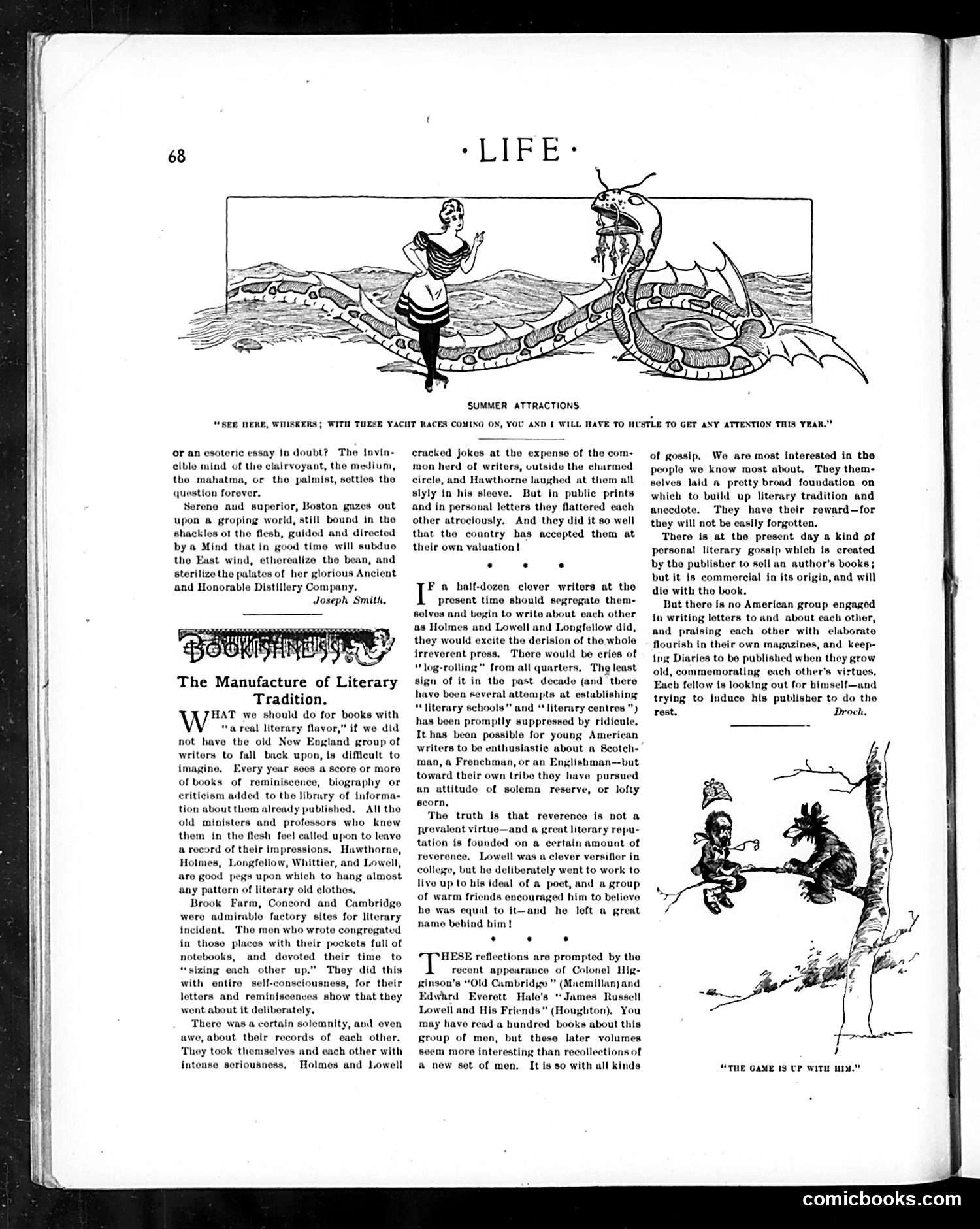
The top illustration titled "Summer Attractions" depicts a woman in bathing attire encountering fantastical sea creatures, with a caption about yacht races demanding attention. This appears to be satirizing the social season and competing leisure activities for wealthy Americans. The main article, "The Manufacture of Literary Tradition," critiques how American writers cultivate reputations through social circles and mutual promotion. It references specific literary figures including Holmes, Lowell, Longfellow, Hawthorne, and Emerson—establishing that this targets 19th-century New England's literary establishment. The piece mocks how these writers' legacies were constructed through deliberate image-building rather than purely merit-based recognition. The small cartoon at bottom right remains unclear without additional context.
📄 Transcribed text from this page (OCR, searchable)
Machine-transcribed from the original scan — historical spelling and the odd misread are preserved.
“SEE HERE, WHISKERS ; WITH TOESE YACHT RACES COMING 0} or an esoteric essay In doubt? The tovin- cible mind of the clairvoyant, the medium, the mahatma, or the palmist, settles the question forever, Serene aud superior, Boston gazes out upon a groping world, still bound in tho shackles of the flesh, guided and directed by a Mind that in good timo will subduo the East wind, etherealize the bean, and sterilize the palates of her glorious Ancient and Honorable Distillery Company. Joseph Smith. The Manufacture of Literary Tradition. HAT we should do for books with “a real literary flavor,” it we did not have the old New England group of writors to fall back upon, is diMcult to imagine, Every year sees a score or moro of books of reminiscence, biography or criticism added to the library of informa- tion about them already published. All tho old ministers and professors who knew them in the flesh feel called upon to leavo a record of their impressions, Hawthorne, Holmes, Longfellow, Whittier, and Lowell, aro good pegs upon which to hang almost any pattern of literary old clothes, Brook Farm, Concord and Cambridgo were admirable factory sites for literary incident. The men who wrote congregated in those places with their pockets full of notebooks, and devoted their time to “sizing each other up.” They did this with entire self-consciousness, for their lotters and reminiscences show that they went about it deliberately. There was a certain solomnity, and oven awe, about their records of each other. They took themselves and each other with intense seriousness, Holmes and Lowell SUMMER ATTRACTIONS. cracked jokes at the expense of the com- mon herd of writers, vutside the charmed circle, and Hawthorne laughed at them all slyly in his sleeve, But in public prints and in personal letters they flattered each other atrociously. And they did it so well that the country has accepted them at their own valuation! . . * F a half-dozen clover writers at the I present time should segregate them- solves and begin to write about each other a8 Holmes and Lowell and Longfellow did, they would excite the derision of the whole irreverent press, Thoro would be cries of “log-rolling” from all quarters. The least sign of it in the past decade (and there have boen several attempts at establishing “literary schools” and “literary centres”) has been promptly suppressed by ridicule, It has beon possible for young American writers to be enthusiastic about a Scotch- man, a Frenchman, or an Englishman—but toward their own tribo thoy have pursued an attitude of solemn reserve, or lofty scorn, ‘The truth is that reverenco is not a Trevalent virtuo—and a great literary repu- tation is founded on a certain amount of reverence, Lowell was a clever versifler in college, but he deliberately went to work to live up to his ideal of a poet, and a group of warm friends encouraged him to be he was equal to it-and he left a great namo behind him! . . . HESE reflections are prompted by the recont appearance of Colonel Hig- ginson’s “Old Cambridge " (Macmillan) and Edward Everett Hale's James Russell Lowell and His Friends” (Houghton), You may havo read a hundred books about this group of men, but these later volumes seem more interesting than recollections of a new set of men, It is so with all kinds YOU AND I WILL HAVE TO HUSTLE TO GET ANY ATTENTION THIS YRAR."* of gossip, Wo are most interested in tho people we know most about, They them- selves laid a pretty broad foundation on which to build up literary tradition and anecdote. They have thelr reward—for they will not be easily forgotten, Thoro is at tho present day a kind of personal literary gossip which {8 created by tho publisher to sell an author's books; but it is commercial in its origin, and will die with tho book, But thero is no American group engaged in writing letters to and about cach other, and praising each otber with elaborate flourish in their own magazines, and keep- Ing Diaries to bo published when they grow old, commemorating each other's virtues. Each fellow is looking out for bimself—and trying to induce his publisher to do the rest. Droch. “THE GAME 18 UP WITH HIM." comicbooks.com