
Life, 1899-07-27 · page 4 of 20
Life — July 27, 1899 — page 4: what you’re looking at
What you’re looking at
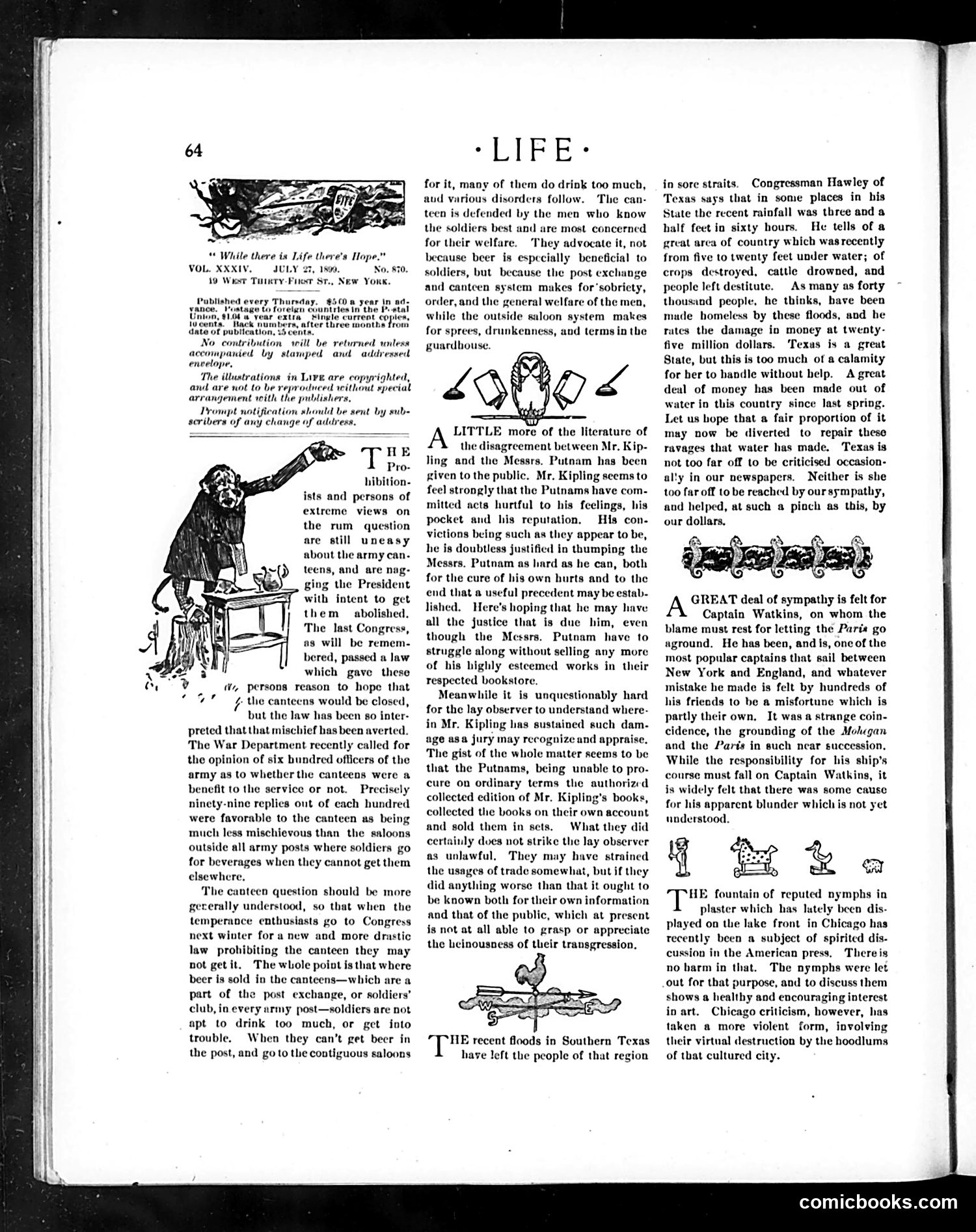
This page contains editorial commentary rather than political cartoons. The main illustration shows a figure at a desk, likely representing a publisher or editor addressing concerns about canteen operations and beer sales to soldiers. The text discusses a dispute between Rudyard Kipling and the Putnams (likely the publishing house) regarding unauthorized collected editions of Kipling's works sold without his consent. The editorial defends Kipling's position, arguing he was justified in his anger at this copyright violation. A secondary section addresses recent Texas floods and their devastation, calling for federal aid to help the state recover from water damage affecting crops and leaving many homeless. The page demonstrates Life's role as a forum for social commentary on literary disputes and natural disasters.
📄 Transcribed text from this page (OCR, searchable)
Machine-transcribed from the original scan — historical spelling and the odd misread are preserved.
“ While there is Life here's Hop VOL. XXXIV. JULY 23, 19 West Tunery-F New You. 9500 a year in ad- ign Countries tn th xtra Published every Thursday. vance. Mustage to for 104 Mingle cu {ter three accomp envelope, The illustrations in Lave are copyrighted, and are not to be reproduced without speciat arrangement with the publishers, ed Uy stamped and addressed Trompt notification should be sent by sub- scribers of any change of address, Pro- hibition- ists and persons of extreme views on the rum question are still uneasy about the army can- teens, and are nag- ging the President with intent to get them abolished. The last Congr as will be remem- bered, passed a law which gave these «, persons reason to hope that 7 the cantecns would be closed, but the law has been so inter- preted that that mischief has been averted. ‘The War Department recently called for the opinion of six bundred officers of the army as to whether the canteens were a benefit to the service or not. Precisely ninety-nine replies out of each hundred were favorable to the canteen as being much less mischievous than the saloons outside all army posts where soldiers go for beverages when they cannot get them elsewhcre, The cantecn question should be more gererally understood, so that when the temperance enthusiasts go to Congress next winter fora new and more drastic law prohibiting the canteen they may not getit. The whole point is that where beer is sold in the canteens—which are a part of the post exchange, or soldiers’ club, in every army post—soldiers are not apt to drink too much, or get into trouble. When they can’t get beer in the post, and go to the contiguous saloons “LUPE * for it, many of them do drink too much, aud various disorders follow. The can- teen is defended by the men who know the soldiers best and are most concerned for their welfare. T advocate it, not because beer is especially beneficial to soldiers, but because the post exchange and canteen system mukes for’sobricty, order, and the general welfare of the men, while the outside saloon system makes for sprees, drunkenness, and terms inthe guardhouse, SLOUID S LITTLE more of the literature of the disagreement between Mr. Kip- ling and the Messrs. Putnam has been given to the public. Mr. Kipling seems to feel strongly that the Putnams have com- mitted acts hurtful to his feelings, his pocket and his reputation, His con. victions being such as they appear to be, he is doubtless justified in thumping the Messrs. Putnam as hard as he can, both for the cure of his own hurts and to the end that a useful precedent may be estab- lished. Here's hoping that he may have all the justice that is due him, even though the Messrs. Putnam have to struggle along without selling any more of his highly esteemed works in their respected bookstore, Meanwhile it is unquestionably hard for the lay observer to understand where- in Mr. Kipling has sustained such dam. age asa jury may recognize and appraise. ‘The gist of the whole matter seems to be that the Putnams, being unable to pro- cure on ordinary terms the authorized collected edition of Mr. Kipling’s books, collected the books on their own account and sold them in sets. What they did certainly does not strike the lay observer as unlawful, They may have strained the usages of trade somewhat, but if they did anything worse than that it ought to be known both for their own information and that of the public, which at present is not at all able to grasp or appreciate the heinousness of their transgression, HE recent floods in Southern Texas have left the people of that region in sore straits. Congressman Hawley of Texas says that in some places in his State the recent rainfall was three and a half feet in sixty hours. He tells of a great area of country which wasrecently from five to twenty feet under water; of crops destroyed, cattle drowned, and people left destitute. As many as forty thousand people, he thinks, bave been mude homeless by these floods, and he rates the damage in money at twenty- five million dollars. ‘Texus is a great State, but this is too much of a calamity for ber to handle without help. A great deal of money has been made out of water in this country since last spring. Let us hope that a fair proportion of it may now be diverted to repair these ravages that water has made. Texas is not too far off to be criticised occasion- ally in our newspapers. Neither is she too far off to be reached by our sympathy, and helped, at such a pinch as this, by our dollars, A GREAT deal of sympathy is felt for Captain Watkins, on whom the blame must rest for letting the Parts go aground. He has been, and Is, one of the most popular captains that sail between New York and England, and whatever mistake he made is felt by hundreds of his friends to be a misfortune which is partly their own, It was a strange coin- cidence, the grounding of the Mohegan and the Parts in such near succession, While the responsibility for his ship’ course must fall on Captain Watkins, it is widely felt that there was some cause for his apparent blunder which is not yet understood. HE fountain of reputed nymphs in plaster which has lately been dis- played on the lake front in Chicago has recently been a subject of spirited dis- cussion in the American press. Thereis no harm in that. The nymphs were let out for that purpose, and to discuss them shows a healthy and encouraging interest in art. Chicago criticism, however, has taken a more violent form, involving their virtual destruction by the hoodlums of that cultured city. comicbooks.com