
A complete issue · 26 pages · 1899
Life — June 1, 1899
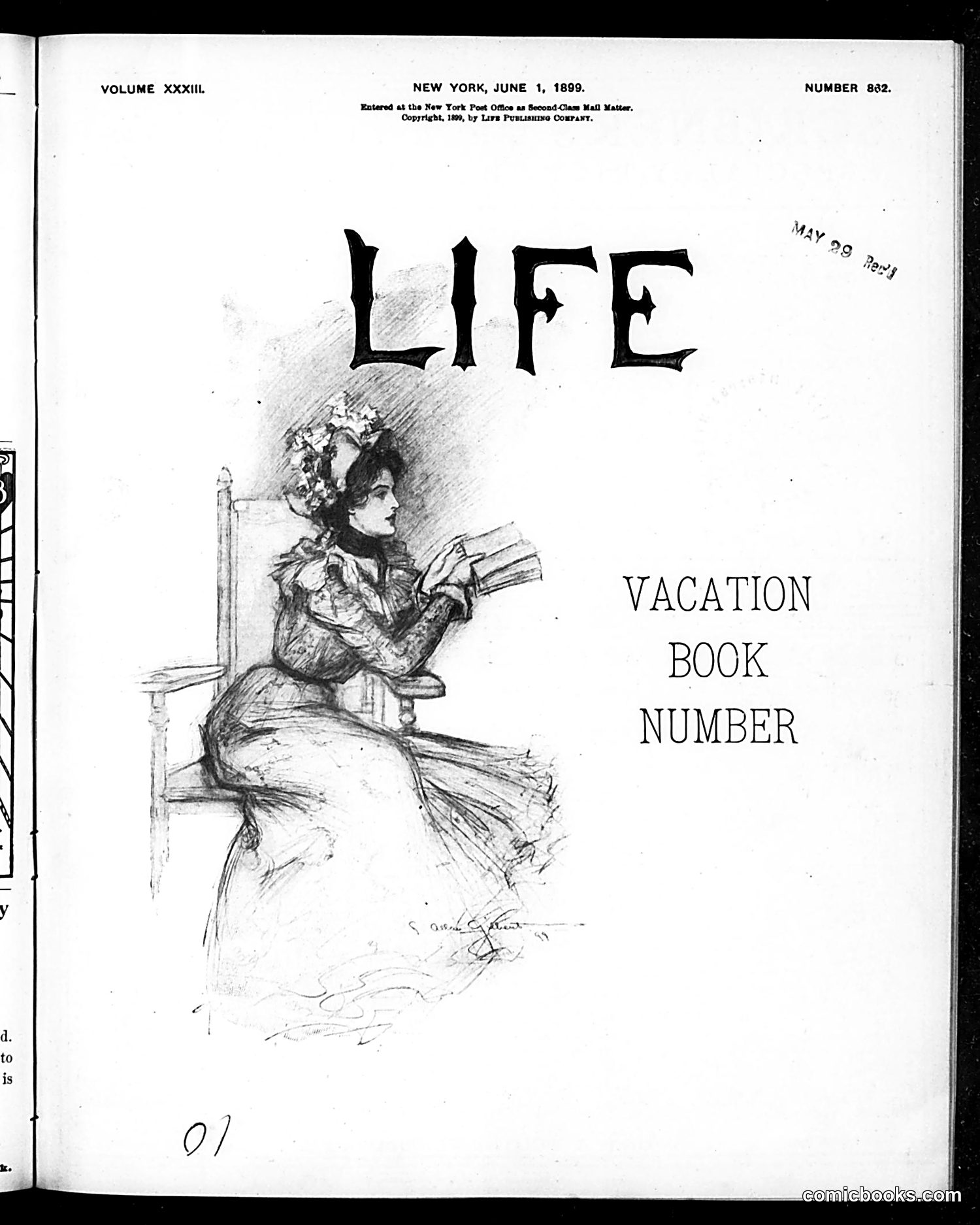
This is the cover of Life magazine's June 1, 1899 "Vacation Book Number" issue. The illustration depicts an elegantly dressed woman in 1890s fashion—featuring a large feathered hat, fitted jacket with puffed sleeves, and a full skirt—seated and reading what appears to be a vacation guide or travel book. The satire likely mocks the leisure culture of wealthy Americans preparing for summer travel. The woman's fashionable attire and relaxed pose suggest the emerging "Gibson Girl" ideal—the modern, independent woman of that era. The vacation book number would have catered to affluent readers planning seasonal retreats, making it both an advertisement for leisure travel and gentle commentary on the leisured class's preoccupations during the Gilded Age.
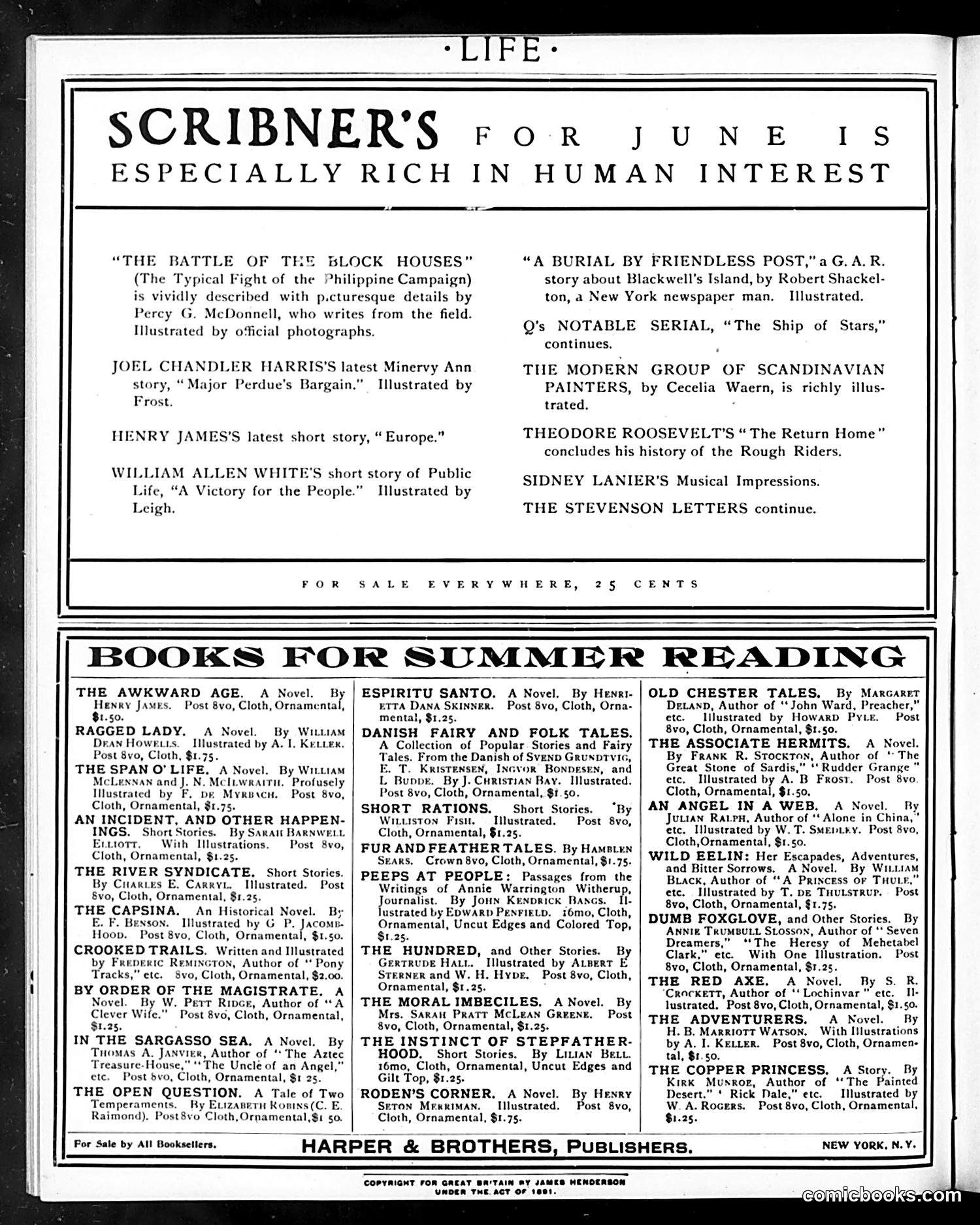
This page is primarily **advertising content**, not editorial cartoons or satire. It consists of two sections: 1. **Top section**: Advertisement for Scribner's Magazine's June issue, highlighting literary content by authors like Joel Chandler Harris, Henry James, and William Allen White, plus features on the Philippine Campaign and Theodore Roosevelt. 2. **Bottom section**: Advertisement for Harper & Brothers Publishers promoting summer reading books, listing numerous novels with prices and brief descriptions. There are **no political cartoons or satirical illustrations visible** on this page. The content reflects early 1900s literary culture and commercial book promotion rather than political commentary. The references to the Philippine Campaign and Roosevelt represent contemporary news interests, but these appear in straightforward editorial listings, not satirical treatment.
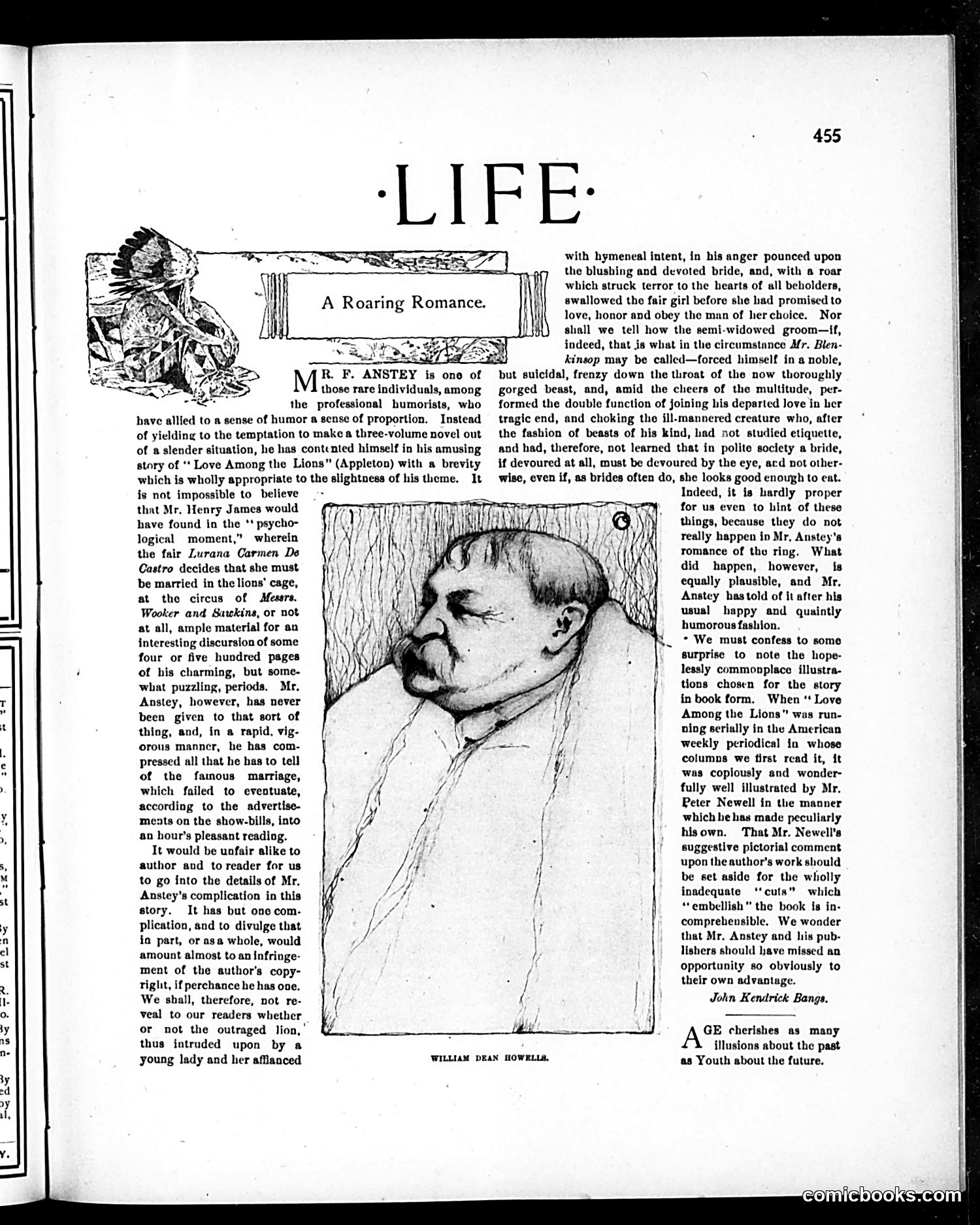
This page reviews a serialized story by F. Anstey that appeared in Life magazine. The portrait shows **William Dean Howells**, likely the illustrator or a notable literary figure of the period. The review critiques Anstey's work as a "slender situation" dressed up with humor rather than substantial plot. It notes that while Anstey typically compresses his narratives into brief magazine pieces, this serialized romance sprawls across multiple installments—described as nearly an infringement of authorial rights. The reviewer expresses skepticism about whether the story's central plot—a young woman and her affiance involved in outrageous behavior at a circus—justifies its extended length and elaborate illustration, even by Peter Newell's capable hand.
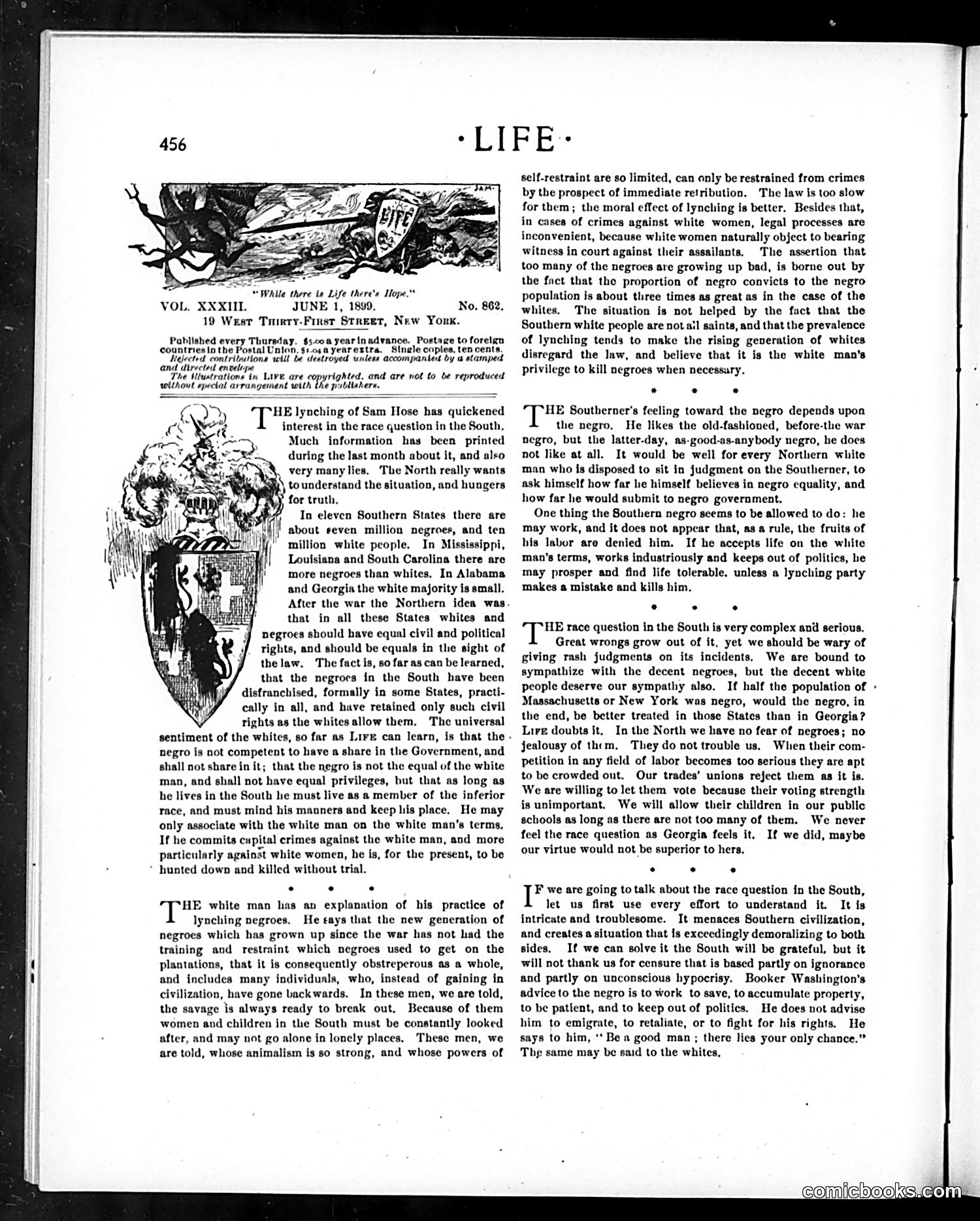
**The Cartoon:** The illustration shows a lynched Black man, titled "While there is Life there's Hope." This macabre image accompanies an article discussing the Sam Hose lynching and broader race violence in the South. **The Context:** The article addresses escalating racial violence, noting that Southern states justify lynching through claims about Black criminality and the need for "immediate retribution." The text critiques the hypocrisy: while Northern whites claim moral superiority, they tolerate Southern violence. **The Point:** Life satirizes the contradiction between American ideals of law and equality versus the actual practice of extrajudicial murder. The grim cartoon title suggests that hope for justice is itself dying—that the legal system cannot or will not protect Black lives from mob violence.
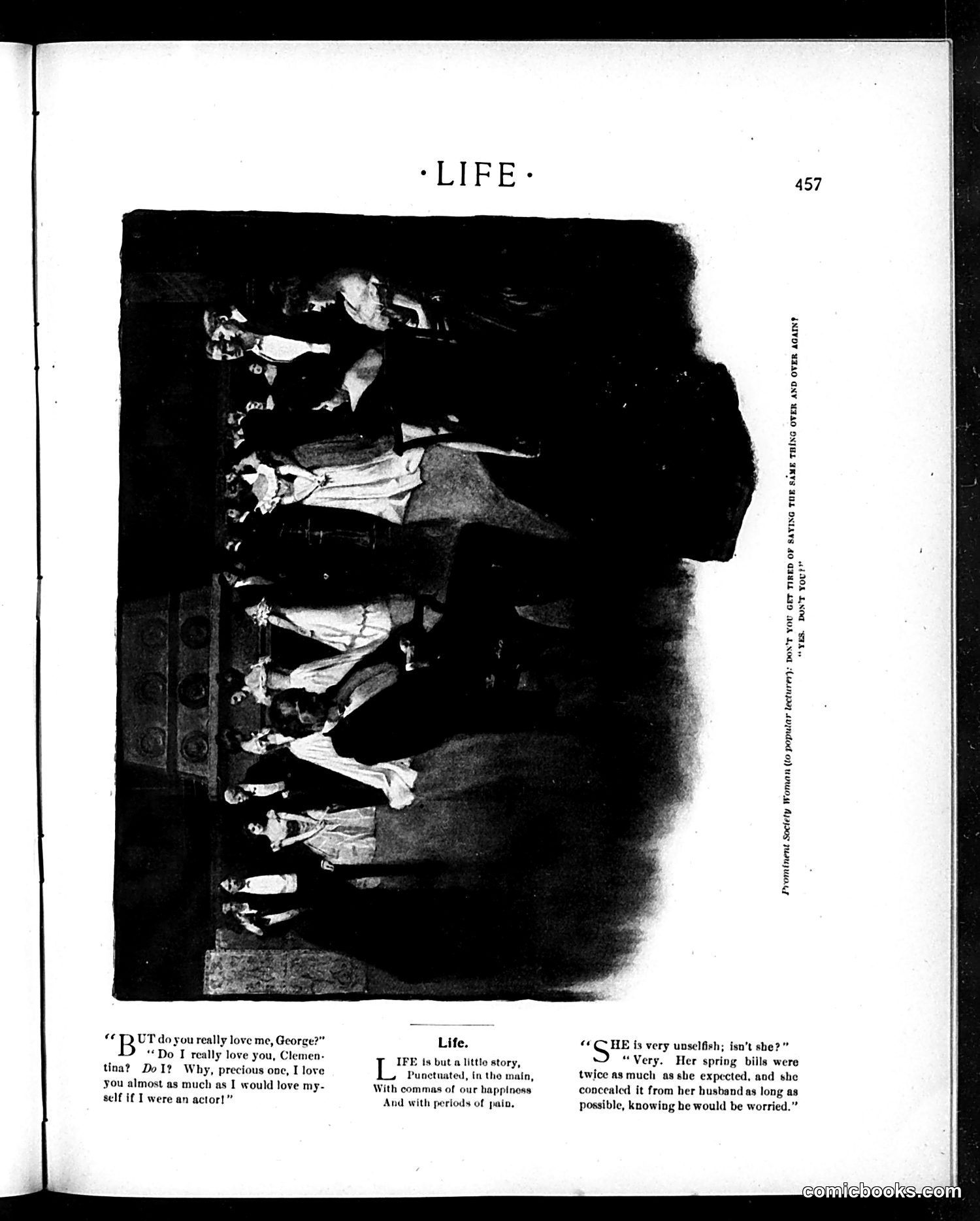
This page presents a domestic comedy sketch titled "Life," typical of Life magazine's satirical social commentary. The central poem defines life as "a little story, / Punctuated, in the main, / With commutes of our happiness / And with periods of pain." The accompanying dialogue scenes appear to satirize marriage dynamics. One caption shows a husband claiming he loves his wife "almost as much as I would love myself if I were an actor" — mocking male vanity and conditional affection. The opposing caption criticizes a wife for being "very unselfish" while actually concealing financial extravagance from her husband, satirizing hypocrisy and deception within marriages. The sketch uses domestic situations to humorously critique gender relations and relationship authenticity of the era.
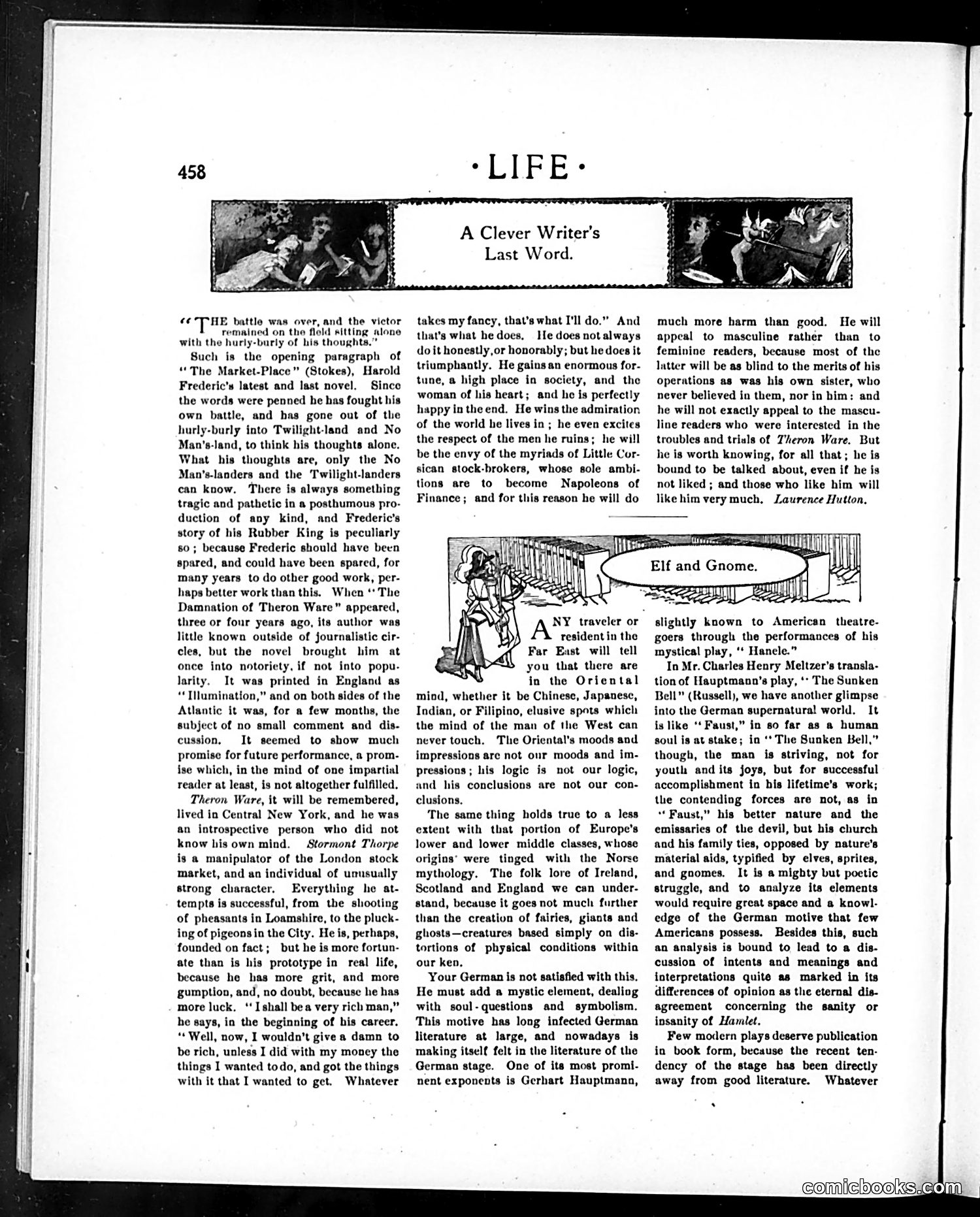
This page contains two distinct sections: **Left column:** A literary essay titled "A Clever Writer's Last Word," discussing various authors and their works, including references to Harold Frederic's "The Market-Place" and "The Damnation of Theron Ware." This is straightforward literary criticism, not satire. **Right section:** An illustrated piece titled "Elf and Gnome" discussing mystical elements in theater, specifically Hauptmann's "The Sunken Bell." The accompanying sketch shows a figure in what appears to be a fantastical or theatrical setting. Neither section contains obvious political satire or caricature. The page represents *Life* magazine's literary and cultural criticism function rather than its better-known satirical cartoon work. The "Elf and Gnome" discussion examines German theatrical mysticism's influence on American drama—cultural analysis rather than political commentary.
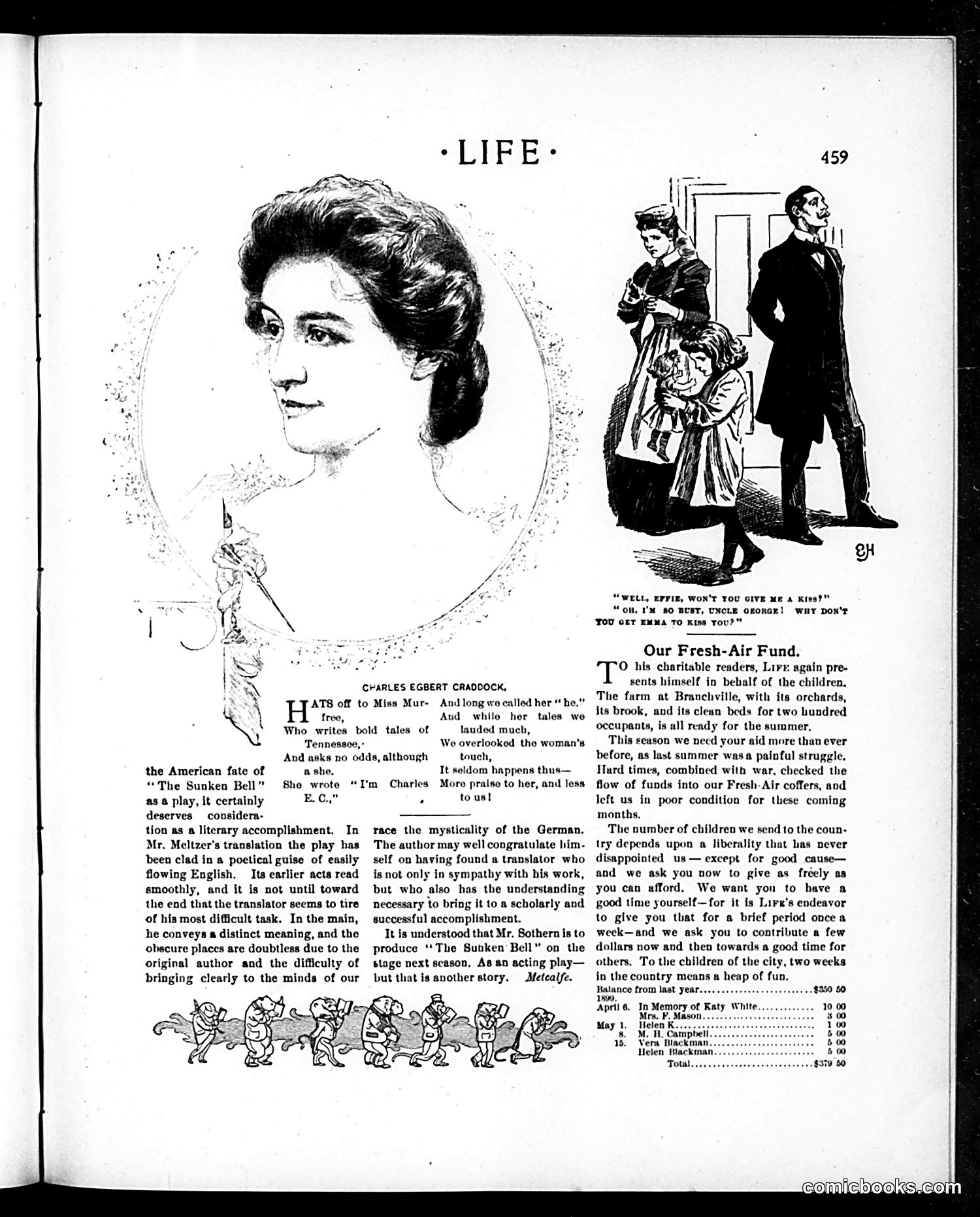
This page features a profile of **Charles Egbert Craddock**, a writer of Tennessee tales. The text discusses Mr. Sothern's theatrical adaptation of her work "The Sunken Bell," praising the translator's ability to convey the original's meaning clearly. The cartoon shows a domestic scene where a man asks a child for a kiss, but the child refuses, saying "Oh, I'm so busy, Uncle George! Why don't you get Emma to kiss you?" This appears to be gentle satire about social awkwardness or romantic pursuit—the child deflects the man's affection by suggesting he seek it elsewhere, likely commenting humorously on courtship customs of the era. The page also includes a "Fresh-Air Fund" charitable appeal for children's welfare.
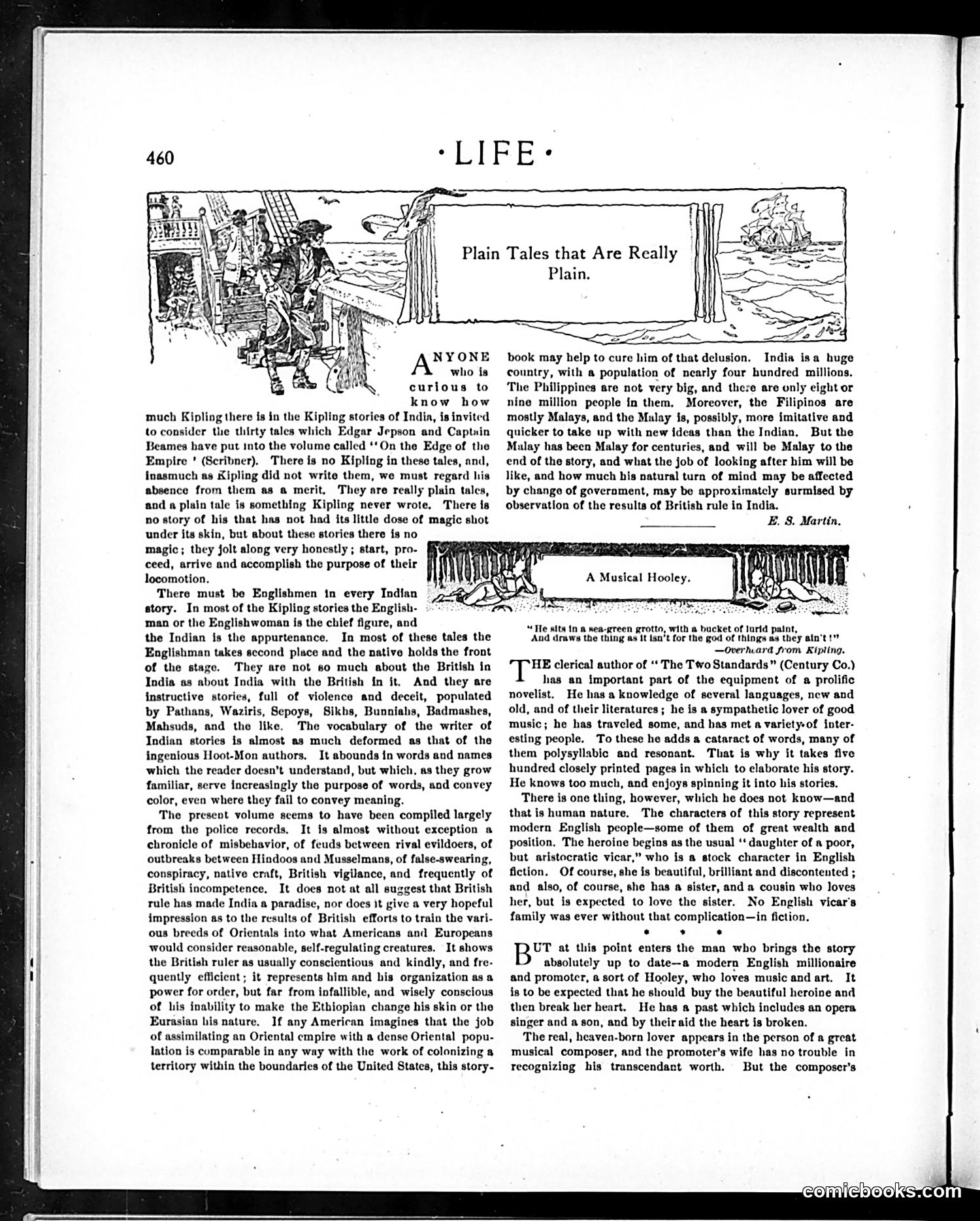
This page contains a literary discussion rather than political satire. The main text critiques how British authors depict India in fiction, noting that English characters typically dominate these narratives while Indian characters remain secondary. The small illustration titled "A Musical Hooley" (likely referring to an Irish social gathering) shows a figure in a seaside grotto with paint, quoting Kipling's work. The piece discusses how a clerical novelist uses exotic vocabulary and "polysyllabic and resonant" language when writing about India, often getting details wrong while claiming authenticity. The broader critique examines British colonial attitudes toward India and questions whether such fiction accurately serves British imperial interests or merely perpetuates stereotypes about "Oriental" peoples.
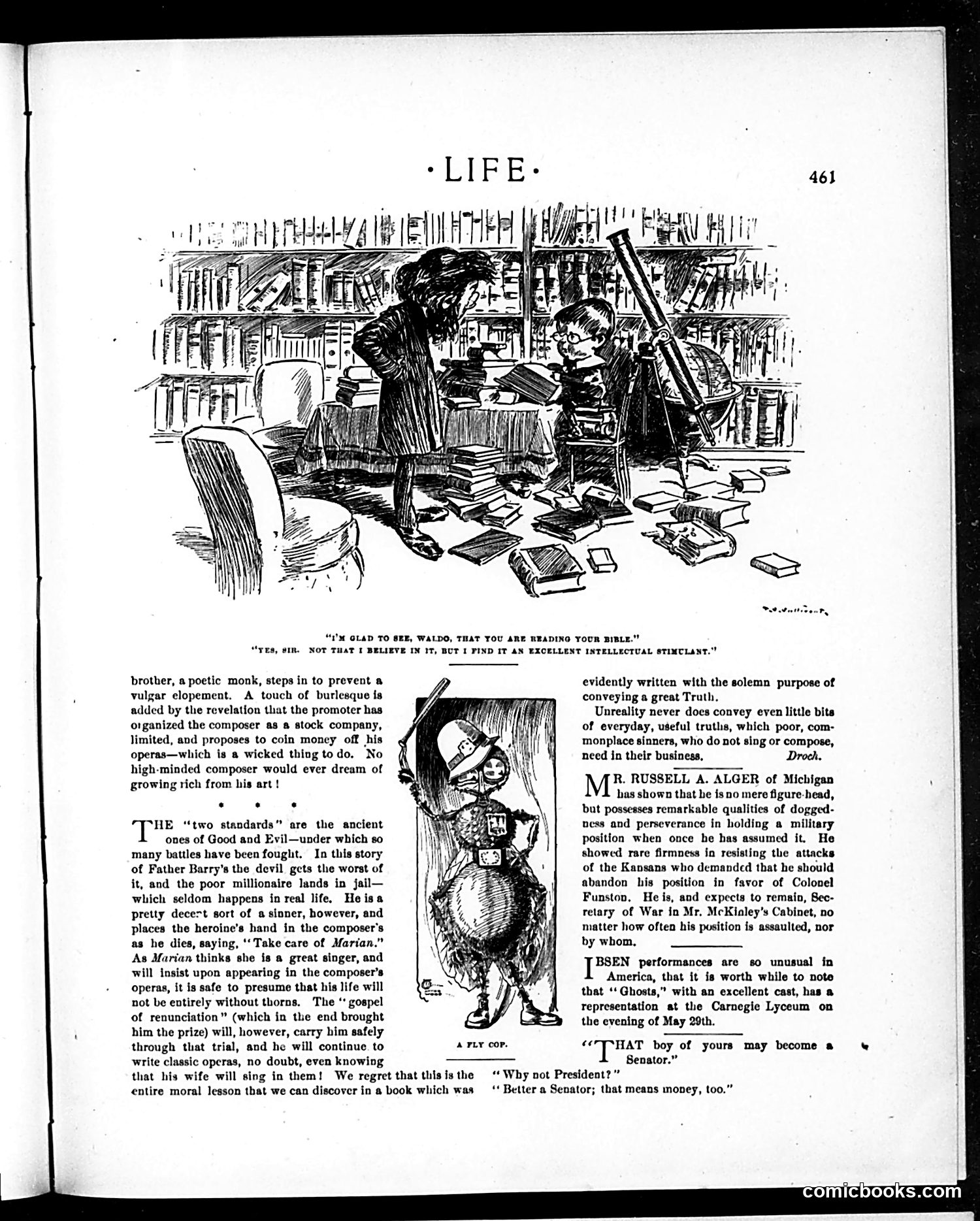
The main cartoon depicts a library scene where an adult (likely a parent or authority figure) confronts a young boy about reading his Bible. The child responds that while he doesn't believe in it, he finds it "an excellent intellectual stimulus." The satire mocks the gap between professed religious devotion and actual intellectual engagement—the child treats scripture as literature rather than faith. This reflects turn-of-century debates about biblical criticism and whether religious texts should be valued for moral content versus literary/intellectual merit. The smaller cartoon titled "A Fly Cop" appears unrelated, showing a figure with exaggerated features in what seems to be separate social commentary. The page's text discusses opera composers and theatrical performances, suggesting this is a broader cultural commentary issue.
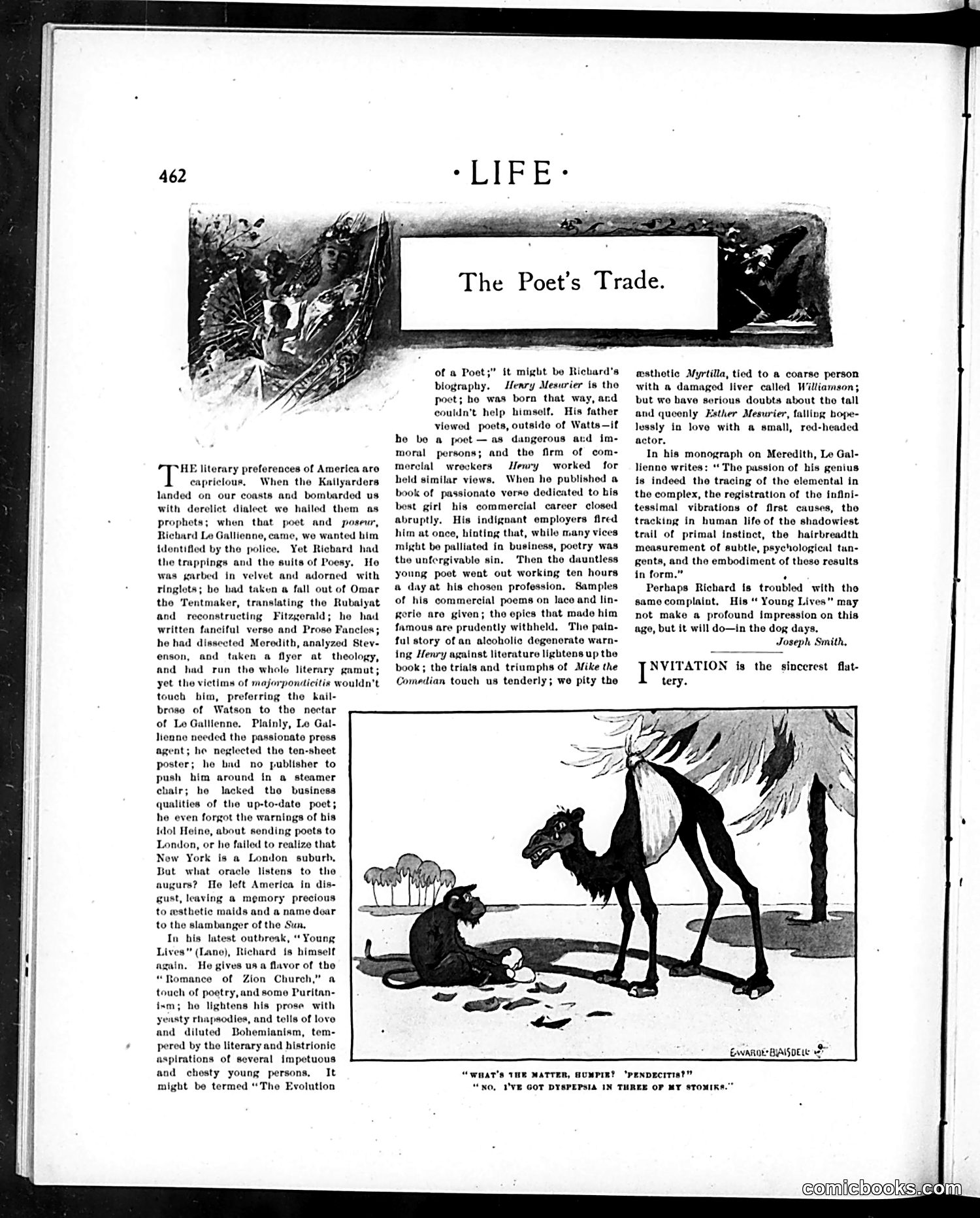
This page features an article about Richard Le Gallienne, a poet and literary figure. The text critiques American literary preferences, noting that Le Gallienne—despite talent—struggled commercially because he lacked business acumen and practical publishing connections. The article lists his works and notes his unsuccessful American career. The cartoon below, captioned "What's the matter, Humph? 'Pendicitis'?" / "No, I've got dyspepsia in three of my stomachs," depicts camels in a desert setting. This appears to be unrelated satire, likely poking fun at animals complaining of human ailments—a common humor device of the era. The joke's specific context remains unclear from the visible text.
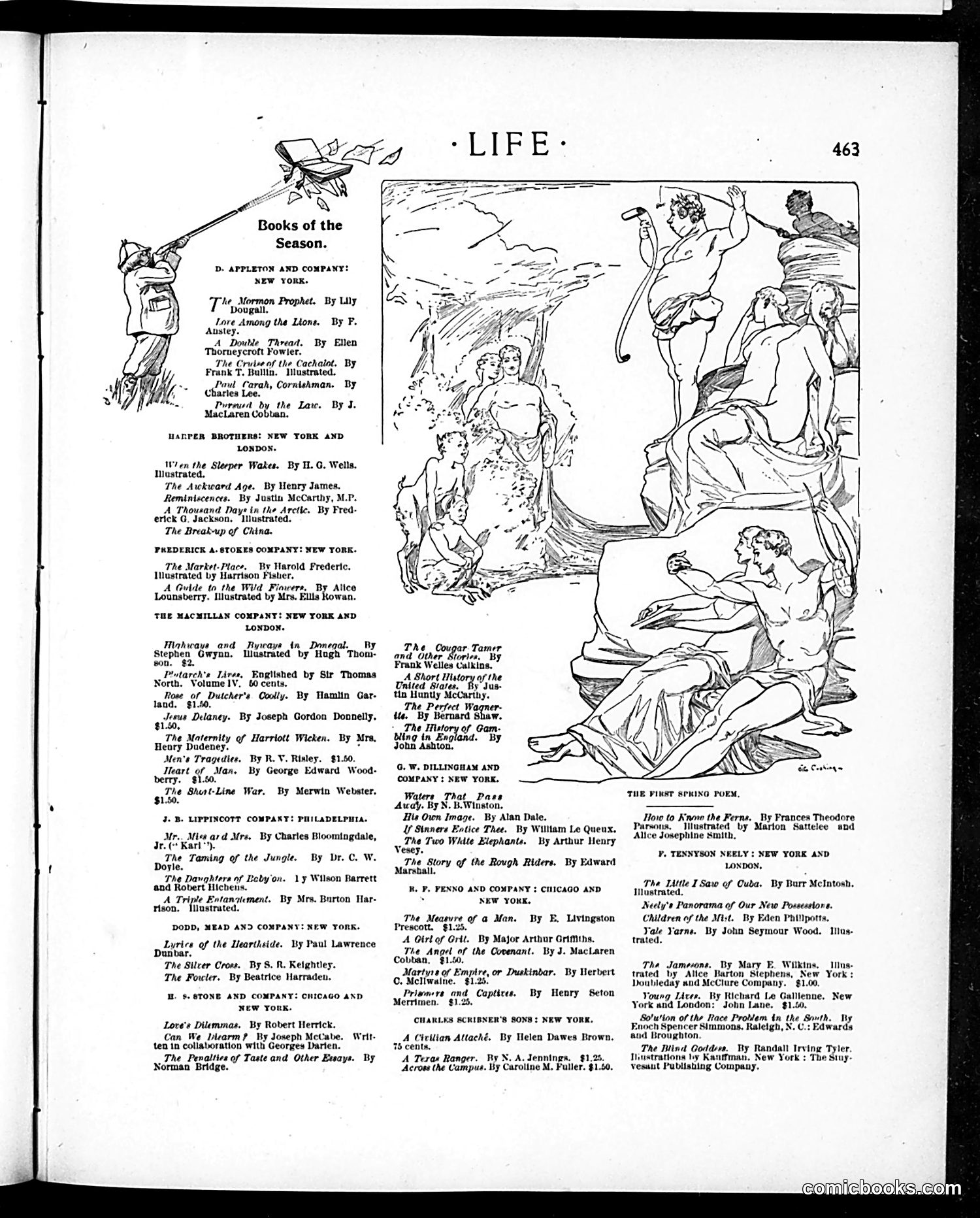
This page is primarily a **book advertisement section** titled "Books of the Season," listing new publications from various publishers (D. Appleton, Harper Brothers, The Macmillan Company, etc.). The single illustration labeled "THE FIRST SPRING POEM" depicts **classical allegorical figures**—multiple nude or semi-draped figures in a pastoral setting, appearing to represent spring, nature, or poetic inspiration. The style is classical/romantic rather than satirical. This is **not a political cartoon**. It's a literary page featuring book recommendations alongside decorative artwork. The illustration functions as thematic decoration for seasonal reading recommendations, typical of Life magazine's mix of satire, literature, and advertising during this era.
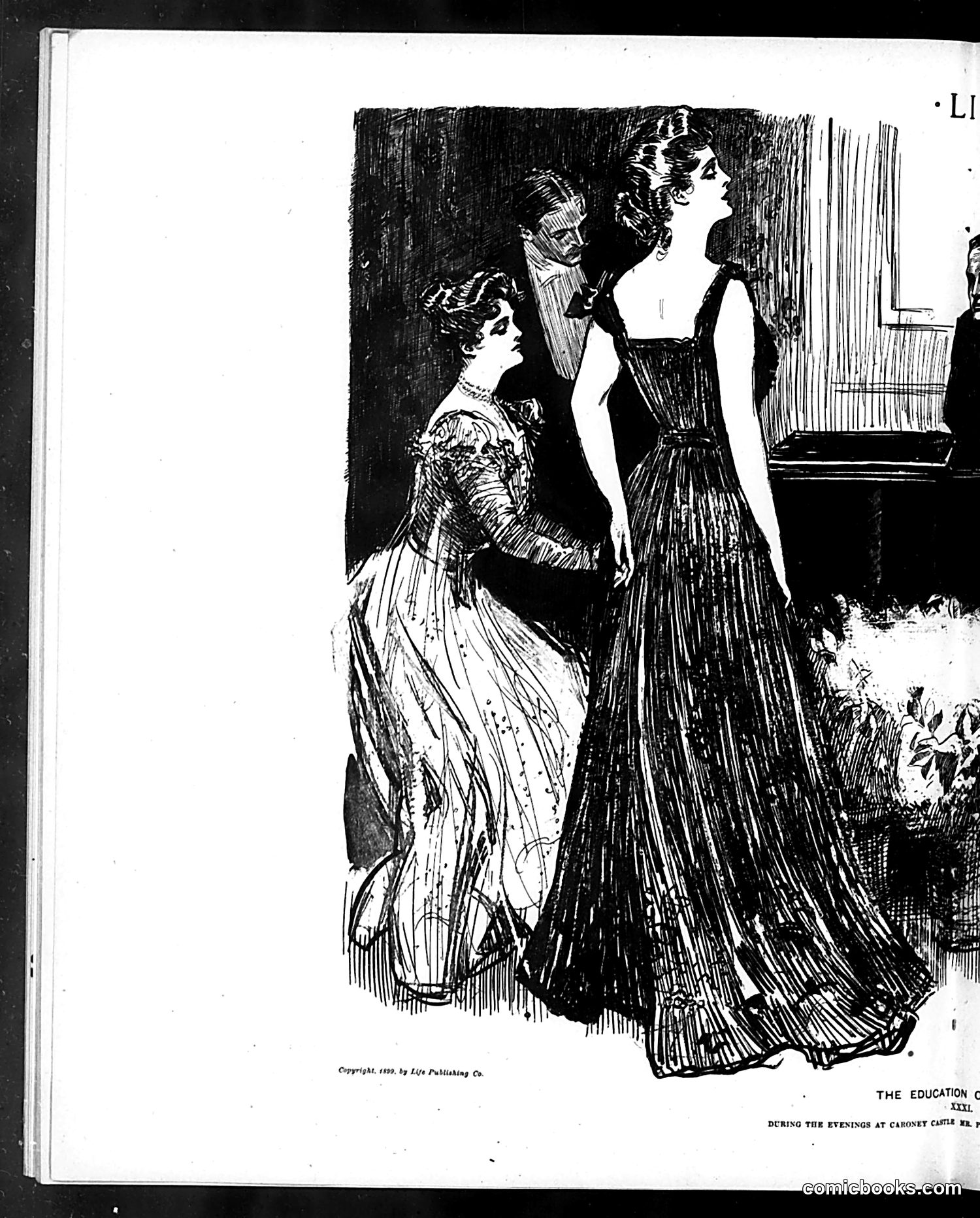
This is an illustration from Life magazine (copyright 1903 by Life Publishing Co.) titled "The Education of..." with a subtitle referencing "During the Evenings at Caroney Castle." The image shows two elegantly dressed women in Edwardian evening wear. The sketch satirizes social dynamics of the upper class, likely depicting a mentoring or "education" scenario between an experienced woman and a younger one during social gatherings at what appears to be a country estate. The satirical point seems to involve the informal education—manners, social navigation, romantic tactics—that occurred among society women during evening entertainments. Without additional context about "Caroney Castle," the specific target remains unclear, but the piece mocks the artificial refinement and social maneuvering of wealthy circles.
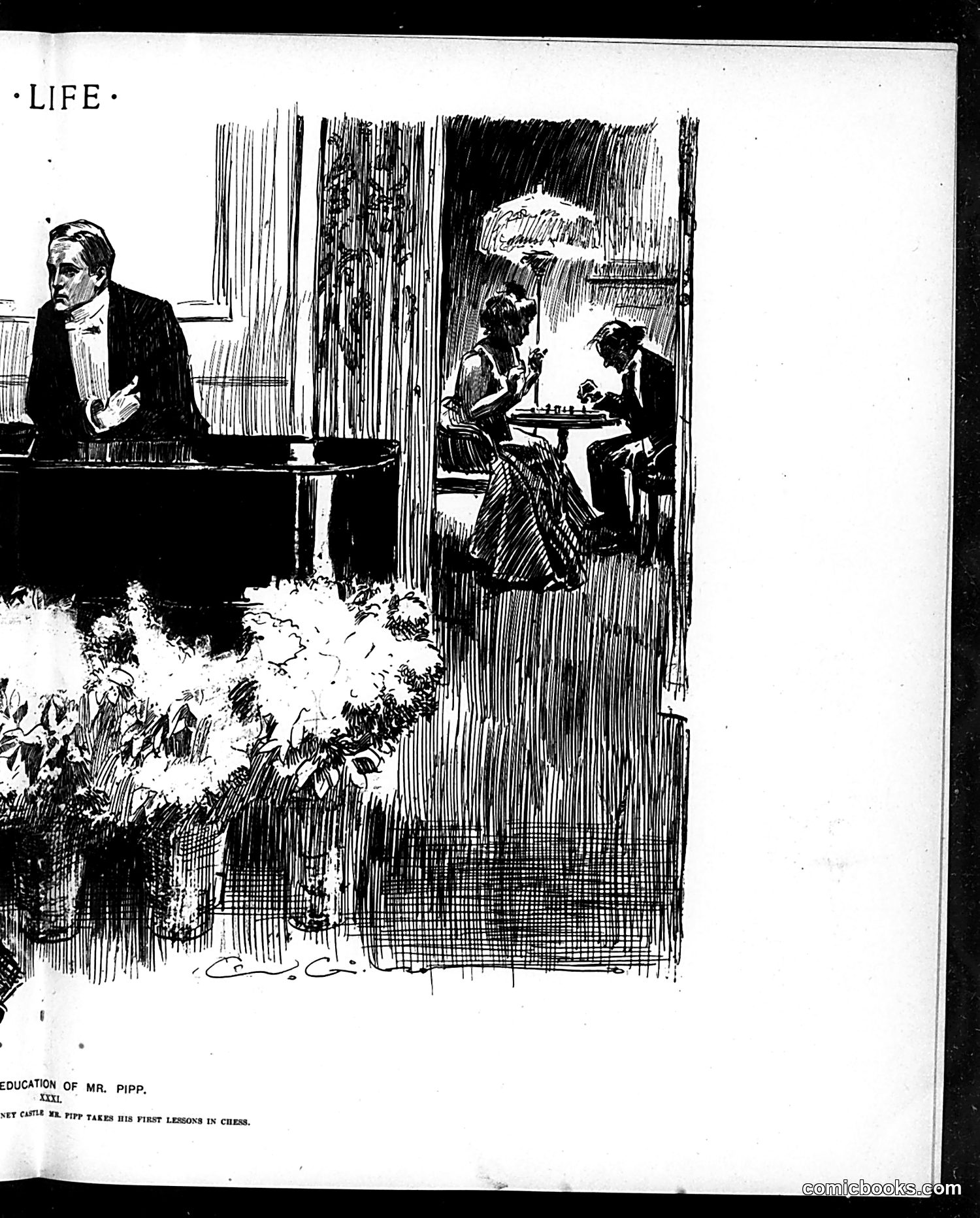
This illustration depicts a scene titled "Mr. Pipp Takes His First Lessons in Chess," part of a serialized story called "The Education of Mr. Pipp." On the left, a man in formal attire sits alone at a chess board, appearing contemplative or troubled. On the right, separated by a curtain or doorway, a woman and man play chess together under an umbrella indoors, suggesting a romantic or clandestine setting. The satire appears to comment on domestic life and relationships—juxtaposing solitary masculine pursuits with romantic feminine company. The chess metaphor suggests strategic maneuvering in romance or social situations. The caption indicates this is documenting Mr. Pipp's humorous "education" through life experiences, typical of Life magazine's satirical humor about contemporary social customs.
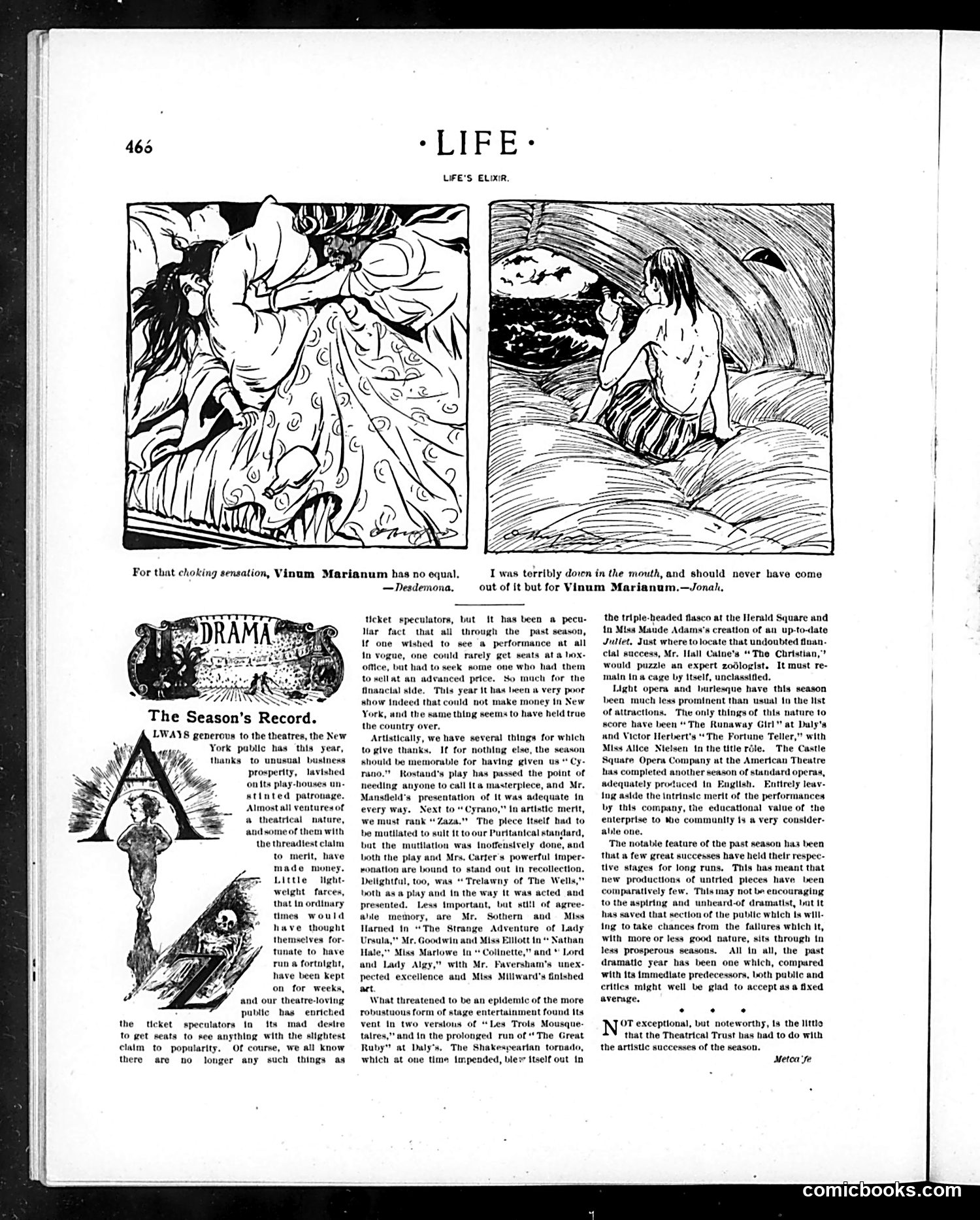
This page reviews the 1898-99 Broadway theater season. The top illustrations appear to show classical or mythological scenes, accompanying advertisements for "Vinum Marianum" (a patent medicine). The main article praises New York's generous theater patronage and financial success across most productions. The critic highlights several acclaimed plays: Rostand's "Cyrano" (with Richard Mansfield), Mrs. Patrick Campbell's "Zaza," and "Trelawny of The Wells." Other notable productions mentioned include "Nathan Hale," "Colette," and "The Christian." The piece notes an "epidemic" of swashbuckling entertainment, referencing two productions of "The Three Musketeers" and "The Great Ruby." Shakespeare's attempted theatrical dominance "blew itself out" in failed productions. The critic observes that light opera and burlesque were less prominent than usual, except for "The Runaway Girl" and Victor Herbert's "The Fortune Teller" with Alice Nielsen. Overall, the tone celebrates Broadway's commercial prosperity and artistic merit during this season.
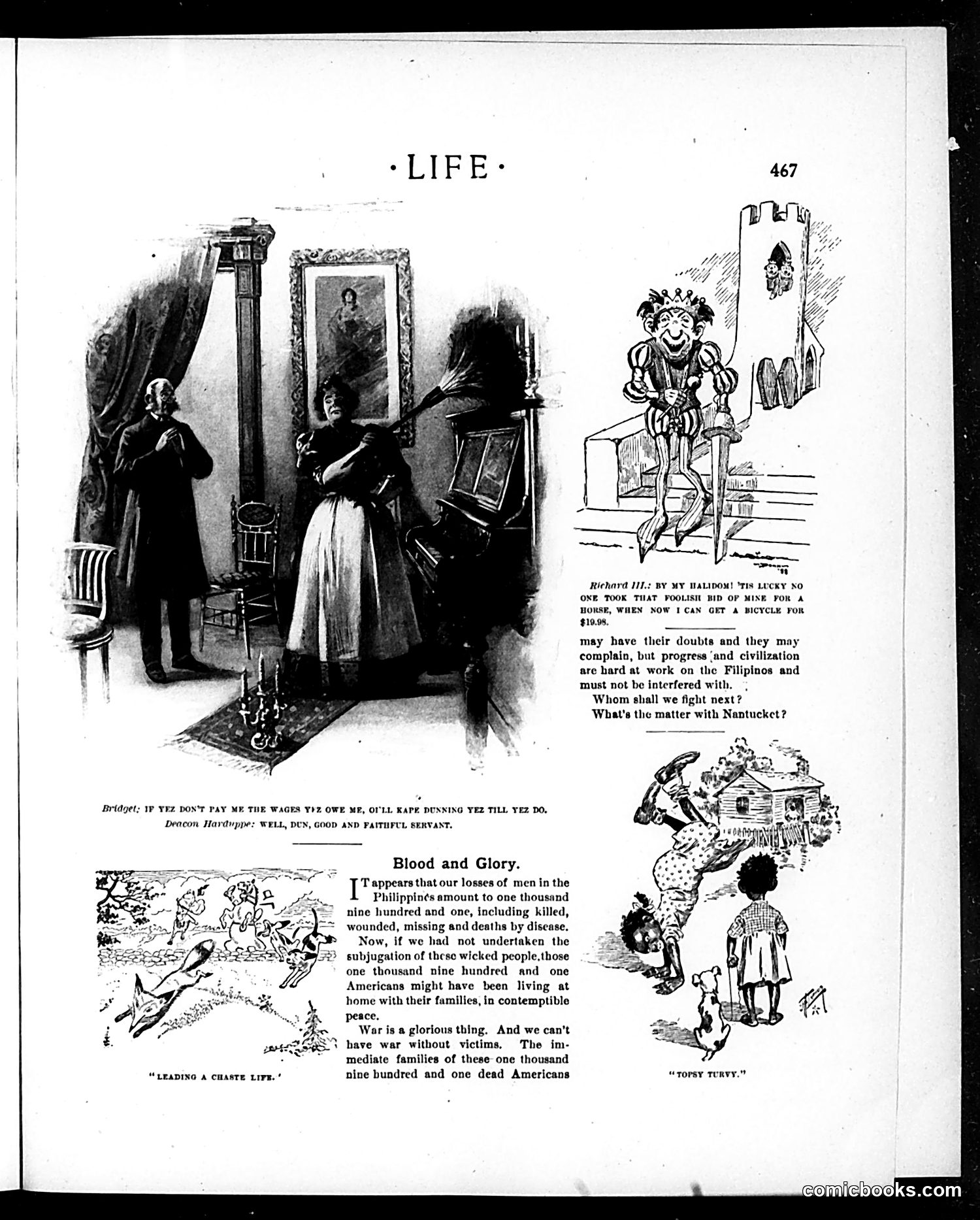
This Life magazine page critiques American military intervention in the Philippine-American War (1899-1902). The "Blood and Glory" section sarcastically defends war's "gloriousness" while listing 1,901 American casualties, then notes these men "might have been living at home with their families, in contemptible peace"—the satire lies in calling peaceful domestic life "contemptible" while praising war despite its human cost. The top cartoon depicts a domestic dispute over unpaid wages, likely satirizing economic hardship at home while resources fund foreign wars. The page mocks the justification that Philippine "subjugation" serves "progress and civilization"—a common imperialist rhetoric of the era. The sarcastic closing questions ("Whom shall we fight next?") suggest endless imperial ambition. Overall, Life presents anti-war satire challenging American interventionism and the casualty toll it exacted.
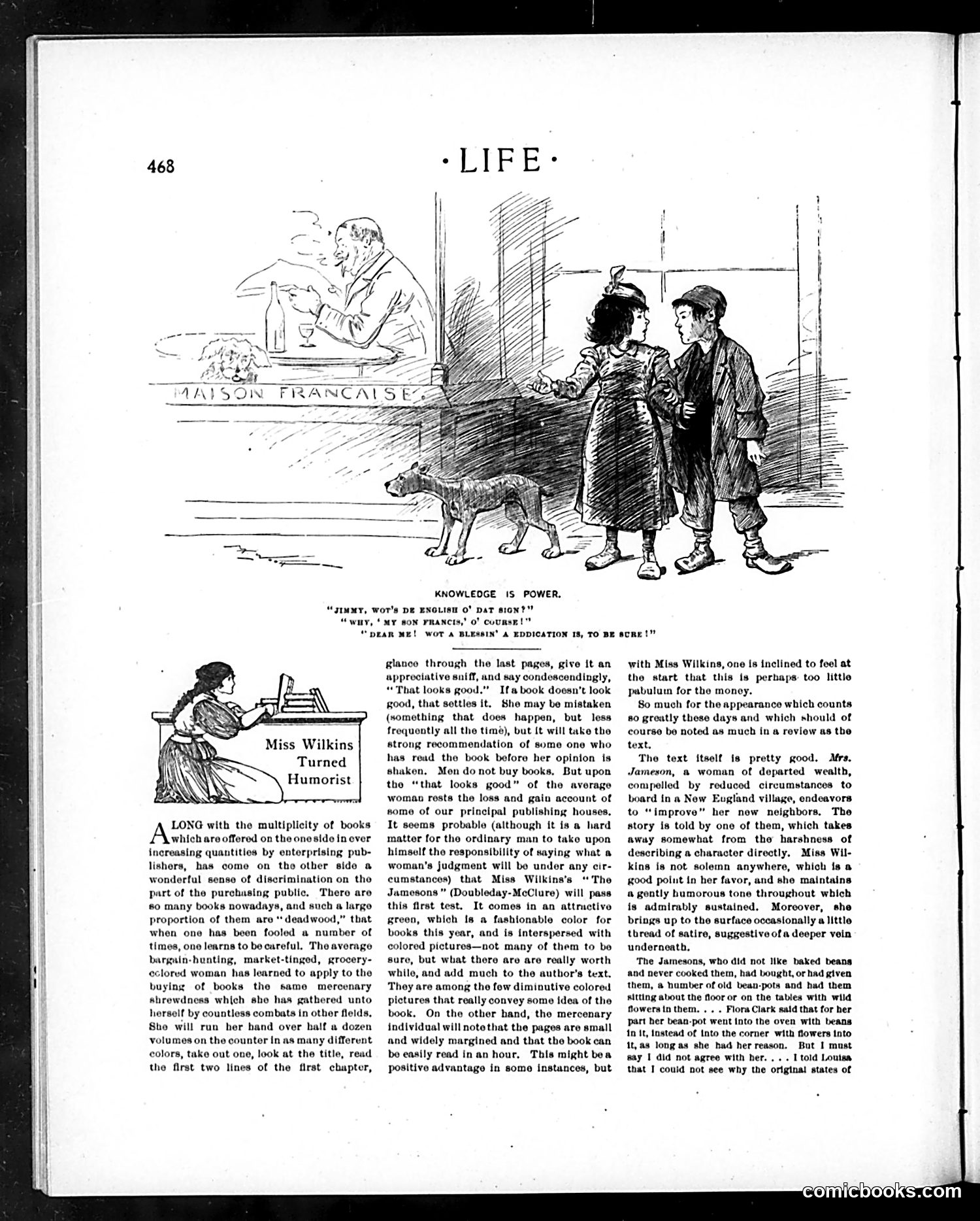
The page reviews "The Jamesons" by Miss Wilkins (Mary E. Wilkins Freeman), a novel about a genteel but impoverished woman trying to "improve" her New England village neighbors. The top cartoon illustrates the book's central conflict: a boy speaks French to a man at a "Maison Française" establishment, claiming "Knowledge is Power" while his companion corrects his grammar—satirizing Mrs. Jameson's well-intentioned but often misguided attempts to educate those around her. The review itself critiques how women shoppers judge books by appearance (cover color, illustrations, page margins, length) rather than content—a mercenary approach the critic ironically notes drives publishers' profits. The critic praises Wilkins's actual text for its gentle humor and subtle satire, though finds the book slight for the money. The page exemplifies *Life* magazine's characteristic blend of visual humor and literary commentary.
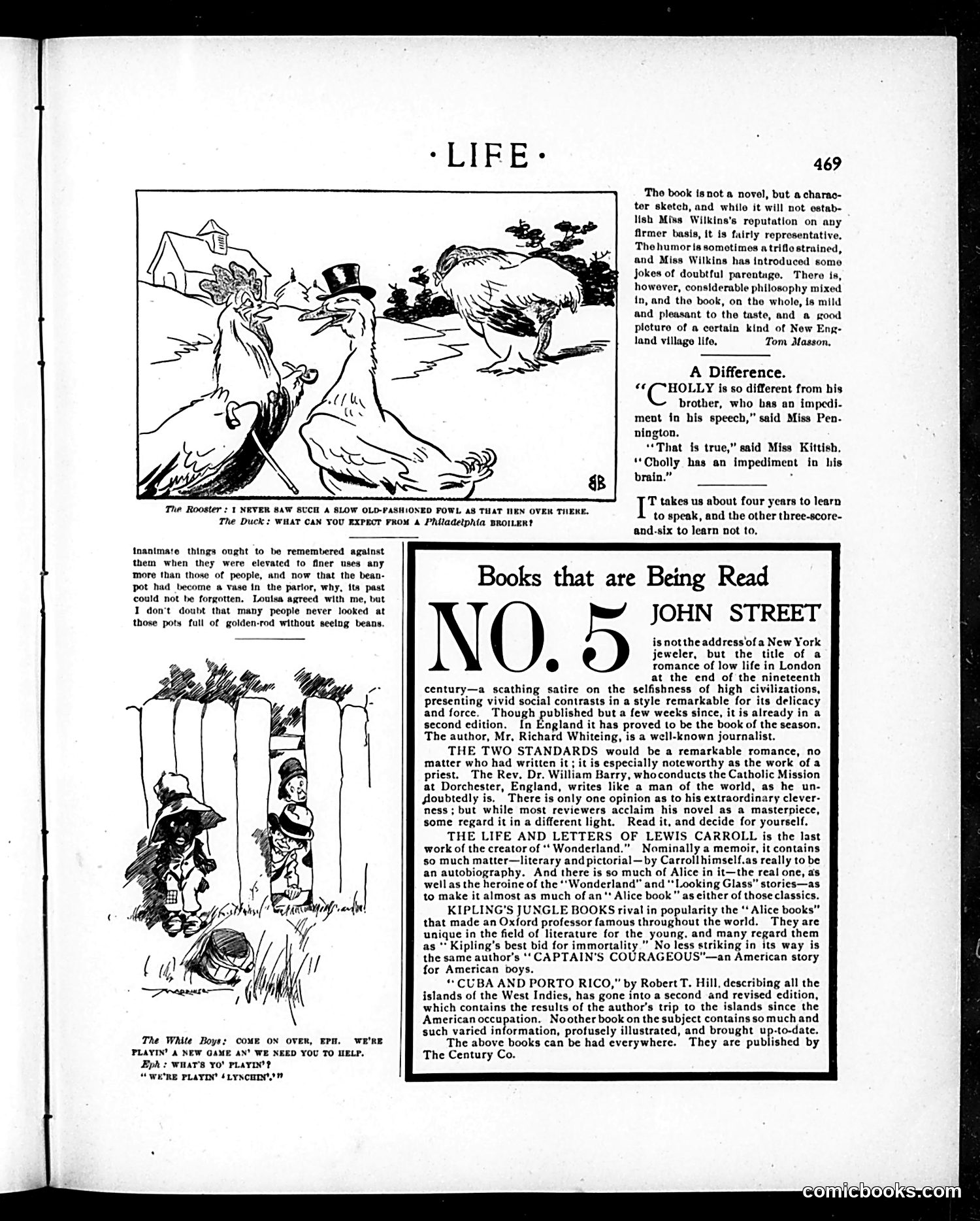
This page contains two satirical cartoons with captions mocking regional stereotypes and social attitudes of the era. The **top cartoon** depicts a rooster and duck discussing a hen. The rooster criticizes the hen as "slow" and "old-fashioned," while the duck retorts that one shouldn't expect better from a "Philadelphia broiler"—a regional jab suggesting Philadelphia produces inferior poultry (or people). The **bottom cartoon** is far darker: white boys invite their friend "Eph" (likely a Black child, given the dialect) to play a "new game," which they reveal is "playing a lynching." This is presented as humor but documents the casual, normalized violence and racism of the period—showing how lynch mobs were treated as entertainment, even involving children. The page also includes book reviews and a joke about a character named "Cholly" having "an impediment in his brain" rather than speech—wordplay on intellectual capacity. These cartoons reflect early 20th-century American attitudes: casual regional mockery and, disturbingly, the normalization of racial violence.
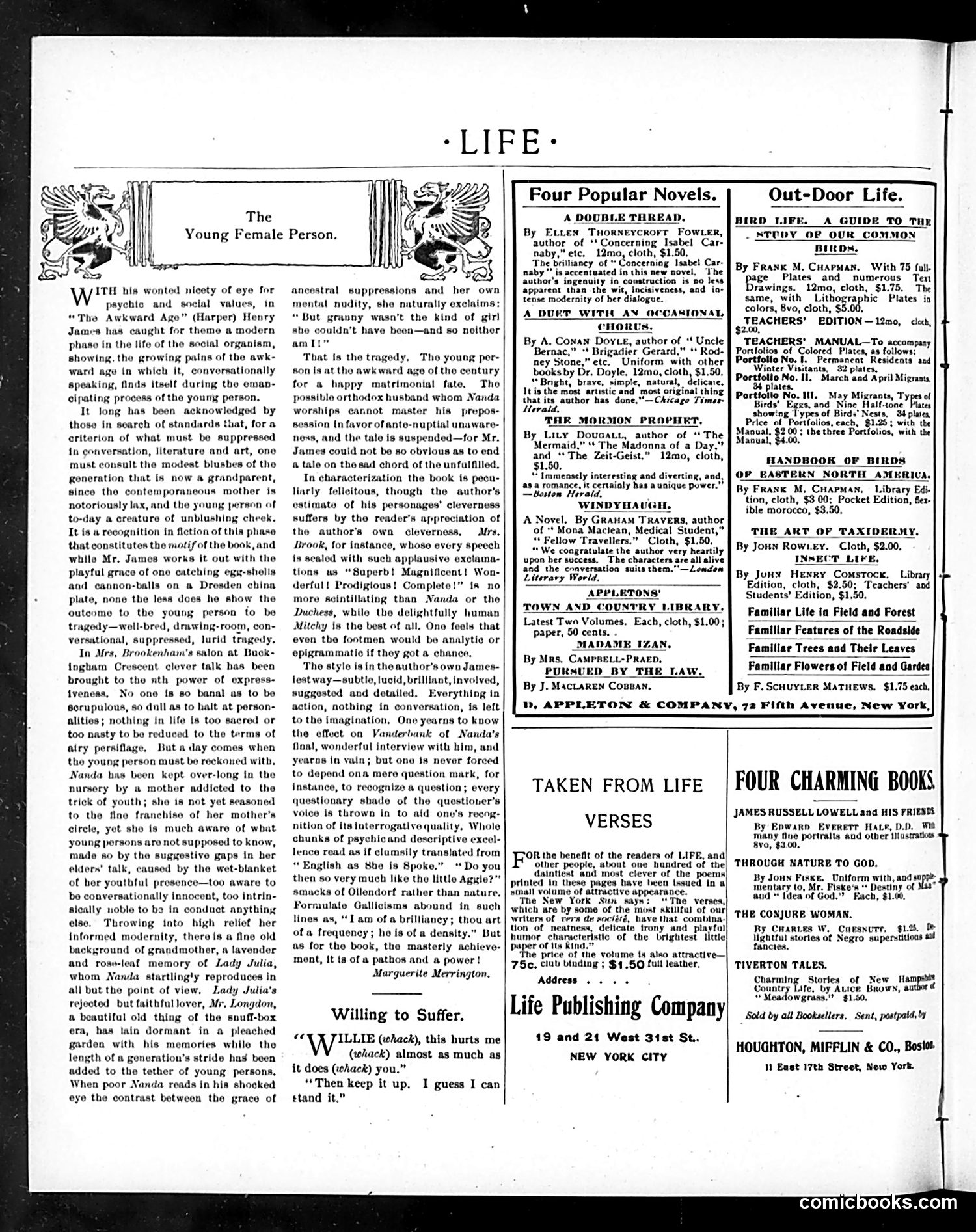
This page is primarily a **book review** of Henry James's novel *The Awkward Age*, not a political cartoon. The reviewer discusses James's treatment of a modern social problem: the "young female person" of the contemporary era who is simultaneously too innocent and too aware. The satire targets **generational shifts in morality**. The protagonist, Nanda, represents the tension between Victorian propriety (embodied by her grandmother, "Lady Julia") and modern frankness. Her elders conduct witty but morally loose salon conversations, forcing young Nanda into uncomfortable knowledge while expecting her to maintain innocence—an impossible contradiction. The tragedy, the reviewer explains, is that Nanda's potential husband cannot accept her "informed modernity," creating a matrimonial impasse. James critiques both the older generation's hypocritical sophistication and society's contradictory expectations of young women navigating the "awkward age" of the century. The page includes advertisements for other novels and books.
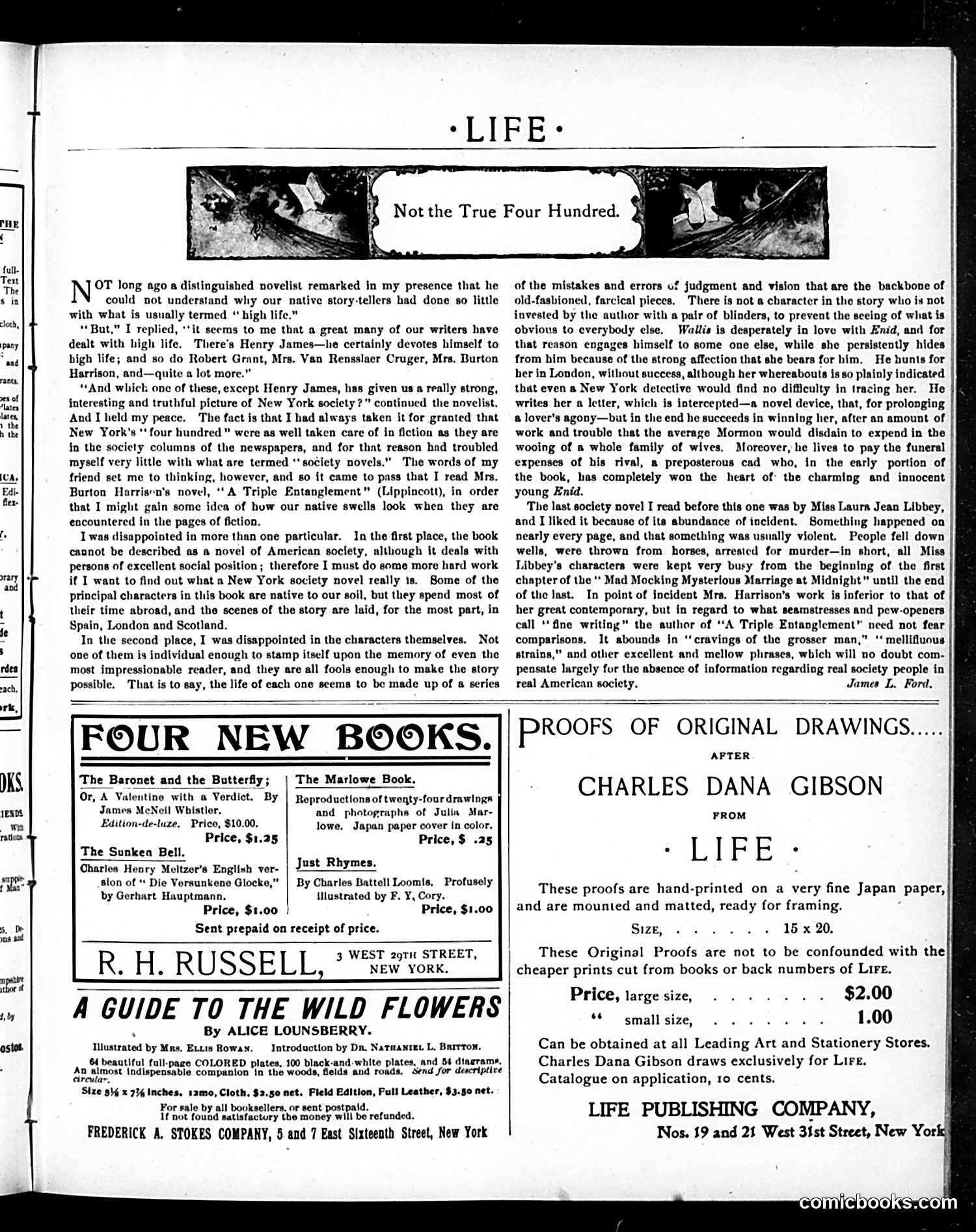
This page critiques society novels—popular fiction about New York's wealthy elite (the "Four Hundred"). The author reviews Mrs. Burton Harrison's *A Triple Entanglement*, finding it disappointing because: 1. **Setting problem**: Though allegedly about American society, the story occurs mainly in Spain, London, and Scotland rather than New York itself. 2. **Character weakness**: The characters lack individuality and behave foolishly—they're artificially "blinded" to obvious truths to create plot complications (a woman hides her location though it's plainly evident). 3. **Comparison to pulp fiction**: The author contrasts Harrison's sophisticated approach unfavorably with Laura Jean Libbey's sensational novels, which at least maintain constant dramatic action through melodrama (wells, arrests, murders). The satire suggests that "high life" fiction of this era failed to authentically capture New York society—settling instead for artificial contrivance or implausible melodrama.
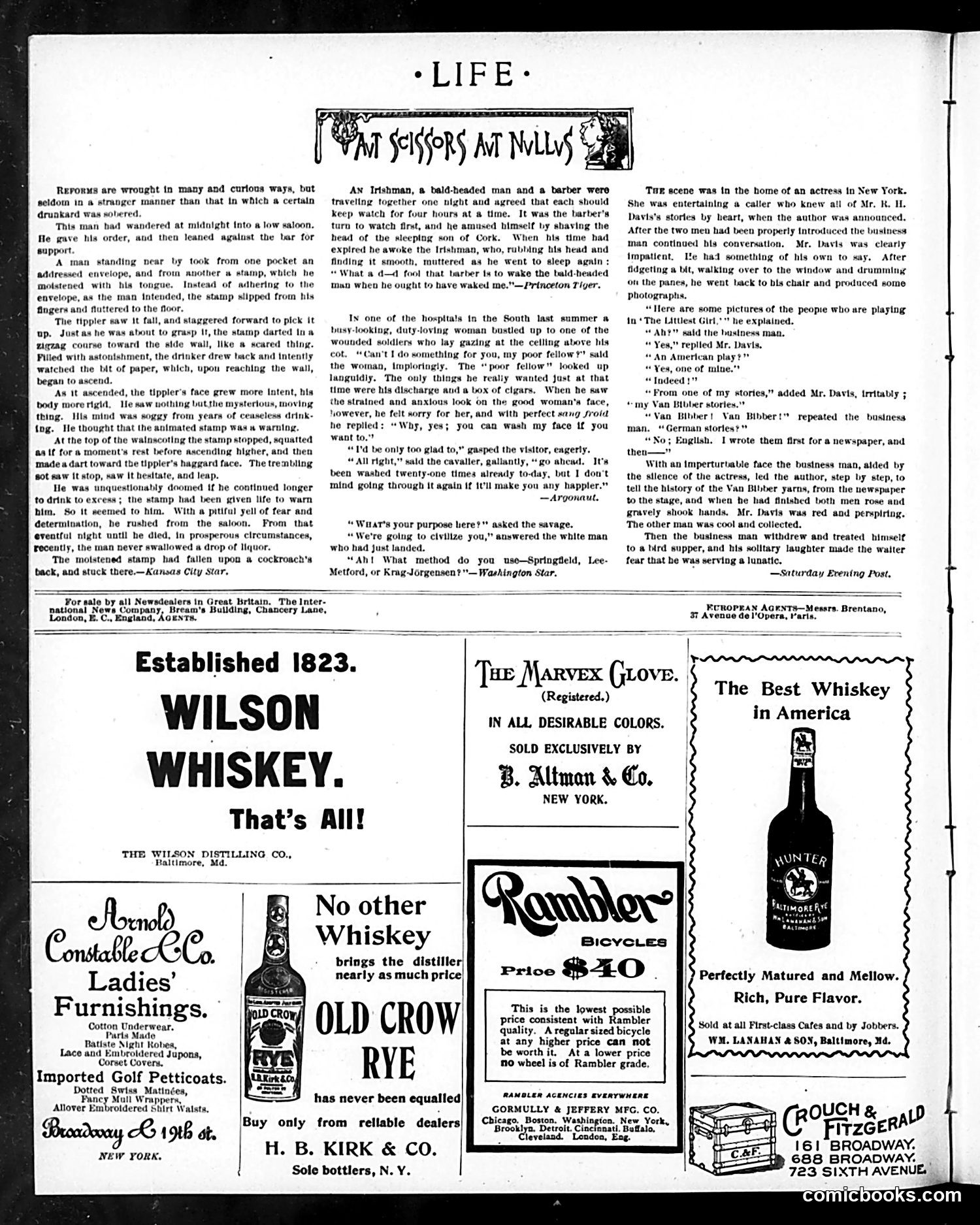
This page consists primarily of **humorous anecdotes rather than political cartoons**. The content reflects turn-of-the-century American humor: 1. **"The Sobered Drunkard"**: A moral tale where a drunk mistakes a cockroach-covered stamp for a supernatural warning, prompting lifelong sobriety—satirizing the superstitious desperation of alcoholics. 2. **"The Barber's Trick"**: An Irish stereotype joke about a bald man's obliviousness after being shaved while sleeping. 3. **"The Wounded Soldier"**: Gentle satire on well-meaning female visitors who pester hospitalized soldiers with repetitive kindnesses. 4. **"Civilization"**: Dark satire on imperialism—a "savage" asks what method the colonizer uses to "civilize," listing weapons (Springfield, Lee-Metford, Krag-Jorgensen rifles), implying civilization means conquest. 5. **"The Actress's Caller"**: Social comedy about a story-monopolizing bore meeting the actual author. The page is primarily **advertising** for period products (Wilson Whiskey, Old Crow Rye, etc.).
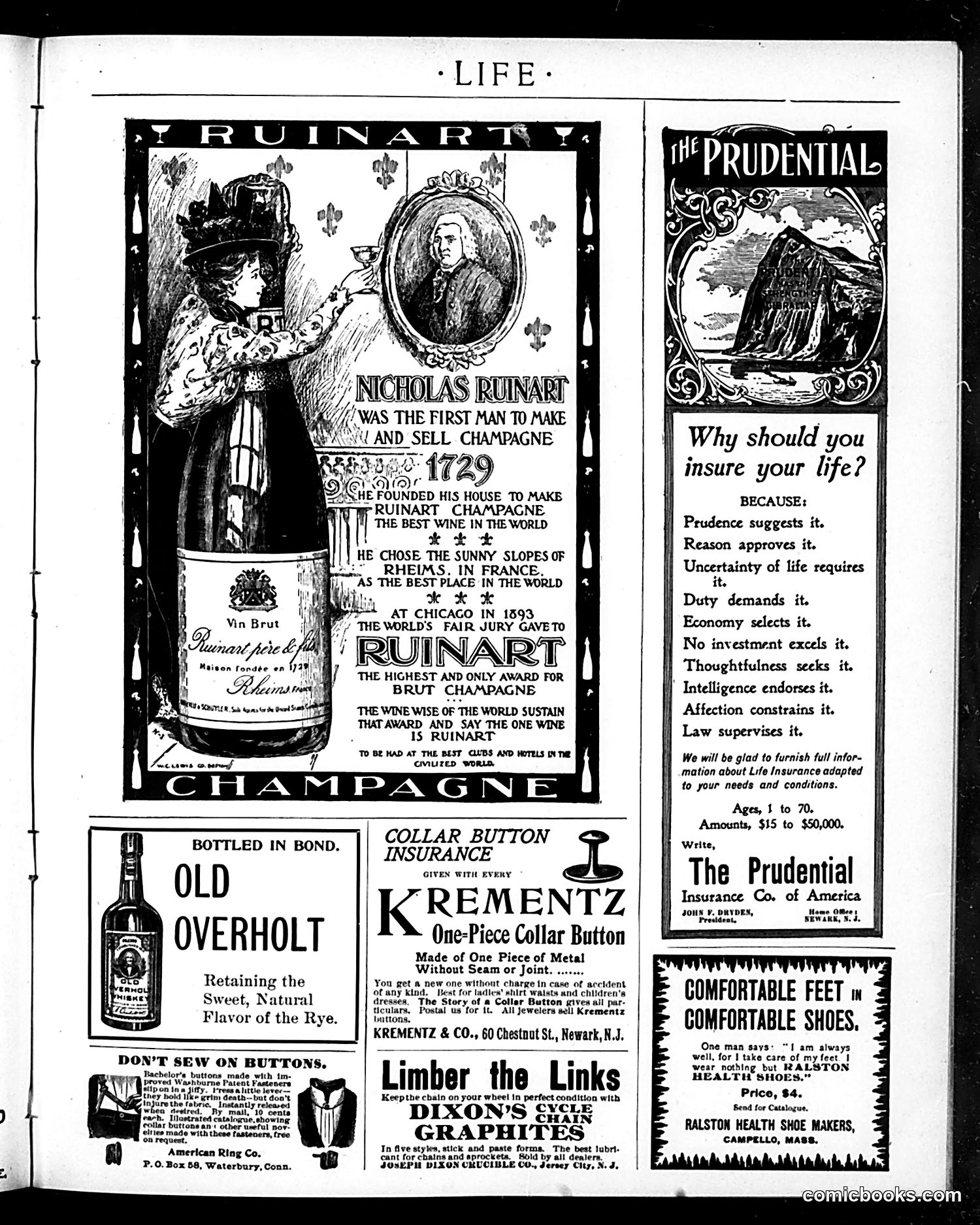
This page consists entirely of **advertisements** from what appears to be an early 1900s issue of Life magazine. The dominant image is a **Ruinart champagne ad**—a French wine brand established in 1729—portraying an elegant woman in formal dress presenting the product as award-winning and served at exclusive clubs and hotels. The remaining content advertises mundane consumer goods: Old Overholt rye whiskey, Krementz collar buttons (marketed as durable and convenient), sewing-free "bachelor buttons," shoe lubricant, and health shoes. These products reflect practical concerns of the era. Notably, **The Prudential Insurance Company** presents life insurance as a moral imperative, appealing to notions of duty, prudence, and family obligation—reflecting early 20th-century anxieties about mortality and economic security. The page reflects the magazine's commercial character and era's consumer culture rather than containing satire or political commentary.
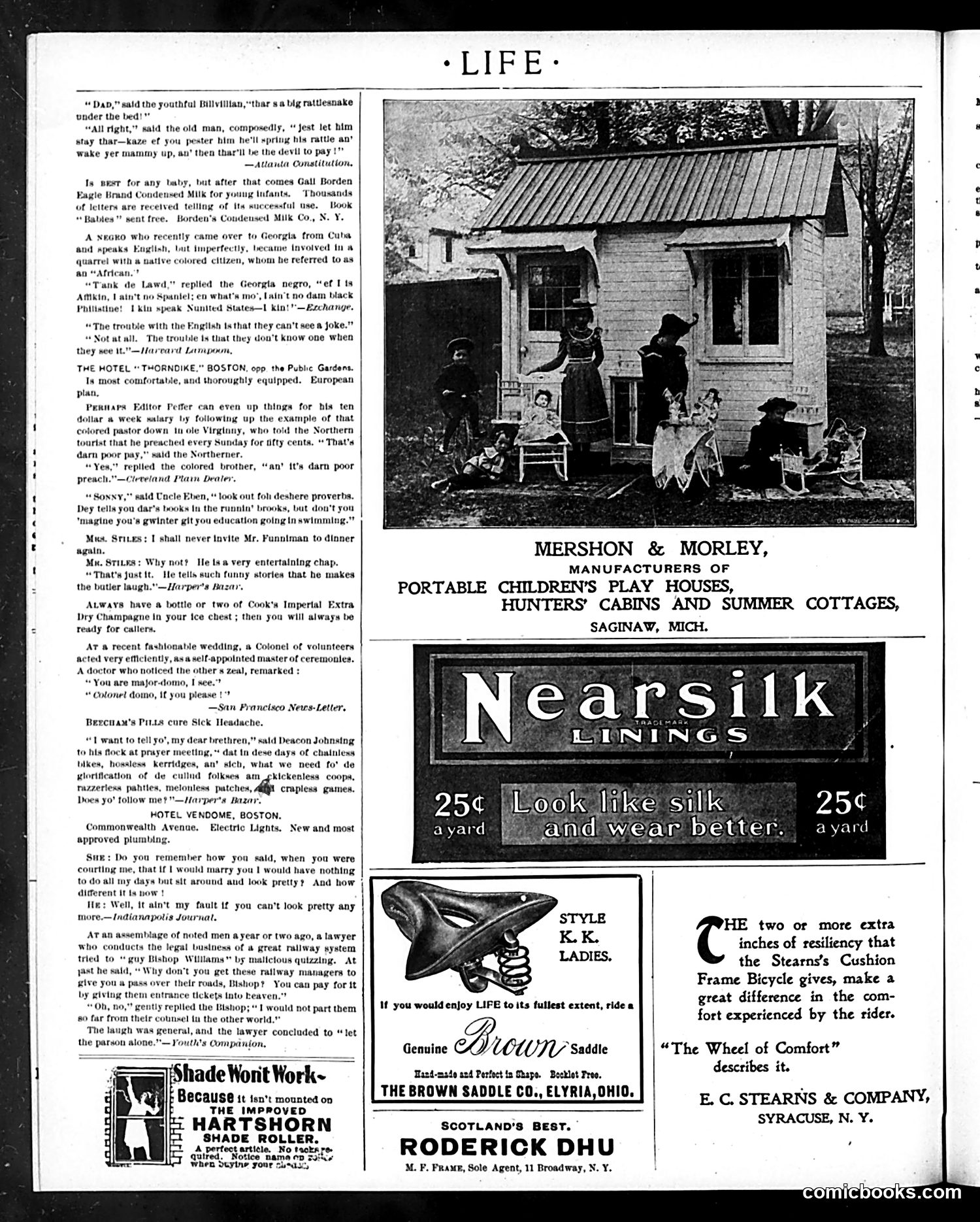
This page from *Life* magazine consists primarily of **humorous anecdotes and advertisements** rather than political cartoons. The text pieces use racial stereotypes common to the era, including dialect humor featuring African American characters. Notable examples include a Georgia Negro's prideful assertion of American citizenship over Spanish identity, and a Deacon's malapropism-filled prayer about modern conveniences ("chainless bikes, hossless kerridges"). Other anecdotes mock English humorlessness, feature a colored pastor's comment on low sermon pay, and include a Bishop's witty rejoinder to a railroad lawyer's skeptical questioning about heavenly passes. The page is dominated by **period advertisements** for products like Nearsik Linings, Brown Saddles, Roderick Dhu whisky, and various hotels and home goods—typical of *Life*'s revenue model. The humor relies on social observation, wordplay, and character types rather than explicit political commentary, reflecting early 1900s American satirical magazine conventions.
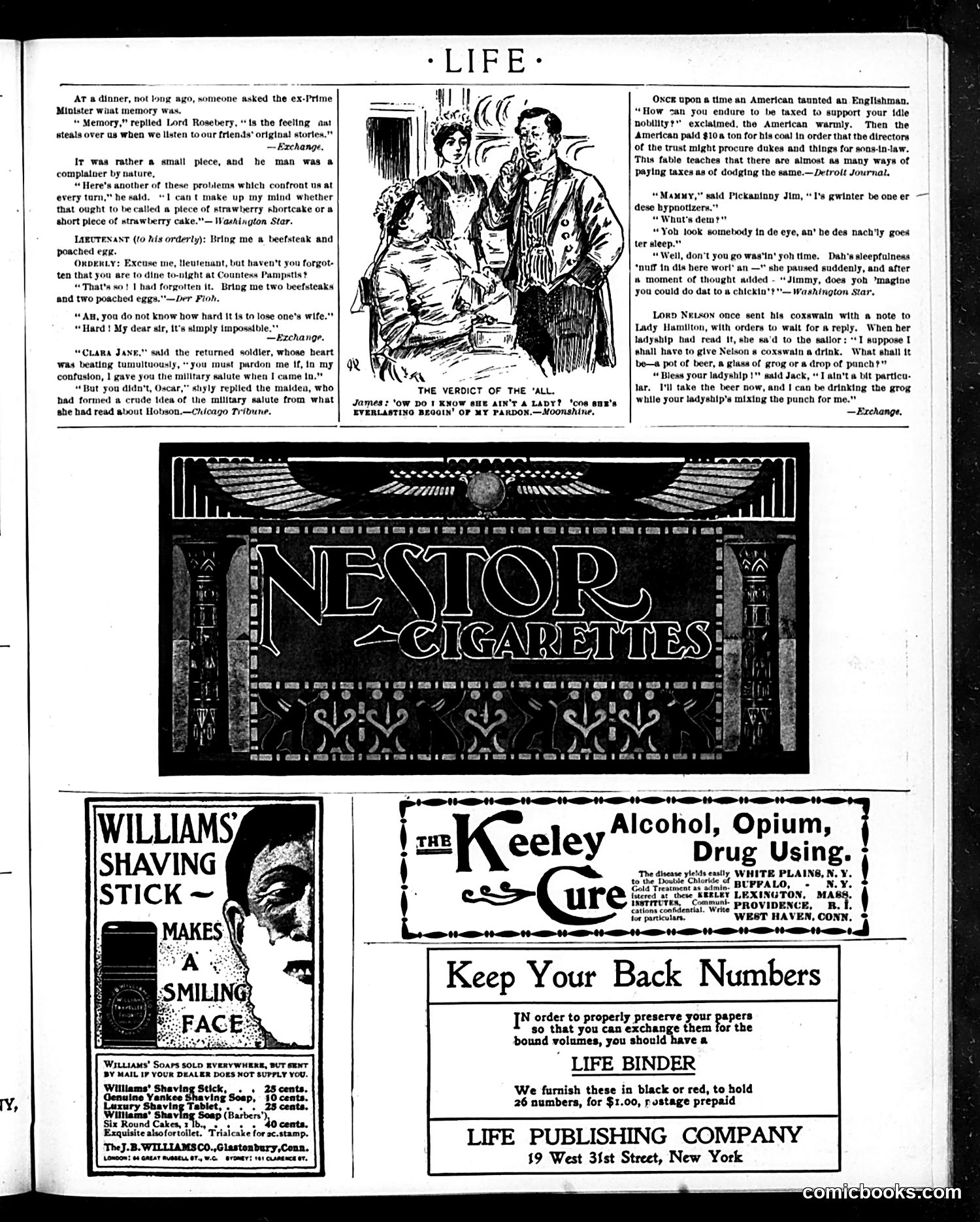
This page from the satirical magazine *Life* contains several short humorous anecdotes mocking social pretension and human foibles, plus period advertisements. **The cartoons/jokes include:** - A quip attributed to Lord Rosebery about memory being "the feeling that steals over us when we listen to our friends' original stories"—satirizing how people recycle anecdotes as their own. - A barb about American hypocrisy: an American mocks British nobility for supporting idle aristocrats through taxes, then pays inflated prices to wealthy industrialists—equating tax-dodging with aristocratic parasitism. - A dialect joke about "Pickaninny Jim" discussing hypnosis (reflecting period racial caricature conventions). - A naval anecdote about Lord Nelson's coxswain expertly negotiating drinks from Lady Hamilton. The page is otherwise **mostly advertisements**: Williams' Shaving Stick, the Keeley Cure (for alcohol/opium addiction), and *Life* magazine's own binder service. These ads are typical of early 20th-century magazine monetization.
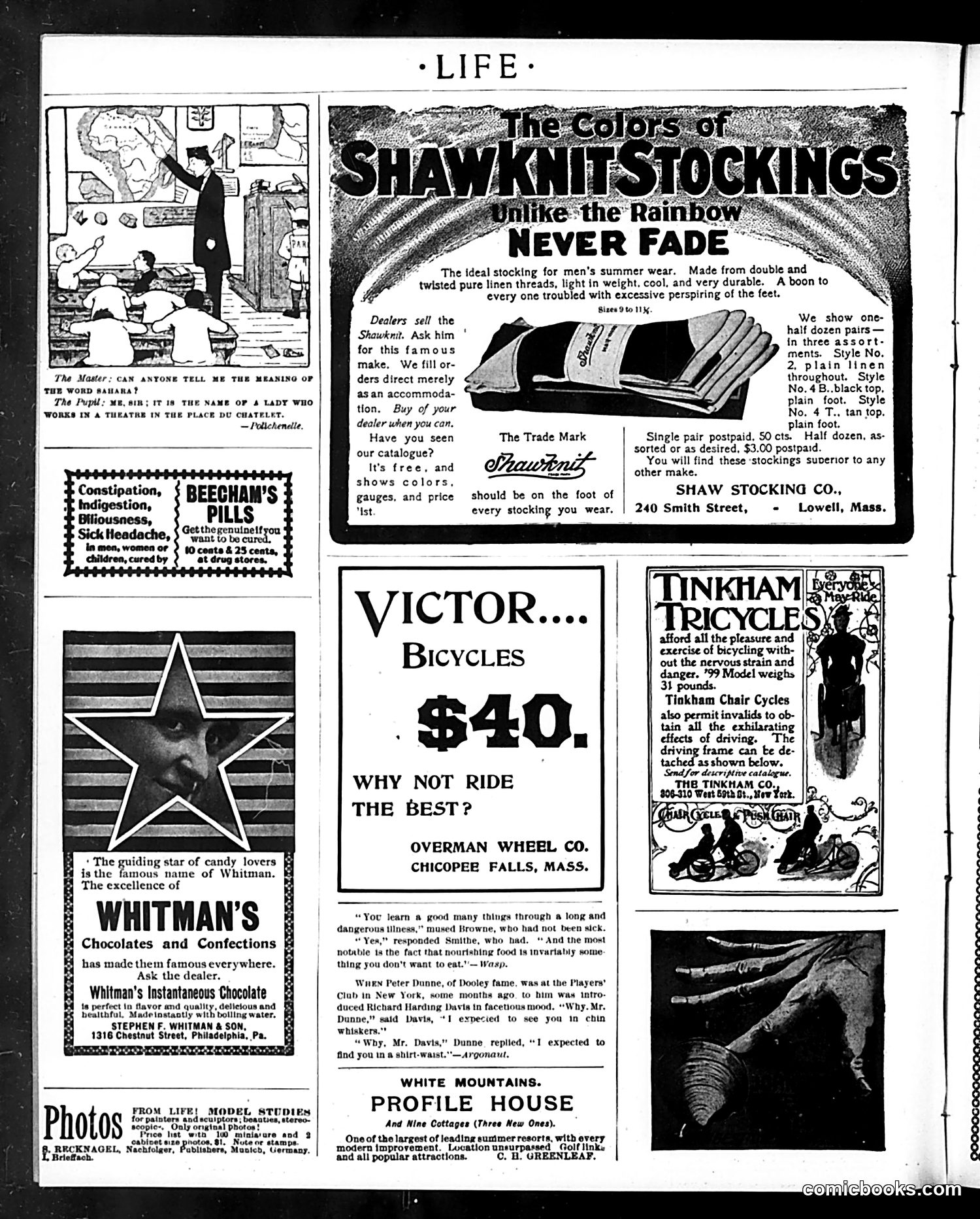
This page is primarily **advertising**, with one small satirical cartoon at the top. ## The Cartoon The cartoon features a schoolmaster and pupil discussing the word "sauna." The master asks its meaning; the pupil defines it as "the name of a lady who works in a theatre in the Place du Chatelet" (a Parisian location). The joke plays on the French word "saunat" sounding like a woman's name rather than being the Finnish bathing concept. The attribution to "Polichinelle" suggests this is a translated European joke, likely poking fun at linguistic confusion or misunderstandings between cultures. ## The Advertisements The remaining content comprises period product ads: Beecham's Pills (digestive remedy), Whitman's Chocolates, Shawknit stockings for men, Victor bicycles ($40), Tinkham tricycles for invalids, and resort/hotel services. These reflect early 20th-century consumer goods and leisure activities.
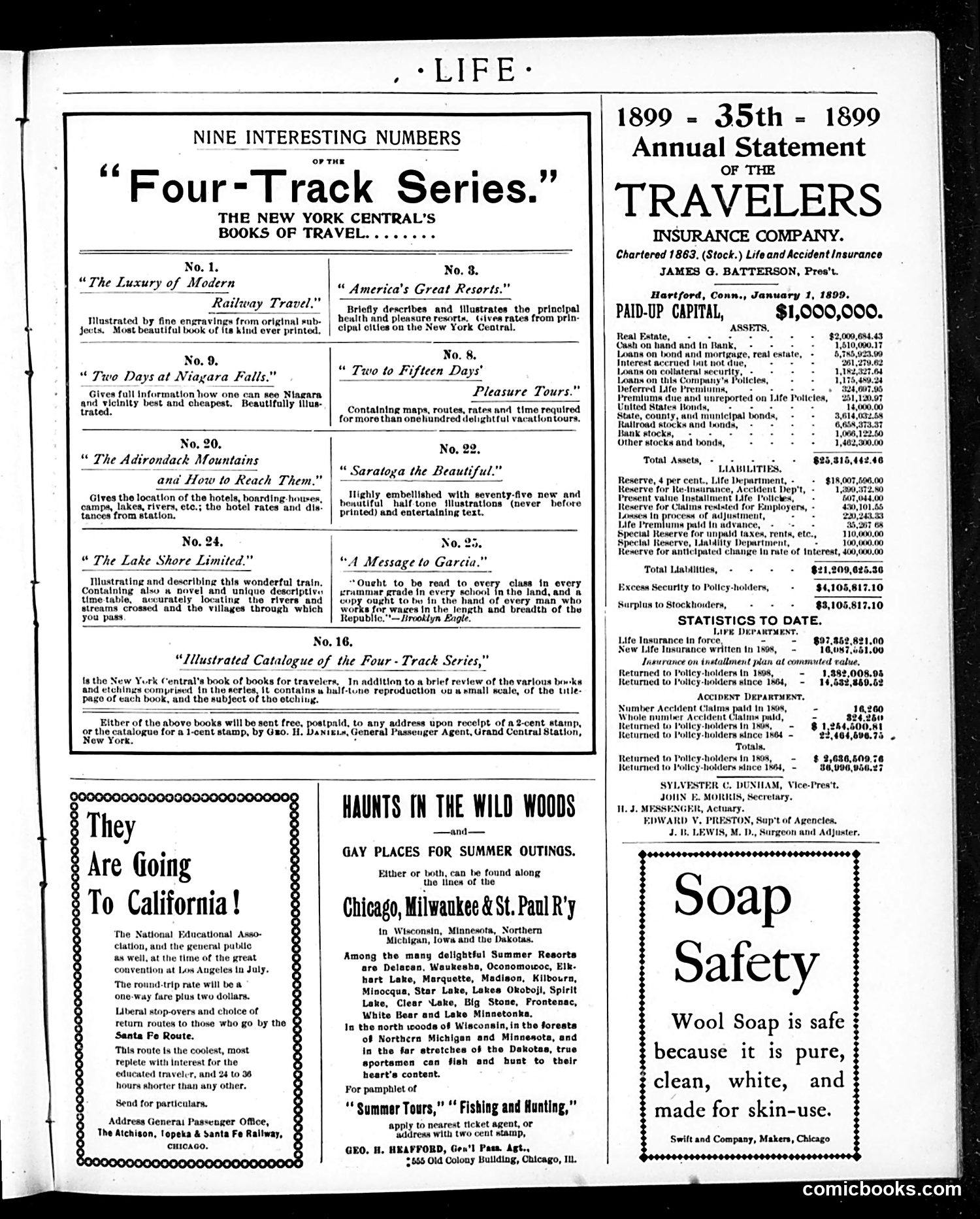
This page is primarily **advertisements and corporate announcements**, not satire or political cartoons. **Main content:** - The "Four-Track Series" — New York Central Railroad's travel books, advertising luxurious rail journeys to American destinations (Niagara Falls, Adirondacks, Saratoga) - Travelers Insurance Company's 35th annual financial statement, showcasing solid assets ($1 million paid-up capital) - A California excursion advertisement for the National Educational Association convention - Railroad advertisements for Chicago, Milwaukee & St. Paul Railway's resort destinations in Wisconsin and Minnesota - A soap safety advertisement for "Wool Soap" **Historical context for modern readers:** These ads reflect the 1890s leisure culture of affluent Americans discovering domestic tourism via expanding rail networks. The detailed insurance statement demonstrates corporate transparency and the era's emerging middle-class financial institutions. No political satire is evident on this page.
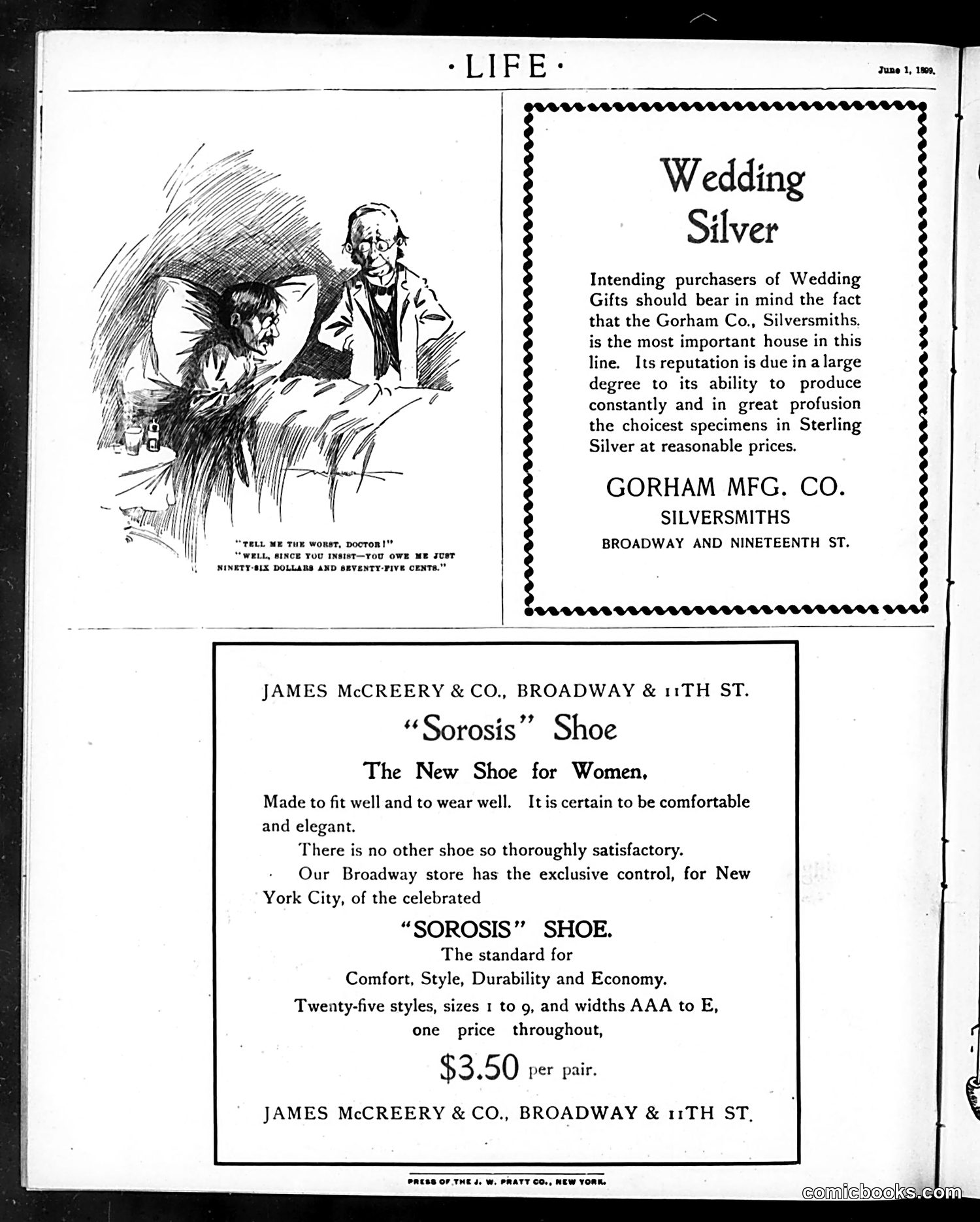
The cartoon satirizes medical billing practices. A patient, appearing ill in bed, asks a doctor to "tell me the worst"—expecting dire news about their health. The doctor's punchline reveals the real catastrophe: a bill for $96.75. The joke plays on the era's anxieties about medical costs, suggesting that the financial burden of healthcare was as dangerous as the illness itself. This reflects genuine turn-of-the-century concerns about affordability of medical care. The page is primarily advertising—for Gorham silverware (wedding gifts) and Sorosis women's shoes ($3.50/pair)—typical of Life's model as a satirical magazine subsidized by commercial advertisements.