
Life, 1899-06-01 · page 17 of 26
Life — June 1, 1899 — page 17: what you’re looking at
What you’re looking at
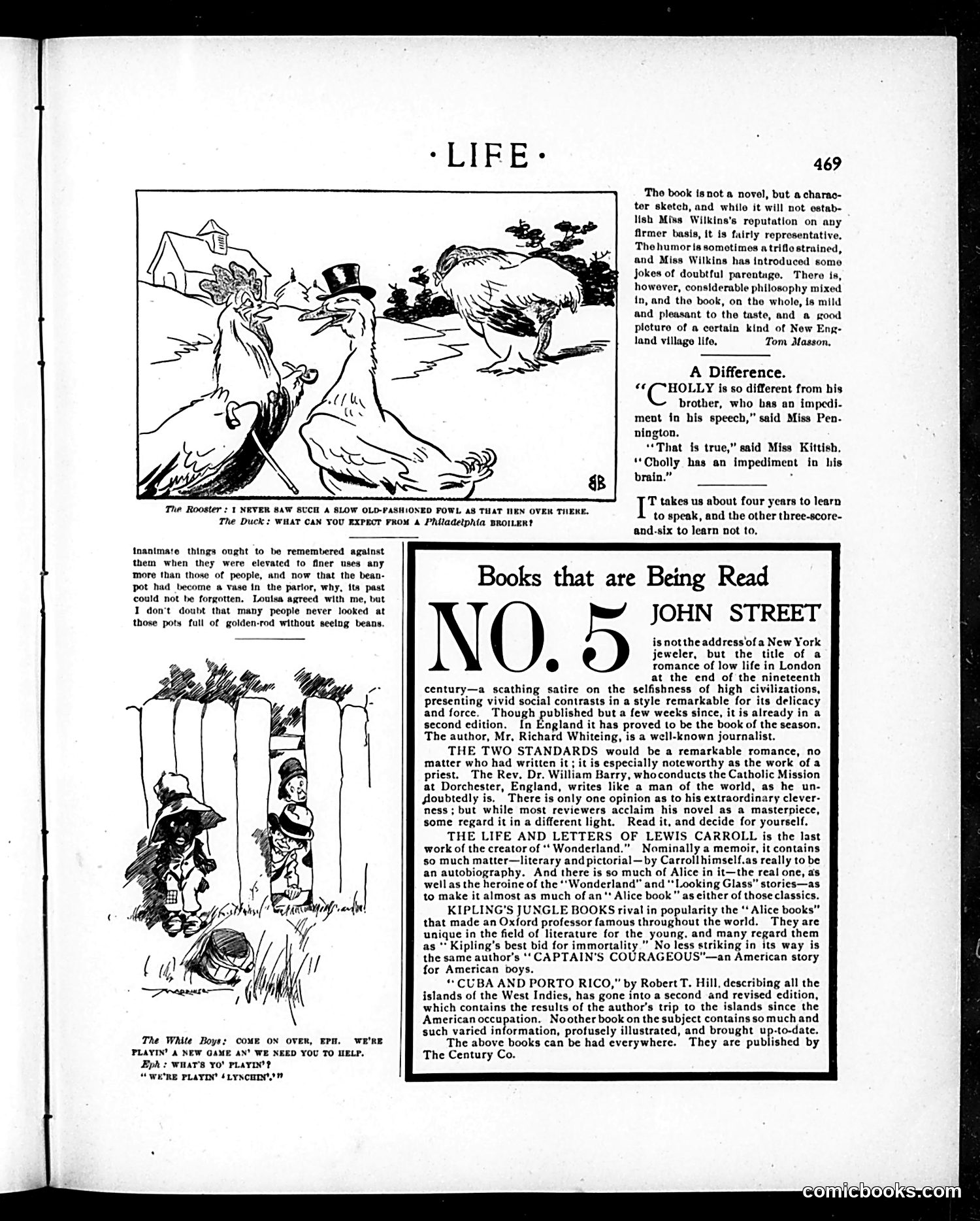
This page contains two satirical cartoons with captions mocking regional stereotypes and social attitudes of the era. The **top cartoon** depicts a rooster and duck discussing a hen. The rooster criticizes the hen as "slow" and "old-fashioned," while the duck retorts that one shouldn't expect better from a "Philadelphia broiler"—a regional jab suggesting Philadelphia produces inferior poultry (or people). The **bottom cartoon** is far darker: white boys invite their friend "Eph" (likely a Black child, given the dialect) to play a "new game," which they reveal is "playing a lynching." This is presented as humor but documents the casual, normalized violence and racism of the period—showing how lynch mobs were treated as entertainment, even involving children. The page also includes book reviews and a joke about a character named "Cholly" having "an impediment in his brain" rather than speech—wordplay on intellectual capacity. These cartoons reflect early 20th-century American attitudes: casual regional mockery and, disturbingly, the normalization of racial violence.
📄 Transcribed text from this page (OCR, searchable)
Machine-transcribed from the original scan — historical spelling and the odd misread are preserved.
The Rooster : 1 NEVER SAW SUCH A SLOW OLD-PASHIONED FOWL AS THAT NEN OVER THERE. The Duck: WHAT CAN YOU EXPECT FROM 4 Philadelphia BROILER? inanimate things ought to be remembered against them when they were elevated to finer uses any more than those of people, and now that the bean- pot had become # vase in the parlor, why, 1ts past could not be forgotten, Loulsa agreed with me, but I dont doubt that many people never looked at those pots full of golden-rod without seelng beans, The White Boys: COME ON OVER, EPH. WE'RE PLAYIN’ A NEW GAME AN’ WE NEED YOU TO HELP. Eph : WHat's Yo! PLAYDO? “WERE PLAYIN’ 4LYNCHIN') 7 469 Tho book isnot a novel, but a charac- ter sketch, and while it will not estab- lsh Miss Wilkins’s reputation on any firmer basis, it is fairly representative. Tho humors somotimos atriflostrained, and Miss Wilkins has introduced somo Jokes of doubtful parontugo. There is, however, considerable philosophy mixed {n, and tho book, on the whole, is mild and pleasant to the taste, and a rood ploturo of a certain kind of Now Eng- land village lite, Tom Masson, A Difference. «€ (HOLLY is so different from his brother, who bas an impedi- ment in his speech,” said Miss Pen- nington. “That is true,” said Miss Kittish, “Cholly has an impediment in his brain.” : T takes us about four years to learn to speak, and the other three-score- and-six to learn not to, Books that are Being Read is notthe address of a New York jeweler, but the title of a e romance of low life in London at the end of the nineteenth century—a scathing satire on the selfishness of high civilizations, presenting vivid social contrasts in a style remarkable for its delicacy and force. Though published but a few weeks since, it is already in a second edition. In England it has proved to be the book of the season. The author, Mr, Richard Whiteing, is a well-known journalist. THE TWO STANDARDS would be a remarkable romance, no matter who had written it; it is especially noteworthy as the work of a priest. The Rev. Dr. William Barry, whoconducts the Catholic Mission at Dorchester, England, writes like a man of the world, as he un- Aoubtedly is. ' There is only one opinion as to his extraordinary clever- ness; but while most reviewers acclaim his novel as a masterpiece, some regard it in a different light. Read it, and decide for yourself. THE LIFE AND LETTERS OF LEWIS CARROLL is the last work of the creator of “* Wonderland.” Nominally a memoir, it contains so much matter—literary and pictorial—by Carrollhimself.as really to be an autobiography. And there is so much of Alice in it—the real one, as wellas the heroine of the ‘‘Wonderland” and ‘Looking Glass” stories—as to make it almost as much of an" Alice book” as either of those classics. KIPLING’S JUNGLE BOOKS rival in popularity the ‘* Alice books” that made an Oxford professor famous throughout the world. They are unique in the field of literature for the young. and many regard them as * Kipling’s best bid for immortality” No less striking in its way is the same author's ‘‘ CAPTAIN'S COURAGEOUS"—an American story for American boys. * CUBA AND PORTO RICO," by Robert T. Hill, describing all the islands of the West Indies, has gone into a second and revised edition, which contains the results of the author's trip to the islands since the American occupation. Noother book on the subject contains so much and such varied information, profusely illustrated, and brought upsccdate: The above books can be had everywhere. They are published by The Century Co.