
Life, 1899-06-01 · page 6 of 26
Life — June 1, 1899 — page 6: what you’re looking at
What you’re looking at
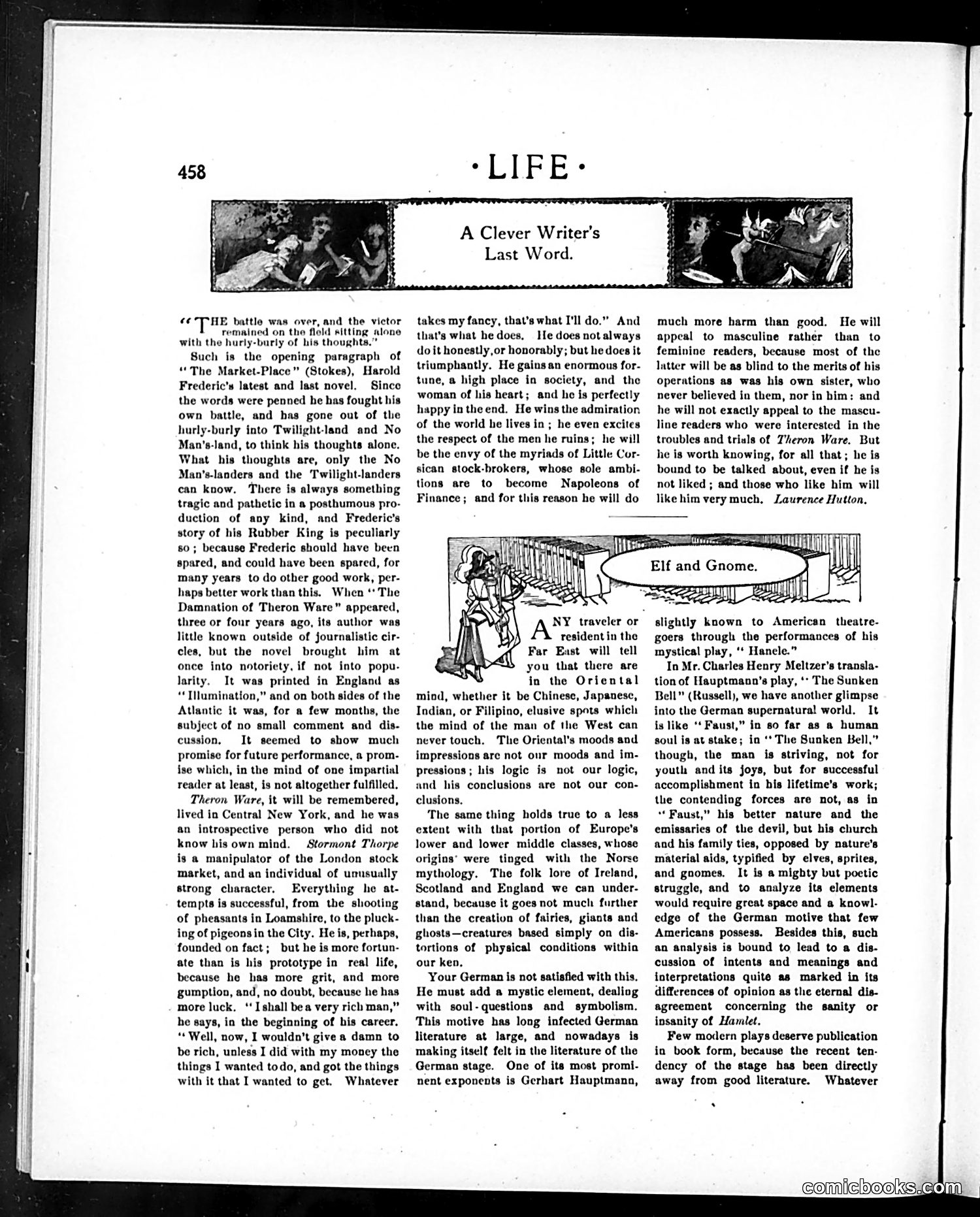
This page contains two distinct sections: **Left column:** A literary essay titled "A Clever Writer's Last Word," discussing various authors and their works, including references to Harold Frederic's "The Market-Place" and "The Damnation of Theron Ware." This is straightforward literary criticism, not satire. **Right section:** An illustrated piece titled "Elf and Gnome" discussing mystical elements in theater, specifically Hauptmann's "The Sunken Bell." The accompanying sketch shows a figure in what appears to be a fantastical or theatrical setting. Neither section contains obvious political satire or caricature. The page represents *Life* magazine's literary and cultural criticism function rather than its better-known satirical cartoon work. The "Elf and Gnome" discussion examines German theatrical mysticism's influence on American drama—cultural analysis rather than political commentary.
📄 Transcribed text from this page (OCR, searchable)
Machine-transcribed from the original scan — historical spelling and the odd misread are preserved.
¢€ THE battle was over, and the victor remained on tho flold sitting alone with the hurly-burly of his thoughts.” Such is the opening paragraph of “The Market-Place” (Stokes), Harold Frederic's latest and last novel. Since the words were penned he has fought his own battle, and has gone out of the hurly-burly into Twilight-land and No Man's-land, to think his thoughts alone. What his thoughts are, only the No Man’s-landers and the Twilight-landers can know. There is always something tragic and pathetic in a posthumous pro- duction of any kind, and Frederic’s story of his Rubber King is peculiarly 80 ; because Frederic should have been spared, and could have been spared, for many years to do other good work, per- haps better work than this. When ‘The Damnation of Theron Ware” appeared, three or four years ago, its author was little known outside of journalistic cir- cles, but the novel brought him at once into notoriety, if not into popu- larity. It was printed in England as “‘Tilumination,” and on both sides of the Atlantic it was, for a few months, the subject of no small comment and dis- cussion, It seemed to show much promise for future performance, a prom- ise which, in the mind of one impartial reader at least, is not altogether fulfilled. Theron Ware, it will be remembered, lived in Central New York, and he was an introspective person who did not know his own mind. Stormont Thorpe is a manipulator of the London stock market, and an individual of unusually strong character. Everything he at- tempts is successful, from the shooting of pheasants in Loamshire, to the pluck- ing of pigeons in the City. He is, perhaps, founded on fact; but he is more fortun- ate than is his prototype in real life, because he has more grit, and more gumption, and, no doubt, because he has more luck. ‘I shall bea very rich man,” he says, in the beginning of his career. “Well, now, I wouldn't give a damn to be rich, unless I did with my money the things I wanted todo, and got the things with it that I wanted to get. Whatever A Clever Writer's Last Word. takes my fancy, that's what I'll do.” And that's what he does, He does not always do it honestly or honorably; but he does it triumphantly. He gains an enormous for- tune, a high place in society, and the woman of his heart; and he is perfectly happy in the end. He wins the admiration of the world he lives in ; he even excites the respect of the men he ruins; he will be the envy of the myriads of Little Cor- sican stock-brokers, whose sole ambi- tions are to become Napoleons of Finance ; and for this reason he will do AN traveler or residentin the Far East will tell you that there are ° in the Oriental mind, whether it be Chinese, Japanese, Indian, or Filipino, elusive spots which the mind of the man of the West can never touch. The Oriental's moods and impressions arc not our moods and im- pressions; his logic is not our logic, and his conclusions are not our con- clusions, ‘The same thing holds true to a less extent with that portion of Europe's lower and lower middle classes, whose origins’ were tinged with the Norse mythology. The folk lore of Ireland, Scotland and England we can under- stand, because it goes not much further than the creation of fairies, giants and ghosts—creatures based simply on dis- tortions of physical conditions withia our ken, Your German is not satisfied with this, He must add a mystic element, dealing with soul-questions and symbolism. This motive has long infected German literature at large, and nowadays is making itself felt in the literature of the German stage. One of its most promi- nent exponents is Gerhart Hauptmann, Elf and Gnome. “=e, ow much more harm than good. He will appeal to masculine rather than to feminine readers, because most of the latter will be as blind to the merits of his operations as was his own sister, who never believed in them, nor in him: and he will not exactly appeal to the mascu- line readers who were interested in the troubles and trials of Theron Ware. But he is worth knowing, for all that; he is bound to be talked about, even if he is not liked ; and those who like him will like him very much, Laurence Hutton, SS iil eg! ill 3 slightly known to American theatre- goers through the performances of his mystical play, ‘* Hancle.” In Mr. Charles Henry Meltzer’s transla- tion of Hauptmann’s play, ‘* The Sunken Bell" (Russell), we have another glimpse into the German supernatural world. It is like ‘* Faust,” in so far as a human soul is at stake; in ‘* The Sunken Bell,” though, the man is striving, not for youth and its joys, but for successful accomplishment in his lifetime's work; the contending forces are not, as in “Faust,” his better nature and the emissaries of the devil, but his church and his family ties, opposed by nature's material aids, typified by elves, sprites, and goomes. It is a mighty but poetic struggle, and to analyze its elements would require great space and a knowl- edge of the German motive that few Americans possess. Besides this, such an analysis is bound to lead to a dis- cussion of intents and meanings and interpretations quite as marked in its differences of opinion as the eternal dis- agreement concerning the sanity or insanity of Hamlet. Few modern plays deserve publication in book form, because the recent ten- dency of the stage has been directly away from good literature. Whatever comichooks, com