
Life, 1899-06-01 · page 4 of 26
Life — June 1, 1899 — page 4: what you’re looking at
What you’re looking at
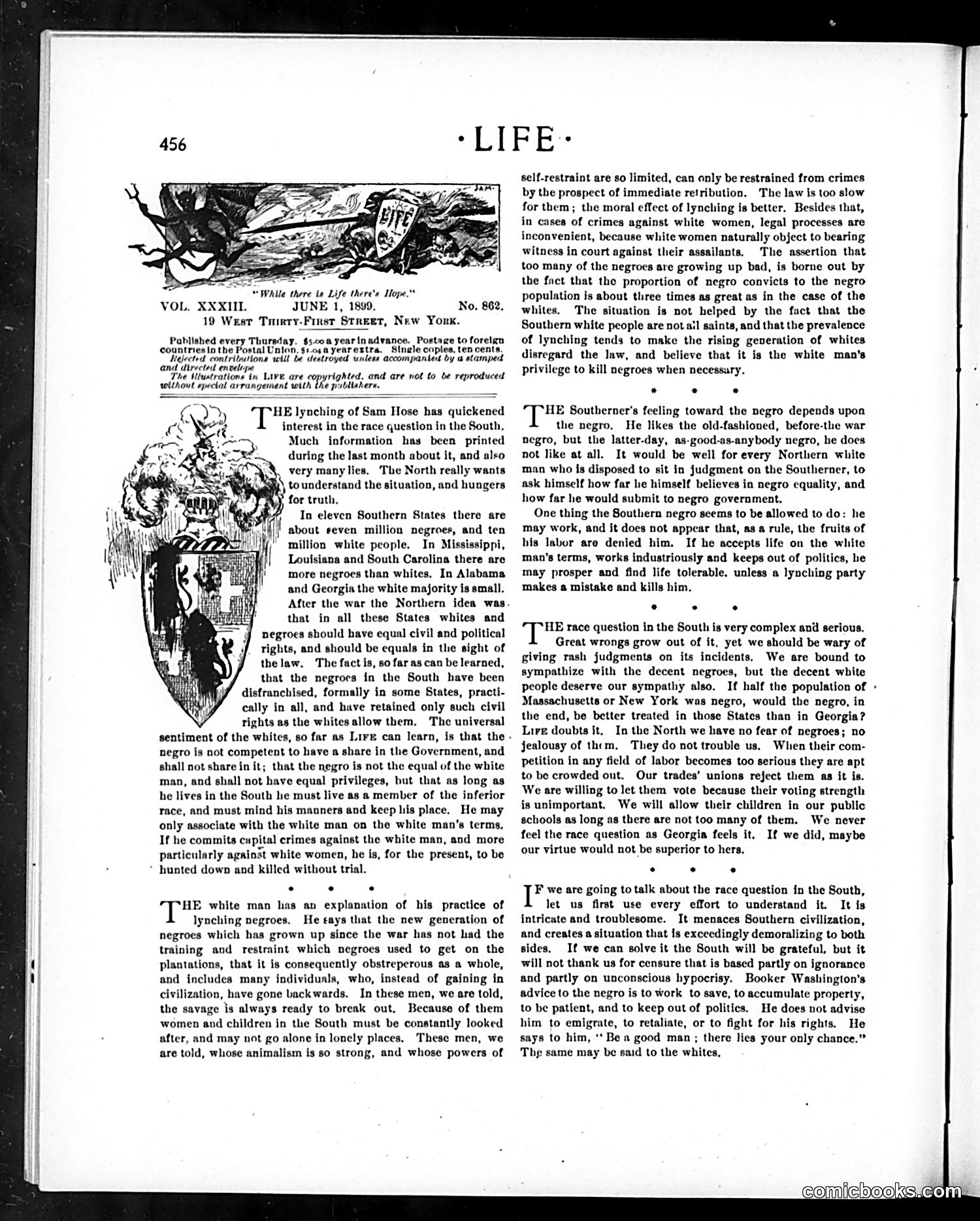
**The Cartoon:** The illustration shows a lynched Black man, titled "While there is Life there's Hope." This macabre image accompanies an article discussing the Sam Hose lynching and broader race violence in the South. **The Context:** The article addresses escalating racial violence, noting that Southern states justify lynching through claims about Black criminality and the need for "immediate retribution." The text critiques the hypocrisy: while Northern whites claim moral superiority, they tolerate Southern violence. **The Point:** Life satirizes the contradiction between American ideals of law and equality versus the actual practice of extrajudicial murder. The grim cartoon title suggests that hope for justice is itself dying—that the legal system cannot or will not protect Black lives from mob violence.
📄 Transcribed text from this page (OCR, searchable)
Machine-transcribed from the original scan — historical spelling and the odd misread are preserved.
*LIPE~ * yaile there is Life there's Hope.” VOL. XXXIIL. JUNE 1, 1899, No. 862. 19 West Truery-Finst Street, New York. Pablished every Thursday. $5coa year in advance. Postage to foreign countries in the Postal Union, $1.o4ayearextra. Single copies. ten cents. Hejected contritrutions will be destroyed unless accompanied by a stamped and directed envelipe The Hlwstrations in Lave are copyrighted. and are not to be reproduced without epectal arrangement with the publishera, ie: Te lynching of Sam Hose has quickened ae interest in the race question in the South, Much information has been printed during the last month about it, and also . very many lies, The North really wants tounderstand the situation, and hungers for truth, In eleven Southern States there are about even million negroes, and ten million white people. In Mississippi, Louisiana and South Carolina there are more negroes than whites. In Alabama and Georgia the white majority is small. After the war the Northern idea was. that in all these States whites and negroes should have equal civil and political rights, and should be equals in the sight of thelaw, The fact is, so faras can be learned, that the negroes in the South have been disfranchised, formally in some States, practi- cally in all, and have retained only such civil rights as the whites allow them, The universal sentiment of the whites, so far as Lire can learn, is that the - negro is not competent to have a share in the Government, and shall not share in it; that the negro is not the equal of the white man, and shall not have equal privileges, but that as long as he lives in the South he must live as a member of the inferior race, and must mind his manners and keep his place. He may only associate with the white man on the white man’s terms. If he commits cupital crimes against the white man, and more particularly against white women, he is, for the present, to be * hunted down and killed without trial. . . . HE white man has an explanation of his practice of lynching negroes, He says that the new generation of negroes which has grown up since the war has not had the training and restraint which negroes used to get on the plantations, that it is consequently obstreperous as a whole, and includes many individuals, who, instead of gaining in civilization, have gone backwards. In these men, we are told, the savage is always ready to break out, Because of them women and children in the South must be constantly looked after, and may not go alone in lonely places, These men, we are told, whose animalism is so strong, and whose powers of self-restraint are so limited, can only be restrained from crimes by the prospect of immediate retribution. The law is too slow for them; the moral effect of lynching is better. Besides that, in cases of crimes against white women, legal processes are inconvenient, because white women naturally object to bearing witness in court against their assailants. The assertion that too many of the negroes are growing up bad, is borne out by the fact that the proportion of negro convicts to the negro population is about three times as great as in the case of the whites. The situation is not helped by the fact that the Southern white people are not ail saints, and that the prevalence of lynching tends to make the rising generation of whites disregard the law, and believe that it is the white man’s privilege to kill negroes when necessary. T= Southerner's feeling toward the negro depends upon the negro. He likes the old-fashioned, before-the war negro, but the latter-day, as-good-as-anybody negro, he does not like at all. It would be well for every Northern white man who {s disposed to sit in judgment on the Southerner, to ask himself how far le himself believes in negro equality, and how far he would submit to negro government. One thing the Southern negro seems to be allowed to do: he may work, and it does not appear that, asa rule, the fruits of his labor are denied him. If he accepts life on the white man’s terms, works industriously and keeps out of politics, he may prosper and find life tolerable. unless a lynching party makes a mistake and kills him, . . . HE race question in the South is very complex and serious. Great wrongs grow out of it, yet we should be wary of giving rash judgments on its incidents, We are bound to sympathize with the decent negroes, but the decent white people deserve our sympathy also. If half the population of Massachusetts or New York was negro, would the negro, in the end, be better treated in those States than in Georgia? Live doubts it, In the North we have no fear of negroes; no jealousy of them, They do not trouble us, When their com- petition in any ficld of labor becomes too serious they are apt to be crowded out. Our trades’ unions reject them as it is. We are willing to let them vote because their voting strength is unimportant. We will allow their children in our public schools as long as there are not too many of them. We never feel the race question as Georgia feels it. If we did, maybe our virtue would not be superior to hers. F we are going to talk about the race question in the South, let us first use every effort to understand it. It is intricate and troublesome. It menaces Southern civilization, and creates a situation that is excecdingly demoralizing to both sides. If we can solve it the South will be grateful, but it will not thank us for censure that is based partly on ignorance and partly on unconscious hypocrisy. Booker Washington's advice to the negro is to work to save, to accumulate property, to be patient, and to keep out of politics. He does not advise him to emigrate, to retaliate, or to fight for his rights. He says to him, ‘* Be a good man ; there lies your only chance.” The same may be said to the whites,