
Life, 1899-06-01 · page 8 of 26
Life — June 1, 1899 — page 8: what you’re looking at
What you’re looking at
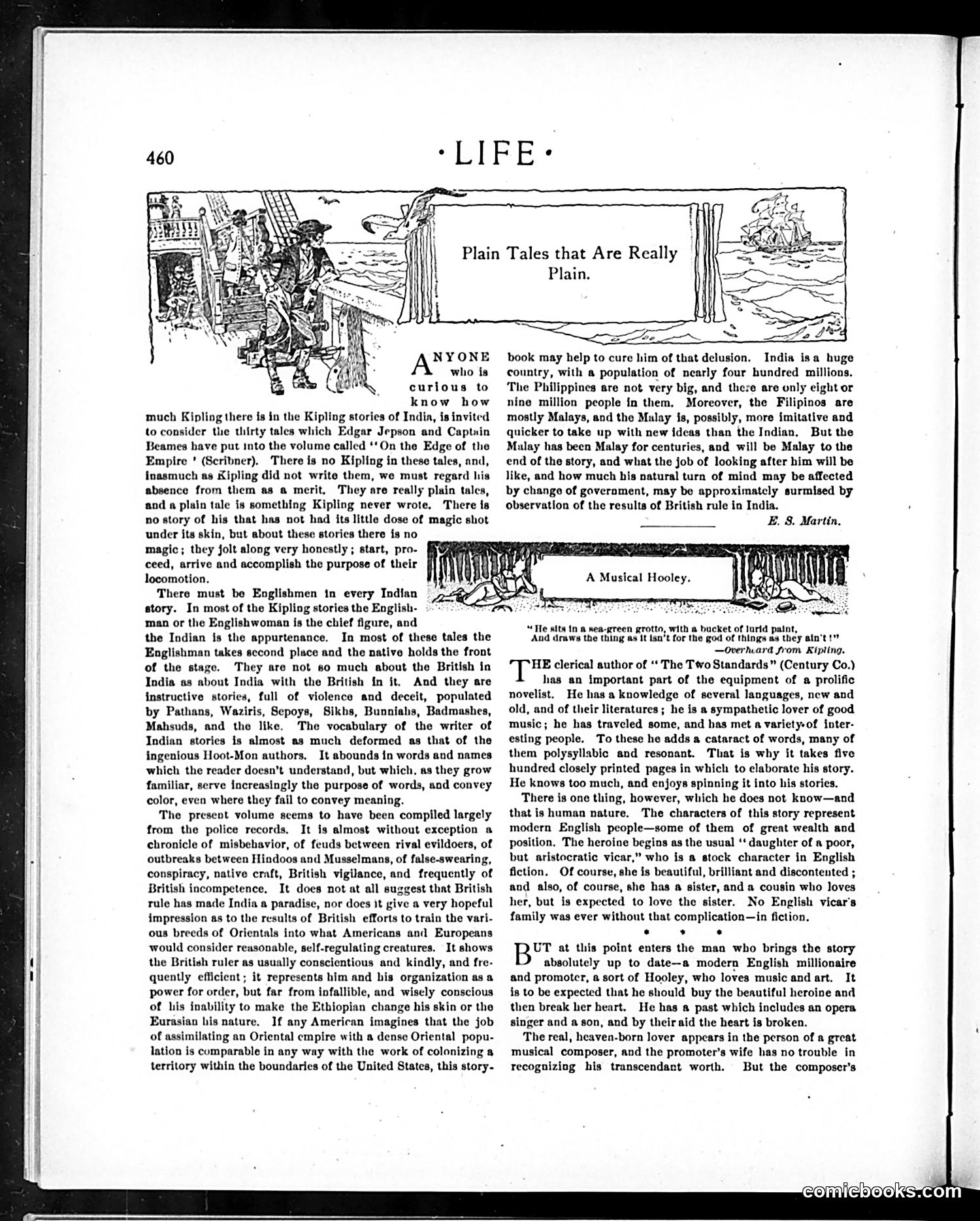
This page contains a literary discussion rather than political satire. The main text critiques how British authors depict India in fiction, noting that English characters typically dominate these narratives while Indian characters remain secondary. The small illustration titled "A Musical Hooley" (likely referring to an Irish social gathering) shows a figure in a seaside grotto with paint, quoting Kipling's work. The piece discusses how a clerical novelist uses exotic vocabulary and "polysyllabic and resonant" language when writing about India, often getting details wrong while claiming authenticity. The broader critique examines British colonial attitudes toward India and questions whether such fiction accurately serves British imperial interests or merely perpetuates stereotypes about "Oriental" peoples.
📄 Transcribed text from this page (OCR, searchable)
Machine-transcribed from the original scan — historical spelling and the odd misread are preserved.
Plain Tales that Are Really NYONE who is curious to know how much Kipling there is in the Kipling stories of India, is invited to consider the thirty tales which Edgar Jepson and Captain Beames have put into the volume called ‘‘On the Edge of the Empire ' (Scribner). There is no Kipling in these tales, and, inasmuch as Kipling did not write them, we must regard his absence from them as a merit. They are really plain tales, and a plain tale is something Kipling never wrote, There is no story of his that has not had its little dose of magic shot under its skin, but about these stories there is no magic; they jolt along very honestly ; start, pro- ceed, arrive and accomplish the purpose of their locomotion. There must be Englishmen in every Indian story. In most of the Kipling stories the English- man or the Englishwoman is the chief figure, and the Indian is the appurtenance. In most of these tales the Englishman takes second place and the native holds the front of the stage. They are not 60 much about the British in India as about India with the British fn it, And they are instructive stories, full of violence and deceit, populated by Pathans, Waziris, Sepoys, Sikhs, Bunniahs, Badmashes, Mahsuds, and the like. The vocabulary of the writer of Indian stories is almost as much deformed as that of the ingenious Hoot-Mon authors, It abounds in words and names which the reader doesn’t understand, but which, as they grow familiar, serve increasingly the purpose of words, and convey color, even where they fail to convey meaning. The present volume scems to have been compiled largely from the police records, It is almost without exception a chronicle of misbehavior, of feuds between rival evildoers, of outbreaks between Hindoos and Musselmans, of false-swearing, conspiracy, native craft, British vigilance, and frequently of British incompetence, It does not at all suggest that British rule has made India a paradise, nor does it give a very hopeful impression as to the results of British efforts to train the vari- ous breeds of Orientals into what Americans and Europeans would consider reasonable, self-regulating creatures. It shows the British ruler as usually conscientious and kindly, and fre- quently efficient; it represents him and bis organization as a power for order, but far from infallible, and wisely conscious of his inability to make the Ethiopian change his skin or the Eurasian his nature, If any American imagines that the job of assimilating an Oriental empire with a dense Oriental popu- lation is comparable in any way with the work of colonizing 8 territory within the boundaries of the United States, this story- Plain. book may help to cure him of that delusion. India isa huge country, with @ population of nearly four hundred millions. The Philippines are not very big, and thcze are only eight or nine million people in them. Moreover, the Filipinos are mostly Malays, and the Mulay is, possibly, more imitative and quicker to take up with new ideas than the Indian. But the Malay has been Malay for centuries, and will be Malay to the end of the story, and what the job of looking after him will be like, and how much bis natural turn of mind may be affected by chango of government, may be approximately surmised by observation of the results of British rule in India. E. 8. Martin, “Tle alts In a xea-green grotto, with a bucket of lurid paint, And draws the thing as it isn’t for the god of things as they ain't” —Overhard from Kipling. HE clerical author of ‘‘ The Two Standards” (Century Co.) has an important part of the equipment of a prolific novelist. He has a knowledge of several languages, new and old, and of their literatures ; he is a sympathetic lover of good music; he has traveled some, and has met a variety-of inter- esting people. To these he adds a cataract of words, many of them polysyllabic and resonant. That is why it takes five hundred closely printed pages in which to elaborate his story. He knows too much, and enjoys spinning it into his stories, There is one thing, however, which he does not know—and that is human nature. The characters of this story represent modern English people—some of them of great wealth and position. The heroine begins as the usual ‘‘ daughter of a poor, but aristocratic vicar,” who is a stock character in English fiction. Of course, she is beautiful, brilliant and discontented ; and also, of course, she has a sister, and a cousin who loves her, but is expected to love the sister. No English vicar's family was ever without that complication—in fiction. . * . UT at this point enters the man who brings the story absolutely up to date—a modern English millionaire and promoter, a sort of Hooley, who loves music and art. It is to be expected that he should buy the beautiful heroine and then break her heart. He has a past which includes an opera singer and a son, and by their aid the heart is broken. The real, heaven-born lover appears in the person of a great musical composer, and the promoter’s wife has no trouble in recognizing his transcendant worth. But the composer's