
A complete issue · 20 pages · 1899
Life — April 13, 1899
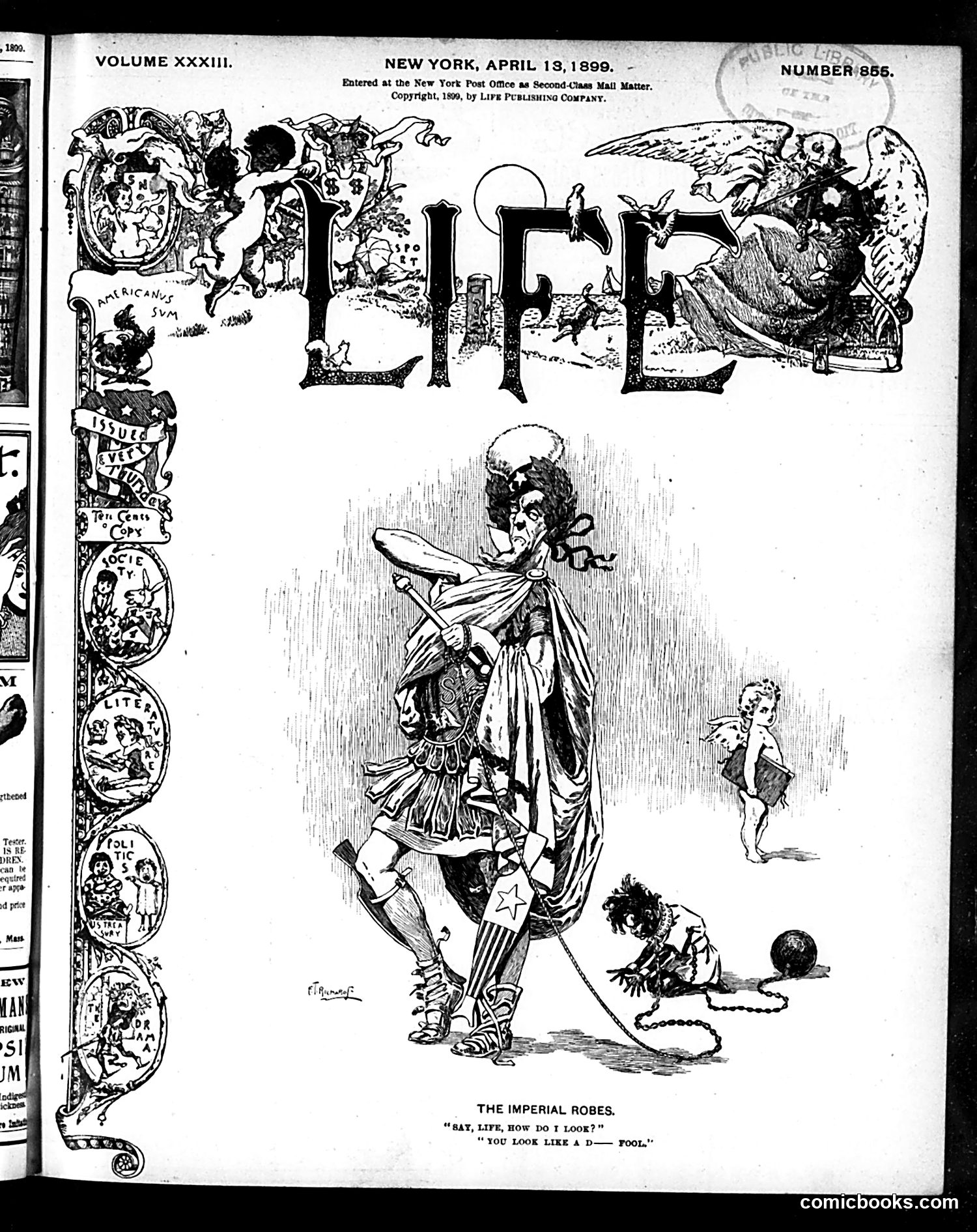
This political cartoon satirizes American imperial ambitions following the Spanish-American War (1898). The central figure, dressed as a Roman emperor in elaborate military regalia, appears to represent either the United States government or American imperial power personified. Two cherub-like figures below represent colonial territories or dependencies—likely the Philippines and Cuba, which the U.S. had recently acquired or influenced. The caption "Hat, Life, how do I look?" / "You look like a D—— fool" mocks American pretensions to empire. The artist criticizes the U.S. adopting grandiose "imperial robes" and Roman-style domination, suggesting this contradicts American democratic ideals. The satire questions whether imperial expansion befits a republic founded on anti-colonial principles.
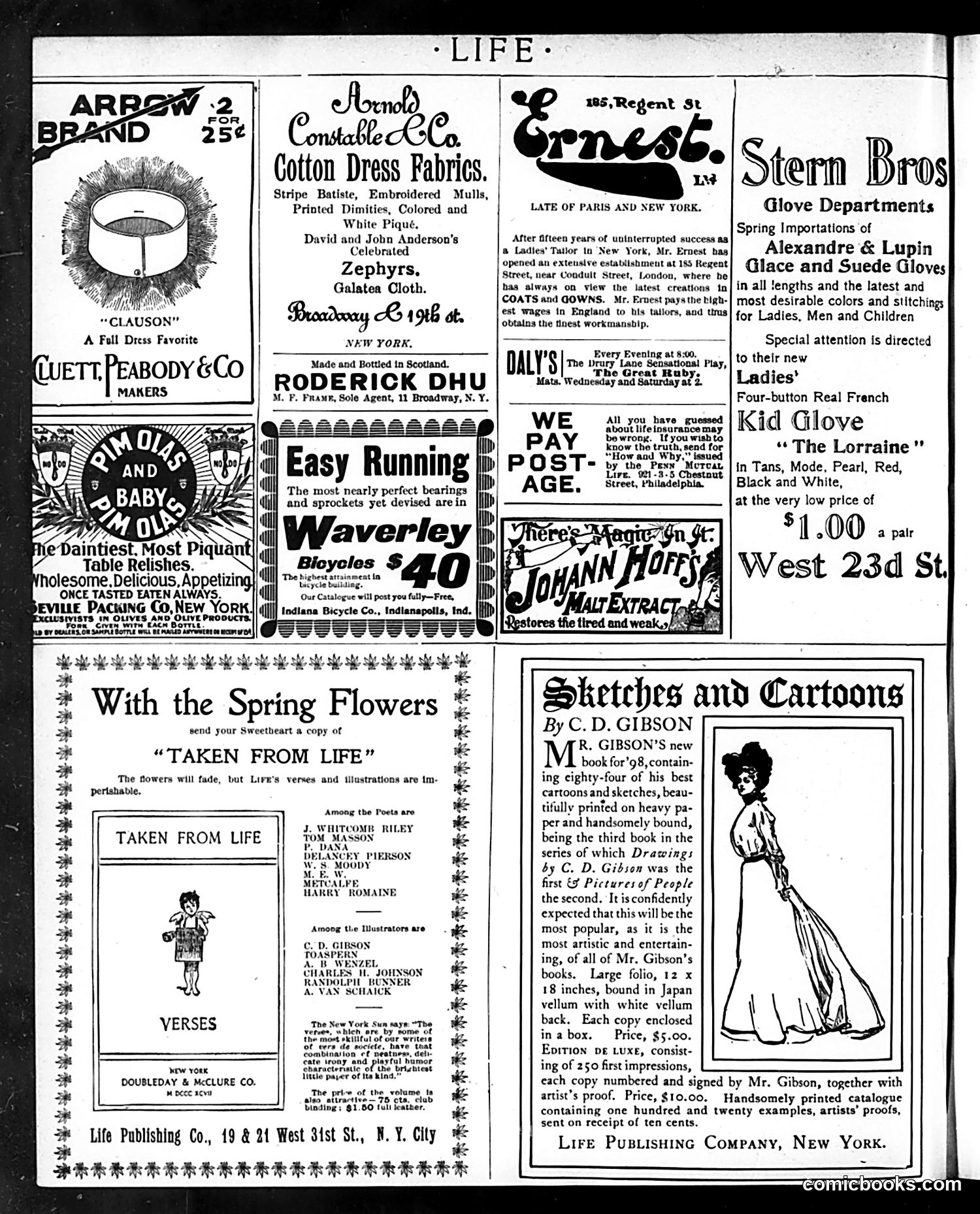
This page is **primarily advertising** with minimal satirical content. The advertisements promote various consumer goods typical of the era: Arrow collars, cotton dress fabrics, bicycles, gloves, and published books. The only potentially humorous element is the small illustration accompanying "Sketches and Cartoons by C.D. Gibson"—showing a fashionably dressed woman in an elegant gown. This likely references Gibson's famous "Gibson Girl" illustrations, which depicted idealized American women and were popular in early 20th-century culture. The page also advertises "Taken from Life," a poetry collection with verses by notable writers, suggesting Life magazine functioned as both satirical publication and literary venue. Overall, this is a commercial page with minimal political or social satire to interpret.
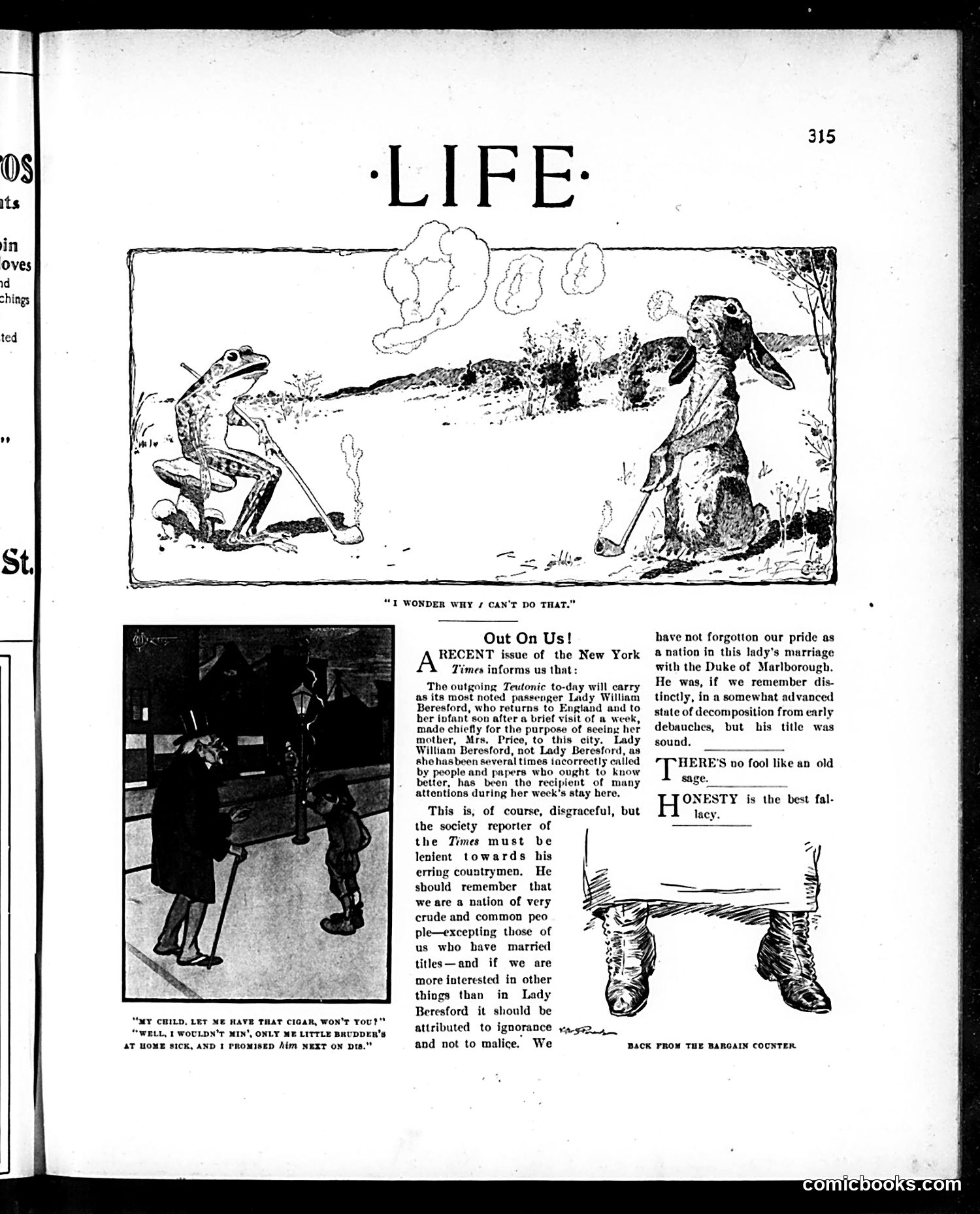
**Top Cartoon:** "I Wonder Why I Can't Do That" depicts a frog attempting to mimic a rabbit's hopping, satirizing the futility of imitating others' natural abilities. **"Out On Us!" Article:** Criticizes the New York *Times* society reporter for misidentifying Lady Beresford during her visit to America. The piece sarcastically notes this error is "disgraceful" but argues the *Times* should be lenient toward "erring countrymen," as Americans are "crude and common people" unfamiliar with titled nobility. The satire mocks both the reporter's incompetence and American society's general ignorance of British aristocracy—suggesting the mistake reflects broader national unsophistication rather than individual malice. **Aphorisms:** "There's no fool like an old sage" and "Honesty is the best fallacy" offer cynical observations on human nature.
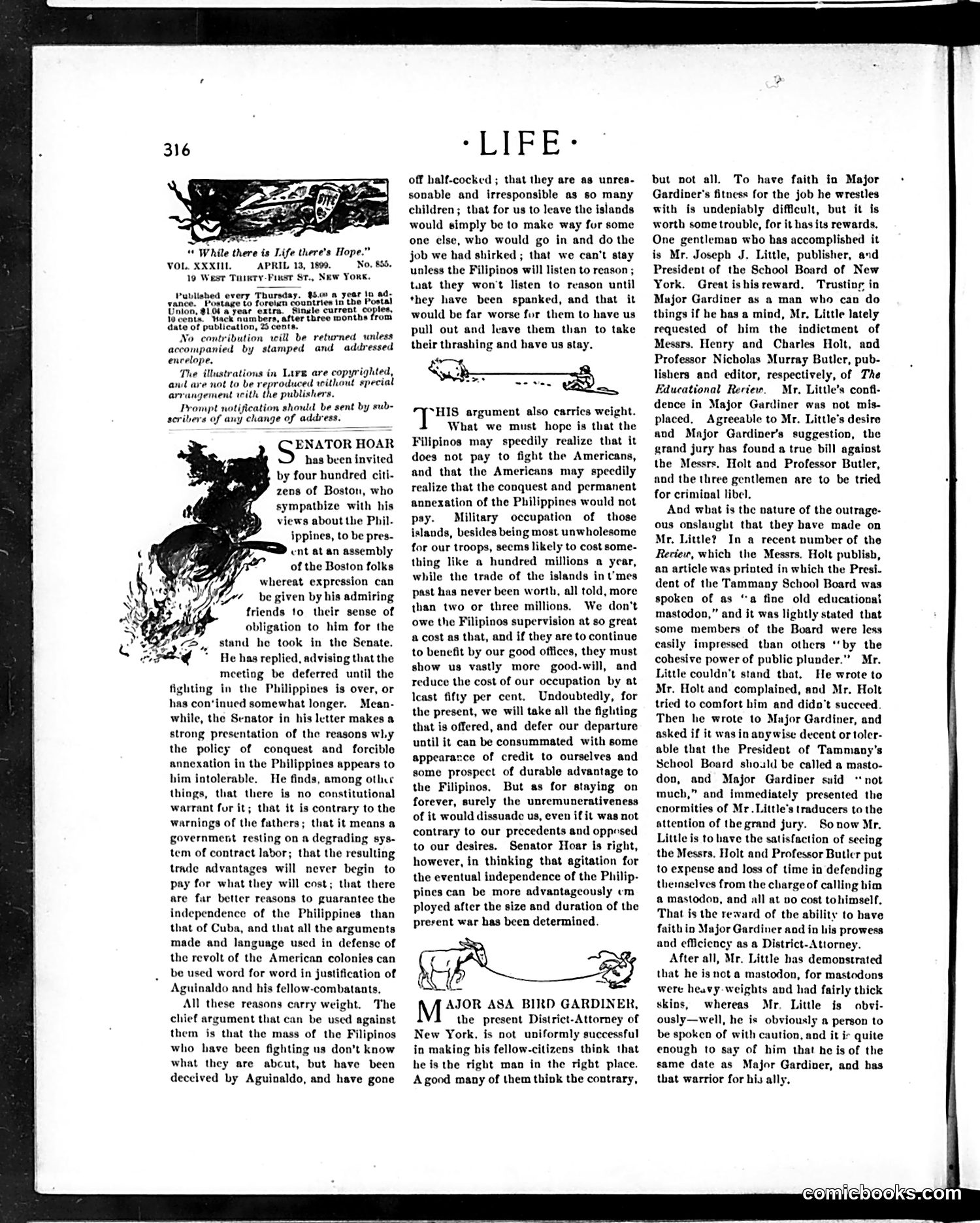
This page discusses the Philippine-American War and American colonial policy. The text debates whether the U.S. should maintain military occupation of the Philippines, presenting arguments from Senator Hoar (who opposed annexation) against the policy. The cartoons appear to satirize American imperialism in the Philippines. One sketch shows a figure labeled "PHILIPPINE BOAR" being invited by Boston citizens to speak about Philippine independence—likely mocking American hypocrisy about democracy while denying it to Filipinos. The page criticizes those defending the occupation as costly and unjust, while praising Mr. Joseph J. Little (a publisher and School Board President) for questioning whether the conquest was worth its expense and moral cost. The satire targets American colonial ambitions in the early 1900s.
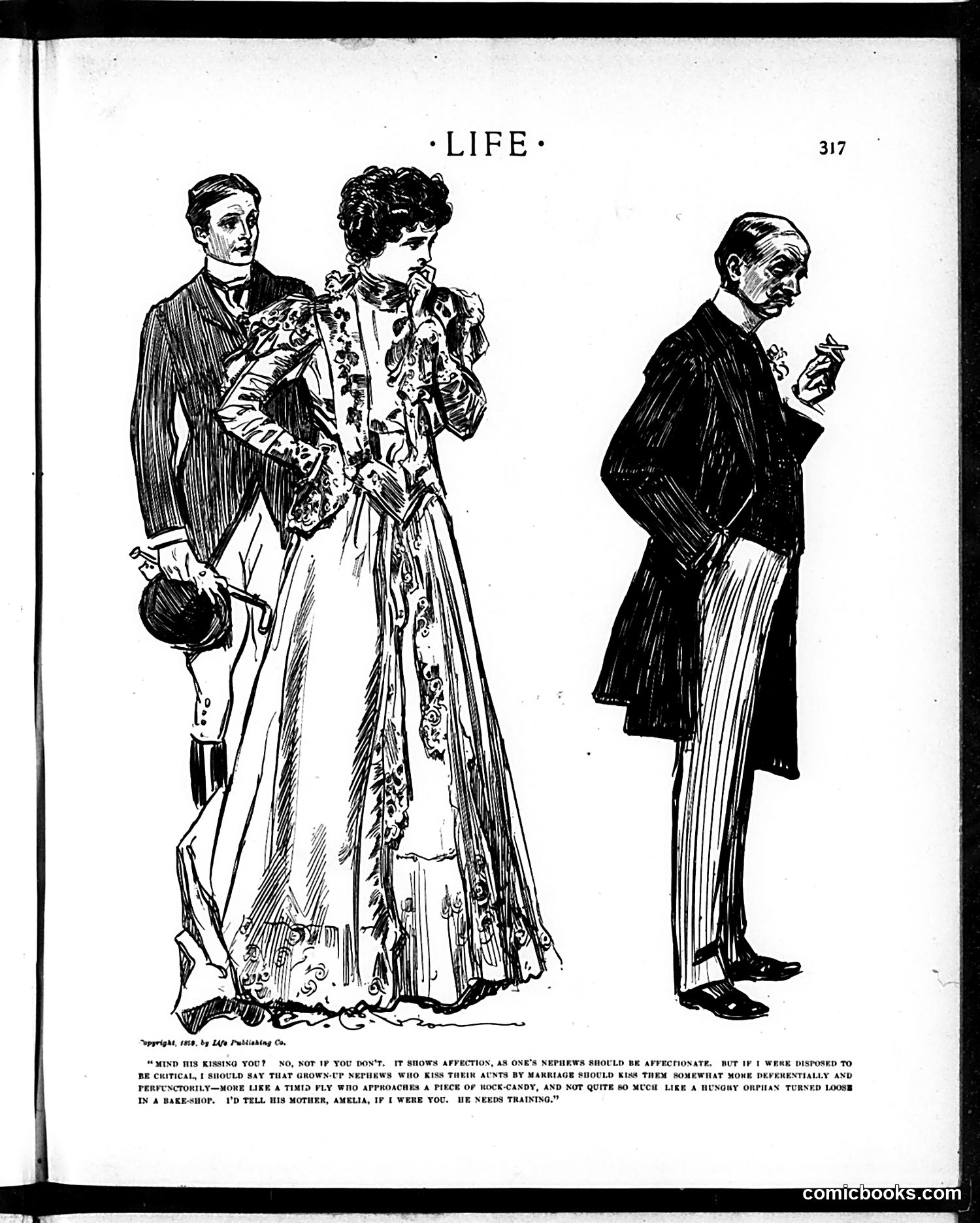
This Life magazine page satirizes etiquette and social expectations around nephews and aunts. The left panel shows a well-dressed couple (an aunt in an elaborate gown with a man), while the right panel depicts a poorly-behaved nephew. The text criticizes grown nephews who lack manners—specifically those who kiss their aunts casually through marriage rather than showing proper deference. The satire targets the nephew's poor upbringing and suggests he "needs training" like "a hungry orphan turned loose in a bakeshop." The joke mocks both the nephew's crude behavior and, implicitly, the strict social conventions of the era regarding proper family decorum and respectful conduct toward elder relatives. It reflects early-20th-century American middle-class anxieties about maintaining proper social standards.
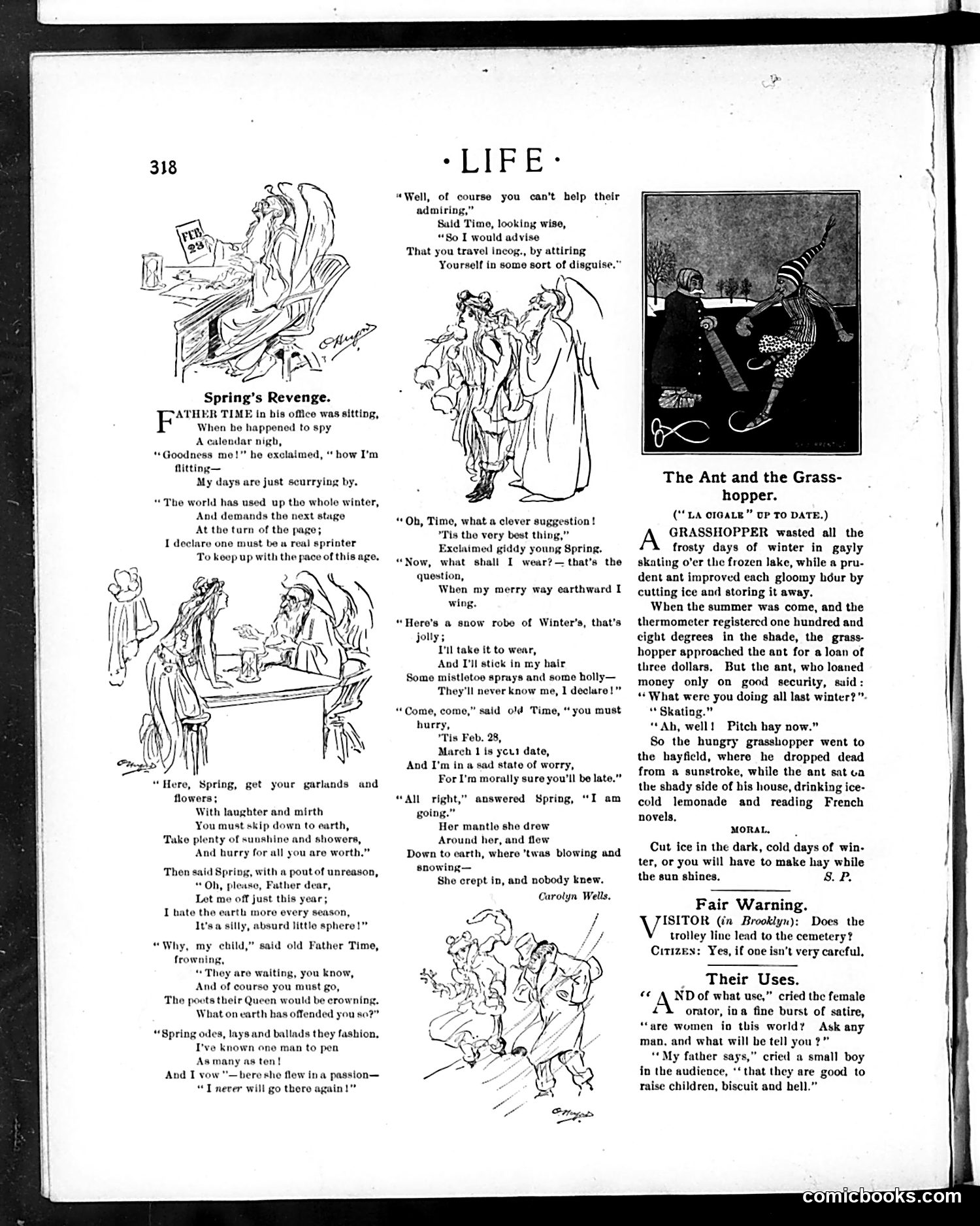
This page contains three separate humorous pieces rather than unified political commentary: 1. **"Spring's Revenge"**: A poem-illustrated narrative about Father Time encountering Spring, discussing winter's hardships. The satire mocks seasonal complaints and romantic notions about spring's arrival. 2. **"The Ant and the Grasshopper"**: An Aesop's fable adaptation showing a grasshopper who wasted winter and now begs a hardworking ant for loans. The moral critiques idleness and financial irresponsibility, typical of early 20th-century moralistic humor. 3. **Short satirical pieces** ("Fair Warning," "Their Uses"): Brief jokes about cemetery trolleys and women's roles, using typical period comedic stereotypes. The page reflects *Life* magazine's mix of literary satire, moral instruction, and light domestic humor rather than hard political commentary.
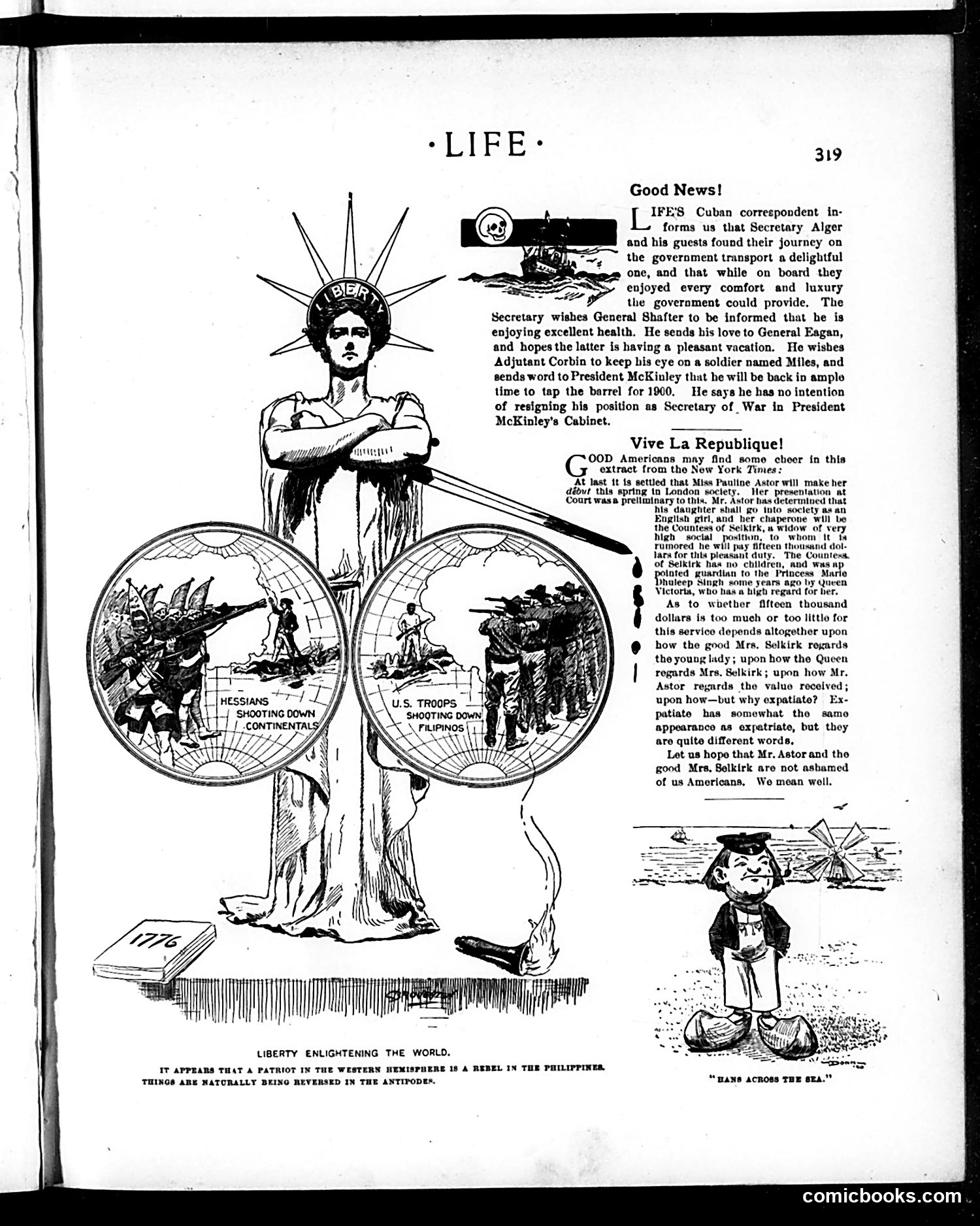
This satirical cartoon depicts the Statue of Liberty holding globes showing two conflicts: "Hessians Shooting Down Continentals" (American Revolution reference) and "U.S. Troops Shooting Down Filipinos" (Philippine-American War). The caption sarcastically notes that "a patriot in the western hemisphere is a rebel in the Philippines," suggesting American hypocrisy: the nation that fought for liberty against colonial powers (Britain/Hessians) now violently suppresses Filipino independence fighters. The accompanying "Good News!" section mocks Secretary of War Elihu Root's optimistic reports about the Philippines conflict, contrasting official rhetoric with the cartoon's darker reality. This reflects contemporary American anti-imperialist criticism circa 1900-1902.
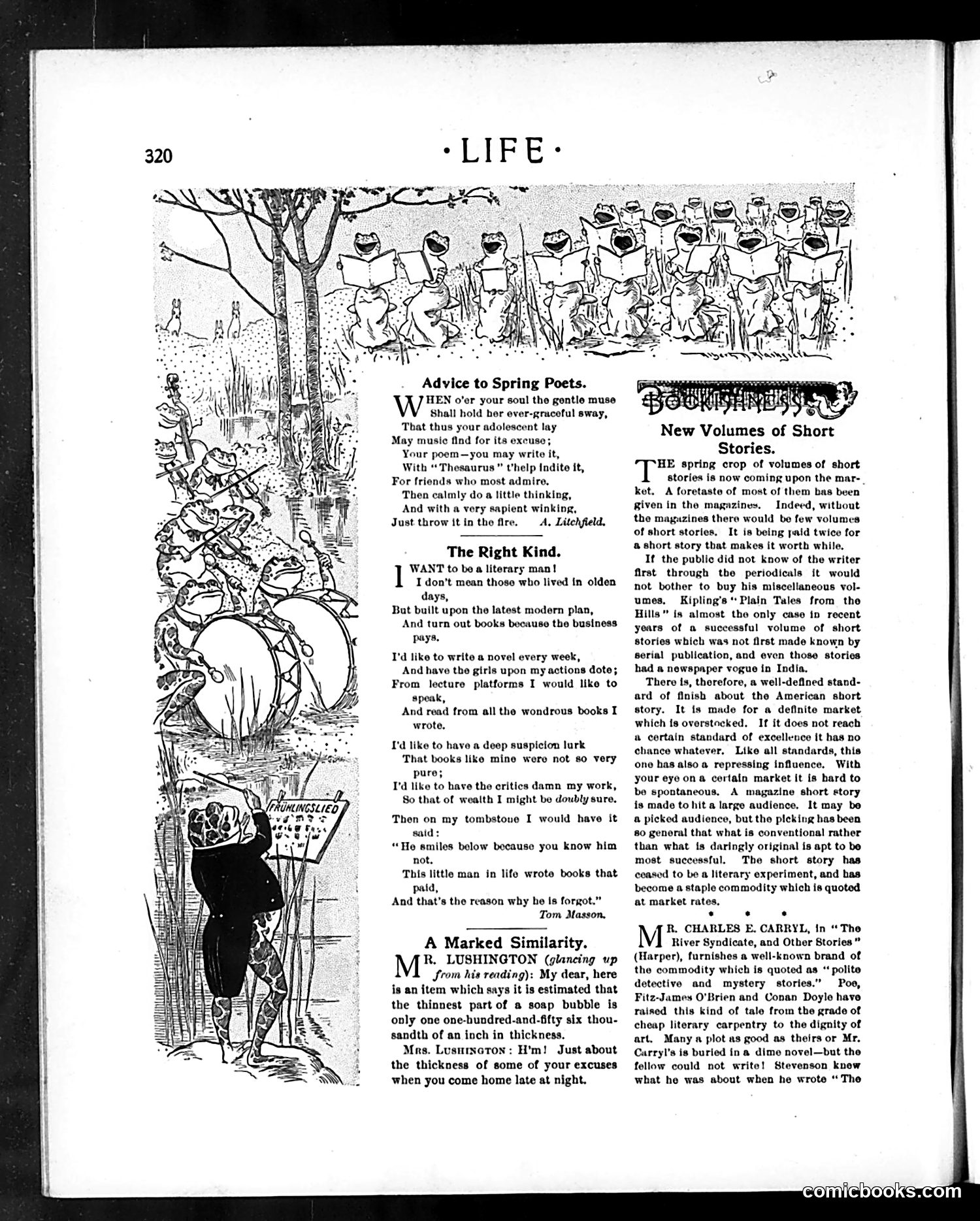
This is primarily **literary content**, not political satire. The page features three articles about writing: 1. **"Advice to Spring Poets"** — A humorous poem mocking aspiring poets who write derivative work, use thesauruses, and seek validation from friends rather than genuine literary merit. The satire targets amateurish versifying common in the era. 2. **"The Right Kind"** — A poem satirizing the modern "literary man" who writes for money and commercial success rather than art, cranking out novels weekly while courting critics and wealth. 3. **"A Marked Similarity"** — A brief comic dialogue mocking Mr. Lushington's excessive drinking, with his wife comparing his late-night thickness to the thickness of his excuses. The accompanying illustration shows a nature scene with figures, supporting the spring poetry theme.
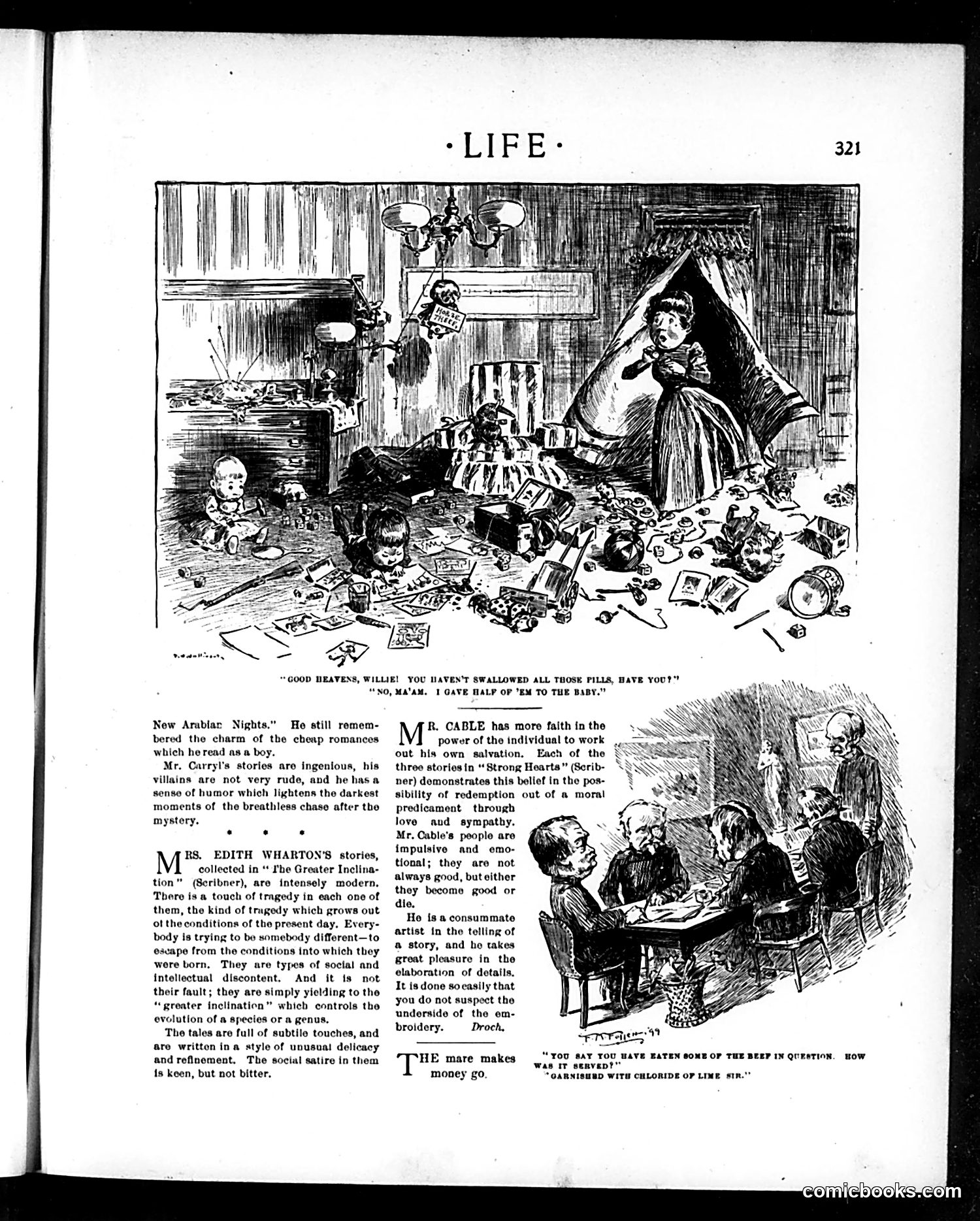
This page contains book reviews rather than political cartoons. The text discusses three authors: 1. **"Arabian Nights"** - praised for charming romantic stories with ingenious plots and humorous villains that provide redemption themes 2. **Mr. Cable** - credited with faith in individual redemption across three stories in "Strong Hearts," using love and sympathy to explore moral rehabilitation 3. **Mrs. Edith Wharton** - her collection "The Greater Inclination" is critiqued as intensely modern, featuring tragic social commentary about people trapped by contemporary conditions. The reviewer notes her stories contain "subtle touches" and "unusual delicacy," though with social satire that "is keen, but not bitter." The accompanying illustrations show domestic Victorian scenes related to the reviewed works. This is literary criticism, not political satire.
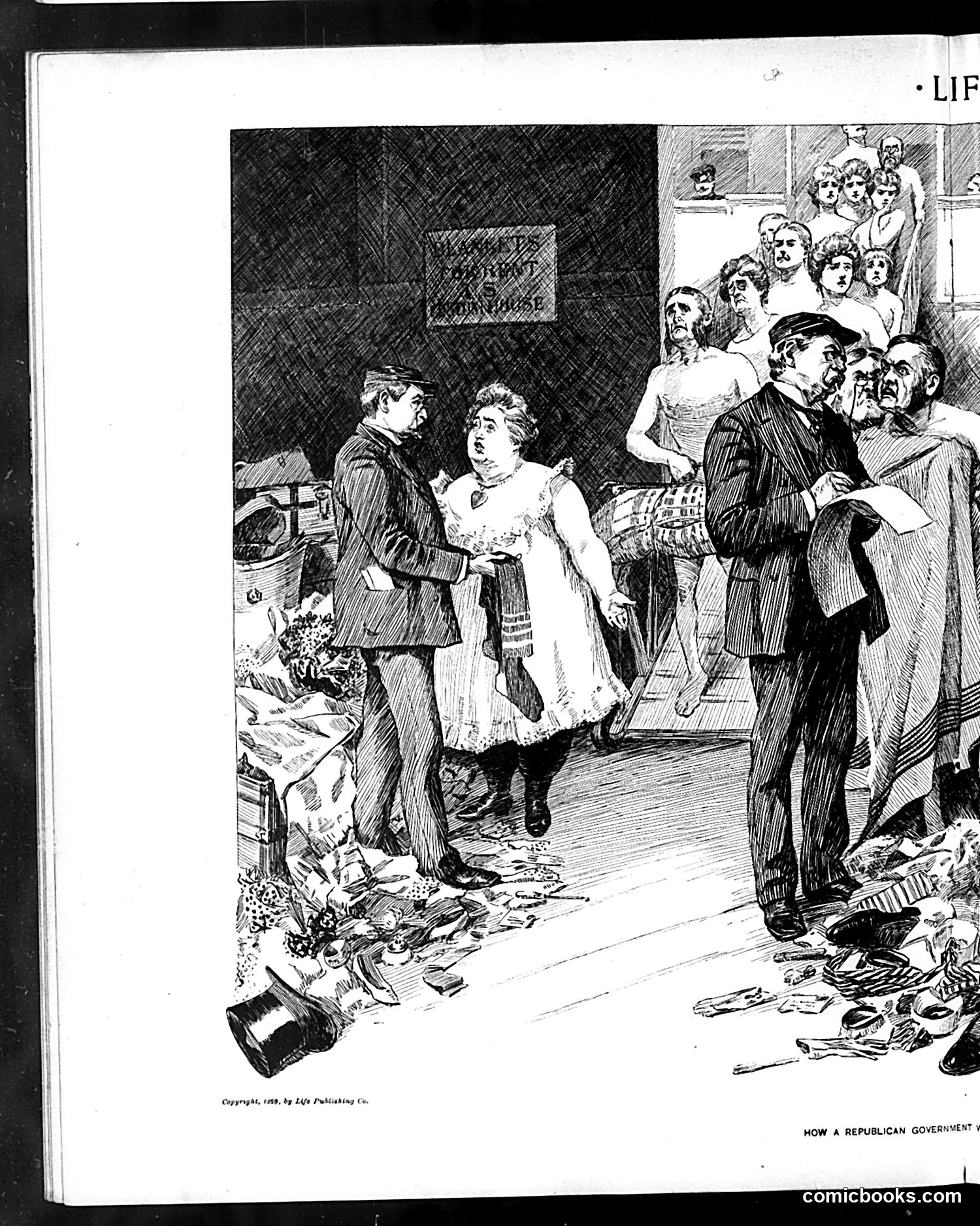
This appears to be a satirical illustration titled "How a Republican Government..." (text cut off). The scene depicts a crowded, chaotic indoor gathering where a woman in white stands central, appearing distressed or confrontational with a man in a suit to her left. Multiple well-dressed men in suits surround them, with additional figures visible through a doorway above. The scattered debris on the floor—papers, what appears to be a overturned container—suggests disorder or corruption. The cramped, messy composition and the woman's apparent distress suggest this is mocking Republican governance as disorganized or mismanaged. Without the complete caption, the specific political moment remains unclear, but the imagery implies critique of Republican administrative chaos or misconduct.
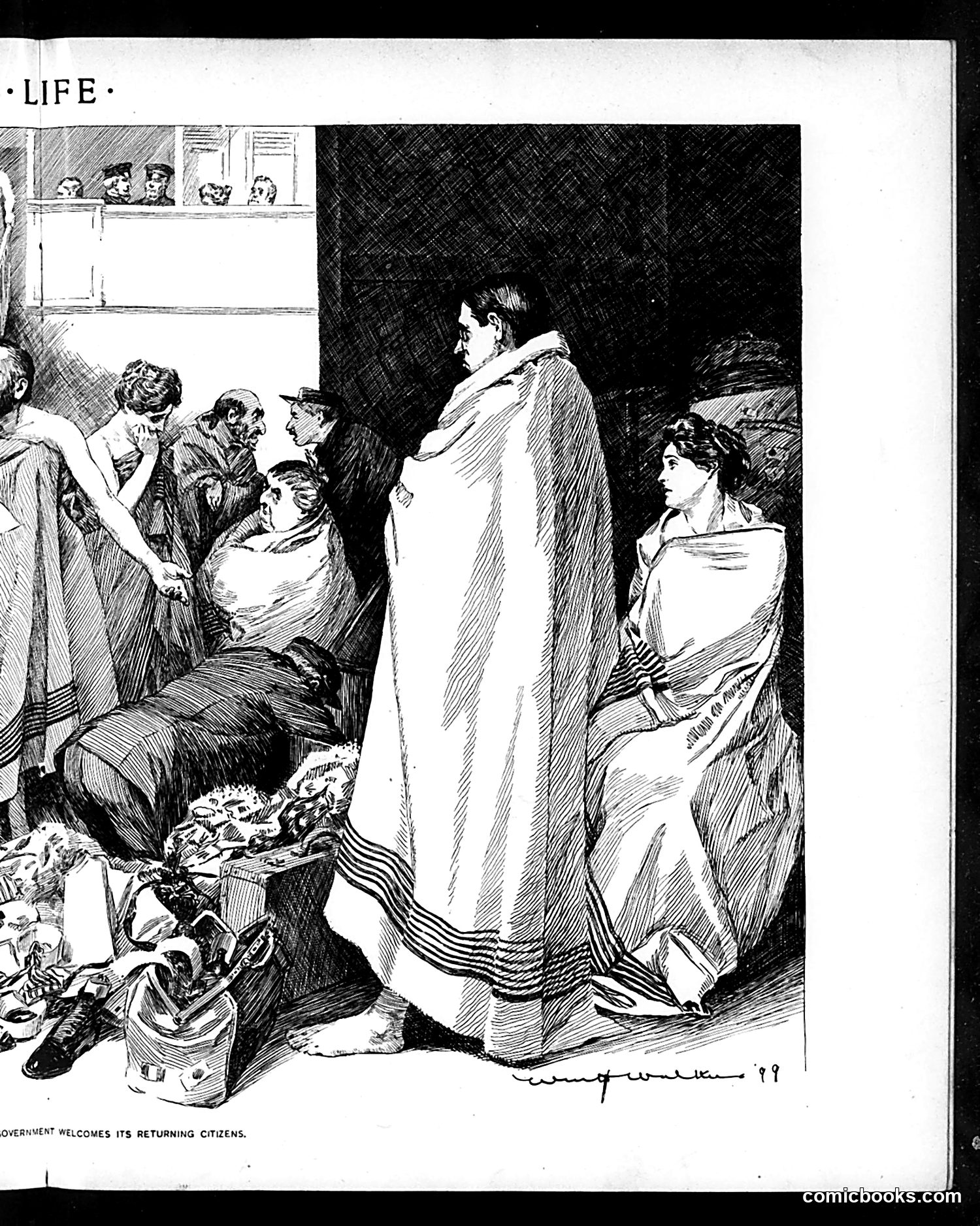
This satirical Life magazine cartoon depicts a government official (center, in white robes) formally greeting what appears to be newly released prisoners or returning citizens. The figures are wrapped in blankets, looking disheveled and impoverished, surrounded by scattered belongings on the ground. The satire critiques the gap between official ceremony and actual citizen welfare: while the government performs an elaborate welcome ritual, the people being "welcomed" are clearly in dire circumstances—poorly clothed, seemingly destitute. The contrast between the dignified official posture and the actual conditions of these citizens suggests governmental hypocrisy or failure to genuinely support those it claims to welcome back. The specific historical context remains unclear without dating information.
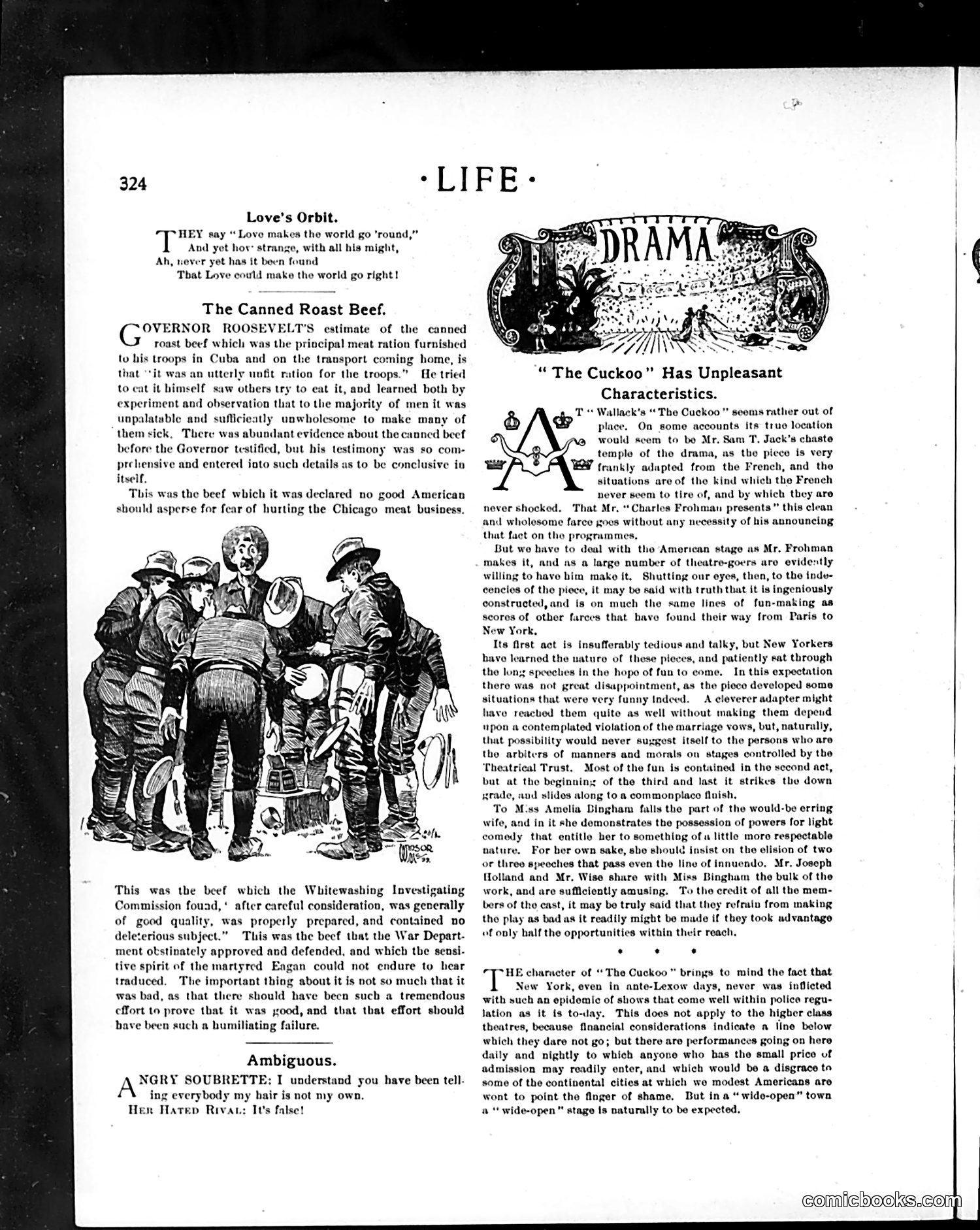
This page contains three distinct pieces: 1. **"Love's Orbit"** — A brief humorous poem mocking the saying that "Love makes the world go 'round." 2. **"The Canned Roast Beef"** — A political satire about Governor Roosevelt's (Theodore Roosevelt's) claim that canned beef supplied to U.S. troops in Cuba was inedible. The text suggests Roosevelt's criticism harmed the Chicago meat industry, implying his investigation was a "humiliating failure" despite initial efforts to prove the beef was genuinely bad. 3. **"The Cuckoo" Has Unpleasant Characteristics** — A theater review of a French farce adapted for American audiences by Charles Frohman, discussing its construction and entertainment value. The cartoon illustrates the beef controversy with period-dressed figures examining meat.
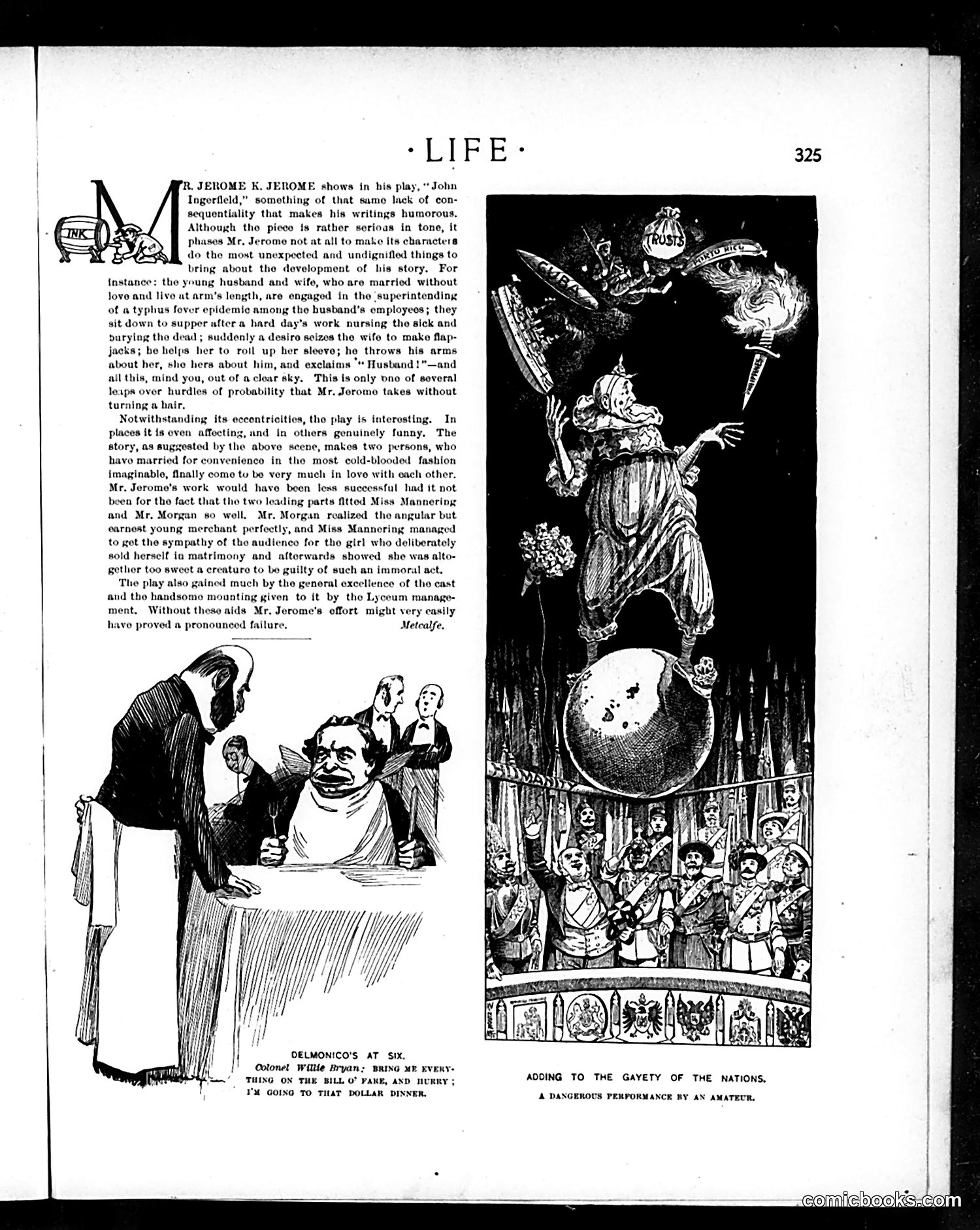
This page reviews playwright Jerome K. Jerome's play "John Ingerfield" and includes two satirical cartoons mocking contemporary figures. The **left cartoon** depicts Colonel Willie Bryan at Delmonico's restaurant, ordering "everything on the bill of fare" for a "dollar dinner"—a jest about extravagance and contradiction. This likely references William Jennings Bryan, the populist politician known for advocating common people's interests, now humorously portrayed as a wealthy diner. The **right cartoon**, titled "Adding to the Gayety of the Nations," shows an amateur performer attempting a dangerous aerial stunt before an ornate theater audience. The satire appears to critique amateur performers taking on acts beyond their skill level, endangering themselves for entertainment—a commentary on incompetence masquerading as spectacle. Both cartoons employ exaggerated caricature typical of turn-of-the-century American satire, targeting political hypocrisy and theatrical pretension.
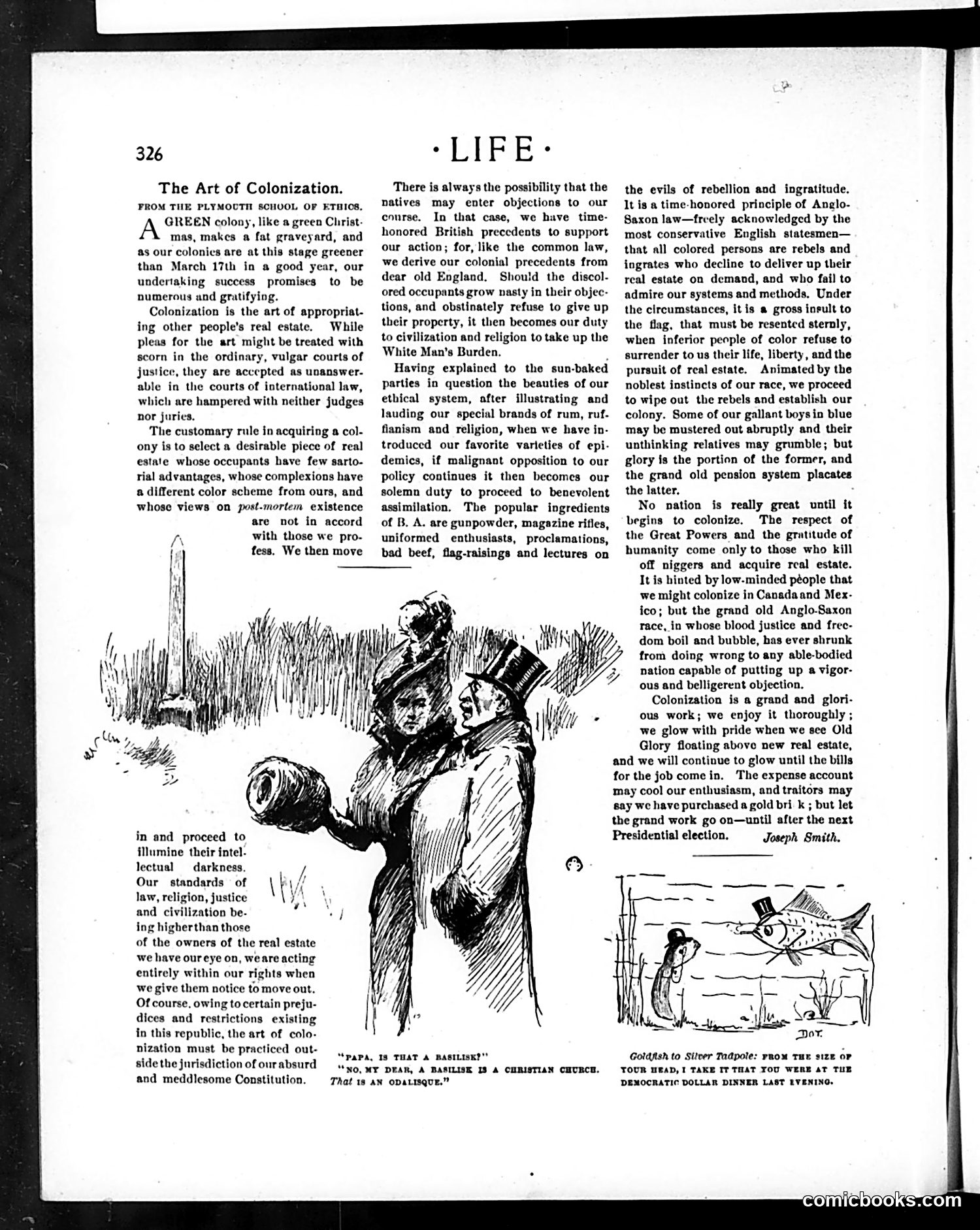
This is savage satire on American imperial colonization, particularly targeting U.S. expansion in the Philippines and similar ventures. The piece mocks the justifications used to seize foreign territories. **The main argument satirized:** Colonizers claim moral superiority—religious enlightenment, "civilization," legal authority—to dispossess non-white populations of their land. The text ironically catalogs the actual methods: gunpowder, disease introduction, rum distribution, and killing resistance as "ingratitude." **Key satirical points:** - "Benevolent assimilation" masks violent conquest - Anglo-Saxon racial superiority is presented as legal doctrine - Opposition by natives is criminalized as rebellion - American exceptionalism depends on exempting colonization from constitutional restrictions that would prohibit it domestically **The cartoons** appear to mock the sanitized presentation of colonialism through children's innocence (the girl mistaking a church for a dangerous "basilisk") and through the "Goldfish to Silver Tadpole" illustration (context unclear from visible text). The author (Joseph Smith, per signature) condemns American colonial ventures as naked land-theft dressed in religious and civilizational rhetoric.
This page is primarily **advertisements and book announcements** from *Life* magazine, with two brief humorous anecdotes at the top. The main story concerns **President McKinley** touring a Southern military camp during what appears to be the Spanish-American War era. A sentinel challenges him, and McKinley must prove his identity—the joke being the absurdity of the President needing a "countersign" to pass. The second anecdote involves **Mr. Cruikshank** (likely the artist), who declines wine but accepts a potato, leading to wordplay about potatoes and Irish identity—a common stereotype of the era. The page's bulk consists of *Life* Publishing Company advertisements for bound volumes, pen sets, and shoes—typical period magazine content. The literary announcements reference works by Macmillan and Harper & Brothers publishers. **The satire is gentle**: poking fun at military protocol and ethnic humor rather than sharp political commentary.
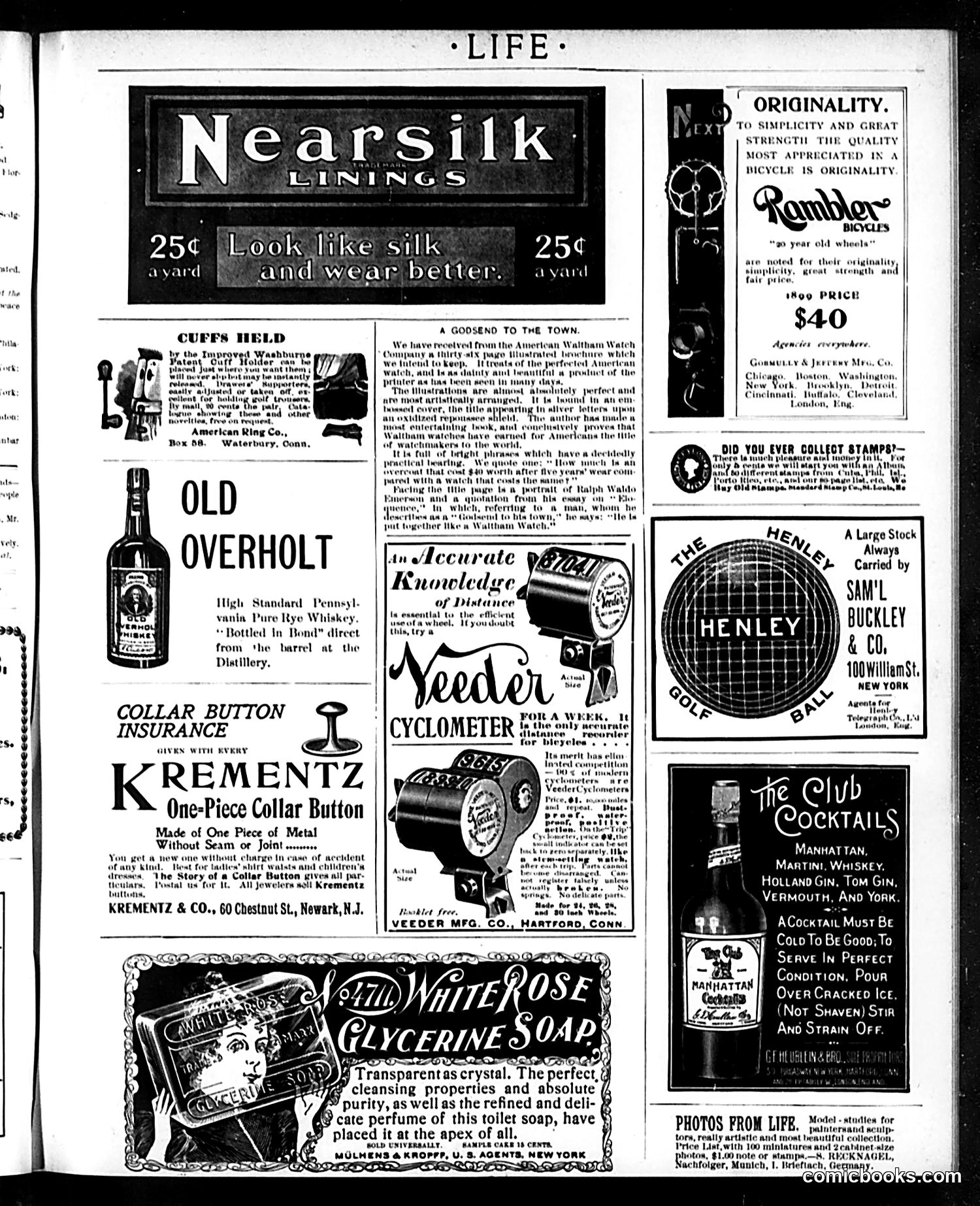
This is primarily an **advertising page** from an early 20th-century issue of Life magazine, not a political cartoon. The content consists entirely of commercial advertisements with minimal editorial material. The only substantive editorial content is a brief article titled "A Godsend to the Town," which appears to favorably review an **American Waltham Watch Company** illustrated book about watches. The piece describes the book as entertaining and concludes that "Waltham watches have earned for themselves the title of 'American Watches.'" The remaining content advertises consumer goods typical of the era: **Nearsilk linings** (25¢ per yard), **Ramblers bicycles** ($40), **Old Overholt whiskey**, **Veeder cyclometers** (bicycle odometers), **White Rose glycerine soap**, and **cocktail recipes**. There is no political satire or social commentary visible on this page—it reflects Life's commercial nature during this period.
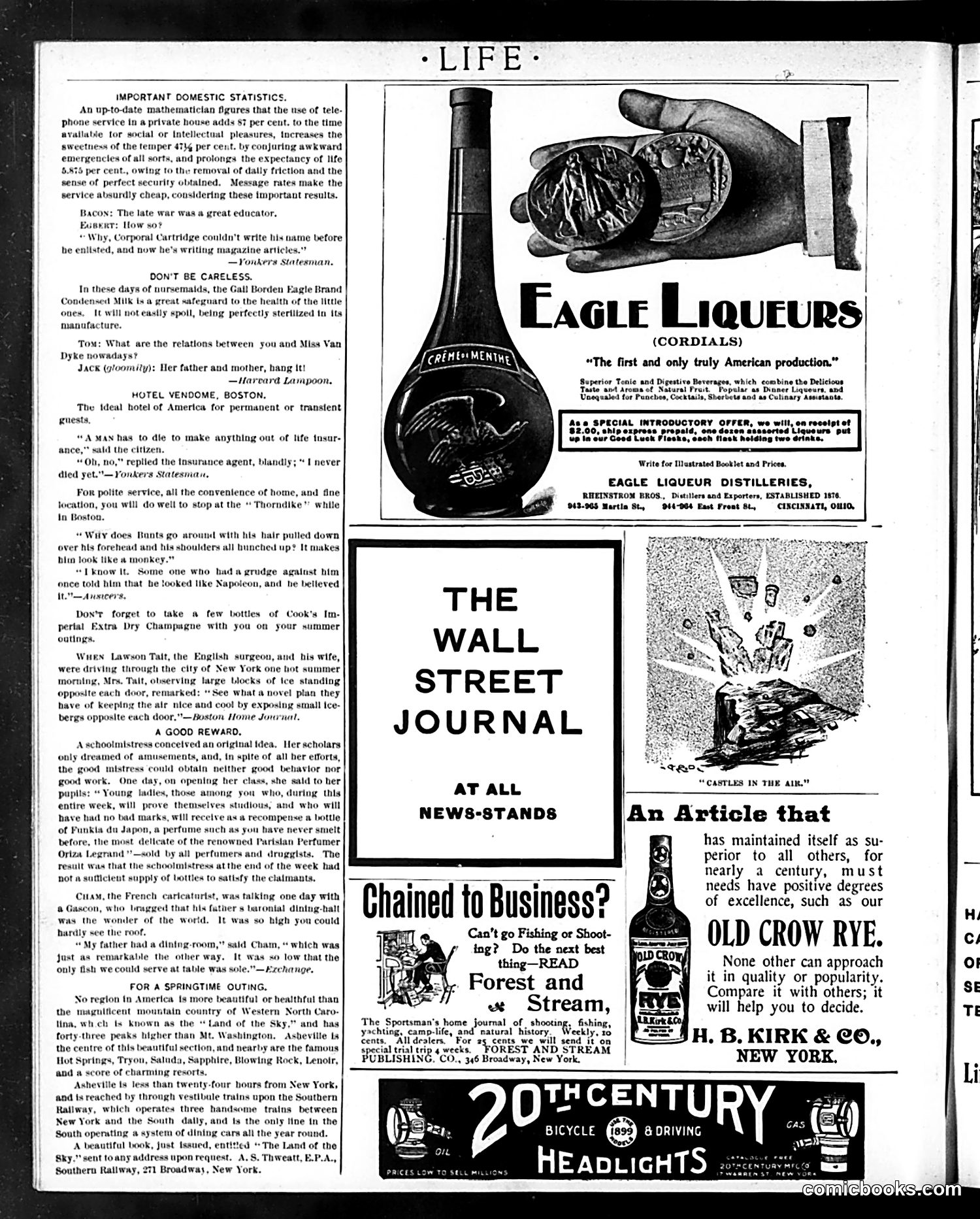
This page is primarily **advertising with humorous filler content**, typical of early 20th-century American magazines. The main advertisements are for **Eagle Liqueurs** (cordials), **The Wall Street Journal**, **Forest and Stream** magazine, **Old Crow Rye whiskey**, and **20th Century Bicycle Headlights**. The left column contains short humorous anecdotes and jokes—not political cartoons—mocking various subjects: telephone use, military literacy, insurance, hairstyles, and so forth. These brief quips appear designed to fill space between advertisements. The only actual cartoon visible is a small illustration labeled "Castles in the Air" accompanying the Old Crow advertisement. **No significant political satire or social commentary appears on this page.** It's a commercial publication page mixing light humor with product promotion, representing standard magazine layout practices of the era.
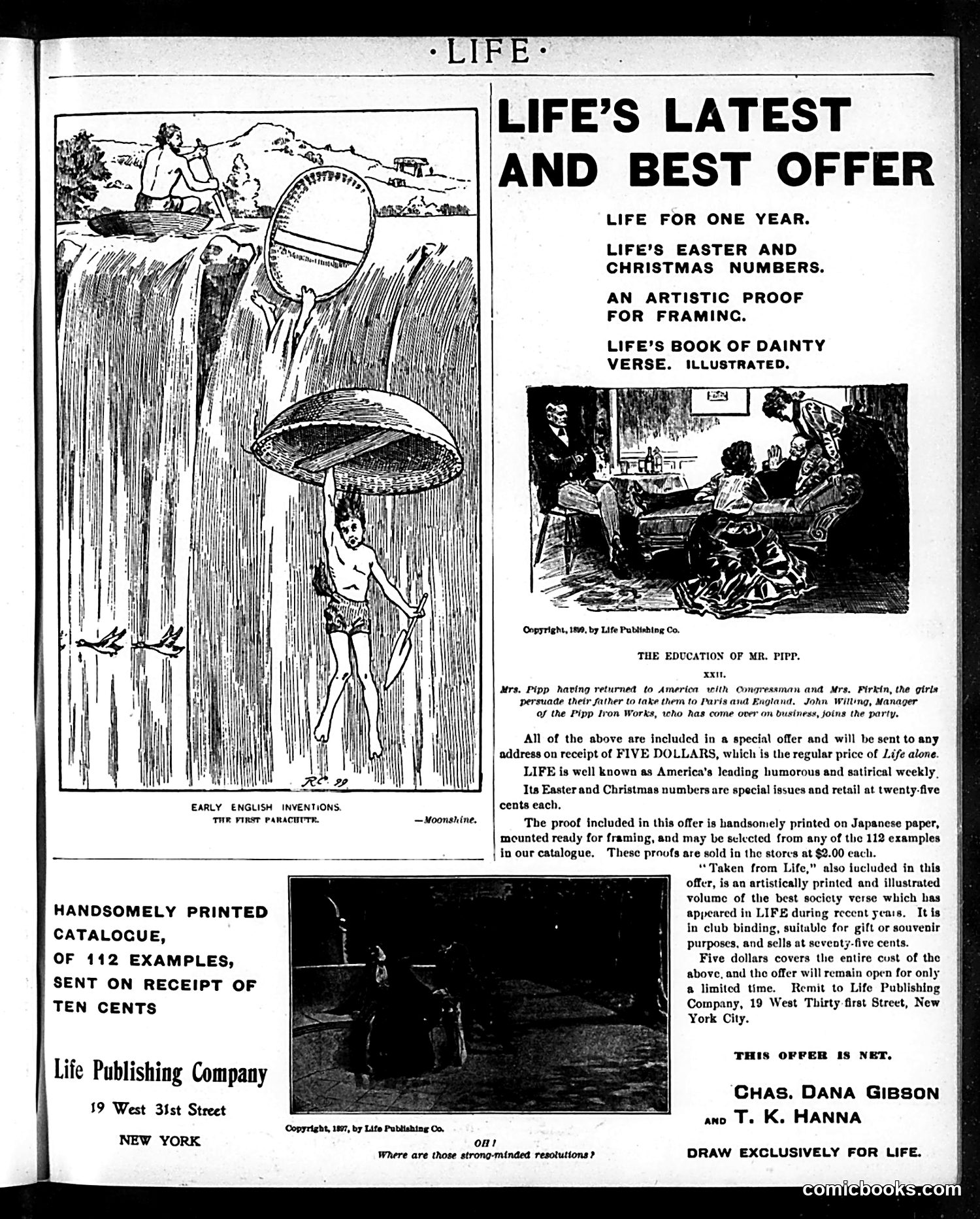
This is primarily a **subscription and merchandise advertisement** rather than editorial content. The page promotes Life magazine's yearly subscription ($5) bundled with special offers: Easter/Christmas issues, an artistic proof for framing, and an illustrated poetry collection. Two cartoons appear: 1. **"Early English Inventions: The First Parachute"** (left) – A humorous illustration showing a primitive parachute device, captioned "Moonshine," suggesting absurdist historical "invention" humor typical of Life's satirical style. 2. **"The Education of Mr. Pipp" (bottom right)** – Part of an ongoing serial about Mr. and Mrs. Pipp and their family traveling to Paris and England with a congressman. The caption "Where are those strong-minded resolutions?" suggests domestic comedy about New Year's resolutions—likely poking fun at middle-class aspirations and family dynamics. Both cartoons are credited to **Chas. Dana Gibson and T. K. Hanna**, prominent Life contributors. This appears to be from **1897**, when Life was America's leading satirical weekly.
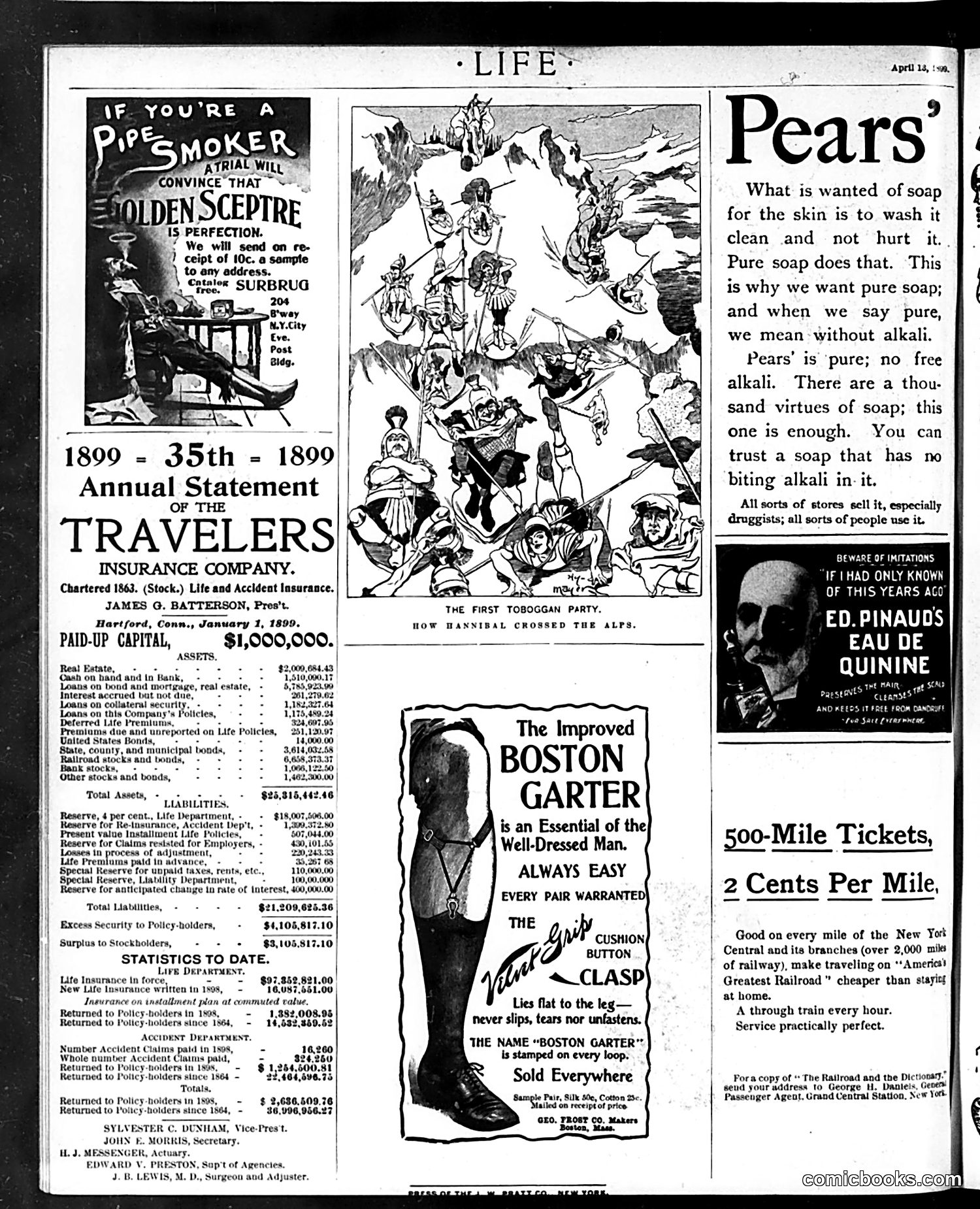
This page is primarily **advertising and financial statements** rather than satirical content. The central cartoon, titled "The First Toboggan Party: How Hannibal Crossed the Alps," appears to be a humorous anachronism—depicting the historical military commander Hannibal's famous Alpine crossing as if it were a modern winter recreation activity, with figures tobogganing down snowy slopes. The joke relies on the absurdity of applying 1890s leisure sports to ancient history. The page otherwise contains the **Travelers Insurance Company's 1899 annual financial statement** (showing $1 million paid-up capital and over $23 million in total assets) and various period advertisements: Golden Sceptre pipe tobacco, Boston Garter suspenders, Pears' soap (emphasizing purity without alkali), and New York Central Railroad 500-mile tickets at 2 cents per mile. No significant political satire is evident on this page.