
Life, 1899-04-13 · page 4 of 20
Life — April 13, 1899 — page 4: what you’re looking at
What you’re looking at
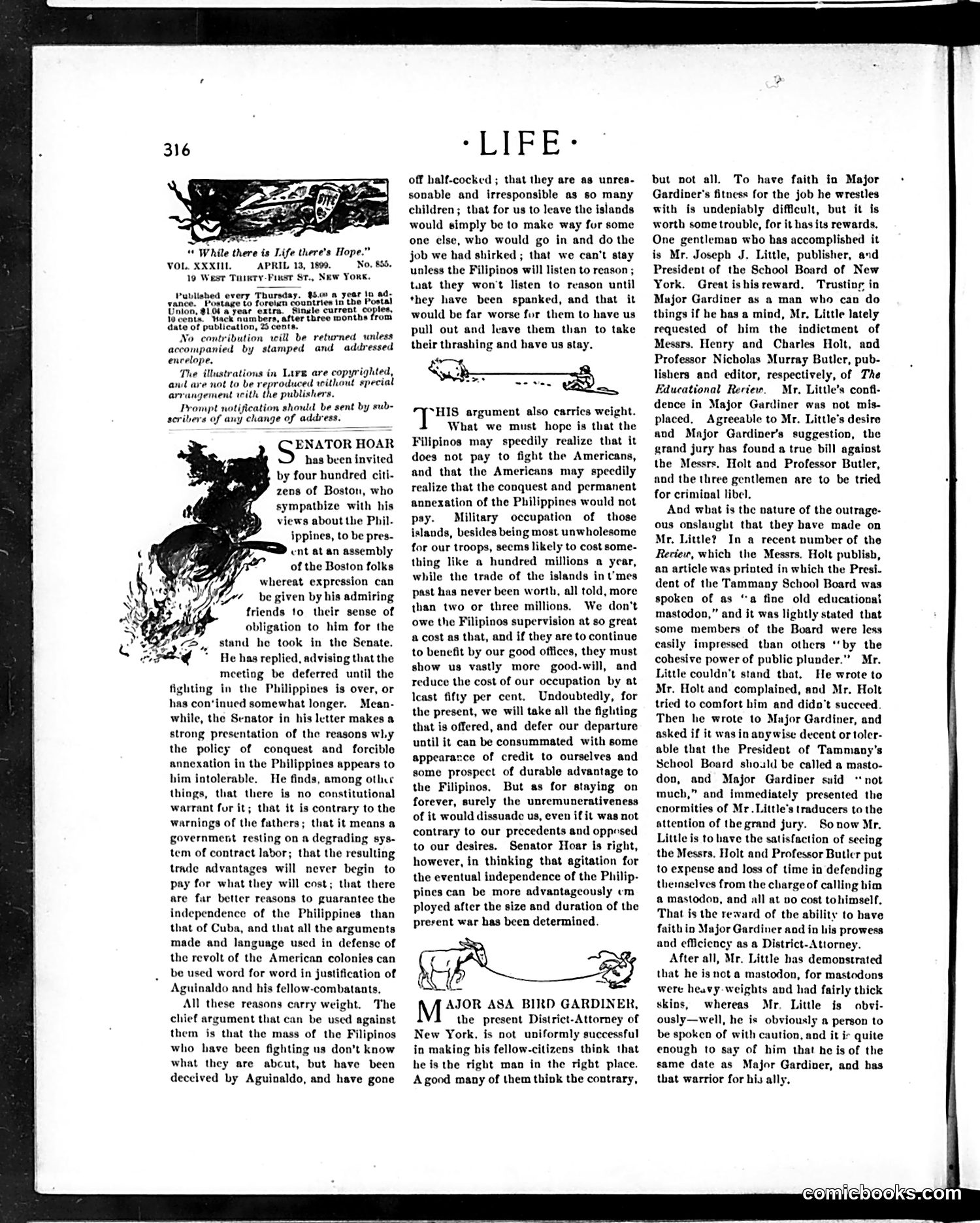
This page discusses the Philippine-American War and American colonial policy. The text debates whether the U.S. should maintain military occupation of the Philippines, presenting arguments from Senator Hoar (who opposed annexation) against the policy. The cartoons appear to satirize American imperialism in the Philippines. One sketch shows a figure labeled "PHILIPPINE BOAR" being invited by Boston citizens to speak about Philippine independence—likely mocking American hypocrisy about democracy while denying it to Filipinos. The page criticizes those defending the occupation as costly and unjust, while praising Mr. Joseph J. Little (a publisher and School Board President) for questioning whether the conquest was worth its expense and moral cost. The satire targets American colonial ambitions in the early 1900s.
📄 Transcribed text from this page (OCR, searchable)
Machine-transcribed from the original scan — historical spelling and the odd misread are preserved.
ut VOL. XXXL. Puplished every Thursday. #0 a year in, ad matage Co forelun countries in tbe Postal 81 bh peae extra. Single current coples, ‘ots. Hack numbers, after three months from Gato of publication, 2 cents. No contribution will be returned unless accompanied by stamped and addressed enrelope. The illustrations in Lire are copyrighted, anil are not to be reproduces, without special arrangement with the publishers. Prompt notification should be sent by sub- scriters of any change of address. ENATOR HOAR has been invited by four hundred citi- zens of Boston, who sympathize with his views about the Phil- ippines, to be pres- ent atan assembly of the Boston folks whereat expression can be given by his admiring friends to their sense of obligation to him for the f,A,, stand he took in the Senate. pad He has replied, advising that the meeting be deferred until the fighting in the Philippines is over, or has con‘inued somewhat longer. Mean- while, the Senator in his letter makes a strong presentation of the reasons why the policy of conquest and forcible annexation in the Philippines appears to him intolerable. He finds, among othie things, that there is no constitutional warrant fur it; that it is contrary to the warnings of the fathers; that it means a government resting on a degrading sys- tem of contract labor; that the resulting trade advantages will never begin to pay for what they will cost; that there are far better reasons to guarantec the independence of the Philippines than that of Cuba, and that all the arguments made and language used in defense of the revolt of the American colonies can be used word for word in justification of Aguinaldo and his fellow-combatants, All these reasons carry weight. The chief argument that can be used against them is that the mass of the Filipinos who have been fighting us don’t know what they are abcut, but have been deceived by Aguinaldo, and have gone ad LIFE off half-cocked ; that they are as unrea- sonable and irresponsible as so many children; that for us to leave the islands would simply be to make way for some one else, who would go in and do the job we had shirked ; that we can’t stay unless the Filipinos will listen to reason ; tuat they won't listen to reason until they have been spanked, and that it would be far worse four them to have us pull out and leave them than to take their thrashing and have us stay. THs argument also carrics weight. What we must hope is that the Filipinos may specdily realize that it does not pay to fight the Americans, and that the Americans may specdily realize that the conquest and permanent. annexation of the Philippines would not pay. Military occupation of those islands, besides being most unwholesome for our troops, seems likely to cost some- thing like a hundred millions a year, while the trade of the islands in t'mes past has never been worth, all told, more than two or three millions. We don't owe the Filipinos supervision at so great a cost as that, and if they are to continue to benefit by our good offices, they must show us vastly more good-will, and reduce the cost of our occupation by at Icast fifty per cent. Undoubtedly, for the present, we will take all the fighting that is offered, and defer our departure until it can be consummated with some appearance of credit to ourselves and some prospect of durable advantage to the Filipinos, But as for staying on forever, surely the unremunerativeness of it would dissuade us, even if it was not contrary to our precedents and opprsed to our desires. Senator Hoar is right, however, in thinking that agitation for the eventual independence of the Philip- pines can be more advantageously cm ployed after the size and duration of the present war has been determined. M08 ASA BIRD GARDINER, the present District-Attorney of New York, is not uniformly successful in making his fellow-citizens think that he is the right man in the right place. Agood many of them think the contrary, but not all. To have faith in Major Gardiner's fitness for the job he wrestles with is undeniably difficult, but it is worth some trouble, for it has its rewards. One gentleman who has accomplished it is Mr. Joseph J. Little, publisher, and President of the School Board of New York. Great ishisreward. ‘Trusting in Major Gardiner as a man who can do things if he has a mind, Mr, Little lately requested of him the indictment of Messrs. Henry and Charles Holt, and Professor Nicholas Murray Butler, pub- lishers and editor, respectively, of The Educational Reriew. Mr. Litvle’s confl- dence in Major Gardiner was not mis- placed, Agreeable to Mr. Little's desire and Major Gardiner’s suggestion, the grand jury has found a true bill against the Messrs, Holt and Professor Butler, and the three gentlemen are to be tried for criminal libel. And what is the nature of the outrage- ous onslaught that they have made on Mr. Little? In a recent number of the Review, which the Messrs. Holt publish, an article was printed in which the Presi. dent of the Tammany School Board was spoken of as ‘a fine old educational mastodon,” and it was lightly stated that some members of the Board were less casily impressed than others ‘‘by the cohesive power of public plunder.” Mr. Little couldn't stand that, He wrote to Mr. Holt and complained, and Mr. Holt tried to comfort him and dido't succeed Then he wrote to Major Gardiner, and asked if it was in any wise decent or toler- able that the President of Tammaoy’s School Board should be called a masto- don, and Major Gardiner suid “not much,” and immediately presented the cnormities of Mr.Little’s traducers to the attention of the grand jury. So now Mr. Little is to have the satisfaction of secing the Messrs. Holt and Professor Butler put to expense and loss of time in defending themselves from the chargeof calling bim a mastodon, and all at no cost tohimself. That is the reward of the ability to have faith in Major Gardiner and in his prowess and efficiency as a District-Attorney. After all, Mr. Little has demonstrated that he is not a mastodon, for mastodons were heavy-weights and had fairly thick skins, whereas Mr. Little is abvi- ously—well, he is obviously a person to be spoken of with caution, and it ir quite enough to say of him that he is of the same date as Major Gardiner, and has that warrior for his ally,