
Life, 1899-04-13 · page 9 of 20
Life — April 13, 1899 — page 9: what you’re looking at
What you’re looking at
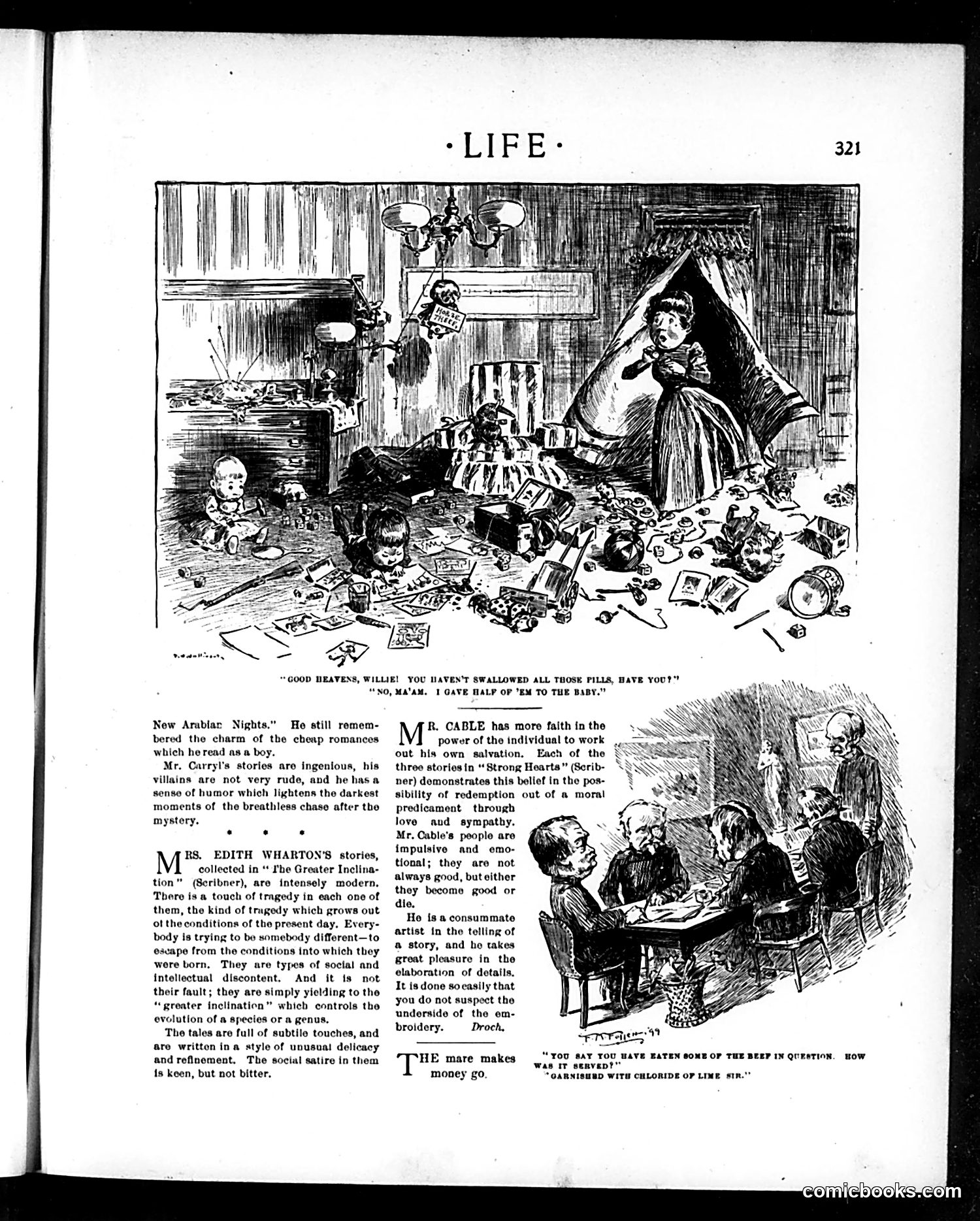
This page contains book reviews rather than political cartoons. The text discusses three authors: 1. **"Arabian Nights"** - praised for charming romantic stories with ingenious plots and humorous villains that provide redemption themes 2. **Mr. Cable** - credited with faith in individual redemption across three stories in "Strong Hearts," using love and sympathy to explore moral rehabilitation 3. **Mrs. Edith Wharton** - her collection "The Greater Inclination" is critiqued as intensely modern, featuring tragic social commentary about people trapped by contemporary conditions. The reviewer notes her stories contain "subtle touches" and "unusual delicacy," though with social satire that "is keen, but not bitter." The accompanying illustrations show domestic Victorian scenes related to the reviewed works. This is literary criticism, not political satire.
📄 Transcribed text from this page (OCR, searchable)
Machine-transcribed from the original scan — historical spelling and the odd misread are preserved.
“GOOD HEAVENS, WILLIE! YOU LAVEN'T SWALLOWED ALL THOSE PILLS, BAVE You?” “NO, MataM. New Arablar Nights." Ho still remem- bered the charm of the cheap romances which he read as a boy. Mr. Carryl's stories aro ingenious, his villains are not very rude, and he hasa senso of humor which lightens the darkest moments of the breathless chase after the mystery. . . . RS. EDITH WHARTON'S stories, collected in “* I'he Greater Inclina- tion” (Scribner), are intensely modern, Thore is a touch of tragedy in each one of them, the kind of tragedy which grows out ot the conditions of the present day. Every- body is trying to be somebody different—to escape from the conditions into which they wore born, They are types of social and Intellectual discontent. And it 1s not their fault; they are simply yielding to the “greater inclination” which controls tho evolution of a species or a genus, Tho tales aro full of subtile touches, and aro writton ina style of unusual delicacy 1 GAVE HALP OF ’EM TO THE BBY.” R. CABLE has moro faith in the power of the individual to work out his own salvation. Each of the three stories in “Strong Hearts” (Serib- ner) demonstrates this belief in the pos- sibility of redemption out of a moral predicament through Jove aud sympathy. Mr. Cable's people are impulsive and emo- tional; they are not always good, but either they become good or die. Ho {s a consummate artist in the telling of @ story, and ho takes great pleasure in the elaboration of details. It is done socasily that you do not suspect the underside of the em- broidery. — Droch, “YOU SAY TOU WAVE EATEN OOME OF THE BEEP IN QUESTION. HOW was It senvep?” *OARNISUBD WITH CHLORIDE OF LIME stR."* HE mare makes money go. and refinement. The social satire in them is keen, but not bitter,