
Life, 1899-04-13 · page 8 of 20
Life — April 13, 1899 — page 8: what you’re looking at
What you’re looking at
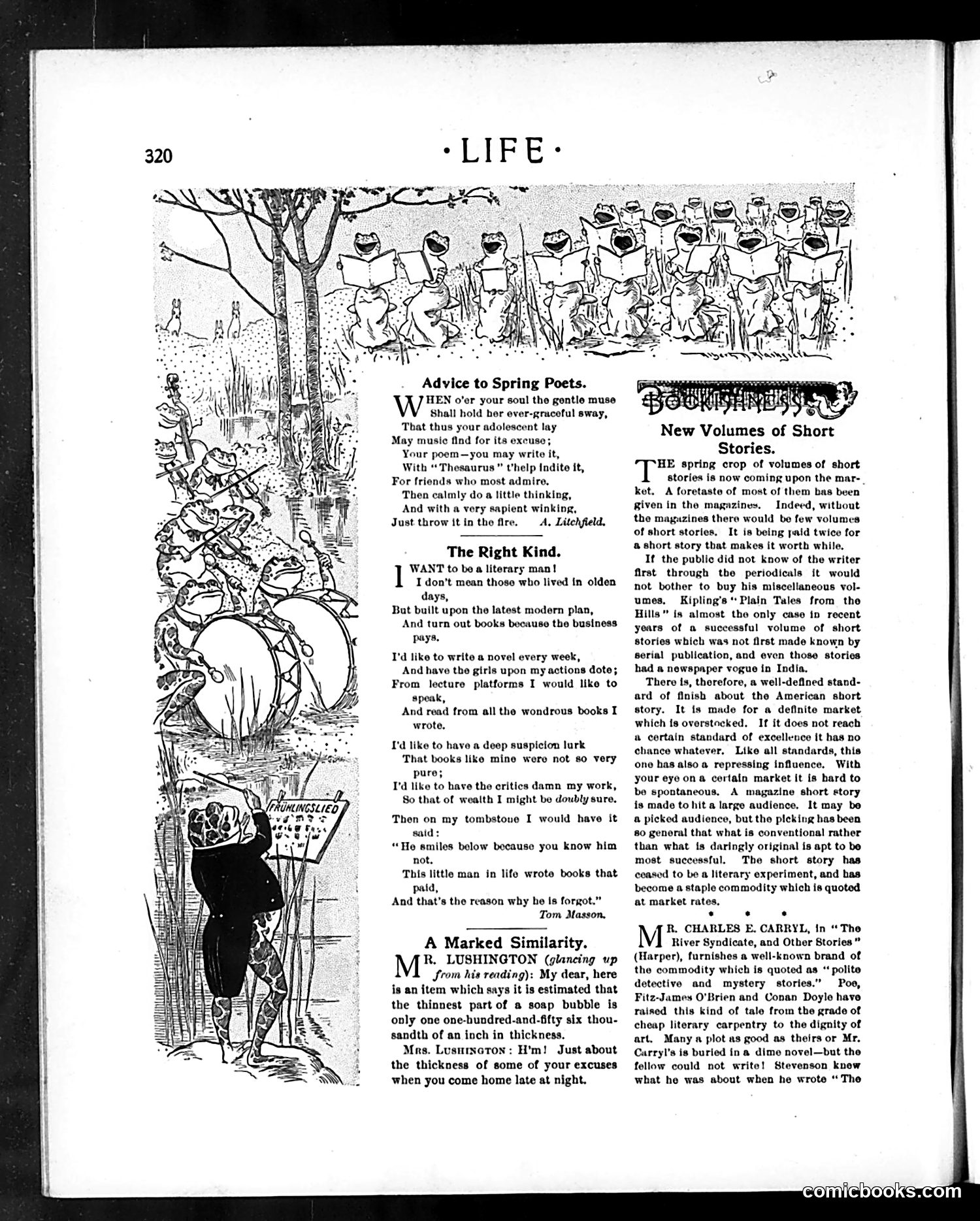
This is primarily **literary content**, not political satire. The page features three articles about writing: 1. **"Advice to Spring Poets"** — A humorous poem mocking aspiring poets who write derivative work, use thesauruses, and seek validation from friends rather than genuine literary merit. The satire targets amateurish versifying common in the era. 2. **"The Right Kind"** — A poem satirizing the modern "literary man" who writes for money and commercial success rather than art, cranking out novels weekly while courting critics and wealth. 3. **"A Marked Similarity"** — A brief comic dialogue mocking Mr. Lushington's excessive drinking, with his wife comparing his late-night thickness to the thickness of his excuses. The accompanying illustration shows a nature scene with figures, supporting the spring poetry theme.
📄 Transcribed text from this page (OCR, searchable)
Machine-transcribed from the original scan — historical spelling and the odd misread are preserved.
Advice to Spring Poets. HEN o'er your soul the gentle muse Shall hold hor ever-grucotul sway, That thus your adolescent lay May music find for its excuse; Your poem—you may write it, With “Thesaurus” Uhelp Indite it, For friends who most admire. Then calmly do a little thinking, And with a vory sapient winking, Just throw itin tho fire, A, Litchfield, The Right Kind. WANT to bo a literary man! I don’t mean thoso who lived in olden days, Bat built upon the latest modern plan, And turn out books because the business paya, I'd like to writo a novel every week, And have the girls upon my actions dote; From lecture platforms I would like to speak, And read from all the wondrous books I wrote. I'd like to have a deep suspicion lurk ‘That books like mine wero not so very pure; I'd like to have the critics damn my work, So that of wealth I might be doubly sure. Thon on my tombstoue I would have it said: “Ho smiles bolow because you know him not. This little man in life wrote books that patd, And that’s the reason why he Is forgot.” Tom Masson, A Marked Similarity. R. LUSHINGTON (glancing up Srom his reading): My dear, here is an item which says it is estimated that the thinnest part of a soap bubble is only one one-hundred-and-fifty six thou- sandth of an inch in thickness. Mrs. Lusursoton: H'm! Just about the thickness of some of your excuses when you come home late at night. ‘ rete} sera Stories. HE spring crop of volumes of short stories is now coming upon the mar-_ ket. A foretaste of most of them bas been given in the magazines. Indeed, without the maguzines there would be few volumes of short stories. It is being paid twice for a short story that makes it worth while. It the public did not know of the writer first through tbe periodicals it would not bother to buy his miscellaneous vol- umes, Kipling’s Plain Tales from tho Hills” is almost the only case ip recent years of a successful volume of short stories which was not first made known by serial publication, and even those stories had a newspaper vogue in India. There ts, thorefore, a well-defined stand- ard of flnish about the American short story. It is made for a deflnite market which is overstocked, If it does not reach a certain standard of excellence it bas no chance whatever, Like all standards, thi one has also a repressing influence, With your eye ona certain market it is hard to be spontaneous. A magazine short story is made to hit a large audience. It may be a picked audience, but tho picking has been 80 genoral that what is conventional rather than what {s daringly original is apt to be most successful, The short story has ceased to be a literary experiment, and bas become a staple commodity which is quoted at market rates, eo 8 8 R. CHARLES E. CARRYL, in “Tho M River Syndicate, and Other Stories” (Harper), furnishes a well-known brand of the commodity which is quoted as “polite detective and mystery stories.” Poo, Fitz-James O'Brien and Conan Doyle have raised this kind of tale from the grade of cheap literary carpentry to the dignity of art, Many a plot as good as theirs or Mr. Carryl’s is buried in a dime novel—but tho fellow could not write! Stevenson knew what he was about when he wrote “The