
Life, 1899-04-13 · page 12 of 20
Life — April 13, 1899 — page 12: what you’re looking at
What you’re looking at
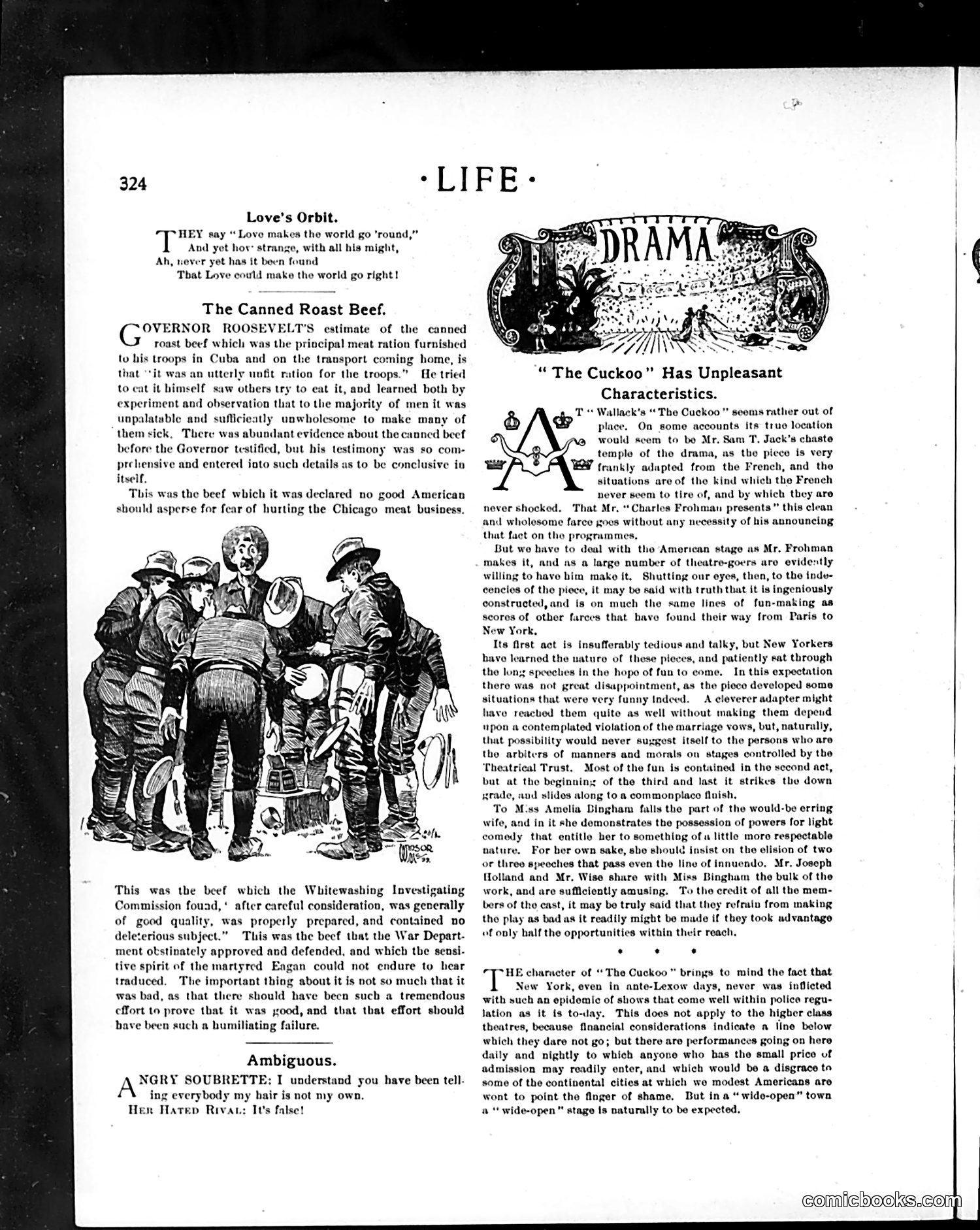
This page contains three distinct pieces: 1. **"Love's Orbit"** — A brief humorous poem mocking the saying that "Love makes the world go 'round." 2. **"The Canned Roast Beef"** — A political satire about Governor Roosevelt's (Theodore Roosevelt's) claim that canned beef supplied to U.S. troops in Cuba was inedible. The text suggests Roosevelt's criticism harmed the Chicago meat industry, implying his investigation was a "humiliating failure" despite initial efforts to prove the beef was genuinely bad. 3. **"The Cuckoo" Has Unpleasant Characteristics** — A theater review of a French farce adapted for American audiences by Charles Frohman, discussing its construction and entertainment value. The cartoon illustrates the beef controversy with period-dressed figures examining meat.
📄 Transcribed text from this page (OCR, searchable)
Machine-transcribed from the original scan — historical spelling and the odd misread are preserved.
Love’s Orbit. HEY say “Love makes the world go ‘round,” And yet hov strange, with all his might, Ah, never yet has it been found That Love could make the world go right! The Canned Roast Beef. OVERNOR ROOSEVELT’S estimate of the canned roast beef which was the principal meat ration furnished to his troops in Cuba and on the transport coming home, is that ‘it was an utterly unfit ration for the troops.” He tried to cat it himself saw others try to eat it, and learned both by experiment and observation that to the majority of men it was unpalatable and sufficieatly unwholesome to make many of them sick, There was abundant evidence about the canned beef before the Govervor testified, but his testimony was so com- prehensive and entered into such details as to be conclusive in itself. This was the beef which it was declared no good American should asperse for fear of hurting the Chicago meat business. This was the beef which the Whitewashing Investigating Commission fouad, ‘ after careful consideration, was generally of good quality, was properly prepared, and contained no deleterious subject.” This was the becf that the War Depart- ment otstinately approved and defended, and which the sensi- tive spirit of the martyred Eagan could not endure to bear traduced. The important thing about it is not so much that it was bad, as that there should have becn such a tremendous effort to prove that it was yood, and that that effort should bave been such a humiliating failure. Ambiguous. NGRY SOUBRETTE: I understand you have been tell: ing everybody my hair is not my own. Her Hatep Riva It's false! “ The Cuckoo” Has Unpleasant Characteristics. T “ Wallack’s “The Cuckoo” scoms rather out of (os) & place. On some accounts its truco location would scom to bo Mr. Sam T, Jack's chaste temple of tho drama, as the piece is very AF frankly adapted from the French, and the situations are of the kind which the French never seem to tire of, and by which they are never shocked. That Mr, “Charles Frohman presents” this clean and wholesome farce goes without any necessity of his announcing that fact on the programmes, But wo have to deal with the American stage as Mr. Frohman makes it, and as a largo number of theatre-goers are evidently willing to have bim make {t, Shutting our eyes, then, to the inde- cencies of the piece, it may be said with truth that it is ingeniously constructed, and is on much the same lines of fun-making as scores of other farces that have found their way from Paris to New York, Its first act is insufferably tedious and talky, but New Yorkers have learned the nature of these pieces, and patiently eat through the lonz speeches in the hopo of fun to come, In this expectation thero was not great disappointment, as the piece developed some situations that were very funny Indeed. A cleverer adapter might have reached them quite as well without making them depend upon a contemplated violation of the marriage vows, but, naturally, that possibility would never suggest itself to the persons who are tho arbiters of manners and morals on stages controlled by the ‘Theatrical Trust. Most of the fun fs contained in the second act, but at tho beginniny of the third and last it strikes the down xrade, and slides along to a commonplace fluish. To Mss Amelia Bingham falls the part of the would-be erring wife, and in it she demonstrates the possession of powers for light comedy that entitle her to something of u little moro respectable nature. For her own sake, she should insist on the elision of two or three speeches that pass even the line of innuendo, Mr. Joseph Holland and Mr. Wise share with Miss Bingham the bulk of the work, and are sufficiently amusing. To the credit of all the mem- bors of the cast, it may be truly said that they refrain from making tho play as bad as it readily might be made if they took udvantago of only half the opportunities within their reach, ww, . . . HE character of “The Cuckoo” brings to mind the fact that New York, even in ante-Lexow days, never was inflicted with such an epidemic of shows that come well within police regu- lation as it is to-day. This docs not apply to the higher class theatres, because financial considerations indicate a line below which they dare not go; but there are performances going on here daily and nightly to which anyone who bas the small prico uf admission may readily enter, and which would be a disgrace to some of the continental cities at which we modest Americans aro wont to point the finger of shame. But in a“ wide-open” town a“ wide-open” stage Is naturally to be expected. comichooks.conp