
A complete issue · 32 pages · 1899
Life — March 25, 1899
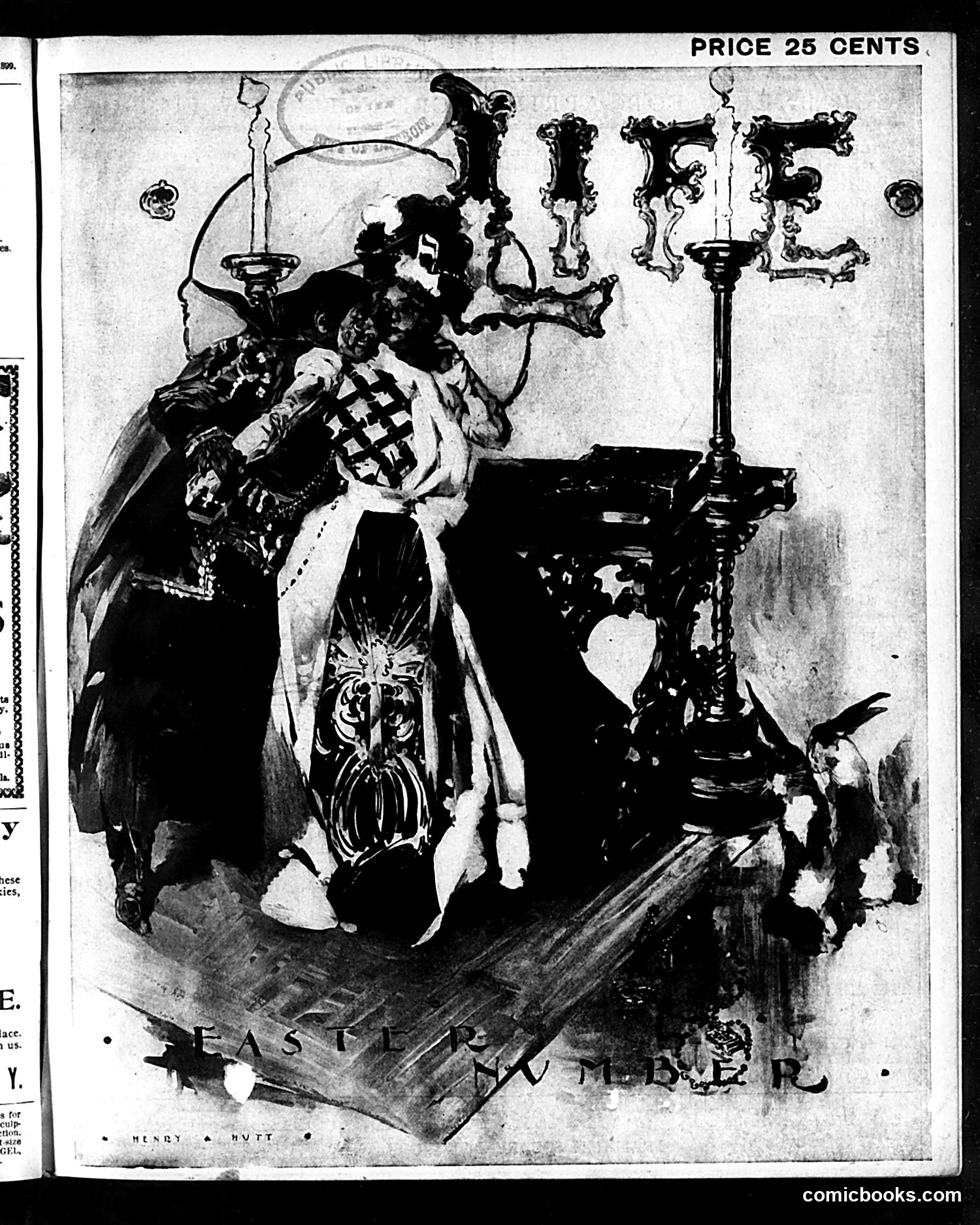
This appears to be a cover or full-page cartoon from *Life* magazine (priced at 25 cents), created by Henry Hutt as indicated at the bottom. The title "LIFE" is prominently displayed in decorative lettering at the top. The image shows an elaborate figure in ornate military or formal dress with elaborate headgear, holding candelabras. The figure appears to be a personification or caricature representing something grand or pompous. Without clearer context about the publication date or specific political events referenced, I cannot definitively identify which historical figure or situation this satirizes. The theatrical costume and theatrical setting suggest social or political satire common to early 20th-century *Life* magazine, but the specific target remains unclear from the visual elements alone.
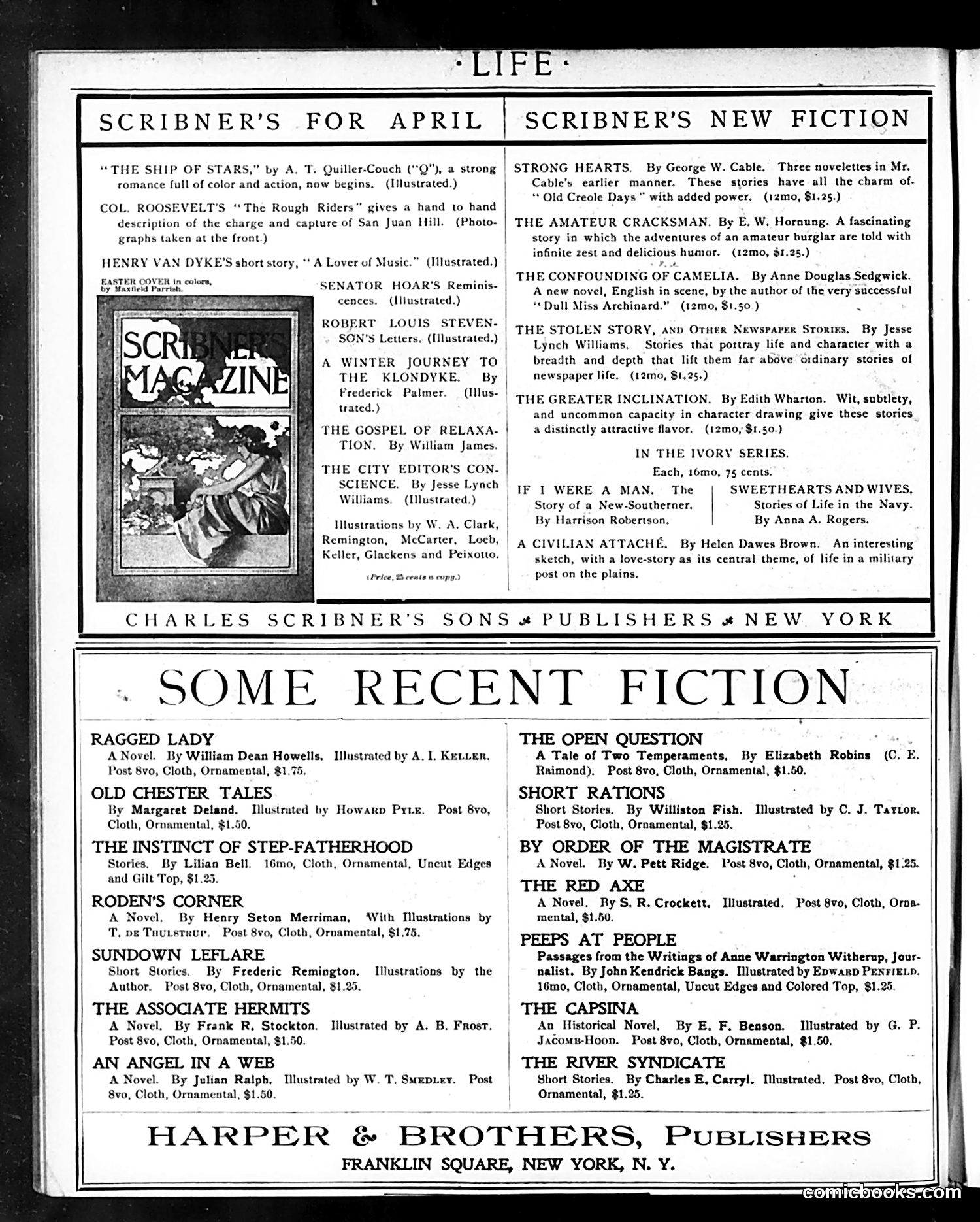
This page is primarily **book advertising** rather than satirical content. It features two sections: 1. **Top section**: Scribner's Magazine advertisements listing April fiction, including works by A.T. Quiller-Couch, Colonel Roosevelt, and Henry van Dyke. The magazine cover shown features illustrated figures in period costume. 2. **Bottom section**: "Some Recent Fiction" — a catalog of novels from Harper & Brothers publishers, listing titles like "Ragged Lady," "Old Chester Tales," and "The Red Axe." The page contains **no political cartoons or satirical commentary**. It's a straightforward commercial advertisement page showcasing contemporary early 20th-century fiction titles and publishers, typical of Life magazine's mixed content format during this era.
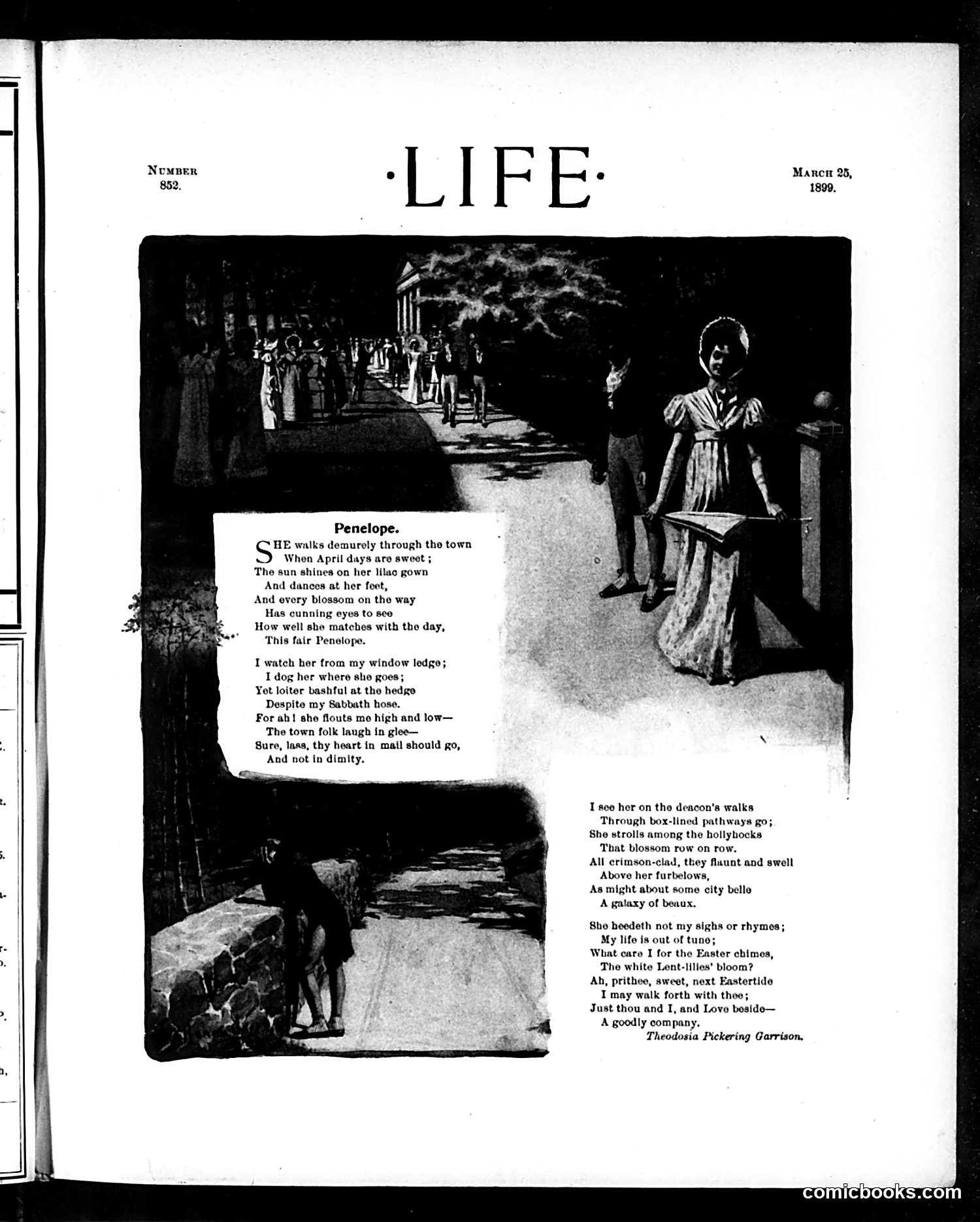
This page presents a romantic poem titled "Penelope" with accompanying illustrations of a young woman in a town setting. The poem is credited to Theodosia Pickering Garrison. The satire here appears gentle rather than political. The text ironically contrasts the speaker's idealized view of "fair Penelope"—whom he watches adoringly from afar, noting her beauty and grace—with her apparent indifference to him and his "Sabbath hose." The final lines reveal the joke: she "heedeth not my sighs or rhymes" and his life is "out of tune," yet he hopes for future companionship. This is sentimental, humorous verse about unrequited love rather than political commentary—typical of Life's lighter, literary content from this period.
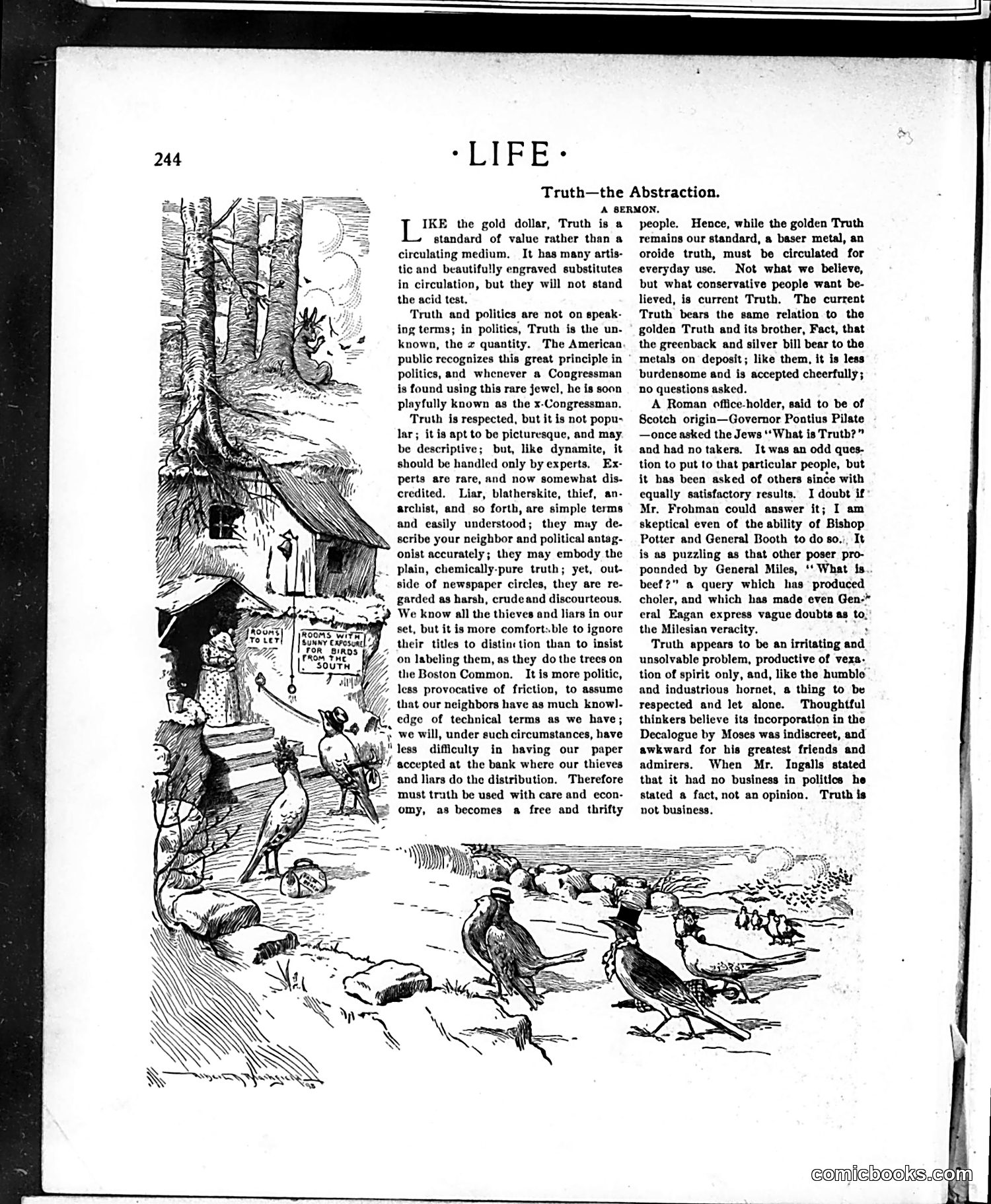
This sermon-styled piece uses the metaphor of currency to critique how truth functions in American politics and society. The author compares Truth to a gold dollar—a standard of value that circulates but isn't popular, since people prefer "baser metal" (lies that are easier to accept). The illustration depicts birds (suggesting common people or voters) near a tree with signage, likely representing the public marketplace of ideas. The sermon references specific political figures—Governor Pontius Pilate, General Miles, General Eagan, and Mr. Ingalls—though their exact disputes remain unclear from context alone. The satire's core point: Truth is inconvenient and unpopular; politicians and the public prefer comfortable falsehoods to harsh truths, making truth a poor "currency" in public discourse.
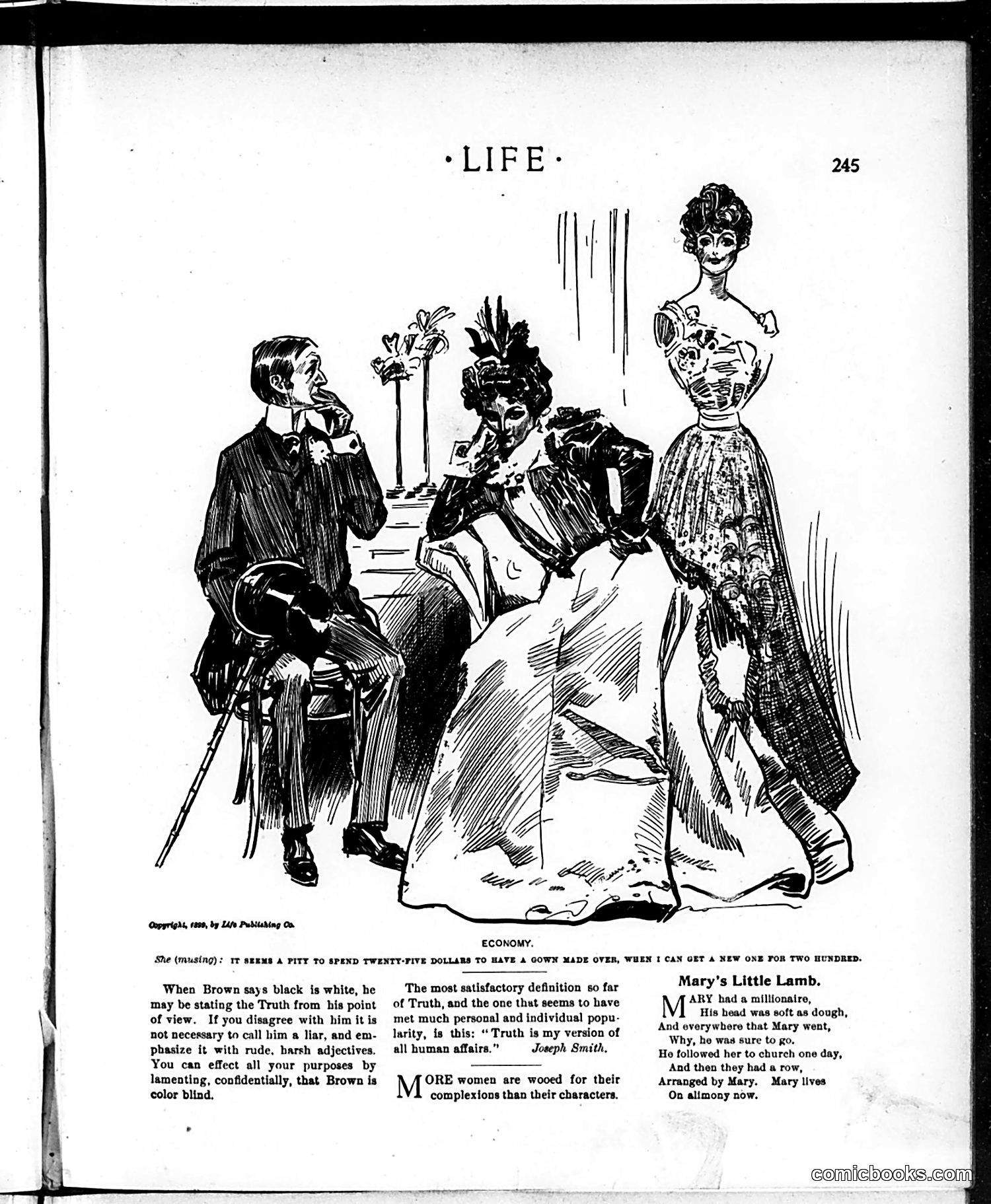
This page contains a satirical cartoon titled "ECONOMY" depicting a social scene where a woman (labeled as "missing") complains about spending $25 on a new dress when she could get a new one for $2. The cartoon mocks wealthy women's wasteful spending habits and their disconnect from economic reality. Below the cartoon are brief essays on truth and character, followed by "Mary's Little Lamb"—a humorous rewritten version of the classic nursery rhyme suggesting the lamb now lives "on alimony," likely satirizing modern divorce and women's financial independence. The overall theme critiques upper-class women's extravagance and changing social attitudes toward marriage and economics in the early 20th century.
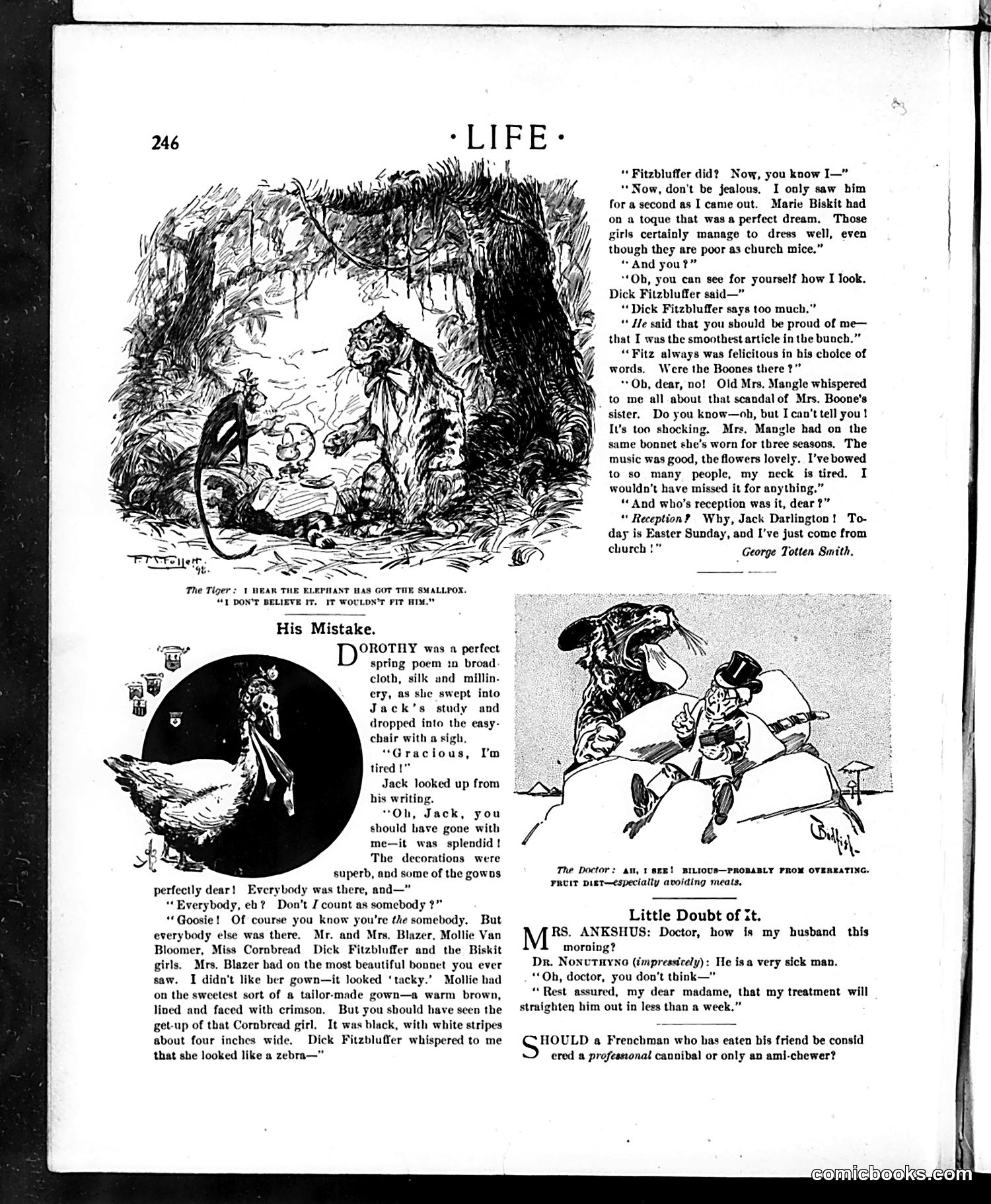
This page contains three separate humorous items rather than unified political commentary: 1. **"The Tiger"** illustration shows an elephant and tiger in a hollow tree, with the tiger claiming to have caught a smallpox victim—a joke about the elephant's gullibility. 2. **"His Mistake"** satirizes a society woman named Dorothy who wore an inappropriately casual gown to a formal reception on Easter Sunday. The humor mocks her fashion faux pas and social embarrassment among the upper class (mentioning attendees like "Dick Fitzbluffer" and "the Biskit girls"). 3. **"Little Doubt of It"** presents a brief comedic dialogue between a patient and doctor about treatment duration—light domestic humor. These appear to be general satirical content targeting social manners and domestic situations rather than specific political events.
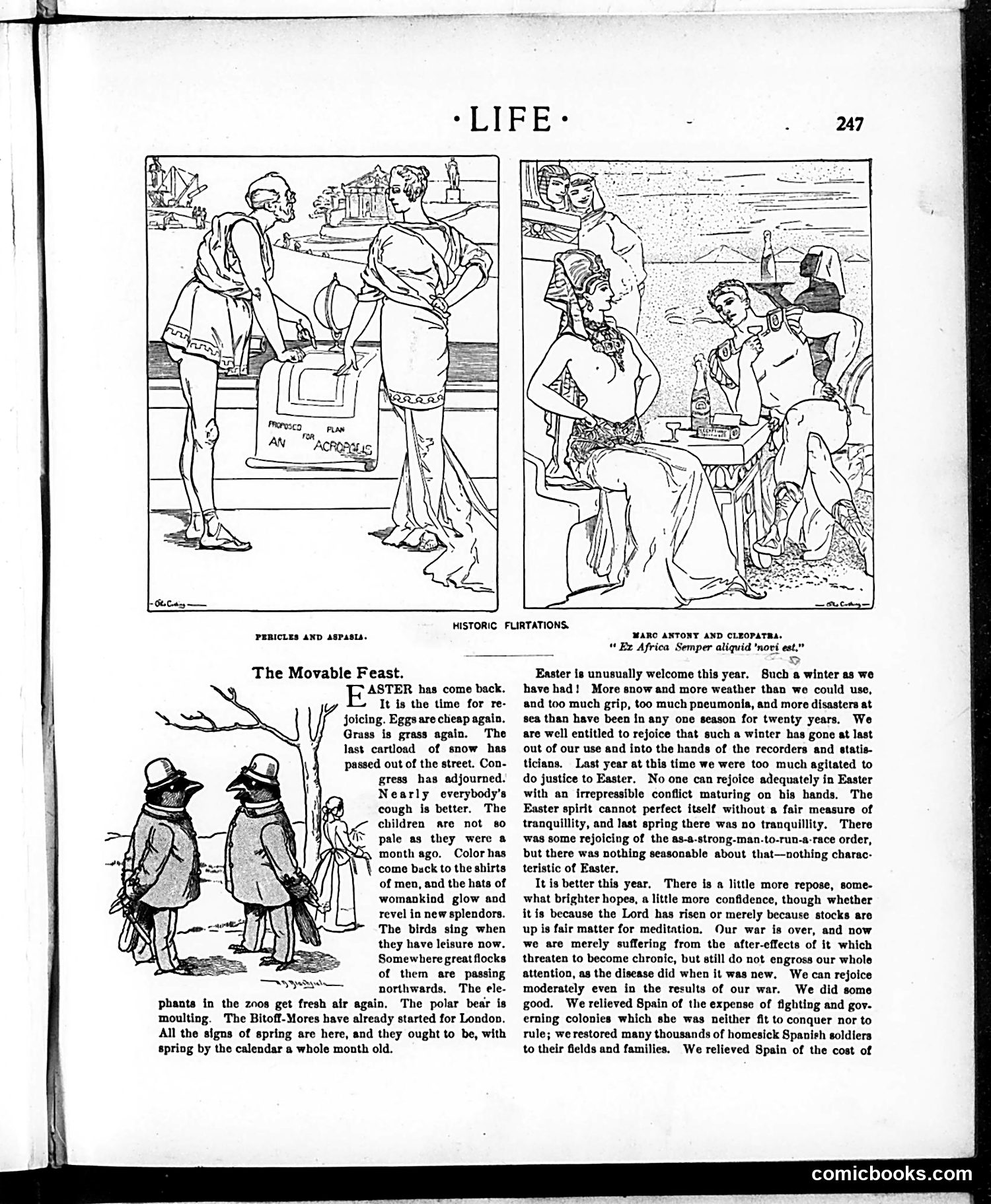
This page contains two distinct editorial cartoons and an essay titled "The Movable Feast." **Left cartoon ("Pericles and Aspasia"):** Shows two figures examining what appears to be an architectural plan labeled "An Acropolis." The satire likely mocks pretentious social climbing or ostentatious building projects among the wealthy. **Right cartoon ("Marc Antony and Cleopatra"):** Depicts figures in classical dress in a luxurious setting, referencing the famous historical romance to satirize contemporary romantic entanglements or excess among the elite. **"The Movable Feast" essay:** Discusses Easter timing and spring's arrival, noting widespread winter illness ("pneumonia") and expressing relief that the harsh season has passed. The accompanying small cartoon shows two bundled figures in snow, emphasizing winter's hardship. The page's overall theme appears to be seasonal transition and social commentary on elite behavior.
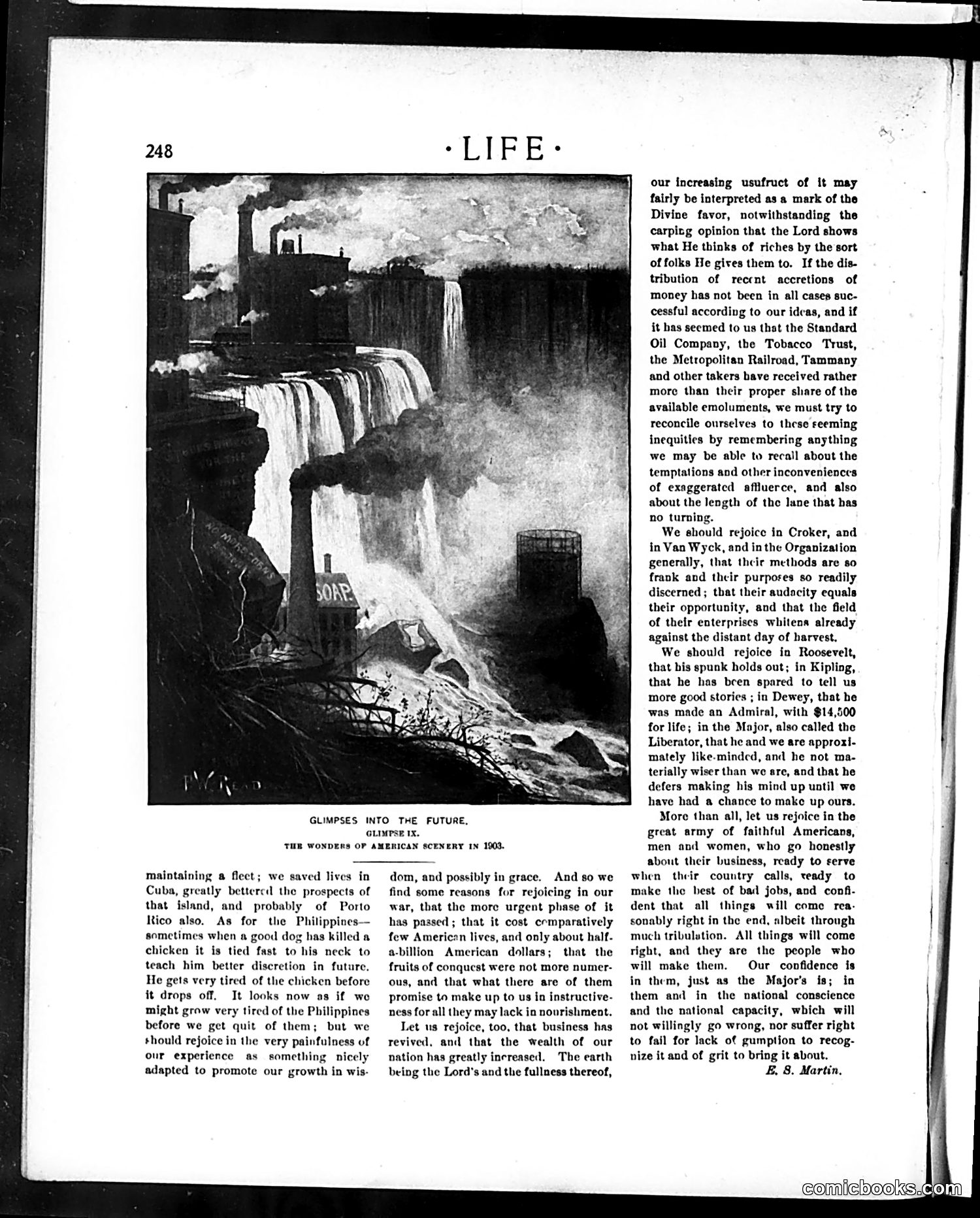
This page features an illustration titled "Glimpses into the Future: The Wonders of American Scenery in 1903," depicting Niagara Falls with industrial structures (factories, smokestacks) integrated into the landscape. The accompanying text is a satirical commentary on American wealth accumulation and business practices. The author criticizes recent financial concentrations (Standard Oil, tobacco trusts, railroads) as potentially excessive, yet ultimately optimistic about American business leaders and the nation's future prosperity. The satire is gentle—suggesting these industrial magnates' methods may be questionable, but expressing faith that America's fundamentally honest workers and leaders will ensure everything works out righteously. The illustration satirizes unbridled industrial development consuming natural wonders, while the text wraps this critique in patriotic reassurance.
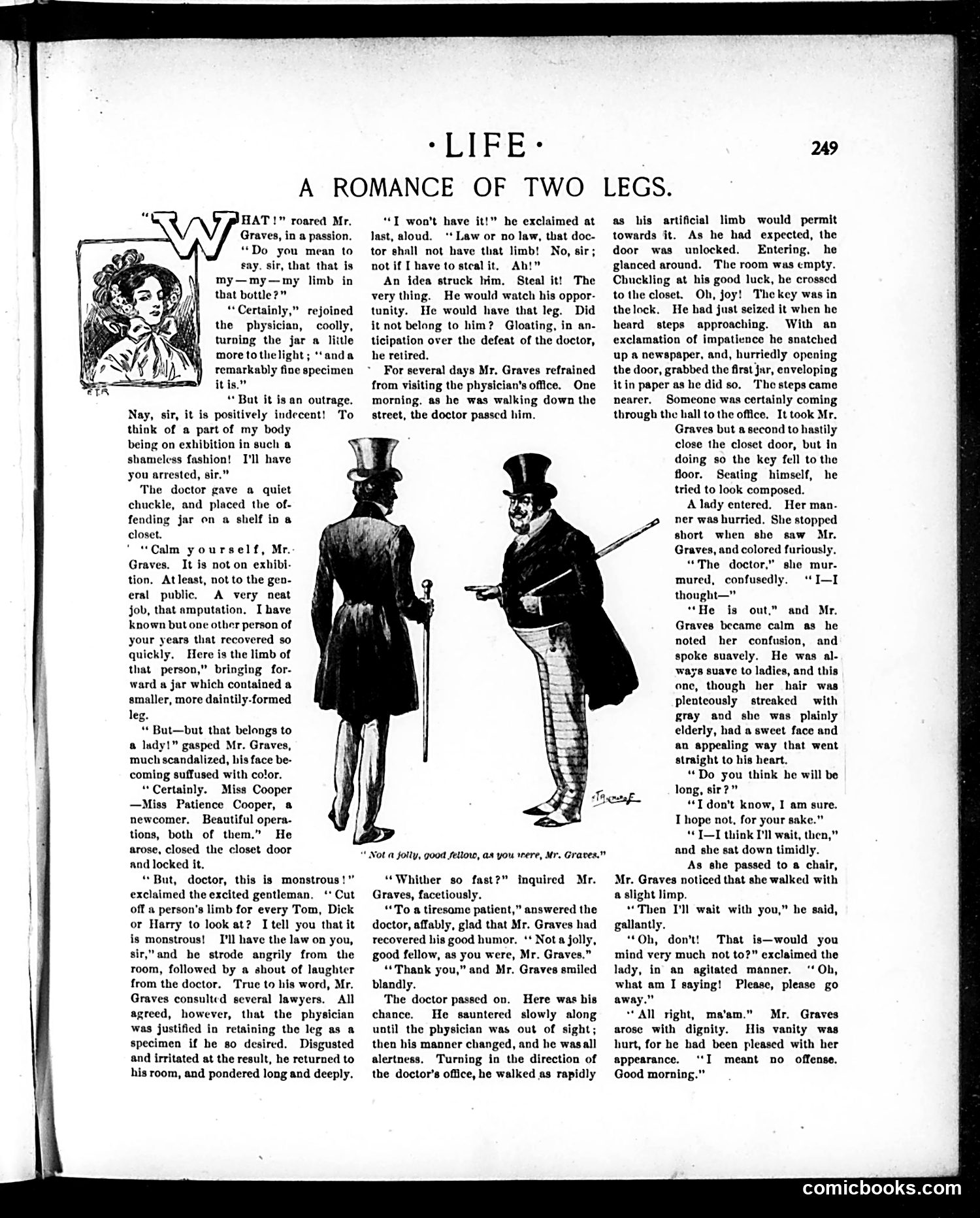
This appears to be a humorous short story about a gentleman, Mr. Graves, who consults a doctor about a prosthetic leg. The narrative satirizes Victorian-era social conventions and medical practice. The illustration shows Mr. Graves (in top hat) encountering a woman while carrying a jar containing an artificial leg—apparently hoping to pass it off as a medical curiosity rather than admit it's his own. When a lady appears, he becomes flustered, demonstrating the era's embarrassment about physical disability and bodily matters in polite company. The satire mocks both the absurdity of maintaining appearances and the social shame surrounding disability. The title's double meaning—"romance" suggesting courtship—hints at complications when the truth emerges. This reflects period attitudes toward disability as something to hide rather than acknowledge openly.
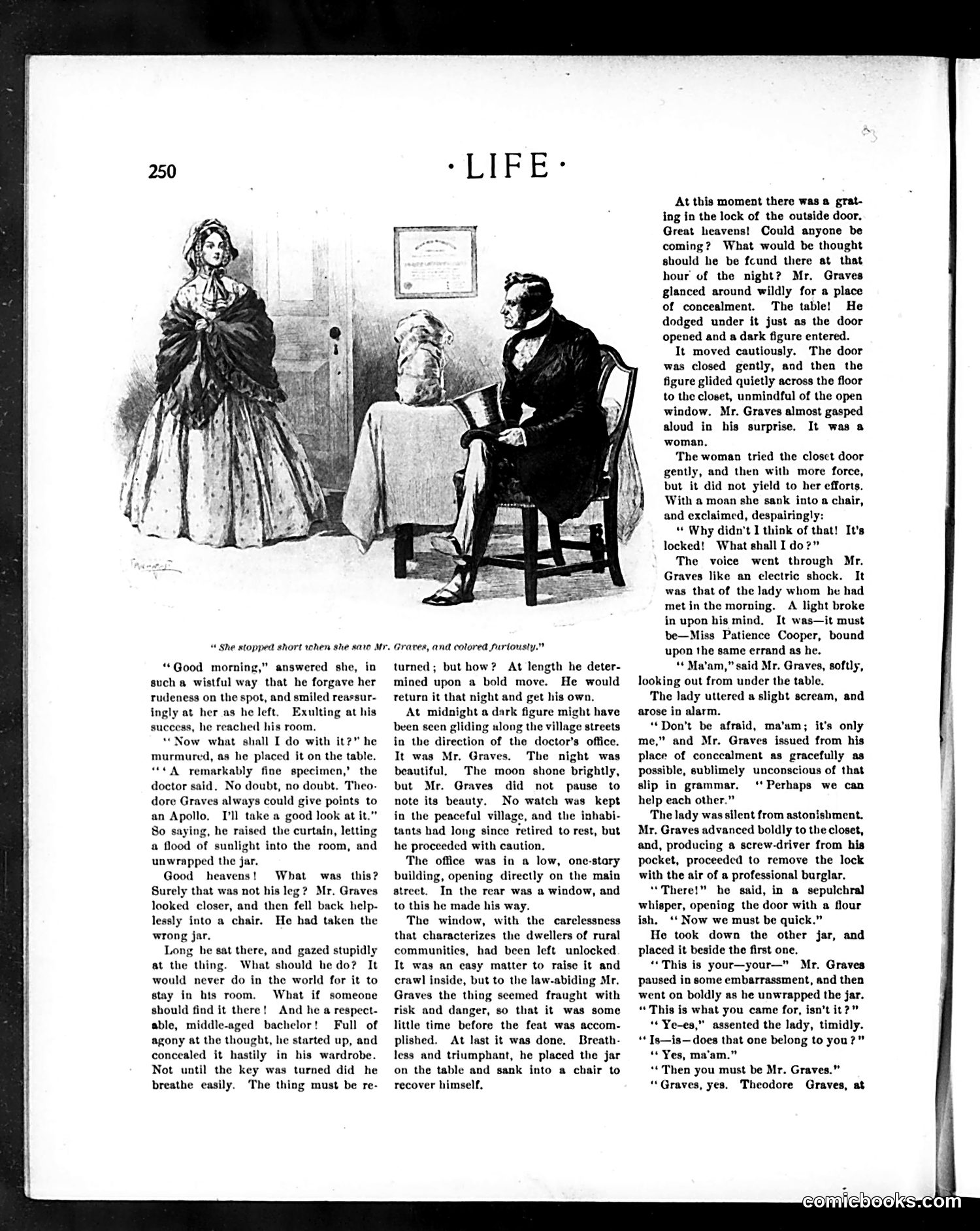
This page depicts a Victorian-era domestic comedy involving a gentleman (Mr. Graves) and a lady. The illustration shows Mr. Graves discovering an unexpected woman hiding in his closet—apparently someone he encountered earlier that day. The satire plays on Victorian propriety and social embarrassment. Mr. Graves had carelessly left his office window unlocked, allowing the mysterious woman to gain access to his home seeking refuge. The humor derives from the awkward situation: a respectable gentleman must now explain why a strange woman is emerging from his closet, risking scandal despite his innocent intentions. The narrative emphasizes the "gracefully ambiguous unconsciousness of that slip in grammar," suggesting the social complications arising from this compromising (though innocent) circumstance. This reflects Victorian-era anxieties about appearances and reputation.
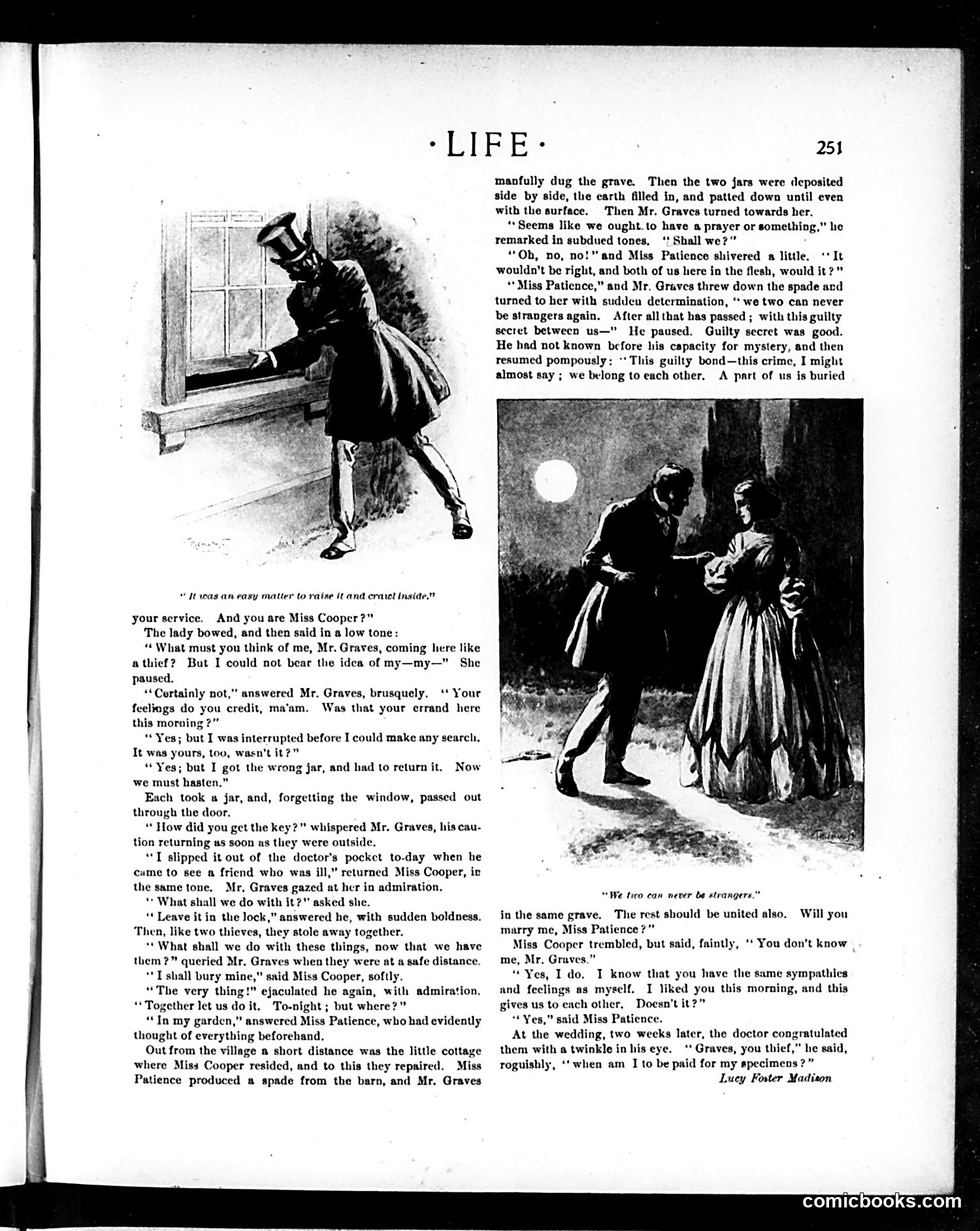
This page is primarily **narrative fiction**, not political satire. It tells a serialized story titled "LIFE" about two characters—Mr. Graves and Miss Patience (also Miss Cooper)—who appear to be involved in a romantic drama with criminal undertones. The plot involves Mr. Graves arriving at night with a suspicious errand, retrieving a jar from Miss Cooper's cottage, and the characters discussing a shared "guilty secret" that bonds them. The illustrations show: a figure at a window, and a nighttime scene with two figures conversing under moonlight. This appears to be a **melodramatic serialized story** rather than political commentary—typical of Life magazine's mixed content format combining humor, satire, and serialized fiction for entertainment purposes.
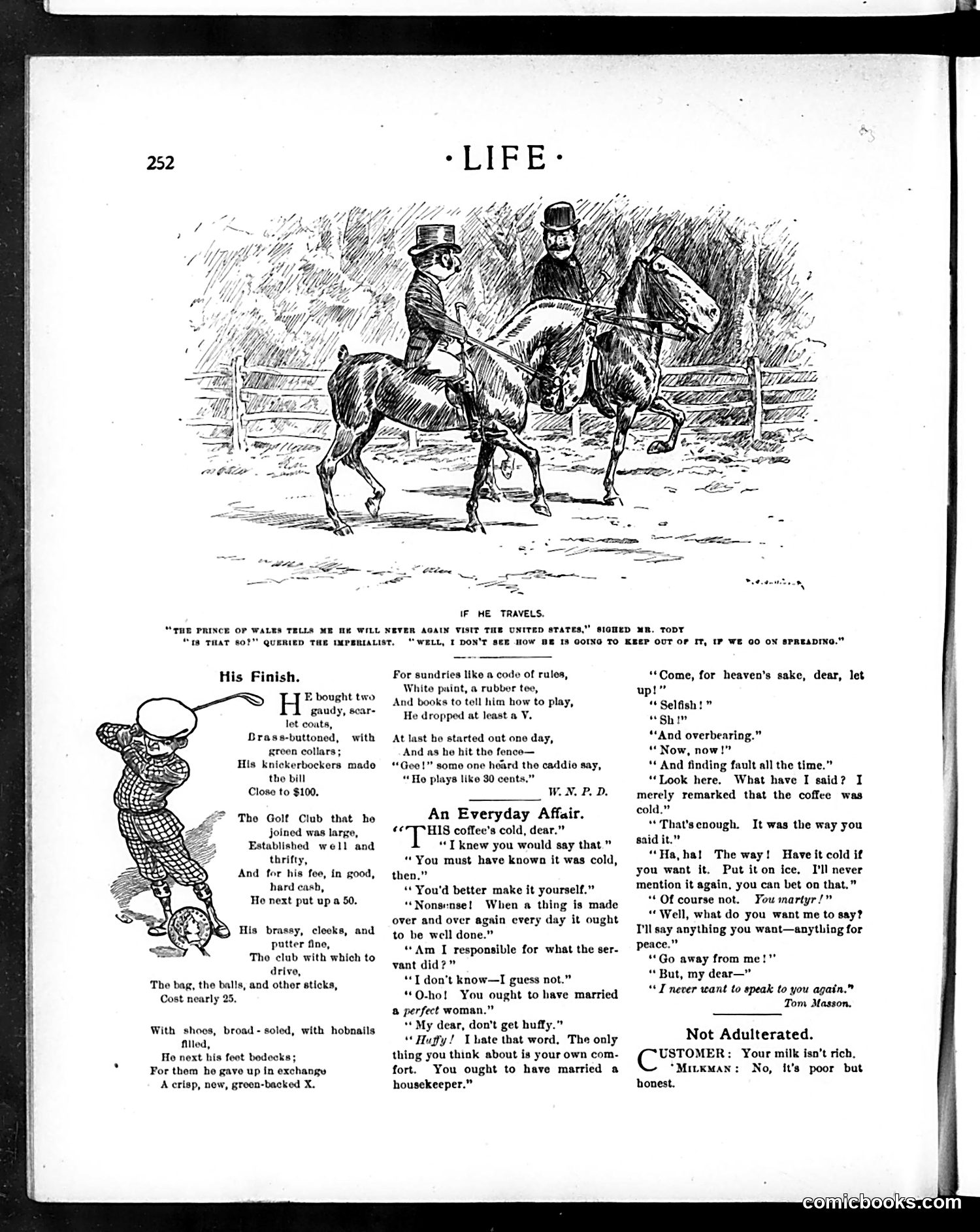
The top illustration shows two well-dressed men on horseback in what appears to be a rural setting. The caption references the Prince of Wales claiming he'll never visit the United States again, with dialogue about "spreading" suggesting political tension—likely relating to early 20th-century Anglo-American relations. Below are three satirical pieces: "His Finish" (a golf joke about expensive equipment), "An Everyday Affair" (a domestic argument about cold coffee and marriage expectations), and "Not Adulterated" (a brief joke about milk purity). The content reflects Life magazine's typical format: mixing political commentary with social humor about gender relations, consumerism, and domestic life. The specific Prince of Wales reference suggests this is pre-WWI era satire.
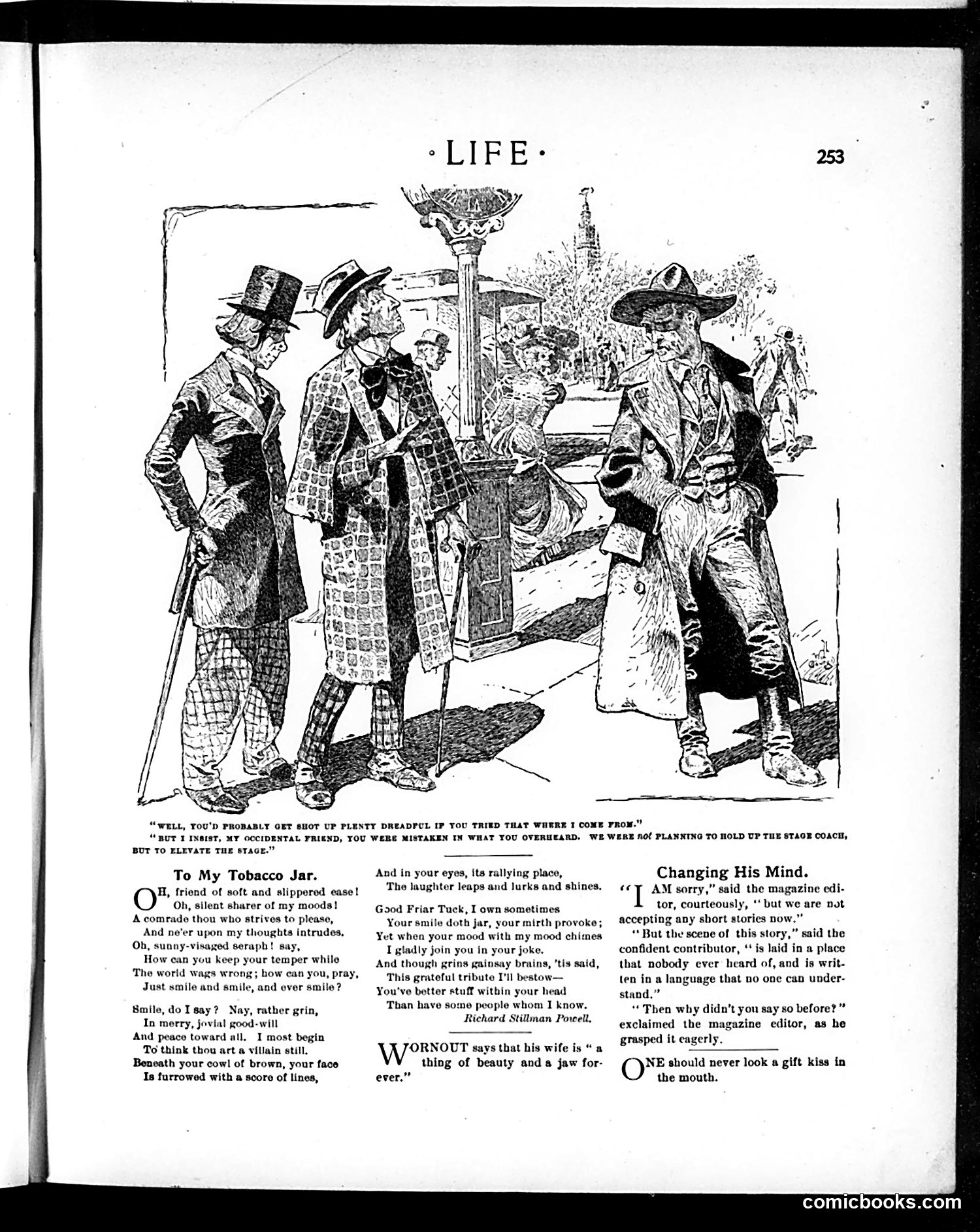
This page contains three distinct satirical pieces: **Top Cartoon:** Shows two men in period dress (appearing to be from different cultures—one Western, one Asian) discussing a misunderstanding. The joke plays on cultural conflict: the Western man warns that where he's from, you'd "get shot up plenty dreadful" for the behavior the Asian man witnessed. The satire mocks both the threat of Western violence and the attempt to suppress uncomfortable truths through intimidation. **"To My Tobacco Jar":** A humorous poem personifying a tobacco jar as a loyal, grinning companion—suggesting the comfort and solace smoking provides. It's lighthearted domestic verse about a smoker's relationship with his habit. **"Changing His Mind":** A brief joke about a magazine editor who initially rejects a story but immediately accepts it upon learning it's set in an unknown place and written in an incomprehensible language. The satire targets editorial pretension and the publishing industry's willingness to accept anything if it sounds sufficiently exotic or obscure. The minor aphorisms ("One should never look a gift kiss in the mouth," "Wornout says...") are filler jokes typical of the era's magazine format.
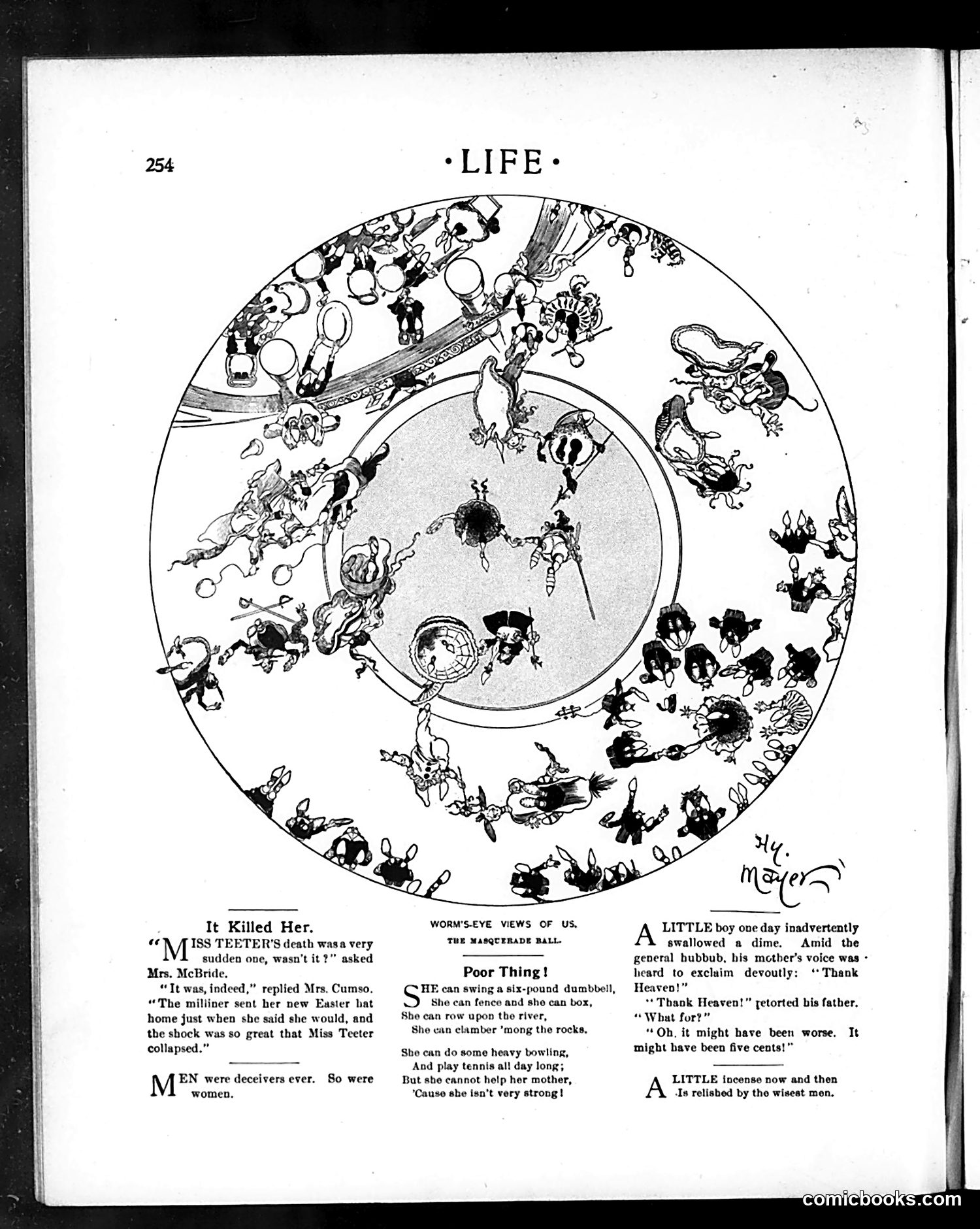
This satirical page contains three separate jokes targeting gender roles and social hypocrisy of the era (appears to be early 20th century): 1. **"It Killed Her"**: Mocks women's vanity—Miss Teeter dies of shock when a milliner *actually* delivers on time, subverting the expectation of tardiness. 2. **"Worm's-Eye Views"**: The central cartoon criticizes the contradiction of "New Woman" athleticism. A woman can swing dumbbells, fence, row, and play tennis all day—yet claims she's "not very strong" when asked to help her mother with housework. It satirizes selective weakness and the rejection of traditional domestic duties despite physical capability. 3. **"A Little Boy"**: A joke about parental priorities—a mother thanks Heaven her son swallowed a dime rather than five cents, prioritizing monetary loss over her child's welfare. The page's closing aphorism endorses "incense" (flattery/deception) as wise. Overall, the humor targets women's contradictions, vanity, and shifting social roles during a period of changing gender expectations.
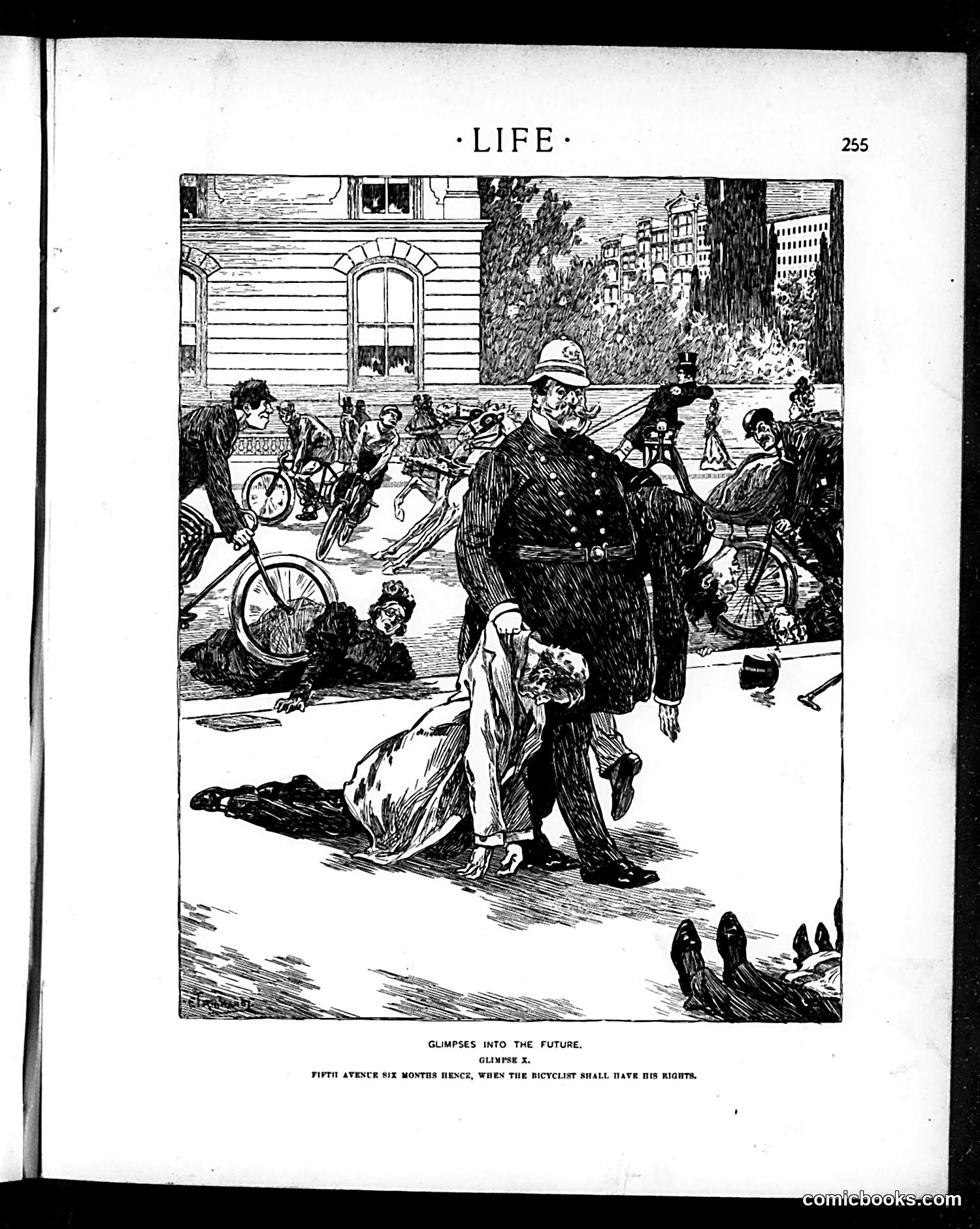
This cartoon satirizes anxieties about bicycles and urban space in late 19th-century America. It depicts a chaotic Fifth Avenue scene where cyclists dominate the street, forcing pedestrians—including a well-dressed man and woman—into danger or subordinate positions. The title promises a "glimpse into the future" when "the bicyclist shall have his rights," suggesting the artist fears bicycles will overtake city streets and displace traditional users. The cartoon mocks both bicycle enthusiasts' growing demands for road access and middle-class anxieties about social disruption. The fashionable pedestrians appear endangered by the bicycle invasion, reflecting contemporary concerns that this new technology would upend established urban hierarchies and safety norms.
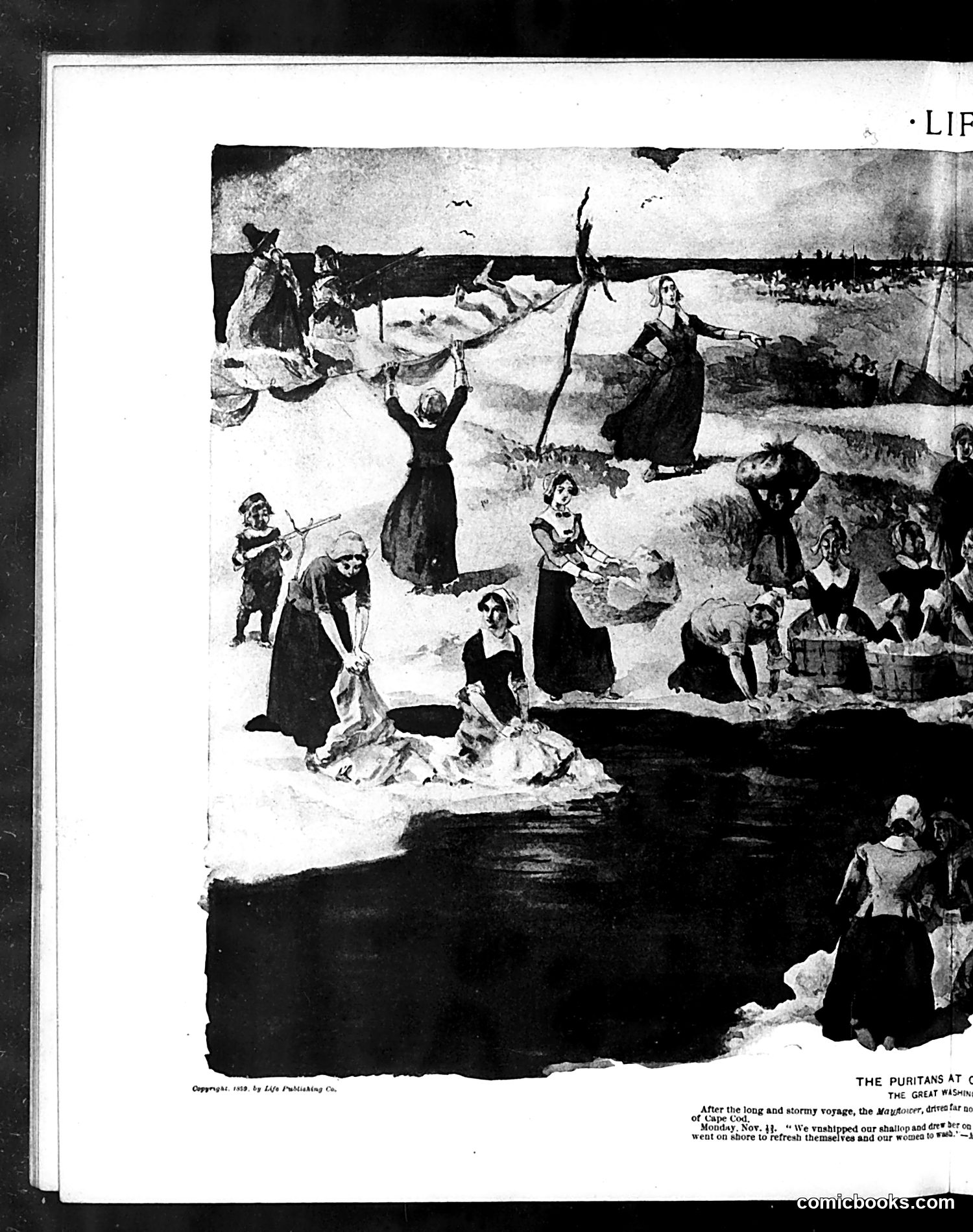
This is a historical illustration titled "The Puritans at [the Great Washing]" (copyright 1939), depicting the Mayflower's arrival and the Pilgrims' early settlement activities. The image shows colonial-era figures engaged in practical tasks—washing clothes, preparing food, and managing daily camp life by a shoreline. The satire likely plays on the romanticized myth of the Pilgrims as purely spiritual pioneers, contrasting this with the mundane reality of their voyage: exhausted travelers attending to laundry and basic survival needs rather than noble ideals. The quoted text emphasizes domestic necessities ("washed our shallop and dre#" and "refresh themselves"), reinforcing this humorous deflation of the Puritan legend. This was a common 1930s Life magazine approach—using historical scenes to gently mock American mythology through practical detail.
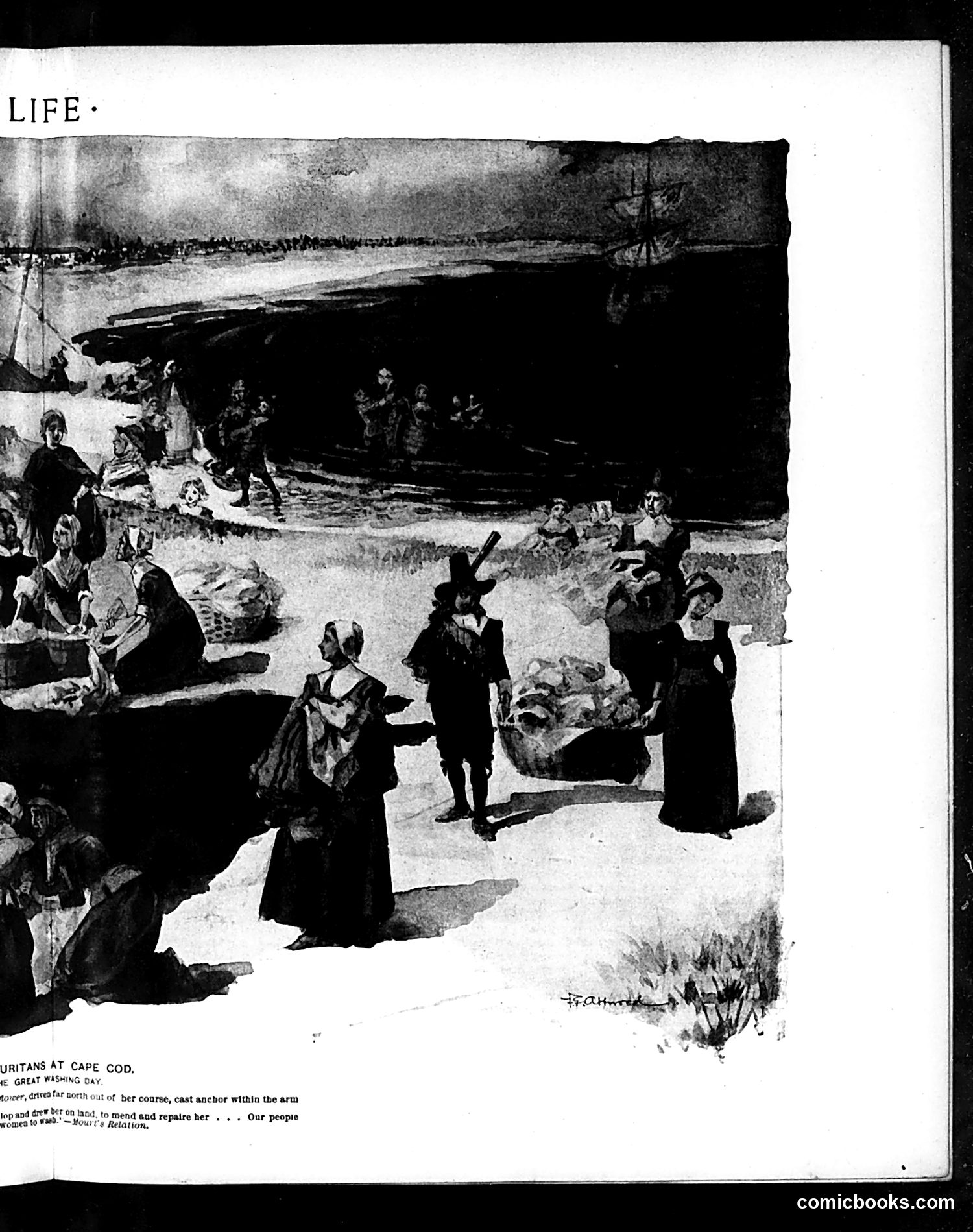
This illustration depicts Puritans at Cape Cod during "the Great Washing Day," referencing an early colonial historical account. The image shows period-dressed figures engaged in laundry work near the shore, with ships visible in the background. The caption quotes a historical relation describing how a ship was "driven far north out of her course" and cast anchor to allow crew to "mend and repaire her," while "our people women to Wald"—likely referring to women going ashore for washing. The satire appears to celebrate or humorously depict the resourcefulness and domestic labor of Puritan settlers, possibly contrasting their practical concerns (ship repair, laundry) with their religious reputation. The artist's signature appears lower right.
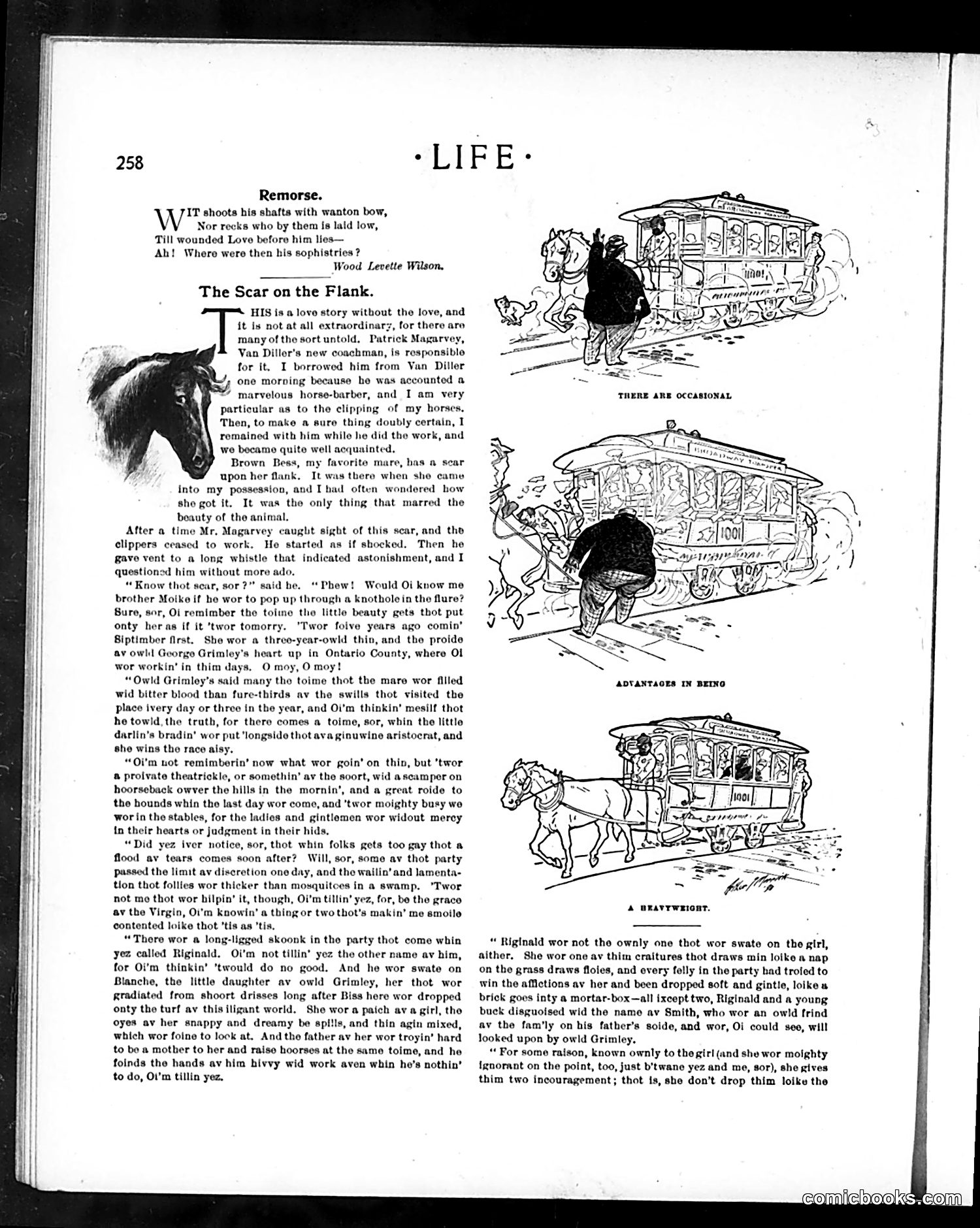
This page contains two pieces of satirical content: **"Remorse"** (top): A brief poem by Wood Levette Wilson mocking romantic hypocrisy—specifically men who pursue women recklessly ("shoots his shafts with wanton bow") but lose their rhetorical sophistication ("sophistries") when confronted with the emotional consequences of their actions. **"The Scar on the Flank"** (main text): A lengthy Irish-dialect anecdote narrated by a coachman named Magarvey about a horse mare's scar. The story functions as a morality tale: a woman named Blanche from Ontario County becomes romantically entangled with an aristocratic man named Reginald during an elaborate house party. The mare's scar allegedly resulted from this romantic drama—suggesting consequences for female virtue and social transgression. The satirical angle appears to target both the pretensions of aristocratic romance and working-class Irish servants' gossipy commentary on their employers' moral failings. The three accompanying cartoon illustrations show horse-drawn carriages, labeled to emphasize both comedic and practical aspects of transportation.
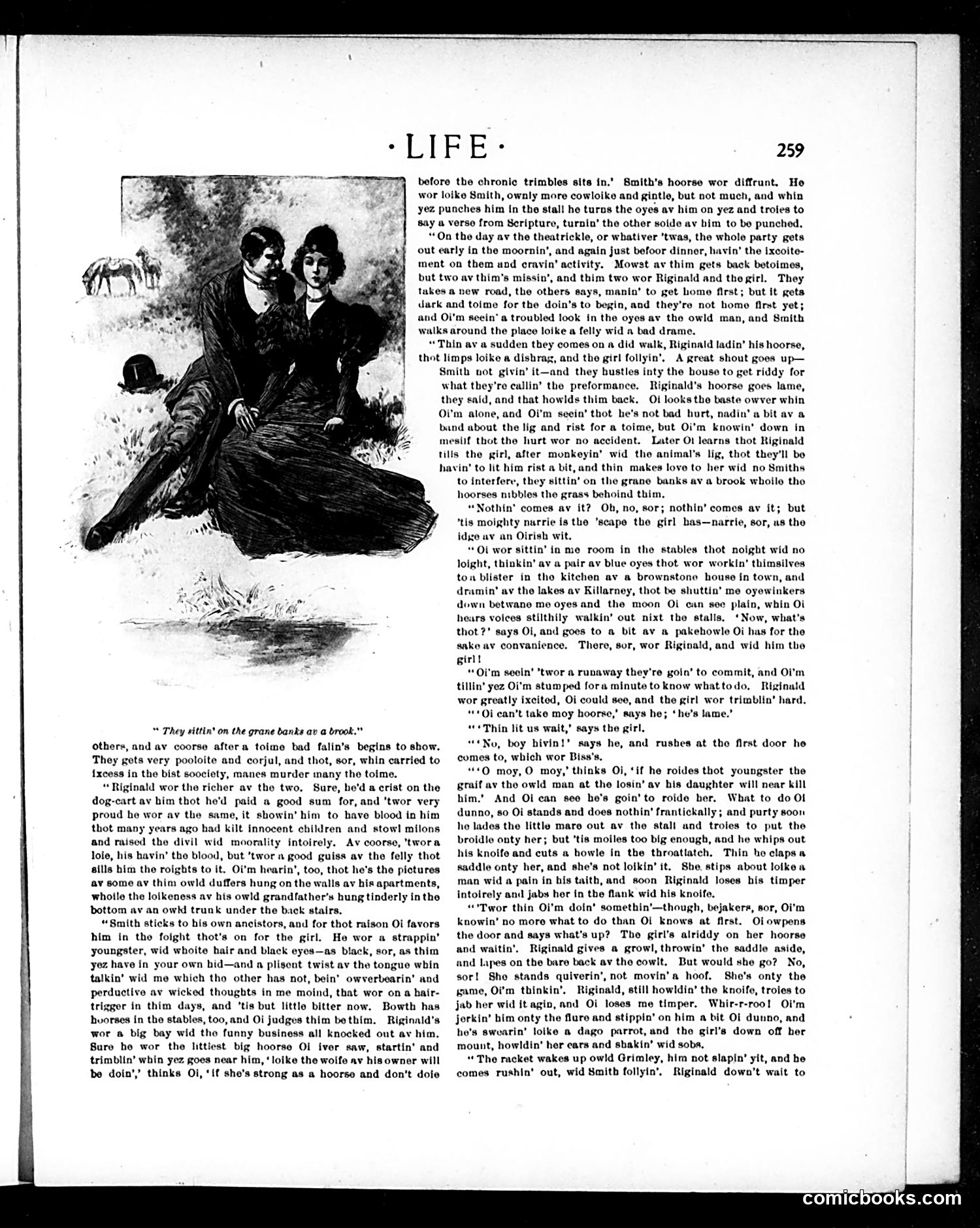
This page presents an Irish-dialect story (likely by a regular Life contributor) mocking class pretension and romantic deception among the wealthy. The narrative, told by what appears to be a working-class Irish stable hand narrator, describes how a wealthy young man named Reginald deliberately lames his horse to create an excuse for a tryst with a girl away from her protective father (Smith). The stable hand discovers the deception. The satire targets **nouveau riche affectation**: Reginald flaunts his wealth through heraldic crests on his dog-cart and displays of aristocratic ancestry, yet behaves dishonorably. Meanwhile, honest Smith—presumably of humbler background—maintains genuine moral integrity. The joke relies on the period's common *Irish servant narrator* stereotype (heavy dialect, shrewd observation) exposing hypocrisy among the upper classes. The illustration shows the stable hand and principals in a rural setting, emphasizing the contrast between genteel pretense and working-class candor.
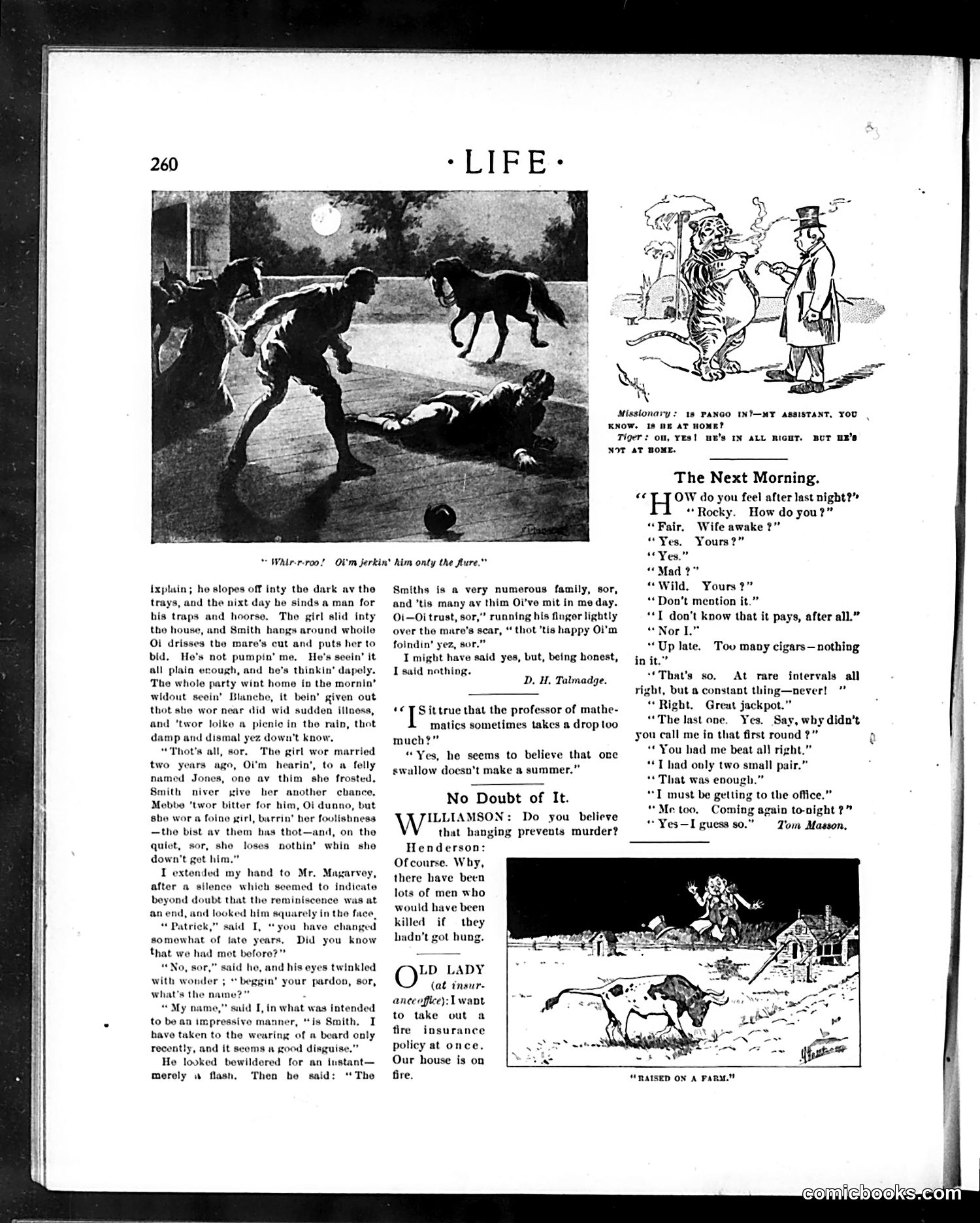
This page contains several unrelated humorous pieces typical of *Life* magazine's satirical format: **Main story (left)**: A lengthy Irish-dialect narrative by D.H. Talmadge about a man named Smith who encounters an old acquaintance (Patrick Magarvey) years later, now disguised by a beard. The story involves romantic drama from their past involving a girl named Blanche. The humor relies on Irish vernacular and the ironic twist that Magarvey doesn't recognize Smith despite their shared history. **Top right cartoon**: A missionary and tiger joke playing on the phrase "at home"—the tiger claims the assistant isn't home, creating absurdist humor. **"No Doubt of It"**: A brief joke about capital punishment's supposed deterrent effect, where Henderson argues that executed men couldn't commit murder, an absurd logical fallacy presented as wit. **"The Next Morning"**: A married couple's dialogue about a late night of cards and cigars—depicting domestic routine with mild self-deprecating humor about hangovers and excessive smoking. **Bottom right illustration**: Captioned "Raised on a Farm," showing rural life. The page reflects early 20th-century *Life* style: conversational humor, dialect comedy, and domestic observation.
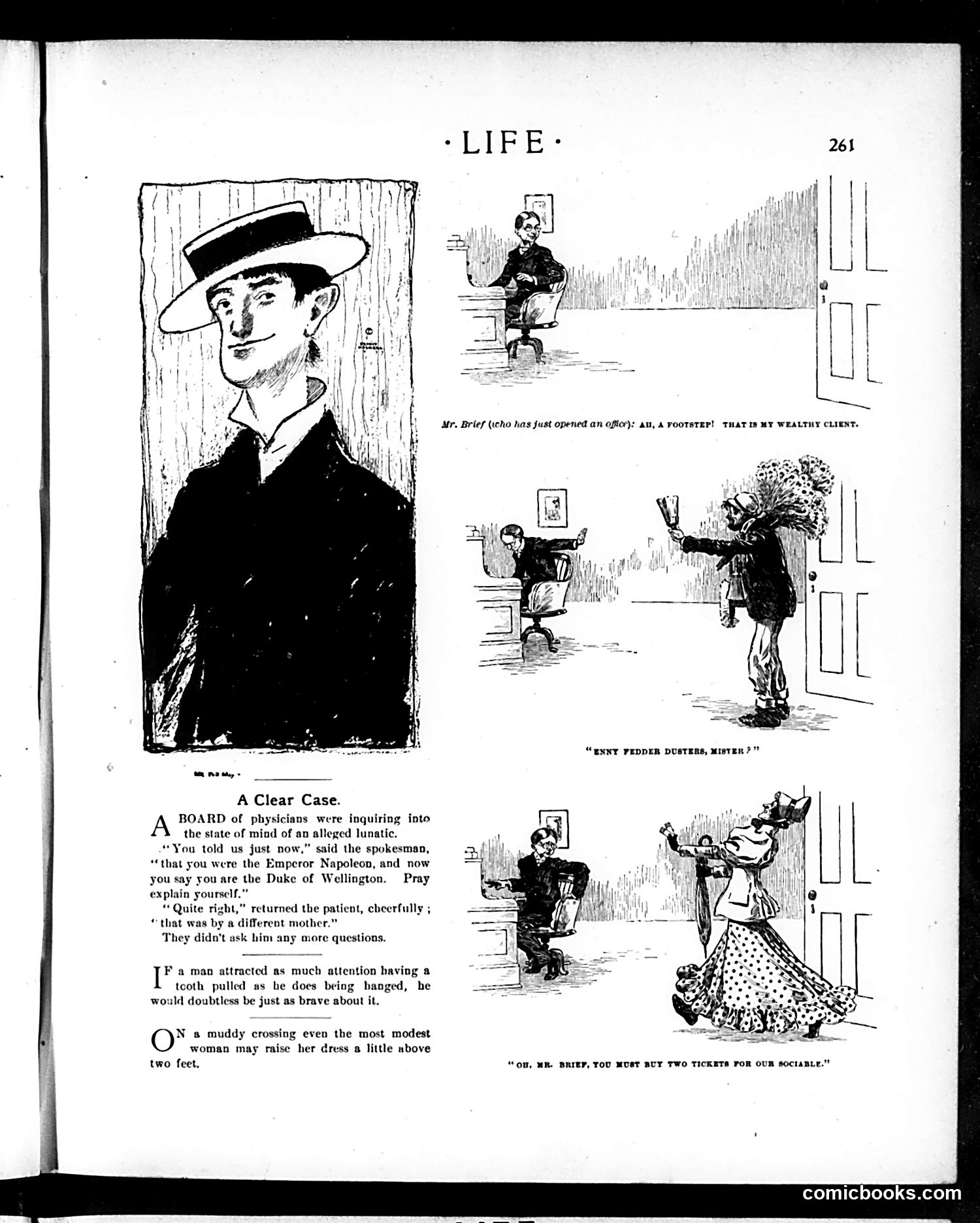
This page contains three separate humor pieces: **Main cartoon**: A lunatic claims to be both Emperor Napoleon and the Duke of Wellington. When questioned about this contradiction, he says "that was by a different mother"—implying he had different parentage for each identity. The physicians give up questioning him, treating his absurd logic as unarguable. The joke satirizes both the patient's circular reasoning and the physicians' helplessness in the face of it. **Side cartoons**: Street scenes showing Mr. Brief, a newly opened office owner, being importuned by a woman to buy two tickets to a "sociable" (likely a social event/fundraiser). The humor derives from his vulnerability as a newcomer being immediately solicited. **Bottom text fragments** offer brief observational humor about human nature—comparing bravery during tooth extraction to bravery during hanging, and noting that modesty has practical limits when crossing muddy streets. These are typical early-20th-century satirical vignettes mixing social commentary with absurdist humor.
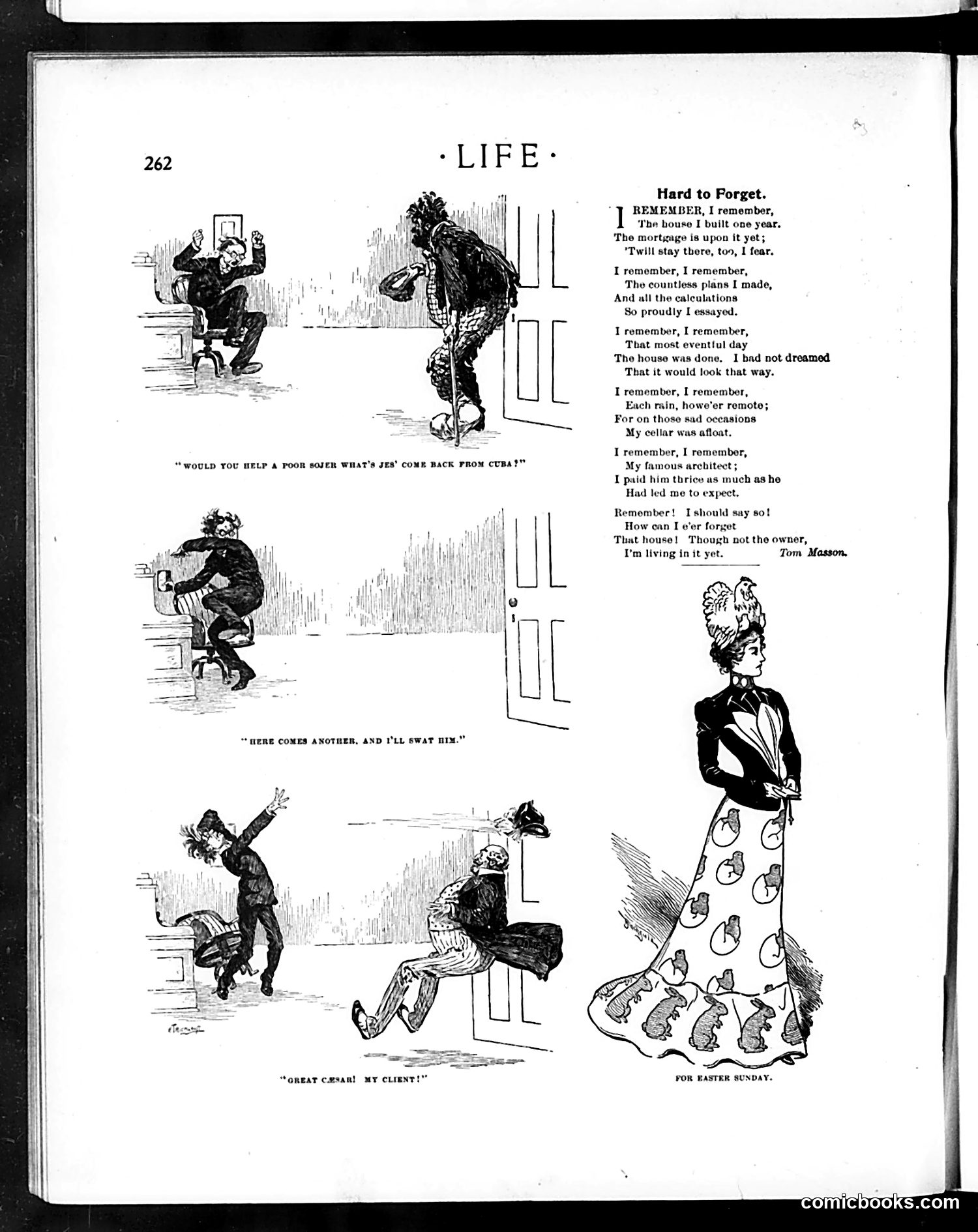
This page satirizes the miseries of homeownership through comic illustrations and a melancholic poem. The cartoons show a man repeatedly discovering problems with his newly built house—pest invasions ("Would you help a poor sewer what's jes' come back from Cuba?"), structural failures, and unwelcome visitors. The poem, attributed to Tom Masson, chronicles a homeowner's regrets: the endless mortgage, the architect's inflated fees (paid three times the quoted price), unexpected construction flaws, water damage in the cellar during rains, and the cruel irony of renting the house to tenants while he himself must live elsewhere due to financial strain. The Easter Sunday illustration of a woman in a decorative dress appears unrelated—likely a seasonal fashion feature. The satire targets the gap between homeownership dreams and disappointing reality, particularly the dishonest contractor/architect who overcharges and underperforms—a timeless complaint.
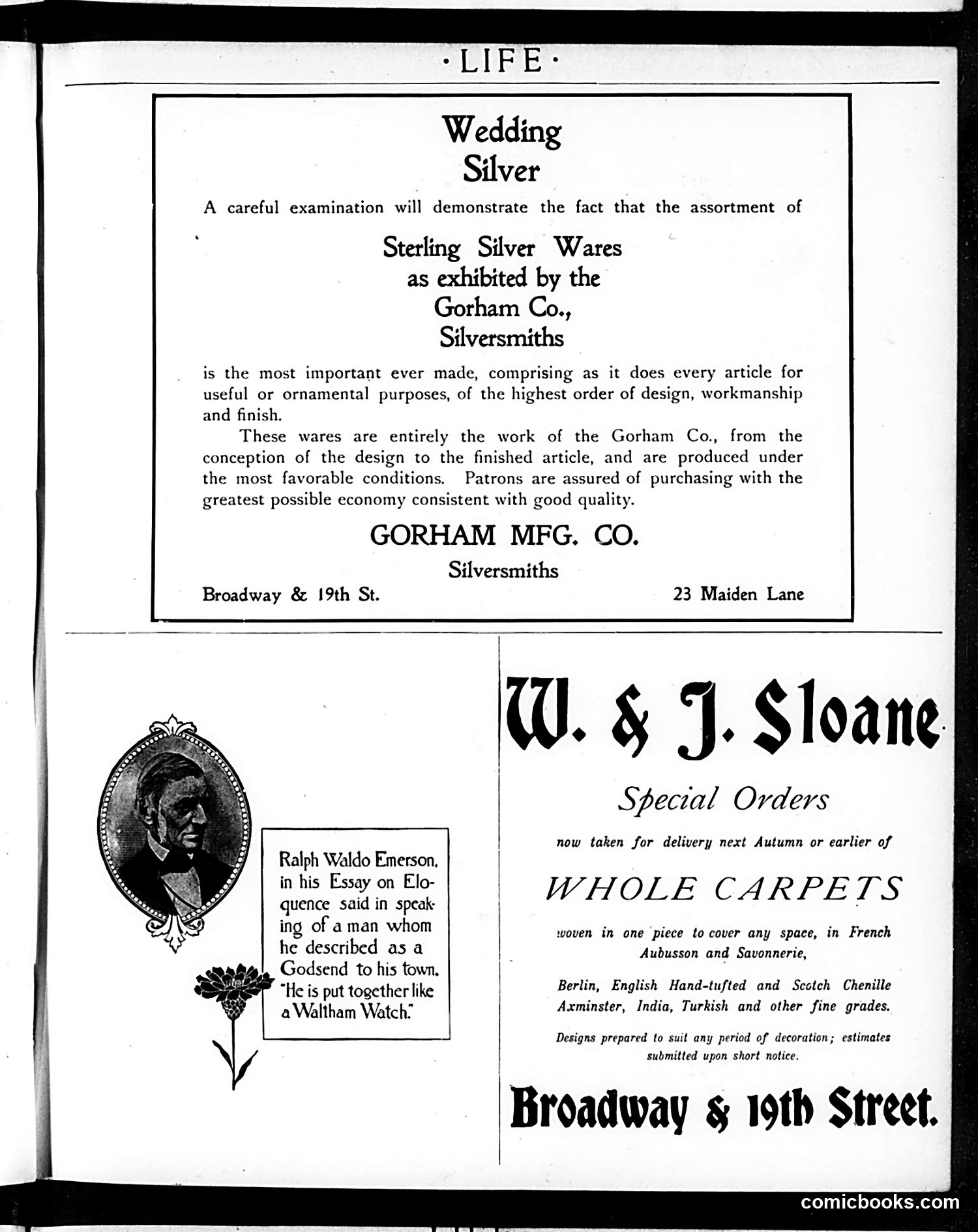
This page is primarily **advertising**, not satire or political commentary. It contains three luxury product advertisements typical of early 20th-century Life magazine. The **Gorham Co.** advertisement promotes sterling silver wares for weddings. The **W. & J. Sloane** ad offers custom whole carpets in various styles (French, English, Turkish, etc.). The only cartoon element is a portrait medallion of **Ralph Waldo Emerson** accompanying a quote about a man being "put together like a Waltham Watch"—presumably praising precision and reliability. This serves as indirect advertising for Waltham Watch quality, implying that well-made goods are dependable. There is **no political satire** on this page. It reflects the lifestyle aspirations of wealthy Americans circa 1900s-1910s, targeting affluent consumers shopping for fine home goods and furnishings. The Emerson reference was simply a cultural appeal to taste and excellence.
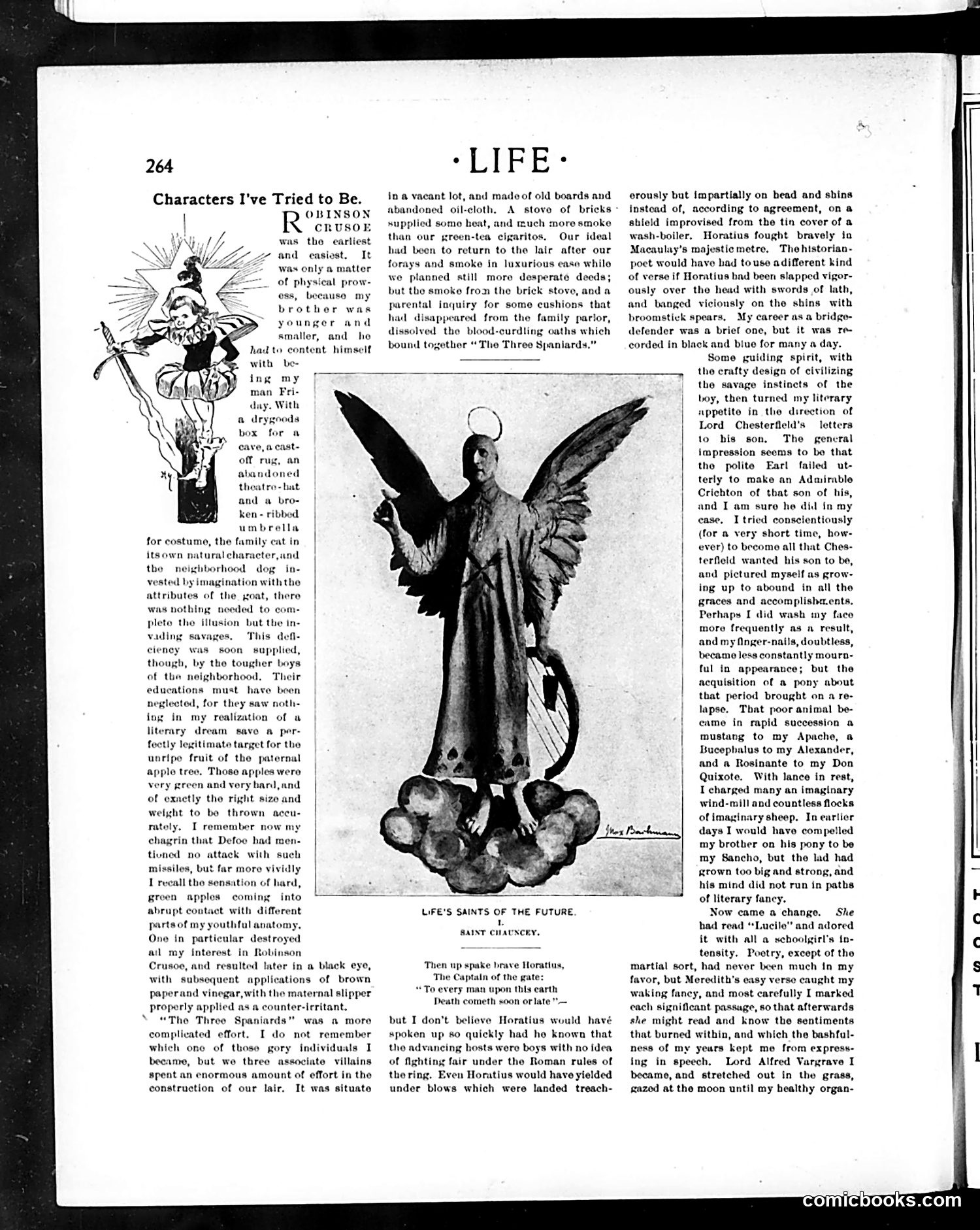
This page from *Life* magazine describes the author's childhood attempts to recreate literary characters through imaginative play. The main text recounts failed efforts to emulate **Robinson Crusoe**, **"The Three Spaniards"** (likely from adventure fiction), and **Horatius** (from Macaulay's famous poem about Roman heroism). The satire lies in the gap between romantic literary ideals and messy reality: a backyard fort made from scrap materials, neighborhood boys attacking with green apples, a borrowed dog and cat substituting for exotic animals, and physical punishment rather than heroic combat. The accompanying illustration labeled "Life's Saints of the Future: Saint Chauncey" appears to mock the author's pretensions—depicting an angelic, ethereal figure that contrasts sharply with the actual scrappy, bruised child described in the text. The piece gently mocks both children's literary escapism and the sentimental idealization of adventurous characters found in period literature.
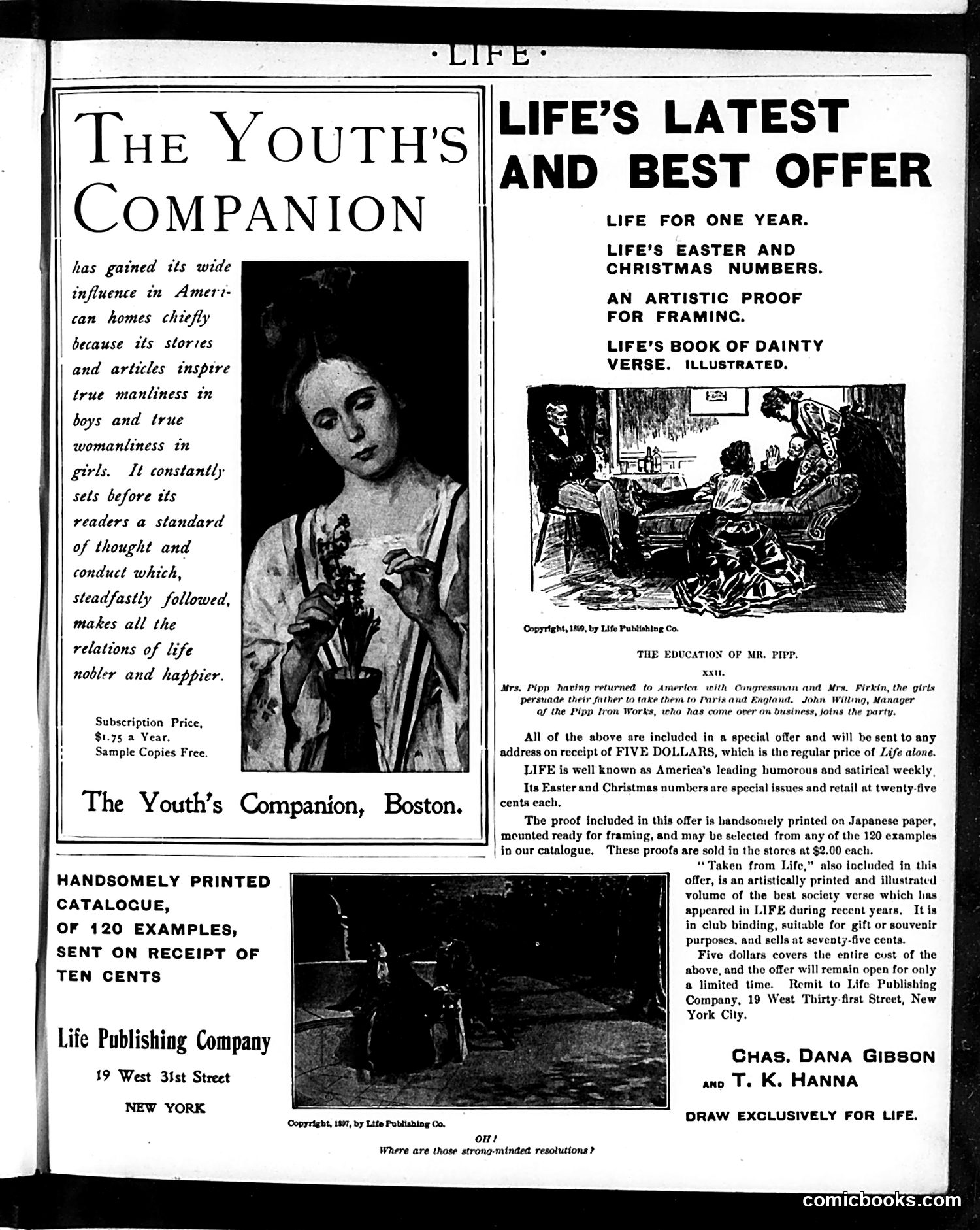
This is primarily an **advertising page** from Life magazine, not a political cartoon. It contains two subscription offers: **Left side**: Advertisement for *The Youth's Companion*, a Boston-based magazine claiming to instill "true manliness in boys and true womanliness in girls." **Right side**: Life magazine's bundled subscription offer ($5) including one year of Life, special Easter/Christmas issues, an artistic proof for framing, and a poetry collection titled "Taken from Life." The page credits illustrators **Charles Dana Gibson and T.K. Hanna** as exclusive contributors to Life. **The cartoon below** titled "The Education of Mr. Pipp" (part XXII of a serialized story) shows Mr. Pipp with his family and business associate planning a European tour to Paris and England. The caption "Where are those strong-minded resolutions?" appears to be a humorous jab—likely suggesting his travel plans contradict previous resolutions, though the specific joke requires seeing the full serial context.
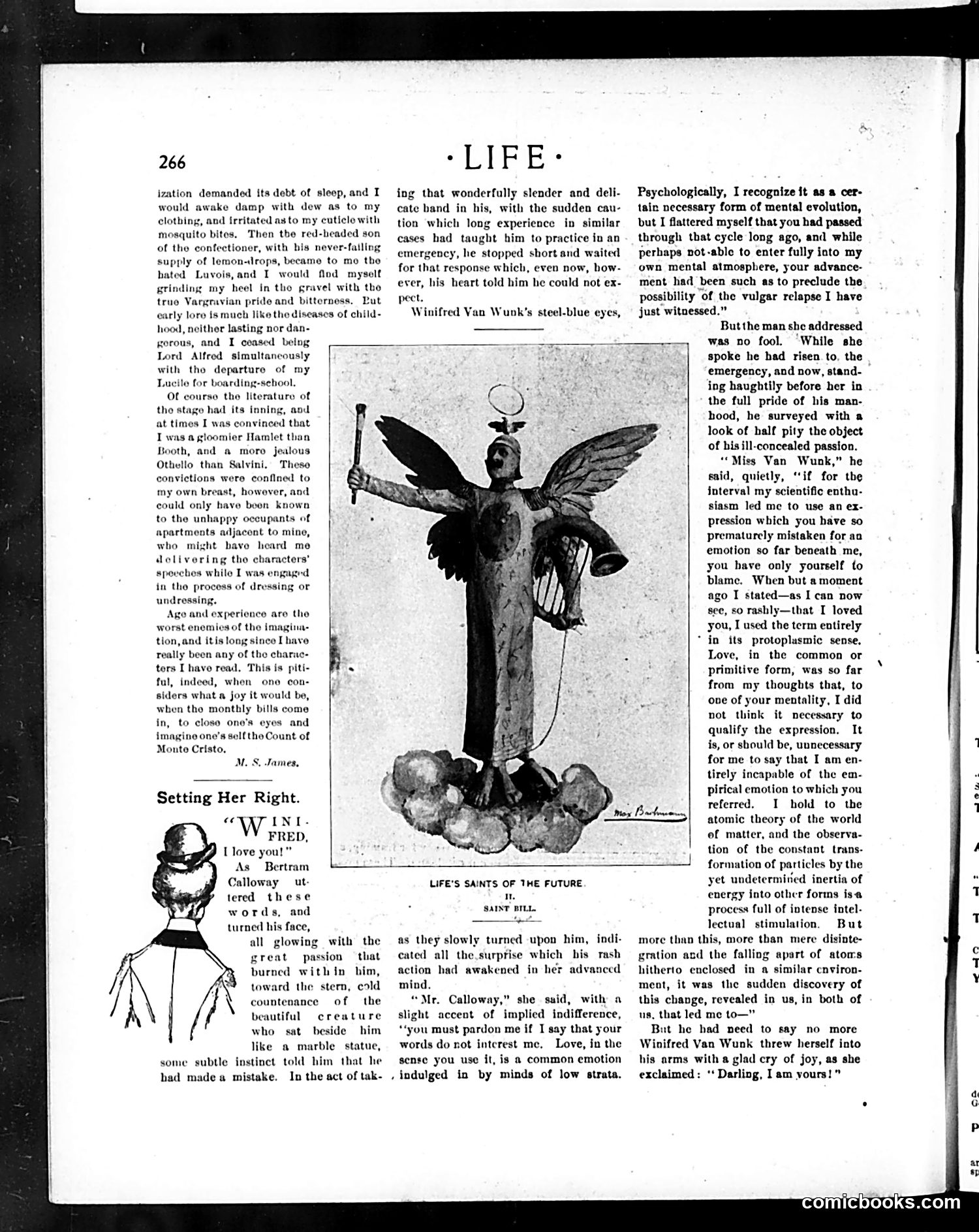
This page contains two distinct satirical pieces about romantic rejection: **"Setting Her Right"** mocks pseudo-intellectual posturing in romance. A man named Calloway attempts to escape an awkward situation—where he's just confessed love—by redefining his words through scientific jargon. He claims he meant "love" only in a "protoplasmic sense" and invokes atomic theory and evolutionary psychology to convince the woman (Miss Van Wunk) that her emotional interpretation was vulgar and beneath her intellectual station. The satire targets late Victorian/Edwardian pretension: men using pseudoscientific language to manipulate women and avoid genuine emotional commitment. The illustration shows Calloway's elaborate self-justification falling flat. The accompanying illustration **"Life's Saints of the Future: Saint Bill"** (artist signed, unclear reference) appears to depict another figure, though context is limited on this page. The overall message: beware men who weaponize intellectual language to evade sincerity.
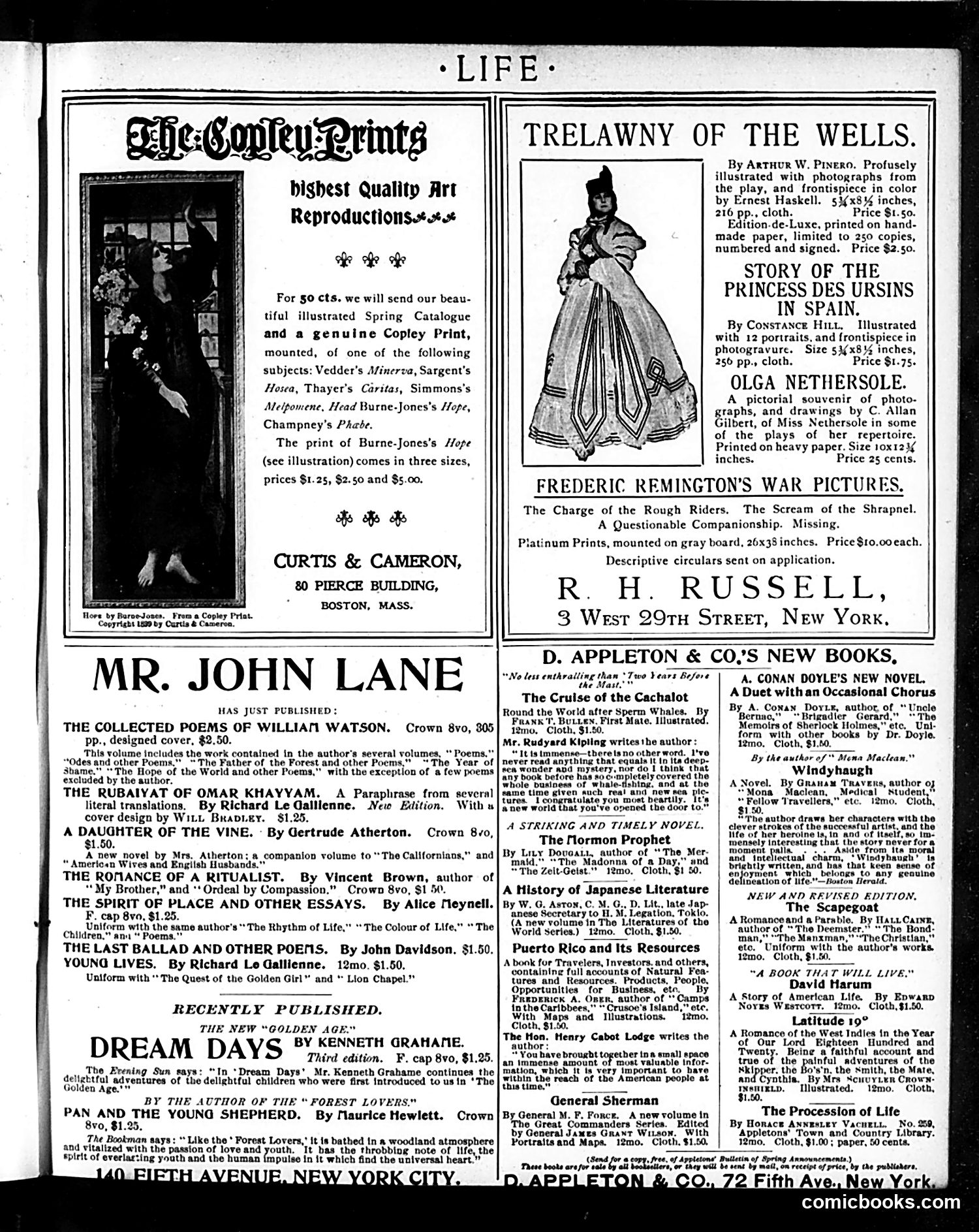
This is primarily a **book and art advertisement page** from Life magazine (circa 1899, based on the "Copyright 1899" visible). There are no political cartoons here. The page advertises: **Left side:** Curtis & Cameron art prints, featuring reproductions of classical paintings (Vedder's *Minerva*, Burne-Jones's *Hope*, etc.). A small illustration shows the *Hope* painting itself. **Center/Right:** Literary publications and theatrical materials, including Arthur Wing Pinero's *Trelawny of the Wells* (a play), and Frederic Remington's war pictures titled "The Charge of the Rough Riders" and "A Questionable Companionship. Missing"—likely referencing the Spanish-American War (1898) and Remington's famous war illustrations. **Bottom:** New books from publisher D. Appleton & Co., featuring Kenneth Grahame's *Dream Days* and works by other period authors. The page reflects turn-of-the-century consumer culture marketing fine art, theater, and literature to educated readers. The Remington titles suggest contemporary interest in the recent war.
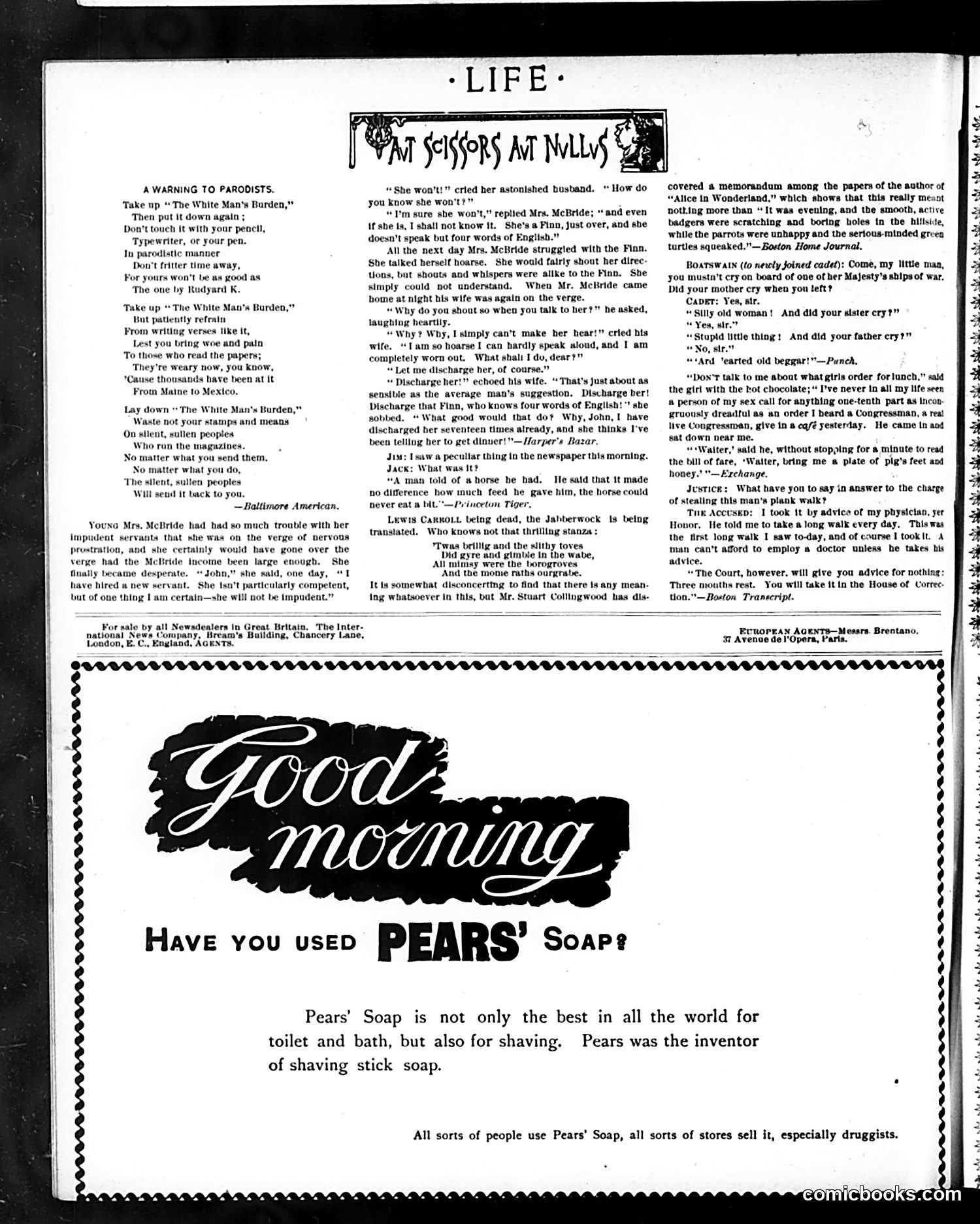
This page contains several satirical pieces typical of early 20th-century American humor: **"A Warning to Parodists"** mocks the countless attempts by amateur writers to parody Rudyard Kipling's famous 1899 poem "The White Man's Burden." The satire suggests that so many mediocre parodies have flooded publications that further attempts are pointless—magazine editors (the "silent, sullen peoples") will simply reject them. **The Mrs. McBride anecdote** satirizes xenophobia and class assumptions about immigrant servants. A wealthy woman hires a Finnish immigrant precisely because she assumes the language barrier will prevent any "impudence"—equating foreignness with servility. The joke reveals her own foolishness when the strategy backfires. **Minor pieces** include wordplay about a horse's appetite, Lewis Carroll translation trivia, and naval humor about homesick recruits. The page is primarily text-based satire with an advertisement for Pears' Soap at the bottom—typical of Life's format mixing editorial content with advertising.
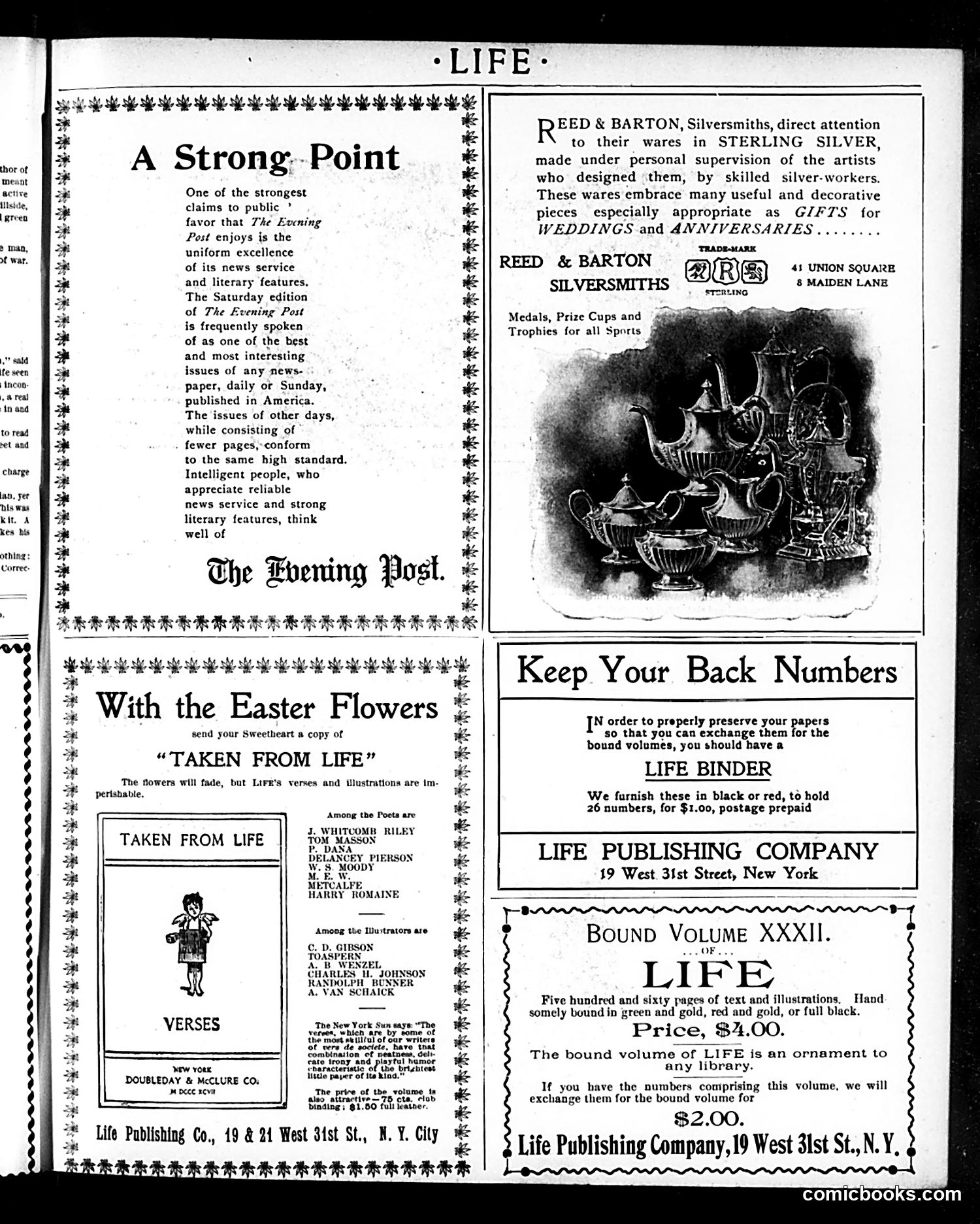
This is primarily an **advertising and promotional page** rather than a satirical cartoon page. The content consists of: 1. **Editorial advertisement** for *The Evening Post* newspaper, claiming superior news coverage and literary quality 2. **Commercial advertisements** for Reed & Barton silversmiths (sterling silver gifts for weddings/anniversaries) and promotional materials 3. **Book promotion** for "Taken from Life," a poetry collection featuring verses by J. Whitcomb Riley and illustrations by various artists, marketed as an Easter gift 4. **Subscription services** advertising bound volumes of *Life* magazine itself, with offers to exchange back issues for hardcover collections The page reflects early 20th-century publishing practices: magazines promoted themselves through bound volumes, encouraged subscribers to preserve issues, and sold gift editions during holidays. No political satire or identifiable caricatures appear—this is straightforward commercial publishing promotion.
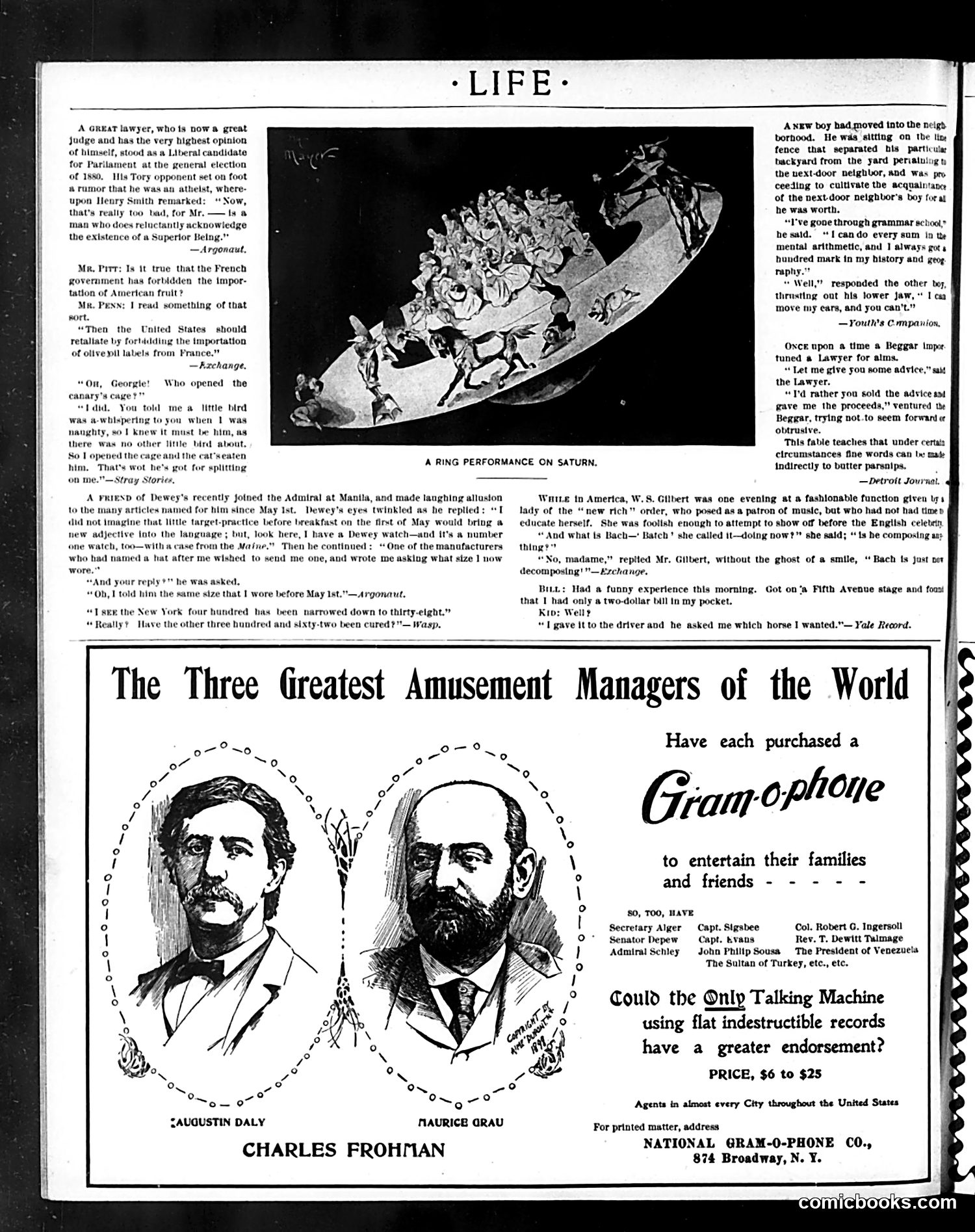
This page contains primarily **short anecdotal jokes** and an **advertisement** rather than political cartoons. The jokes reference contemporary figures and events from circa 1898-1900. "A Ring Performance on Saturn" is a humorous illustration unrelated to specific satire. The text pieces mock various subjects: a Liberal candidate's atheism denial (British politics), American fruit importation policy, and Admiral Dewey's sudden fame following his 1898 Manila naval victory—so much so that manufacturers named products after him. The central **advertisement** promotes the Gramophone (early phonograph) by noting that three major theater managers—Augustin Daly, Maurice Grau, and Charles Frohman—have purchased one, along with government officials like Secretary Alger and Admiral Schley. The ad implies that if America's most prominent entertainment figures endorse the device, it must be worthwhile. The overall tone is light satire on vanity, fame-chasing, and commercial endorsements.
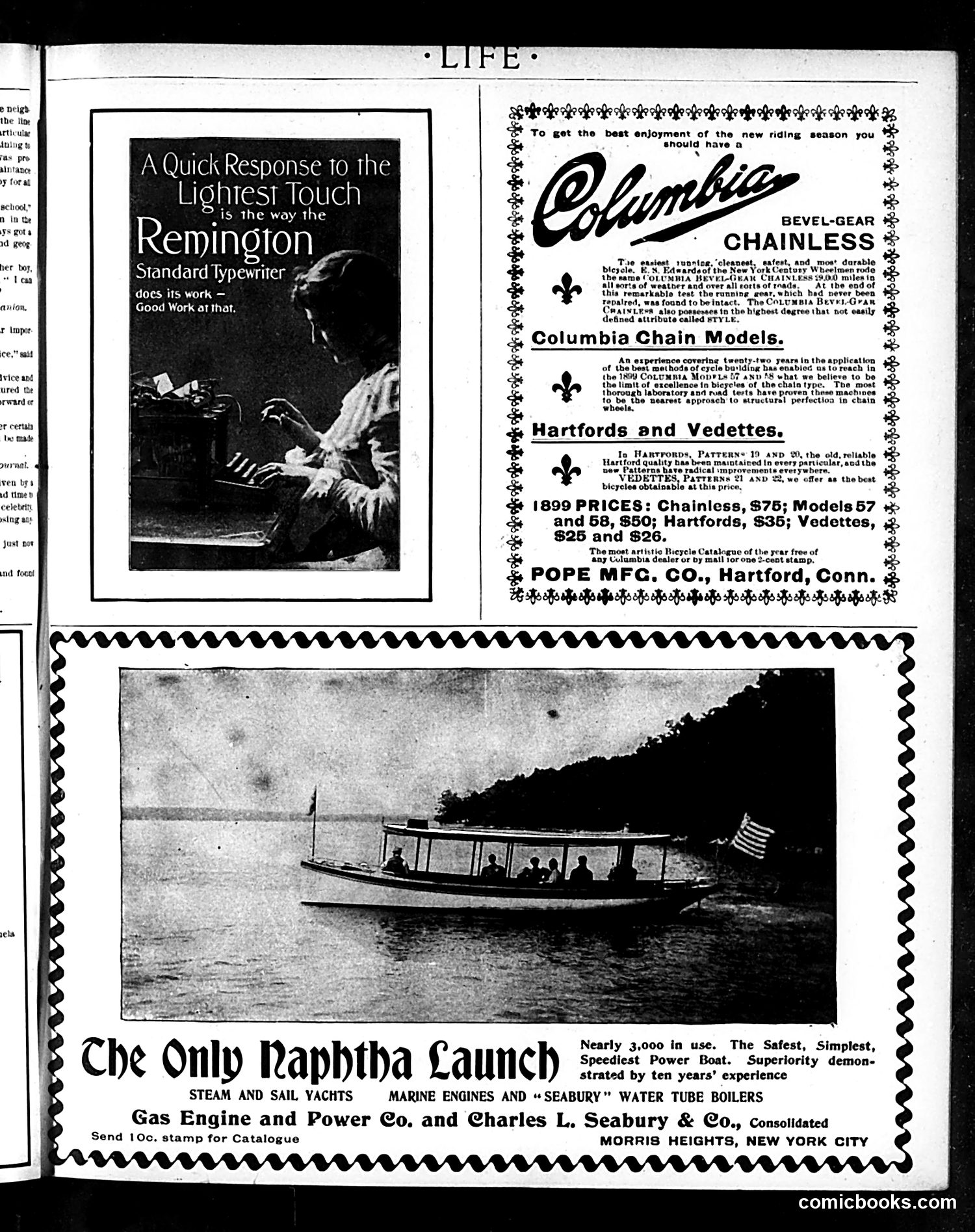
This page is primarily **advertising**, not satire or political commentary. It contains four distinct product advertisements from 1899: 1. **Remington Typewriter** (top left): A straightforward ad emphasizing the machine's "lightest touch" and reliability, featuring a photograph of hands typing. 2. **Columbia Bicycles** (top right): Promotes chainless and chain-drive models with prices ranging from $25-$75, highlighting durability and design superiority. 3. **Naphtha Launch** (center): Advertises a motorized boat ("nearly 3,000 in use"), emphasizing safety and simplicity for steam and sail yachts. 4. **Hartford and Vedette Bicycles** (bottom): A subsidiary bicycle line from Pope Manufacturing Company in Hartford, Connecticut. These ads reflect **turn-of-the-century consumer culture**: the bicycle boom, early motorization, and modern office technology. There is no political cartoon or satire present—the page documents commercial products marketed to the leisure class of 1899.
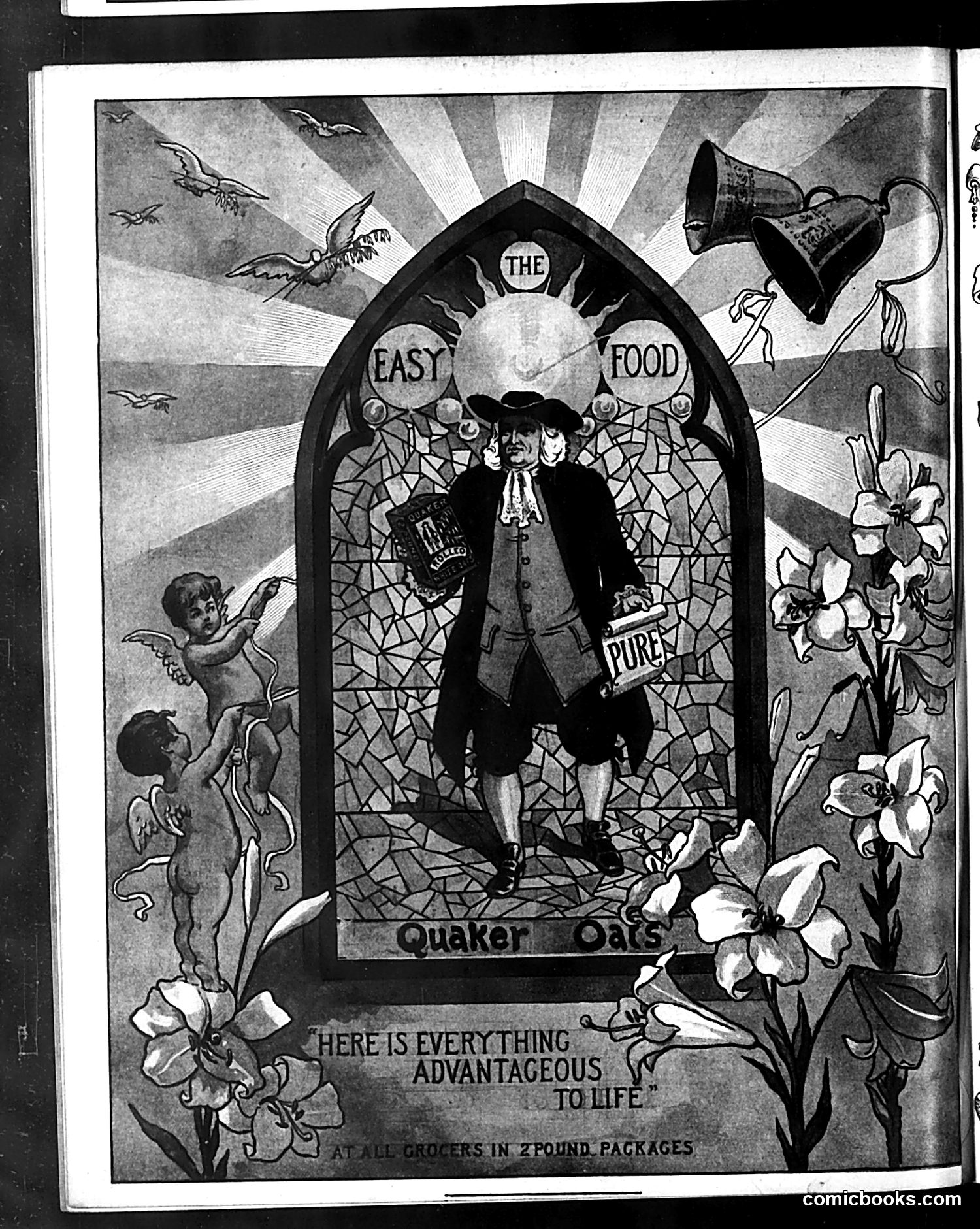
This is a **Quaker Oats advertisement**, not political satire. The central figure is the Quaker mascot—a man in 17th-century Quaker dress holding a package of oats. He's positioned as a benevolent authority figure within an ornate archway, flanked by cherubs and flowers. The text claims "The Easy Food" with "Easy" and "Food" labeled on either side, and "Purge" visible on his package. The tagline reads "Here is Everything Advantageous to Life," promising comprehensive nutritional benefit. This reflects early 20th-century marketing that positioned oatmeal as health-promoting and morally virtuous, leveraging the historical Quaker reputation for honesty and purity to sell breakfast cereal as a complete, wholesome product "at all grocers in 2-pound packages."