
Life, 1899-03-25 · page 4 of 32
Life — March 25, 1899 — page 4: what you’re looking at
What you’re looking at
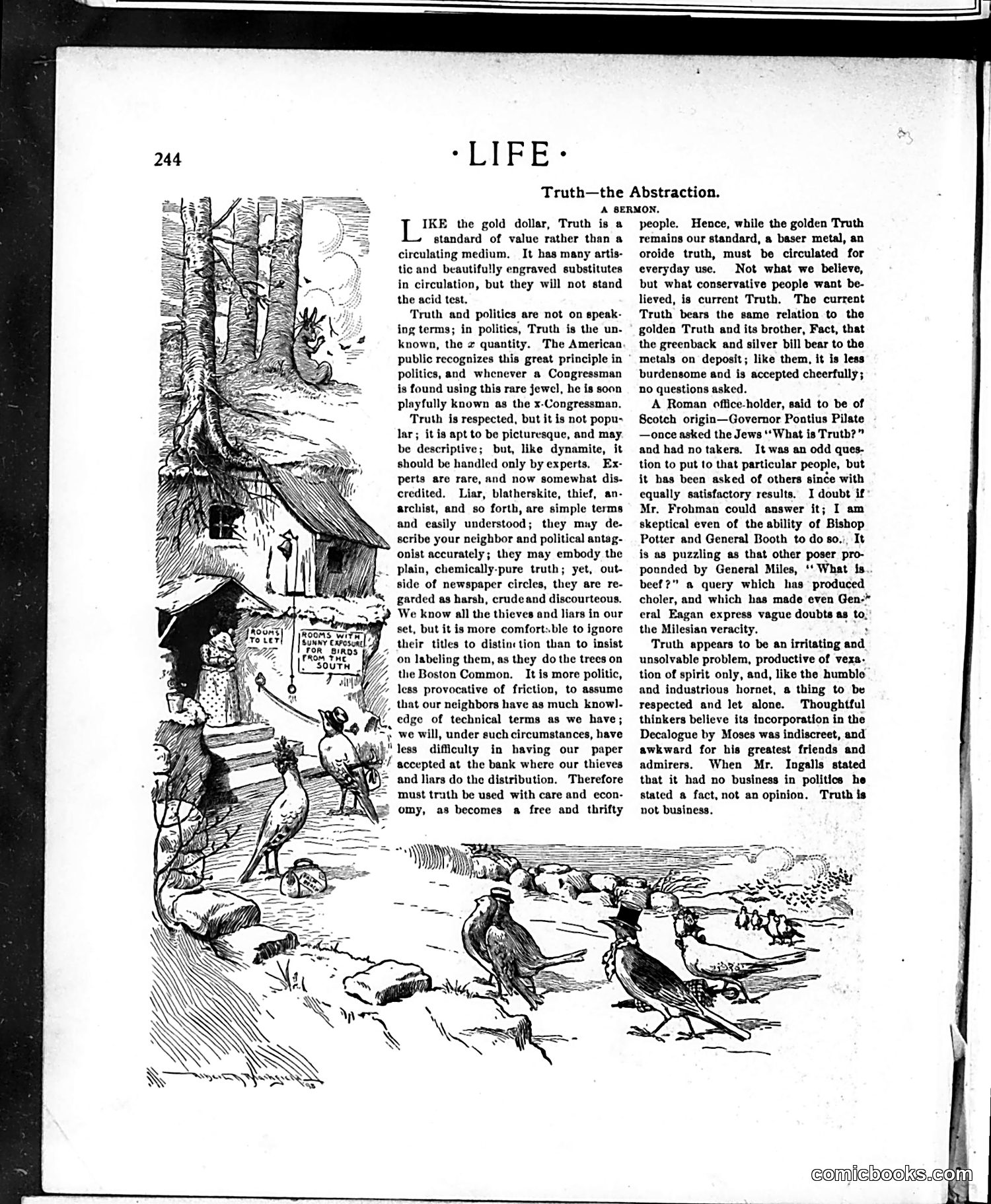
This sermon-styled piece uses the metaphor of currency to critique how truth functions in American politics and society. The author compares Truth to a gold dollar—a standard of value that circulates but isn't popular, since people prefer "baser metal" (lies that are easier to accept). The illustration depicts birds (suggesting common people or voters) near a tree with signage, likely representing the public marketplace of ideas. The sermon references specific political figures—Governor Pontius Pilate, General Miles, General Eagan, and Mr. Ingalls—though their exact disputes remain unclear from context alone. The satire's core point: Truth is inconvenient and unpopular; politicians and the public prefer comfortable falsehoods to harsh truths, making truth a poor "currency" in public discourse.
📄 Transcribed text from this page (OCR, searchable)
Machine-transcribed from the original scan — historical spelling and the odd misread are preserved.
*LIPE Truth—the Abstraction. A 8ERMON. IKE the gold dollar, Truth is a standard of value rather than a circulating medium. It has many artis- tic and beautifully engraved substitutes in circulation, but they will not stand the acid test, Truth and politics are not on speak- ing terms; in polities, Truth is the un- known, the z quantity. The American public recognizes this great principle in politics, and whenever a Congressman is found using this rare jewel, he is soon playfully known as the x-Congressman, Truth is respected, but it is not popu- lar; it is apt to be picturesque, and may. be descriptive; but, like dynamite, it should be handled only by experts. Ex- perts are rare, and now somewhat dis- credited. Liar, blatherskite, thief, an- archist, and so forth, are simple terms and easily understood; they muy de- scribe your neighbor and political antag- onist accurately; they may embody the plain, chemically-pure truth; yet, out- side of newspaper circles, they are re- garded as harsh, crudeand discourteous. We know all the thieves and liars in our set, but it is more comfort:.ble to ignore their titles to distine tion than to insist . on labeling them, as they do the trees on /, the Boston Common. It is more politic, less provocative of friction, to assume that our neighbors have as much knowl- edge of technical terms as we have; + we will, under such circumstances, have less difficulty in having our paper accepted at the bank where our thieves and liars do the distribution. Therefore must truth be used with care and econ- omy, as becomes a free and thrifty people. Hence, while the golden Truth remains our standard, a baser metal, an oroide truth, must be circulated for everyday use. Not what we believe, but what conservative people want be- lieved, is current Truth. The current Truth bears the same relation to the golden Truth and its brother, Fact, that the greenback and silver bill bear to the metals on deposit; like them, it is less burdensome and is accepted cheerfully; no questions asked. A Roman office-holder, said to be of Scotch origin—Governor Pontius Pilate —once asked the Jews ‘What is Truth?” and had no takers. It was an odd ques- tion to put to that particular people, but it has been asked of others since with equally satisfactory results. I doubt if Mr. Frohman could answer it; I am skeptical even of the ability of Bishop Potter and General Booth to do so.), It is as puzzling as that other poser pro- ponnded by General Miles, ‘‘ What is beef?" a query which has’ produced choler, and which has made even Gen-> eral Eagan express vague doubts as to, the Milesian veracity. : Truth appears to be an irritating and. unsolvable problem, productive of vexa- tion of spirit only, and, like the humble and industrious hornet, a thing to be respected and let alone. Thoughtful thinkers believe its incorporation in the Decalogue by Moses was indiscreet, and awkward for his greatest friends and admirers. When Mr. Ingalls stated that it had no business in politics he stated a fact, not an opinion. Truth is not business. ae