
Life, 1899-03-25 · page 18 of 32
Life — March 25, 1899 — page 18: what you’re looking at
What you’re looking at
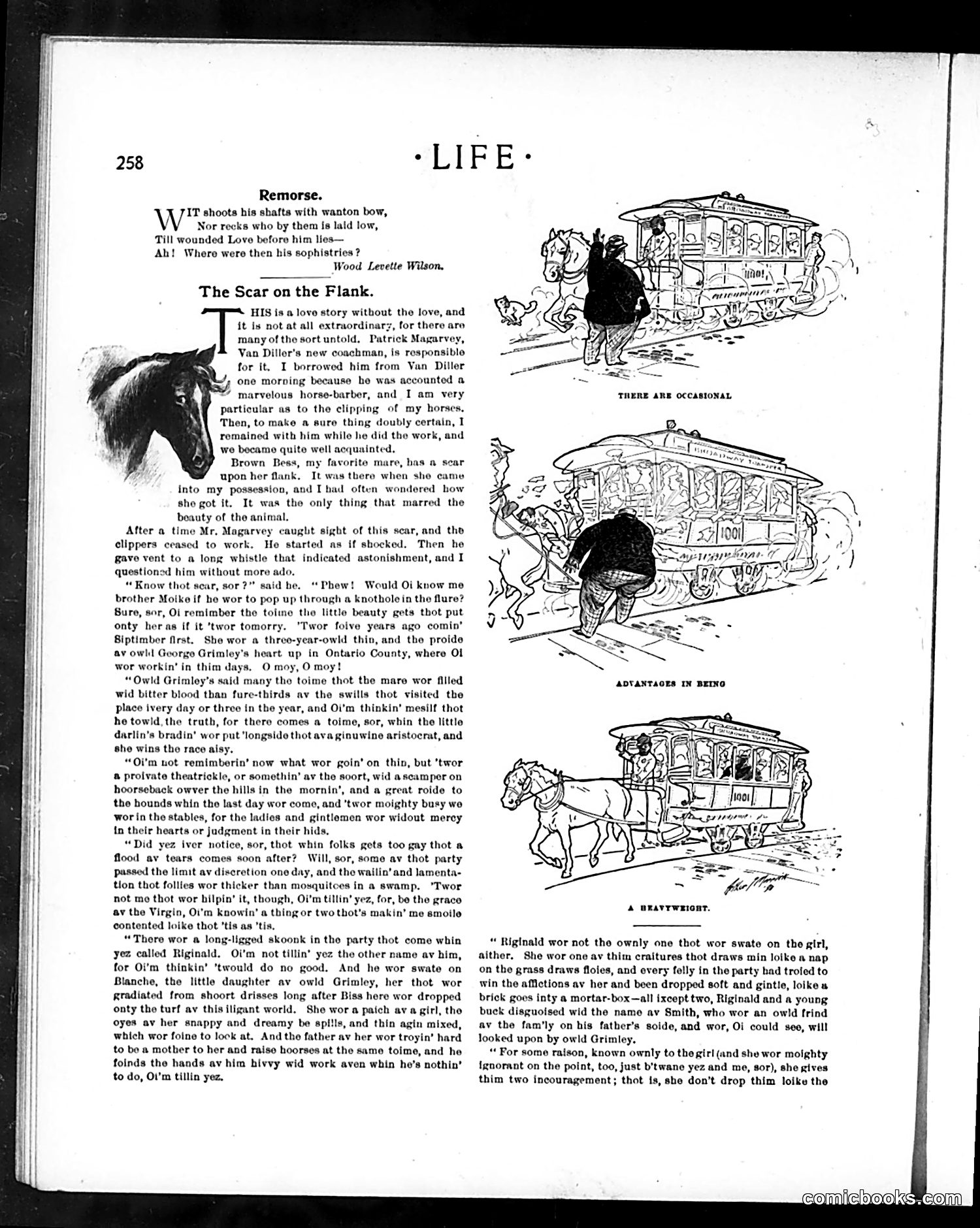
This page contains two pieces of satirical content: **"Remorse"** (top): A brief poem by Wood Levette Wilson mocking romantic hypocrisy—specifically men who pursue women recklessly ("shoots his shafts with wanton bow") but lose their rhetorical sophistication ("sophistries") when confronted with the emotional consequences of their actions. **"The Scar on the Flank"** (main text): A lengthy Irish-dialect anecdote narrated by a coachman named Magarvey about a horse mare's scar. The story functions as a morality tale: a woman named Blanche from Ontario County becomes romantically entangled with an aristocratic man named Reginald during an elaborate house party. The mare's scar allegedly resulted from this romantic drama—suggesting consequences for female virtue and social transgression. The satirical angle appears to target both the pretensions of aristocratic romance and working-class Irish servants' gossipy commentary on their employers' moral failings. The three accompanying cartoon illustrations show horse-drawn carriages, labeled to emphasize both comedic and practical aspects of transportation.
📄 Transcribed text from this page (OCR, searchable)
Machine-transcribed from the original scan — historical spelling and the odd misread are preserved.
Remorse. IT shoots his shafts with wanton bow, V Nor recks who by them {s laid low, Till wounded Love before him lies— Ah! Where were then bis sophistries ? Wood Levette Wilson, The Scar on the Flank. HIS is a lovo story without the love, and it is not at all extraordinary, for there aro many of tho sort untold, Patrick Magarvey, Van Dillor’s new coachman, is responsible for it, I borrowed him from Van Diller one morning because be was accounted a % marvelous horse-barber, and I am very particular as to the clipping of my horses, Then, to make a sure thing doubly certain, I romained with him while he did the work, and we became quite well acquainted, Brown Bess, my favorite mare, has a sear upon her flank, It was there when she came into my possession, and I had often wondered bow sho got it. It was tho only thing that marred the beauty of the animal. After a time Mr, Magarvey caught sight of this scar, and tho clippers ceased to work. He started as if shocked. Then he Gave vent to a long whistle that indicated astonishment, and I questioned him without more ado, “ Know thot scar, sor?” said be. “Phew! Would Oi know me brother Moike if he wor to pop up through a knothole in the flure? Bure, sor, Ol remimber tho toltno the little beauty gets thot put onty heras if it *twor tomorry. "Twor foive years ago comin’ Biptimber first. She wor a threo-year-owld thin, and the proido ay owl! George Grimley’s heart up in Ontario County, where OL wor workin’ in thim days, O moy, O moy! “Owld Grimley’s said many tho toime thot the mare wor filled wid bitter blood than fure-thirds av the swills thot visited the place ivery day or threo in the year, and Oi'm thinkin’ mesilf thot he towld, the truth, for there comes a toime, sor, whin the little darlin’s bradin’ wor put ‘longside thot ava ginuwine aristocrat, and sho wins tho race aisy. “Oi'm uot remimberin’ now what wor goin’ on thin, but ’twor a proivate theatrickle, or somethin’ av the soort, wid ascamper on hoorseback owver the hills in the mornin’, and a great roide to the hounds whin tho last day wor come, and 'twor moighty busy wo wor in the stables, for the ladies and gintlemen wor widout mercy in their hearts or jadgment in their hids, “Did yez iver notice, sor, thot whin folks gets too gay thot a flood av tears comes soon after? Will, sor, some av thot party passed the limit av discretion one day, and tho wailin’ and lamenta- tlon thot follies wor thicker than mosquitces in a swamp. ’Twor not me thot wor hilpin’ it, though, Oi'm tillin’ yez, for, be the graco av the Virgin, Oi'm knowin’ a thing or twothot's makin’ me smoilo contented loike thot ’tis as 'tis, “Thore wor a long-ligged skoonk in tho party thot come whin yez called Riginald. Oi'm not tillin’ yez the other name av him, for Oi'm thinkin’ 'twould do no good. And he wor swate on Blanche, the little daughter av owld Grimley, her thot wor Rradiated from shoort drisses long after Biss here wor dropped onty the turf av this iligant world. She wor a paich ava girl, tho oyes av her snappy and dreamy be spills, and thin agin mixed, which wor foine to lock at, And the father av her wor troyin’ hard to be a mother to her and raise hoorses at the samo toime, and he foinds the hands av him hivvy wid work aven whin he’s nothin’ to do, O1'm tillin yez. iat “uno, —-\- A lik faaniear ie we ie BA, Zz a) TS = “ Riginald wor not tho ownly one thot wor swate on the girl, aither, She wor one av thim craitures thot draws min loike a nap on the grass draws floles, and every folly in the party bad trofed to win the affictions ay her and been dropped soft and gintle, loike a brick goos inty a mortar-box—all ixcept two, Riginald and a young buck disguoised wid the namo av Smith, who wor an owld frind ay the fam'ly on his father’s soide, and wor, Oi could seo, will looked upon by owld Grimley. “ For some raison, known ownly to thogirl (and she wor moighty ignorant on the point, too, just b'twane yez and me, sor), she gives thim two incouragement; thot is, she don’t drop thim loike the