
Life, 1899-03-25 · page 8 of 32
Life — March 25, 1899 — page 8: what you’re looking at
What you’re looking at
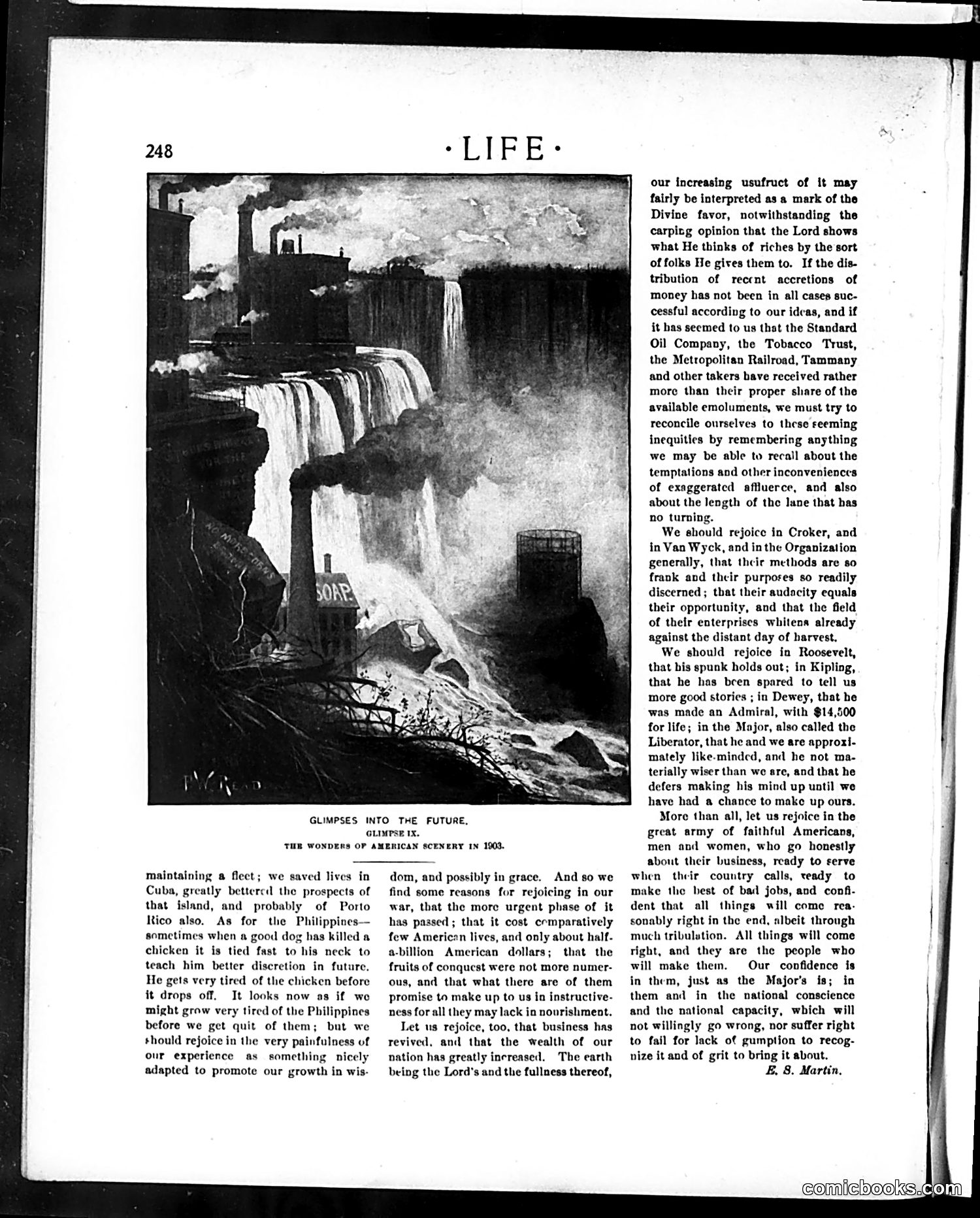
This page features an illustration titled "Glimpses into the Future: The Wonders of American Scenery in 1903," depicting Niagara Falls with industrial structures (factories, smokestacks) integrated into the landscape. The accompanying text is a satirical commentary on American wealth accumulation and business practices. The author criticizes recent financial concentrations (Standard Oil, tobacco trusts, railroads) as potentially excessive, yet ultimately optimistic about American business leaders and the nation's future prosperity. The satire is gentle—suggesting these industrial magnates' methods may be questionable, but expressing faith that America's fundamentally honest workers and leaders will ensure everything works out righteously. The illustration satirizes unbridled industrial development consuming natural wonders, while the text wraps this critique in patriotic reassurance.
📄 Transcribed text from this page (OCR, searchable)
Machine-transcribed from the original scan — historical spelling and the odd misread are preserved.
GLIMPSES INTO THE FUTURE, GLIMPSE IX. THR WONDERS OF AMERICAN SCENERY IN 1903. maintaining a flect; we saved lives in Cuba, greatly bettered the prospects of that island, and probably of Porto Rico also. As for the Philippines— sometimes when a good dog has killed a chicken it is tied fast to his neck to teach him better discretion in future. He gets very tired of the chicken before it drops off. It looks now as if wo might grow very tired of the Philippines before we get quit of them; but we thould rejoice in the very painfulness of our experience as something nicely adapted to promote our growth in wis- dom, and possibly in grace. And so we find some reasons for rejoicing in our war, that the more urgent phase of it has passed ; that it cost comparatively few American lives, and only about half- a-billion American dollars; that the fruits of conquest were not more numer- ous, and that what there are of them promise to make up to us in instructive- ness for all they may lack in nourishment. Let us rejoice, too, that business has revived, and that the wealth of our nation has greatly increased. The earth being the Lord's and the fullness thereof, our increasing usufruct of it may fairly be interpreted as a mark of the Divine favor, notwithstanding the carping opinion that the Lord shows what He thinks of riches by the sort of folks He gives them to. If the dis- tribution of recent accretions of money has not been in all cases suc- cessful according to our idcas, and if it has seemed to us thst the Standard Oil Company, the Tobacco Trust, the Metropolitan Railroad, Tammany and other takers bave received rather more than their proper share of the available emoluments, we must try to reconcile ourselves to these seeming inequities by remembering anything we may be able to recall about the temptations and other inconveniences of exaggerated affluerce, and also about the length of the lane that has no turning. We should rejoice in Croker, and in Van Wyck, and in the Organization generally, that thcie methods are so frank and their purposes so readily discerned ; that their audacity equals their opportunity, and that the field of their enterprises whitena already against the distant day of harvest. We should rejoice in Roosevelt, that his spunk holds out; in Kipling, that he has been spared to tell us more good stories ; in Dewey, that he was made an Admiral, with $14,500 for life; in the Major, also called the Liberator, that he and we are approxi- mately like-minded, and he not ma- terially wiser than we are, and that he defers making his mind up until we have had a chance to make up ours. More than all, let us rejoice in the great army of faithful Americans, men and women, who go honestly about their business, ready to serve when their country calls, teady to make the best of bad jobs, and confi- dent that all things will come rea- sonably right in the end, nlbeit through much tribulation. All things will come right, and they are the people who will make them. Our confidence is in them, just as the Major's is; in them and in the national conscience and the national capacity, which will not willingly go wrong, nor suffer right to fail for lack of gumption to recog- nize it and of grit to bring it about. £, 8. Martin, Comichooks.colm