
A complete issue · 20 pages · 1899
Life — January 19, 1899
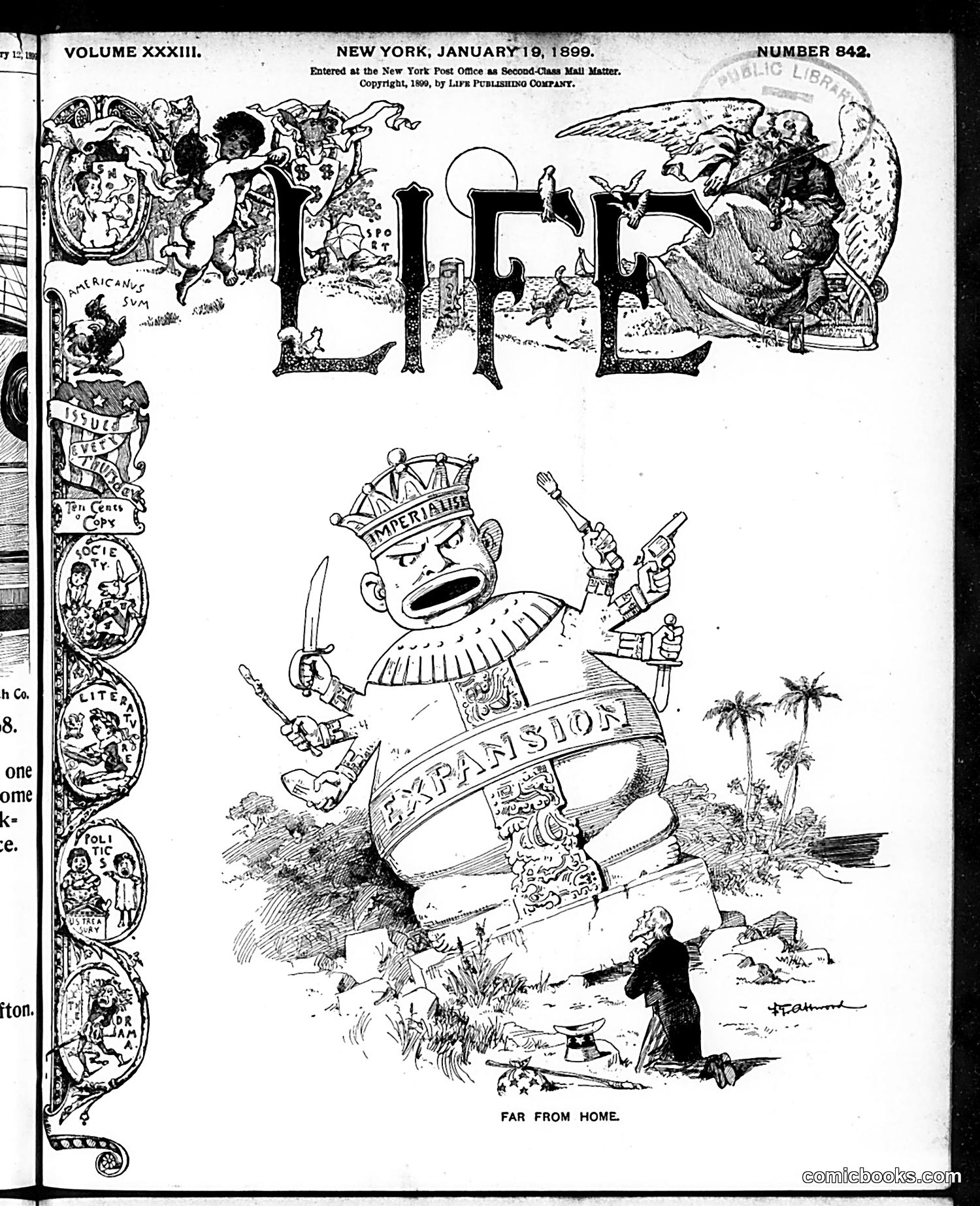
This satirical cartoon depicts **Imperialism** (labeled on the figure's sash) as a grotesque, crowned monster wielding weapons and displaying colonial aggression. The figure wears a crown labeled "Imperialism" and carries swords and guns, suggesting militaristic expansion. The setting shows tropical palms, indicating overseas colonies. A small, frightened man in formal dress kneels before the monster—likely representing either American political leadership or a conquered nation. The caption "FAR FROM HOME" emphasizes the cartoon's critique: imperial expansion takes nations far beyond their borders. Published in 1899, this reflects American debates over territorial expansion following the Spanish-American War (1898), particularly regarding the Philippines. The satire mocks imperialism as monstrous, brutal, and morally bankrupt.
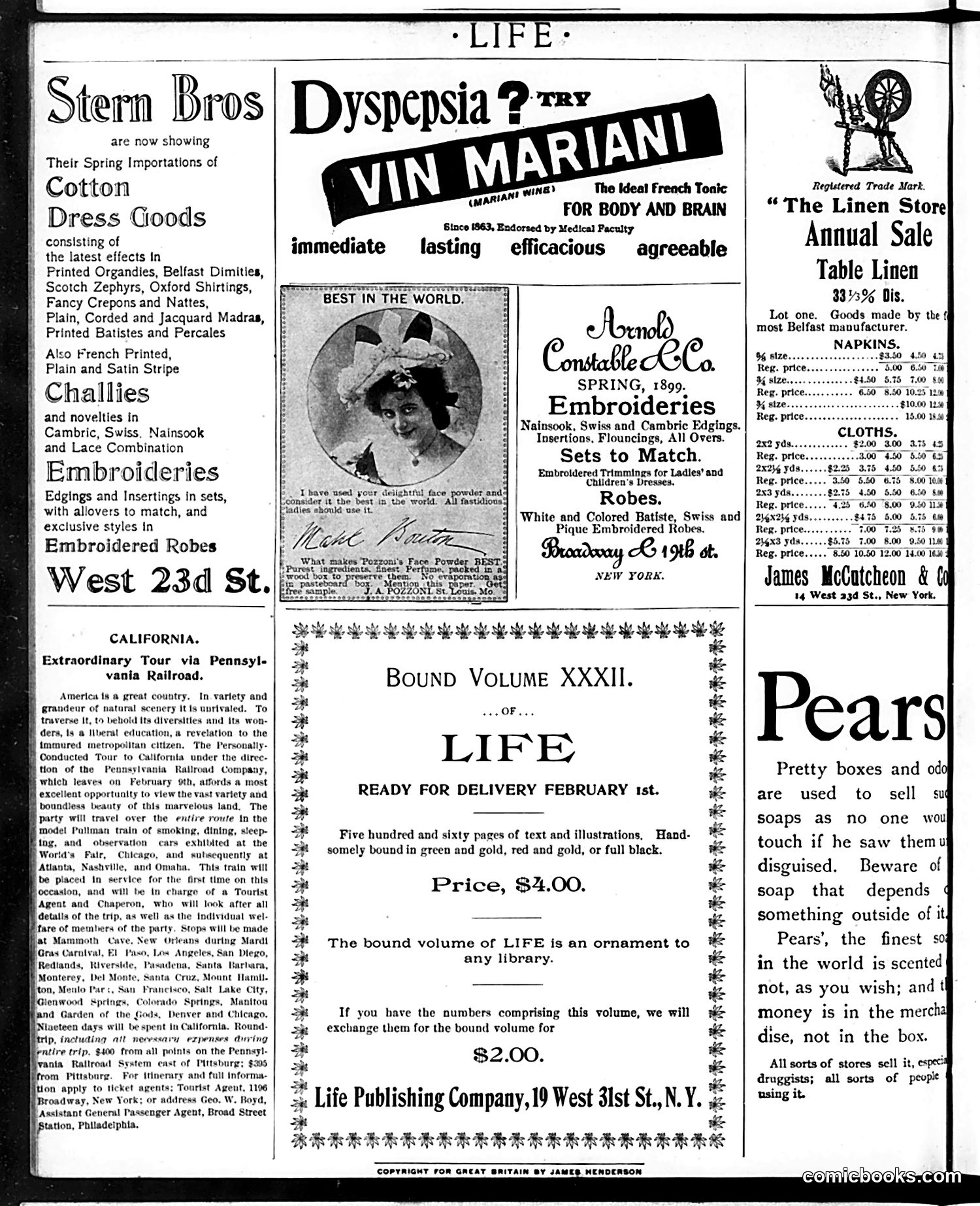
This page is primarily **advertising**, not satire or political commentary. It contains: 1. **Stern Bros** department store ad for cotton dress goods and embroideries (West 23rd St.) 2. **Vin Mariani** advertisement - a patent medicine claiming to treat dyspepsia, endorsed by medical faculty since 1863. The image shows a woman's portrait (possibly a celebrity endorsement, though the name is unclear). 3. **Arnold Constable & Co.** - spring embroideries and dress goods 4. **James McCutcheon & Co.** - table linen sale 5. **Pears soap** - advertisement describing their product in decorative boxes 6. A **Life Publishing Company** announcement for bound volume XXXII, priced at $4.00 The page reflects late 19th/early 20th-century consumer culture, patent medicine marketing, and department store advertising—typical of *Life* magazine's revenue model.
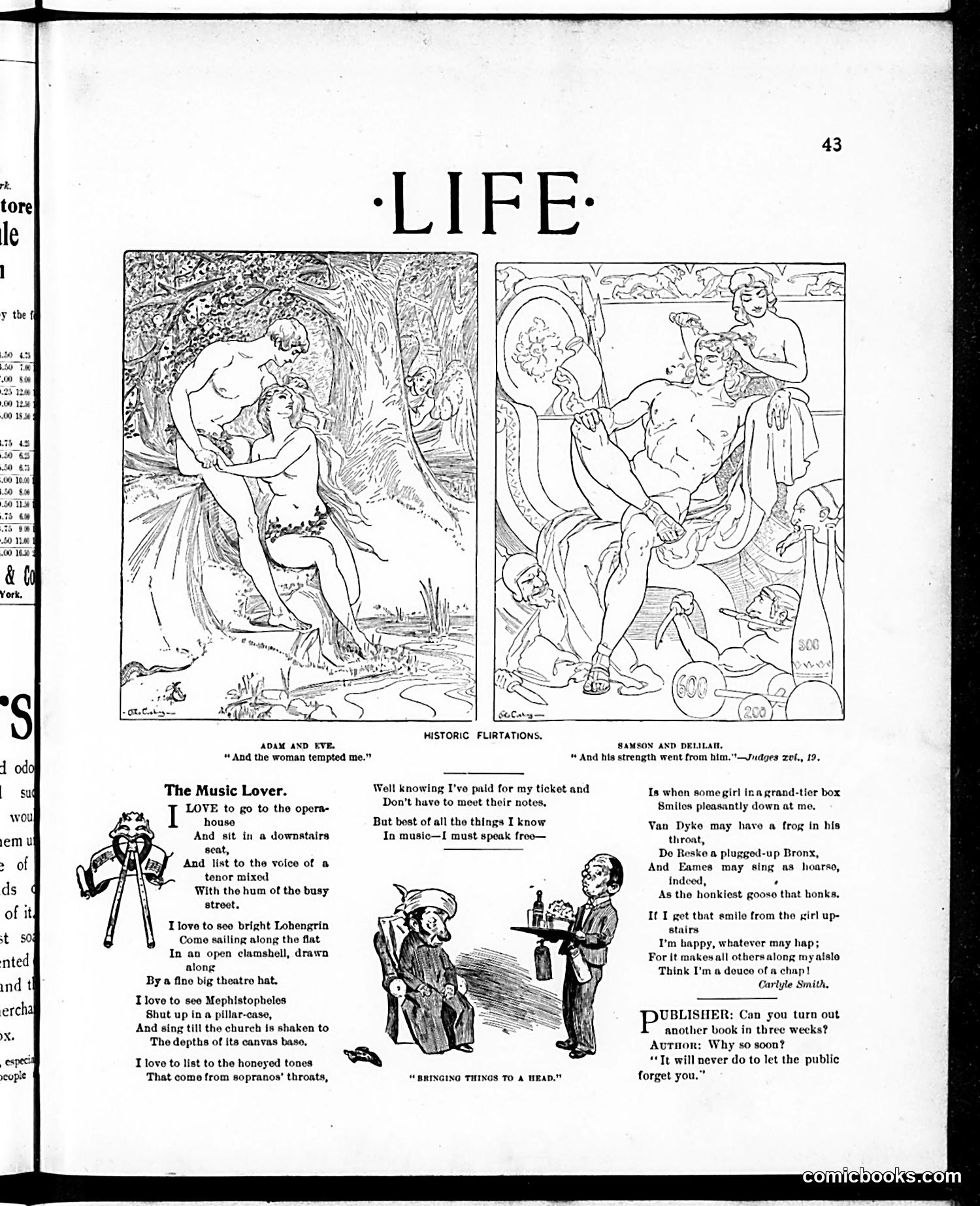
This page contains three satirical pieces: **Top Illustrations:** Two classical-style engravings labeled "Historic Flirtations" reference biblical/literary figures—Adam and Eve, and Samson and Delilah—using them as historical examples of romantic entanglement and seduction. **"The Music Lover":** A poem satirizing opera enthusiasts who attend performances not for musical merit but for social status and to be seen in expensive boxes. The speaker lists shallow reasons for attending—bright singers, fashionable dress, social positioning—while dismissing actual musical quality. **Bottom dialogue:** A brief comic exchange where a publisher pressures an author for another book within three weeks, and the author deflects with excuses. The overall tone is characteristic of *Life* magazine's early 20th-century satirical approach to mocking social pretension and cultural affectation.
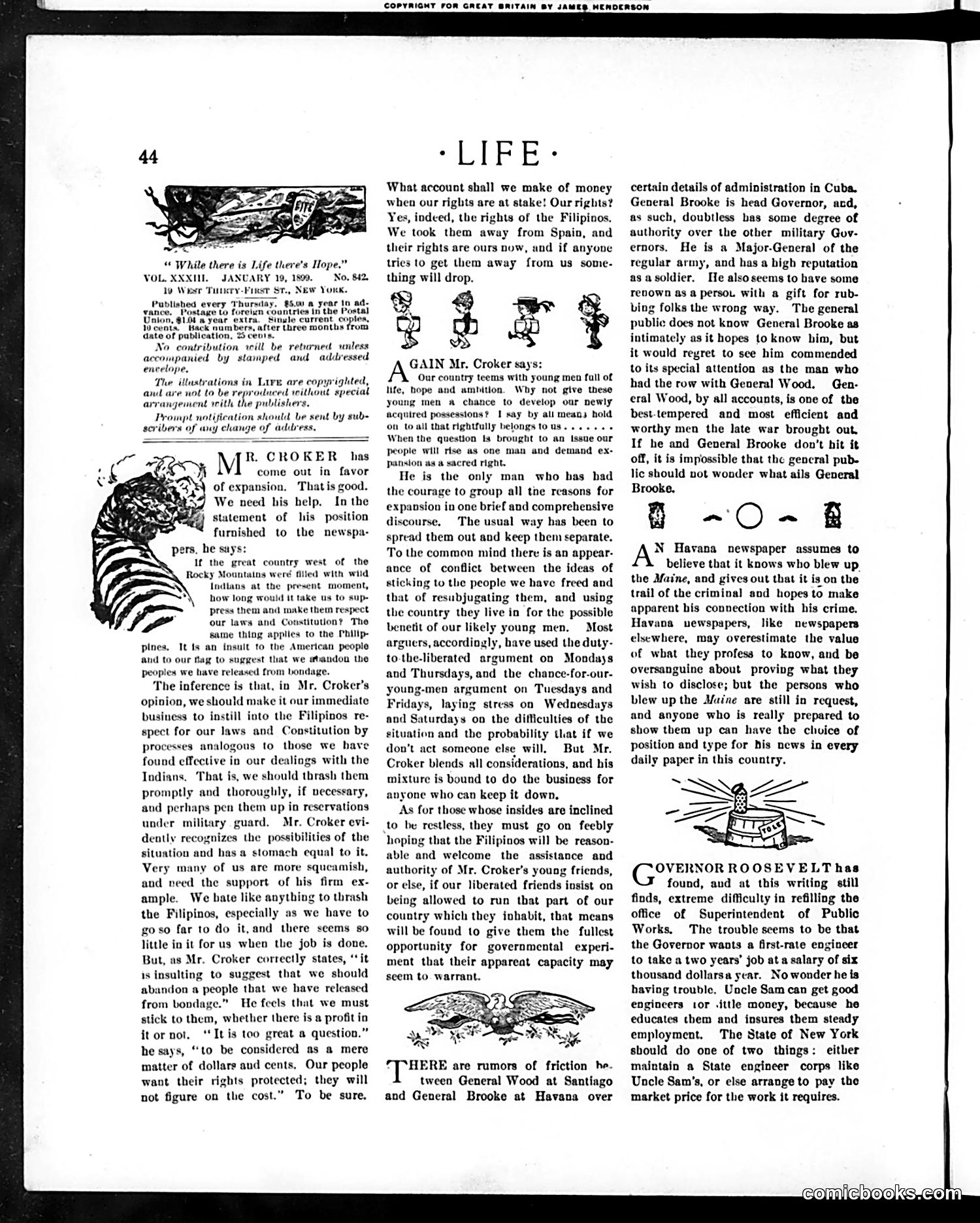
This page satirizes American imperial expansion following the Spanish-American War, particularly regarding the Philippines. The text debates whether the U.S. should retain control of these newly-acquired territories. **Key Figures:** - **Mr. Croker**: Likely Richard Croker, a Tammany Hall political boss, arguing for expansion as economically beneficial - **General Brooke and General Wood**: Military governors administering Cuba and the Philippines **The Satire:** The piece mocks the conflicting justifications for imperialism—presented as both a moral duty to "liberate" peoples and a financial opportunity. The satirist criticizes how newspapers and politicians oversimplify complex colonial questions into convenient political arguments, while suggesting the real motives involve profit and political power rather than genuine concern for the territories or their inhabitants.
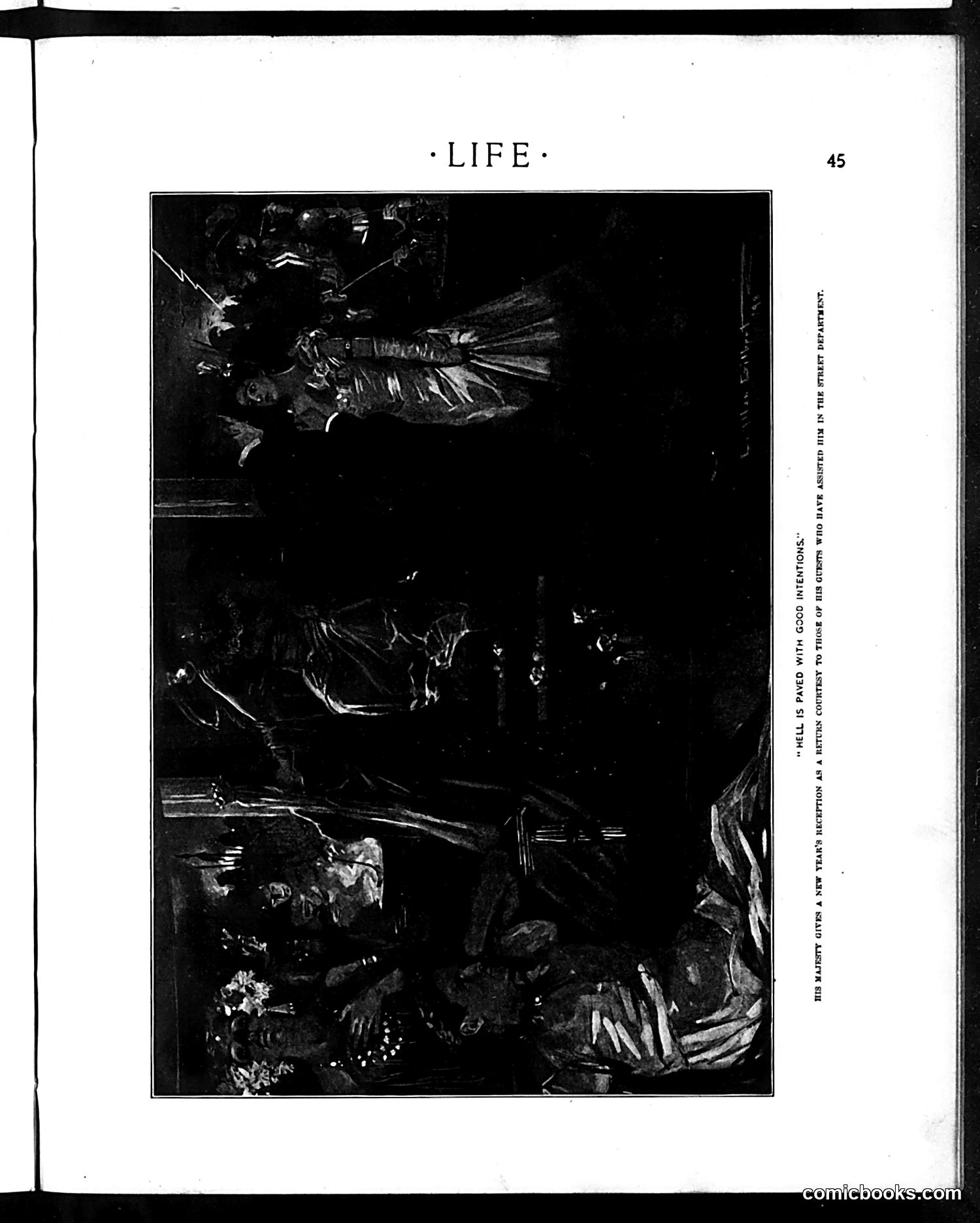
This Life magazine page (p. 45) appears to show a dramatic theatrical or operatic scene rather than a political cartoon. The image depicts multiple figures in elaborate period costumes and poses, rendered in high-contrast black and white photography or illustration. The caption references "Hell is paved with good intentions"—a common moral aphorism—suggesting the content satirizes hypocrisy or the gap between stated virtuous motives and actual consequences. However, without clearer visibility of individual faces or additional context identifying specific political figures or events being mocked, I cannot definitively identify which public figures or contemporary situation this satirizes. The theatrical staging suggests commentary on performative or artificial public behavior, but the specific targets remain unclear from this reproduction.
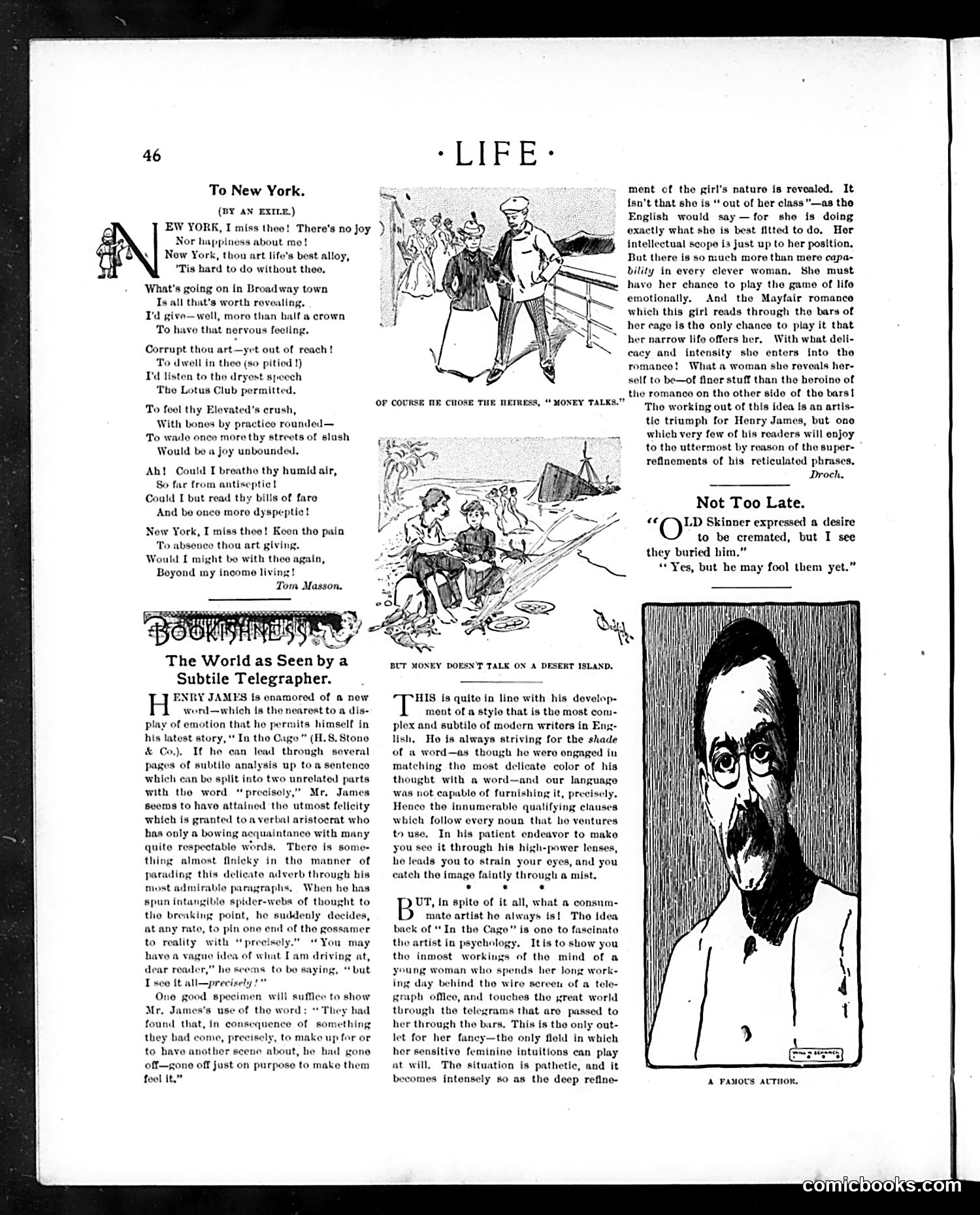
This page contains three distinct pieces: 1. **"To New York (By an Exile)"** - A poem by Tom Masson expressing nostalgia for New York City, contrasting Broadway's excitement with the speaker's current quiet location. 2. **"The World as Seen by a Subtitle Telegrapher"** - A review praising Henry James's novel "In the Cage" for its psychological subtlety. The critic admires James's use of precise language and his ability to convey complex inner thoughts. The piece celebrates how James depicts a young telegraph operator's imaginative life as she processes messages. 3. **Illustrations** - Two sketches accompany the telegrapher article: one showing people on what appears to be a ship, captioned "Of course he chose the heiress, 'Money talks'"; another showing figures near a desert island labeled "Honey doesn't talk on a desert island." A portrait of "A Famous Author" (likely James) concludes the page.
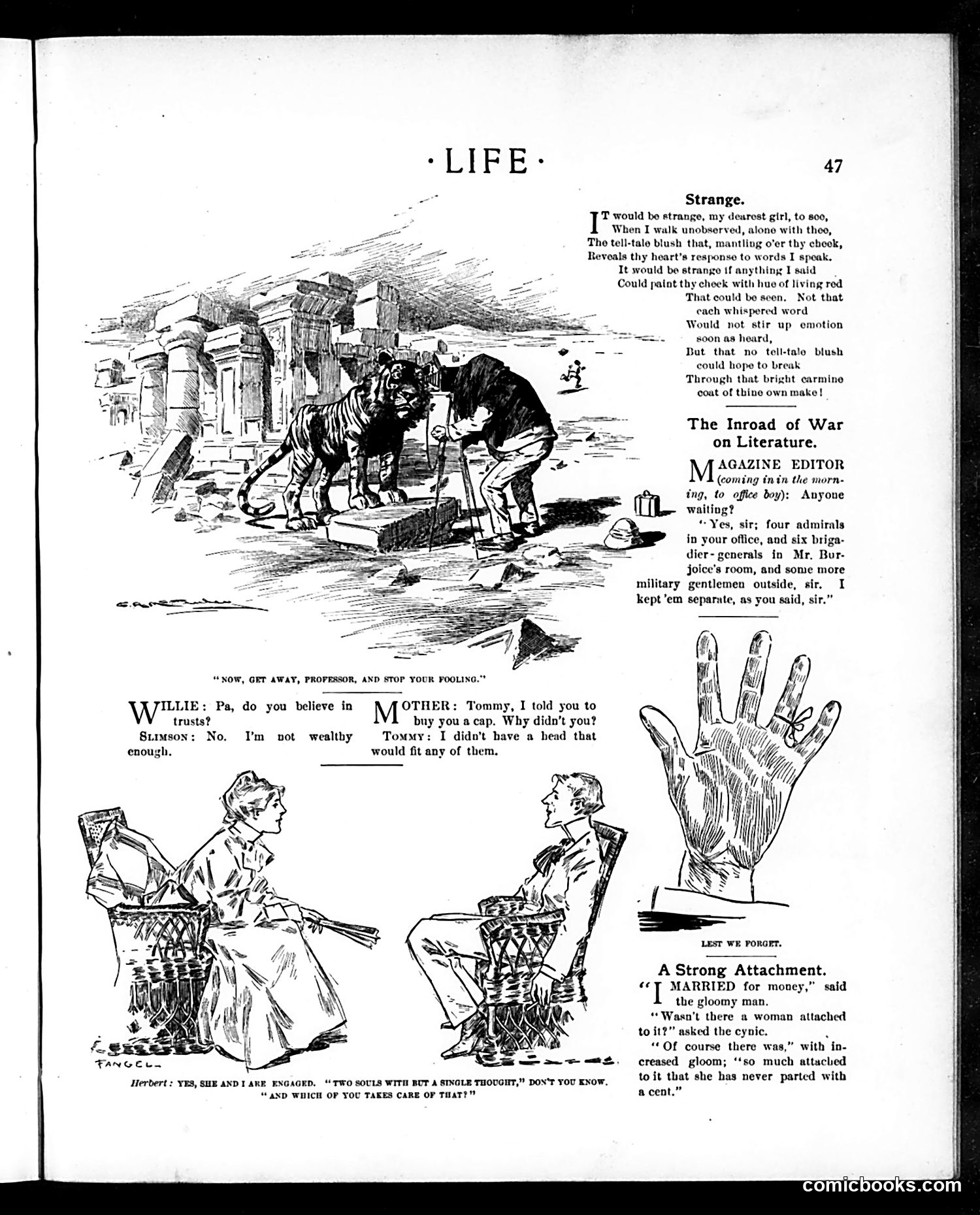
This page contains several satirical sketches on domestic and social themes: **"Strange"** (top): A poem about a woman's emotional reserve when alone with the speaker, contrasting her public blush with private indifference—satirizing female emotional inconsistency or hypocrisy. **"The Inroad of War on Literature"**: A joke about a magazine editor overwhelmed by military visitors (admirals, brigadier-generals) during wartime, implying war's disruption of civilian institutions. **"Willie & Simson" dialogue**: A brief exchange about wealth and purchasing power, likely satirizing class assumptions. **"Mother & Tommy"**: A mother scolds a child for not buying a cap despite having money—mocking parental logic or childhood excuses. **"A Strong Attachment"**: A cynical joke where a gloomy man married for money admits his wife never left him—implying she was equally mercenary, so neither could escape. The overall tone targets hypocrisy, class pretension, and marital discord.
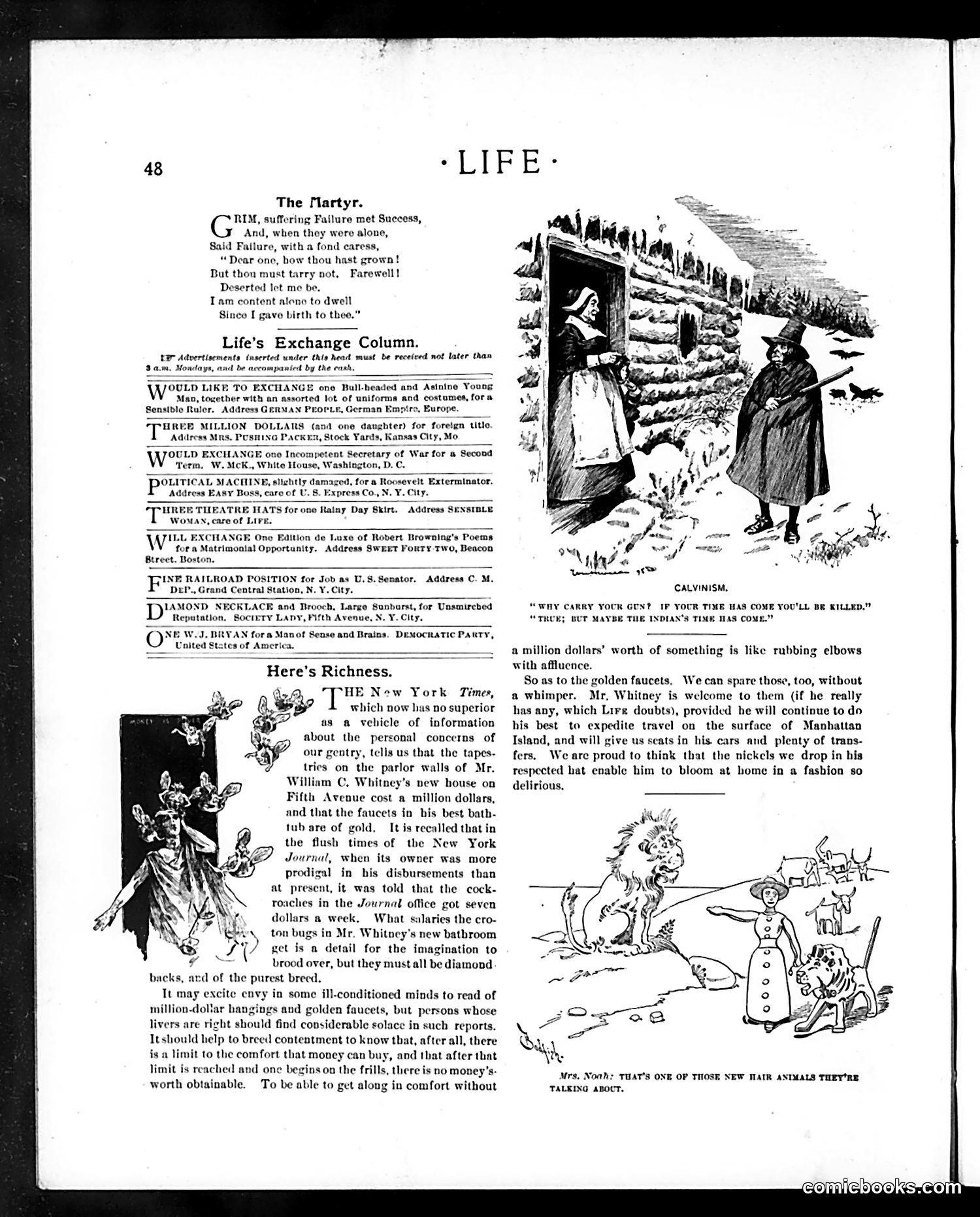
This page contains satirical social commentary typical of *Life* magazine. "The Martyr" poem mocks romantic idealism—a young woman rebuffs her suitor, claiming her independent success matters more than marriage. "Here's Richness" satirizes William C. Whitney's newly built mansion on Fifth Avenue with million-dollar gold faucets. The article argues that extreme luxury breeds moral corruption rather than contentment. The underlying critique: wealth beyond practical needs corrupts character and breeds arrogance. The accompanying illustrations mock Whitney's extravagance—one shows a wealthy woman surrounded by decorative excess, another depicts "Mrs. Noah" with fantastical "new hair animals," satirizing fashionable absurdity among the ultra-rich. The overall message: obscene wealth and frivolous spending reflect shallow values and moral emptiness.
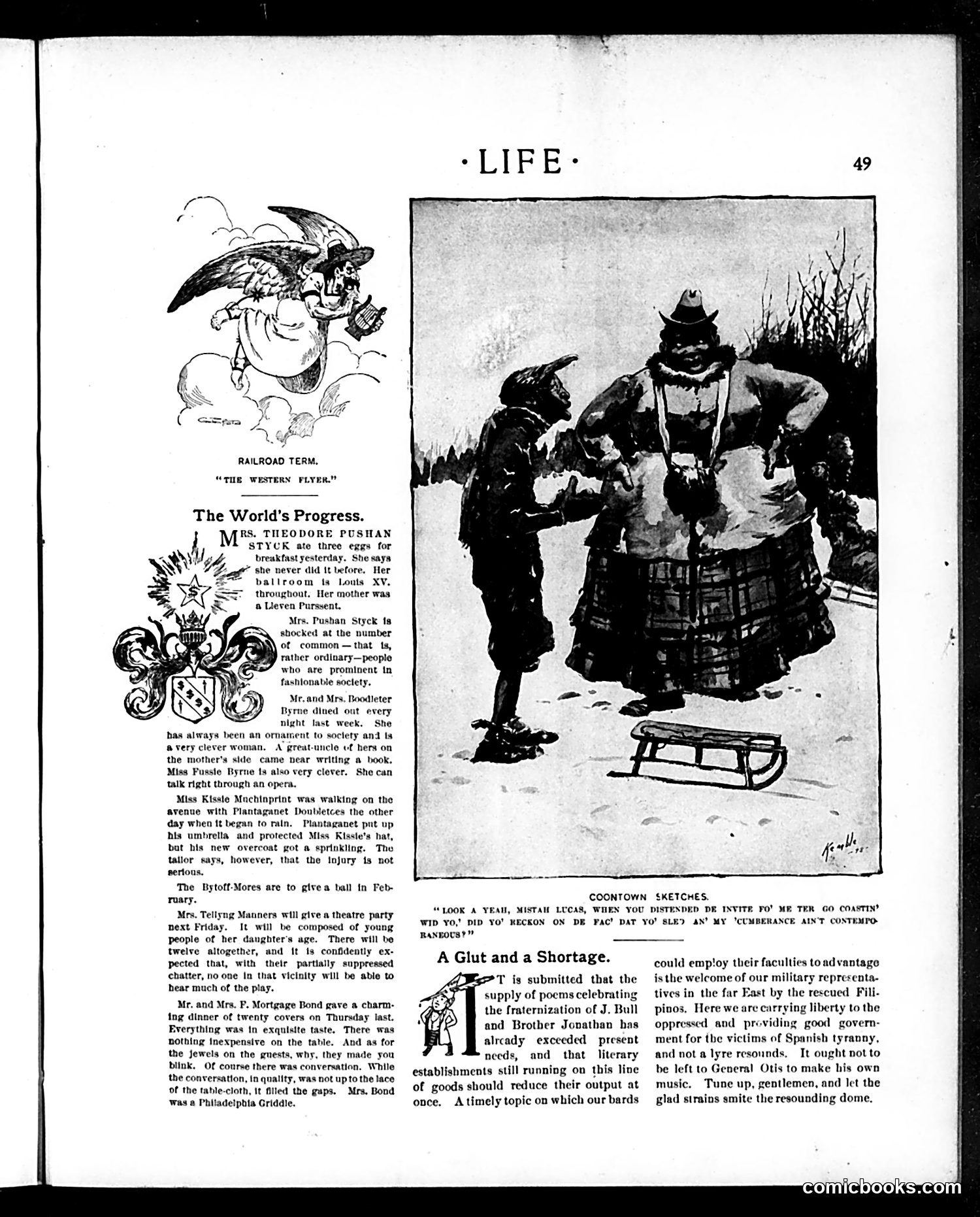
This page contains social commentary and humor typical of Life magazine's satirical approach. **Top Left:** A cartoon labeled "Railroad Term: 'The Western Flyer'" depicts a cherub or cupid figure—likely satirizing romantic notions of westward expansion or frontier mythology. **Main Image (Right):** "Coontown Sketches" shows what appears to be a racist caricature scene with figures and a sled. The caption's dialect ("Mistah Lucas," "reckon") reflects the derogatory minstrel-show humor common in early 20th-century American publications. **Text Sections:** "The World's Progress" discusses society women like Mrs. Theodore Pushkin and Miss Elodie Muchingpint—seemingly satirizing wealthy socialites' trivial pursuits and fashionable circles. The final section, "A Glut and a Shortage," discusses poetry collections and literary merit. **Context:** This reflects Life's era when such racial caricatures and class-based satire were considered acceptable entertainment.
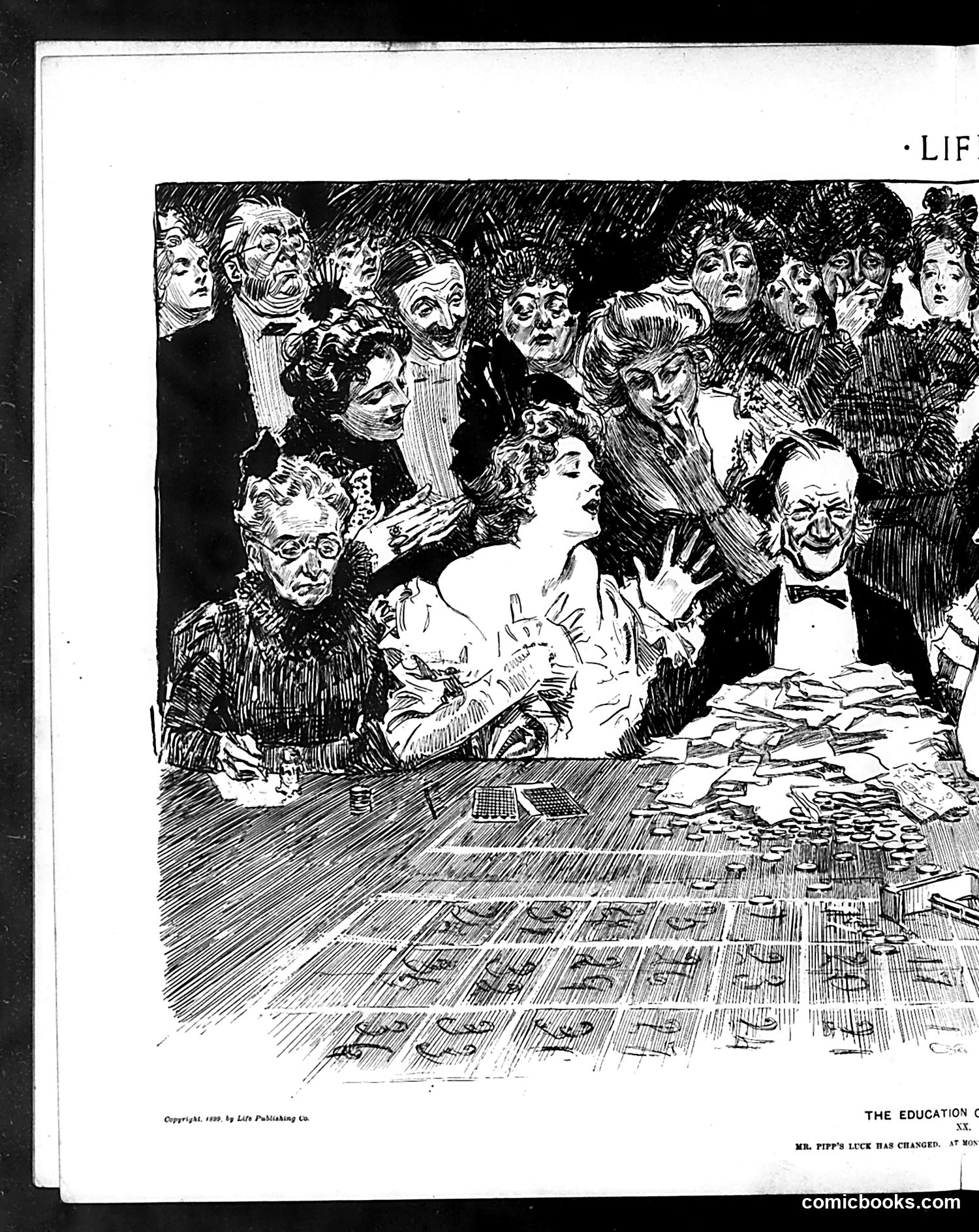
This political cartoon depicts a crowded scene of well-dressed observers gathered around a table covered with scattered papers or documents. A woman in white appears central to the composition, surrounded by men in formal attire displaying various expressions of concern or interest. The caption references "Mr. Pipp's luck has changed," suggesting this satirizes a specific public figure or scandal involving fortune reversal. The scattered papers likely represent financial documents, legal proceedings, or correspondence related to the subject's downfall. Without additional context identifying "Mr. Pipp," the exact historical reference remains unclear. The cartoon's satirical point appears to involve public witnessing of someone's misfortune or exposure through documented evidence, rendered in Life magazine's characteristic sharp, expressive line work.
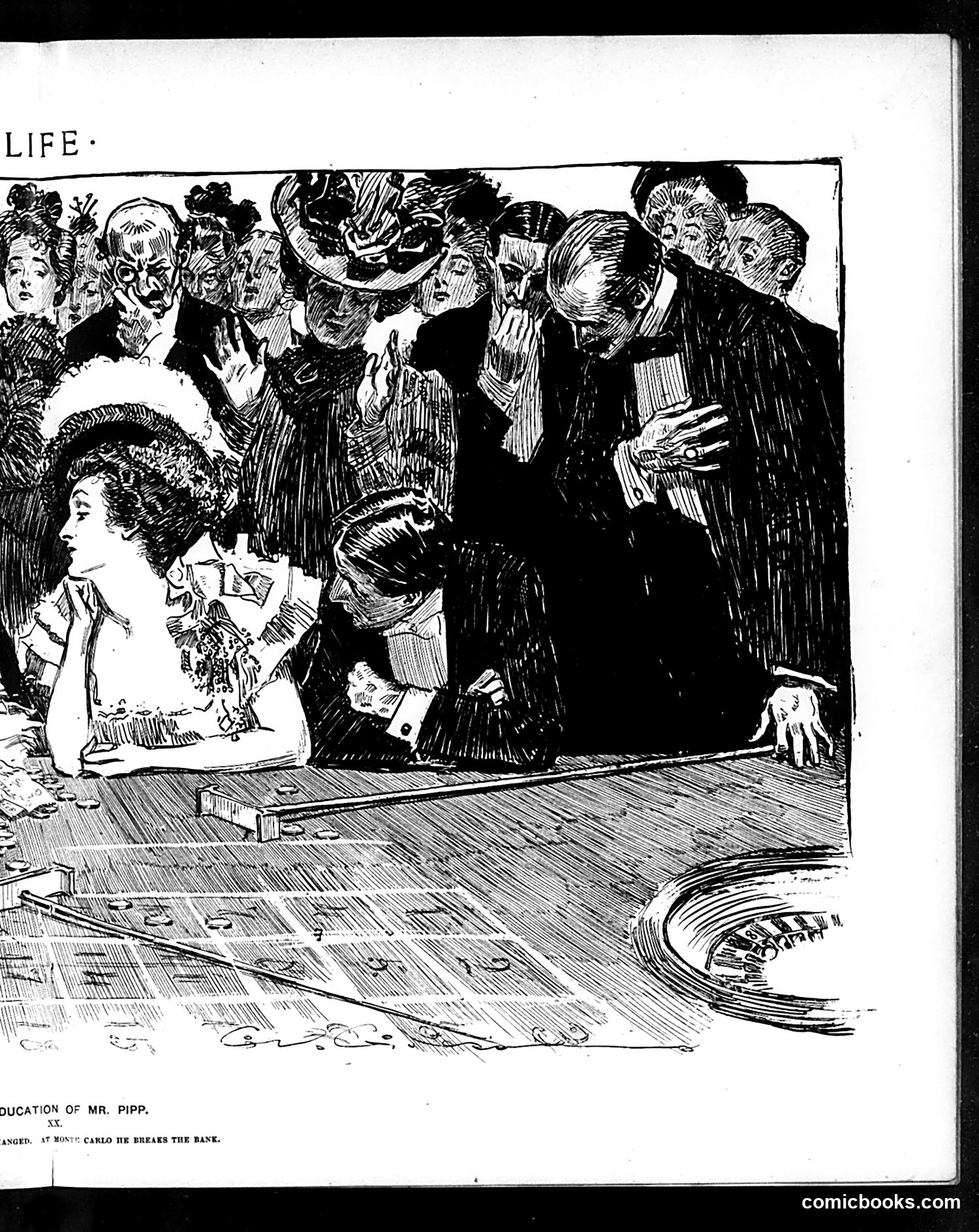
This cartoon depicts a scene at Monte Carlo casino where Mr. Pipp "breaks the bank" (wins a large sum). The illustration shows well-dressed socialites and gentlemen gathered around a gaming table, reacting with apparent shock or dismay to Pipp's success. The satire appears to mock nouveau riche social climbers: Pipp's sudden gambling windfall grants him unexpected entry into high society circles. The crowd's animated reactions suggest both astonishment at his luck and the shallow nature of wealthy society that accepts anyone with money, regardless of background or breeding. The "education" referenced likely means Pipp is being taught a lesson about the fickle nature of wealth and social status through gambling.
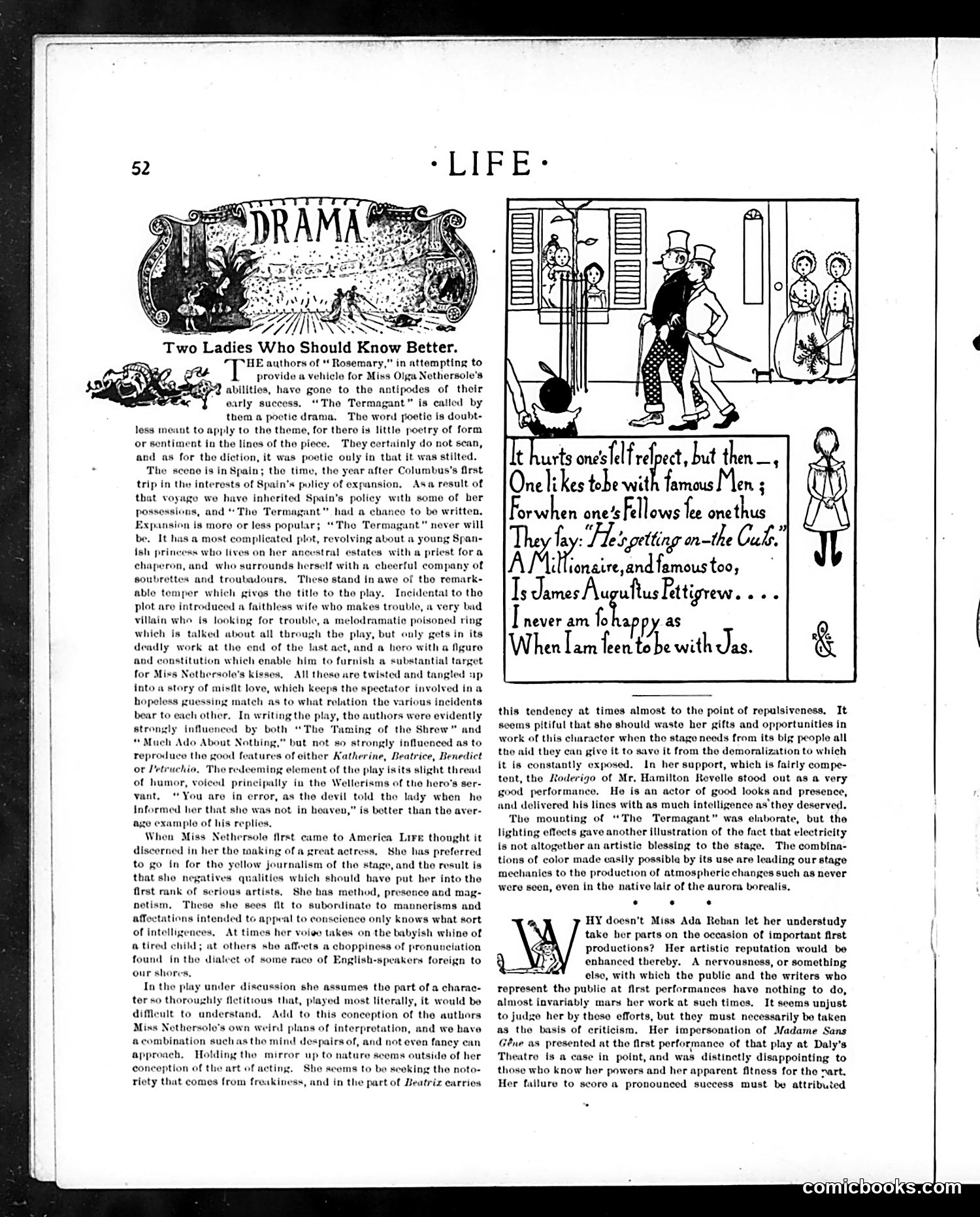
This page contains a drama review titled "Two Ladies Who Should Know Better," critiquing a theatrical production. The accompanying cartoon illustrates a scene where characters interact in what appears to be a domestic setting, with dialogue emphasizing vanity and social ambition. The text discusses actresses' performances and theatrical conventions of the era. The review criticizes how the play presents female characters pursuing fame and association with notable men, as shown in the quoted dialogue: "One likes to be with famous Men" and references to a "Millionaire, and famous too." The satire targets women's preoccupation with social status and romantic conquest rather than substance. The cartoon visually reinforces this critique of shallow female ambition through the staged domestic scene and the characters' interactions, typical of early 20th-century Life magazine's social commentary on gender and theater.
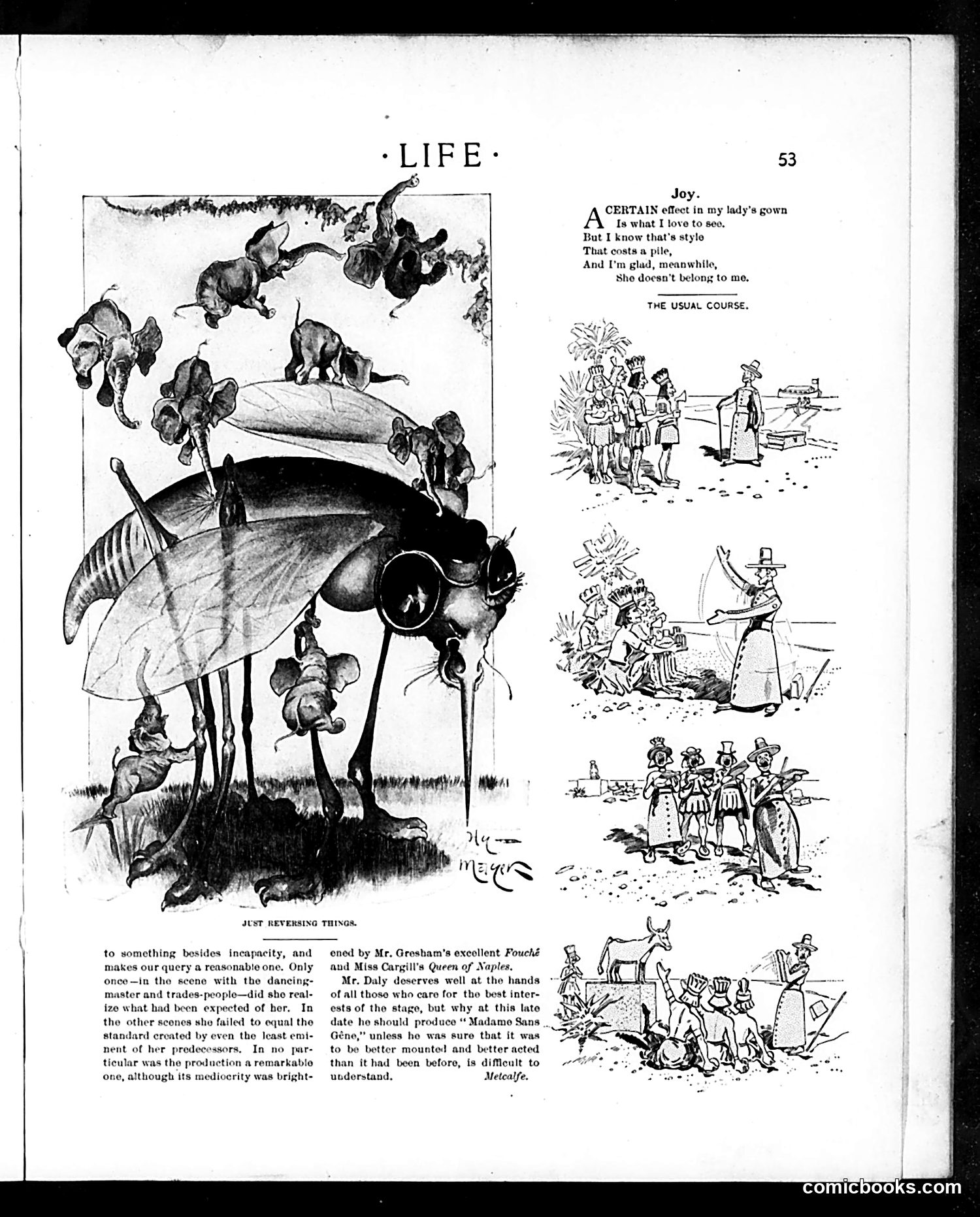
This page contains two distinct elements: **Left side ("Just Reversing Things"):** A theatrical review critiquing a production of "Madame Sans-Gêne," likely staged by impresario Augustin Daly. The reviewer praises supporting performances (Grosham as Fouché, Cargill as Queen of Naples) but criticizes the lead actress for failing to meet standards set by predecessors. The critique questions why Daly would revive this play unless confident in superior execution. **Right side ("The Usual Course"):** A humorous poem with accompanying comic illustrations depicting the typical progression of a romantic relationship—from initial attraction to eventual marriage. The verses express a bachelor's perspective: he admires an expensively-dressed woman but is relieved she "doesn't belong to me," satirizing the financial burdens of courtship and marriage that were social anxieties of the era. The page juxtaposes serious theatrical criticism with light romantic comedy, typical of Life's satirical approach to contemporary culture.
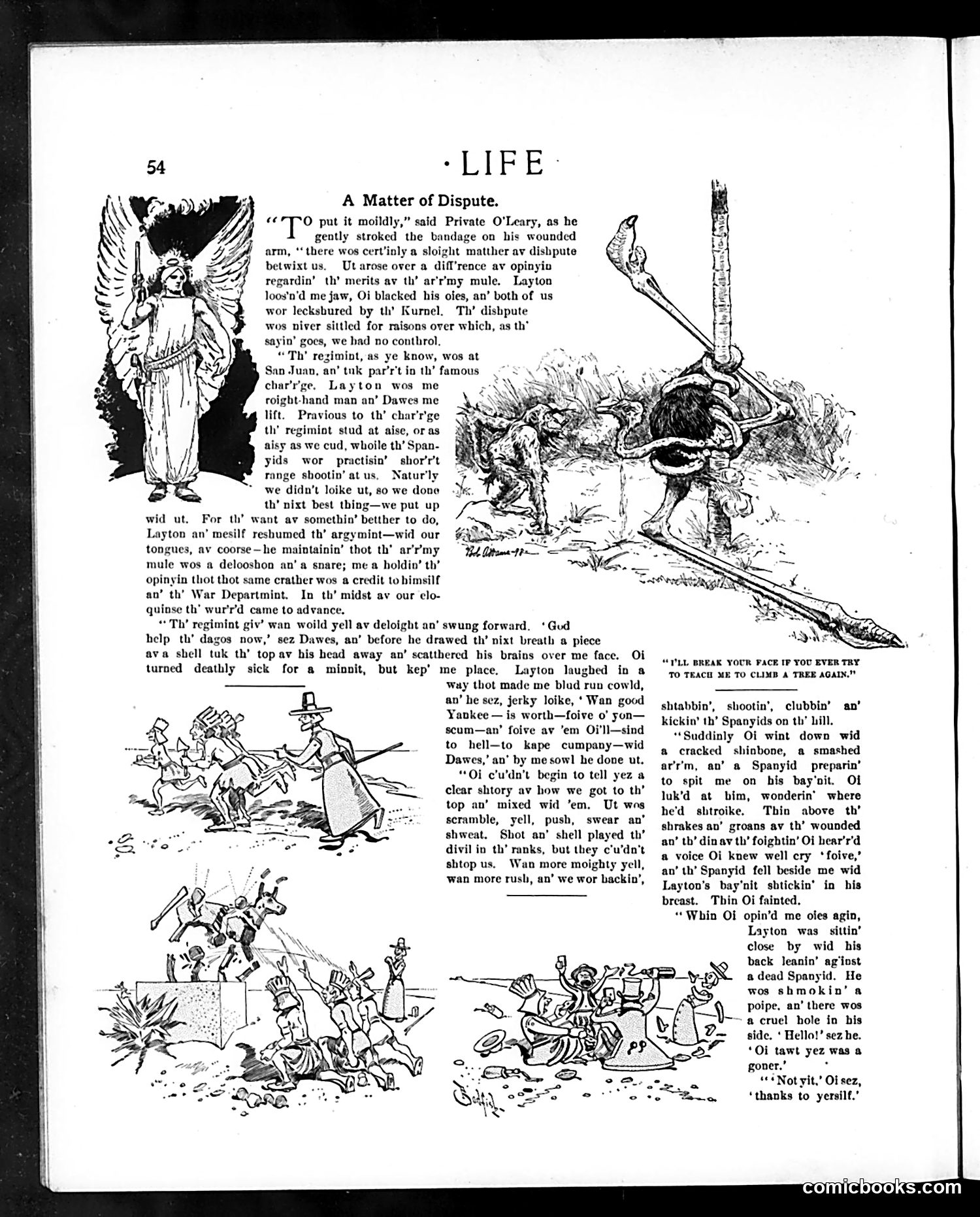
This page presents a soldier's monologue in exaggerated Irish dialect, recounting a dispute with a comrade named Layton during what appears to be the Spanish-American War (referenced by "San Juan" and fighting "Spanyids"). The satire works on multiple levels: The trivial pre-battle argument—whether an army mule was worthless or valuable—escalates into actual combat violence when Layton kills a soldier to prove his point about superiority. The joke is darkly ironic: an abstract disagreement about merits becomes literally fatal. The accompanying illustrations show soldiers in chaotic battle scenes. The piece satirizes military attitudes about honor and argument among soldiers, suggesting that combat provides a brutal context where personal disputes can be "settled" through killing—yet the underlying philosophical disagreement never truly resolves. The heavy Irish-American dialect suggests this targets working-class immigrant soldiers, a common Life magazine subject for both humor and social commentary.
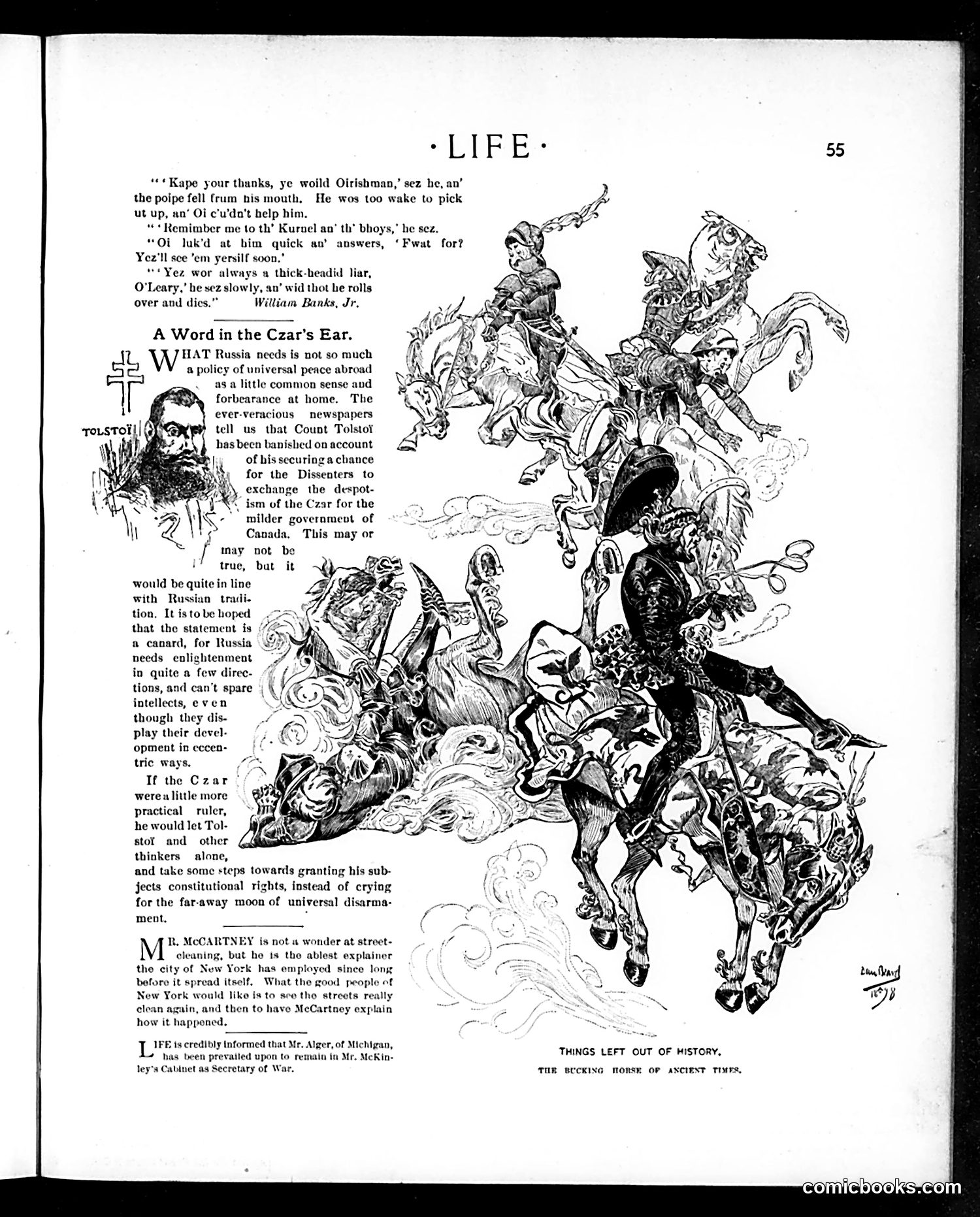
This page contains three distinct pieces of political satire: **1. "A Word in the Czar's Ear"** (main article with Tolstoy caricature): Life criticizes Russian autocracy, referencing rumors that writer Count Tolstoy was banished for helping religious Dissenters. The piece argues Russia needs domestic reform and constitutional rights rather than pursuing universal disarmament rhetoric. It urges the Czar to tolerate intellectuals like Tolstoy instead of suppressing them. **2. "Things Left Out of History"** (large illustration, right): A chaotic cartoon titled "The Bucking Horse of Ancient Times" depicts a wild, bucking horse throwing various historical figures and objects. This appears to be satirizing chaos in history or historical unpredictability, though the specific reference is unclear. **3. Brief mentions** of Secretary of War Alger and street-cleaning official R. McCCartney provide local New York political commentary. The Irish dialect story at top appears unrelated—likely filler content.
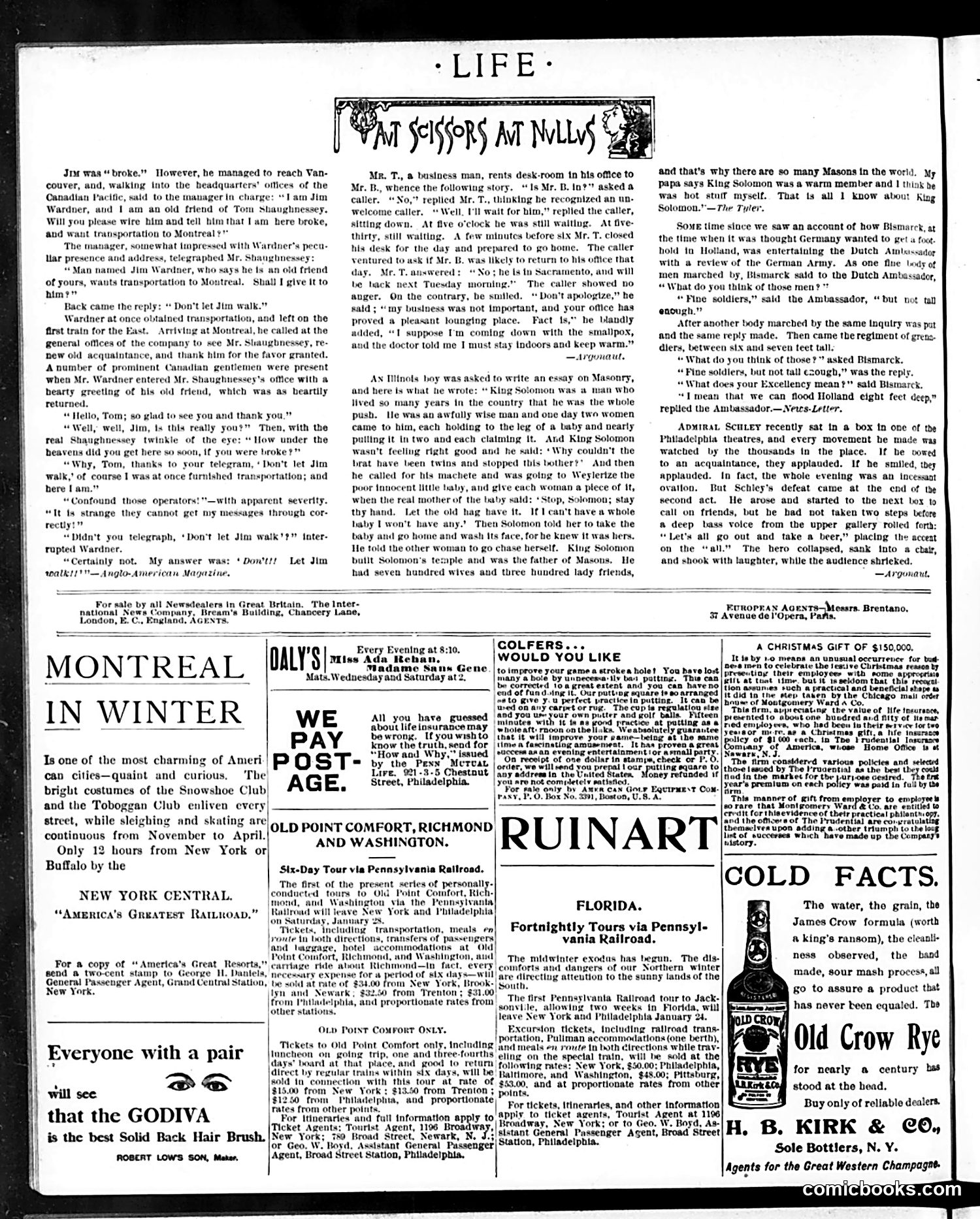
This page from *Life* magazine contains several humorous anecdotes rather than a single political cartoon. The title piece appears to be a serialized story about Jim Wardner, a broke man who successfully cadges transportation from Canadian Pacific Railway by invoking his friendship with company executive Tom Shaughnessey. The other brief jokes satirize bureaucratic absurdity and social pretense: a businessman cheerfully waits hours in an office, unbothered because he has smallpox and needs indoor rest anyway; a schoolboy's essay on King Solomon confuses him with Freemasonry; and Bismarck, Germany's chancellor, brags about military superiority by suggesting German soldiers are so numerous they could flood Holland. These pieces mock human vanity, institutional inefficiency, and diplomatic posturing through deadpan humor typical of *Life's* satirical style. The advertisements for travel and consumer goods surrounding the content are period-typical.
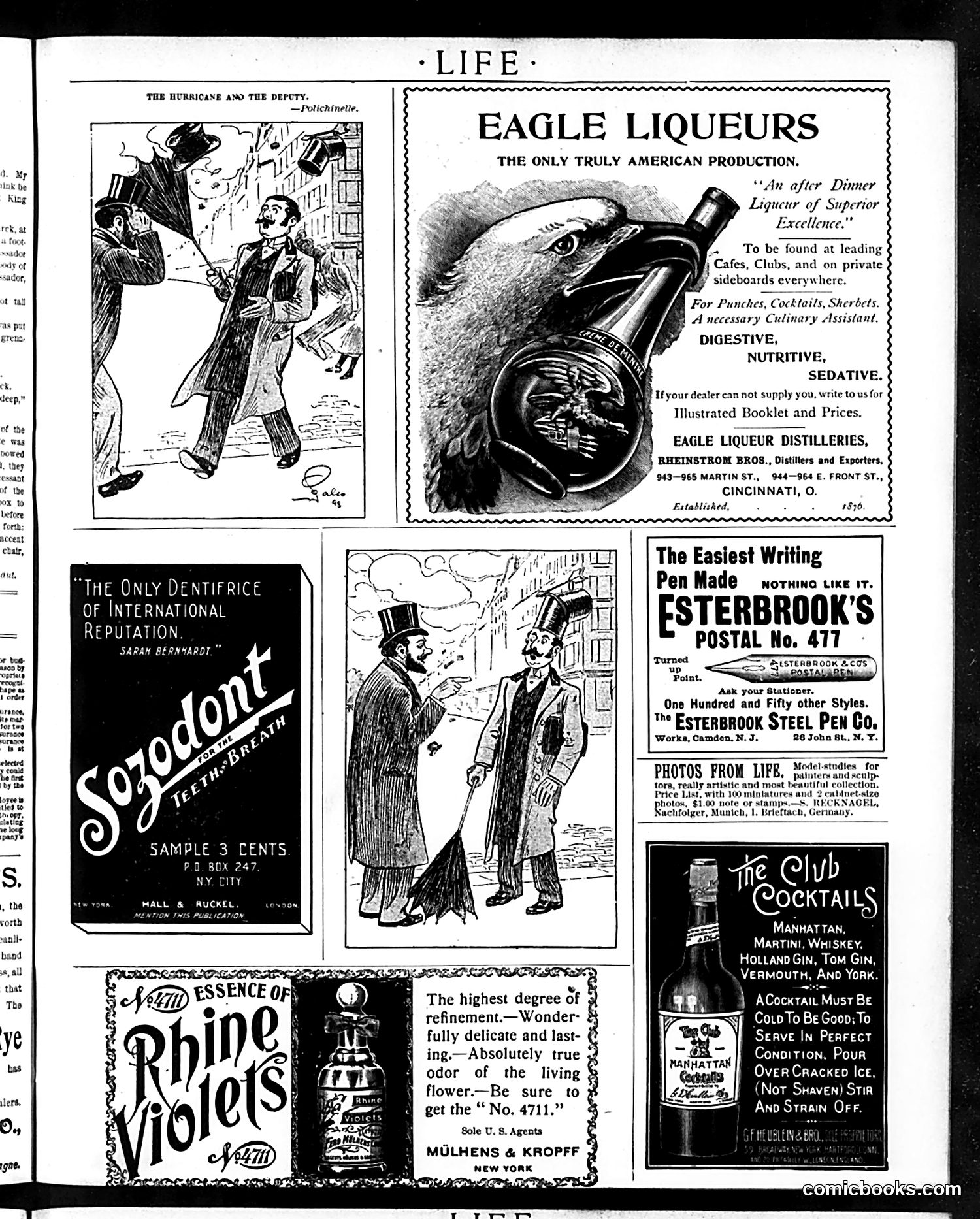
The main cartoon, titled "The Hurricane and the Deputy," shows two figures encountering what appears to be violent urban chaos—likely depicting a street disturbance or riot. The cartoon's satire targets law enforcement's inability to manage social disorder; the "deputy" represents an ineffectual official facing overwhelming "hurricane" (sudden violent upheaval). The page is primarily **advertisements** for luxury goods: Eagle Liqueurs (Cincinnati whiskey), Sozodont toothpaste (endorsed by actress Sarah Bernhardt), Esterbrook pens, Rhine Violets perfume, and cocktail recipes. These ads reflect early 20th-century American consumer culture. The cartoonist credited as "Polichinette" uses the classic figure of Pulcinella (a stock character from commedia dell'arte) to satirize modern disorder. The contrast between refined consumer goods and urban chaos suggests Life magazine's sophisticated audience—wealthy enough to purchase imported liqueurs and fine products, yet anxious about social unrest and lawlessness.
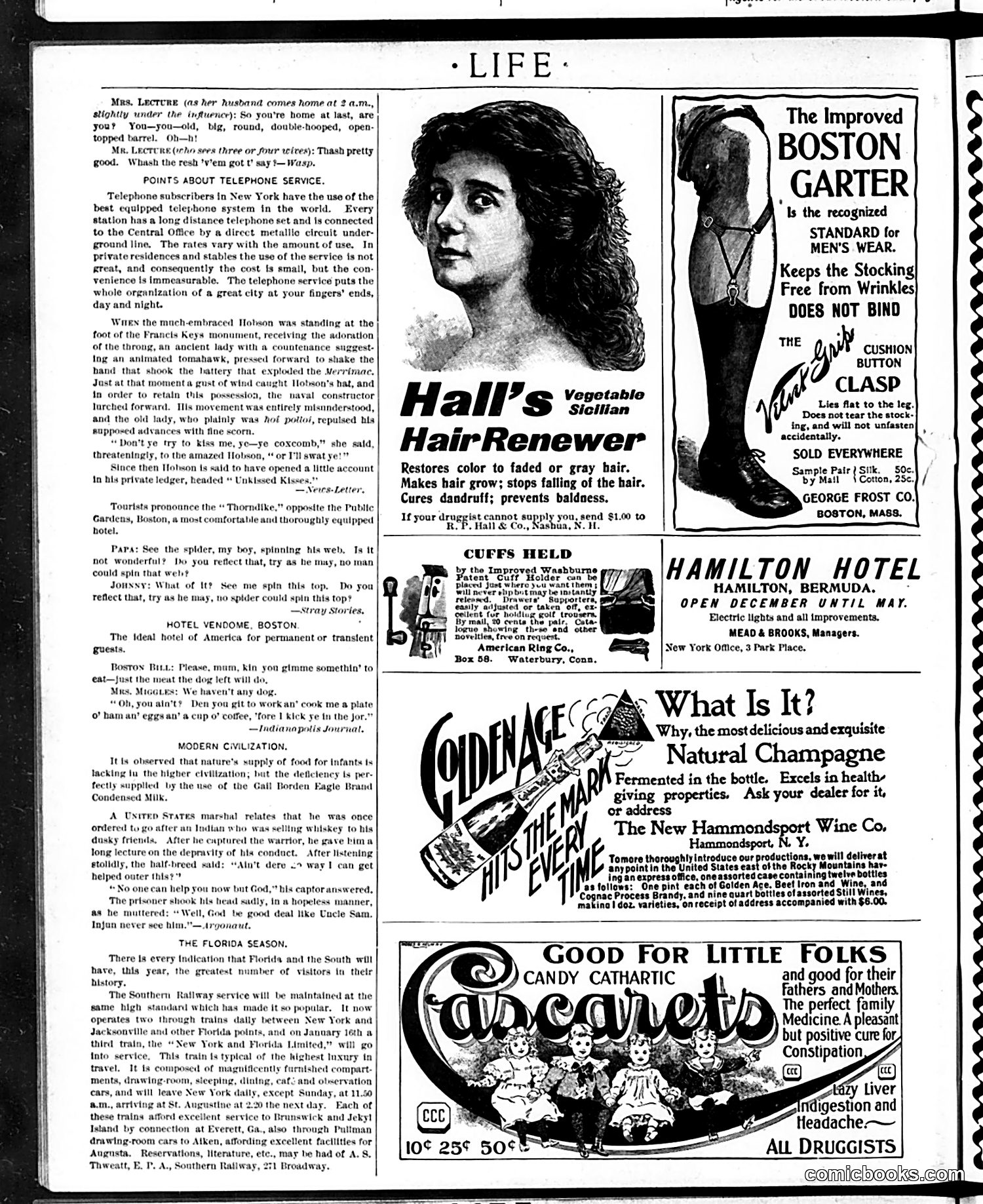
This page is primarily **advertising with comedic vignettes**, typical of early 1900s Life magazine format. The main cartoon depicts a drunk husband returning home at 2 a.m., with his wife berating him as a "barrel." His inebriated response—seeing "three or four wives"—is the joke: his intoxication causes double vision. This reflects common satirical themes about alcohol's effects. The page also includes a historical anecdote about Admiral Hobson (a Spanish-American War hero) being mistakenly repelled by an elderly woman at a monument dedication when he lunched forward to catch his hat, not to kiss her. The humor lies in the misunderstanding and the woman's fierce rebuke. The remaining content consists of hotel advertisements, telephone service explanations, and product ads (hair restorer, garters, champagne, candy laxative). These ads provide social context: the era's preoccupations with appearance, constipation remedies, and travel luxury. The page reflects early 1900s urban American culture, class consciousness, and reliance on patent medicines and "modern conveniences."
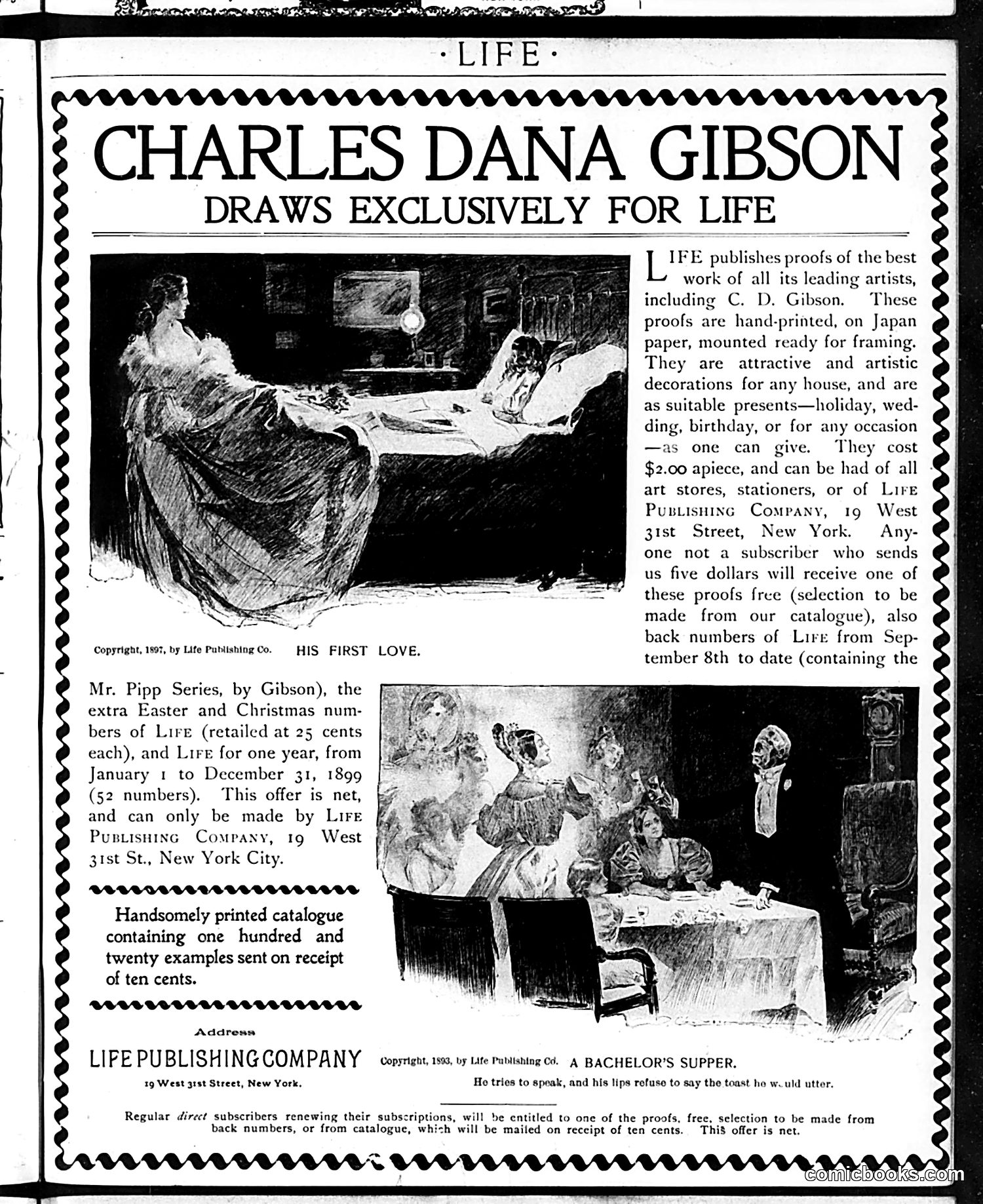
This page is primarily an advertisement for *Life* magazine's art reproductions, featuring work by Charles Dana Gibson, a renowned illustrator of the era. The two cartoons shown are examples of Gibson's work: **"His First Love"** depicts a young couple in an intimate domestic moment—the man reading while the woman reclines, suggesting early romantic attachment. **"A Bachelor's Supper"** shows a dinner scene where a bachelor attempts to propose a toast but finds himself emotionally unable to speak, his "lips refuse to say the toast"—a humorous commentary on male vulnerability and the emotional difficulty of formal social ritual. Both cartoons reflect Gibson's trademark subject matter: courtship, romance, and the social conventions of 1890s upper-class life. The advertisement promotes framed art proofs ($2.00 each) as tasteful home decorations and gifts, targeting middle and upper-class readers with disposable income for such luxury items.
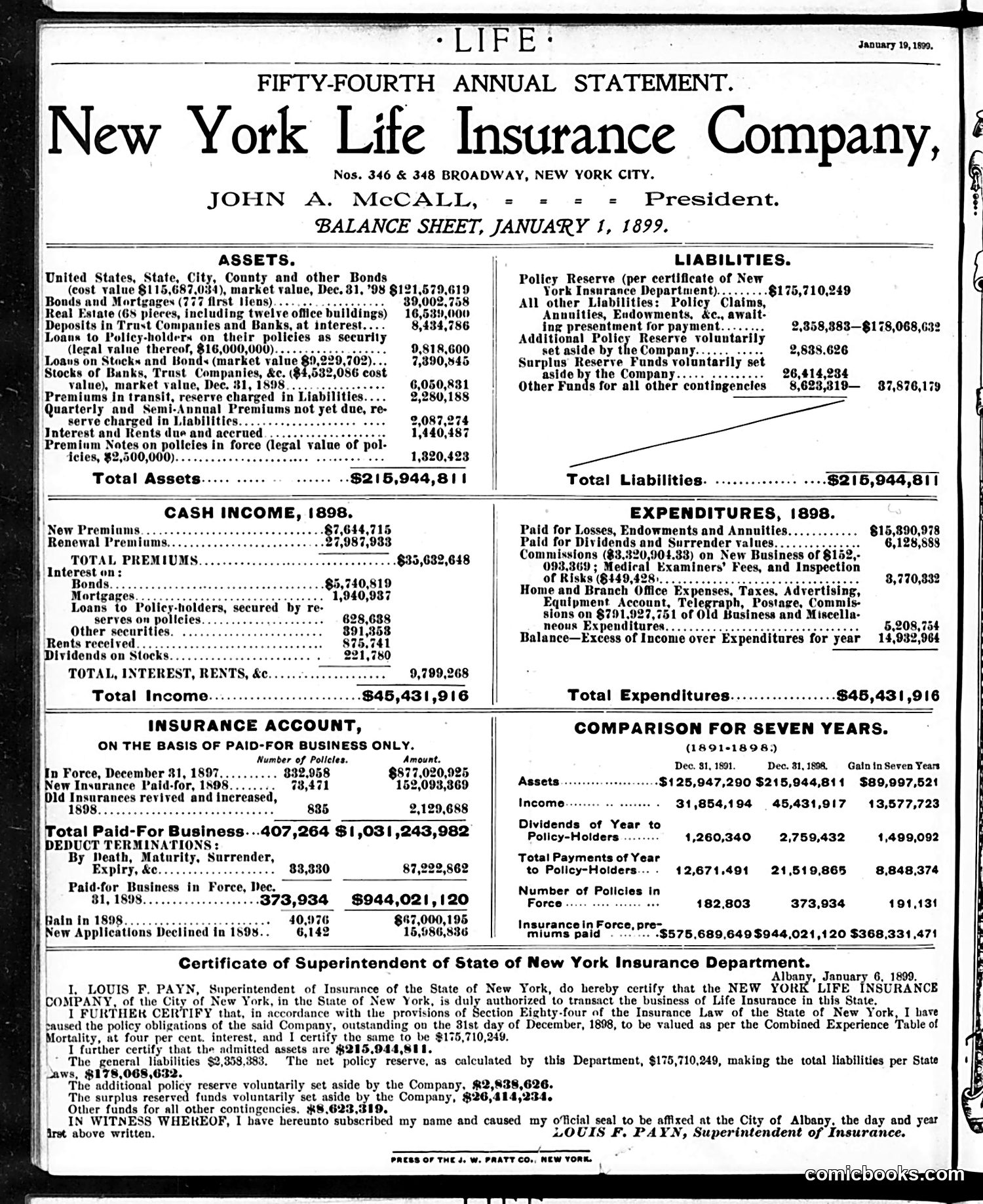
This is **not a cartoon or satirical content** — it's a straightforward financial document. The page reproduces the New York Life Insurance Company's fifty-fourth annual statement for January 1, 1899, published in *Life* magazine (a common practice for major corporations to publish financial disclosures in newspapers and magazines). The document lists the company's assets ($215,944,811), liabilities, income for 1898 ($45,431,916), and expenditures. It includes a seven-year comparison showing the company's growth from 1891-1898, and ends with a certificate from Louis F. Payn, Superintendent of the New York Insurance Department, certifying the financial figures. This represents corporate transparency reporting from the Gilded Age — companies used mass-circulation magazines to demonstrate financial stability to policyholders and the public.