
Life, 1899-01-19 · page 6 of 20
Life — January 19, 1899 — page 6: what you’re looking at
What you’re looking at
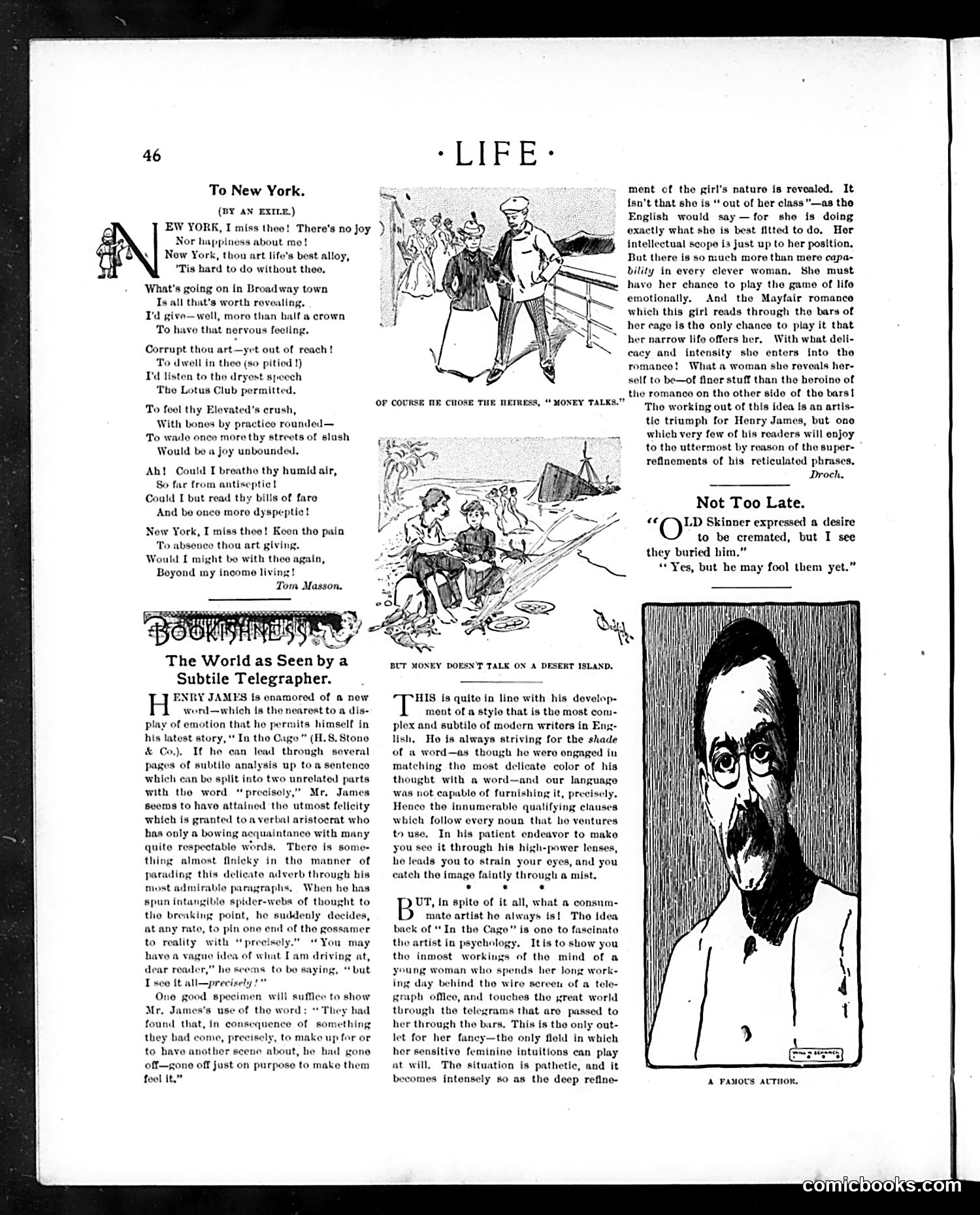
This page contains three distinct pieces: 1. **"To New York (By an Exile)"** - A poem by Tom Masson expressing nostalgia for New York City, contrasting Broadway's excitement with the speaker's current quiet location. 2. **"The World as Seen by a Subtitle Telegrapher"** - A review praising Henry James's novel "In the Cage" for its psychological subtlety. The critic admires James's use of precise language and his ability to convey complex inner thoughts. The piece celebrates how James depicts a young telegraph operator's imaginative life as she processes messages. 3. **Illustrations** - Two sketches accompany the telegrapher article: one showing people on what appears to be a ship, captioned "Of course he chose the heiress, 'Money talks'"; another showing figures near a desert island labeled "Honey doesn't talk on a desert island." A portrait of "A Famous Author" (likely James) concludes the page.
📄 Transcribed text from this page (OCR, searchable)
Machine-transcribed from the original scan — historical spelling and the odd misread are preserved.
To New York. (BY AN Extze.) EW YORK, I miss thee! There's no Joy Nor happiness about me! . | Now York, thou art life's best alloy, "Tis hard to do without theo, What's going on in Broadway town Is all that’s worth rovealing. T'd give—woll, moro than half a crown ‘To have that nervous feeling. Corrupt thou art—yct ont of reach! To dwell in theo (so pitied !) Td listen to the dryost speceh The Lotus Club permitted. To feel thy Elevated's crush, With bones by practice rounded— To wade once more thy streets of slash Would bo a joy unbounded. Abt Could I breatho thy humid air, So far from antiseptic! Could I but read thy bills of faro And be ono moro dyspeptic! New York, I miss thee! Keen tho pain ‘To absence thou art giving. Would [ might be with theo again, Boyond ny income living! Tom Masson. The World as Seen by a Subtile Telegrapher. ENRY JAMES is enamored of a new word—which is the nearest to a dis- play of emotion that ho permits himself in his latest story, “In tho Cago” (H.8.8 & Co.). If ho can lead through several pages of subtilo analysis up toa sentence which can be split into two unrelated parts with the word “precisoly,” Mr, James seoms to havo attained tho utmost felicity which is granted toa verbal aristocrat who has only a bowing acquaintance with many quite respectable words, Thero is some thing almost finicky in tho manner of parading this delicate adverb through bis most admirable paragraphs, When he has spun intangible spider-webs of thought to tho breaking point, he suddenly decides, at any rato, to pin one end of the gossamer to reality with “precisely.” “You may have a vague idea of what Lam driving at, dear reader,” he seems to be sayi I see ft all—prei a One good specimen will suffice to show Mr. James's use of the word: * They found that, in consequence of som they bad come, precisely, to make up for or to have another scene about, he bad gone off—gone off just on purpose to make them fool it” BUT MONEY DOESN'T TALK ON A DESERT ISLAND. HIS is quite in line with his develop mont of a stylo that is tho most com- plex and subtile of modorn writors in Eng- lish, Ho is always striving for the shade of a word—as though ho wero ongaged in mutching tho most delicate color of his thought with a word—and our language was not capable of furnishing it, precisely. Henco the innumerable qualifying clauses which follow every noun that he ventures to use, In his patient endeavor to mako you seo it through his high-power lenses, he leads you to strain your eyes, and you catch tho imago faintly through a mist, * . * B™ in spite of it all, what a consnm- mato artist ho always is! Tho idea back of “In the Cago” is one to fascinate the artist in psychology. It is to show you tho inmost workings of the mind of a young woman who spends hee long work- ing day behind tho wire screen of a tele- gruph office, and touches the sreat world through the telegrams that aro passed to her through the bars. This is the only out- let for her fancy—the only fleld in which her sensitive feminine intuitions can play at will, Tho situation is pathetic, and it becomes intensely $0 as the deep refine- ment of the girl's nature is revealed. It isn’t that sho is “ out of her class”—as the English would say —for sho is doing exactly what sho is best fitted todo, Hor intellectual scope ia just up to her position, But there is so much more than mere capa- bility in every clever woman, She must havo her chanco to play the game of life emotionally, And the Mayfair romance which this girl reads through tho bars of her eago is the only chance to play it that her narrow life offers her, With what deli- cacy and intensity sho enters into tho romance! What a woman she reveals hor- self to be—of flner stuff than the heroine of the romanco on tho other side of the bars! Tho working out of this idea is an artis- tic triumph for Henry James, but one which very few of his readers will enjoy to tho uttermost by reason of the super- reflnements of his reticulated phrases, Droch, Not Too Late. “ LD Skinner expressed a desire to be cremated, but I see they buried him «Yes, but he may fool them yet.” ay A PAMOUS AUTHOR.