
Life, 1899-01-19 · page 14 of 20
Life — January 19, 1899 — page 14: what you’re looking at
What you’re looking at
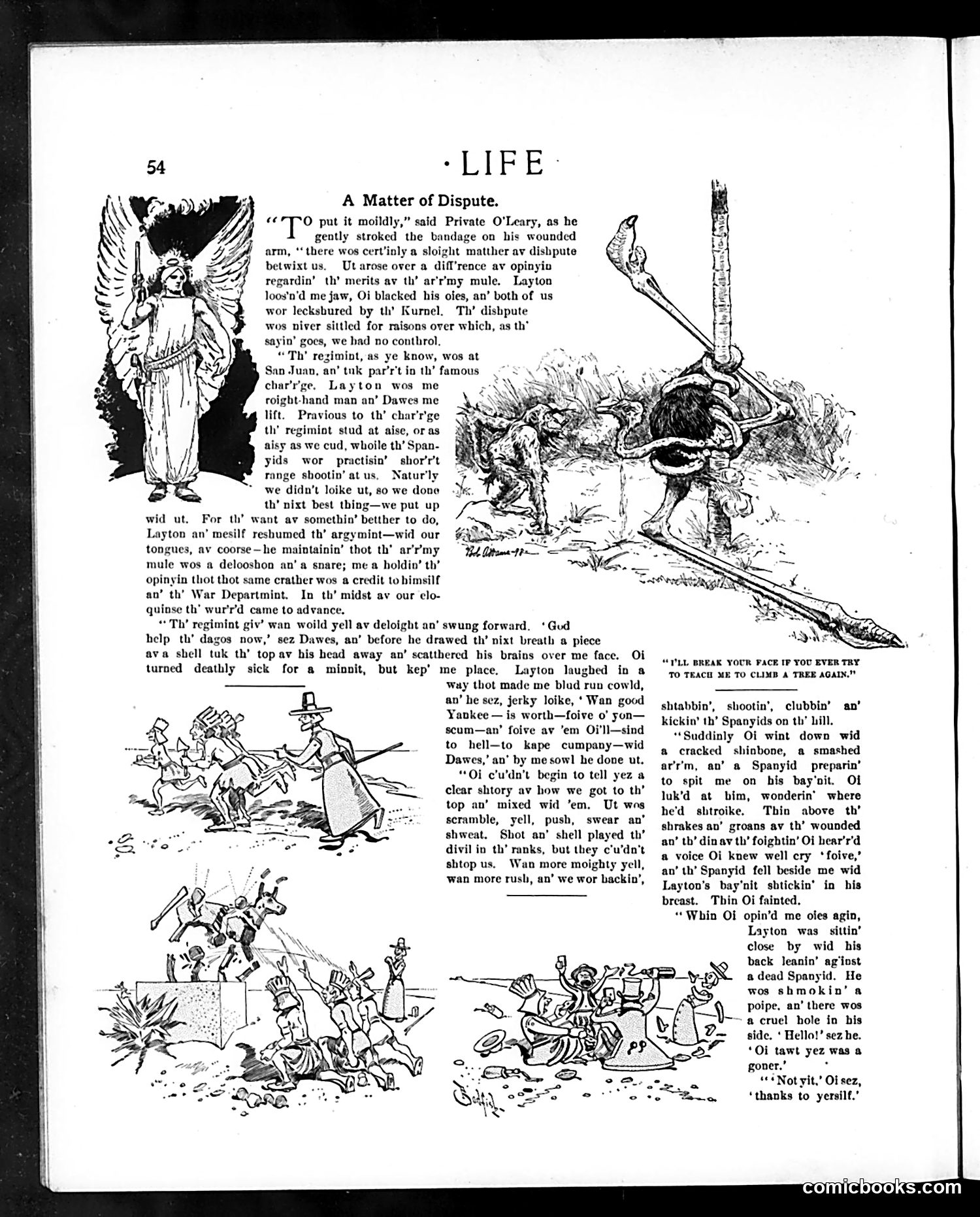
This page presents a soldier's monologue in exaggerated Irish dialect, recounting a dispute with a comrade named Layton during what appears to be the Spanish-American War (referenced by "San Juan" and fighting "Spanyids"). The satire works on multiple levels: The trivial pre-battle argument—whether an army mule was worthless or valuable—escalates into actual combat violence when Layton kills a soldier to prove his point about superiority. The joke is darkly ironic: an abstract disagreement about merits becomes literally fatal. The accompanying illustrations show soldiers in chaotic battle scenes. The piece satirizes military attitudes about honor and argument among soldiers, suggesting that combat provides a brutal context where personal disputes can be "settled" through killing—yet the underlying philosophical disagreement never truly resolves. The heavy Irish-American dialect suggests this targets working-class immigrant soldiers, a common Life magazine subject for both humor and social commentary.
📄 Transcribed text from this page (OCR, searchable)
Machine-transcribed from the original scan — historical spelling and the odd misread are preserved.
Ze ra GEA ‘LIFE : A Matter of Dispute. «TO put it moildly,” said Private O'Leary, as he gently stroked the bandage on his wounded “there wos cert'inly a sloight matther av dishpute us, loos'n'd me jaw, Oi blacked his wor lecksbured by th’ Kurnel. Ut arose over a diff’rence av opinyiu regardin’ th’ merits av th’ ar'r’my mule. Layton oies, an’ both of us Th’ dishpute wos niver sittled for raisons over which, as th* sayin’ goes, we had no conthrol. “Th’ rezimint, as ye know, wos at & San Juan, an’ tuk par’r't in th’ famous char’r’ge. Layton wos me roight-hand man an’ Dawes me lift. Pravious to th’ char’r'ge th’ regimint stud at aise, or as aisy as we cud, whoile th’ Span- yids wor practisin’ shorr't range shootin’ at us, Natur'ly we didn’t loike ut, so we done th’ nixt best thing—we put up wid ut, For th’ want av somethin’ betther to do, Layton an’ mesilf reshumed th’ argymint—wid our tongues, av coorse—he maintainin’ thot th’ arr’my mule wos a deloosbon an’ a snare; me a holdin’ th’ opinyin thot thot same crather wos a credit to himsilf an’ th’ War Departmint. In th’ midst av our clo- quinse th’ wur'r’d came to advance. “ Th’ regimint giv’ wan woild yell av deloight an’ swung forward. ‘Gud help th’ dagos now,’ sez Dawes, an’ before he drawed th’ nixt breath a piece ava shell tuk th’ top av his head away an’ scatthered his brains over me face. but kep’ me place, turned deathly sick for a minnit, Oi Layton laughed in a way thot made me blud run cowld, an’ he sez, jerky loike, ‘Wan good Yankee — is worth—foive o’ yon— scum—an’ foive av ‘em Oi'll—sind to hell—to kape cumpany—wid Dawes,’ an’ by me sowl he done ut. “Oi c'u’dn’t begin to tell yez a clear shtory av how we got to th’ top an’ mixed wid ‘em. Ut wos scramble, yell, push, swear an’ shweat. Shot an’ shell played th’ divil in th’ ranks, but they c’u’dn't shtop us. Wan more moighty yell, ‘wan more rush, an’ we wor backin’, oat m7 Oa err, Tahoe “TLL BREAK YOUR PACE IP YOU EVER TRY TO TEACH ME TO CLIMB A TREE AGAIN,” shtabbin’, shootin’, clubbin’ ¥ kickin’ th’ Spanyids on th’ hill. “Suddinly Oi wint down wid a cracked shinbone, a smashed arr’m, an’ a Spanyid preparin’ to spit me on his bay'nit. Of luk’d at bim, wonderin’ where he'd sbtroike. Thin above th’ shrakes ap’ groans av th’ wounded an’ th’ din av th’ foightin’ Oi hear’r'd a voice Oi knew well cry ‘foive,’ an’ th’ Spanyid fell beside me wid Layton’s bay'nit sbtickin’ in his breast. Thin Oi fainted. *Whin Oi opin’d me ofes agin, Layton was sittin’ close by wid his back leanin’ ag'iost a dead Spanyid. He wos shmokin’ a poipe, an’ there wos a cruel hole in his side. * Hello!’ sez he. ‘Oi tawt yez was a goner.’ ‘«*Not yit,’ Oi sez, ‘thanks to yersilf.’