
Life, 1899-01-19 · page 12 of 20
Life — January 19, 1899 — page 12: what you’re looking at
What you’re looking at
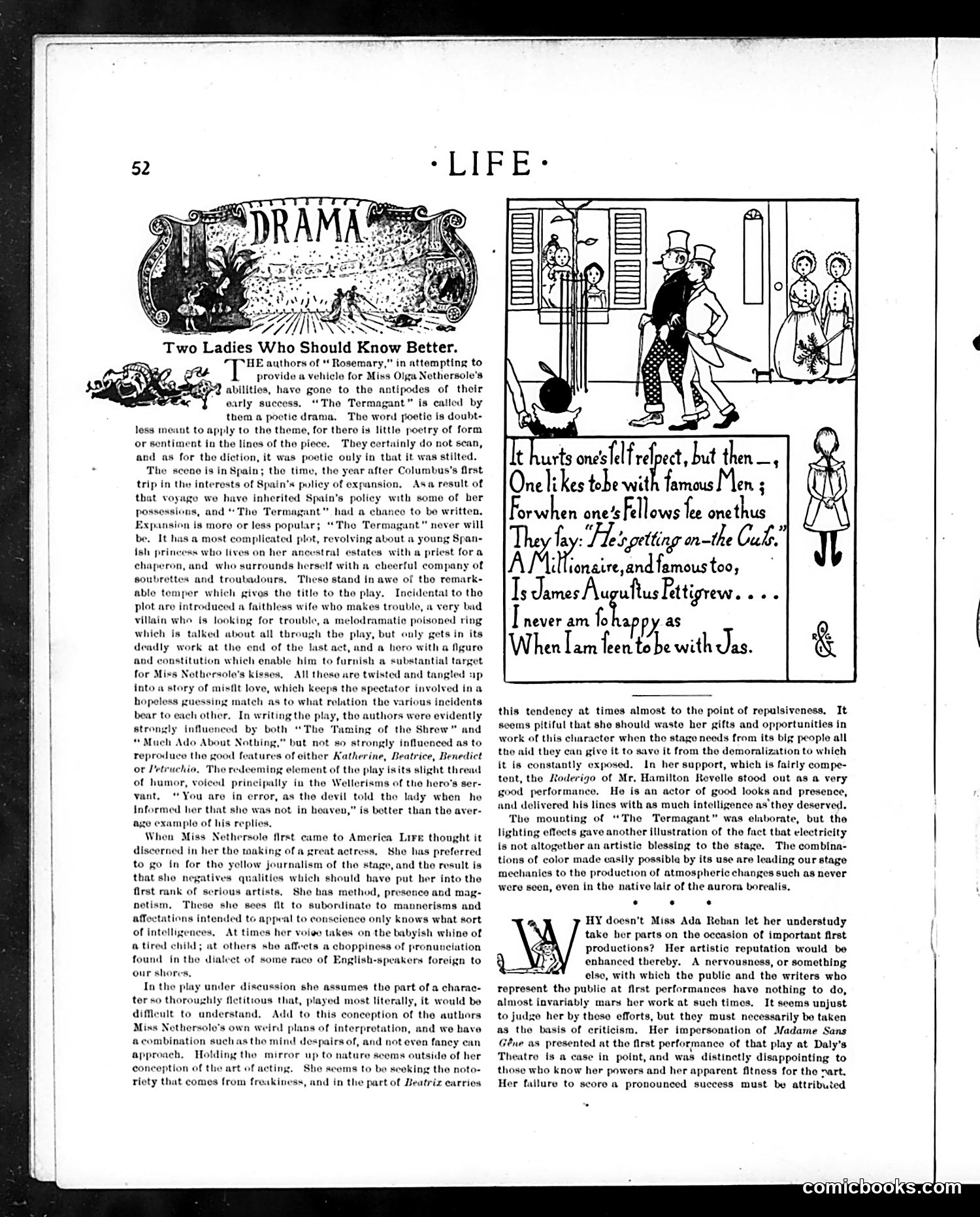
This page contains a drama review titled "Two Ladies Who Should Know Better," critiquing a theatrical production. The accompanying cartoon illustrates a scene where characters interact in what appears to be a domestic setting, with dialogue emphasizing vanity and social ambition. The text discusses actresses' performances and theatrical conventions of the era. The review criticizes how the play presents female characters pursuing fame and association with notable men, as shown in the quoted dialogue: "One likes to be with famous Men" and references to a "Millionaire, and famous too." The satire targets women's preoccupation with social status and romantic conquest rather than substance. The cartoon visually reinforces this critique of shallow female ambition through the staged domestic scene and the characters' interactions, typical of early 20th-century Life magazine's social commentary on gender and theater.
📄 Transcribed text from this page (OCR, searchable)
Machine-transcribed from the original scan — historical spelling and the odd misread are preserved.
Two ‘Ladies Who Should Know Better. HE authors of “ Rosemary,” in attempting to provide a vehicle for Miss Olga Nethersole’s abilities, have gone to the antipodes of their early success, “Tho Termagant” is called by them a poctic drama, The word poetic is doubt- less meant to apply to the theme, for there is little poetry of form or sentiment in the lines of the piece. They certainly do not scan, and as for the diction, it was poetic only in that it was stilted, The scene is in Spain; the time, the year after Columbus's first trip in the interests of Spain's policy of expansion, Asa result of that voyage we havo inherited Spain’s policy with some of ber possessions, and “The Termagant” had a chance to be written, Expansion is moro or less popular; “The Ter! nt" never will be, It has a most complicated plot, revolving about a young Span- ish princess who lives on her ancestral estates with a priest fora ron, and who surrounds herself with a cheerful company of prettes and troubadours, Theso stand in awe of the remat able temper which gives tho title to the play. Incidental to tho plot are introduced a faithless wife who makes troubl villain who is looking for trouble, a melodramatic poisoned ring which is talked about all through the play, but only gets in its deadly work at the end of the last act, and a hero with a figure and constitution which enable him to furnish a substantial target: for Miss Nethersole’s kigses, All these are twisted and tangled up into a story of misft love, which keeps the spectator involved ina hopeless guessing match as to what relation the various incidents bear to each other. In writing the play, the authors were evidently strongly influ 1 by both “The Taming of the Shrew” and “ Much Ado About Nothing,” but not so strongly influenced as to reproduce the good features of either Katherine, Beatrice, Benedict or Ietruchia, The redeeming element of the play isits slight thread of humor, voiced principally in the Wellerisms of the hero's se vant, “You are in error, as the devil told the lady when ho Informed her that sho was not in heaven,” is better than the aver- age example of his replies, When Miss Nethersole first came to America Lire thought it discerned in her the making of a great actress, She has preferred to go in for tho yellow journalism of tho stage, and tho result is that sho negatives qualities which should have put her into the first rank of serious artists, She method, presence and mag- netism. These she sees fit to subordinate to mannerisms and affectations intended to appeal to conscience only knows what sort of intelligences, At times her voiee takes on the babyish whine of a tired child; at others she affects a choppiness of pronunciation found inthe dialect of some race of English-speakers foreign to our shores, In the pla ter so thorou under discussion she assumes the part of a charac- zhly fictitious that, played most literally, it would be diMeult to anderstand. Add to this conception of the authors Miss Nethersolo’s own weird plans of interpretation, and wo bave acombination suchas tho mind despairs of, and not even fancy ean approach, Holding tho mirror up to nature seems outside of her conception of the art of acting. She seems to be seeking the noto- riety that comes from freakiness, and in the part of Beatriz carries t hurts Alia ect, but then, One likes rie Men ; Forwhen one sFellows fee eats They fa Tlexpetting on-the Culp. AR Wonaire, andfamoustoo, Is Sagal ttigrew. aise [never am foha When Tam fen te tobe with ses. this tendency at times almost to the point of repulsiveness, It scoms pitiful that she should waste her gifts and opportunities in work of this character when tho stage needs from its big people all tho aid they can give it to save it from the demoralization to which it is constantly exposed. In her support, which is fairly compe- tont, the Koderigo of Mr, Hamilton Revelle stood out as a very good performance, He is an actor of good looks and presence, and delivered his lines with as much intelligence as they deserved. The mounting of “The Termagant” was elaborate, but the lighting effects gave another illustration of the fact that electricity is not altogotbor an artistic blessing to the stage. The combina- tions of color made casily possibla by its use are leading our stage mechanics to the production of atmospheric changes such as never were seen, even in the native lair of the aurora borealis, . . . HY doesn’t Miss Ada Rehan let her understudy take her parts on the occasion of important first productions? Her artistic reputation would be enbanced thereby. A nervousness, or something clso, with which the public and the writers who represent tho public at first performances have nothing to do, almost invariably mary her work at such times, It seoms unjust to judge her by theso efforts, but they must necessarily be taken as tho basis of criticism. Her impersonation of Madame Sans Géne as presented at tho first performance of that play at Daly's Theatre is a case in point, and was distinctly disappointing to those who know her powers and her apparent fitness for the nart. Her failure to score a pronounced success must be attributed