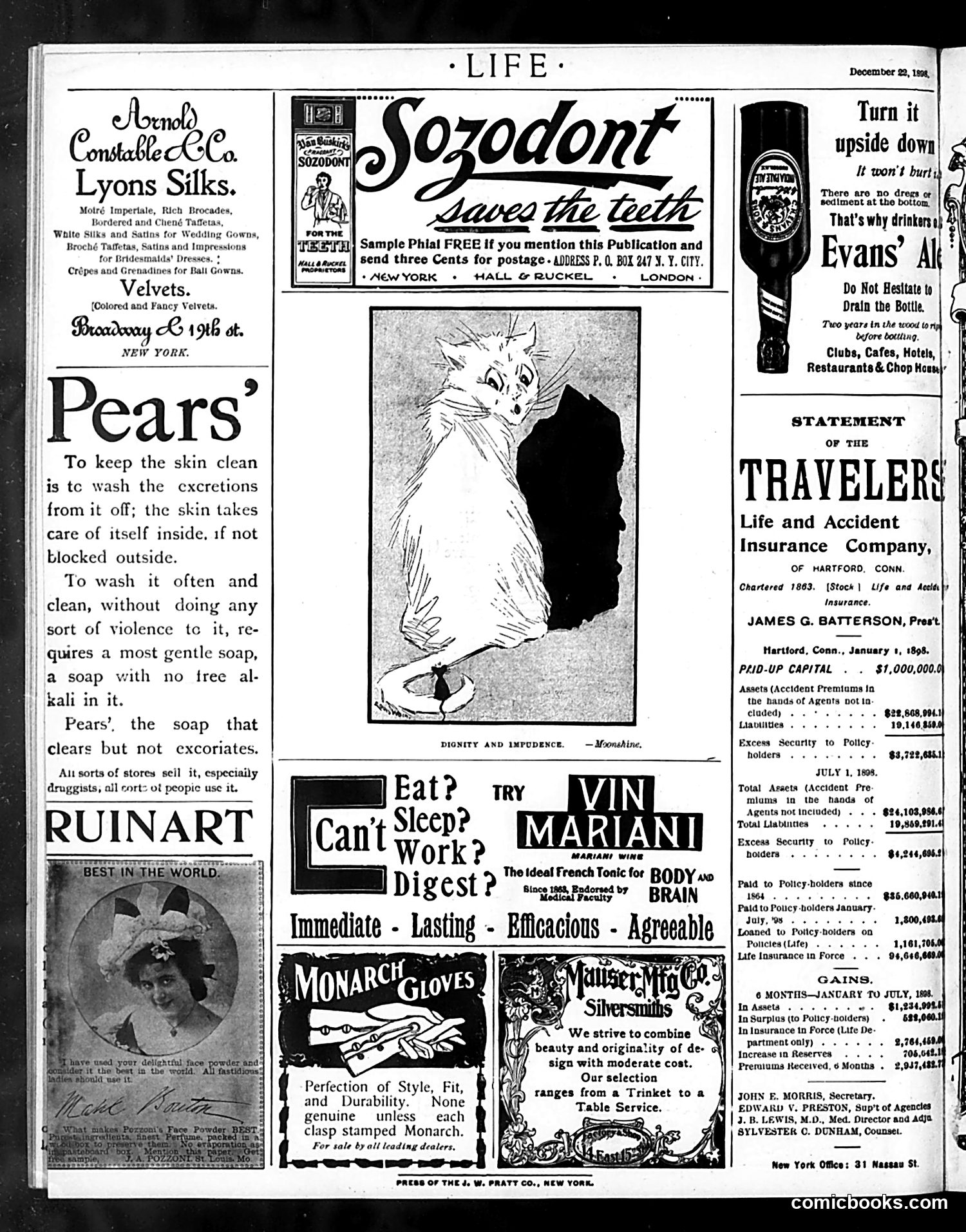
A complete issue · 22 pages · 1898
Life — December 22, 1898
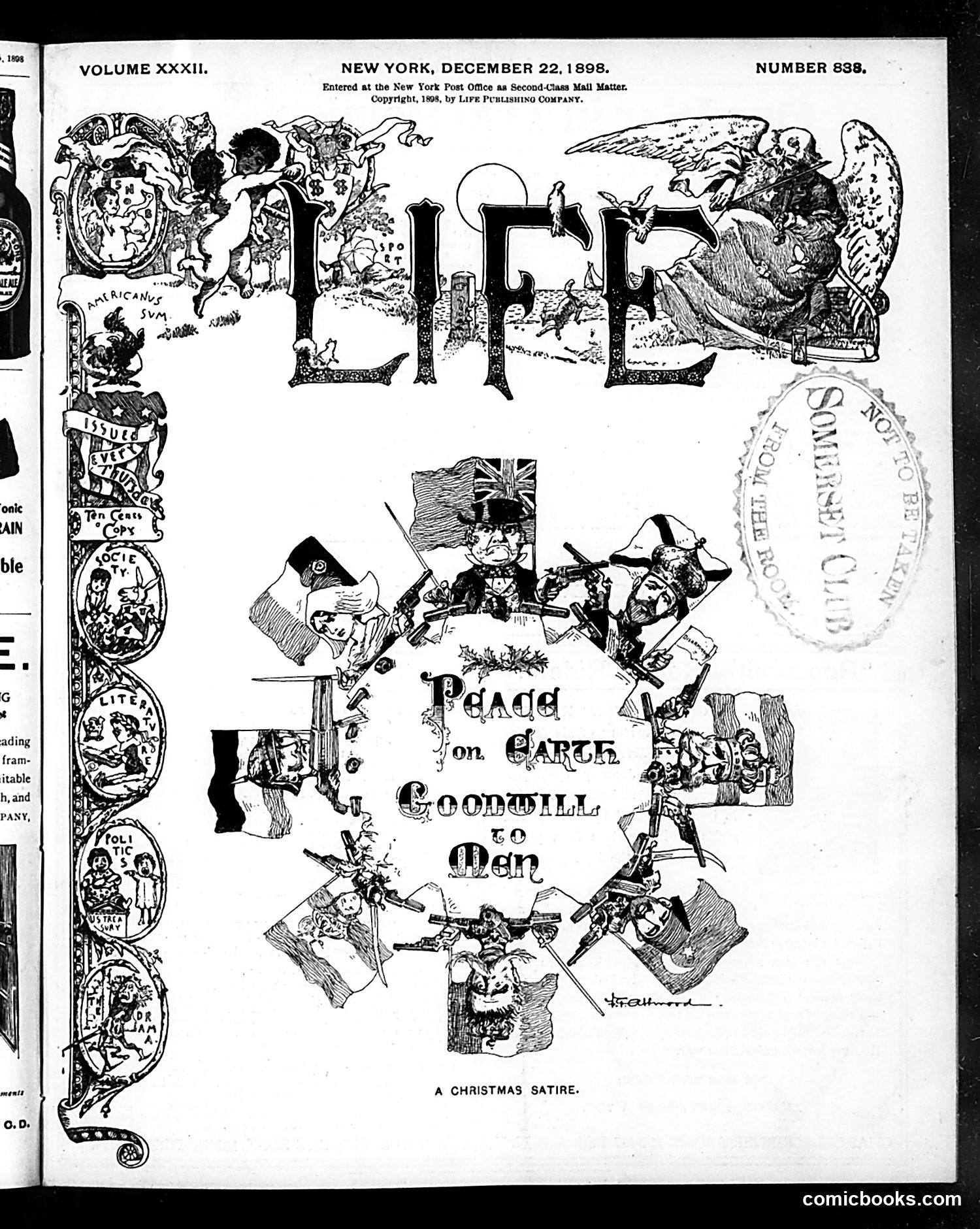
This is a Christmas satirical cover from *Life* magazine (December 22, 1898). The central illustration titled "Peace on Earth, Goodwill to Men" depicts military figures with weapons and flags engaged in conflict, creating ironic contrast with the peaceful message. The satire critiques international military aggression during this period. The 1898 context suggests reference to the Spanish-American War (concluded that year) and ongoing imperial conflicts. The figures appear to represent various nations competing for global dominance through military force, while the idealistic Christmas message above mocks their actual behavior. The ornate decorative border on the left contains smaller satirical vignettes, typical of *Life's* visual style. The overall message sardonically observes that nations' peaceful rhetoric contradicts their violent, expansionist actions—a timely commentary on turn-of-century imperialism.
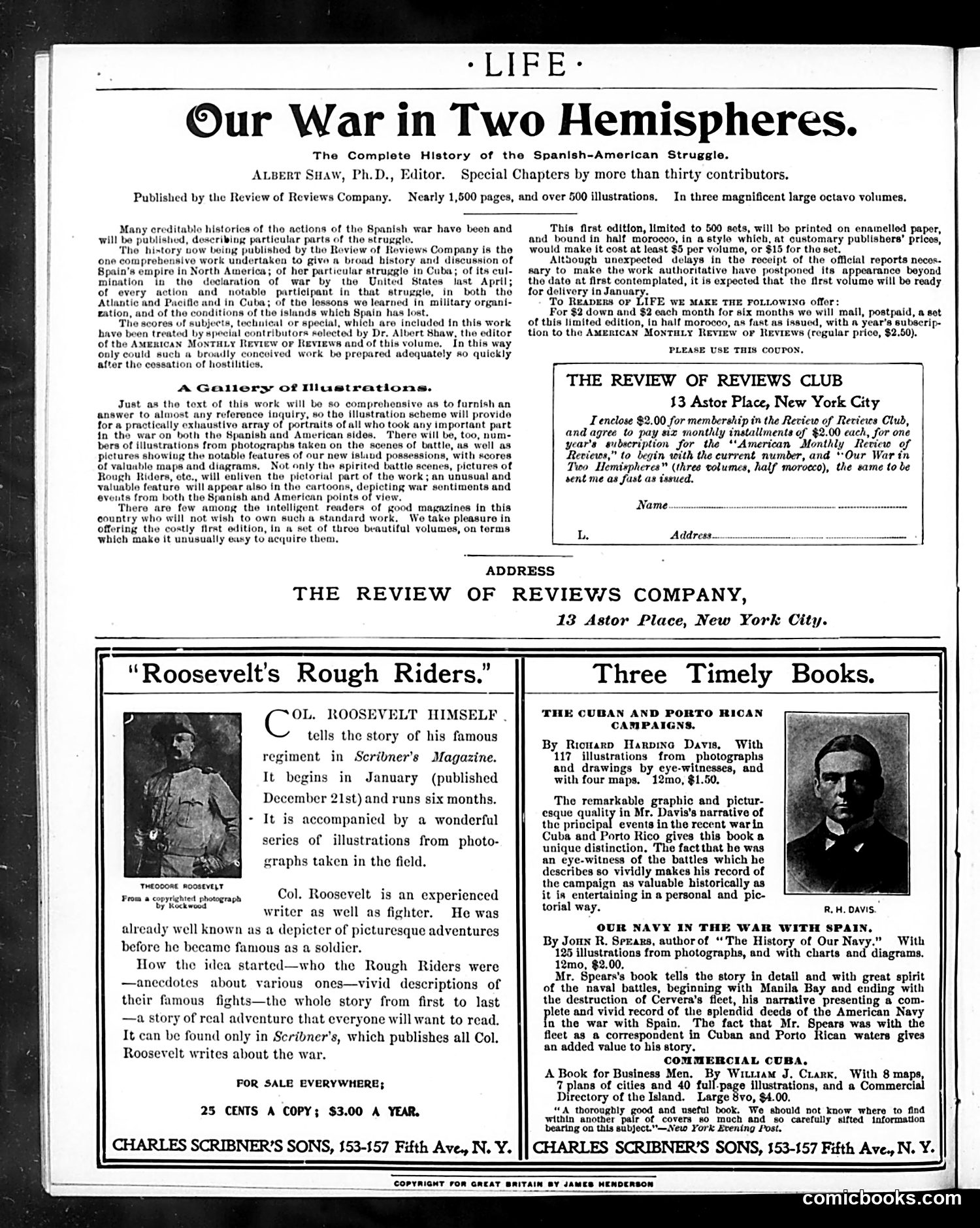
This page is primarily **advertising**, not political satire. It promotes three books related to the Spanish-American War (1898): 1. **"Roosevelt's Rough Riders"** — Colonel Theodore Roosevelt's account in *Scribner's Magazine*, featuring field photographs. The image shows Roosevelt in military uniform. 2. **"The Cuban and Porto Rican Campaigns"** by Richard Harding Davis, with illustrations from an eyewitness perspective. 3. **"Our Navy in the War with Spain"** by John R. Spears, documenting naval battles. A fourth advertisement promotes a business directory for the island (likely Cuba or Puerto Rico). The page reflects America's imperial expansion following the 1898 war. Rather than satire, it capitalizes on public interest in the conflict through firsthand accounts and Roosevelt's celebrity status as a war hero.
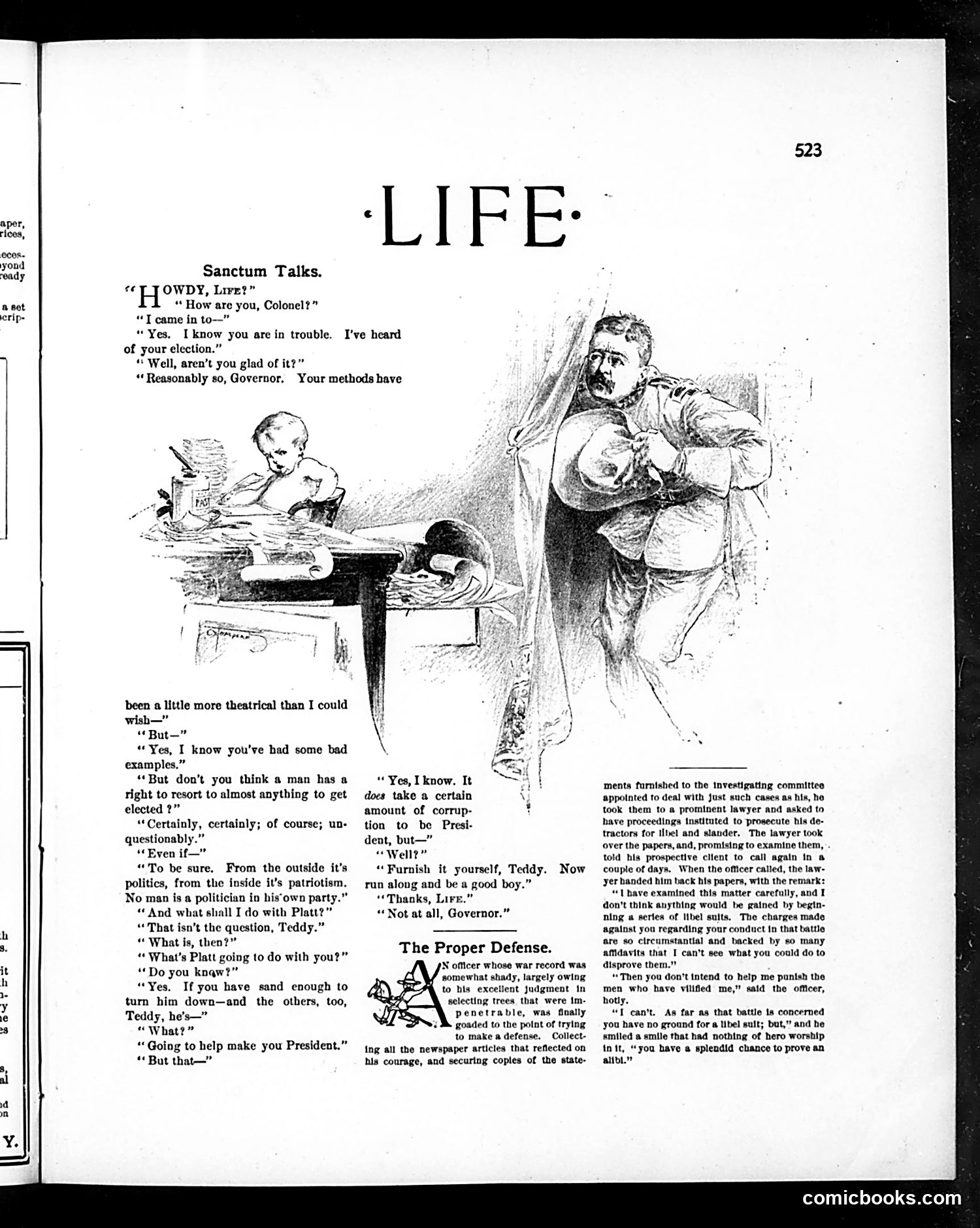
This page contains two satirical pieces. The upper section, "Sanctum Talks," depicts a dialogue between a Governor and someone named "Teddy" (likely Theodore Roosevelt), shown as a rotund figure. The conversation concerns political corruption and methods of prosecution, with Teddy suggesting he'll help "make you President" while the Governor expresses reservations about Teddy's theatrical approach to fighting corruption. The lower section, "The Proper Defense," features a military officer's war record being scrutinized. The satire suggests the officer deflects criticism by citing his record and courage rather than substantively addressing accusations about his conduct in battle—a rhetorical dodge the text explicitly mocks as evasive. Both pieces critique political and military figures' tactics for avoiding accountability through bluster and misdirection.
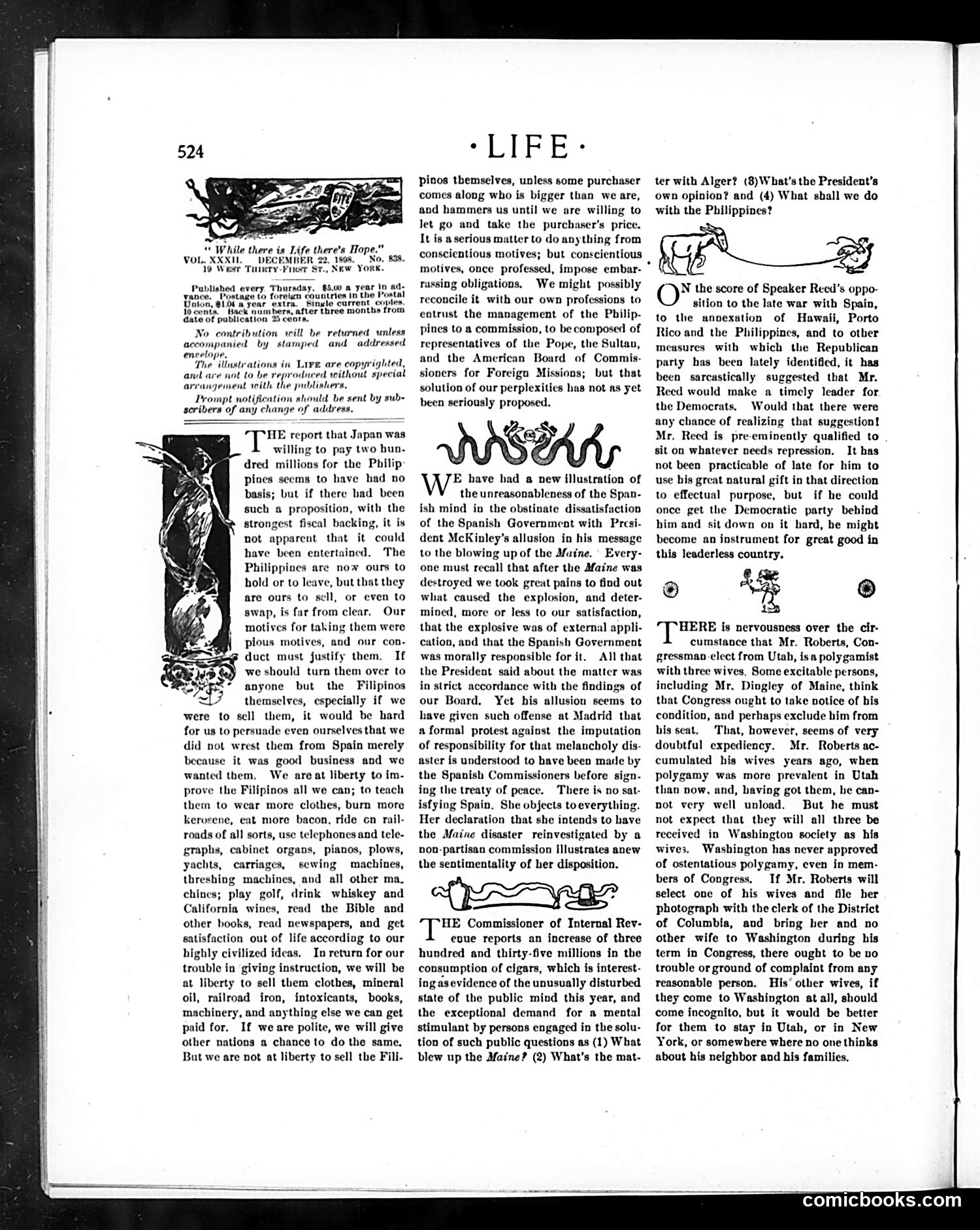
This page contains political commentary rather than cartoons. The main subjects are: 1. **Philippine Islands**: Discussion of whether America should sell the newly-acquired Philippines to Spain or another power, mocking the idea that the U.S. would surrender territory it fought to obtain. 2. **USS Maine**: References to the recent explosion that killed hundreds and sparked the Spanish-American War. The text discusses Spain's responsibility and President McKinley's diplomatic response. 3. **Speaker Reed's Opposition**: Commentary on Speaker Thomas B. Reed's Democratic opposition to Hawaiian annexation, suggesting he could be an effective Democratic leader. 4. **Mr. Roberts' Wives**: Satirical discussion of a congressman with three wives, mocking his potential embarrassment if his wives appeared in Washington society. The tone is typical turn-of-century American political satire, addressing imperial expansion and domestic political controversy.
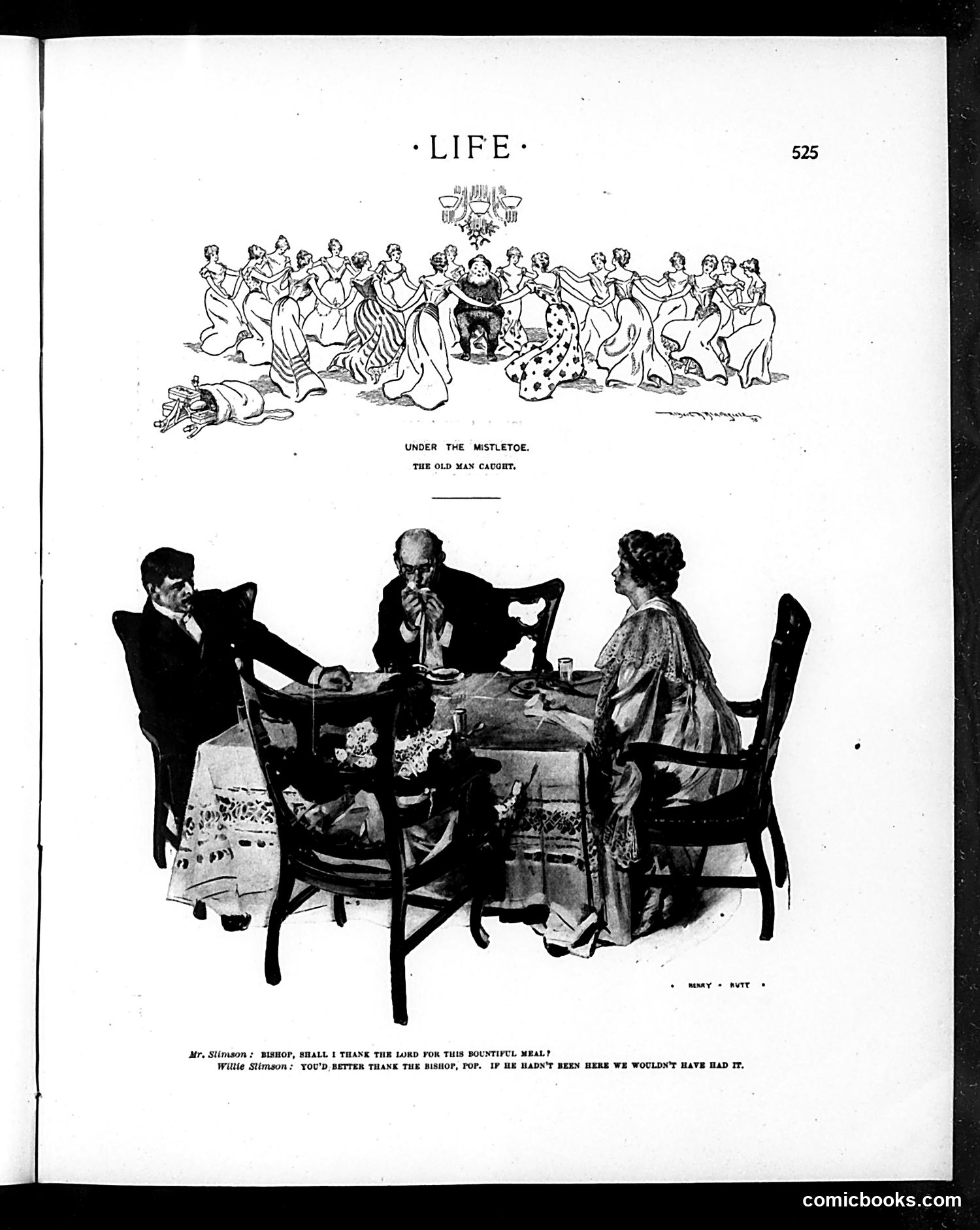
This page contains two distinct illustrations about Christmas and social class. The top panel, titled "Under the Mistletoe: The Old Man Caught," depicts upper-class women in flowing gowns dancing around a seated gentleman, suggesting holiday revelry among the wealthy. The bottom cartoon shows three figures at a dining table—two men and a woman—during what appears to be a Christmas meal. The dialogue reveals social satire: Mr. Simmon thanks the bishop for the "bountiful meal," while Willie Simmon responds that they should thank the bishop instead, since "if he hadn't been here we wouldn't have had it." This jokes about economic inequality and dependency—the implication being the family could only afford a decent meal because the bishop's presence obligated them to provide one.
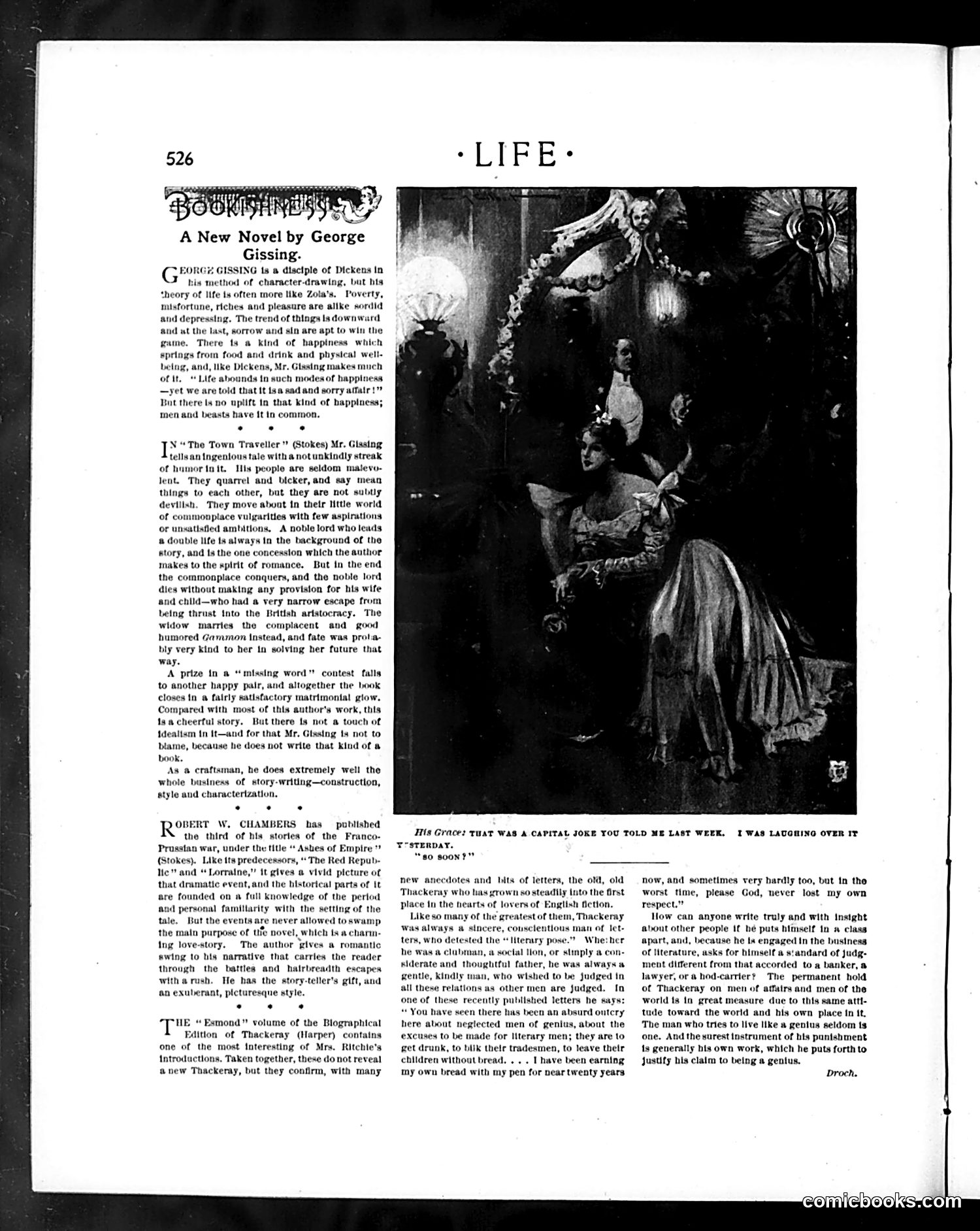
This page reviews George Gissing's novel "The Town Traveller" and Robert W. Chambers' historical fiction about the Franco-Prussian War. The accompanying illustration depicts a scene from Gissing's work showing working-class characters in what appears to be a modest domestic setting. The reviews are literary criticism rather than political satire. The text praises Gissing's ability to portray ordinary people's lives authentically, noting his characters' commonplace vulnerabilities and modest aspirations. The reviewers appreciate that despite life's hardships, the narratives contain moments of genuine happiness and human connection. This is a book review section rather than editorial cartooning, reflecting Life magazine's dual purpose as both satirical commentary and literary criticism in this era.
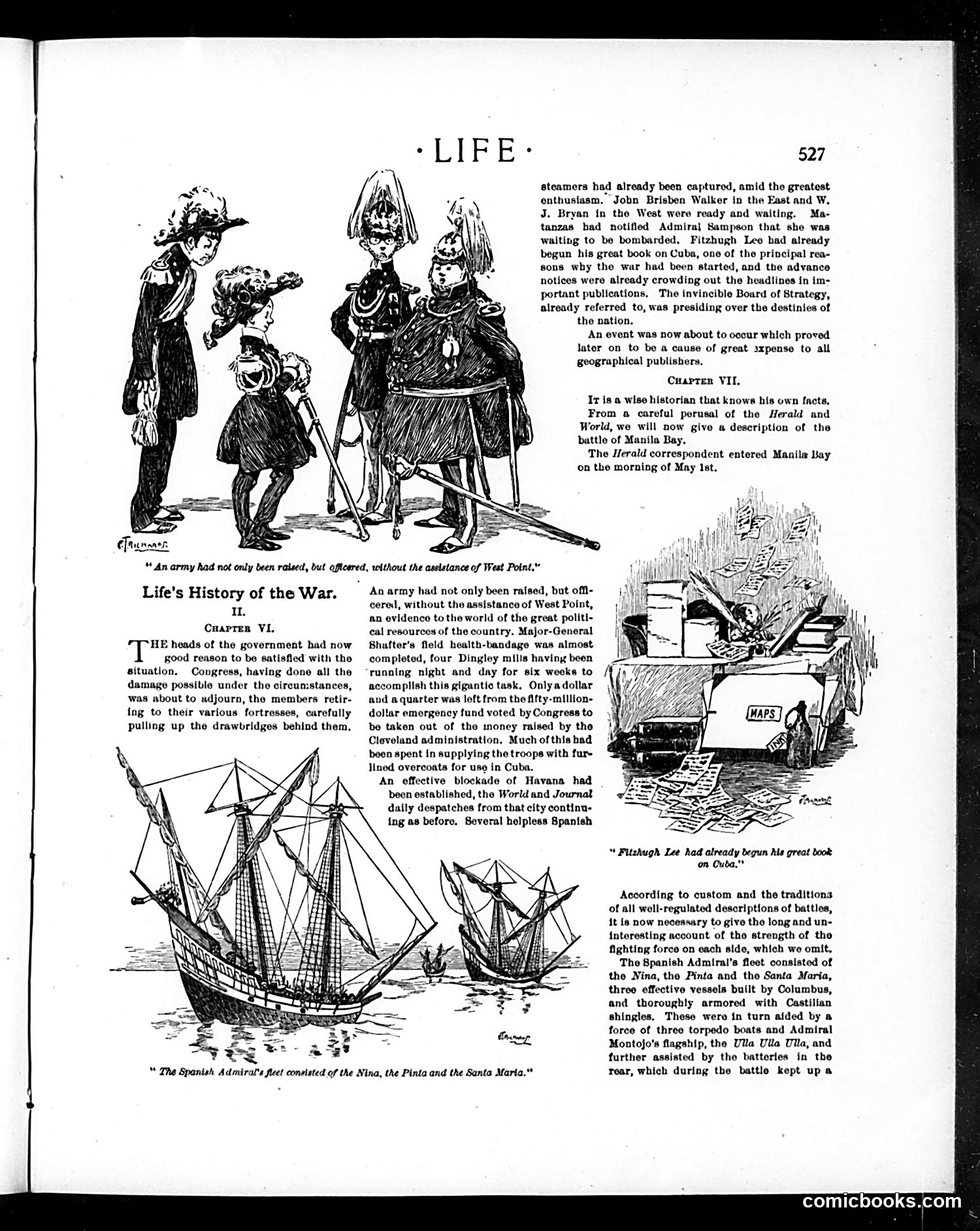
This page presents satirical commentary on the Spanish-American War era. The top cartoon depicts military officers in ornate uniforms, with the caption "An army had not only been raised, but officered, without the assistance of West Point"—satirizing the rapid, seemingly improvised officer appointments during wartime mobilization. The text discusses Major-General Shafter's field operations and mentions Cuba preparation efforts. The ship illustrations show Spanish Admiral's fleet (the Nina, Pinta, and Santa Maria), making a historical pun by invoking Columbus's famous vessels. The page transitions to Chapter VII, describing the Herald correspondent's arrival at Manila Bay on May 1st, connecting to Philippine campaign events. Overall, the satire criticizes military improvisation and wartime logistics management while documenting historical developments.
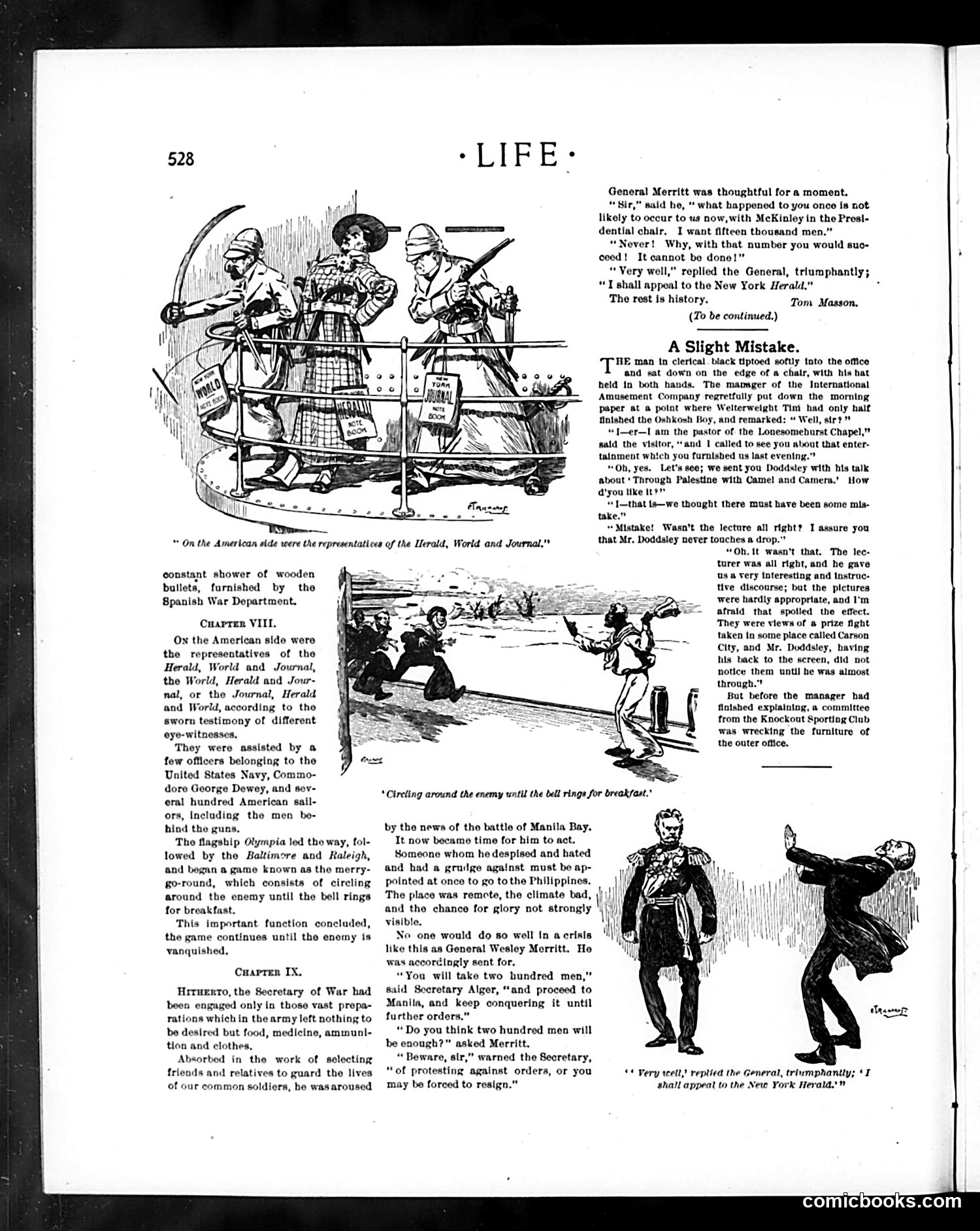
This page from *Life* magazine satirizes American newspaper coverage of the Spanish-American War. The top cartoon mocks how American papers (the *Herald*, *World*, and *Journal*) sensationalized combat, depicting them as armed combatants literally firing at the enemy alongside U.S. soldiers. The text references how these newspapers' "representatives" witnessed the war firsthand. The satire suggests that American journalists didn't merely report events—they actively participated in and shaped the conflict through inflammatory coverage. A separate section titled "A Slight Mistake" humorously describes a lecturer's confusion about a photograph he showed, mixing up images and inadvertently offending an audience member. This lighter anecdote contrasts with the sharper media criticism above, illustrating *Life*'s range from political commentary to social comedy.
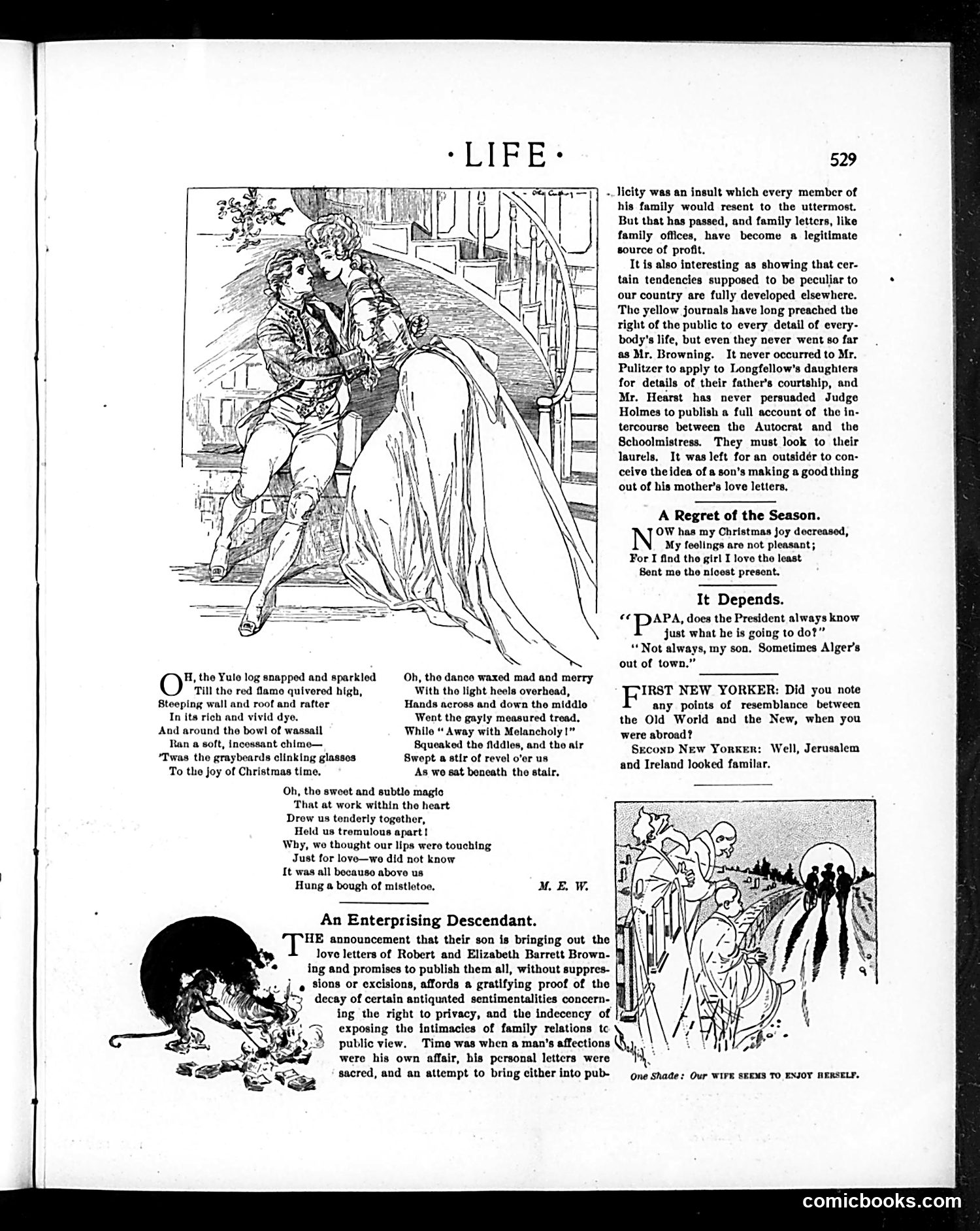
This page contains several distinct pieces of satirical content. The main article "An Enterprising Descendant" criticizes the public announcement that Robert and Elizabeth Barrett Browning's love letters will be published. The satire argues this violates privacy—that personal affections and intimate family correspondence should remain sacred rather than exposed to public view. This reflects late 19th/early 20th-century debates about celebrity privacy and the commercialization of famous figures' private lives. The other items on the page include poems ("A Regret of the Season," "It Depends") and a humorous dialogue between two New Yorkers comparing the Old World and New. The decorative illustrations accompanying these pieces are period-typical romantic and comedic sketches. The overall tone satirizes contemporary social pretensions and sentimental attitudes.
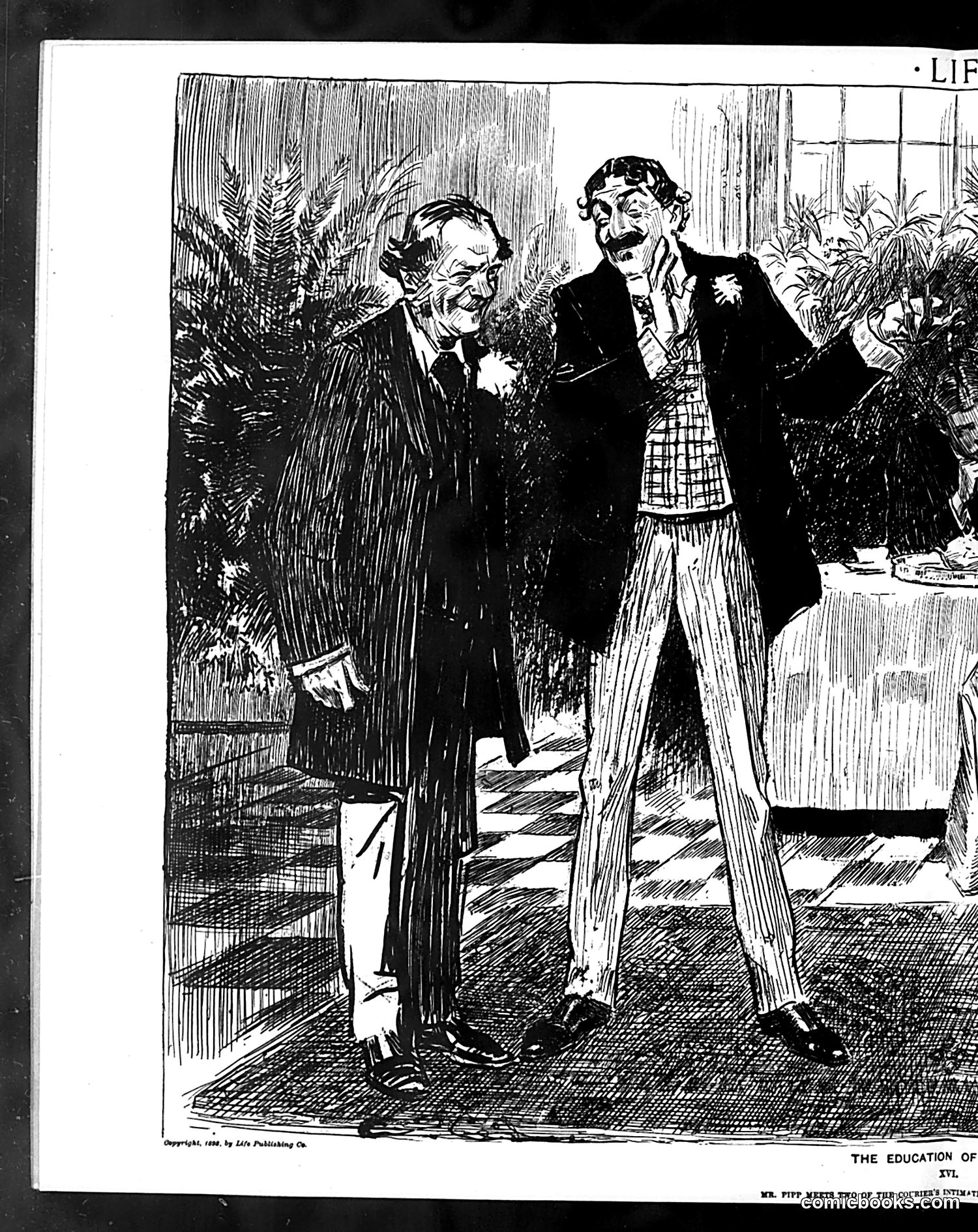
This appears to be a satirical illustration from Life magazine titled "The Education of" with text mentioning "Mr. Piff Meets Two of the Countess's Estimable." The cartoon depicts two well-dressed men in what appears to be an indoor setting with plants. The man on the left wears a dark overcoat and looks somewhat uncomfortable or disapproving, while the man on the right wears lighter colored clothing and displays an exaggerated, jovial expression with a prominent mustache. Without clearer text identifying "Mr. Piff" or "the Countess," the exact satirical target is unclear. However, the scene suggests social comedy—likely mocking either pretentious socialite circles or an outsider being introduced to questionable acquaintances. The contrasting expressions and body language suggest the humor involves culture clash or moral disapproval being confronted with dubious companions.
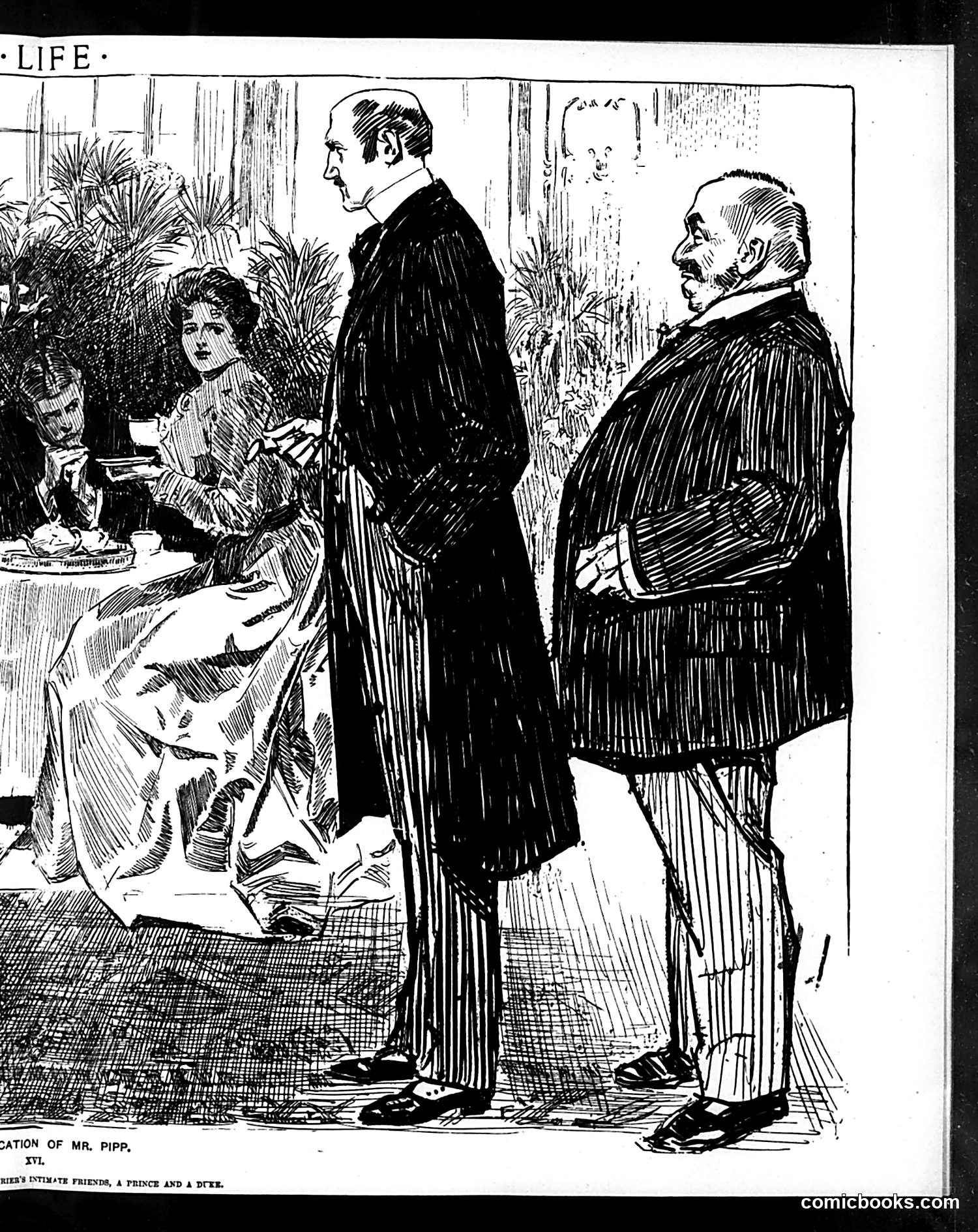
This appears to be a satirical cartoon from Life magazine depicting a social scene. The partially visible caption references "MR. PIPP" and mentions "HER'S INTIMATE FRIENDS, A PRINCE AND A DUKE." The cartoon shows three well-dressed men in formal attire encountering a seated woman in an elegant interior setting with potted plants. The satire likely mocks social pretension—specifically, the humor seems to center on someone (Mr. Pipp, presumably) associating with or claiming connections to nobility ("a prince and a duke") to impress others or elevate social status. The composition emphasizes the contrast between the figures' formal dress and the somewhat awkward social interaction, suggesting ridicule of social climbing or name-dropping among the upper classes. Without the full caption, the specific individuals referenced remain unclear.
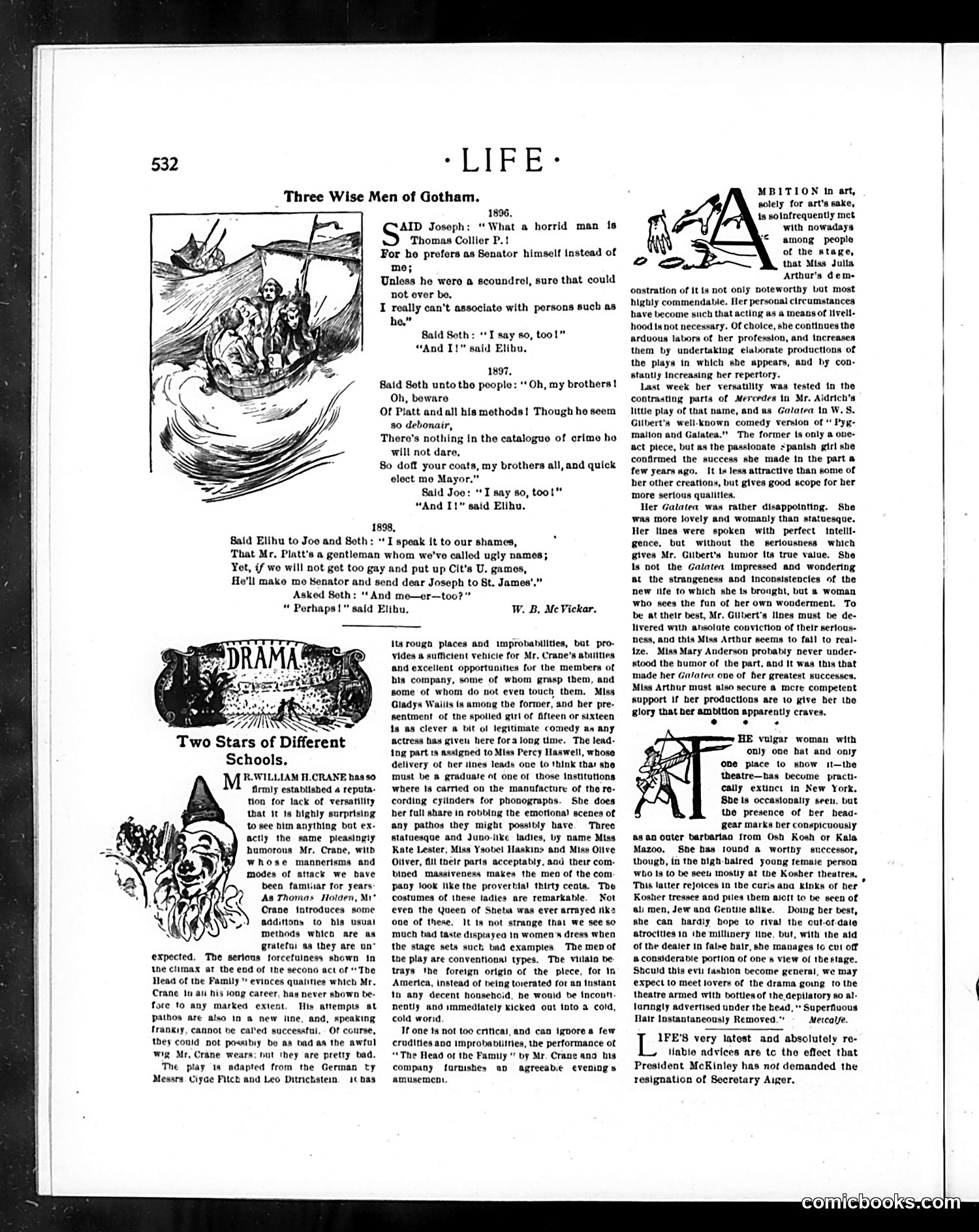
This page contains two theatrical reviews from 1896-1898. **"Three Wise Men of Gotham"** (top) is a humorous dialogue among three characters debating whether to elect someone as Mayor. The sketch appears to be satirizing New York City politics through wordplay and comedic banter. **"Two Stars of Different Schools"** (bottom) reviews Mr. Crane's theatrical company, praising the versatility and talent of his performers, particularly Miss Gladys Waits. The review notes that Crane introduces "novel methods" to staging and successfully adapts German dramatic works for American audiences. Both pieces are theater criticism with accompanying illustrations. The satire targets theatrical conventions and political pretension rather than specific contemporary figures. The page demonstrates Life's focus on entertainment criticism and theatrical society gossip circa the 1890s.
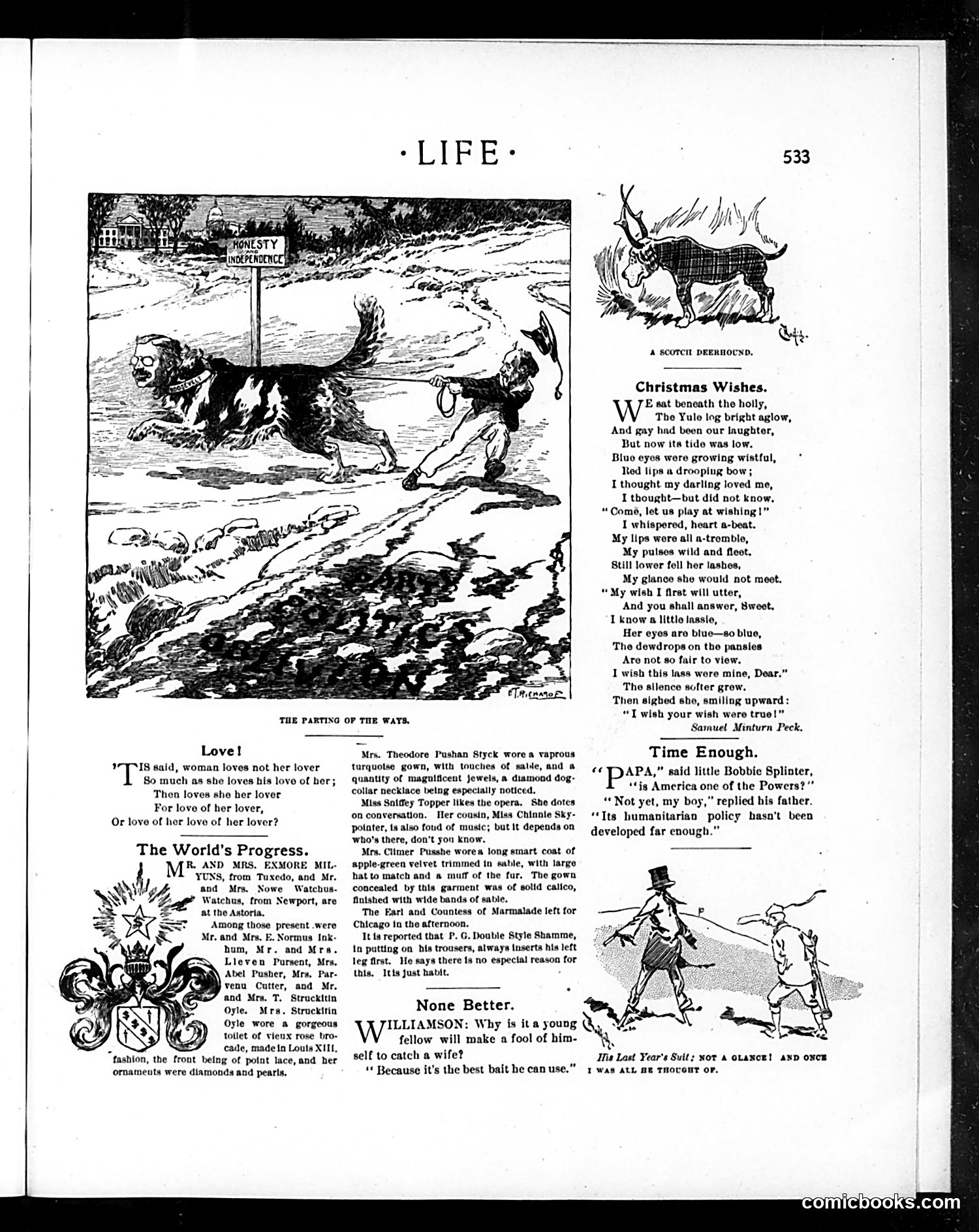
This page from *Life* magazine contains several satirical pieces targeting American society's pretensions and absurdities: **"The Parting of the Ways"** (left illustration): Shows dogs at a signpost marked "Independence," satirizing sentimental romantic narratives—likely mocking the era's overwrought literary conventions about love and separation. **"The World's Progress"** (center): A gossip column mockingly listing wealthy socialites with deliberately ridiculous names ("E. Normus Inkbum," "Lieven Pursent," "T. Struckitin Oyle"). The satire targets high society's obsession with fashion, jewelry, and status. The description of Mrs. Struckitin Oyle's dress made in "Louis XIII fashion" with "point lace" and "diamonds and pearls" exemplifies the pretentious materialism being lampooned. **"Time Enough"** (bottom right): A brief joke where "Papa" deflects his son's question about American global power, suggesting America hasn't yet developed humanitarian policy sufficiently—likely satirizing America's reluctance to engage internationally or develop progressive social policies. The overall tone mocks Gilded Age excess, romantic sentimentality, and social pretension.
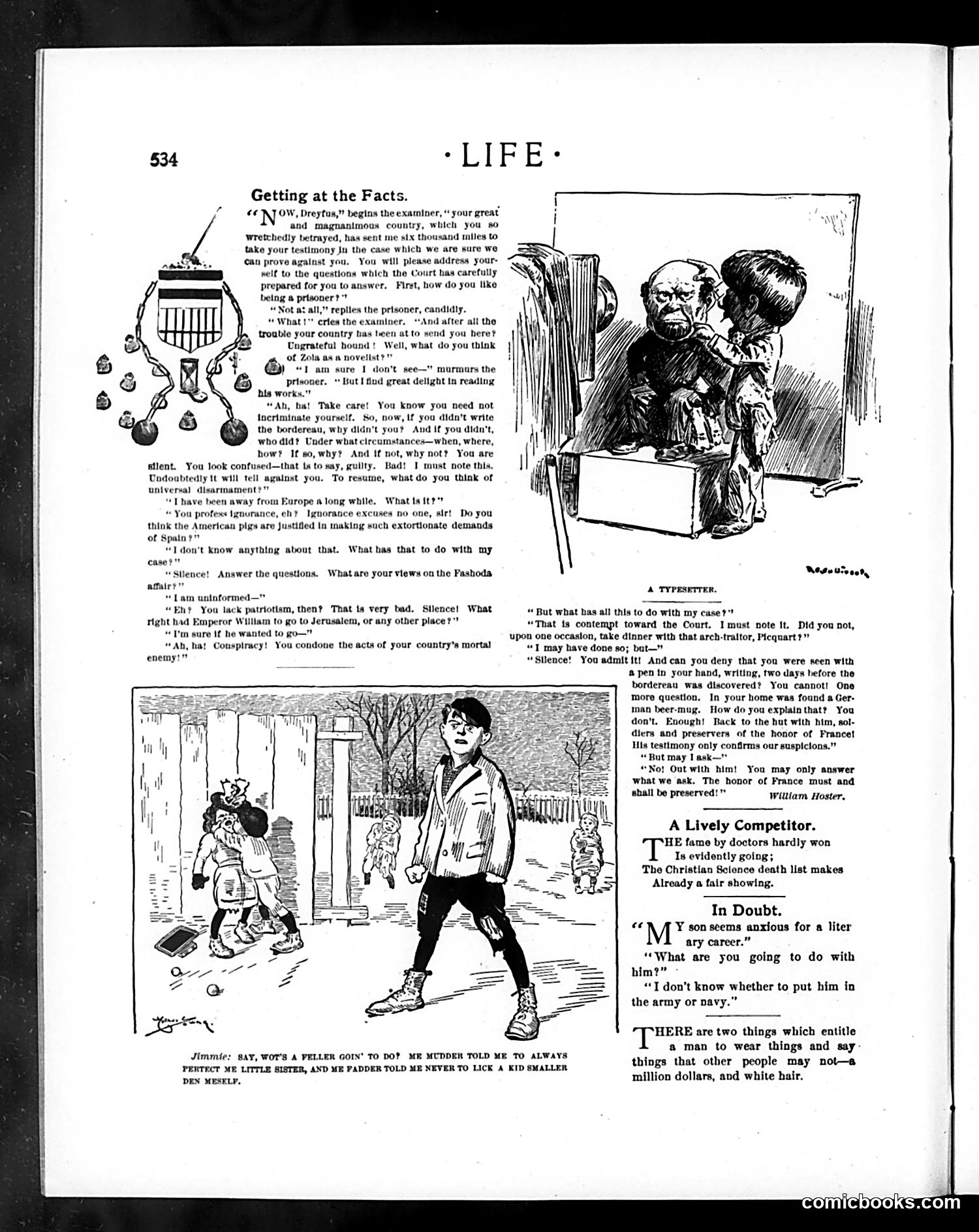
This page satirizes the **Dreyfus Affair**, the famous French military scandal. The main cartoon depicts an examiner interrogating Captain Alfred Dreyfus (a Jewish French officer falsely accused of treason in 1894-1906). The satire mocks the absurdity of the trial: the examiner asks Dreyfus irrelevant questions about Zola, Spanish demands, Emperor William, and a German beer-mug—none connected to the actual charges. Each evasive answer is twisted as "evidence" of guilt. The cartoon exposes how the rigged court uses circular logic and prejudicial questioning to condemn him regardless of facts. References to "Picquart" (an officer who investigated the case) and "honor of France" reflect the nationalist fervor that politicized the trial. The cartoon criticizes how judicial procedure was corrupted by predetermined conclusions and nationalist sentiment rather than genuine evidence. The secondary cartoons address unrelated contemporary topics: Christian Science's medical competition and gender-role confusion among children.
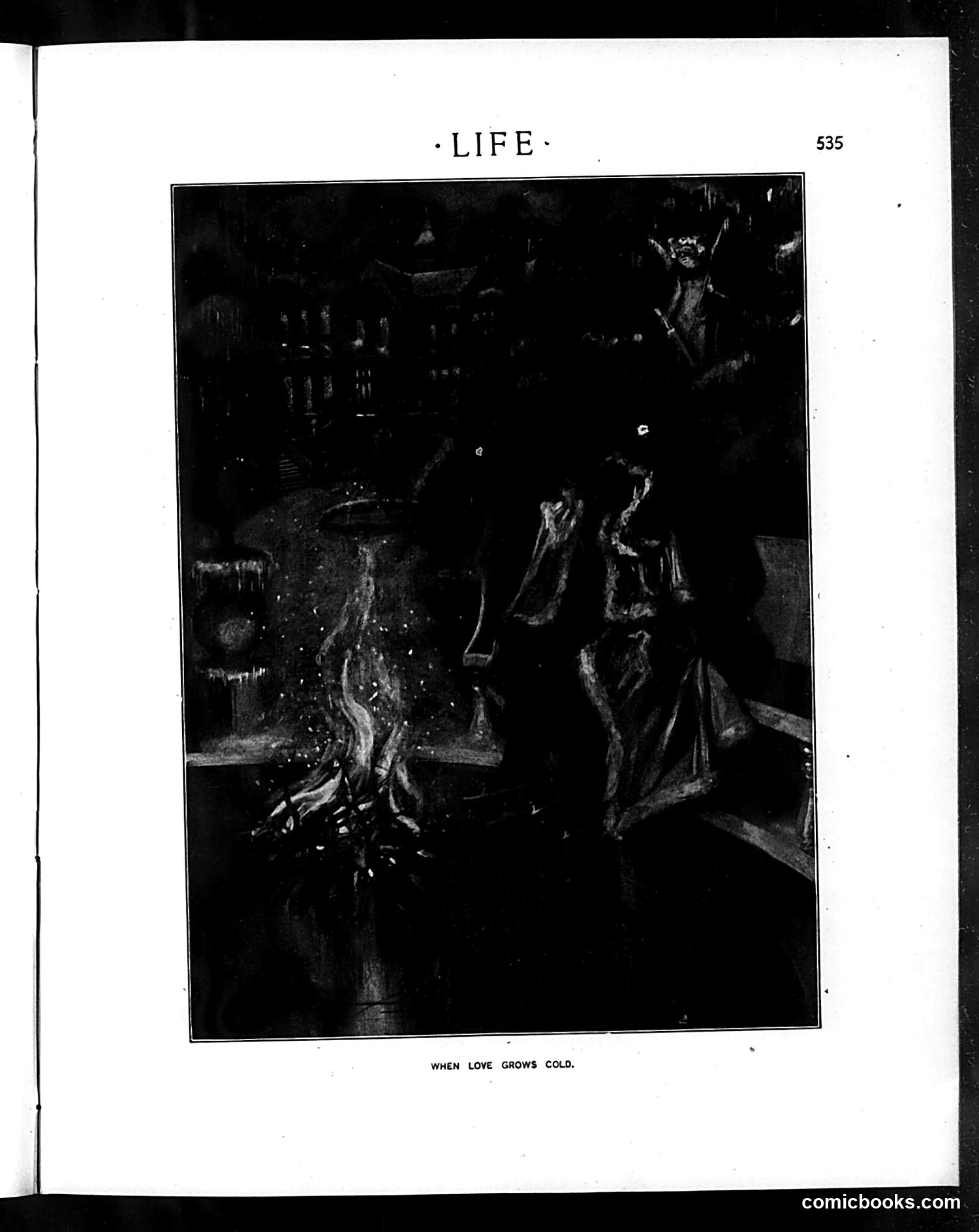
This appears to be a dramatic illustration rather than political satire. The dark, expressionistic image shows figures in what seems to be an intimate or domestic scene, with stark lighting and shadowy compositions typical of early 20th-century Life magazine's artistic illustrations. The caption "When Love Grows Cold" suggests a melodramatic narrative about romantic disappointment or relationship deterioration. The style—high contrast black and white with theatrical staging—indicates this is likely illustrating a story or social commentary on failed relationships, which was common subject matter for Life's satirical and literary content. Without additional context or text, the specific narrative or social commentary intended remains unclear, though the tone suggests cynicism about romantic promises.
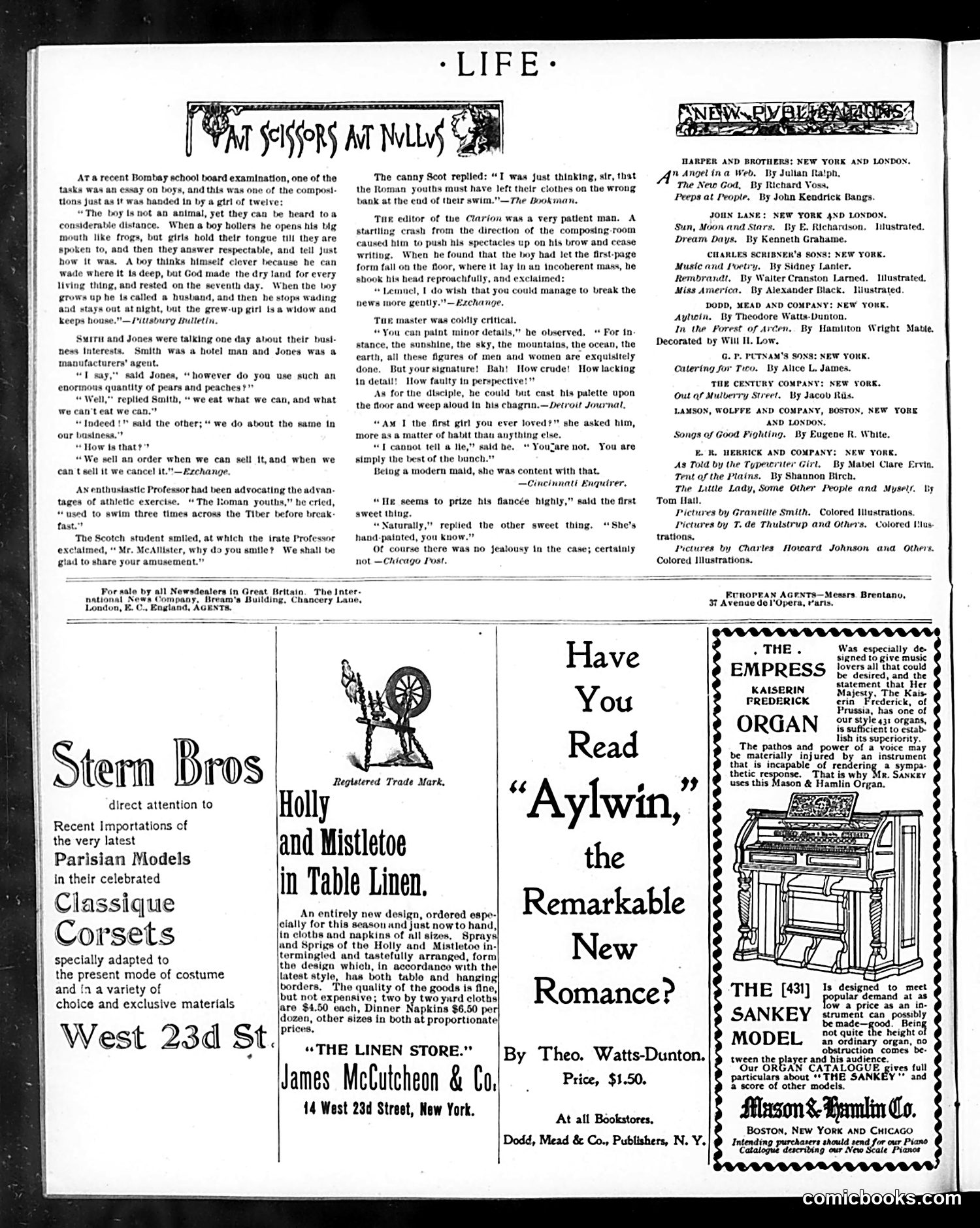
This page is primarily **humorous anecdotes** rather than political cartoons. The title piece presents a witty essay supposedly written by a 12-year-old girl comparing boys to animals—unfavorably. The humor lies in her innocent yet cutting observations: boys are loud, foolish, and become worse as men (husbands who stay out late). This satirizes both childhood gender attitudes and marital dynamics of the era. The other jokes target professional pretension and romantic conventions: a hotel owner's pun about produce, a Scottish student's practical joke about Roman swimmers' logistics, an impatient editor, an art student's overblown signature, and a woman accepting being "not the first" girl her suitor loved. These are **light satirical vignettes** mocking professional pomposity, gender relations, and social expectations—typical of *Life* magazine's early 20th-century humor style. The advertisements below (corsets, organs, linens) indicate the magazine's middle-class audience.
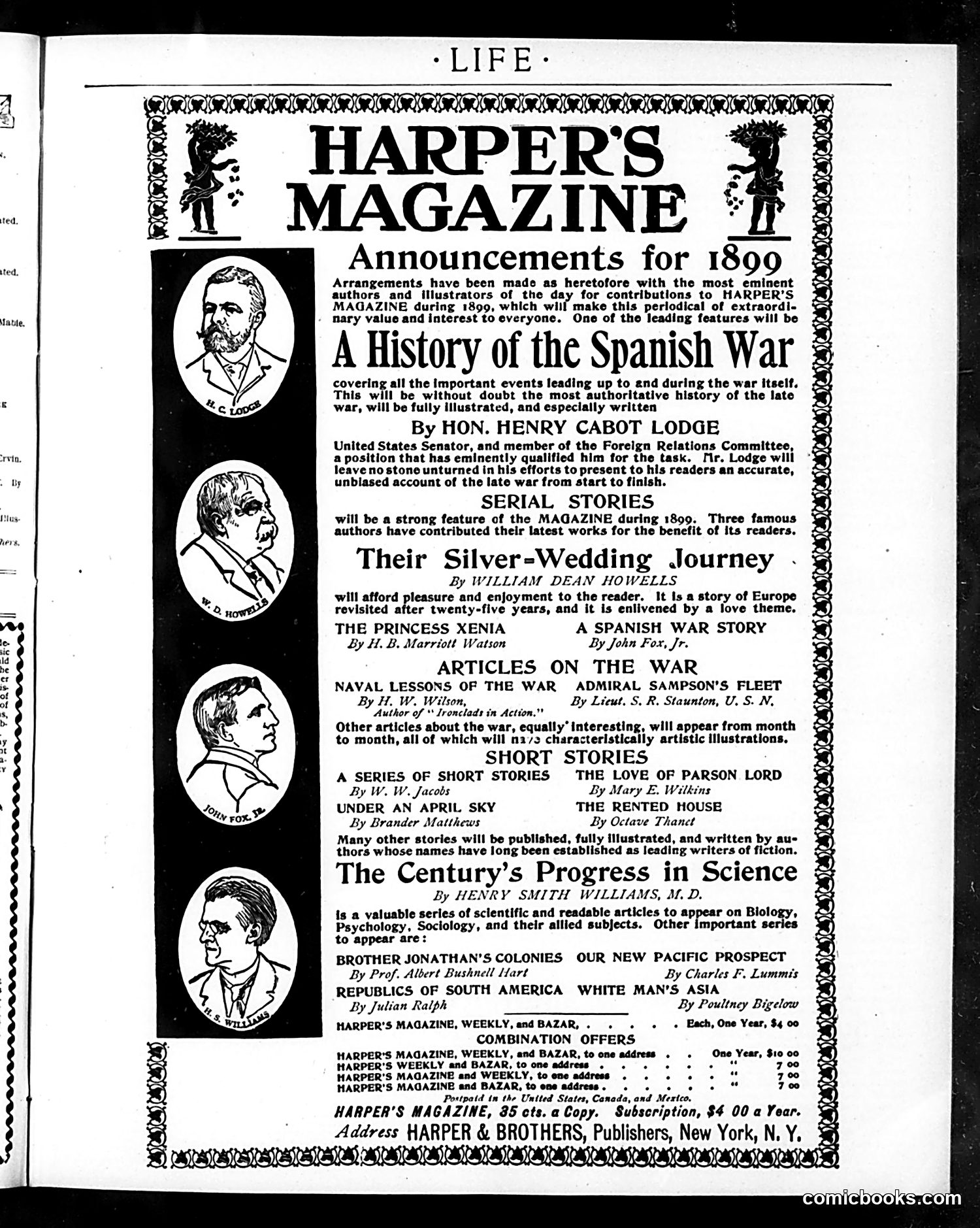
This is primarily an advertising page from Life promoting Harper's Magazine's 1899 content. Rather than political satire, it showcases editorial announcements. The four portrait sketches show featured contributors: Hon. Henry Cabot Lodge (U.S. Senator), William Dean Howells, and other prominent authors. These weren't caricatures but respectful illustrations of distinguished writers and politicians contributing to the publication. The page's focus reflects contemporary American interests: coverage of the recently-concluded Spanish-American War (1898) dominates announcements—Lodge will provide "authoritative history," with additional articles on naval lessons and Admiral Sampson's fleet. Serialized fiction by major literary figures like Howells and stories addressing social themes round out the offerings. For modern readers: this reveals 1899 America's preoccupation with justifying its new imperial role following the Spanish-American War, alongside continued appetite for literary fiction. The page is straightforward publishing promotion rather than satirical commentary.
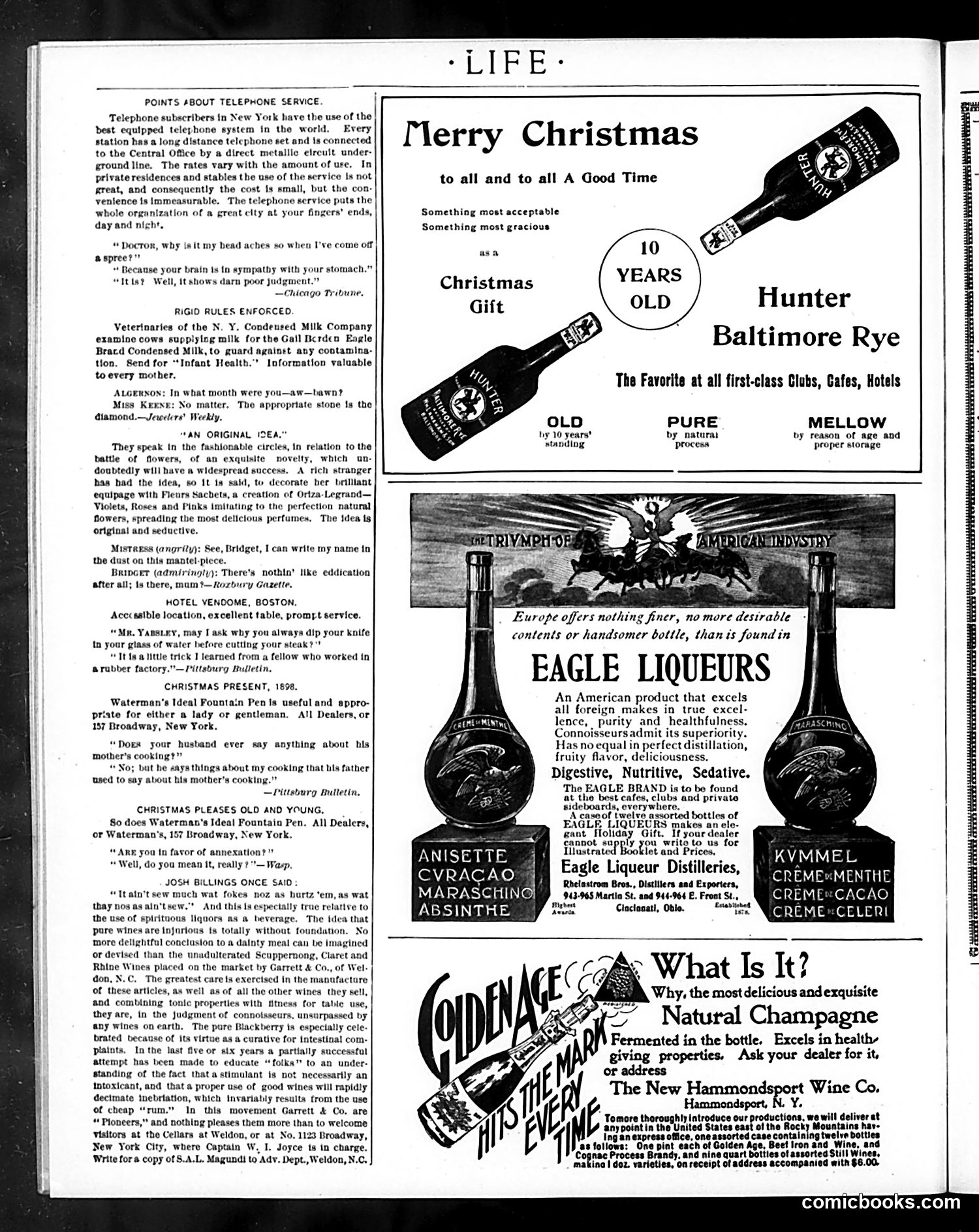
This page is primarily **advertising**, not political satire. It's a Christmas issue of *Life* magazine featuring liquor and product advertisements alongside brief humorous anecdotes and advice columns. The small jokes scattered throughout are genteel period humor: a doctor's quip about hangovers and poor judgment; a servant's clever observation about dust on furniture revealing literacy; complaints about wives' cooking versus mothers'. These reflect late-19th-century domestic comedy conventions—no political content. The advertisements promote **Hunter Baltimore Rye**, **Eagle Liqueurs**, **Poidenavge Natural Champagne**, and **Waterman's Fountain Pens**—products marketed as appropriate Christmas gifts for the wealthy. The "Points About Telephone Service" opening note describes New York's then-modern telephone infrastructure as a civic achievement. The page has no political cartoons or caricatures. It's essentially a period advertisement collection with light, apolitical humor inserted between ads.
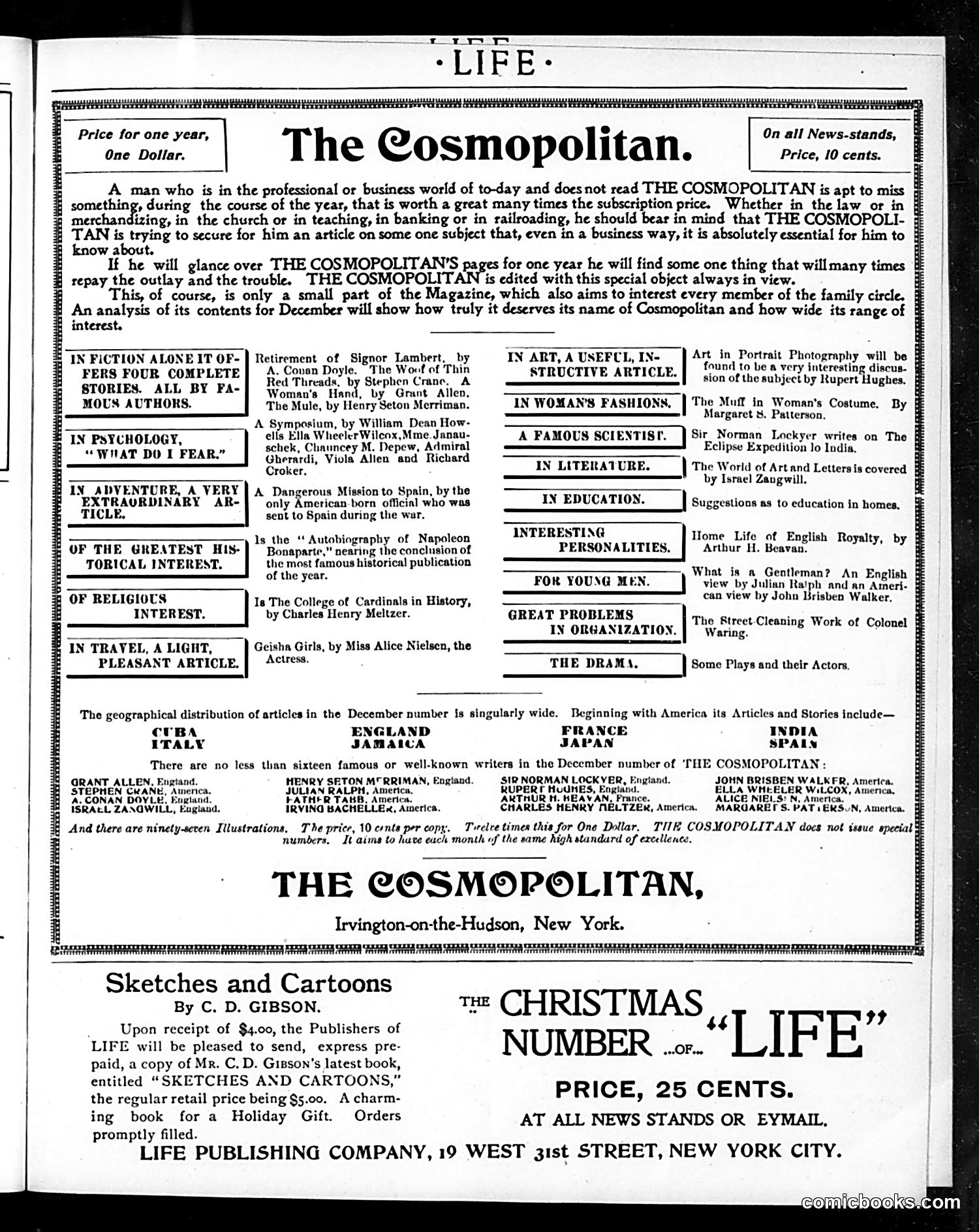
This is primarily an **advertisement/promotional page** for *The Cosmopolitan* magazine, not a satirical cartoon page. The page pitches *The Cosmopolitan* as an essential subscription for professionals and businessmen, promising diverse content spanning fiction, art, science, travel, and international affairs. It lists 16 famous writers contributing to the December issue, including Arthur Conan Doyle, Stephen Crane, and Julian Ralph—legitimizing the magazine's prestige. The geographic scope ("Cuba, Italy, Jamaica, England, France, Japan, Spain, India") emphasizes cosmopolitanism as worldliness, appealing to educated readers seeking comprehensive knowledge. The pricing ($1 yearly; 10 cents per newsstand copy) positions it as accessible to the middle class. A secondary ad promotes C.D. Gibson's *Sketches and Cartoons* book, and *Life* magazine's Christmas issue. **This is a title/advertising page, not editorial content or satire.**
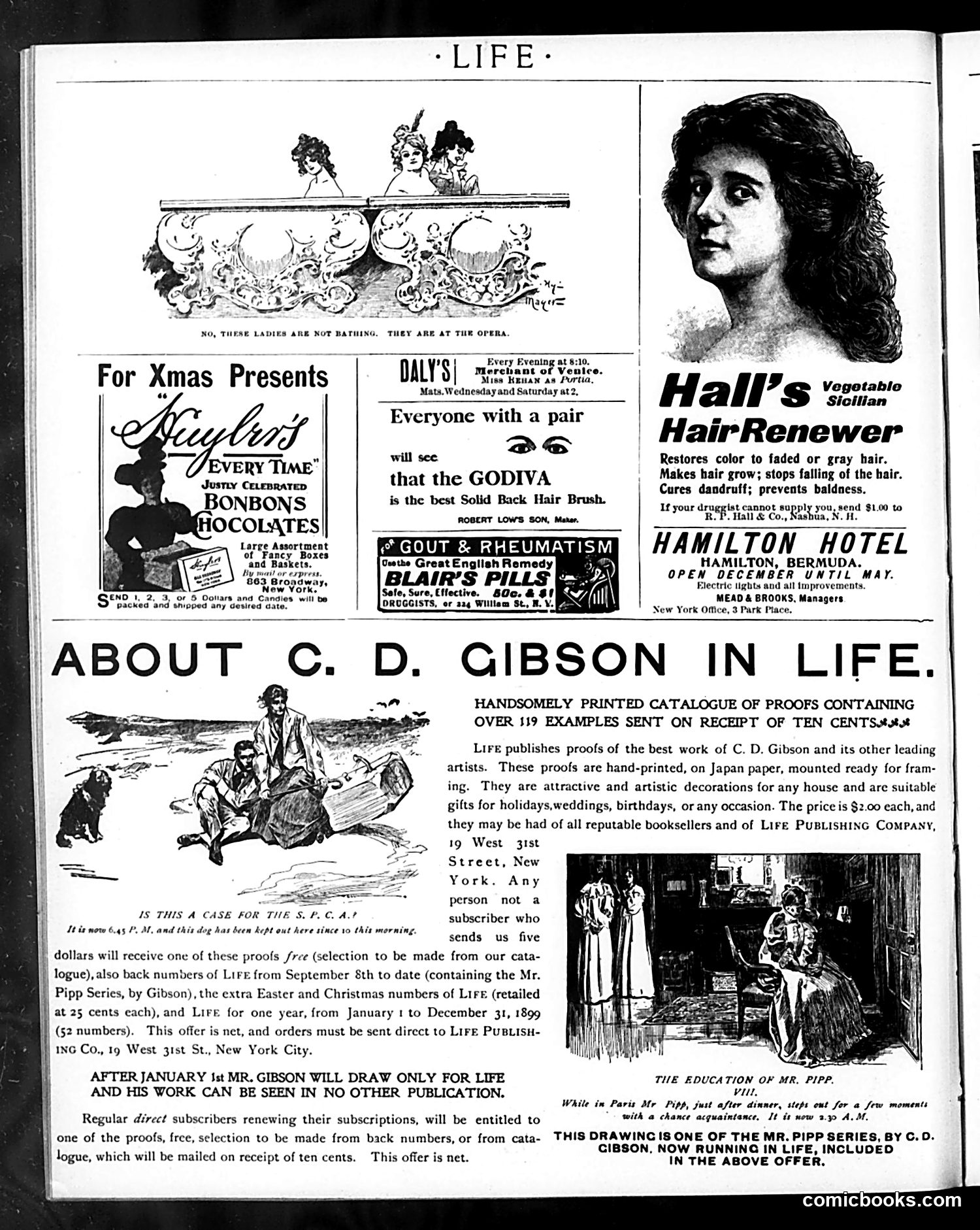
This is primarily a **promotional page for C.D. Gibson**, a prominent illustrator of the era. The top cartoon satirizes upper-class women at the opera—the caption jokes that these elaborately dressed, heavily adorned figures aren't bathing despite appearing nearly submerged in ornate decoration. This mocks the excessive, ostentatious fashion and jewelry worn by wealthy women to social events. The page advertises Gibson's work through Life Publishing Company, offering hand-printed proofs of his drawings as gifts or collectibles. Gibson was famous for illustrations of idealized women ("Gibson Girls") and social satire. The small cartoon labeled "Is This a Case for the S.P.C.A.?" (Society for Prevention of Cruelty to Animals) shows a dog left outside in cold weather—likely satirizing neglectful pet owners among the wealthy. The "Mr. Pipp Series" mentioned appears to be Gibson's serialized comic narrative about a character's social education, running in Life magazine.
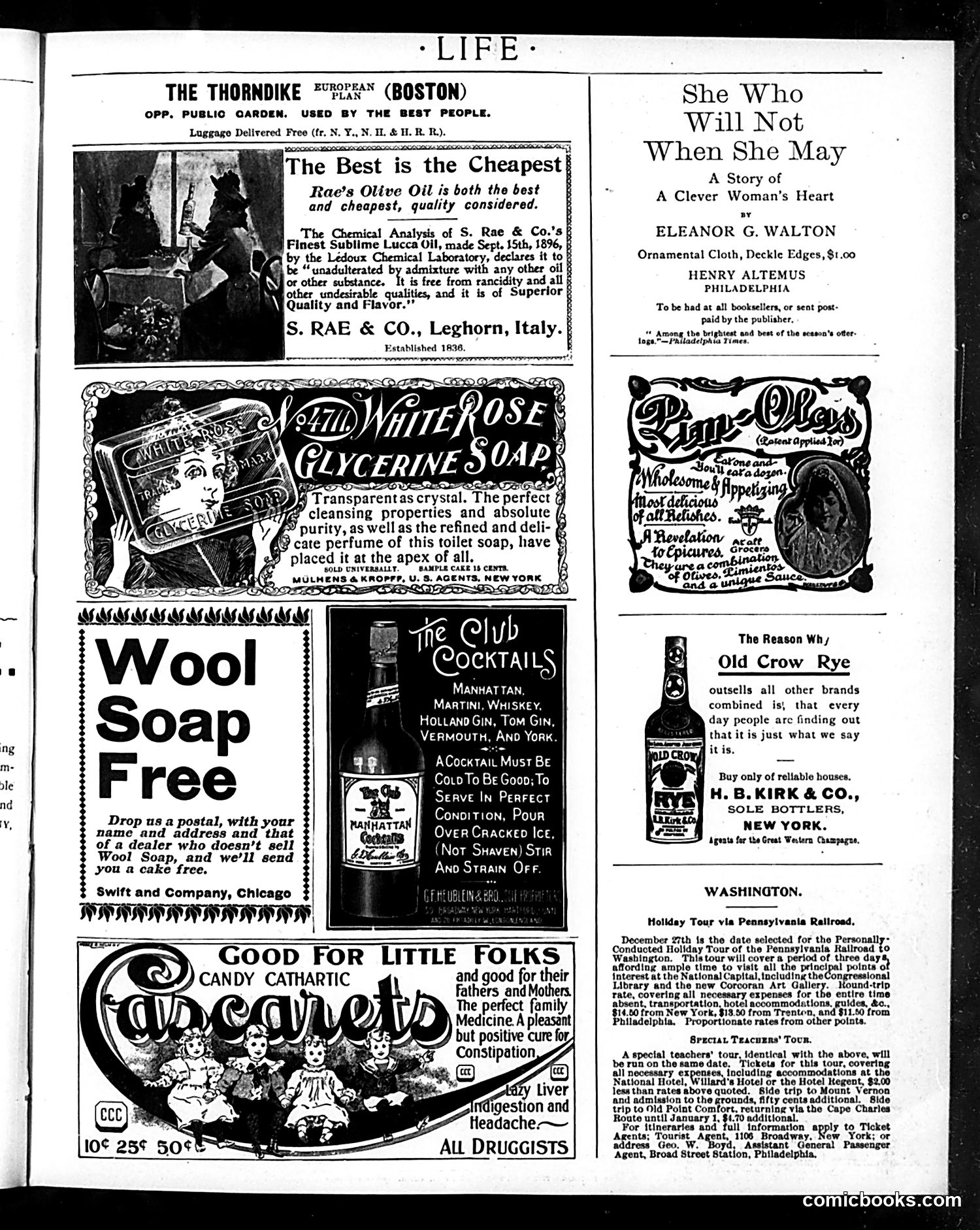
This page is primarily **advertising**, not political satire. It's from what appears to be a late-19th century issue of *Life* magazine and consists almost entirely of commercial ads with no editorial cartoons. The ads promote consumer goods typical of the era: olive oil (emphasizing chemical purity), glycerine soap, wool soap, rye whiskey, cocktail recipes, a patent medicine ("candy cathartic"), and books. There's also a notice for a Pennsylvania Railroad holiday tour to Washington, D.C., aimed at both tourists and teachers. The only non-commercial content is a book advertisement for Eleanor G. Walton's novel "She Who Will Not When She May," described as "A Story of A Clever Woman's Heart." The page reflects turn-of-the-century consumer culture and advertising conventions—heavy use of ornamental typography, chemical claims to establish product legitimacy, and appeals to "quality" and propriety ("used by the best people").