
Life, 1898-12-22 · page 14 of 22
Life — December 22, 1898 — page 14: what you’re looking at
What you’re looking at
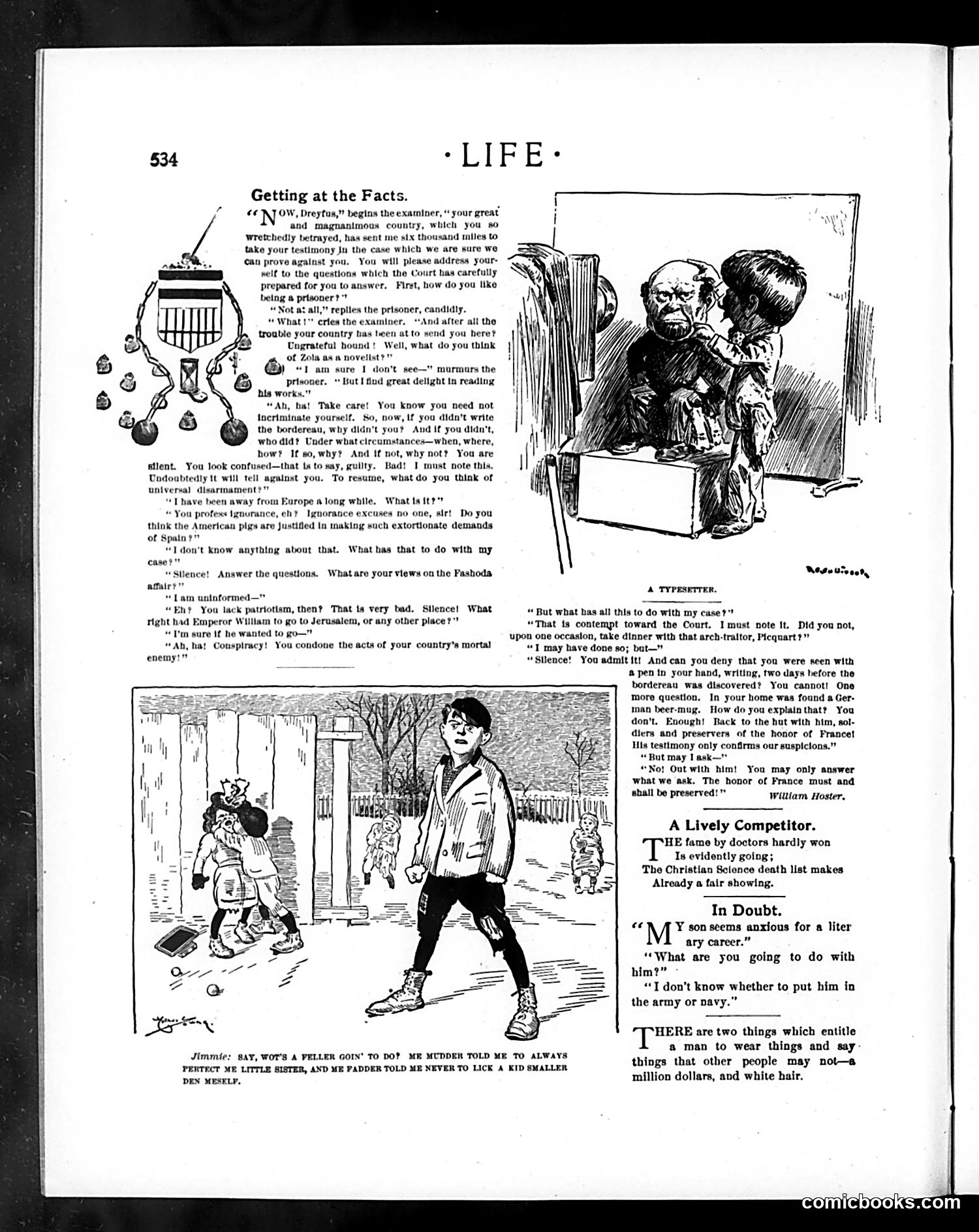
This page satirizes the **Dreyfus Affair**, the famous French military scandal. The main cartoon depicts an examiner interrogating Captain Alfred Dreyfus (a Jewish French officer falsely accused of treason in 1894-1906). The satire mocks the absurdity of the trial: the examiner asks Dreyfus irrelevant questions about Zola, Spanish demands, Emperor William, and a German beer-mug—none connected to the actual charges. Each evasive answer is twisted as "evidence" of guilt. The cartoon exposes how the rigged court uses circular logic and prejudicial questioning to condemn him regardless of facts. References to "Picquart" (an officer who investigated the case) and "honor of France" reflect the nationalist fervor that politicized the trial. The cartoon criticizes how judicial procedure was corrupted by predetermined conclusions and nationalist sentiment rather than genuine evidence. The secondary cartoons address unrelated contemporary topics: Christian Science's medical competition and gender-role confusion among children.
📄 Transcribed text from this page (OCR, searchable)
Machine-transcribed from the original scan — historical spelling and the odd misread are preserved.
» LIFE « Getting at the Facts. €€ XY OW, Dreytus,” begins the examiner, “your great and magnanimous country, which you 80 wWretvhedly betrayed, has sent me six thousand miles to take your testimony Jn the case which we are sure we can prove against you. You will please address your- self to the questions which the Court has carefully prepared for you to answer. First, how do you ike being a prisoner? * “Not at all,” replies the prisoner, candidly. “What!” cries the examiner, “And after all the trouble your country has been at to send you heret Ungrateful hound! Well, what do you think of Zola as n novelist “1 am sure I don't see—" murmurs the Take care! You know you need not {ncriminate yourself. So sit you didn't write the bordereau, why didn't you? Aud if you didn't, who did? Under what circumstances—when, where, how? Ifo,why? And if not, why not? You are silent. You look confused—that ts to say, guilty, Bad! I must note this, Undoubtedly tt will tell against you. To resume, what do you think of universal disarmament?” “Thave been away from Europe along while, What ts it?" * You profess ignurance, eh? Ignoran uses no one, ltt Do you think the American pigs are Justifled In making such extortionate demands of Spain?" “Idon't know anything about that. Whathas that to do with my case?" “Silence! Answer the questions, What are your views on the Fashoda am untinformed—” Eh? You lack patriotism, then? That ts very bad. Silence! What right had Emperor William to go to Jerusalem, or any other place? 'm sure If he wanted to go—" h, hat Conspiracy! You condone the acts of your country's mortal enemy!” A TYPESETTER. * But what bas all this to do with my case?” “That 1s contempt toward the Court, Imust note It, Did you not, upon one occasion, take dinner with that arch-traltor, Picquart?”” may have done so; bat—” Silence! You admit it! And can you deny that you were seen with pen in your hand, writing, two days before the bordereau was discovered? You cannot! One more question, In your home was found a Ger- man beer-mug. How do you explain that? You don't. Enough! Back to the hut with him, sol- diers and preservers of the honor of Francet Mls testimony only confirms our suspicions.” “But may I ask—" “Not Out with him! You may only answer what we ask. The honor of France must and ‘shall be preserved! " Witltam Hoster, A Lively Competitor. HE fame by doctors hardly won Is evidently going; The Christian Science death list makes Already a fair showing. “In Doubt. Jimm{e: 8A¥, WOT'S A VELLER GOIN’ TO DO? ME MUDDER TOLD ME TO ALWAYS PENTECT ME LITTLE SISTER, AND ME PADDER TOLD ME NEVER TO LICK A KID SMALLER DEN MESELP. Y¥ son seems anxious for a liter ary career.” ‘‘What are you going to do with him?” ° “IT don’t know whether to put him in the army or navy.” HERE are two things which entitle man to wear things and say- things that other people may not—a million dollars, and white hair.