
Life, 1898-12-22 · page 6 of 22
Life — December 22, 1898 — page 6: what you’re looking at
What you’re looking at
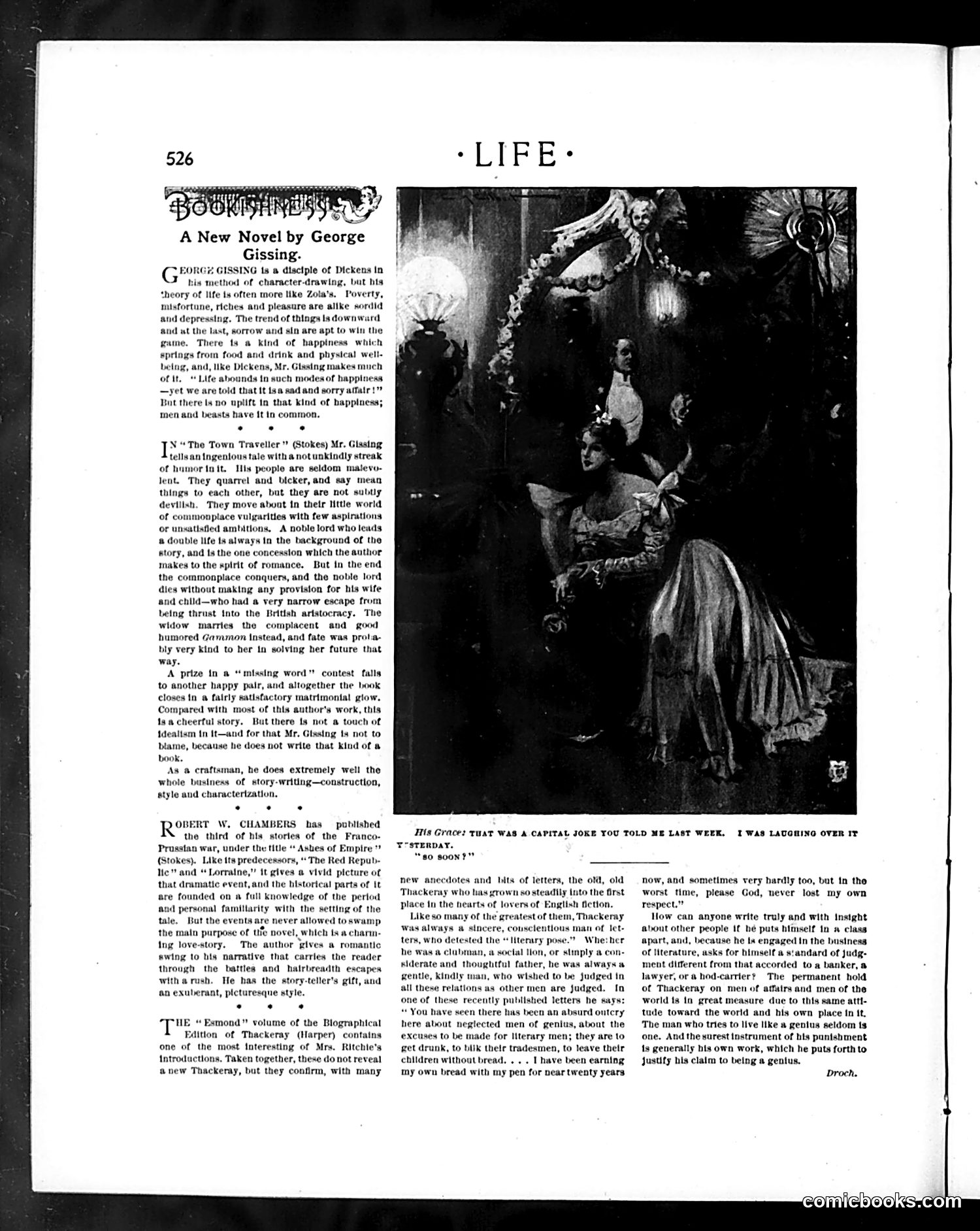
This page reviews George Gissing's novel "The Town Traveller" and Robert W. Chambers' historical fiction about the Franco-Prussian War. The accompanying illustration depicts a scene from Gissing's work showing working-class characters in what appears to be a modest domestic setting. The reviews are literary criticism rather than political satire. The text praises Gissing's ability to portray ordinary people's lives authentically, noting his characters' commonplace vulnerabilities and modest aspirations. The reviewers appreciate that despite life's hardships, the narratives contain moments of genuine happiness and human connection. This is a book review section rather than editorial cartooning, reflecting Life magazine's dual purpose as both satirical commentary and literary criticism in this era.
📄 Transcribed text from this page (OCR, searchable)
Machine-transcribed from the original scan — historical spelling and the odd misread are preserved.
Fa A New Novel by George Gissing. ORGZ GISSING ts @ disciple of Dickens In is Taethod of character-drawing, but his theory of life is often more like Zota’s, Poverty, misfortune, riches and pleasure are allke sordid and depressing. The trend of things Is downward ‘and wt the last, sorrow and sin are apt to win the game. There ts a kind of happiness which springs from food and drink and physical well- being, and, like Dickens, Mr. Glasing makes much of it, “Life abounds tn such modes of happiness et we are told that It isa aad and sorry affair! But there ts no uplift in that kind of happiness; men and beasts have it in common, o 8 6 N“The Town Traveller (Stokes) Mr. Glasing tellsan ingenious tale with a not unkindly streak of humor tuit, Ils people are seldom malevo- lent, They quarrel and bicker, and say mean things to each other, but they are not subtly devilish, They move abont in thelr little world of commonplace vulgarities with few aspinitions or unsatisfied ambitions, A noble lord who leads a double life ts always in the background of the story, and Is the one concesston which the author makes to the xpirit of romance. But tn the end the commonplace conquers, and the noble lord dies without making any provision for his wife and child—who had a very narrow escape from being thrust {nto the British artstocracy. The widow marries the complacent and good humored Gammon Instead, and fate was prota bly very kind to her tn solving her future that way. A prize in “mlxsing word” contest falls to another happy pair, and altogether the book closes in @ fairly satisfactory matrimonial glow. Compared with most of this author's work, thts fsacheerful story. But there {s not a touch of {dealism tn It—and for that Mr, Glasing 14 not to blame, because he does not write that kind of a book, As @ craftsman, he does extremely well the whole business of story-writing—construction, style and characterization. o 8 ROBERT W. CHAMBERS as poditshed the third of his stortes of the Franco- Prussian war, under the title “ Asbes of Empire ** (Stokes). Like tts predecessors, “The Red Repub- Nc" and “Lorraine,” it gives a vivid picture of that dramatic event, and the bistorteal parts of It are founded on full knowledge of the period ‘and personal famillarity with the setting of the tale, But the events are never allowed to swamp the main purpose of te novel, which is a charm- ing love-story, The author gives a romantic swing to bis narrative that carries the reader through the battles and hairbreadth escapes with arush. He has the story-teller's gitt, and an exuberant, pleturesqne style. . 8 6 ‘THE “Esmond” volume of the Blographical Edition of Thackeray (Harper) contains one of the most tnteresting of Mrs. Ritchle’s introductions. Taken together, these donot reveal avew Thackeray, but they confirm, with many His Grace? TuaT WAS A CAPITAL JOKE YOU TOLD ME LAST WEEK. IW. YosteRpar. “#0 soon?” new anecdotes and bits of letters, the ot ‘Thackenty who has grown so steadily Into the Orst place tn the hearts of lovers of English fetion. Like so many of the greatest of them, Thackeray Was always @ sincere, consclentions man of tet ters, who detested the “ Iitentry pose.” Whe:her he was a clubman, a soctal lon, or stinply a xiderate and thoughtful father, he was always a gentle, kindly man, who wished to be judged In all these relations as other men are Judged. In one of these recently published letters he sass: You have seen there has been an absurd outcry, here about neglected men of genius, about the excuses to be made for Ilterary men; they are to get drunk, to blk thelr tradesmen, to leave thetr children without bread, . .. [have been earning my own bread with my pen for near twenty years SAN LAUGHING OVER IT how, and sometimes very hardly too, but In the Worst time, please God, uever lost my own respect.” How can anyone write truly and with Instght about other people If he puts himself In # class apart, and, because he Is engaged In the business of literature, asks for himself a s:andard of judg. ment different from that accorded to a banker, lawyer, or @ hod-carrter?. The permanent hold of Thackeray on men of affairs and men of the world fs In great measure due to this same attl- tude toward the world and his own place In ft, ‘The man who tries to live Iike a gentus seldom ts one. And the surest instrument of his pantahment 1s generally bis own work, which he puts forth to Justify his claim to being a gentus. Droch.