
Life, 1898-12-22 · page 12 of 22
Life — December 22, 1898 — page 12: what you’re looking at
What you’re looking at
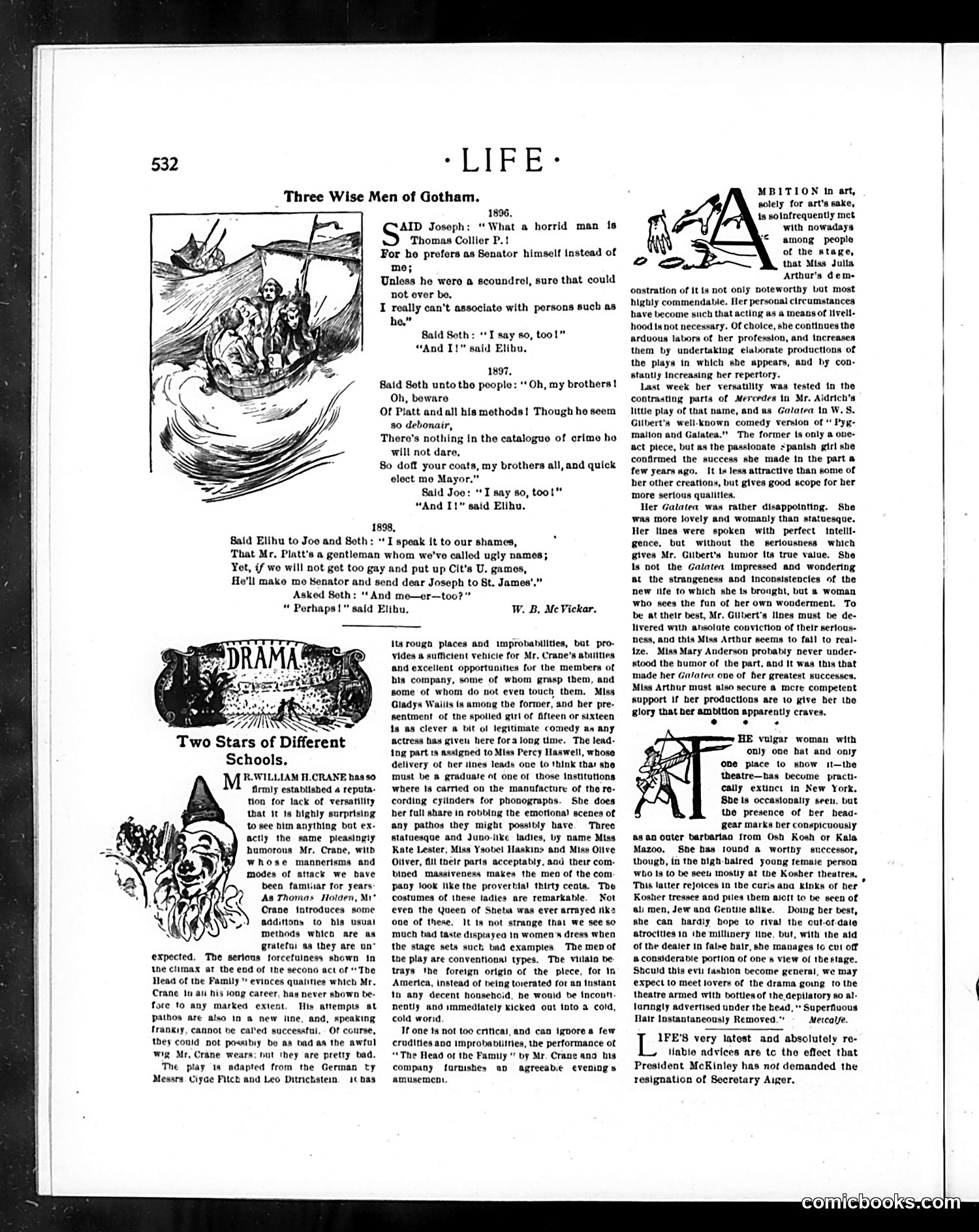
This page contains two theatrical reviews from 1896-1898. **"Three Wise Men of Gotham"** (top) is a humorous dialogue among three characters debating whether to elect someone as Mayor. The sketch appears to be satirizing New York City politics through wordplay and comedic banter. **"Two Stars of Different Schools"** (bottom) reviews Mr. Crane's theatrical company, praising the versatility and talent of his performers, particularly Miss Gladys Waits. The review notes that Crane introduces "novel methods" to staging and successfully adapts German dramatic works for American audiences. Both pieces are theater criticism with accompanying illustrations. The satire targets theatrical conventions and political pretension rather than specific contemporary figures. The page demonstrates Life's focus on entertainment criticism and theatrical society gossip circa the 1890s.
📄 Transcribed text from this page (OCR, searchable)
Machine-transcribed from the original scan — historical spelling and the odd misread are preserved.
«LIFE - Three Wise Men of Gotham. 1896, AID Joseph: “What a horrid man is Thomas Collier P.! For ho prefers as Senator himself instead of me; Unless he wero a scoundrel, sure that could not ever be, I really can’t associate with persons such as he.” Said Soth: “I say 80, tool” “And I!” said Elibu, 1897. Said Soth unto the people Oh, boware Of Platt and all his methods! Though he seem 80 debonair, Thero's nothing in the catalogue of crime ho will not daro, 80 doff your coats, my brothers all, and quick elect mo Mayor.” Said Joo: ‘I say 80, toot” “And 11” said Elihu. Oh, my brothers! 1898, Said Elihu to Joe and Seth: “I speak it to our shames, That Mr. Platt’s a gentleman whom we've called ugly names; Yet, if we will not got too gay and put up Cit’s U. games, He'll make mo Senator and send dear Joseph to St. James'.” Asked Seth: "And me—er—too?” “ Perhaps!” said Elihu. W. B. Me Vickar. Two Stars of Differen' Schools. R.WILLIAM H.CRANE has so firmly established a reputa- tion for lack of versatility that it 1s highly surprising to see him anything but ex- actly the same pleasingly humorous Mr. Crane, witb whose mannerisms and modes of attack we bave been famiiar for years: As Thomas Hotaen, Mi* Crane tntroduces some Additions to his usual methods whico are as grateful as they are un” expected. The serious forcefuiness shown in Ane climax at the end of the secono act of “The Head of the Family ” evinces qualities which Mr. Crane tn ati his long career, hag never shown be- fore to any marked extent. His attempts at Pathos are also in a new line, and, xpeaking frankiy, cannot be cal'ed successful. Of course, they could not possibiy be as bad as the awful wig Mr. Crane wears: but they are pretty bad. ‘The play 18 adapted from the German ty Messrs Ciyae Pitch and Leo Ditrichstein 1c bas {ts rough places and improbabilities, bat pro- vides a sufficient vehicle for Mr. Crane’s abitties and excellent opportunities for the members ot bis company, some of whom grasp them, and some of whom do not even touch them, Miss Gladys Waits is among the former, and her pre- sentment of the spolied girl of fifteen or sixteen 1s as clever @ bit of legitimate comedy as any actress has given here fora long time. The lead- ing part 1s assigned to Miss Percy Haswell, whose delivery of her tines leads one to think thar she must be @ graduate at one of those institutions where Is carried on the manufacture of the re- cording cylinders for phonographs. She does her full share in robbing the emotional scenes of ‘any pathos they might possibly have Three statuesque and Juno-like ladies, by name Miss Rate Lester, Miss Ysobel Haskins and Miss Olive Oitver, fill thelr parts acceptably, and their com- bined massiveness makes the men of the com pany look like the proverbial thirty ceats. Tbe costumes of these Indies are remarkable. Not even the Queen of Sheba was ever arrayed ike one of these. It 14 not strange that we see so much bad taste dispiayea In women’s dress when the stage sets such bad examples The men of the play are conventional types. The villain be trays the foreign origio of the plece, for In America, instead of being torerated fot an Instant 1h any decent honsencid, he would be inconn- nently and immediately kicked out Into a cold, cold worid If one 1s not too critical, and can ignore a few cradities ano Improbablitties, the performance ot “The Head ot the Family " by Mr. Crane ang bis company furmshey ap agreeabe evenings amusemem. . MBITION tn art, solely for art's sake, 4s solnfrequently met with nowadays s< among people of the stage, Oo Br that Miss Julla Arthur's dem- onstration of it 1s not only noteworthy bat most highly commendable. Her personal circumstances have become such that acting as a means of lvell- hood Is not necessary. Of choice, she continues the arduous labors of her profession, and increases them by undertaking elubonite productions of the plays in which she appears, and by con- stantly Increasing her repertory. Last week her versatility was tested in the contrasting parts of Mercedes in Mr. Aldrich’s little play of that name, and as Galatea tn W.S. Gilbert's well-known comedy version of “ Pyg- malton and Galatea.” The former ts only a one- ‘Act piece, but as the passtonate spanish girl she confirmed the success she made in the part a few yearn ngo. It ts less attractive than some of her other creattons, but gives good scope for her more serious qualities. Her Galatea wax rather disappointing. She was more lovely and womanly than statuesque. Her lines were spoken with perfect intellf- gence, but without the seriousness which gives Mr. Guibert’. humor Its true value. She is not the Galaten impressed and wondering ‘at the strangeness and inconsistencies of the new iife to which she ts bronght, but a woman who sees the fun of her own wonderment. To be at thetr best, Mr. Gilbert's Ines must be de- livered with absolute conviction of their serlous- hess, and this Miss Arthur seems to fall to real- ize. Miss Mary Anderson probably never under- stood the humor of the part. and ft was this that made her Galatea one of her greatest successes. Miss Arthur must also secure a mcre competent support if her productions are 10 give her tho glory that ber ambition apparently craves. ee HE vulgar woman with only one hat and only one piace to show it—the theatre—bas becume practi- cally extinct in New York. She ts occastonally seen. but the presence of ber heaa- gear marks her conspicuously asan outer barbarian from Osh Kosh or Kala Mazoo. She has sound a worthy successor, though, in the bigh-batred young femaie person who Is (o be seeu mostly at the Kosher theatres, This latter rejoices in the curis ana kinks of ber Kosher tressee and piles them alctt to be seen of li men, Jew and Gentie alike. Doing ber best, she can hardiy hope to rival the out-or-date atrocities 1 the millinery line, but, with the ald of the dealer in falve hair, she manages to cut off a considerabie portion of one s view of the stage. Shculd this evi fasbion become general, we may expect to meet lovers of the drama goung to the theatre armed with bottles of the,deptiatory 80 al- lanngly advertised under the bead, * Superfuous Nair Instantaneously Removed.” Metcalye. 1FE'S very latest and absolutely ro- Mable advices are tc the effect that President McKinley has not demanded the resignation of Secrotary Aiger.