
A complete issue · 20 pages · 1898
Life — December 15, 1898
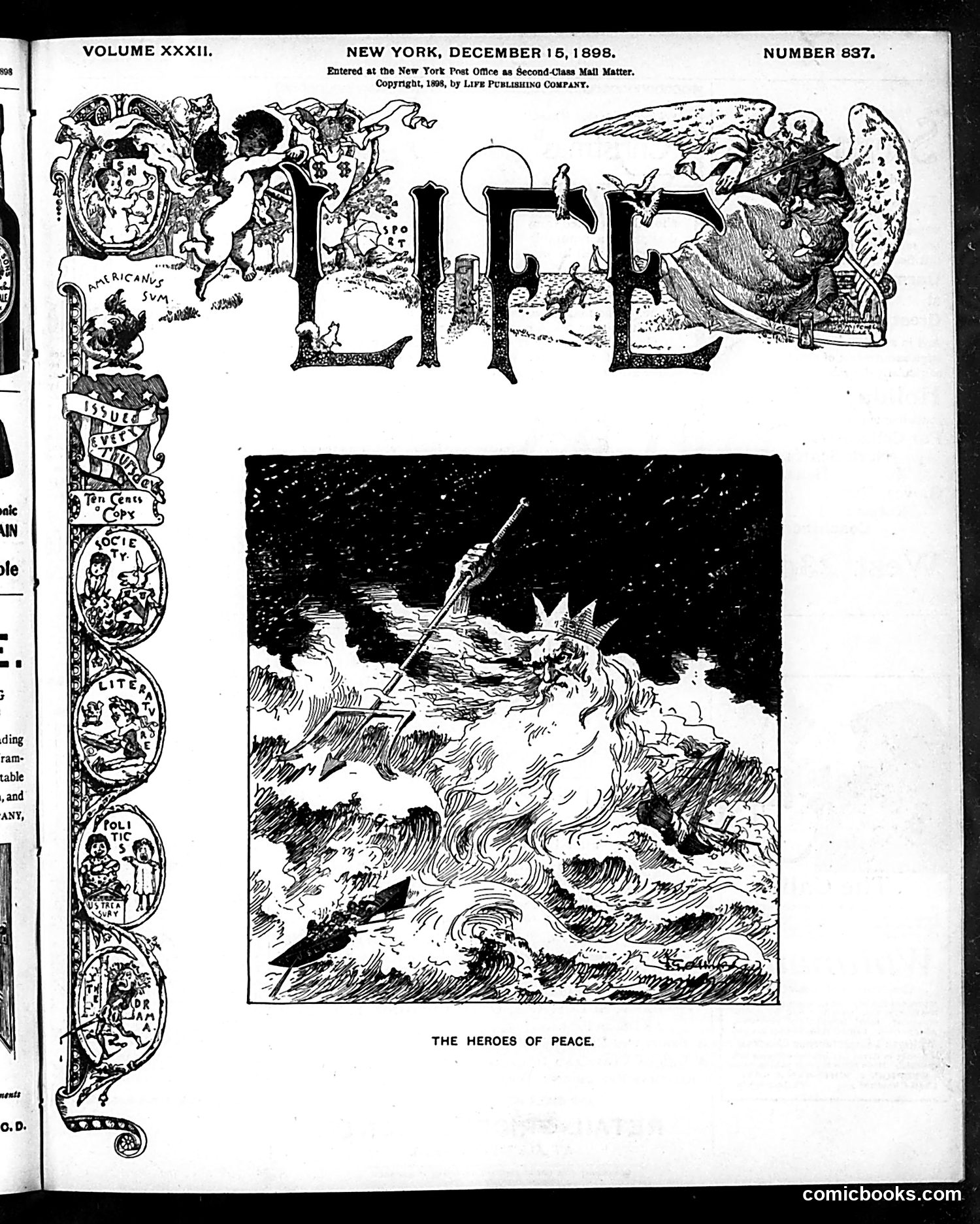
This satirical cover illustrates "The Heroes of Peace," depicting a crowned, bearded figure (likely representing a European monarch, possibly Tsar Nicholas II or similar imperial power) wielding a sword amid turbulent clouds and conflict. The imagery is ironic—calling warmongers "heroes of peace" mocks leaders who claimed peaceful intentions while conducting military aggression. The 1898 date places this during the Spanish-American War era and amid imperial expansion. The elaborate decorative border featuring classical medallions reinforces the satire by contrasting civilization's pretensions with the brutal reality of imperial conquest depicted in the main illustration. The cartoon criticizes how powerful nations justified colonial and military violence under the guise of peaceful progress.
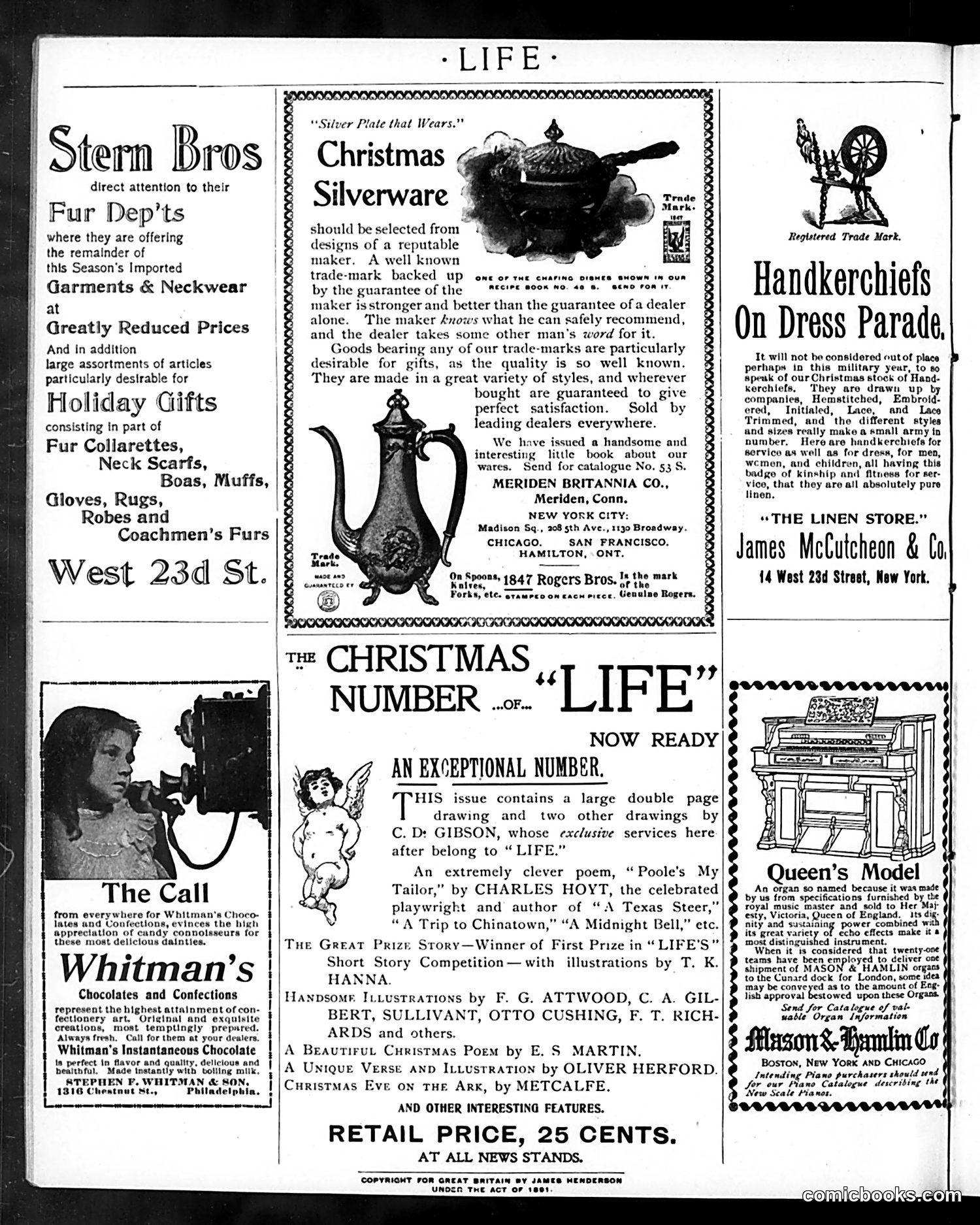
This page is primarily **advertising and promotional content** rather than political satire. The main elements include: **Advertisements:** - Stern Bros. (fur and holiday gifts) - Whitman's Chocolates ("The Call" - featuring a photographer) - James McCutcheon & Co. (linen store) - Mason & Hamlin Co. (pianos) - Meriden Britannia Co. (silverware) **Magazine Promotion:** The central section announces Life's Christmas issue as "AN EXCEPTIONAL NUMBER," highlighting contributions by notable illustrators (C.D. Gibson, T.K. Hanna, F.G. Attwood and others) and literary figures including Charles Hoyt. Content includes prize-winning stories, poems, and illustrations. **Overall context:** This reflects early 1900s consumer culture and Life magazine's status as an illustrated publication mixing humor, art, and upscale advertising targeting wealthy readers.
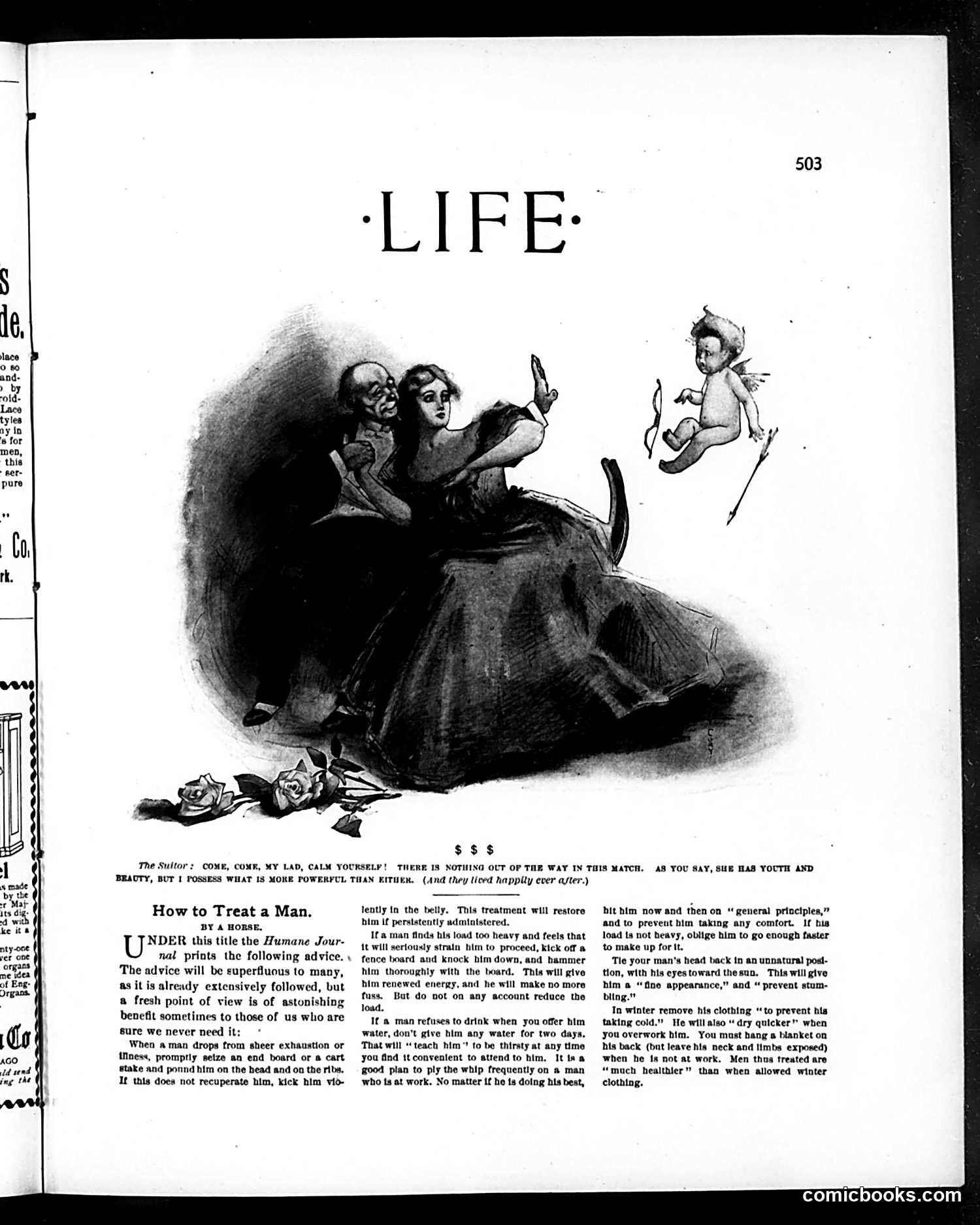
This page presents satirical content about treating horses and men. The main illustration shows two figures (a man and woman) riding a horse, with a cherub flying above. Below is an article titled "How to Treat a Man: By a Horse." The satire appears to compare proper horse care with how men should be treated. The text provides practical advice about feeding exhausted horses, treating injuries, and preventing illness through proper clothing and rest. By framing this as a horse's perspective on treating humans, the piece likely mocks contemporary (likely Victorian-era) attitudes toward male stubbornness or poor self-care, suggesting men should follow the common sense that people apply to horses. The humor relies on the inversion: using animal husbandry logic to address human behavior.
This page contains political commentary on Philippine annexation and expansionism following the Spanish-American War. The left illustration depicts a figure (likely Uncle Sam) burdened by the Philippines, suggesting the weight of imperial responsibility. The text debates whether America should expand into the Philippines, with conservative voices advocating caution due to the costs (mentioned: "two hundred millions a year"). The piece references Senator Hoar's opposition and mentions figures like Reverend Henry Van Dyke and Edward Atkinson as voices in the annexation debate. A secondary item discusses George Aldridge, Rochester's Superintendent of Public Works, and concerns about his political influence and potential investigation into public moneys—representing typical Progressive Era concerns about municipal corruption and patronage politics.
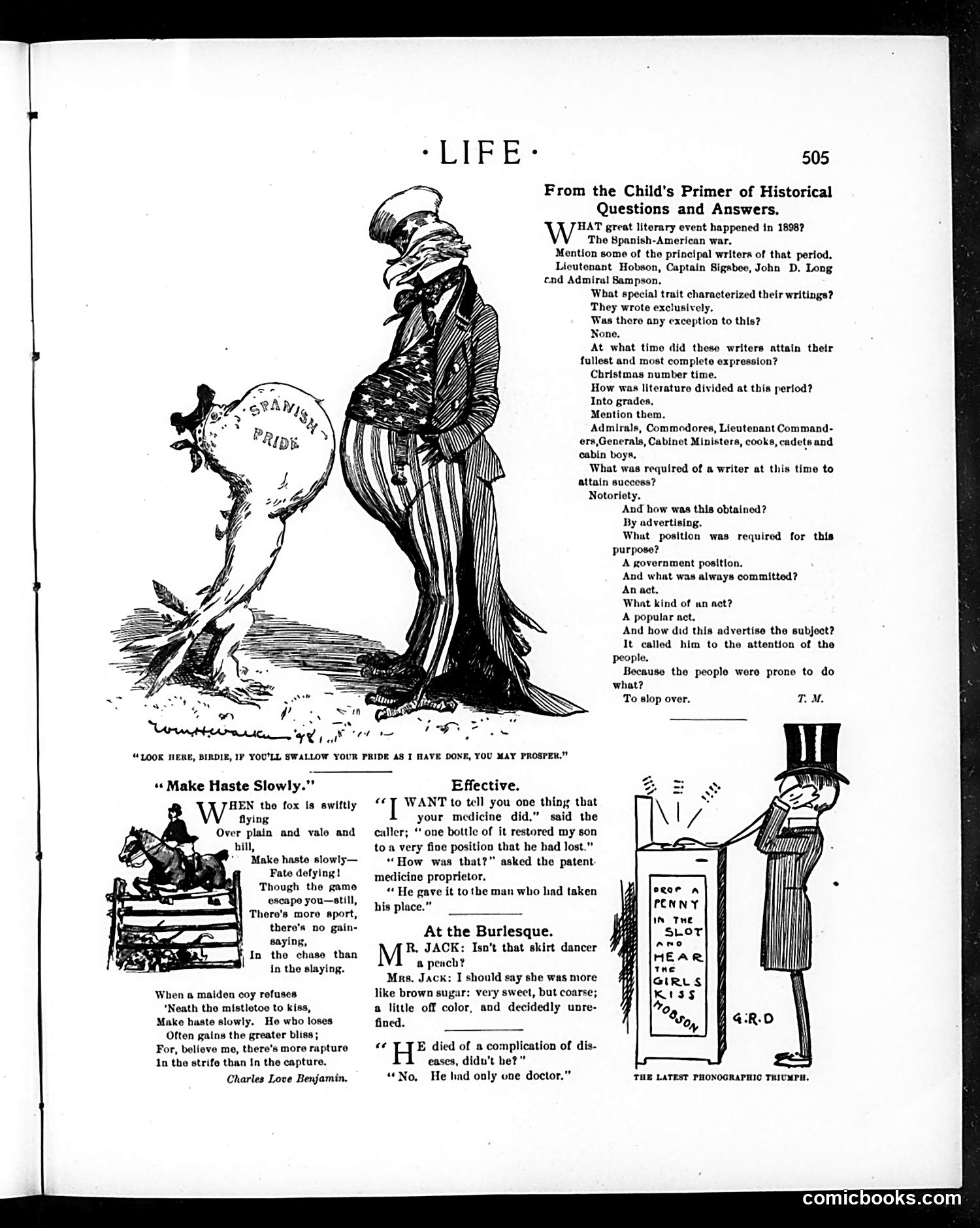
The top cartoon depicts a tall figure labeled "GRAMPA PRIDE" being tempted by a shorter man in formal dress. The caption reads: "LOOK HERE, BIRDIE, IF YOU'LL SWALLOW YOUR PRIDE AS I HAVE DONE, YOU MAY PROSPER." This satirizes compromise of principles for financial gain—the figure representing pride is being pressured to abandon his values, as the other man claims to have done successfully. The remaining content includes period humor pieces ("Make Haste Slowly," "Effective," "At the Burlesque") and a small cartoon titled "THE LATEST PHONOGRAPHIC TRIUMPH" showing a phonograph with "G.R.D" markings. These appear to be typical magazine filler jokes rather than political commentary. The Spanish-American War reference in the header is historical context only.
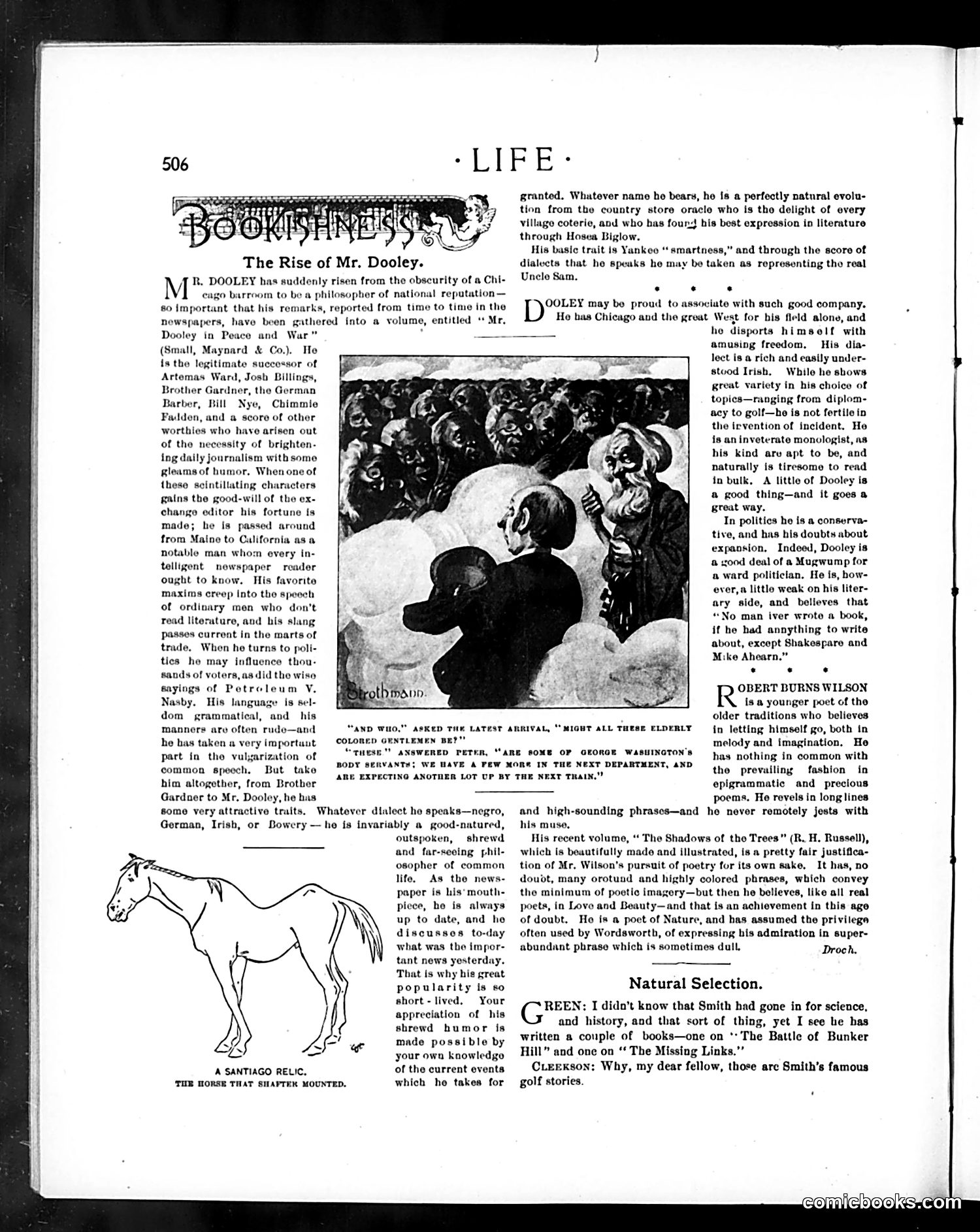
This page features two distinct pieces: **"The Rise of Mr. Dooley"** (main article) discusses a fictional character who has gained prominence through newspaper columns. The text praises "Mr. Dooley" as a witty Irish character whose dialect-heavy commentary on current events and politics has become popular. The article notes his conservative political views and his talent for satirizing public figures through vernacular humor. **The illustration** shows a crowded social gathering, captioned as people asking about "new arrivals" and discussing "George Washington's boot" — likely satirizing pretentious or absurd social climbing and claims of historical significance. **"A Santiago Relic"** (small cartoon below) depicts a horse, apparently mocking dubious souvenirs claimed to be from the Spanish-American War. The page exemplifies Life's satirical approach to popular culture, politics, and social affectation.
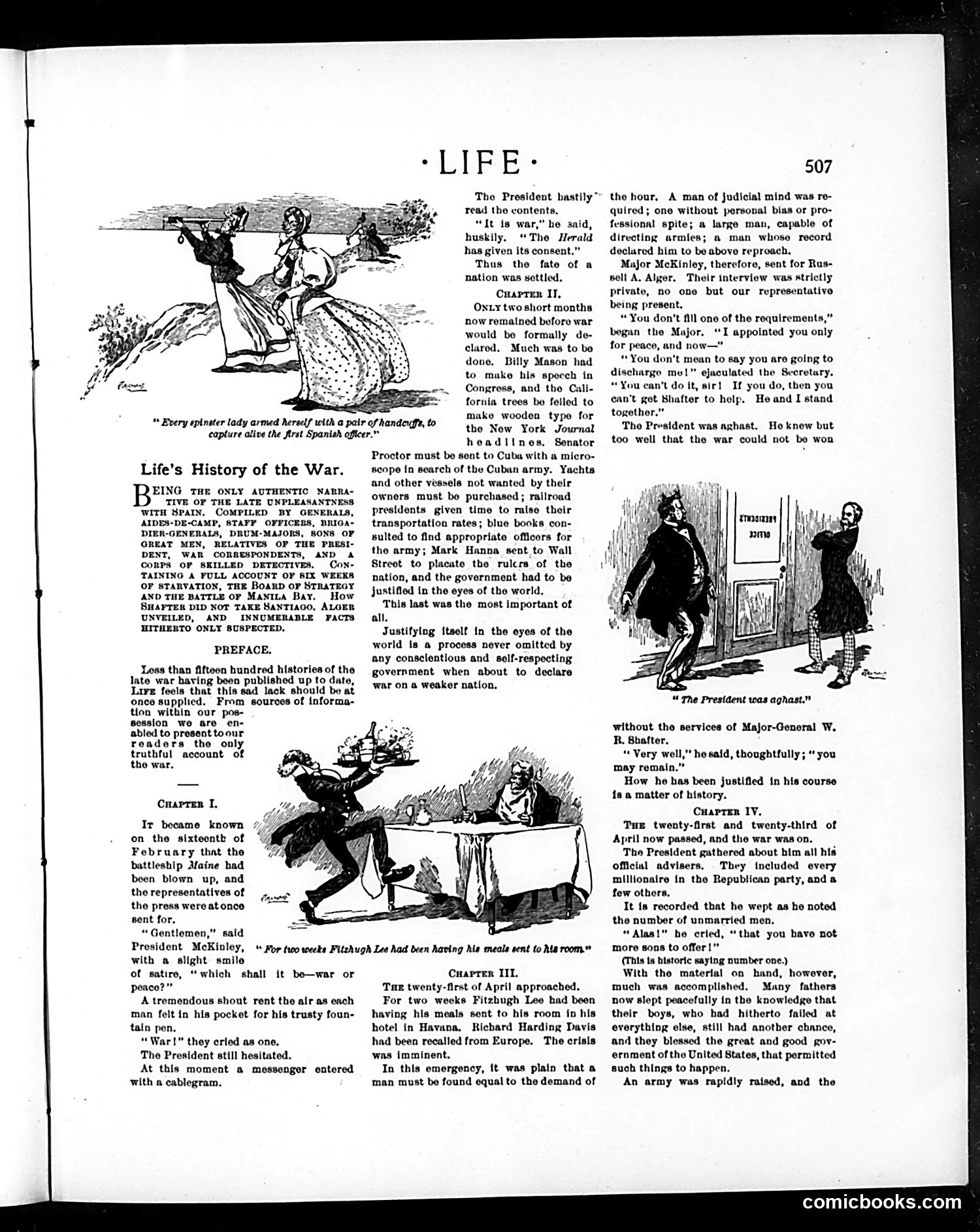
This page presents "Life's History of the War," a serialized account of the Spanish-American War compiled by General Alden D. Sears and others. The illustrations satirize President McKinley's war management. The top cartoon shows a woman armed with handcuffs confronting a man, captioned "Every spinster lady armed herself with a pair of handcuffs, to capture one of the 'duly Spain' officers." The lower cartoons mock McKinley's hesitation and the war's bureaucratic complications—including disputes over railroad rates, military supplies, and officer recruitment. The text references specific problems: sending a microscope to Cuba to locate the enemy, purchasing vessels, and the difficulty of raising an adequate army quickly. The satire critiques McKinley's apparent reluctance and the chaotic military preparations required.
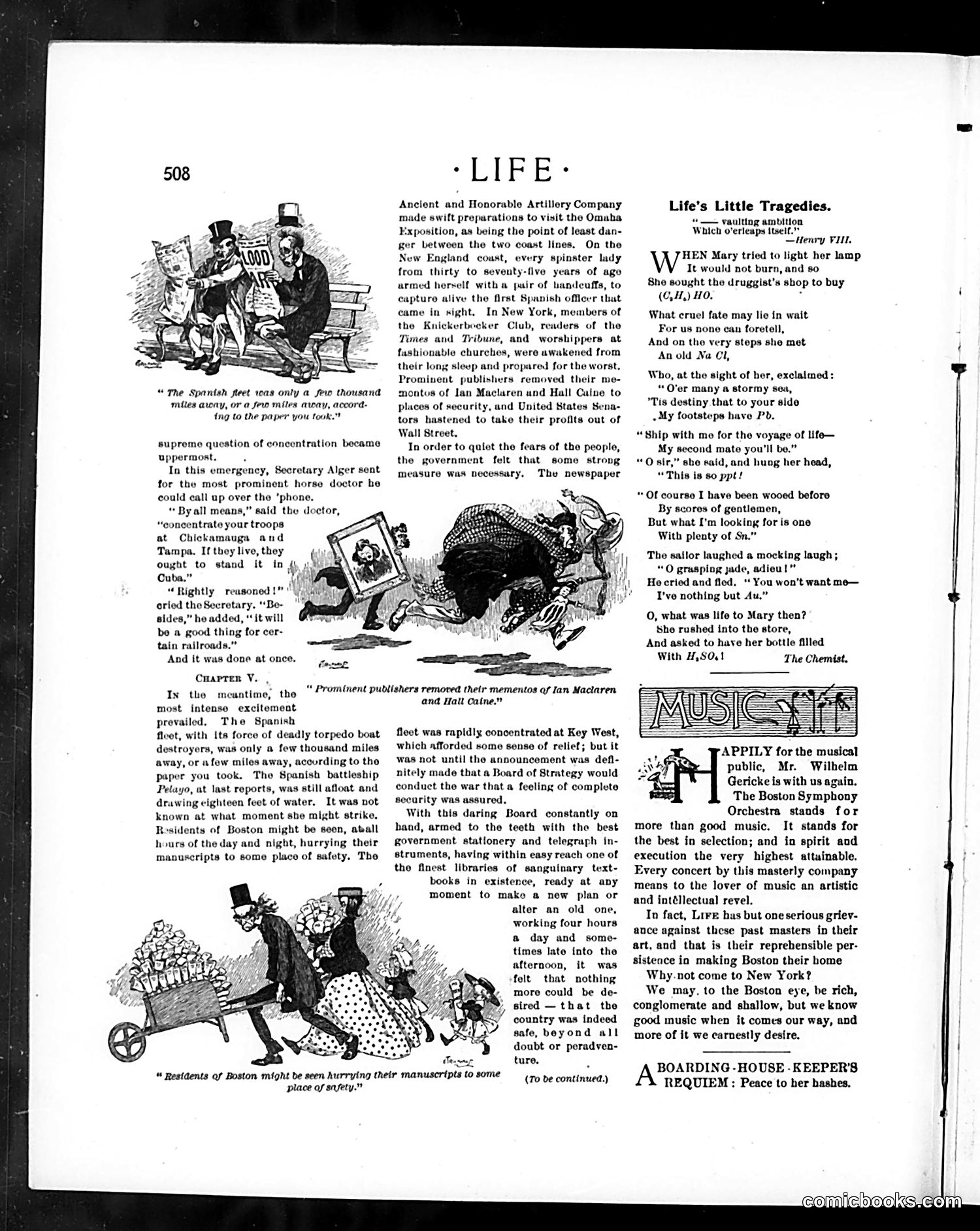
This page combines serialized fiction ("Life's Little Tragedies") with satirical commentary on contemporary events. **The cartoons** depict scenes of bureaucratic chaos during what appears to be war preparation. One illustration shows officials and publishers in disarray, captioned about "prominent publishers removed their mementos of Ian Maclaren and Hall Caine"—referencing literary figures. Another shows Boston residents "hurrying their manuscripts to some place of safety," satirizing the panic among the city's literary establishment. **The satire** mocks how Boston's intellectual class reacted to national military preparations, particularly the fear that manuscripts and cultural artifacts might be lost. The exaggerated scenes of people fleeing with documents suggest Life was ridiculing both the intensity of war anxiety and Boston's self-regard as a cultural center. The text references the Spanish fleet, suggesting this dates to the Spanish-American War era (1898).
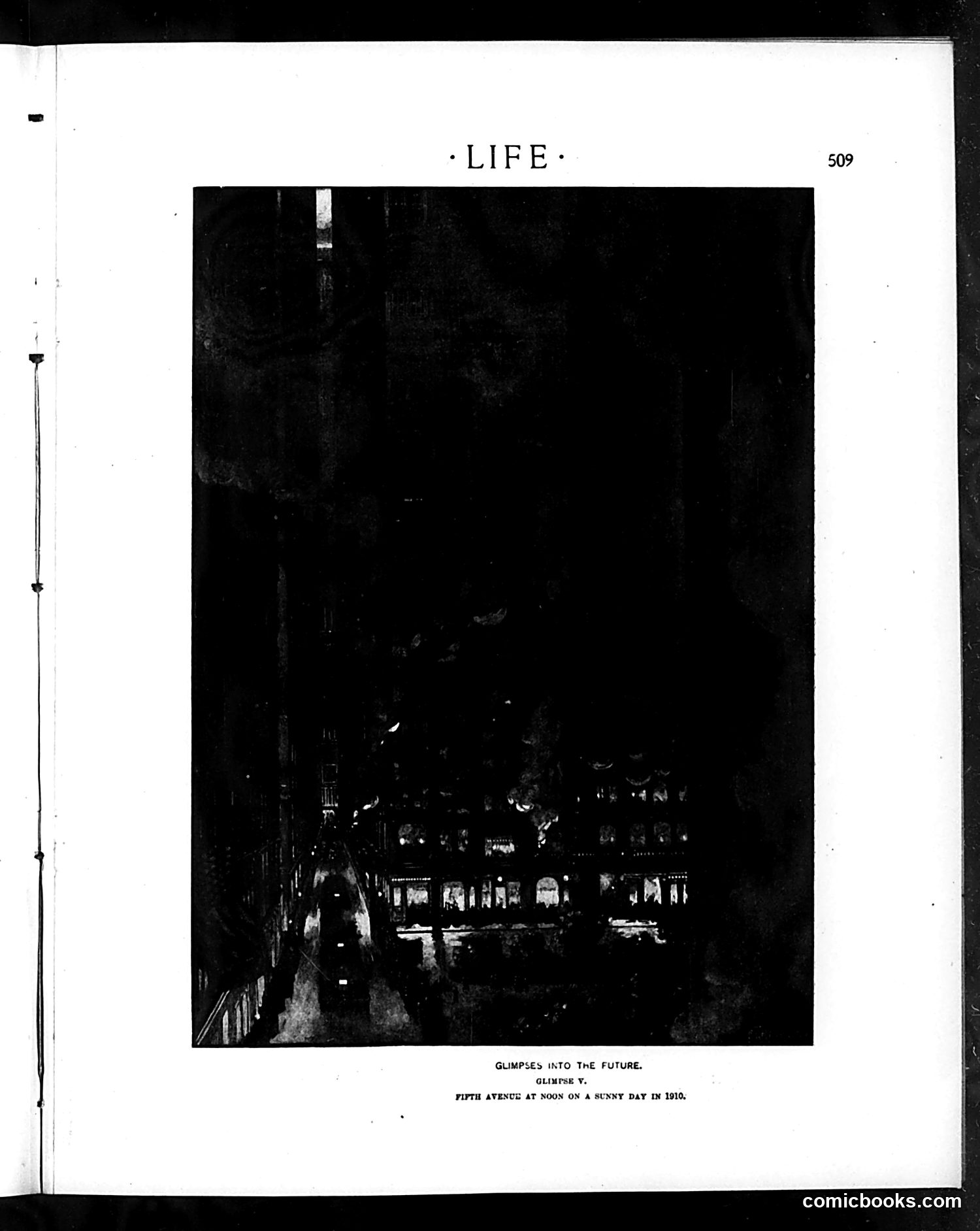
This is a photograph rather than a cartoon, labeled "Glimpses Into the Future" showing Fifth Avenue in New York at noon on a sunny day in 1915. The image depicts a dramatically darkened street scene with tall buildings towering overhead, creating an almost nighttime effect despite the stated sunny conditions. Streetlights and shop windows provide the only illumination in the gloom. The satirical point appears to be social commentary on urban development: the rapidly growing skyscrapers of New York City are so tall they block out natural sunlight from the streets below, even in daytime. This serves as a cautionary "glimpse into the future" warning readers about unchecked vertical expansion and its consequences for city life and public spaces. The irony of a "sunny day" being invisible on the street reflects anxieties about modernization.
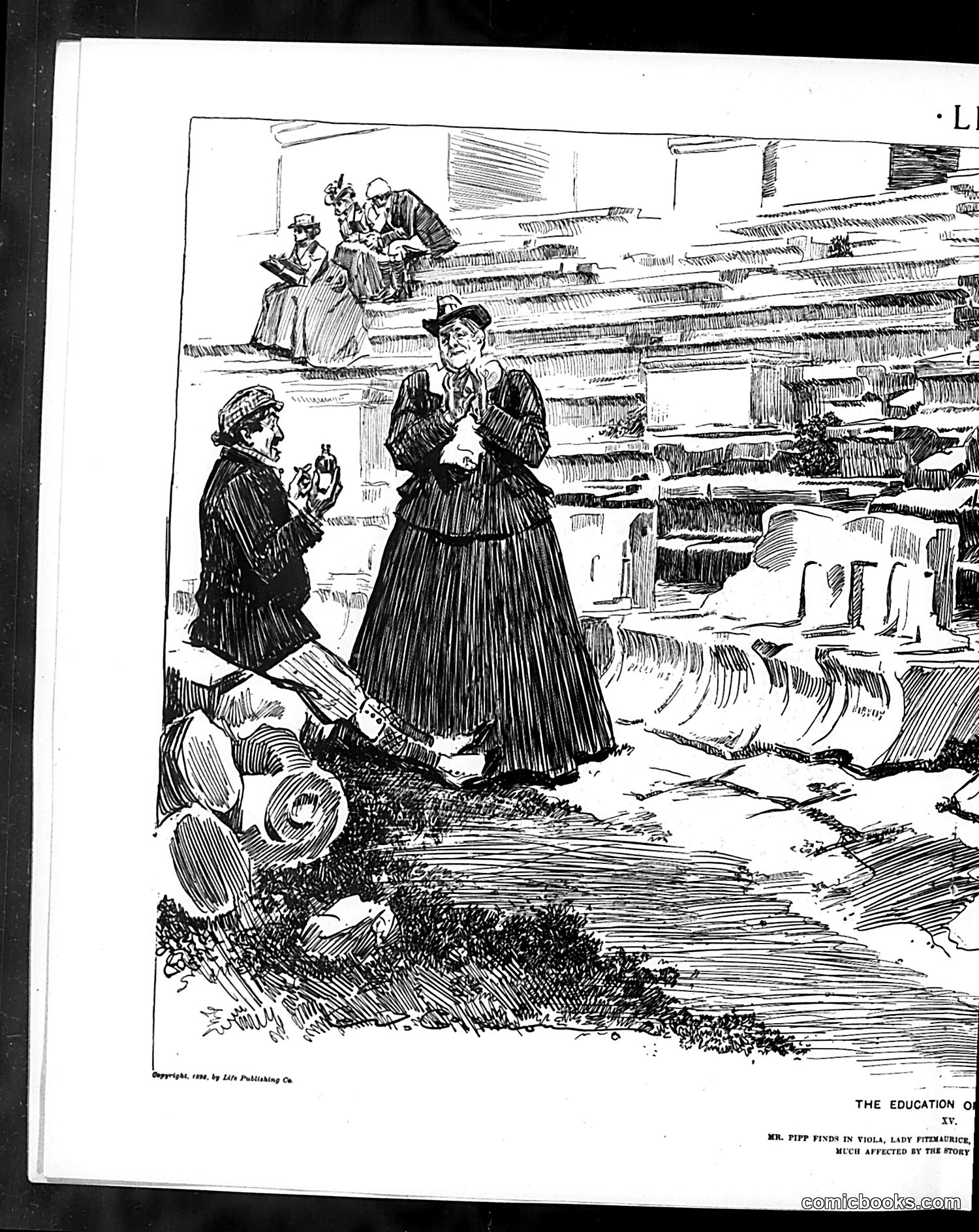
This illustration from *Life* magazine shows a lumber yard scene. The caption indicates this is "The Education of Mr. Pipp Finds in Viola, Lady Fitzpatrick, Much Affected by the Story." The cartoon depicts a gentleman in a bowler hat and formal coat speaking with a woman in Victorian dress at a timber yard. Other figures appear in the background. The scene suggests a narrative moment where Mr. Pipp is engaging with Lady Fitzpatrick, apparently moved or emotionally affected by something he has told her. Without access to the original story or serialized content this illustration accompanied, the specific satirical point remains unclear. The humor likely derived from readers' familiarity with the ongoing narrative about these characters. The setting—an incongruous lumber yard for a gentleman-lady encounter—may itself be part of the comedic point.
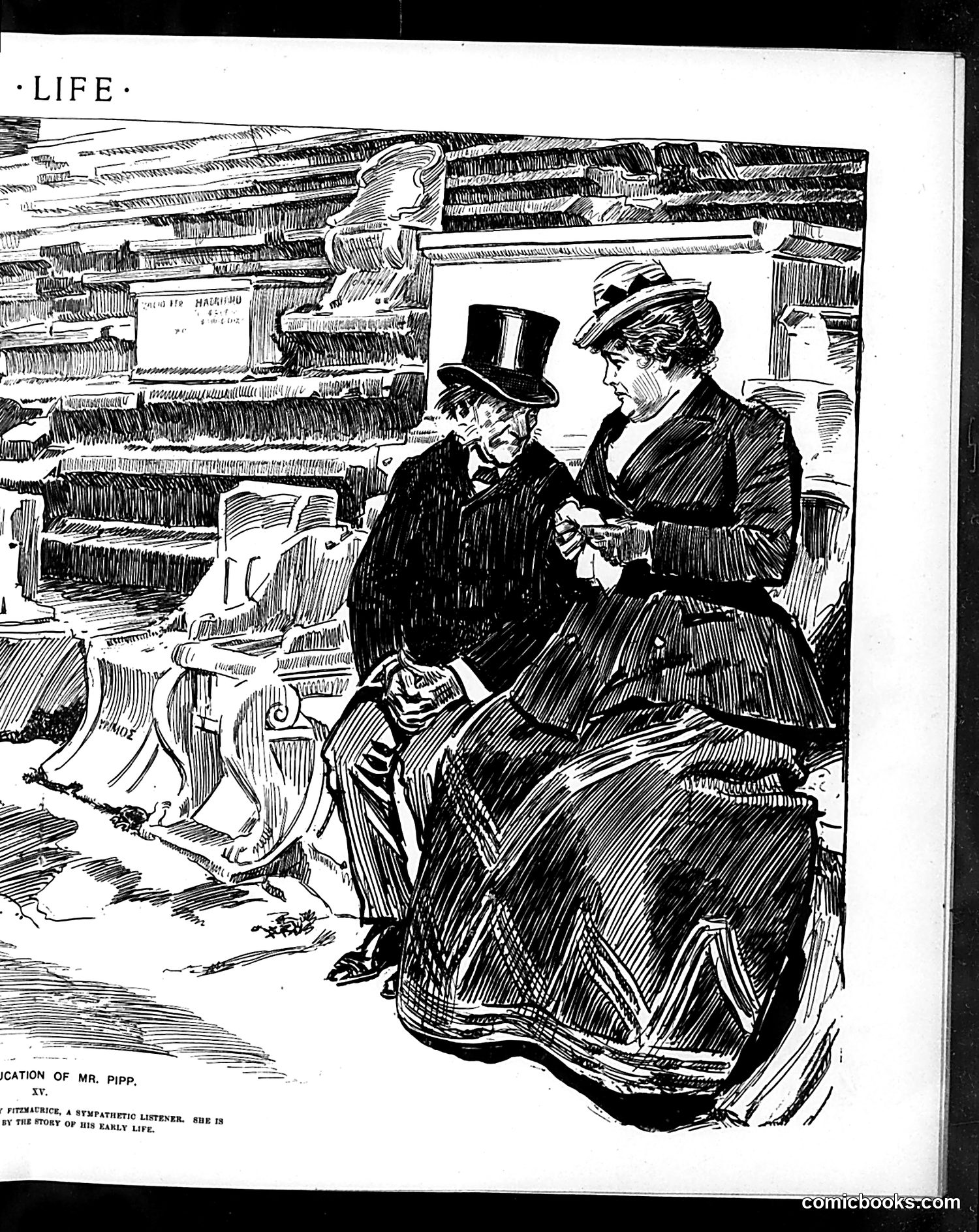
This is a page from *Life* magazine showing an illustration titled "Education of Mr. Pipp" (visible in the caption). The caption indicates it's about "a sympathetic listener" being moved "by the story of his early life." The image depicts two figures in Victorian-era clothing in what appears to be a modest interior with books and furnishings. One man wears a top hat; the other is a woman. Based on the caption's reference to "Mr. Pipp" and "sympathetic listener," this appears to be satirizing a sentimental or manipulative story-telling scenario—likely poking fun at how sob stories or appeals to sympathy can persuade or influence listeners, particularly in social or business contexts. The specific identity of "Mr. Pipp" and the exact satirical target remain unclear from the visible text.
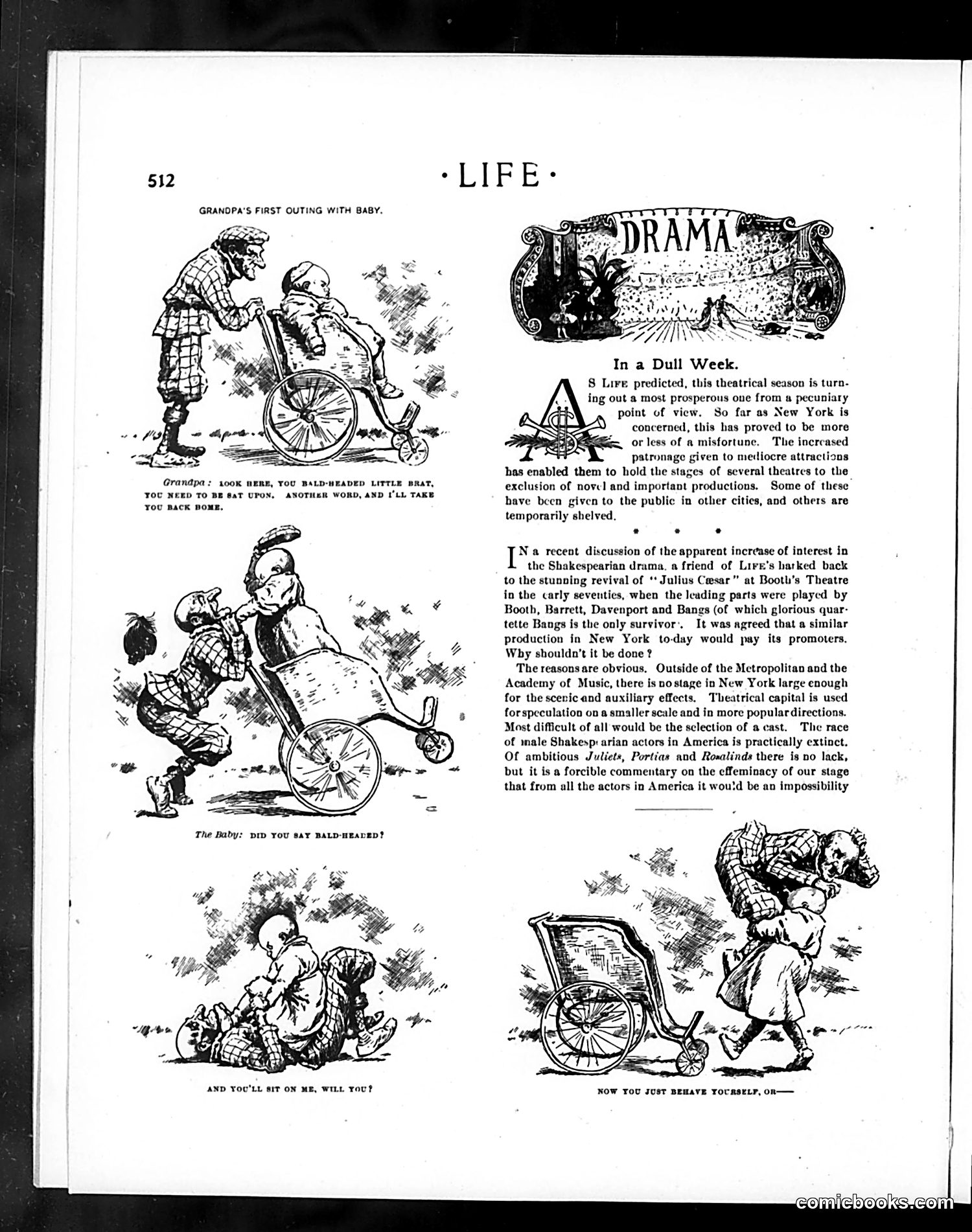
This page contains humorous illustrations about grandparents taking a baby out, paired with a dramatic arts article. The left side shows four comic panels depicting an elderly grandfather struggling with a baby carriage—struggling to control it, the baby misbehaving, and the grandfather losing composure in public situations. The captions use exaggerated dialogue ("bald-headed," "sassy"). The right side, titled "In a Dull Week," discusses the theatrical season in New York. The author argues that reviving Shakespeare's *Julius Caesar* (last performed in the 1600s) could succeed if proper casting were available, but laments the lack of qualified male Shakespearean actors in America, noting the scarcity of suitable talent for such ambitious roles. The satire contrasts domestic chaos with high culture concerns.
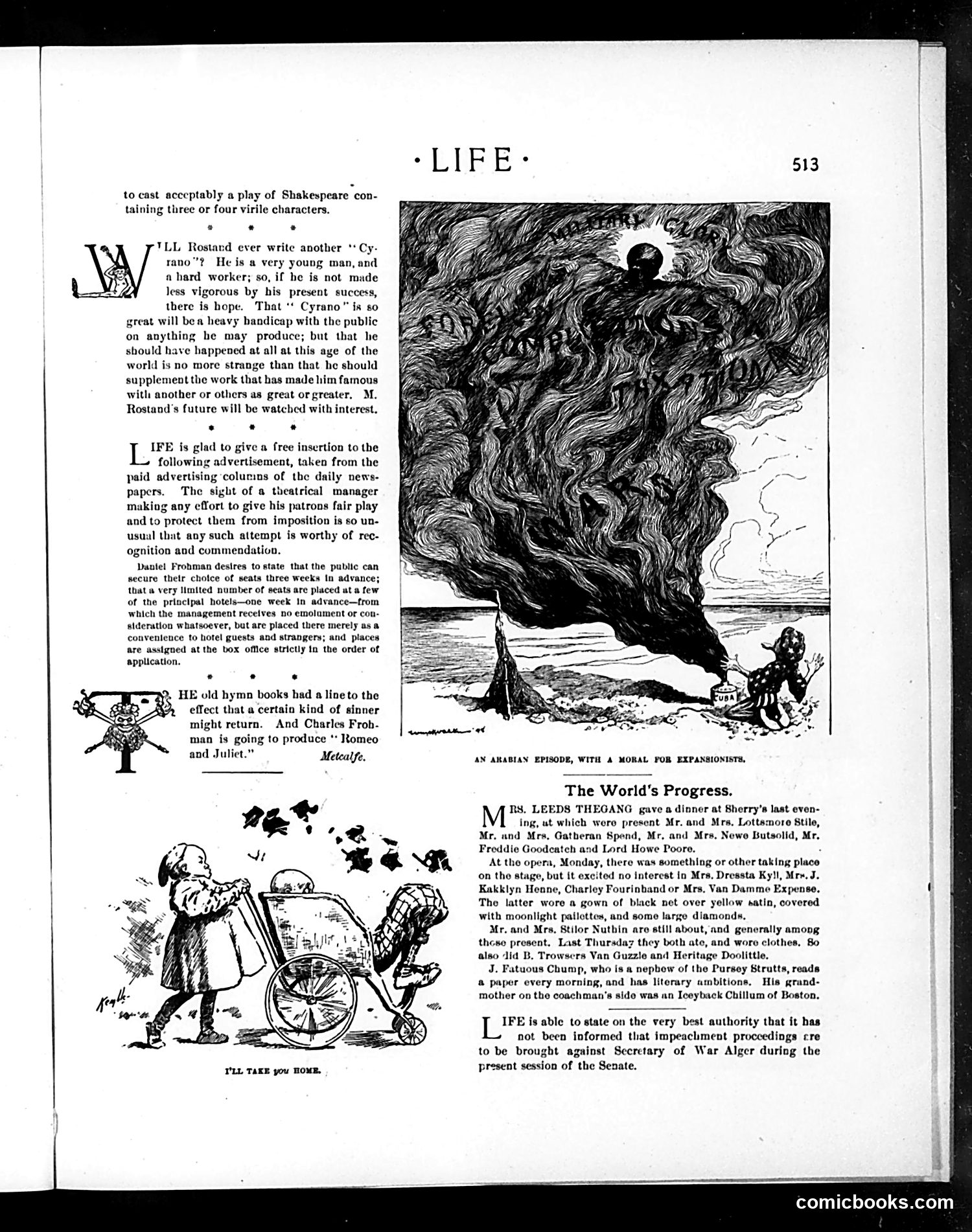
This page contains theater criticism and social satire typical of Life's format. The main content discusses playwright Edmond Rostand (who wrote *Cyrano de Bergerac*) and praises theater manager Daniel Frohman's ethical practice of fairly distributing theater seats—remarkable enough in that era to warrant commendation. Charles Frohman's announcement of producing *Romeo and Juliet* is humorously compared to redemption of sinners. The "Arabian Episode" illustration satirizes American expansionism (likely referencing recent imperialism), showing a figure observing exotic landscapes with a moral warning. "The World's Progress" mockingly catalogs wealthy New Yorkers by their material possessions and social activities—names like "Lottsmore Stile," "Gatheran Spend," and "Van Damme Expense" are transparent satirical inventions highlighting vapid consumerism. The final paragraph's sardonic note about War Secretary Alger suggests contemporary political controversy the editor wishes to ironically deny.
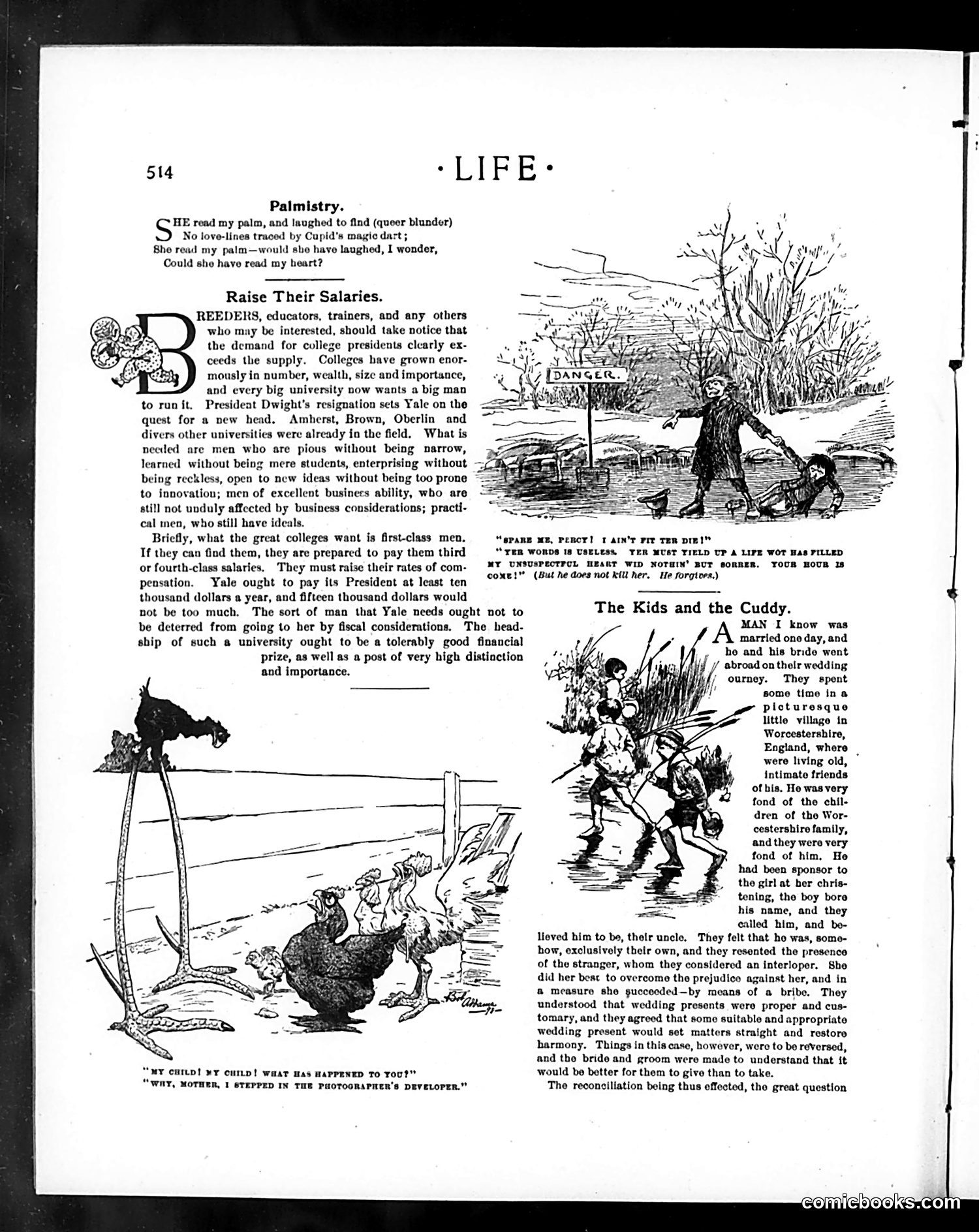
This page contains three distinct pieces of satirical content: **"Raise Their Salaries"** critiques the hypocrisy of elite universities. College presidents like Yale's Dwight (who recently resigned) are in high demand, yet universities want "first-class men" but offer only "third or fourth-class salaries." The satire points out the contradiction: institutions expect distinguished leaders but won't pay competitive wages. The article advocates raising presidential salaries to at least $10,000-15,000 annually. **"The Kids and the Cuddy"** (bottom right) humorously depicts a newlywed couple's visit to family friends in England. The couple's children resent the bride as an "interloper," believing the husband belongs exclusively to them. The satire portrays children's possessiveness and provincial attitudes. The story resolves when the bride and groom strategically give wedding gifts rather than receive them—reversing expectations to win over the jealous children. The cartoons illustrating these articles show period humor typical of early 20th-century Life magazine's blend of social commentary and domestic comedy.
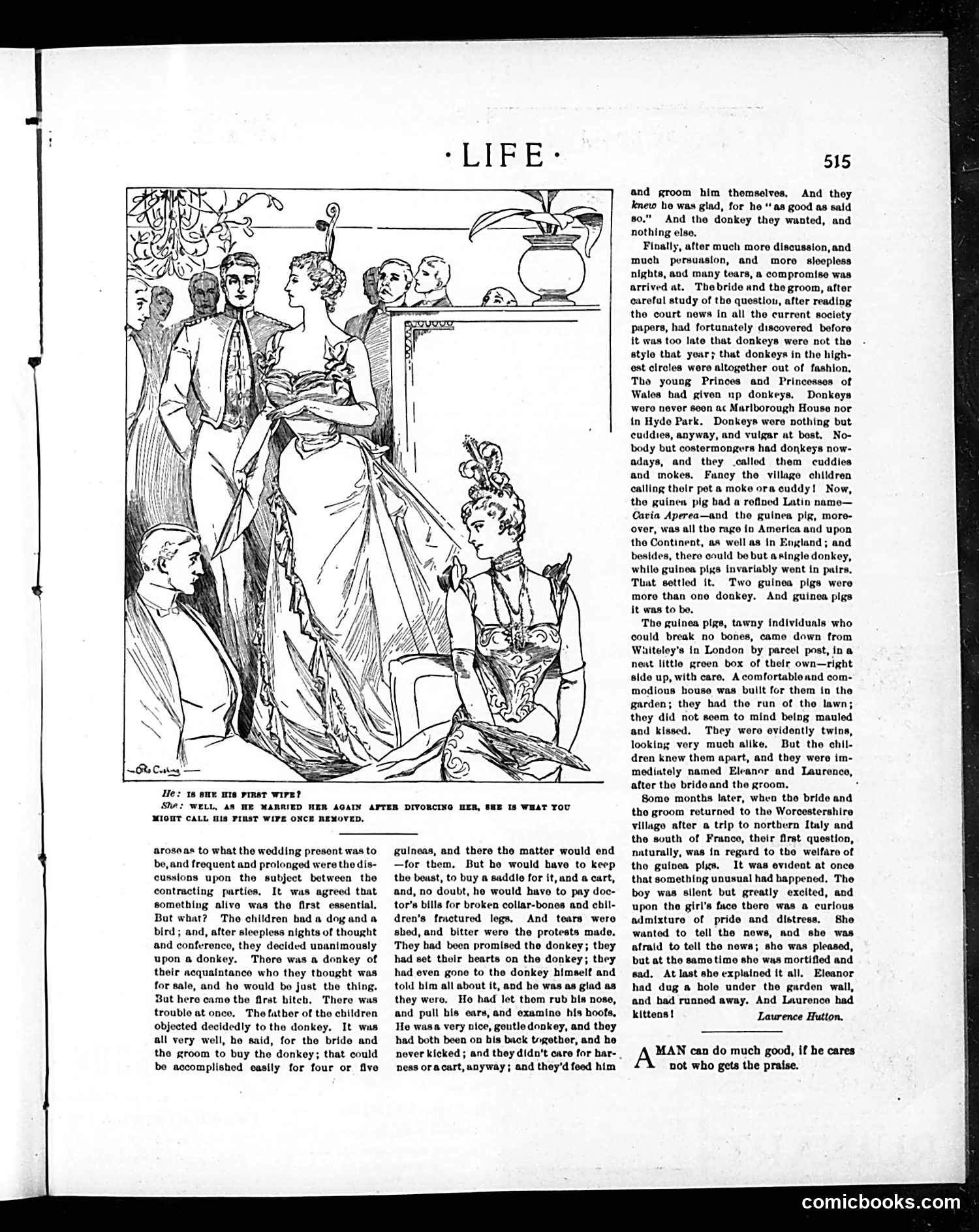
This page contains two distinct pieces of social satire: **The Caption Joke (top):** A couple discusses remarriage. The woman explains that her friend remarried her ex-husband after divorce, making her "your first wife once removed"—a play on the genealogical term for relatives. It's satirizing the increasingly complex marital situations among Victorian/Edwardian society. **The Main Story (illustrated):** A narrative about newlyweds selecting a wedding gift. The bride and groom initially want a donkey, but the groom's father objects to the expense and liability. Rather than fight, they claim donkeys are now "out of fashion" in high society—the young royals (Princes and Princesses of Wales) have abandoned them. They compromise on guinea pigs instead, framed as scientifically sophisticated (Latin name: *Cavia Aperea*) and trendy in America and Europe. **The satire** mocks aristocratic pretension and the absurd logic of fashion-conscious society: the choice changes not from reasoned argument but from the convenient discovery that donkeys are now "vulgar" and associated with working-class costermongers.
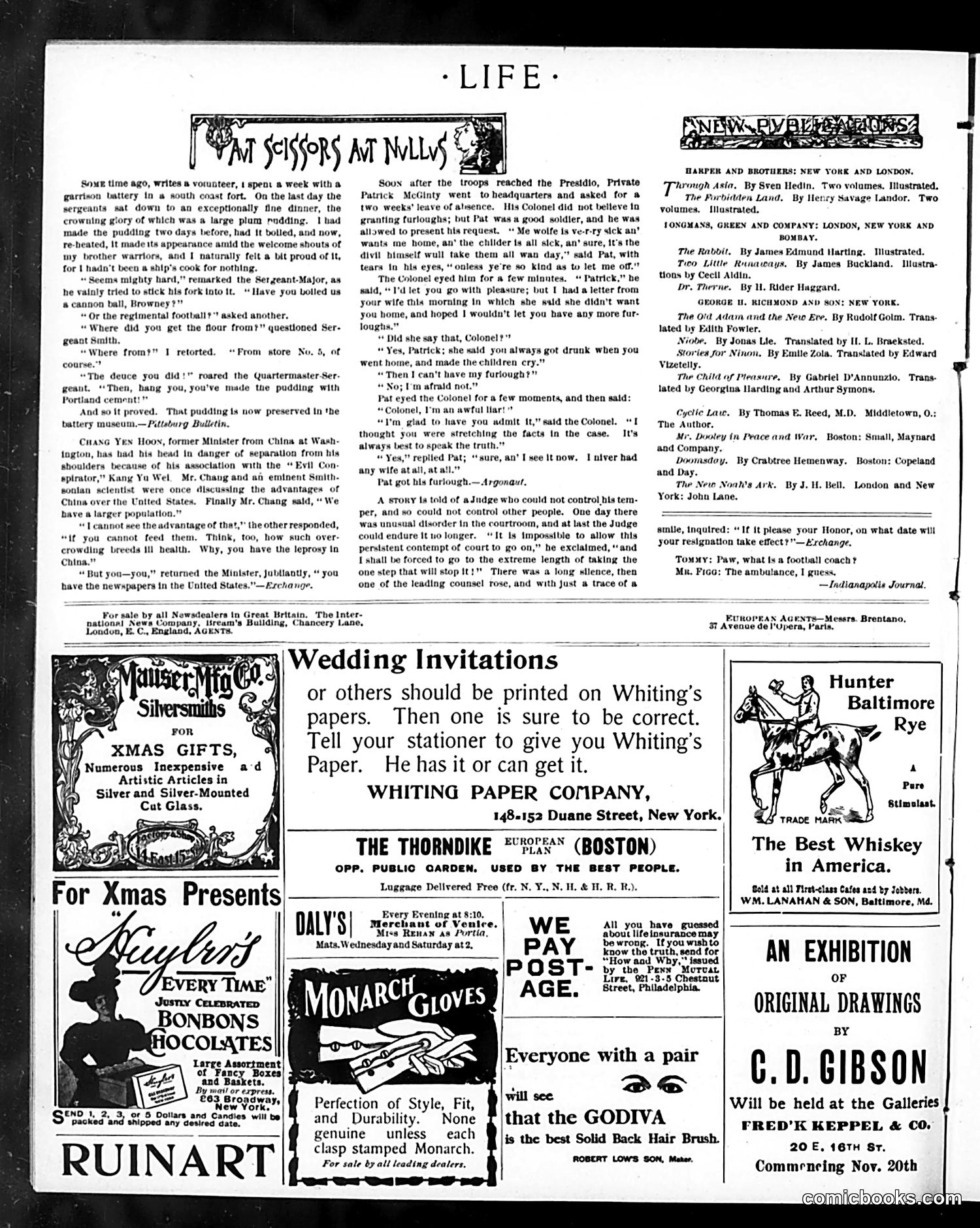
This page is primarily **advertisements and satirical anecdotes**, not political cartoons. The main content consists of three humorous stories: 1. **The Pudding Story**: A soldier's plum pudding is so hard it's jokingly compared to a cannonball. The punchline reveals he accidentally used Portland cement instead of flour—satire on military supply mix-ups. 2. **The Minister's Retort**: Chinese Minister Chang Yen Hoo jokes that America's advantage over China isn't its wealth but its newspapers—satirizing American press freedom and China's lack thereof. 3. **The Soldier's Furlough**: Private McGinty seeks leave by lying about his sick family. When the Colonel reveals his wife wrote saying Pat gets drunk at home, Pat admits he's a liar—earning his furlough through honesty. Gentle satire on human nature. The remainder is **period advertising** for Christmas gifts, gloves, whiskey, and an art exhibition. No identifiable political figures appear.
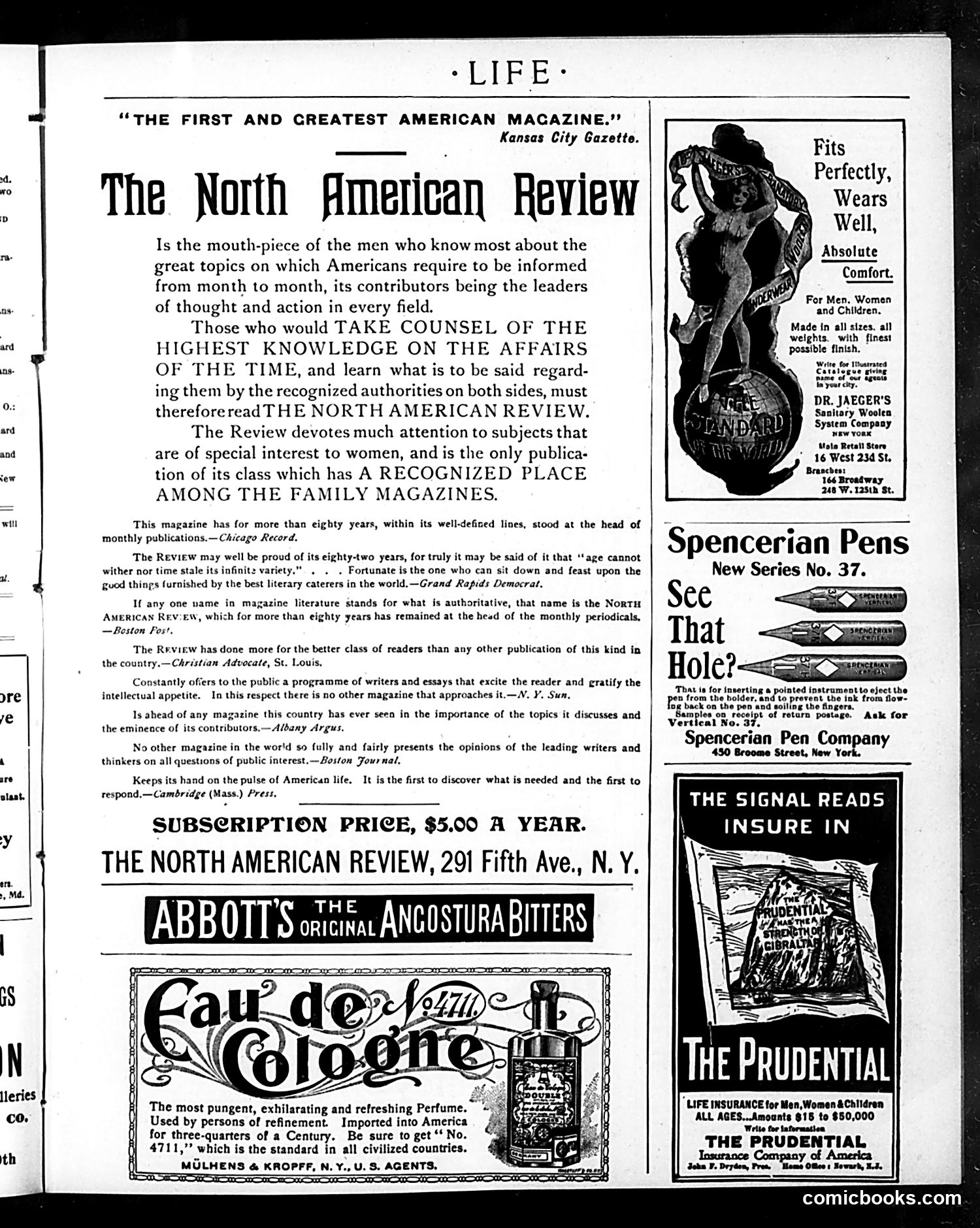
This is primarily a **title/advertising page** rather than a satirical cartoon page. The main content promotes *The North American Review*, a serious literary and opinion magazine, through extensive testimonials from prominent newspapers praising its intellectual authority and eighty-plus-year reputation. The page includes **no political cartoons or satire**. Instead, it features period advertisements for: - Dr. Jaeger's wool clothing (emphasizing health benefits) - Spencerian Pens (with a technical diagram explaining the ink-flow mechanism) - Angostura Bitters (marketed as perfume/toiletry) - Abbott's Bitters - The Prudential Insurance Company The layout reflects *Life's* dual function as both satirical magazine and advertising vehicle. The testimonials position *The North American Review* as essential reading for educated Americans seeking authoritative perspectives on current affairs—a marketing claim typical of serious 19th-century publications competing for middle-class readership.
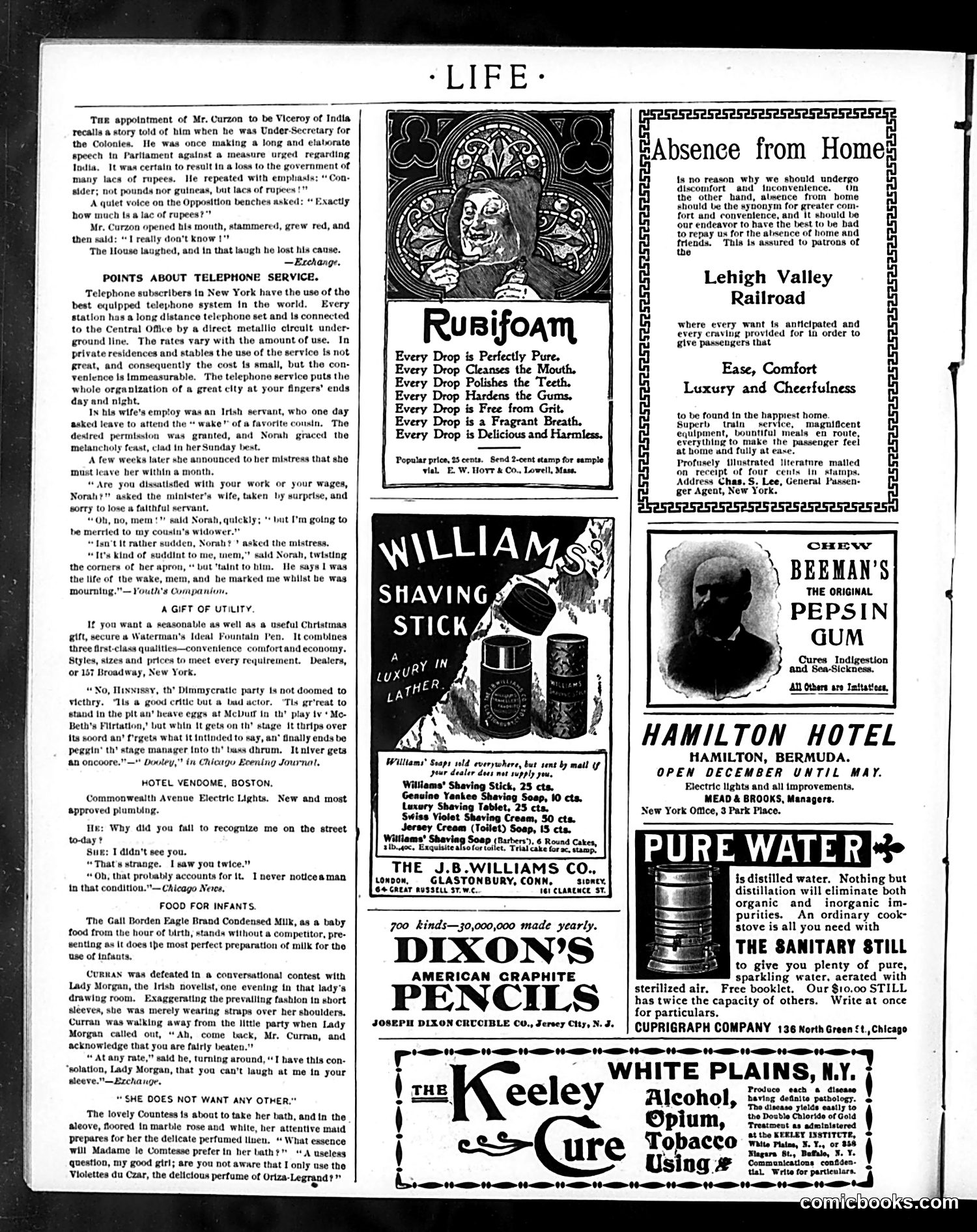
This page from *Life* magazine is primarily **advertising with brief satirical articles**—not political cartoons. The main content includes: **Satirical anecdotes:** Stories mocking public figures, including one about Mr. Curzon (British Viceroy of India) who embarrassingly couldn't define "lac of rupees" during a Parliamentary speech—a joke about his pretentious incompetence on colonial matters. **"Dooley" commentary:** A dialect piece by the popular humorist Mr. Dooley criticizing the Democratic Party as good at criticism but poor at actual governance. **The bulk of the page:** Period advertisements for consumer products—Rubifoam toothpaste, Williams' shaving products, Dixon's pencils, Beeman's pepsin gum, patent medicines, and hotels. These ads reflect early 1900s consumer culture and marketing techniques. The page reflects *Life's* dual purpose as both satirical commentary on politics and society, and a commercial vehicle for advertising to middle-class readers.
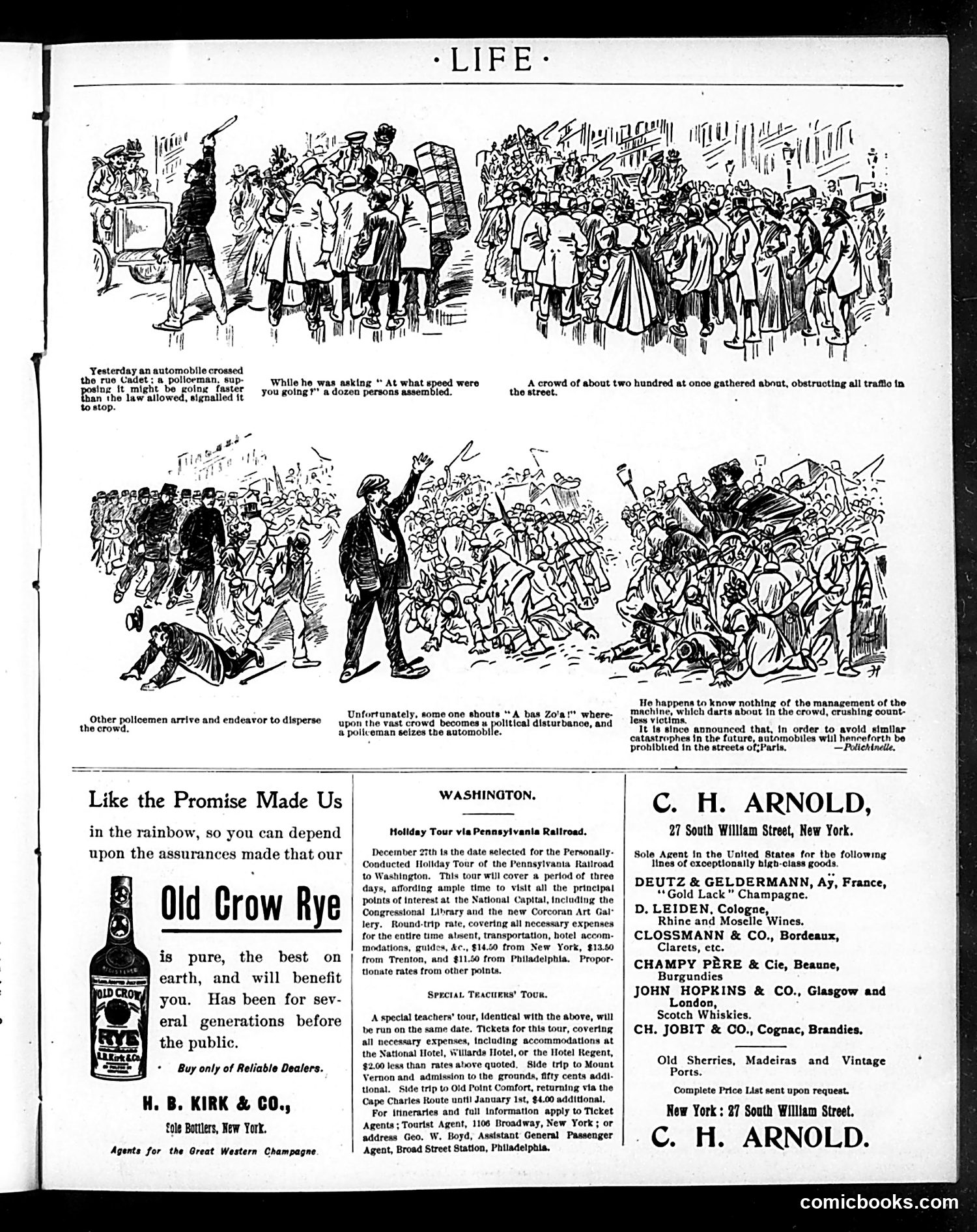
This Life cartoon satirizes early-1900s Paris, where a routine traffic stop spirals into political chaos. A policeman stops an automobile on rue Cadet for speeding. When bystanders gather, someone shouts "A bas Zola!" ("Down with Zola!")—referencing Émile Zola, the famous author then deeply controversial for his pro-Dreyfus activism during the Dreyfus Affair, which had sharply divided France along political lines. The crowd's cry transforms an ordinary incident into a political disturbance. The uncontrolled automobile then injures civilians. The satire's point: Parisian society is so fractured by political passion (the Zola/Dreyfus controversy) that even minor events trigger mob hysteria, with dangerous consequences. The final caption notes that Paris subsequently banned automobiles from streets—blaming the vehicle rather than the volatile crowd. The joke targets both French political volatility and the absurdity of scapegoating technology for human disorder.
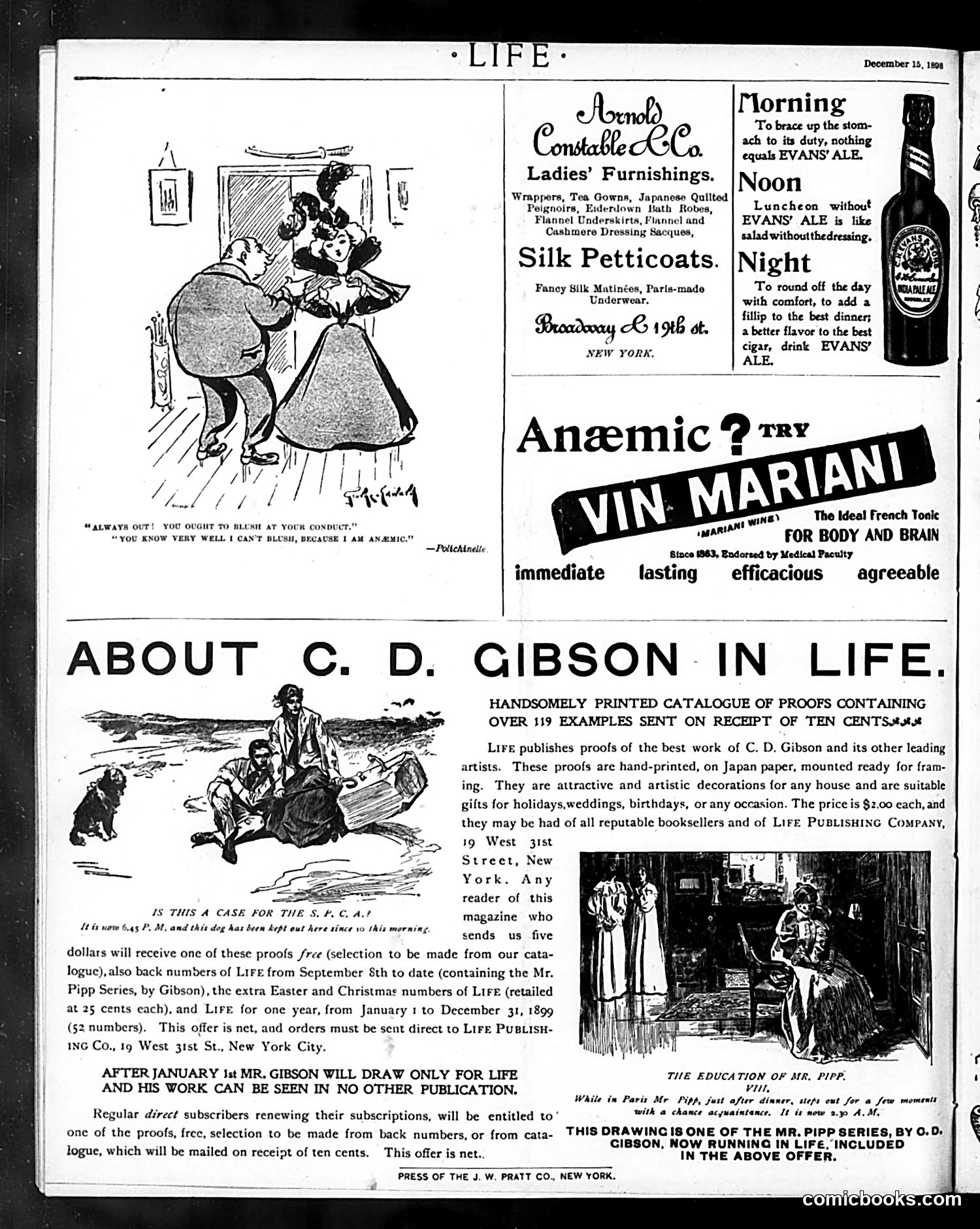
This page is primarily **advertising and promotional content** rather than editorial satire. The small cartoon at top left depicts a woman confronting a man about blushing at his conduct; he responds he cannot blush "because I am anaemic." This is a setup for the adjacent **Vin Mariani advertisement**—a patent medicine marketed as a French tonic for anemia and general vitality, "endorsed by Medical Faculty." The page's main content advertises **C.D. Gibson prints and proofs** (Gibson was Life's renowned illustrator, famous for the "Gibson Girl" ideal). It includes reproductions from Gibson's "Mr. Pipp Series," showing genteel urban scenes. The bottom illustration references Paris, suggesting aspirational cosmopolitan leisure. **Arnold Constable & Co.** advertises women's undergarments and silk petticoats, while **Evans' Ale** uses humorous copy suggesting the beverage suits different times of day. The overall page reflects 1890s consumer culture: patent medicines, fine art reproductions, fashionable women's wear, and genteel beverages marketed to Life's educated, affluent readership.