
Life, 1898-12-15 · page 7 of 20
Life — December 15, 1898 — page 7: what you’re looking at
What you’re looking at
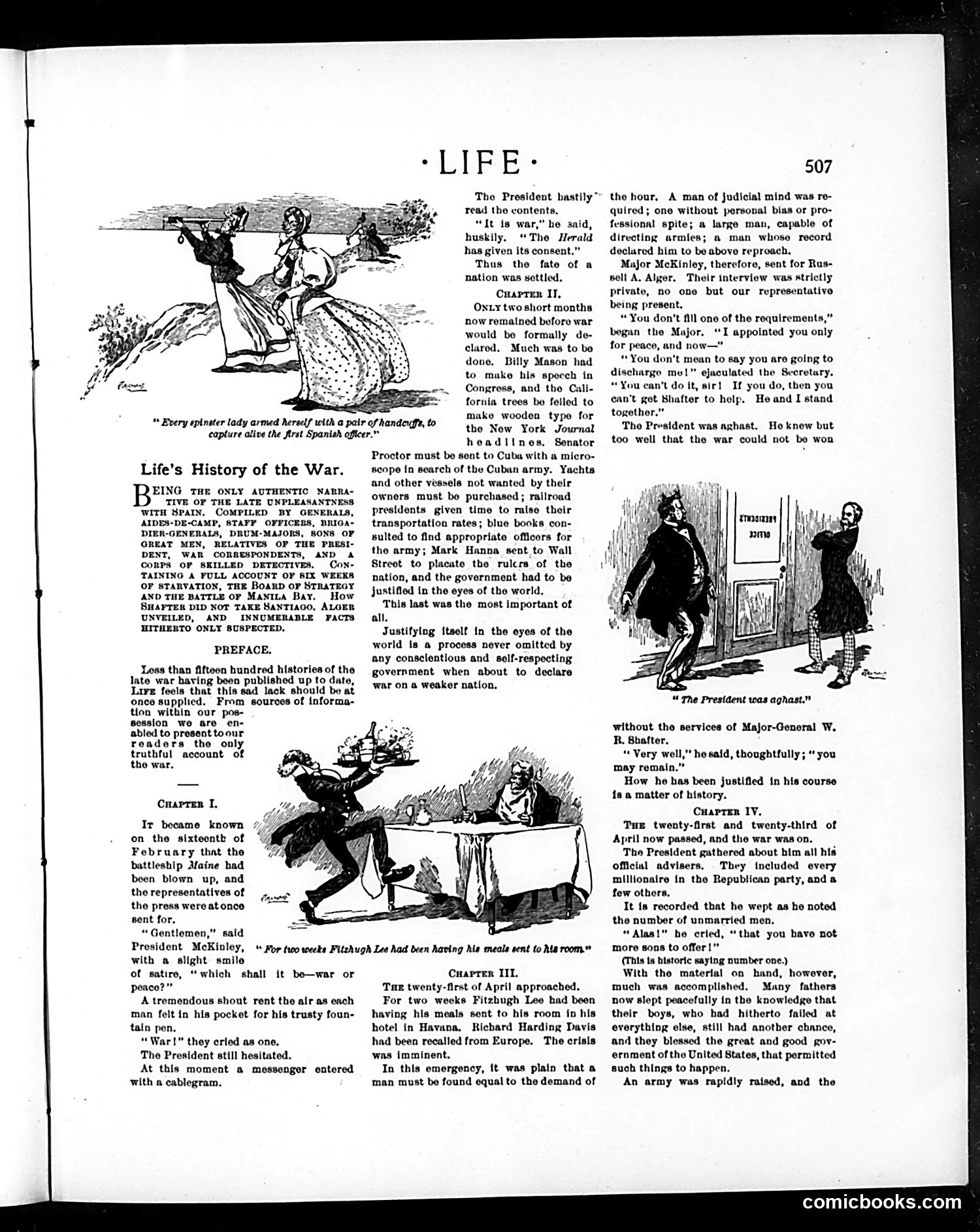
This page presents "Life's History of the War," a serialized account of the Spanish-American War compiled by General Alden D. Sears and others. The illustrations satirize President McKinley's war management. The top cartoon shows a woman armed with handcuffs confronting a man, captioned "Every spinster lady armed herself with a pair of handcuffs, to capture one of the 'duly Spain' officers." The lower cartoons mock McKinley's hesitation and the war's bureaucratic complications—including disputes over railroad rates, military supplies, and officer recruitment. The text references specific problems: sending a microscope to Cuba to locate the enemy, purchasing vessels, and the difficulty of raising an adequate army quickly. The satire critiques McKinley's apparent reluctance and the chaotic military preparations required.
📄 Transcribed text from this page (OCR, searchable)
Machine-transcribed from the original scan — historical spelling and the odd misread are preserved.
Every apinster lady armed heredlf with a pater of handeuffe, to capture alive the first Spanish officer.” Life’s History of the War. EING THE ONLY AUTHENTIC NARRA- TIVE OP THE LATE UNPLEASANTNESS WITH SPAIN. COMPILED BY GENERALS, AIDES-DE-CAMP, STAFP OFFICERS, BRIOA- DIER-GENERALS, DRUM-MAJORS, SONS OF GREAT MEN, RELATIVES OP THE PRESI- DENT, WAR CORRESPONDENTS, AND A CoRPS OP SKILLED DETECTIVES. Con- TAINING A FULL ACCOUNT OF SIX WEEKS OF STARVATION, THE BOARD OF STRATEGY AND THE BATTLE OP MANILA Bay. How SHAFTER DID NOT TAKE SANTIAGO, ALOER UNVEILED, AND INNUMERABLE PACTS HITHERTO ONLY SUSPECTED, PREFACE, Loss than fifteon hundred histories of the late war having been published up to date, Lire feels that this sad lack should be at ‘once supplied. From sources of informa- tion within our pos- session wo are en- abled to present toour roadors tho only truthful account of tho war. Cuaprer I. Ir became known on the sixteonth of Fobruary that tho battleship Maine bad been blown up, and tho representatives of tho press were at once sent for. “Gentlemen,” said President McKinley, with a slight: smile of satire, “which shall it be—war or poaco?” A tremendous shout rent the air as each man felt in his pocket for his trusty foun- tain pen. “ War!" they orled as one. The President still hesitated. At this moment a messengor entered with a cablegram. ‘LIFE ate read tho contents, “It is war,” he said, huskily. “The Herald has given its consent.” Thus the fate of a nation was settled. Cuarren II, ONLY two short months now remained before war would bo formally de- clared. Much was to be done. Billy Mason had to make his specch in Congress, and tho Cali- fornia trees be felled to make wooden type for the New York Journal headlinos, Senator Proctor must be sent to Cuba with a micro- scope in search of the Cuban army, Yachts and other vessela not wanted by their owners must be purchased; railroad presidents given time to ralse their transportation rates; blue books con- sulted to find appropriate officers for the army; Mark Hanna sent to Wall Street to placate the rulcrs of the nation, and the government had to be justified in the eyes of the world. ‘This last was the most important of all. Justifying Itself in the eyes of the world is @ process never omitted by any conscientious and self-respecting government when about to declare war on a weaker nation. “ For two weeks Fitzhugh Lee had been having his meals sent to his room” Cuarter III. ‘Tae twenty-first of April approached, For two weeks Fitzhugh Lee had been having his meals sent to his room in his hotel in Havana, Richard Harding Davis had been recalled from Europe. The crisis was imminent, In this emergency, it was plain that a man must be found equal to the demand of Tho President hastily” 507 the hour, A man of Judicial mind was re- quired ; one without personal bias or pro- fessional spite; a large man, capable of directing armies; a man whose record declared him to be above reproach. Major McKinley, therefore, sent for Rus- sell A. Alger. Their interview was strictly private, no one but our representative being present. “ You don’t fill ono of the requirements,” began the Mujor, ‘I appointed you only for peace, and now—" “You don't mean to say you are going to discharge me!" ejaculated the Secretury. “You can't do tt, sir! If you do, then you can't get Bhafter to help. He and I stand together.” Tho President was aghast, Ho know but too woll that the war could not be won mom iS “ The President was aghast.” without tho services of Major-General W. R, Shafter, “Very well,” he said, thoughtfully; “ you may remain.” How he has been justified in his course is a matter of history. Cuarren IV. ‘Tue twonty-frst and twenty-third of April now passed, and tho war was on. Tho President gathered about bim all his official advisers, They included every millionaire in the Republican party, and a fow others, It {8 recorded that he wept as ho noted the number of unmarried men. “Alaa!” be cried, “that you bavo not more sons to offer!” (This ts historic saying number one.) With the material on hand, however, much was accomplished. Many fathers now slept peacefully in the knowledge that their boys, who had hitherto failed at everything else, still had another cbance, and they blessed the great and good gov- ernment of the United States, that permitted such things to happen. ‘An army was rapidly raised, and the comicbooks.com