
Life, 1898-12-15 · page 6 of 20
Life — December 15, 1898 — page 6: what you’re looking at
What you’re looking at
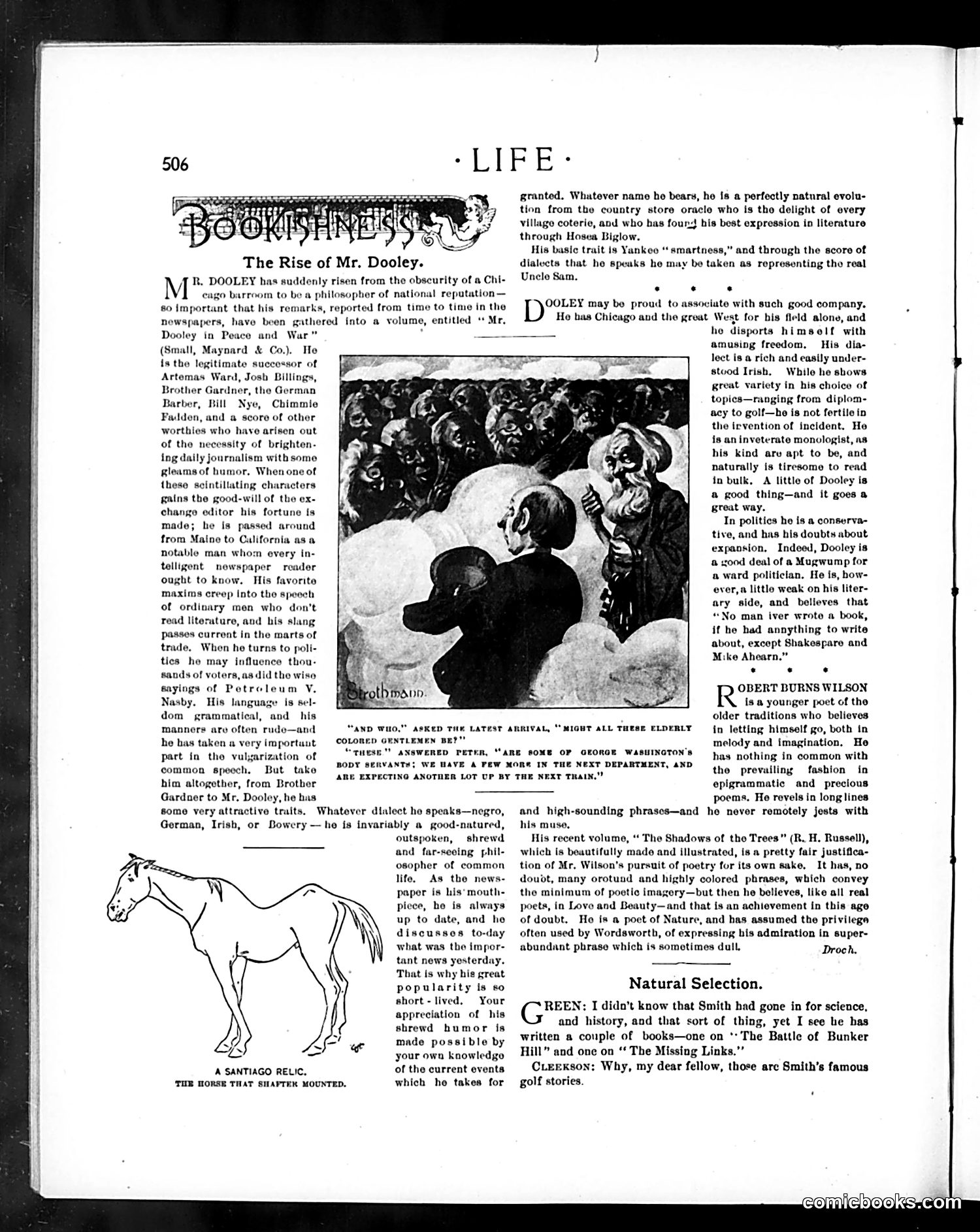
This page features two distinct pieces: **"The Rise of Mr. Dooley"** (main article) discusses a fictional character who has gained prominence through newspaper columns. The text praises "Mr. Dooley" as a witty Irish character whose dialect-heavy commentary on current events and politics has become popular. The article notes his conservative political views and his talent for satirizing public figures through vernacular humor. **The illustration** shows a crowded social gathering, captioned as people asking about "new arrivals" and discussing "George Washington's boot" — likely satirizing pretentious or absurd social climbing and claims of historical significance. **"A Santiago Relic"** (small cartoon below) depicts a horse, apparently mocking dubious souvenirs claimed to be from the Spanish-American War. The page exemplifies Life's satirical approach to popular culture, politics, and social affectation.
📄 Transcribed text from this page (OCR, searchable)
Machine-transcribed from the original scan — historical spelling and the odd misread are preserved.
R. DOOLEY bas suddenly risen from the obscurity of a Chi- cago barroom to be a philosopher of national reputation— 80 important that his remarks, reported from time to time in the newspapers, have been gathered into a volume, entitled * Mr, Dooley in Peace and War” . (Small, Maynard & Co,). He isthe legitimate successor of Artemas Ward, Josb Billings, Brother Gardner, the German Barber, Bill Chimmie Fadden, and a score of other worthies who have arisen out of the necessity of brighten. ing daily journalism with some gleams of humor, When one ot theso scintillating charactors gains the good-will of the ex- chango editor his fortune is made; he is passed around from Maine to California as a notable man whom every in- telligent newspaper reader ought to know. His favorite maxims creep Into tho speech of ordinary men who don't read literature, and his slung passes current in the marts of trade. When he turns to poli- ties ho may influence thou- sands of voters, as did the wiso sayings of Petroleum V. Nasby. His language is sel- dom grammatical, and his manners aro often rude—and he bas taken a very important part in tho vulyarization of common speech. But take him altogether, from Brother Gardner to Mr. Dooley, he has some very attractive traits, Whatever dialect ho speaks—negro, German, Irish, or Bowery —ho {s invariably a good-natured, outspoken, shrewd. and far-seoing phil- osopher of common life, As tho news- paper is his‘ mouth- piece, he is always up to date, and ho discusses to-day what was the impor- tant news yesterday. That is why hie great popularity is so short - lived. Your appreciation of his shrewd humor is made possible by your own knowledgo of the current events which ho takes for COLORED GENTLEMEN BE?" “rnese, co ‘A SANTIAGO RELIC, THE WORSE THAT SHAPTEK MOUNTED. “AND WHO.” ASKED THK LATEST ARRIVAL, MIGHT ALL THESE ELDERLY ANSWERED PETER, “ARE SOME OF GEORGE WasuINaTON's BODY SERVANTS; WE WAVE A PEW MOR# IN THE NEXT DEPARTMENT, AND ARE EXPECTING ANOTRER LOT UP BY THE NEXT TRAIN," granted. Whatever name ho bears, ho {8 a perfectly natural ovolu- tien from the country store oracle who Is tho delight of every Village coterie, and who has foun} his best expression in literature through Hosea Biglow. His basic trait is Yankeo “ smartness,” and through the scoro of dialocts that ho speaks he may be taken as representing tho real Uncle Sam. . . . OOLEY may be proud to associate with such good company, Ho bas Chicago and the great West for bis fleld alone, and ho disports himself with amusing freedom, His dia- lect is @ rich and easily under- stood Irish, While he shows great variety in his choice of topics—ranging from diplom- acy to golf—ho is not fertile in the irvention of incident. He is an inveterate monologist, ns his kind aru apt to be, and naturally is tiresome to read in bulk, A little of Dooley is @ good thing—and it goes a great way. In politics he is a conserva- tive, and has his doubts about expansion, Indeed, Dooley is a zood deal of a Mugwump for a ward politician. He is, how- ever,a little weak on his liter- ary side, and believes that “No man iver wrote a book, if he had annything to write about, except Shakespare and Mike Ahearn.” . . . OBERT BURNS WILSON is a younger poet of the older traditions who believes in letting himself go, both in melody and imagination, Ho has nothing in common with the prevailing fashion in epigrammatic and precious poems. He revels in long lines and high-sounding phrases—and he never remotely jests with his muse, His recent volume, “ The Shadows of tho Trees” (R. H. Russell), which is beautifully mado and illustrated, is a pretty fair justifica- tion of Mr, Wilson's pursuit of poetry for its own sake, It has, no doudt, many orotund and highly colored phrases, which convey the minimum of poetic imagery—but then he believes, like all real poets, in Lovo and Beauty—and that is an achievement in this ago of doubt. Ho is a poet of Nature, and has assumed the privilege often used by Wordsworth, of expressing bis admiration in super- abundant phrase which is sometimes dull Droch. Natural Selection. REEN: I didn’t know that Smith had gone in for science, and history, and that sort of thing, yet I see he bas written a couple of books—one on *: The Battle of Bunker Hill” and one on “‘ The Missing Links.”’ CLEEKSON: Why, my dear fellow, those are Smith’s famous golf stories.