
Life, 1898-12-15 · page 12 of 20
Life — December 15, 1898 — page 12: what you’re looking at
What you’re looking at
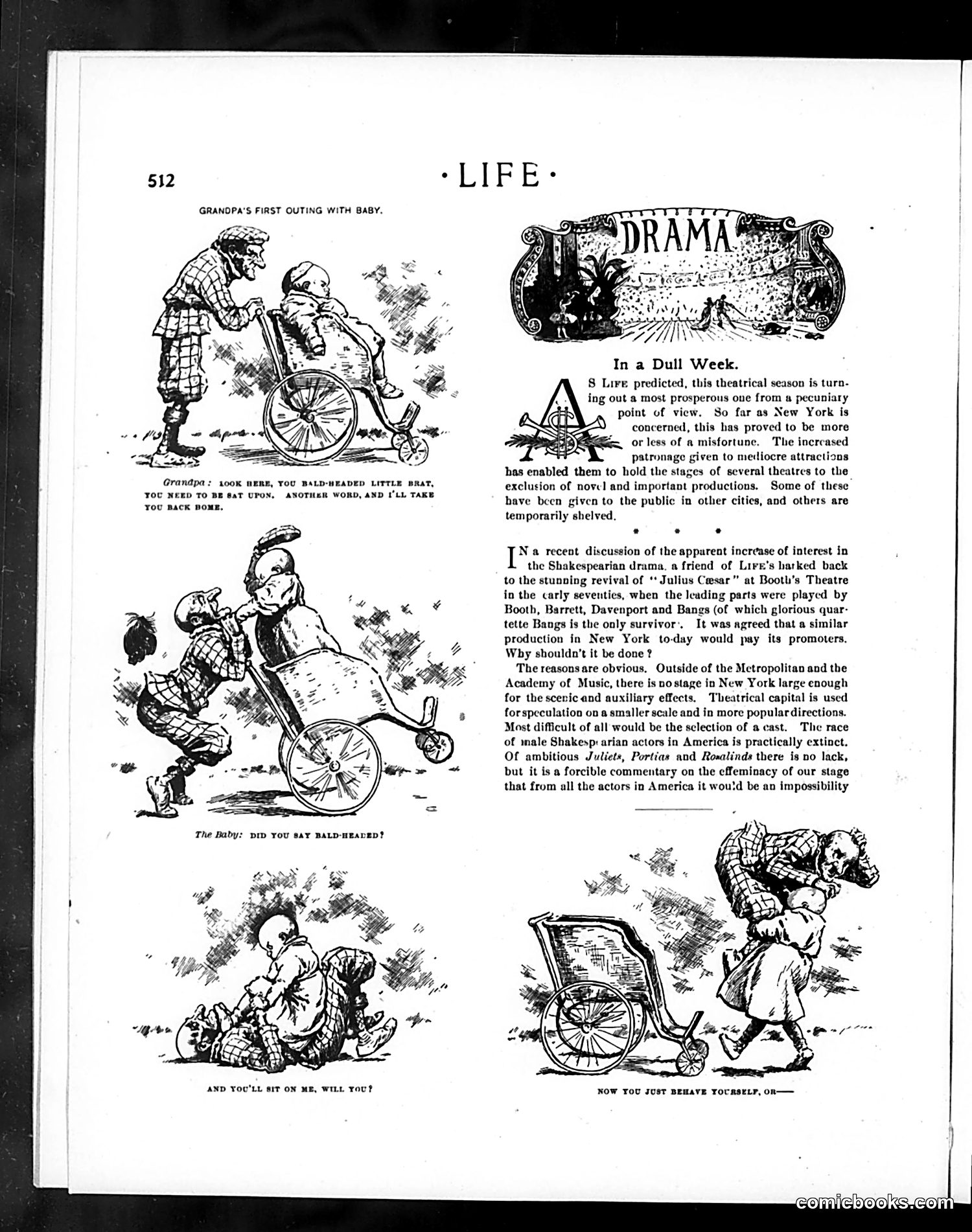
This page contains humorous illustrations about grandparents taking a baby out, paired with a dramatic arts article. The left side shows four comic panels depicting an elderly grandfather struggling with a baby carriage—struggling to control it, the baby misbehaving, and the grandfather losing composure in public situations. The captions use exaggerated dialogue ("bald-headed," "sassy"). The right side, titled "In a Dull Week," discusses the theatrical season in New York. The author argues that reviving Shakespeare's *Julius Caesar* (last performed in the 1600s) could succeed if proper casting were available, but laments the lack of qualified male Shakespearean actors in America, noting the scarcity of suitable talent for such ambitious roles. The satire contrasts domestic chaos with high culture concerns.
📄 Transcribed text from this page (OCR, searchable)
Machine-transcribed from the original scan — historical spelling and the odd misread are preserved.
GRANOPA'S FIRST OUTING WITH BABY. Grandpa: 100K HERE, YOU BALD-HEADED LITTLE BRAT, YOU NEED TO BE SaT UPON, ANOTHER WORD, AND I'LL TAKE You BACK py} AND YOU'LL SIT ON ME, WILL You? In a Dull Week. 8 Lire predicted, this theatrical season is turn- ing out a most prosperous one from a pecuniary point of view. So faras New York is concerned, this has proved to be more or less of a misfortune. The increased patronage given to mediocre attractions has enabled them to hold the stages of several theatres to the exclusion of novel and important productions. Some of these have been given to the public in other cities, and others are temporarily shelved. * . . Na recent discussion of the apparent increase of interest in the Shakespearian drama, a friend of Live's barked back to the stunning revival of ‘* Julius Cesar” at Booth’s Theatre in the carly seventies, when the leading parts were played by Booth, Barrett, Davenport and Bangs (of which glorious quar- tette Bangs {s the only survivor’. It was agreed that a similar production in New York to-day would pay its promoters. Why shouldn't it be done ? The reasons are obvious. Outside of the Metropolitan and the Academy of Music, there is no stage in New York large enough for the scenicand auxiliary effects, Theatrical capital is used forspeculation on a smaller scale and in more populardirections. Most difficult of all would be the selection of a cast. The race of male Shakesp: arian actors in America is practically extinct. Of ambitious Juliets, Portias and Rosalinds there is no lack, but it is a forcible commentary on the effeminacy of our stage that from all the actors in America it wou'd be an impossibility Now YOU JUST BEHAVE TOCRSELY, on—