
A complete issue · 20 pages · 1898
Life — September 22, 1898
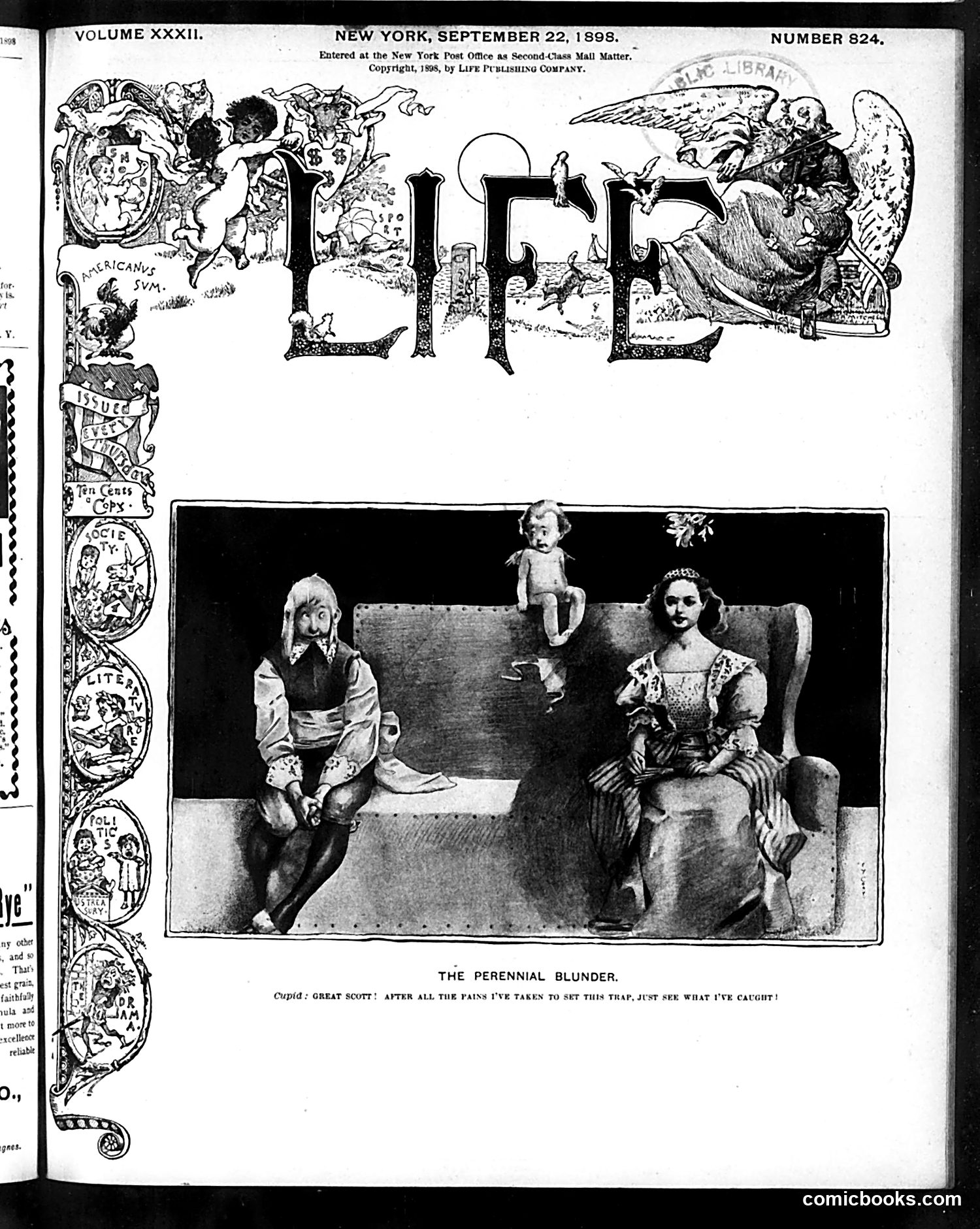
This cartoon satirizes a character identified as "Great Scott" (likely a play on words or reference to a prominent figure of 1898), depicted as Cupid. The scene shows a domestic situation where Cupid claims to have set an elaborate trap for romance ("after all the pains I've taken to set this trap, just see what I've caught"). The joke appears to target the unreliability or failure of romantic scheming—despite careful planning, the outcome is unsatisfactory or absurd. The decorative border on the left contains classical allegorical imagery typical of Life's satirical style. Without additional historical context, the specific identity of "Great Scott" and the precise social commentary remain unclear, though the overall theme mocks romantic misadventure or deception.
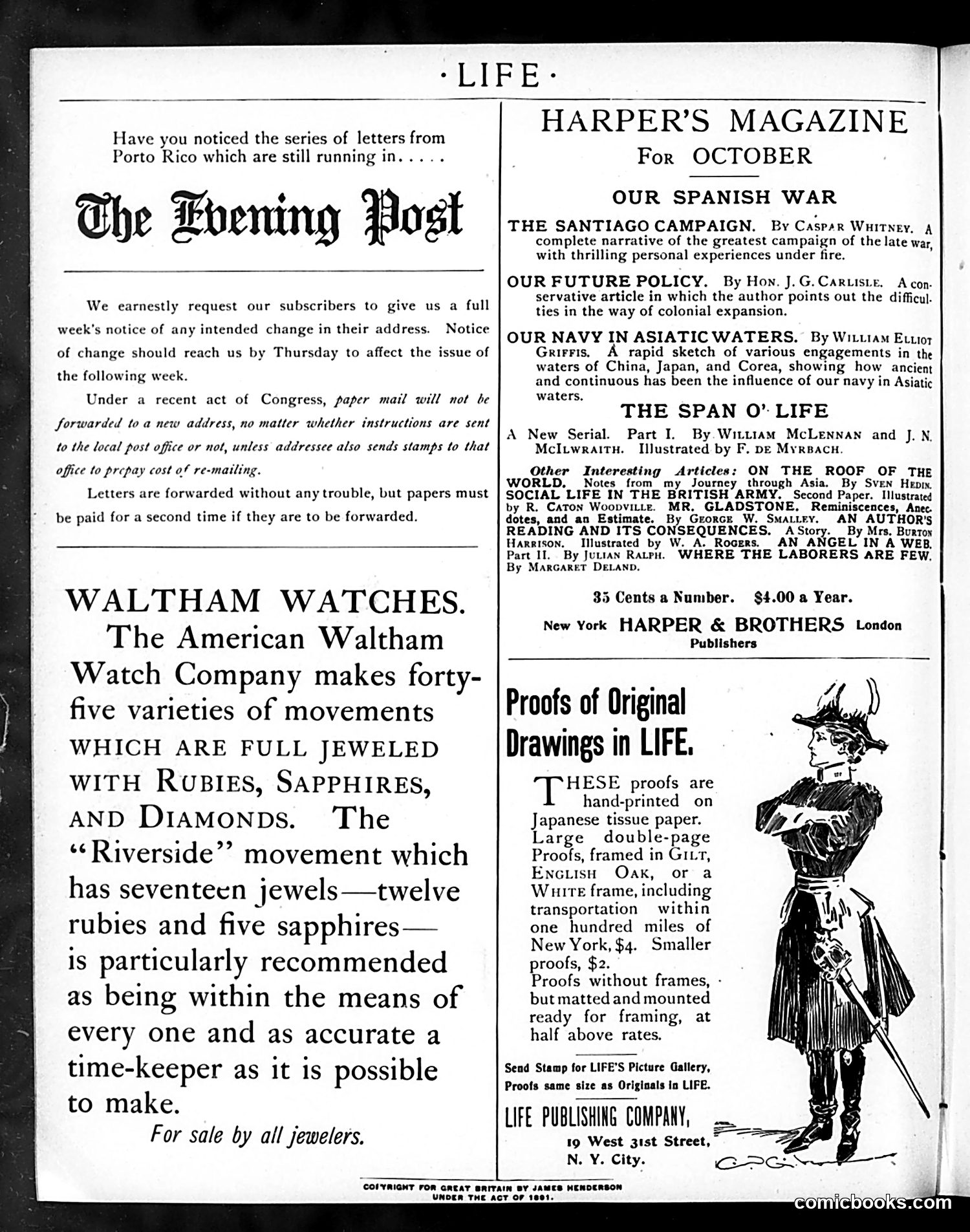
This page is primarily **advertising and administrative notices** rather than political satire. The left side contains notices from *The Evening Post* about mail forwarding policies and an advertisement for Waltham Watches. The right side advertises *Harper's Magazine* for October, featuring articles on the Spanish-American War (including "The Santiago Campaign"), colonial expansion policy, and the U.S. Navy in Asian waters—reflecting contemporary imperialist concerns of the era. Below is an advertisement for "Proofs of Original Drawings in LIFE," offering framed artwork on Japanese tissue paper for sale, with an illustration of a fashionably-dressed woman. **The page contains no significant political cartoon or satire**—it's essentially a commercial/informational page from a late-1890s publication.
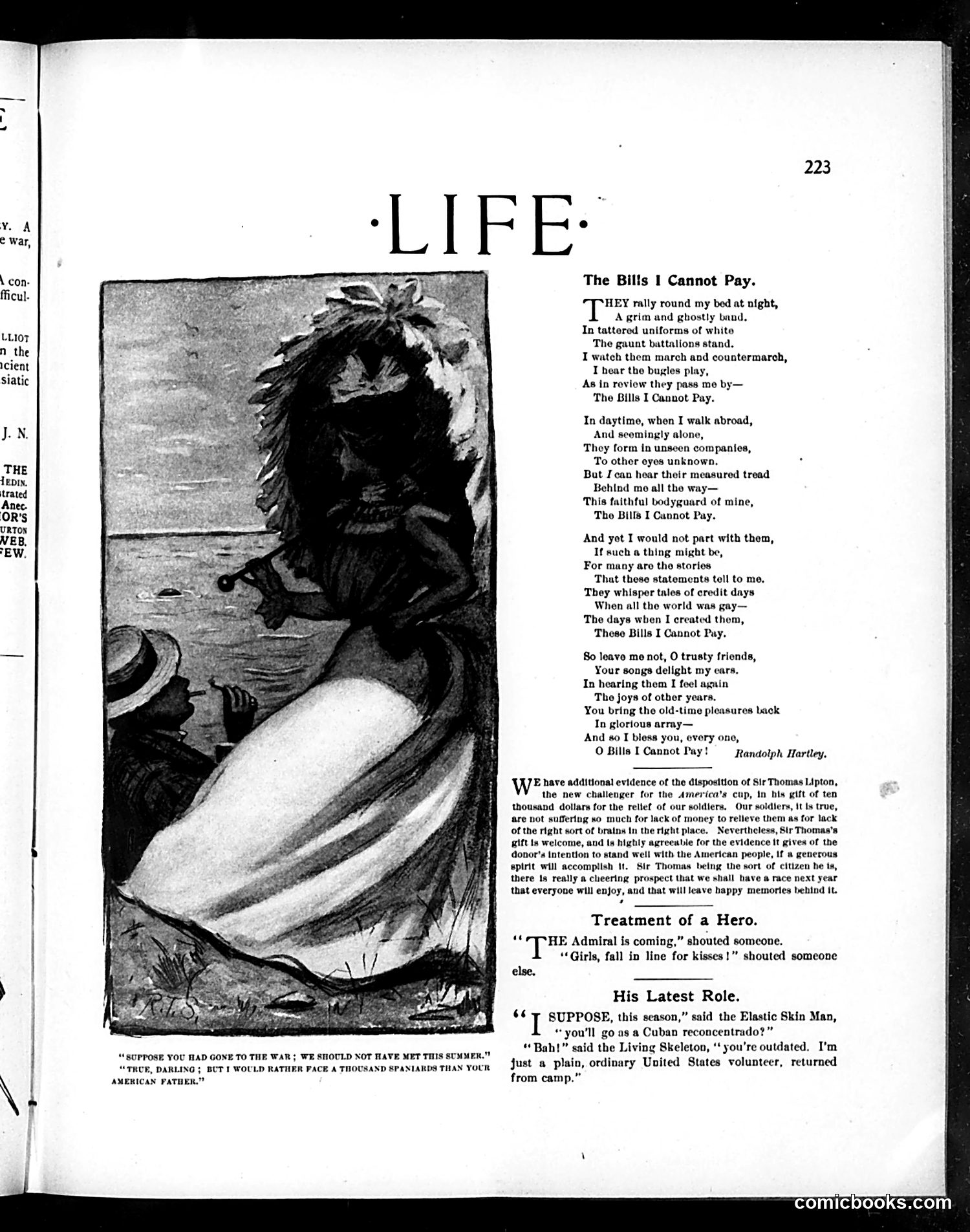
The main illustration depicts a disheveled soldier in tattered uniform, labeled with a quote: "Suppose you had gone to the war; we should not have met this summer. 'Trek, darling; but I would rather face a thousand Spaniards than your American father.'" This appears to be satirizing romantic complications created by the Spanish-American War. The soldier represents an American serviceman, likely returning from Cuba (referenced in "His Latest Role" section below). The joke mocks how wartime absence disrupted courtship and domestic life. The poem "The Bills I Cannot Pay" by Randolph Hartley addresses another war-related hardship: unpaid military obligations. Both pieces suggest Life magazine was critiquing the practical human costs—romantic, financial, and emotional—of the recent Spanish-American conflict.
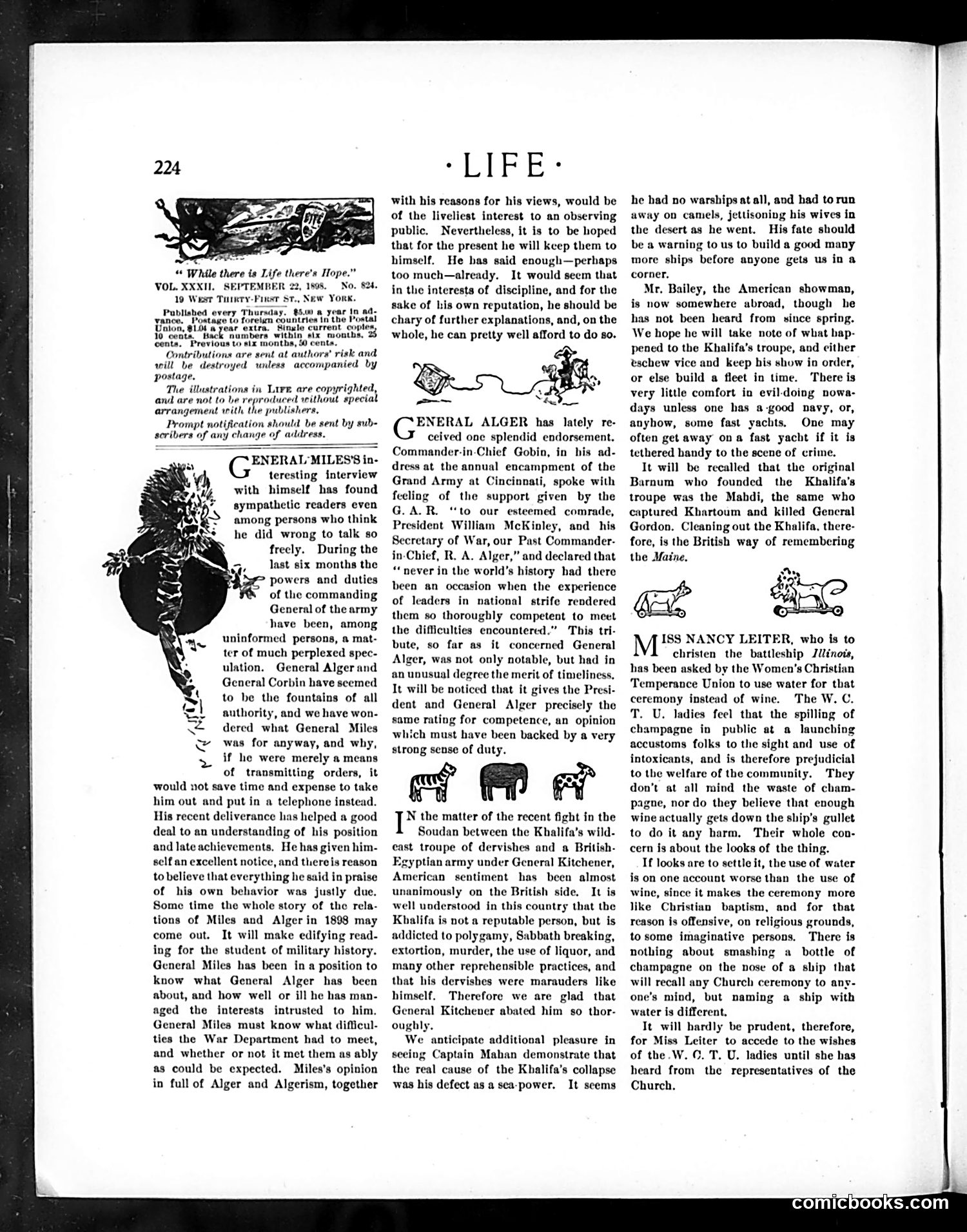
The page features commentary on General Nelson Miles, a prominent American military figure. The left-side illustration shows Miles in profile, depicted with exaggerated features typical of early 20th-century satirical portraiture. The text discusses Miles's recent public statements and endorsements, particularly regarding military leadership and competence. The article appears critical of Miles's credibility, suggesting his opinions, while influential in military circles, may be self-serving or questionable. The page also contains brief commentary on other topics including General Alger, Miss Nancy Leiter's christening of a battleship, and disputes over using water versus wine in naval ceremonies—typical satirical fodder of the era addressing naval affairs and social propriety.
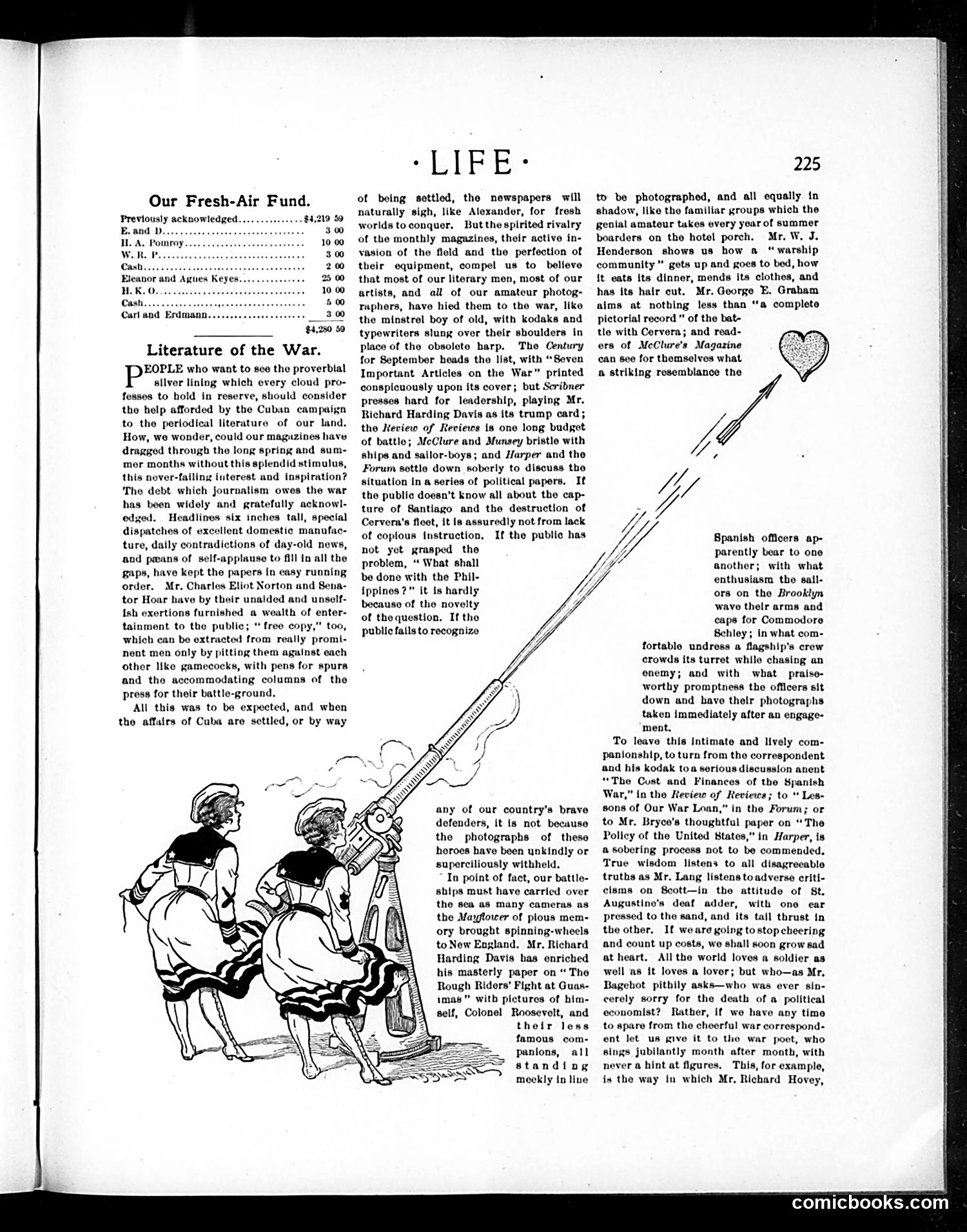
The main illustration depicts two naval officers operating a large telescope or naval instrument, rendered in a cartoonish style typical of early 20th-century satirical magazines. The accompanying article discusses war photography and journalism during what appears to be the Spanish-American War era, referencing correspondents, magazines like *The Century* and *Harper's*, and military figures including Richard Harding Davis and Colonel Roosevelt. The cartoon likely satirizes the relationship between military operations and press coverage—specifically how officers and journalists compete to document and sensationalize naval combat. The exaggerated poses and comedic rendering suggest mockery of either the journalists' eagerness or the officers' theatrical presentations for cameras. The text emphasizes tension between accurate war reporting and sensational entertainment.
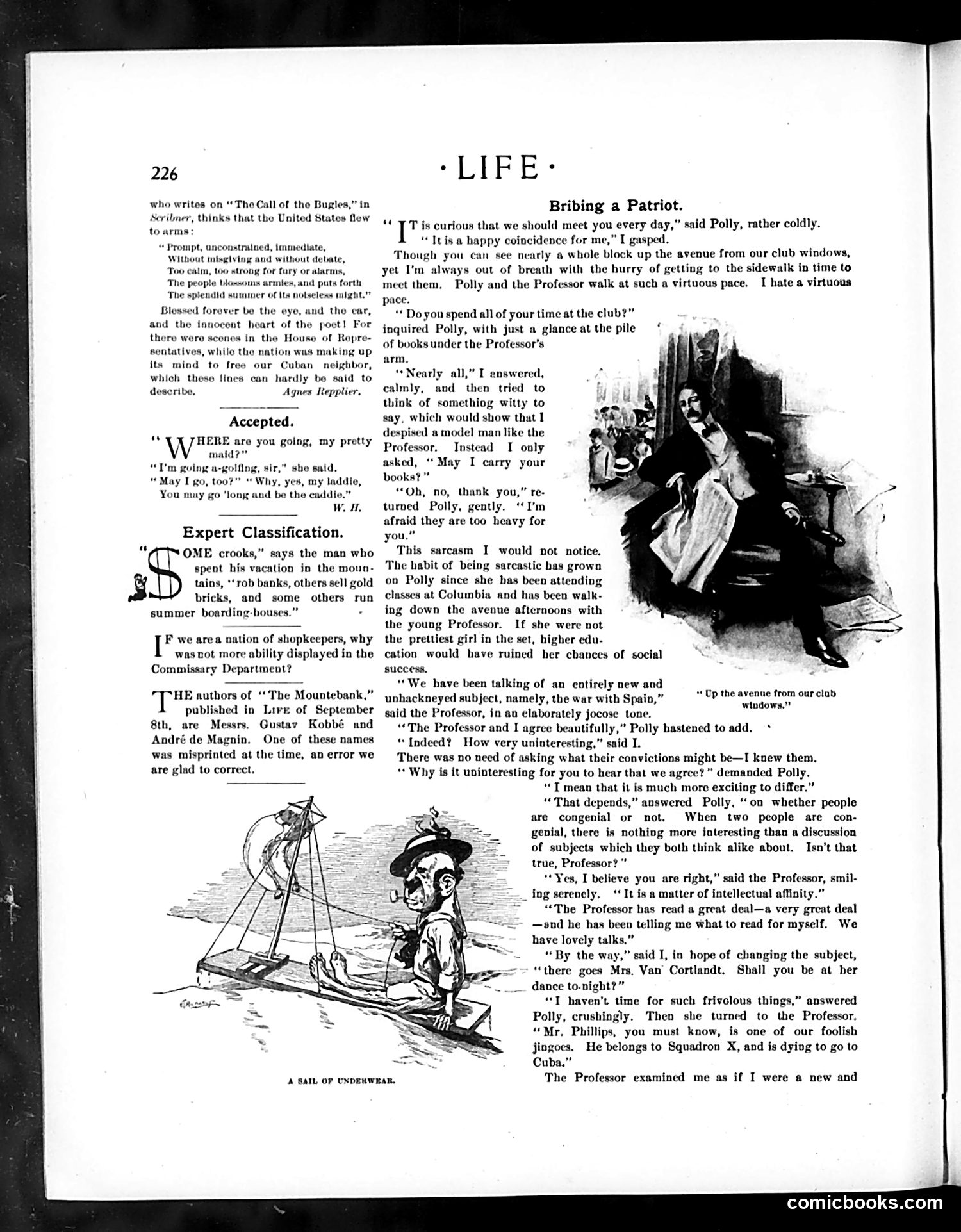
This cartoon depicts a figure using underwear as a makeshift sail on a small raft—a visual pun on the phrase "bail of underwear" (playing on "bail" meaning escape or financial payment). The cartoon likely satirizes financial corruption or improper use of resources. The figure appears to be escaping or fleeing using improvised means, suggesting someone evading consequences through dubious methods. Without additional context about specific historical events or named figures referenced on this page, the exact political target remains unclear. However, the cartoon's placement in *Life*'s satirical section indicates it mocks a recognizable contemporary scandal or public figure involved in financial misconduct or fraud circa the publication date. The humor relies on the visual absurdity of using clothing as nautical escape equipment.
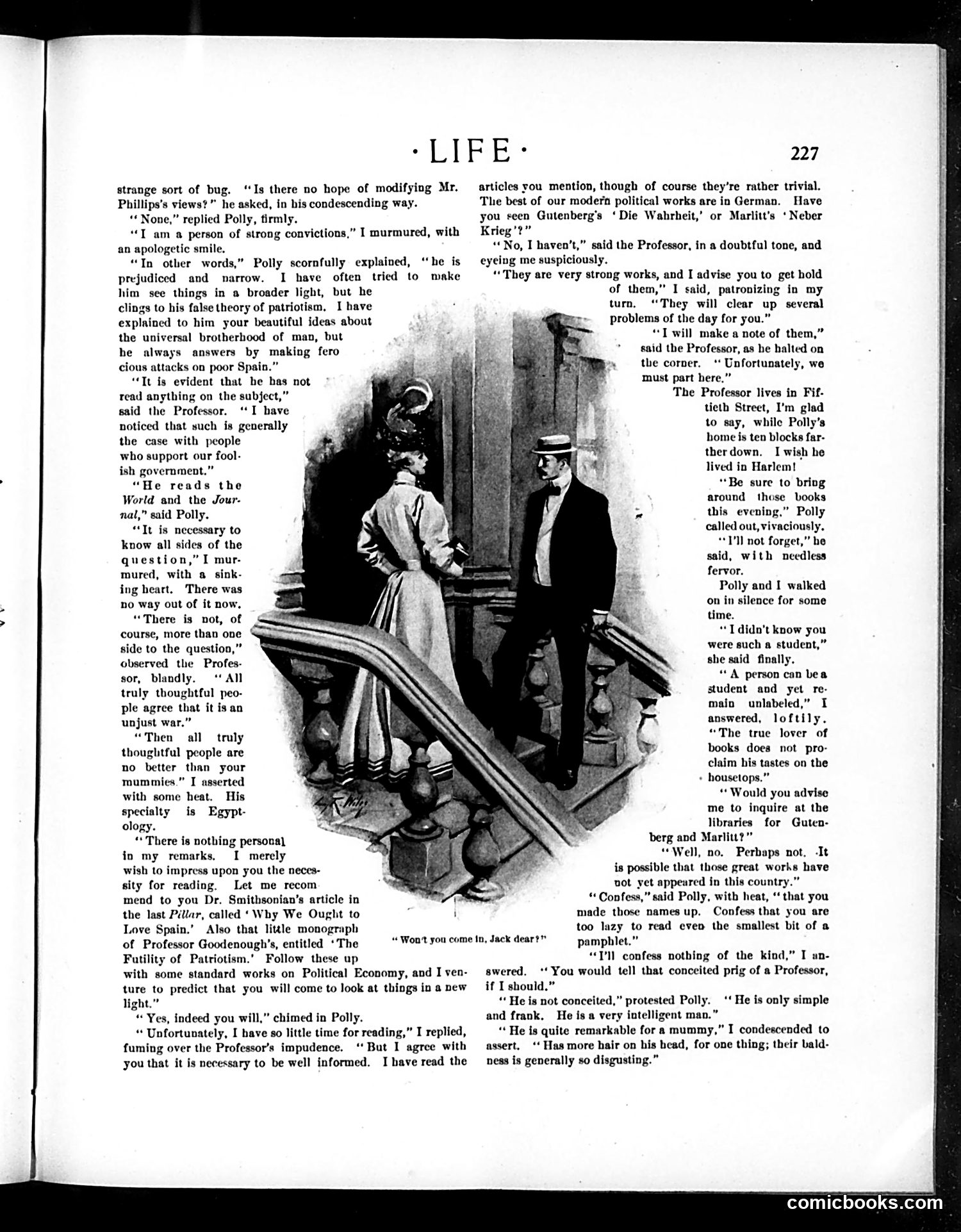
This page depicts a dialogue between characters discussing political ideology and reading habits. The illustration shows what appears to be a street encounter between gentlemen, with one character (likely representing an intellectual or Professor) engaging another named Polly in debate. The satire targets narrowness of political conviction. One character criticizes Mr. Phillips for being "prejudiced and narrow," while another defends reading the *World* and *Journal* as necessary for understanding "all sides of the question." The humor pivots on elitism: educated characters mock those supporting "our foolish government" while debating whether truly thoughtful people need better literature. The page satirizes how intellectuals weaponize reading lists and specialized knowledge to establish social superiority, treating book recommendations as markers of proper thinking rather than genuine persuasion.
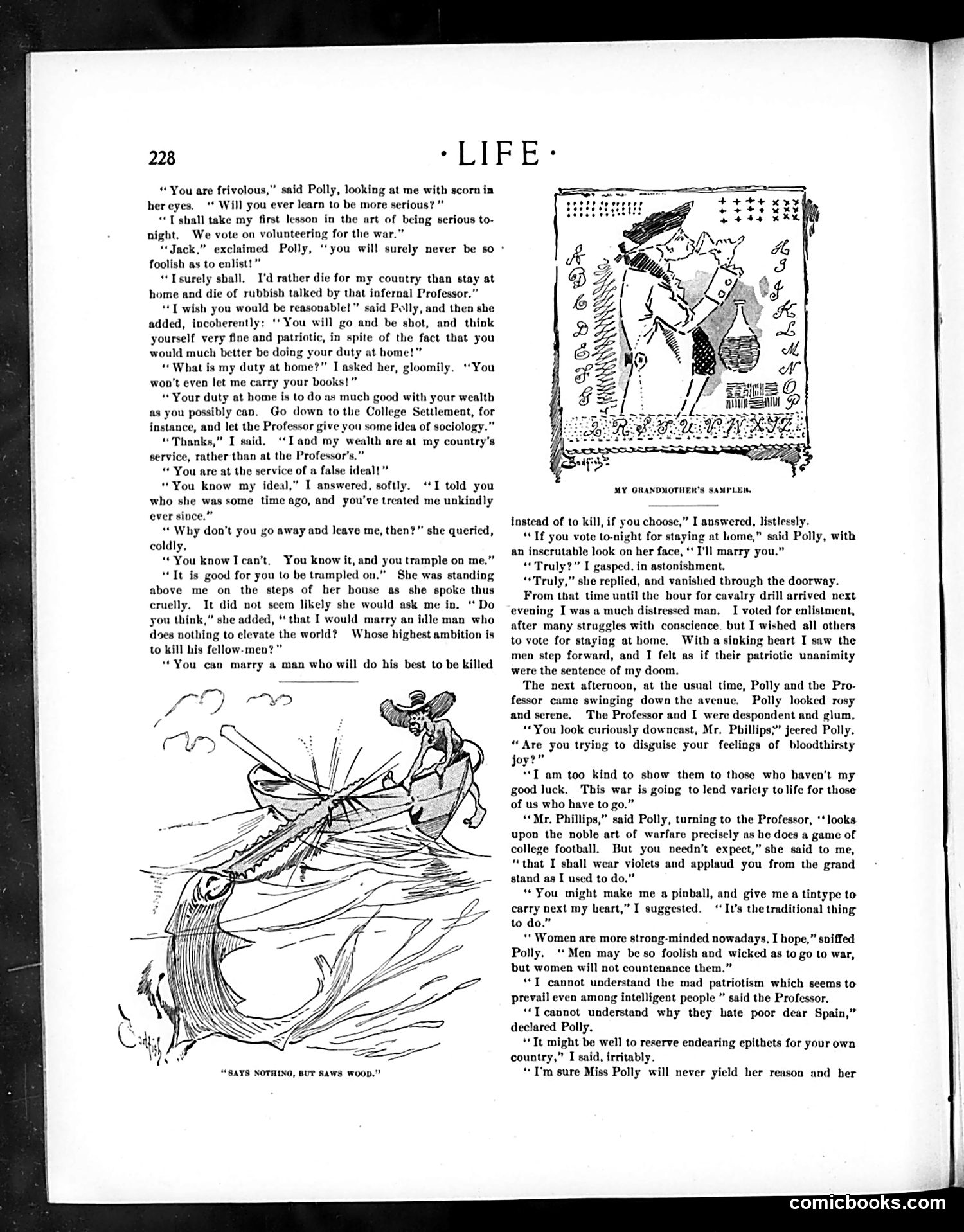
This page satirizes wartime patriotism and gender roles during what appears to be WWI. The dialogue between Polly (a young woman) and the Professor presents a debate over women's military participation versus traditional domestic duty. The top cartoon titled "MY GRANDMOTHER'S SAMPLER" shows a figure engaged in active combat—likely mocking the contrast between traditional feminine crafts and modern warfare. The lower cartoon, "SAYS NOTHING, BUT SAWS WOOD," depicts someone sawing, suggesting productive labor during wartime. The text reveals tension between the Professor's intellectualism (opposing the war) and Polly's patriotic enthusiasm for volunteering. The satire critiques how wartime rhetoric affects different social classes and genders, questioning whether intellectual objection to war holds moral weight against patriotic duty. The magazine mocks both antiwar intellectualism and uncritical patriotic fervor.
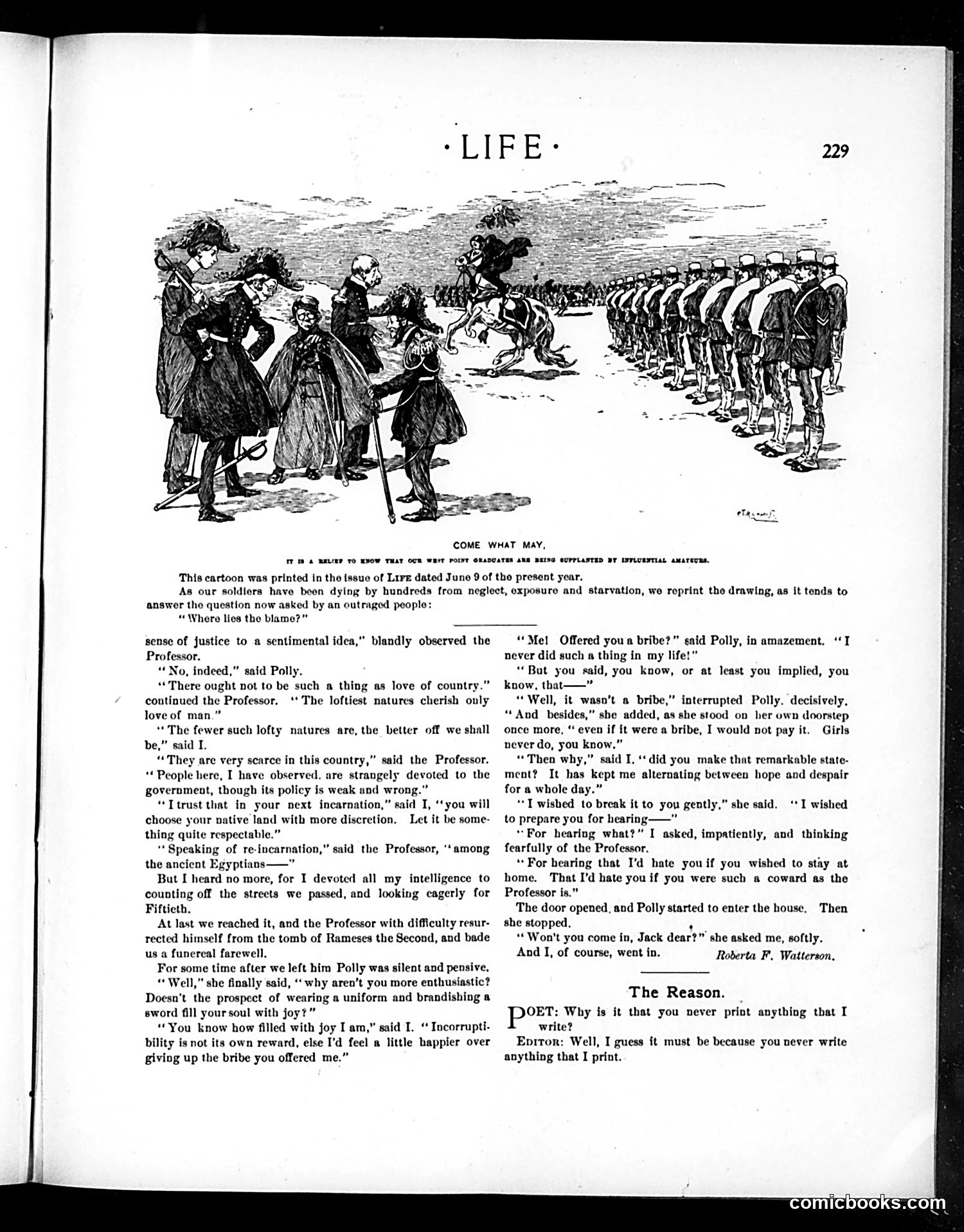
The cartoon "Come What May" depicts a scene with civilians (including women and children) on the left confronting a military formation on the right. According to the caption, this was reprinted from Life's June 9 issue because soldiers were "dying by hundreds from neglect, exposure and starvation." The accompanying dialogue satirizes moral arguments: a Professor and "Polly" debate whether patriotism justifies sacrifice. Polly had offered a bribe to avoid military service, which she now defends. The Professor argues true patriotism requires "lofty natures" who love country, while Polly pragmatically counters that "girls never do, you know." The piece criticizes both military mismanagement causing soldier deaths and the gap between idealistic patriotic rhetoric and citizens' actual willingness to sacrifice.
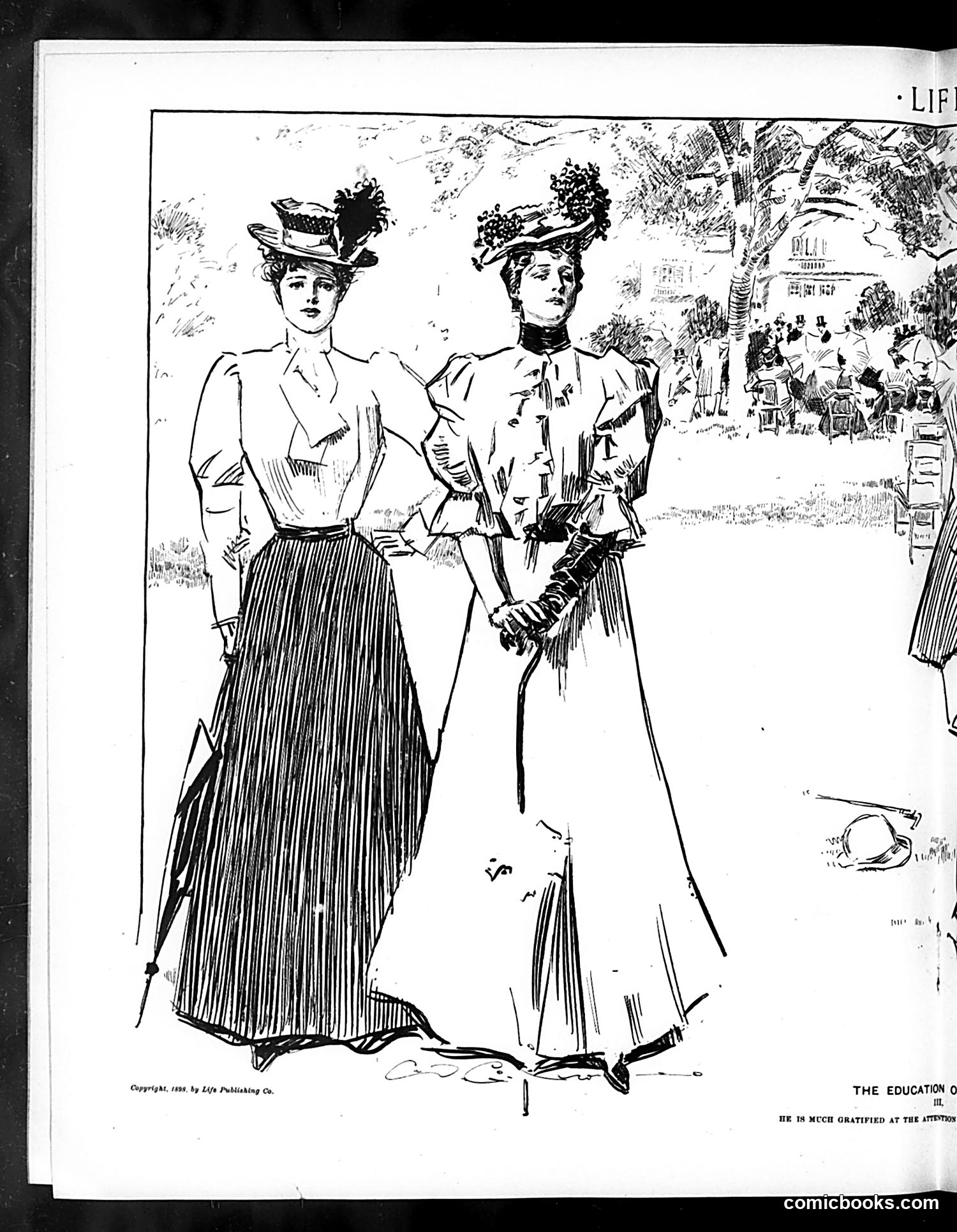
This illustration depicts two elegantly dressed women at what appears to be a public social gathering or park scene. The caption reads "THE EDUCATION OF [unclear] / HE IS MUCH GRATIFIED AT THE ATTENTION." The satire appears to target early 1900s courtship and social expectations. The well-dressed women—one in a striped skirt, both wearing elaborate hats—represent fashionable society ladies. The joke likely concerns male attention and courtship rituals: "he" (presumably an unseen male figure) is pleased by the women's attention, satirizing either masculine vanity or the elaborate social performance of courtship customs. The background shows a leisurely public space with other figures, emphasizing the social spectacle of courtship. Without clearer text or specific identifiable figures, the precise political target remains unclear, though the satire targets gender relations and upper-class social conventions.
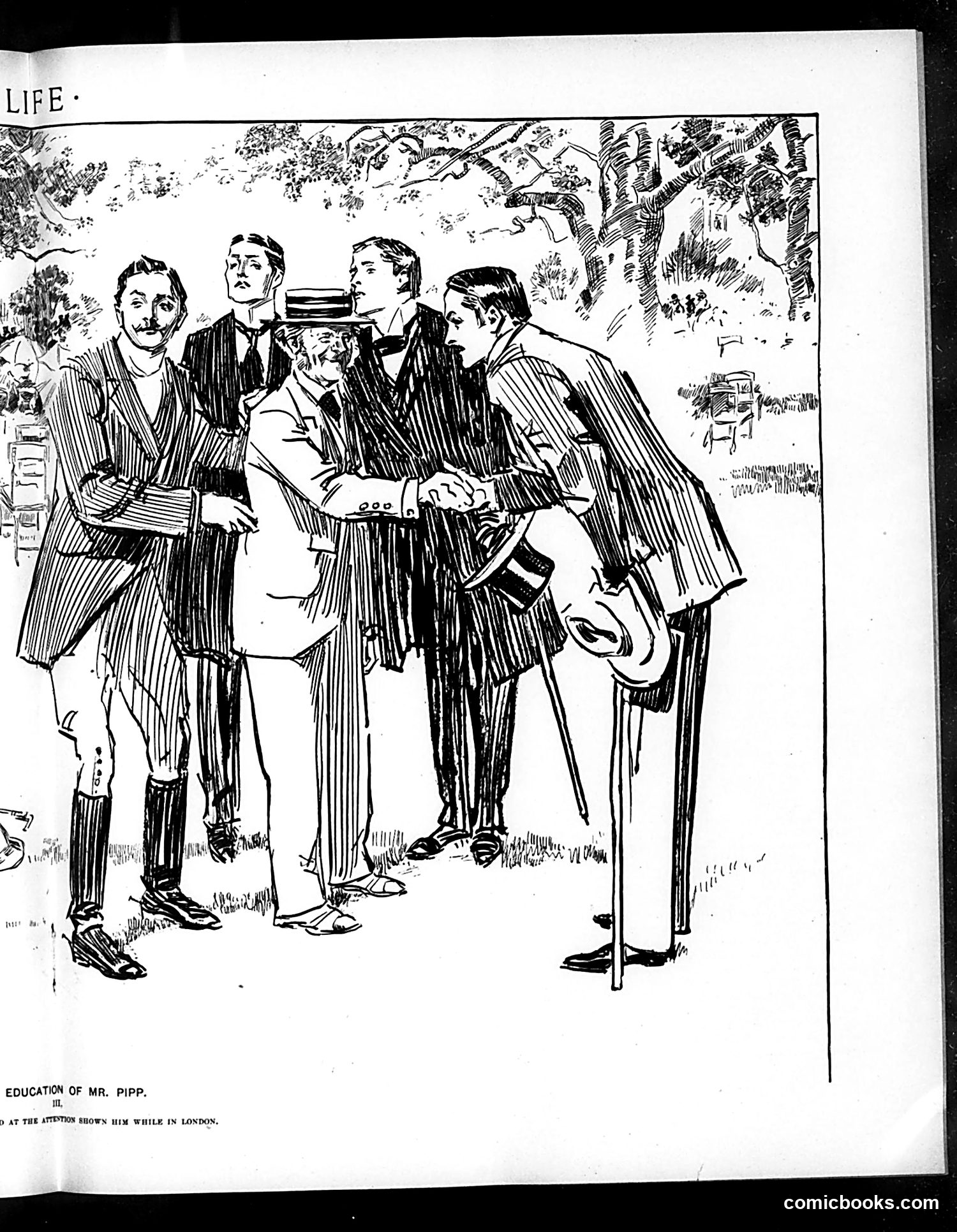
This is Part III of a serial cartoon titled "Education of Mr. Pipp," with the caption indicating it shows attention being drawn to him while in London. The image depicts five men in formal business attire (suits and hats) engaged in conversation outdoors. One man appears to be the central figure being addressed by the others, suggesting he's Mr. Pipp undergoing some form of social or business instruction. Without additional context about who Mr. Pipp was or the specific historical moment, the exact satirical point remains unclear. However, the serial nature suggests this tracked an ongoing narrative about a character's social or professional development, likely poking fun at American businessmen abroad or social climbing in the early 20th century.
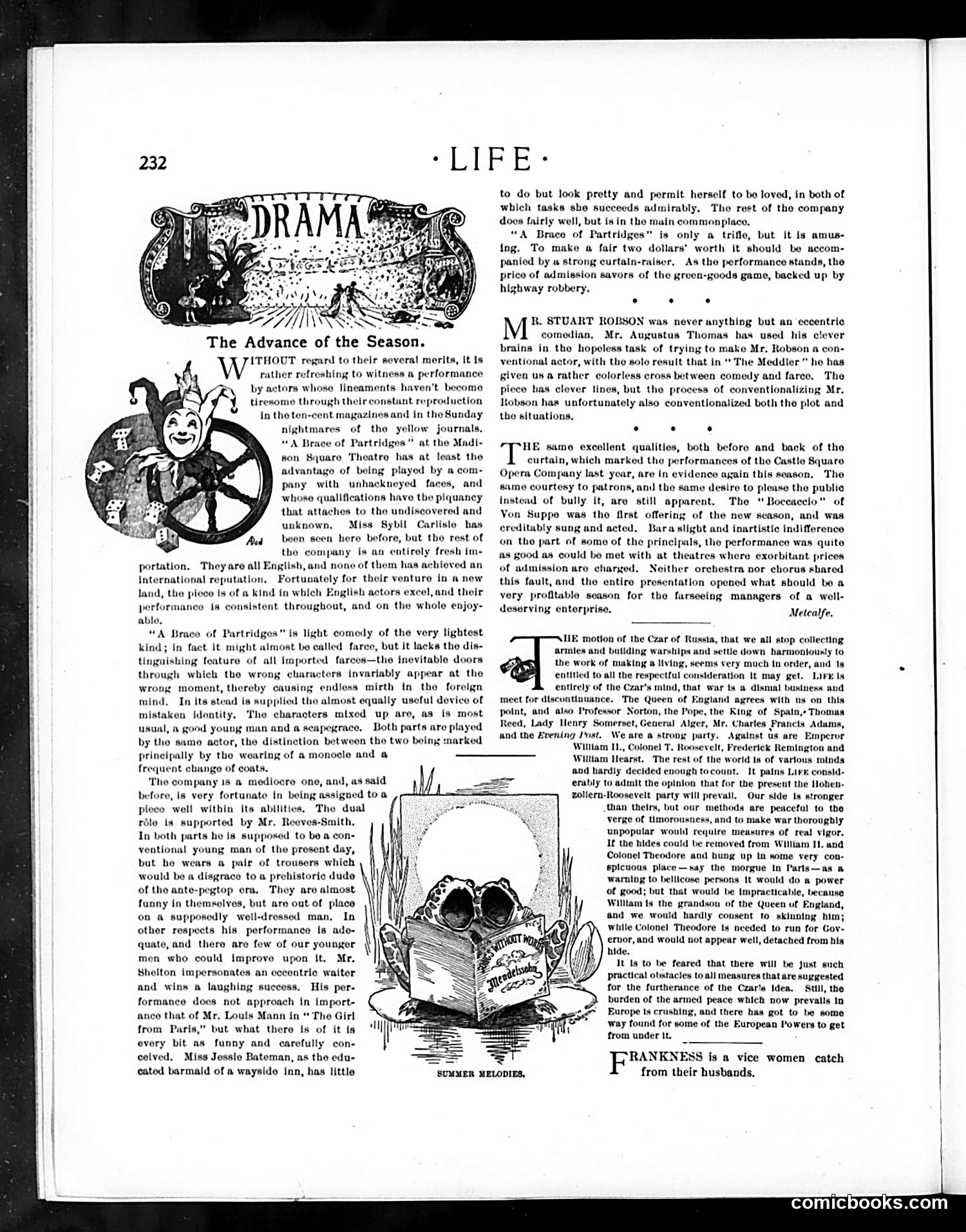
This page reviews theatrical productions from what appears to be summer theater season. The main cartoon labeled "Summer Melodies" depicts a figure in a barrel or container, likely satirizing a theatrical production or performer. The text discusses "A Brace of Partridges" (described as lightweight farce comedy), performances at Madison Square Theatre, and various actors including Mr. Stuart Robson and Augustus Thomas. The reviews critique the quality of performances and plots, suggesting some productions lack sophistication or originality. The lengthy political commentary at bottom references the Czar of Russia, William II, Colonel Theodore, and European powers—appearing to comment on contemporary international tensions and diplomatic concerns, though the specific historical moment is unclear from this excerpt alone.
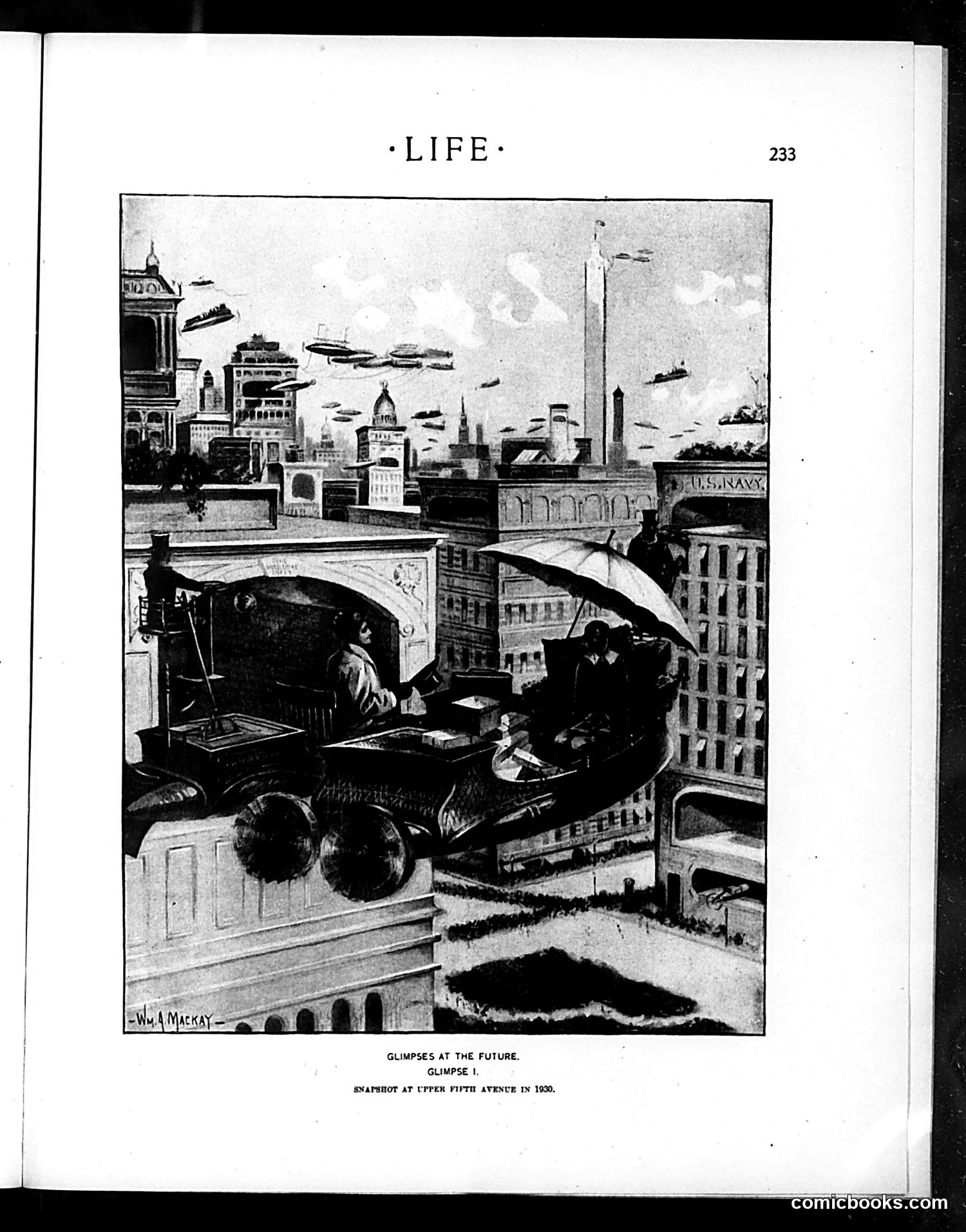
This satirical illustration by W.A. Mackay depicts a futuristic vision of New York City's Upper Fifth Avenue as imagined for 1930. The cartoon shows a rooftop scene where well-dressed figures with umbrellas observe airships and flying vehicles filling the sky above Manhattan's skyline. The joke critiques contemporary predictions of technological progress—specifically the expectation that air travel would become commonplace in urban settings within a decade. The satire works on two levels: it mocks both the breathless optimism of futurists predicting rapid technological advancement and the impracticality of such crowded aerial congestion. The presence of U.S. Navy signage suggests military applications were also anticipated. This reflects early-twentieth-century anxiety about technology's pace of change and humorous skepticism about whether such dramatic transformations could actually occur.
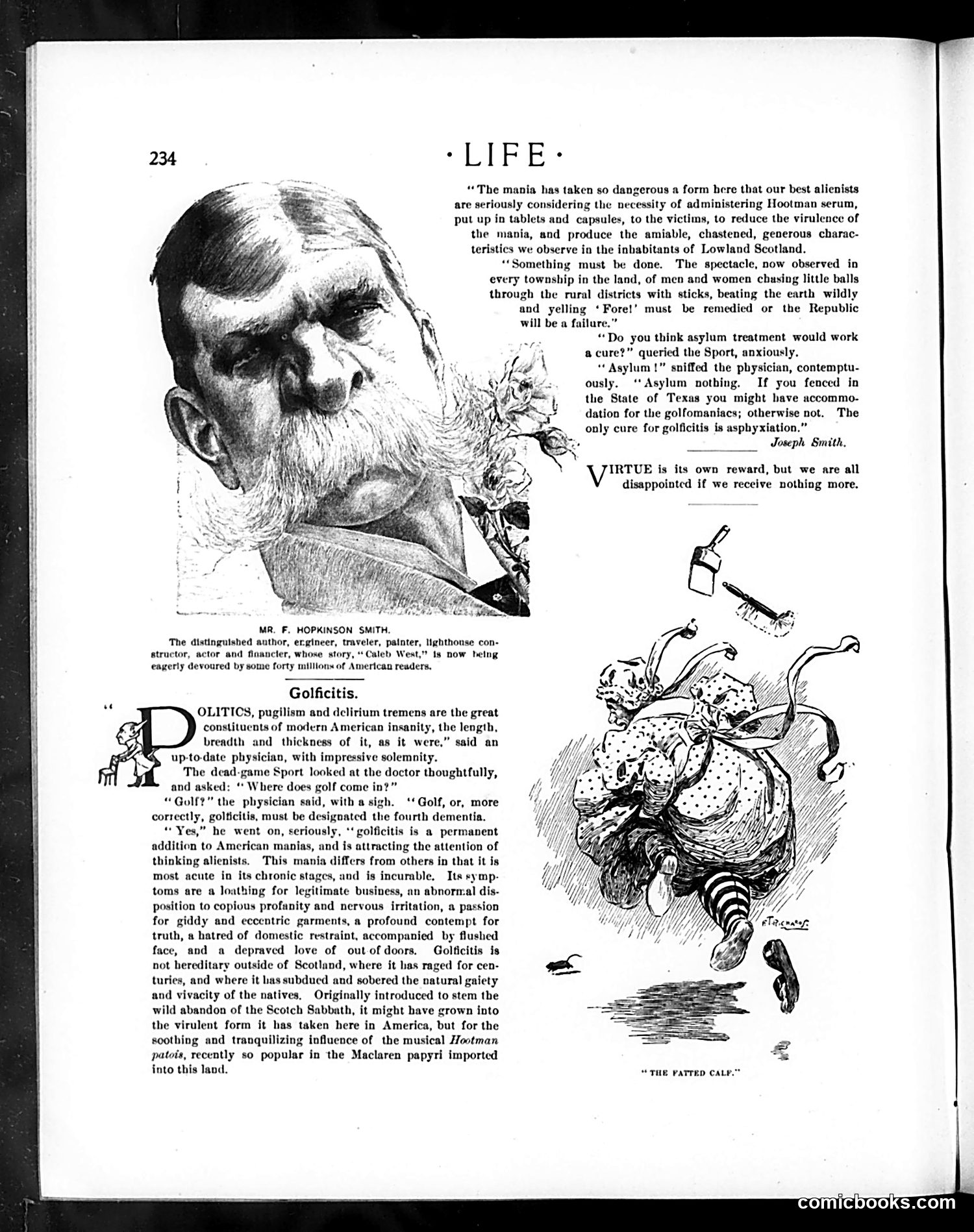
This *Life* magazine page satirizes the explosive popularity of golf in America, treating it as a contagious social "mania" or mental illness. A physician describes "golficitis" as a fourth form of dementia alongside politics, pugilism, and alcoholism—characterized by neglecting business, profanity, eccentric clothing, contempt for truth, and domestic abandonment. The joke presents golf obsession as so widespread that Texas would be needed as an asylum to contain afflicted golfers. The illustration "The Fatted Calf" (bottom right) appears to mock the sport's ridiculous nature. The satirical tone reflects early-1900s cultural anxiety about golf's rapid social spread among Americans—a leisure activity previously associated with Scotland that was becoming an all-consuming national preoccupation among the middle and upper classes. The invented "Hootman serum" cure parodies contemporary pseudoscientific medical treatments.
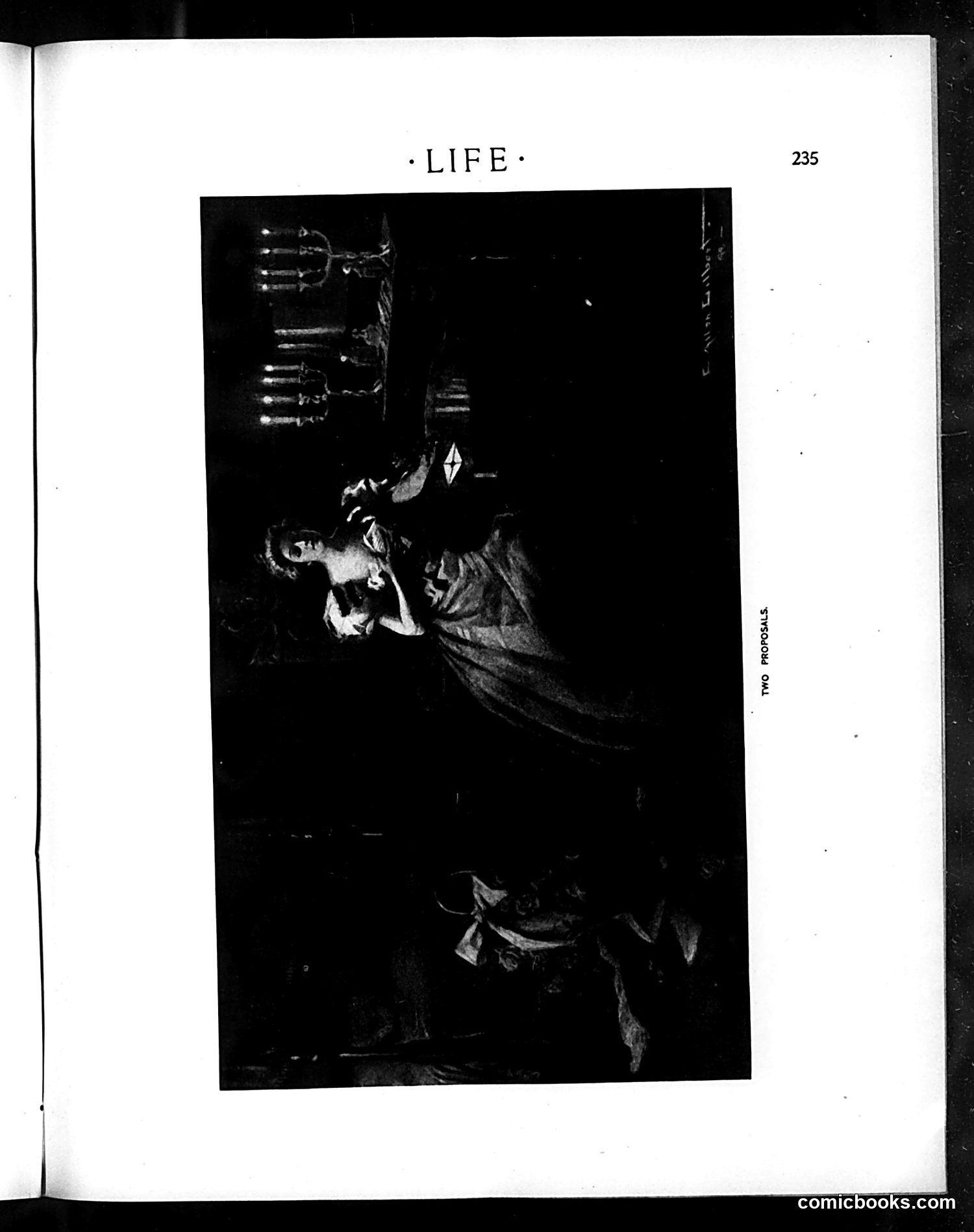
This page from *Life* magazine (page 235) shows what appears to be a dramatic black-and-white illustration labeled "TWO PROPOSALS" along the right margin. The image depicts what seems to be a theatrical or social scene with multiple figures in period dress, though the dark photography makes specific details difficult to discern with certainty. Without clearer visibility of facial features or additional context clues, I cannot confidently identify the specific individuals being caricatured or the exact historical/political references intended. The title "Two Proposals" suggests satire around courtship, marriage, or possibly political/business negotiations, but the specific targets and satirical point remain unclear from this reproduction alone.
This page from *Life* magazine contains primarily **humorous prose and poetry** rather than political cartoons. The main content is "The Reg'lar Army Man," a poem by Joe Lincoln celebrating working-class soldiers—men who lack social refinement but serve faithfully in combat. The satire targets romantic notions of military service: the soldier isn't a genteel "pretty soldier boy" but a rough, pragmatic fighter who does the actual killing while society ignores him. Below are several short humorous anecdotes playing on Scottish dialect and clever wordplay—a common *Life* feature. One involves a boy outwitting a magistrate; another depicts a cabby's delight at overcharging a passenger. The page is **primarily advertising** (Evans' Ale, Hunter Baltimore Rye whiskey, Rhine wines) with an announcement for Westminster Kennel Club's 22nd annual dog show featuring illustrations of French bulldogs. The satire's point: ordinary soldiers deserve more respect than society gives them.
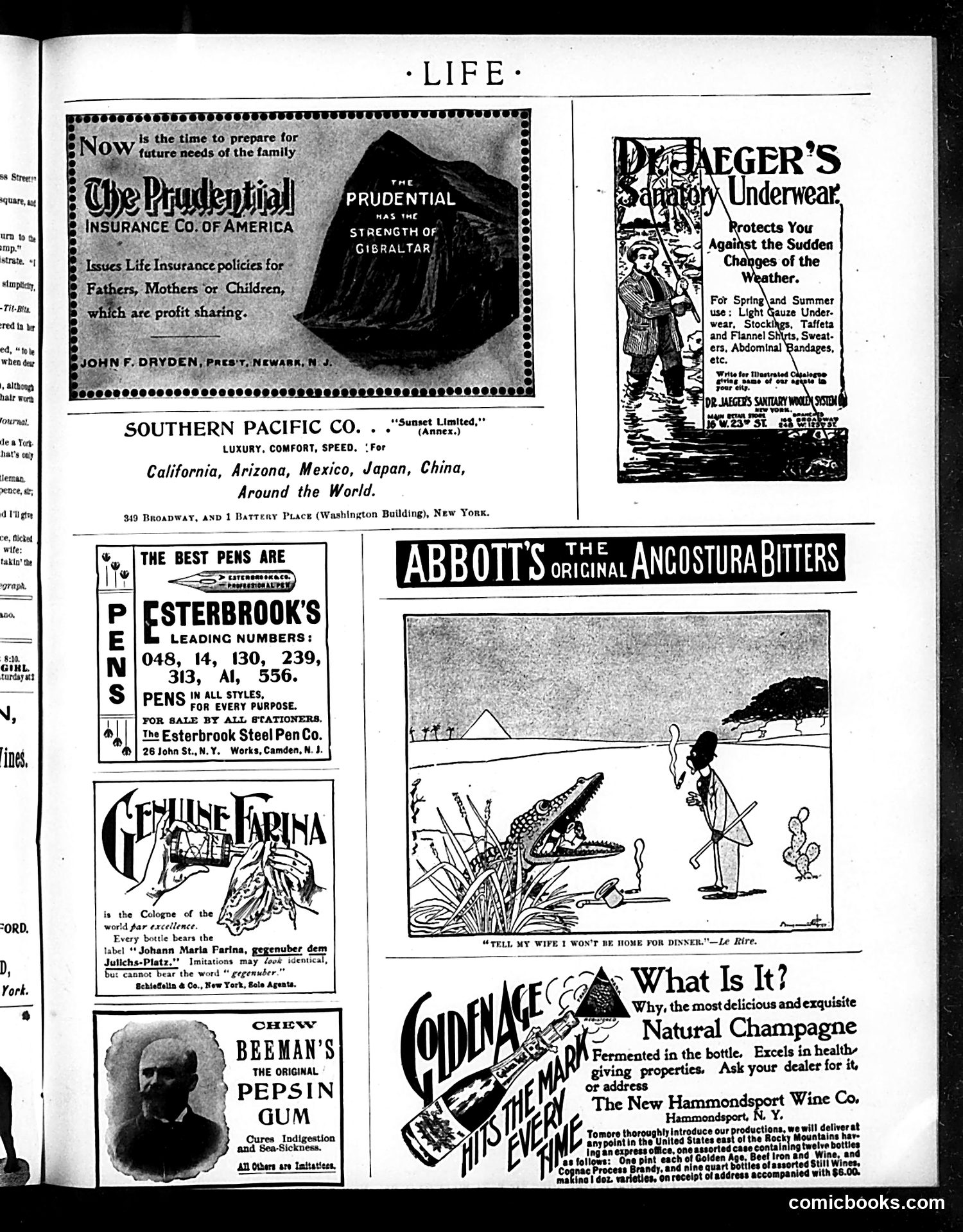
This page is primarily **advertising**, not editorial content or political satire. It contains multiple product advertisements typical of early 20th-century American magazines: **Key advertisements include:** - Prudential Insurance (life policies for families) - Southern Pacific Co. (railroad travel to exotic destinations) - Esterbrook Steel Pens (writing instruments) - Genuine Farina cologne - Beeman's Pepsin Gum (digestive aid) - Cointreau liqueur (champagne alternative) - Dr. Jaeger's underwear (weather protection) - Abbott's Angostura Bitters (with a cartoon showing a man telling his wife he won't be home for dinner—a mild domestic humor joke) **The single cartoon** (Abbott's Bitters) depicts marital tension humorously: a man encounters a crocodile while out, using it as an excuse for his late arrival home. This is straightforward visual humor rather than political satire. The page reflects consumer culture and product marketing of the era rather than commentary on current events or social issues.
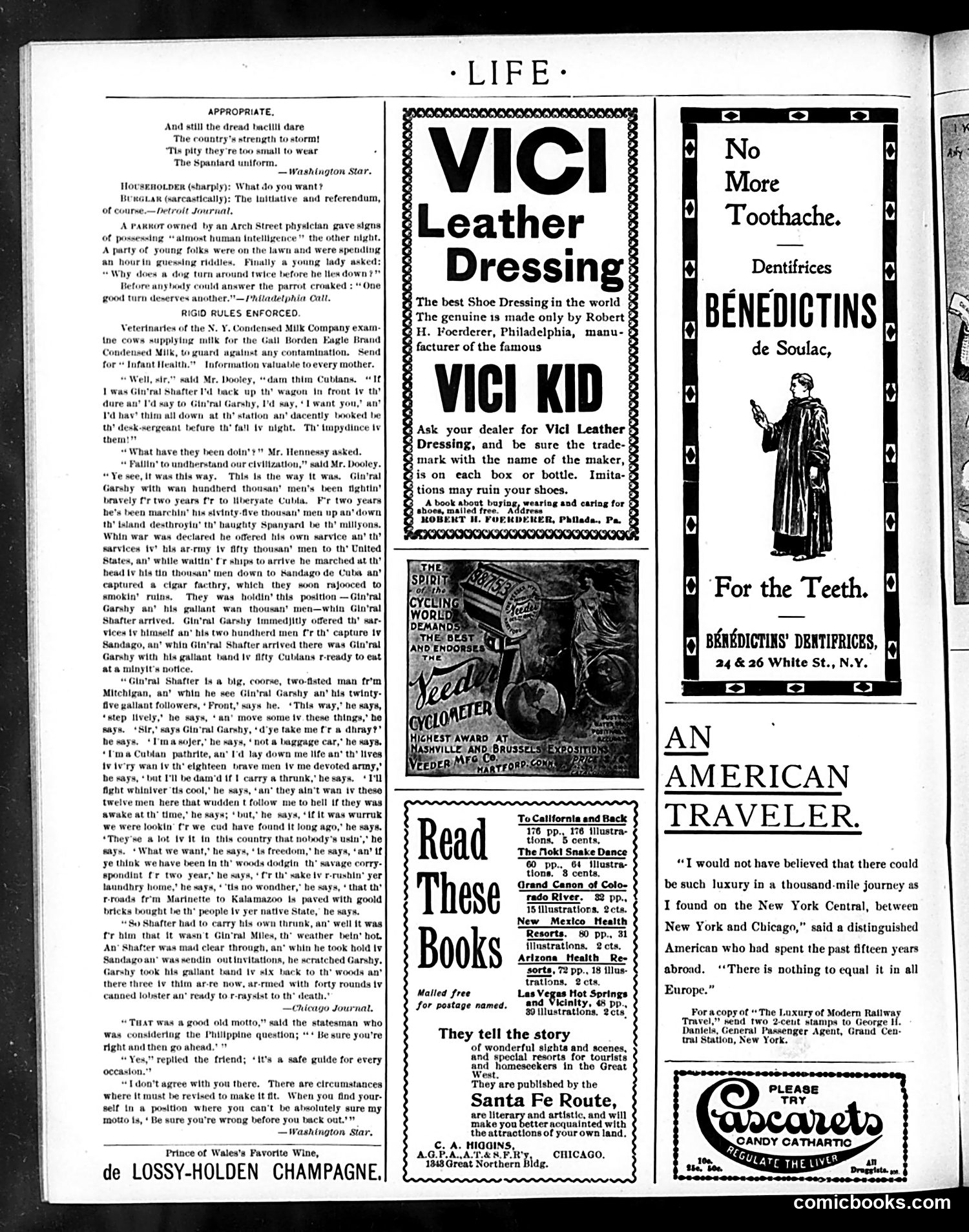
This page is primarily **advertisements and humorous short pieces**, not a unified political cartoon. The notable satirical content is a **Mr. Dooley piece** (recognizable Irish-dialect humor column popular in Life). It mocks **General Garcie** of Cuba during the Spanish-American War (appearing to be 1898). The satire targets: 1. **Cuban independence fighters' expectations**: Garcie believes he deserves recognition for his "patriotic" two-year struggle, but American General Shafter dismisses his contribution, treating Cuban forces as baggage rather than soldiers. 2. **American condescension**: Shafter represents American imperial presumption—assuming Americans will "civilize" Cuba while disrespecting local fighters who actually fought Spain. 3. **Colonial hypocrisy**: Garcie's indignant refusal to carry luggage (demanding "freedom," not servitude) satirizes how American "liberation" often meant American dominance over the liberated territory. The page's upper content includes brief jokes and medical/veterinary advertisements—typical of Life's format mixing satire with commercial content.
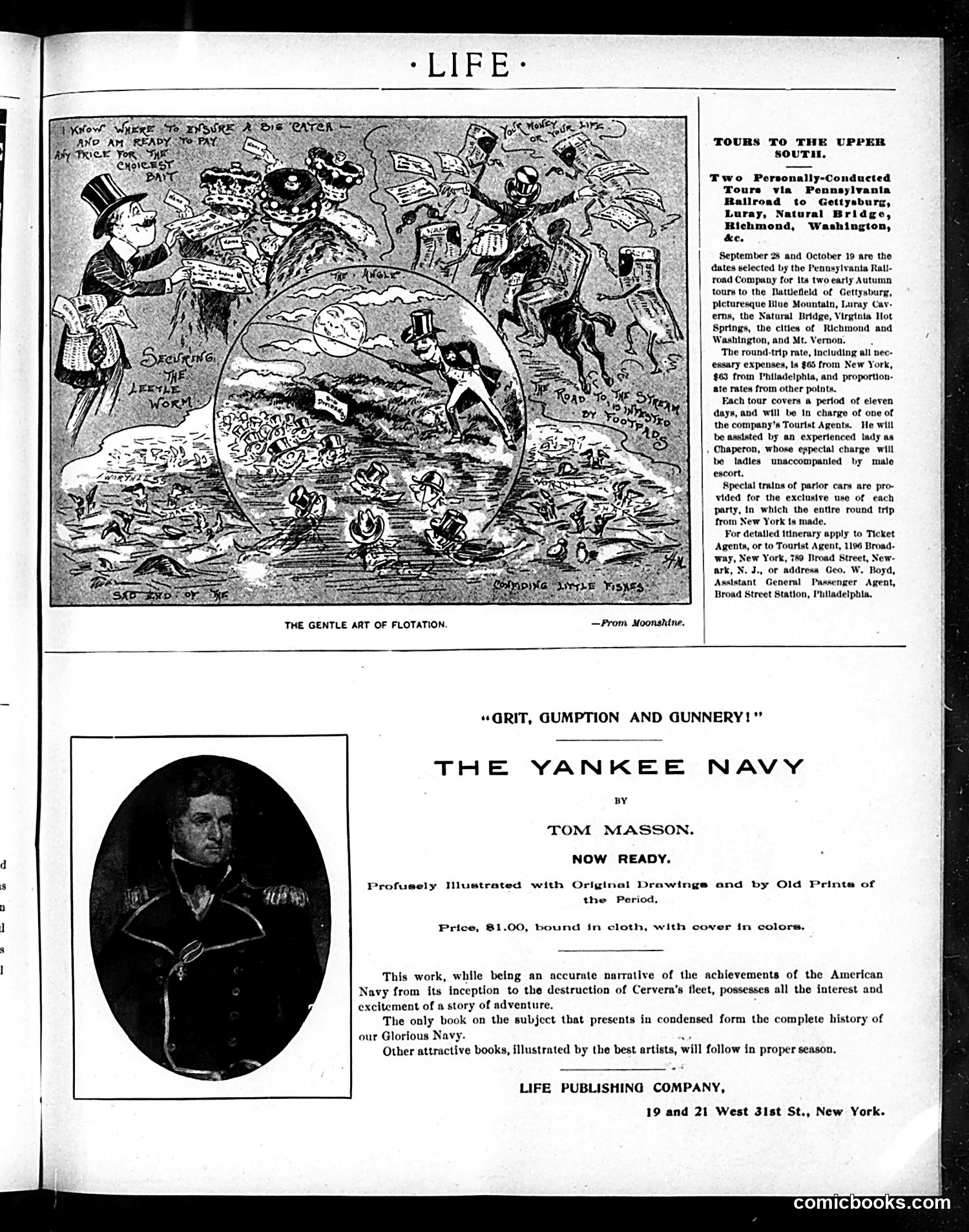
This cartoon satirizes American financial speculation and risky investment schemes. The chaotic scene depicts various well-dressed figures engaged in precarious "flotation"—a pun on both floating and the financial term for launching new companies. The imagery suggests people literally struggling to stay afloat amid water and debris, representing investors caught in unstable ventures. The exaggerated, panicked poses mock both the desperation of speculators and the absurdity of get-rich-quick schemes popular in the era. The cartoon likely critiques the business culture of promoting dubious enterprises to the public, portraying flotation as a dangerous, undignified scramble where participants risk everything on uncertain schemes. The humorous visual metaphor transforms financial abstraction into literal drowning.
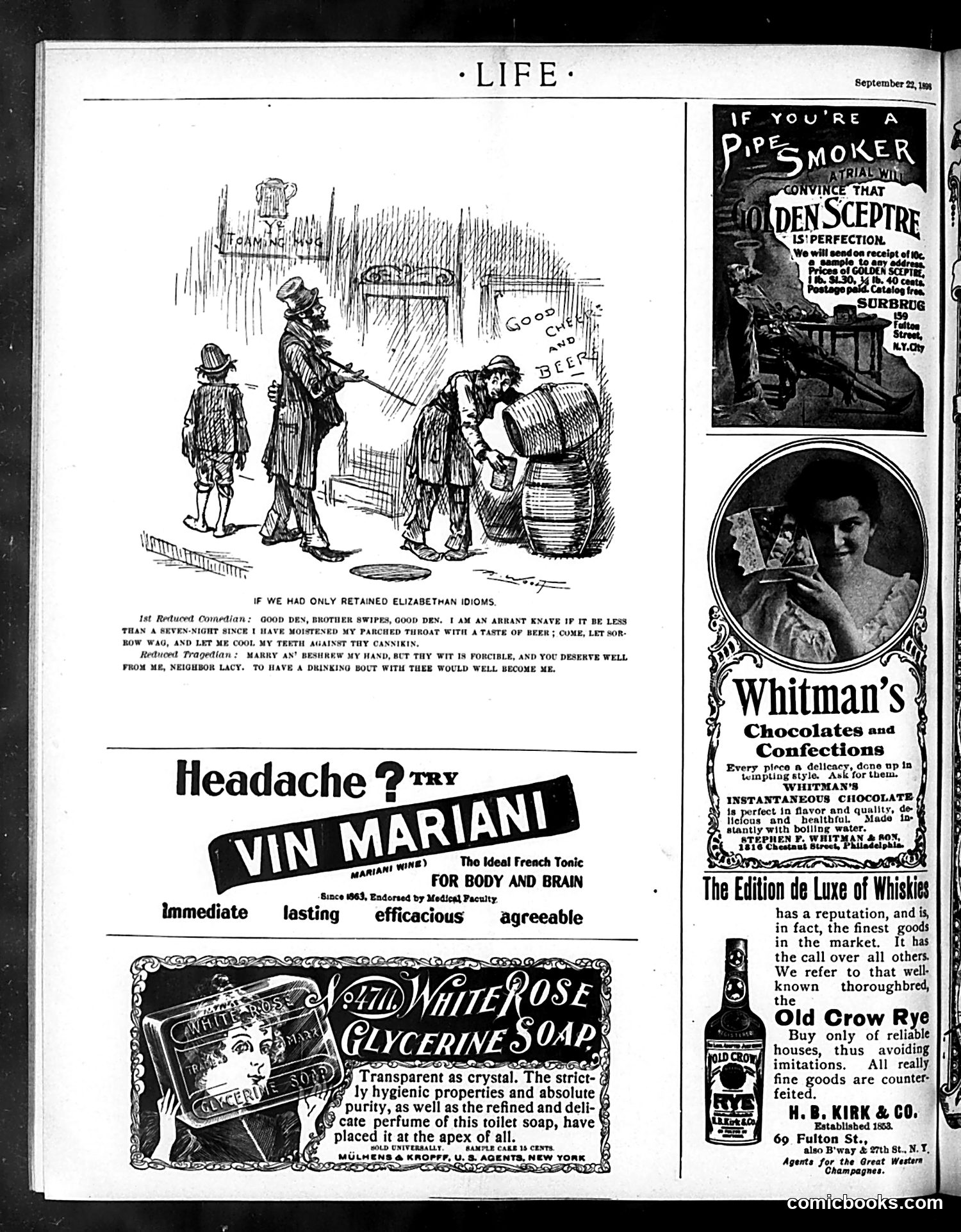
This page contains a satirical cartoon titled "If We Had Only Retained Elizabethan Idioms." It mocks how affected and overwrought dialogue becomes when rendered in archaic Shakespearean English. Two characters—labeled "Reduced Comedian" and "Reduced Tragedian"—attempt casual conversation about drinking beer, but their simple desire comes across as grandiose and ridiculous when expressed through elaborate period language ("arrant knave," "parched throat," "cannikin," "beshrew my hand"). The joke targets contemporary theater performers and the fashion for affected, over-theatrical speech. By showing how ludicrous everyday chat sounds in Elizabethan dialect, Life satirizes those who adopt pretentious speech patterns or excessive dramatics in modern contexts. The rest of the page consists of vintage advertisements for Vin Mariani tonic, White Rose soap, Whitman's chocolates, Old Crow whiskey, and other period products—typical filler for early 20th-century magazines.