
Life, 1898-09-22 · page 4 of 20
Life — September 22, 1898 — page 4: what you’re looking at
What you’re looking at
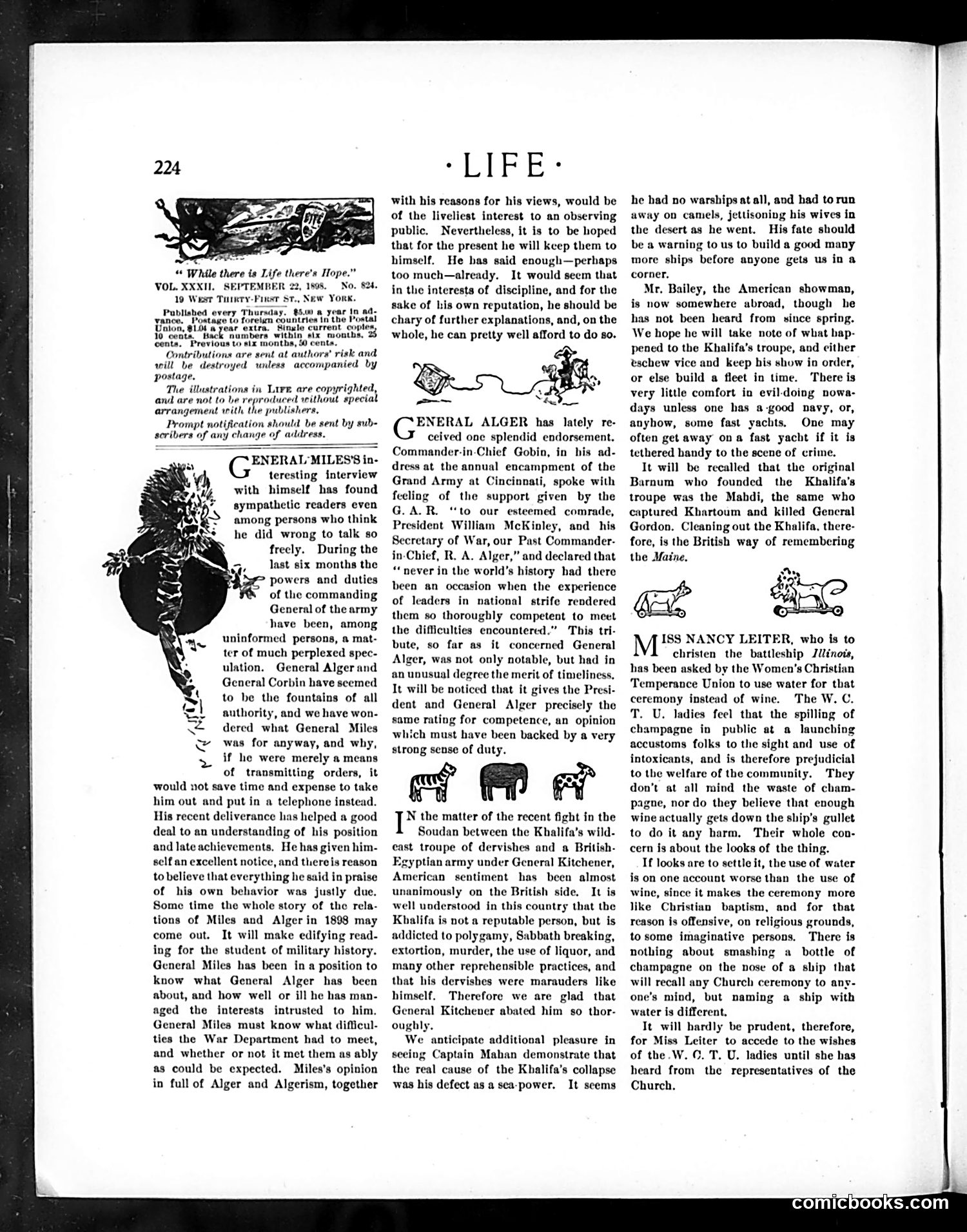
The page features commentary on General Nelson Miles, a prominent American military figure. The left-side illustration shows Miles in profile, depicted with exaggerated features typical of early 20th-century satirical portraiture. The text discusses Miles's recent public statements and endorsements, particularly regarding military leadership and competence. The article appears critical of Miles's credibility, suggesting his opinions, while influential in military circles, may be self-serving or questionable. The page also contains brief commentary on other topics including General Alger, Miss Nancy Leiter's christening of a battleship, and disputes over using water versus wine in naval ceremonies—typical satirical fodder of the era addressing naval affairs and social propriety.
📄 Transcribed text from this page (OCR, searchable)
Machine-transcribed from the original scan — historical spelling and the odd misread are preserved.
“* While there is Life there’s Hope.” VOL. XXXII. SEPTEMBER 22, 1898. No. 824, 19 West Tutery-Finsr St., New Yorw. Published every Thursday. $5.00 a year In ad~ se poatage Co foreumn countries in the Portal LO a year extra. ingle current coptess al 10 cents. Back ra months, cents. Previow mont nts. Contributions are sent at authors’ risk and will be destroyed unless accompanied by postage. The illustrations in Lire are copyrighted, and are not to be reproduced without special arrangement with the publishers. Prompt notification should be sent by sub- seribers of any change of address. ENERAL MILES’ in- teresting interview with himself has found sympathetic readers even among persons who think he did wrong to talk so freely. During the last six months the powers and duties of the commanding General of the army have been, among uninformed persons, a mat- ter of much perplexed spec- ulation. General Alger and General Corbin have seemed to be the fountains of all authority, and we have won- dered what General Miles was for anyway, and why, if he were merely a means of transmitting orders, it would not save time and expense to take him out and put in a telephone instead. His recent deliverance has helped a good deal to an understanding of his position and late achievements. He has given him- self an excellent notice, and there is reason to believe that everything he said in praise of his own behavior was justly due. Some time the whole story of the rela- tions of Miles and Alger in 1898 may come out. It will make edifying read- ing for the student of military history. General Miles has been in a position to know what General Alger has been about, and how well or ill he has man- aged the interests intrusted to him, General Miles must know what difficul- ties the War Department had to meet, and whether or not it met them as ably as could be expected. Miles’s opinion in full of Alger and Algerism, together *LIPE* with his reasons for his views, would be of the liveliest interest to an observing public, Nevertheless, it is to be hoped that for the present he will keep them to himself. He bas said enough—perhaps too much—already. It would secm that in the interests of discipline, and for the sake of his own reputation, he should be chary of further explanations, and, on the whole, he can pretty well afford to do so. ENERAL ALGER has lately re- ceived one splendid endorsement. Commander-in-Chief Gobin, in his ad- dress at the annual encampment of the Grand Army at Cincinnati, spoke with feeling of the support given by the G.A.R. “to our esteemed comrade, President William McKinley, and his Secretary of War, our Past Commander- in-Chief, R. A. Alger,” and declared that “never in the world’s history had there been an occasion when the experience of leaders in national strife rendered them so thoroughly competent to meet the difficulties encountered.” This tri- bute, so far as it concerned General Alger, was not only notable, but had in an unusual degree the merit of timeliness, It will be noticed that it gives the Presi- dent and General Alger precisely the same rating for competence, an opinion which must have been backed by a very strong sense of duty. cy OP wv ]* the matter of the recent fight in the Soudan between the Khalifa’s wild- east troupe of dervishes and a British- egyptian army under General Kitchener, American sentiment has been almost unanimously on the British side, It is well understood in this country that the Khalifa is not a reputable person, but is addicted to polygamy, Sabbath breaking, extortion, murder, the use of liquor, and many other reprehensible practices, and that his dervishes were marauders like himself. Therefore we are glad that General Kitchener abated him so thor- oughly. We anticipate additional pleasure in seeing Captain Mahan demonstrate that the real cause of the Khalifa’s collapse was his defect as a sea-power. It seems he had no warships at all, and had to run away on camels, jettisoning his wives in the desert as he went. His fate should be a warning to us to build a good many more ships before anyone gets us in a corner. Mr, Bailey, the American showman, is now somewhere abroad, though he has not been heard from since spring. We hope he will take note of what bap- pened to the Khalifa’s troupe, and either eschew vice and keep bis show in order, or else build a fleet in time. There is very little comfort in evil-doing nowa- days unless one has a-good navy, or, anyhow, some fast yachts. One may often get away ona fast yacht if it is tethered handy to the scene of crime. It will be recalled that the original Barnum who founded the Khalifa’s troupe was the Mahdi, the same who captured Khartoum and killed Gencral Gordon. Cleaning out the Khalifa, there- fore, is the British way of remembering the Maine, ISS NANCY LEITER, who is to christen the battleship JUinois, has been asked by the Women’s Christian Temperance Union to use water for that ceremony instead of wine. The W. C. T. U. ladies feel that the spilling of champagne in public at a launching accustoms folks to the sight and use of intoxicants, and is therefore prejudicial to the welfare of the community. They don’t at all mind the waste of cham- pagne, nor do they believe that enough wine actually gets down the ship's gullet to do it any harm. Their whole con- cern is about the looks of the thing. If looks are to settle it, the use of water is on one account worse than the use of wine, since it makes the ceremony more like Christian baptism, and for that reason is offensive, on religious grounds, to some imaginative persons. There is nothing about smashing a bottle of champagne on the nose of a ship that will recall any Church ceremony to any- one’s mind, but naming a ship with water is different, It will hardly be prudent, therefore, for Miss Leiter to accede to the wishes of the.W. ©. T. U, ladies until she has heard from the representatives of the Church, sy