
Life, 1898-09-22 · page 7 of 20
Life — September 22, 1898 — page 7: what you’re looking at
What you’re looking at
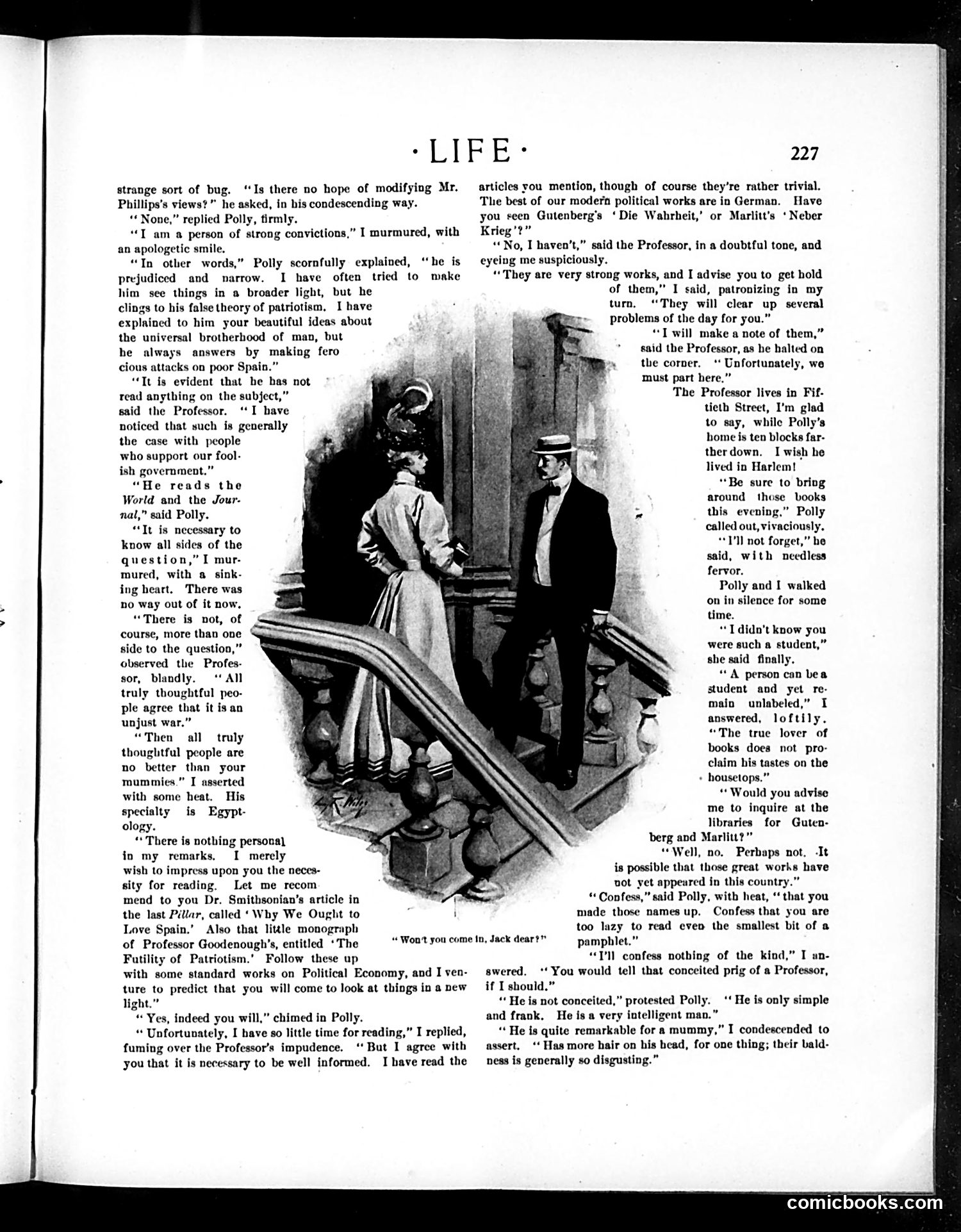
This page depicts a dialogue between characters discussing political ideology and reading habits. The illustration shows what appears to be a street encounter between gentlemen, with one character (likely representing an intellectual or Professor) engaging another named Polly in debate. The satire targets narrowness of political conviction. One character criticizes Mr. Phillips for being "prejudiced and narrow," while another defends reading the *World* and *Journal* as necessary for understanding "all sides of the question." The humor pivots on elitism: educated characters mock those supporting "our foolish government" while debating whether truly thoughtful people need better literature. The page satirizes how intellectuals weaponize reading lists and specialized knowledge to establish social superiority, treating book recommendations as markers of proper thinking rather than genuine persuasion.
📄 Transcribed text from this page (OCR, searchable)
Machine-transcribed from the original scan — historical spelling and the odd misread are preserved.
LIFE = strange sort of bug. ‘Is there no hope of modifying Mr. Phillips's views?” he asked, in bis condescending way. “None,” replied Polly, tirmly. “I am a person of strong convictions,” I murmured, with an apologetic smile, “In other words,” Polly scornfully explained, ‘he is prejudiced and narrow. I have often tried to make him see things in a broader light, but he clings to his false theory of patriotism, I have explained to him your beautiful ideas about the universal brotherhood of man, but he always answers by making fero cious attacks on poor Spain.” “Tt is evident that be has not read anything on the subject,” said the Professor. ‘I have noticed that such is generally the case with people who support our fool- ish government.” “He reads the World and the Jour- nal,” said Polly. “It is necessary to know all sides of the question,” I mur. mured, with a sink- ing heart. There was no way out of it now, “There is not, of course, more than one § side to the question,” observed the Profes- sor, blandly. ‘All truly thoughtful peo- ple agree that it isan unjust war.” “Then all truly thoughtful people are no better than your moummies.” I asserted with some heat. His specialty is Egypt- ology. “ There is nothing persona) in my remarks, I merely wish to impress upon you the neces- sity for reading. Let me recom mend to you Dr. Smithsonian’s article in the last Pillar, called ‘Why We Ought to Love Spain.’ Also that little monograph of Professor Goodenough’s, entitled ‘The Futility of Patriotism.’ Follow these up with some standard works on Political Economy, and I ven- ture to predict that you will come to Jook at things in a new light.” “Yes, indeed you will,” chimed in Polly. “ Unfortunately, I bave so little time for reading,” I replied, fuming over the Professor’s impudence. ‘But I agree with you that it is necessary to be well informed. I have read the “ Won't you come In, Jack dear?” 227 articles you mention, though of course they’re rather trivial. The best of our modern political works are in German. Have you seen Gutenberg’s ‘Die Wahrheit,’ or Marlitt's ‘Neber Krieg’?” “No, I haven’t,” said the Professor, in a doubtful tone, and eyeing me suspiciously, “They are very strong works, and I advise you to get hold of them,” I said, patronizing in my turn, ‘They will clear up several problems of the day for you.” “T will make a note of them,” said the Professor, as he halted on the corner. ‘ Unfortunately, we must part here.” The Professor lives in Fif- tieth Street, I’m glad to say, while Polly’s home is ten blocks far- therdown. I wish he lived in Harlem! “Be sure to bring around those books this evening,” Polly called out, vivaciously, **1'll not forget,” he said, with needless fervor. Polly and I walked on in silence for some time. “T didn't know you were such a student,” she said finally, “A person can bea student and yet re- main unlabeled,” I answered, loftily. “The true lover of books does not pro- claim his tastes on the housetops.” “Would you advise me to inquire at the libraries for Guten- berg and Marlitt?” “Well, no. Perbaps not. -It is possible that those great works have vot yet appeared in this country.” “ Confess,” said Polly, with heat, “that you made those names up. Confess that you are too lazy to read even the smallest bit of a pamphlet.” “T'll confess nothing of the kind,” I an- swered. ‘You would tell that conceited prig of a Professor, if I should.” “ He is not conceited,” protested Polly. and frank, He is a very intelligent man.” “He is quite remarkable for a mummy,” I condescended to assert. ‘‘ Has more hair on his bead, for one thing; their bald- ness is generally so disgusting.” “*He is only simple comicbooks.com