
Life, 1898-09-22 · page 5 of 20
Life — September 22, 1898 — page 5: what you’re looking at
What you’re looking at
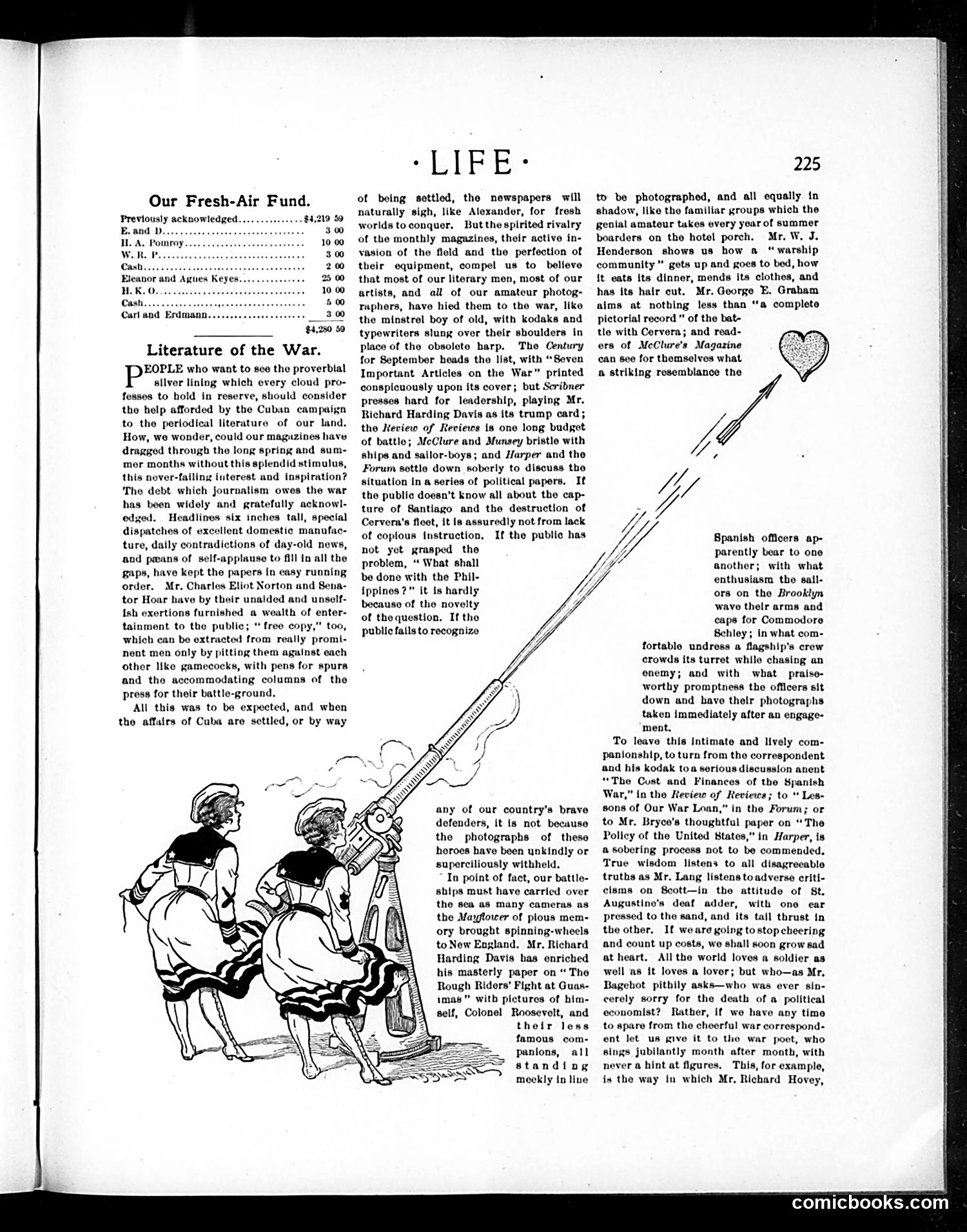
The main illustration depicts two naval officers operating a large telescope or naval instrument, rendered in a cartoonish style typical of early 20th-century satirical magazines. The accompanying article discusses war photography and journalism during what appears to be the Spanish-American War era, referencing correspondents, magazines like *The Century* and *Harper's*, and military figures including Richard Harding Davis and Colonel Roosevelt. The cartoon likely satirizes the relationship between military operations and press coverage—specifically how officers and journalists compete to document and sensationalize naval combat. The exaggerated poses and comedic rendering suggest mockery of either the journalists' eagerness or the officers' theatrical presentations for cameras. The text emphasizes tension between accurate war reporting and sensational entertainment.
📄 Transcribed text from this page (OCR, searchable)
Machine-transcribed from the original scan — historical spelling and the odd misread are preserved.
Our Fresh-Air Fund. Previously acknowledged. E.and D. H. A. Pomroy W.R. P. Cas! Eleanor and Agues: BLK. 0.... Cash... Carl and Erdmann. Literature of the War. EOPLE who want to see the proverbial silver lining which every cloud pro- “LT RE of being sottled, the newspapers will naturally sigh, like Alexander, for fresh worlds toconquer, But the spirited rivalry of the monthly maguzines, their active in- vasion of the fleld and the perfection of their equipment, compel us to believe that most of our literary men, most of our artists, and all of our amateur photog- ruphers, havo hied them to the war, like the minstrel boy of old, with kodaks and typewriters slung over their shoulders in place of the obsolete harp. The Century for September heads tho list, with “Seven Important Articles on the War” printed conspicuously upon its cover; but Scribner 225 to be photographed, and all equally in shadow, like the familiar groups which the genial amateur takes every year of summer boarders on the hotel porch. Henderson shows us how a Mr. W. J. “warship community" gets up and goes to bed, how {t eats its dinner, mends its clothes, and has its hair cut, Mr. George E, Graham aims at nothing less than “a complete pictorial record” of tho bat- tle with Cervera; and read- ers of McClure’s Magazine can see for themselves what a striking resemblance the feases to hold in reserve, should consider tho help afforded by the Cuban campaign to the periodical literature of our land. How, we wonder, could our maguzines have dragged through the long spring and sum- mor months without this splendid stimulus, this never-failing iuterest and inspiration? The debt which journalism owes the war has been widely and gratefully acknowl- edged. Headlines six inches tall, special dispatches of excellent domestic manufac- ture, daily contradictions of day-old news, and pmans of self-applause to fill in all the gaps, have kept the papers in easy running order. Mr. Charles Eliot Norton and Sena- tor Hoar have by their unaided and unself- ish exertions furnished a wealth of enter- tainment to the public; “free copy,” too, which can be extracted from really promi- nent men only by pitting them aguinst each other like gamecocks, with pens for spurs and the accommodating columns of the press for their battle-ground. All this was to be expected, and when tho affairs of Cuba are settled, or by way presses hard for leadership, playing Mr. Richard Harding Davis as its trump card; the Keview of Reviews is one long budget of battle; McClure and Munsey bristle with ships and sallor-boys; and Harper and tho Forum sottle down soberly to discuss the situation In a series of political papers. If the public doesn’t know all about the cap- ture of Santiago and the destruction of Cervera’s fleet, it is assuredly not from lack of coplous Instruction, If the public has not yet grasped the problem, “ What shall be done with the Phil- ippines?” it is hardly because of the novelty of thoquestion. If tho public fails to recognize Bpanish officers ap- parently bear to ono another; with what enthusiasm tho sail- ors on tho Brooklyn wave thelr arms and caps for Commodore Schley; in what com- fortablo undress a flagship’s crew crowds its turret while chasing an enemy; and with what praiso- worthy promptness the officers sit down and havo thelr photographs taken immediately after an engage- ment, To leave this Intimate and lively com- Panionship, to turn from the correspondent and his kodak toa serious discussion anent “The Cost and Finances of the Spanish War,” in the Review of Reviews; to “ Les- sons of Our War Loan,” in the Forum; or to Mr. Bryco’s thoughtful paper on “The Policy of the United States,” in Harper, is a sobering process not to be commended, True wisdom listens to all disagrecablo truths as Mr. Lang listens toadverse eriti- cisms on Scott—in the attitude of St. Augustino’s deaf adder, with ono ear pressed to the sand, and its tail thrust in the other, If weare going to stop cheering and count up costs, we shall soon grow sad at heart. All the world loves a soldier as well as it loves a lover; but who—as Mr. Bagebot pitbily asks—who was over sin- cerely sorry for the death of a political economist? Rather, if we have any timo to spare from the cheerful war correspond- famous com- ent let us give it to the war poct, who panions, all sings jubilantly month after month, with standing neverahintat figures, This, for example, meekly inline is the way in which Mr, Richard Hovey, any of our country’s bravo defenders, it is not because the photographs of these heroes have been unkindly or superciliously withheld, In point of fact, our battle- ships must have carried over the sea a8 many cameras as the Mayflower of plous mem- ory brought spinning-wheels to New England. Mr. Richard Harding Davis has enriched his masterly paper on “ Tho Rough Riders’ Fight at Guas- imas” witb pictures of him- self, Colonel Roosevelt, and their less comicbooks.com